

The quality and safety of using generative AI to produce patient-centred discharge instructions
Open accessThe DOI matches its Crossref record; 33 of the 33 references it cites were found in a registry or an index.
Abstract
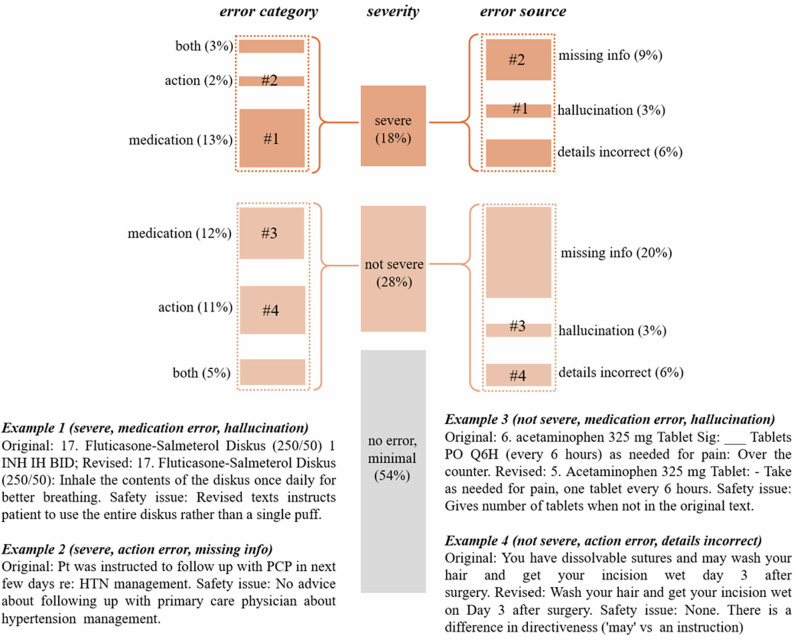
Patient-centred instructions on discharge can improve adherence and outcomes. Using GPT-3.5 to generate patient-centred discharge instructions, we evaluated responses for safety, accuracy and language simplification. When tested on 100 discharge summaries from MIMIC-IV, potentially harmful safety issues attributable to the AI tool were found in 18%, including 6% with hallucinations and 3% with new medications. AI tools can generate patient-centred discharge instructions, but careful implementation is needed to avoid harms.
Overview
The claims and statistics of this paper haven’t been checked yet.
Free: it reads the open-access text and checks the first 5 claims that cite a source we can check. Create a free account to check every claim.
Integrity signals
Registry
Cites
Statistics
Figures
Verification
Claims the paper makes
The claims and statistics of this paper haven’t been checked yet.
Free: it reads the open-access text and checks the first 5 claims that cite a source we can check. Create a free account to check every claim.
Claims other papers make about this one
Each is checked against this paper’s own text: does it say what the citing paper says it does?
The source backs part of the claim, not all of it — or backs it for a different population, condition or comparison.
In the citing paper
“To counterbalance this, engineering techniques such as fine-tuning, disease knowledge bases, and prompt engineering, as applied in this study, are essential to enhance the local model’s capabilities in patient simulation38.”
From A large language model digital patient system enhances ophthalmology history taking skills (2025) · cites this paper as [38]
Experimental — accuracy not yet measuredThe source backs part of the claim, not all of it — or backs it for a different population, condition or comparison.
In the citing paper
“By processing extensive medical literature and electronic health records (EHRs), LLMs has demonstrated the ability to extract detailed clinical information from patient discharge summaries38.”
From A large language model digital patient system enhances ophthalmology history taking skills (2025) · cites this paper as [38]
Experimental — accuracy not yet measuredThe check wasn’t confident either way, so it gives no verdict — never disputed.
In the citing paper
“Another study J o u r n a l P r e -p r o o f reported 61.8% reproducibility for ChatGPT-3.5 after retesting on a different day.58”
From Large Language Models in Pharmacist-Led Direct Patient Care: A Rapid Review of Published Evaluations (2026) · cites this paper as [58]
Experimental — accuracy not yet measuredThe check wasn’t confident either way, so it gives no verdict — never disputed.
In the citing paper
“LLM response reproducibility refers to the consistency of its outputs to the same query and has been shown to differ on repeat assessment.58,59,66”
From Large Language Models in Pharmacist-Led Direct Patient Care: A Rapid Review of Published Evaluations (2026) · cites this paper as [58]
Experimental — accuracy not yet measured
Self-check
Percentages, sums and reported differences re-computed from the paper’s own numbers.
The self-check needs the paper’s full text.
Citations
Cites
Goldberger, A. L., Amaral, L. A. N., Glass, L., Hausdorff, J. M., Ivanov, P. C., Mark, R. G., Mietus, J. E., Moody, G. B., Peng, C.-K., & Stanley, H. E. (2000) · Circulation · doi:10.1161/01.cir.101.23.e215 · Cited by 14,809
MIMIC-IV, a freely accessible electronic health record dataset
Johnson, A. E. W., Bulgarelli, L., Shen, L., Gayles, A., Shammout, A., Horng, S., Pollard, T. J., Hao, S., Moody, B., Gow, B., et al. (2023) · Scientific Data · doi:10.1038/s41597-022-01899-x · Cited by 3,401
A governance model for the application of AI in health care
Reddy, S., Allan, S., Coghlan, S., & Cooper, P. (2020) · Journal of the American Medical Informatics Association · doi:10.1093/jamia/ocz192 · Cited by 979
Health literacy interventions and outcomes: an updated systematic review.
Berkman, N. D., Sheridan, S., Donahue, K. E., Halpern, D. J., Viera, A. J., Crotty, K., Holland, A. L., Brasure, M., Lohr, K. N., Harden, E. A., et al. (2011) · PubMed Central · Cited by 909
ChatGPT: the future of discharge summaries?
Patel, S. B., & Lam, K. (2023) · The Lancet Digital Health · doi:10.1016/s2589-7500(23)00021-3 · Cited by 728
Johnson, A., Bulgarelli, L., Pollard, T., Gow, B., Moody, B., Horng, S., Celi, L. A., & Mark, R. (2024) · PhysioNet · doi:10.13026/07hj-2a80 · Cited by 524
Johnson, A., Bulgarelli, L., Pollard, T., Horng, S., Celi, L. A., & Mark, R. (2023) · PhysioNet · doi:10.13026/s6n6-xd98 · Cited by 524
Interventions for Individuals with Low Health Literacy: A Systematic Review
Sheridan, S. L., Halpern, D. J., Viera, A. J., Berkman, N. D., Donahue, K. E., & Crotty, K. (2011) · Journal of Health Communication · doi:10.1080/10810730.2011.604391 · Cited by 495
Lyu, Q., Tan, J., Zapadka, M. E., Ponnatapura, J., Niu, C., Myers, K. J., Wang, G., & Whitlow, C. T. (2023) · arXiv · doi:10.48550/arxiv.2303.09038 · Cited by 393
Using ChatGPT to write patient clinic letters
Ali, S. R., Dobbs, T. D., Hutchings, H. A., & Whitaker, I. S. (2023) · The Lancet Digital Health · doi:10.1016/s2589-7500(23)00048-1 · Cited by 375
Research works printed but not linked: 1
- Johnson, A. et al. MIMIC-IV. PhysioNet 10.13026/RRGF-XW32. · DOI
Cited by
A large language model digital patient system enhances ophthalmology history taking skills
Luo, M.-J., Bi, S., Pang, J., Liu, L., Tsui, C.-K., Lai, Y., Chen, W., Yang, Y., Xu, K., Zhao, L., et al. (2025) · npj Digital Medicine · doi:10.1038/s41746-025-01841-6 · Cited by 39
“By processing extensive medical literature and electronic health records (EHRs), LLMs has demonstrated the ability to extract detailed clinical information from patient discharge summaries 38 .”
Artificial Intelligence Techniques and Health Literacy: A Systematic Review
Abeo, A. N. A., Armstrong, S., Scriney, M., & Goss, H. R. (2025) · Mayo Clinic Proceedings Digital Health · doi:10.1016/j.mcpdig.2025.100269 · Cited by 37
“16,17 20 For example, AI has been used in health literacy through chatbots built on large language models to provide educational support and enhance understanding of medical topics like vaccination 21 and to automatically identify and curate understandable and medically relevant health information,…”
Kewalramani, D., Jawa, R. S., Martin, C. A., Gosain, A., Wan, D. C., Varghese, T. K., Boland, G. M., Dream, S. Y., Sifri, Z. C., Mollen, K. P., et al. (2025) · Surgery · doi:10.1016/j.surg.2025.109849 · Cited by 24
Ethical Assessment of Generative AI Tools for Clinical Summarization Tasks
Char, D. S., Downing, N. L., Youssef, A., & Mello, M. M. (2026) · The American Journal of Bioethics · doi:10.1080/15265161.2026.2657875 · Cited by 17
“Errors in output may also be clinically significant but easily overlooked (e.g., a digital scribe records “more pain” rather than “no pain” as a symptom) (Goodman et al. 2024; Stanceski et al. 2024).”
MedReadCtrl: Personalizing medical text generation with readability-controlled instruction learningPreprint
Tran, H., Yao, Z., Jang, W. S., Sultana, S., Chang, A., Zhang, Y., & Hong, Y. (2025) · medRxiv · doi:10.1101/2025.07.09.25331239 · Cited by 16
“These improvements are more than stylistic; they translate directly into better comprehension for patients who may otherwise misinterpret discharge instructions, medication labels, or follow-up plans 23 .”
Rullo, R., Maatouk, A., Huang, T., Chen, J., Qiu, W., O’Connor, G., Womack, J. A., Sadak, T. I., Rodriguez, C., Carneiro, P. B., et al. (2025) · Journal of Medical Internet Research · doi:10.2196/77053 · Cited by 8
“In addition, AI has been used for treatment plans, discharge summaries, and medical chatbots [7,35,36,46,47,77-79].”
Wang, M., Ma, H., & Piao, M. (2026) · npj Digital Medicine · doi:10.1038/s41746-025-02302-w · Cited by 9
Ayre, J., Taba, M., Nickel, B., Edlund, G., Vu, T., Yan, J. J., Butters, L., Ma, I. C. K., & McCaffery, K. J. (2025) · npj Digital Medicine · doi:10.1038/s41746-025-02056-5 · Cited by 6
Self-citationGenerative AI in the Care of Older Adults: A Position Statement From the American Geriatrics Society
Bharija, A., Khan, A., Pavon, J. M., Hashmi, A. Z., Jindal, S. K., Dredze, M. H., Josyula, A. V., Hung, W., Nothelle, S. K., Patel, N. K., et al. (2026) · Journal of the American Geriatrics Society · doi:10.1111/jgs.70566 · Cited by 5
“Recent studies show that AI-generated summaries may include clinically meaningful errors, underscoring the need for consistent clinician review and thoughtful integration into clinical work-flows [16, 40].”
Palmer, W. J., Michlin, D., Estephan, L. E., Tasoulas, J., Arianpour, K., Sethi, H. K., Campbell, D. J., Krein, H. D., & Heffelfinger, R. N. (2025) · OTO Open · doi:10.1002/oto2.70170 · Cited by 4
“37,38 OpenEvidence (Cambridge, MA) is one such RAG that draws speci fi cally on medical literature.”
Samardzic, D., Curkovic, J., Okmažić, D., Glumac, S., Vrdoljak, J., Kolega, M. S., & Krešo, A. (2025) · Clinics and Practice · doi:10.3390/clinpract15110208 · Cited by 3
Assessing the safety of patient-centred discharge medication instructions generated by an AI model
Tang, M., Markova, K., Stanceski, K., Zhong, S., Tracy, M., Koria, L. G., Lo, S. Y., Zhang, X., Pan, A., Kim, J., et al. (2026) · International Journal of Medical Informatics · doi:10.1016/j.ijmedinf.2026.106272 · Cited by 5
Self-citationKlufas, T., Zedek, M., Ajmani, A., Zhou, A. E., & Grant-Kels, J. M. (2025) · Clinics in Dermatology · doi:10.1016/j.clindermatol.2025.02.004 · Cited by 3
MedCT: A Clinical Terminology Graph for Generative AI Applications in Healthcare
Chen, Y., Huang, D., Shen, Y., Xu, H., Sheng, L., Zhou, Q., & Wang, K. (2025) · Lecture notes in computer science · doi:10.1007/978-3-031-97557-8_3 · Cited by 6
Doctors raise safety concerns over Palantir linked AI tool in hospitals
Armstrong, S. (2026) · BMJ · doi:10.1136/bmj.s338 · Cited by 3
Robert, L., & Sauvage, J. (2026) · AI-Linguistica Linguistic Studies on AI-Generated Texts and Discourses · doi:10.62408/ai-ling.v4i1.51 · Cited by 2
Yin, J., Wang, W., Wu, L., Li, Z., Wang, W., He, T., Wang, Y., Li, G., Tang, L., Zhao, X., et al. (2026) · Stroke · doi:10.1161/strokeaha.126.055189 · Cited by 2
Gwóźdź-Broczkowska, A. (2026) · International Journal of Medical Informatics · doi:10.1016/j.ijmedinf.2026.106645 · Cited by 2
Lamb, N. (2026) · Frontiers in Digital Health · doi:10.3389/fdgth.2026.1771051 · Cited by 2
“For example, Stanceski et al. (2024) reported improved readability of AI-generated discharge instructions but identified safety concerns in 18% of cases, including hallucinations and the introduction of novel medications not present in the source material (22).”
InfluentialMedCT: A Clinical Terminology Graph for Generative AI Applications in HealthcarePreprint
Chen, Y., Huang, D., Xu, H., Fu, C., Sheng, L., Zhou, Q., Shen, Y., & Wang, K. (2025) · arXiv (Cornell University) · doi:10.48550/arxiv.2501.06465 · Cited by 2
“However, general-purpose LLMs, if used as-is in a vanilla fashion, typically cannot meet the safety requirements of the medical domain [43, 46, 49].”
Automated Feedback Loops to Protect Text Simplification with Generative AI from Information Loss
Nandiraju, A. K. S. K., Gondy Leroy, A., Kauchak, D., & Ahmed, A. (2025) · Lecture notes in networks and systems · doi:10.1007/978-3-032-00071-2_31 · Cited by 3
“However, it should be noted that the discharge summaries generated by LLMs like ChatGPT are prone to errors [24] and hallucinations since they are not fine-tuned to understand complex biomedical terms.”
InfluentialSaid-Criado, I., Pietrantonio, F., Montagna, M., Rosiello, F., Missikoff, O., Drago, C., Leung, T. I., Vinci, A., Signorini, A., & Gómez‐Huelgas, R. (2025) · Clinics and Practice · doi:10.3390/clinpract15110200 · Cited by 1
“For example, hallucinations were detected in 6% of GAI-generated discharge summaries, while 18% presented potential patient safety issues [33].”
Al‐Arkee, S., Falade, J., & Paudyal, V. (2026) · Journal of Medical Internet Research · doi:10.2196/77747 · Cited by 3
“In hospital settings, AI-generated discharge summaries improved readability but also raised safety concerns [26].”
InfluentialWhy We Need Patients and Community at the Center of AI Health Communication Research
Ayre, J., Shao, L., & Dunn, A. G. (2026) · Journal of Medical Internet Research · doi:10.2196/97577 · Cited by 1
“The study contributes to a growing body of evidence suggesting that AI could meaning-fully contribute to more effective communication during this important transition of care [4,5], and it provides a useful example of what a patient-centered evaluation might look like in practice.”
Self-citationLange, F., Mardi, S., Binder, T., Reich, M. M., Odorfer, T., & Volkmann, J. (2026) · The Lancet Regional Health - Europe · doi:10.1016/j.lanepe.2026.101866 · Cited by 1
“15,16 The closest published comparators differ in scope: Lizée and colleagues evaluated a physician-supervised chat agent with every interaction reviewed by a general practitioner, 23 and Bhimani and colleagues applied multi-tier clinician review to more than 307,000 calls in a supervised…”
Wang, Y., Romy, R. W., Deng, Y., & Chen, X. (2026) · Frontiers in Public Health · doi:10.3389/fpubh.2026.1916780 · Cited by 1
“However, the outputs also showed limited clinical tailoring (67), contained omissions and hallucinated information (68, 69), and raised potential safety concerns (69).”
Large Language Models in Pharmacist-Led Direct Patient Care: A Rapid Review of Published Evaluations
Yakob, R. A., Bamgboje-Ayodele, A., Collins, J. C., & Aslani, P. (2026) · Research in Social and Administrative Pharmacy · doi:10.1016/j.sapharm.2026.09.007 · Cited by 1
Aydın, Ö. F., & Ak, R. (2025) · The American Journal of Emergency Medicine · doi:10.1016/j.ajem.2025.04.031
Learning From the Machine’s Mistakes: Embedding AI Error Detection Into Primary Care Safety Culture
Jerjes, W., & Majeed, A. (2025) · Journal of Patient Safety · doi:10.1097/pts.0000000000001453
ChatGPT Health promises to personalise health information. It comes with many risks
Ayre, J., Dunn, A. G., & McCaffery, K. J. (2026) · The Conversation · doi:10.64628/aa.6544ew9dn
Self-citationHernández, P., Rodriguez, G., Fischetti, C., Baugh, C., Baymon, D., Ellis, J., Sarma, D., & Marshall, A. (2026) · Journal of Emergency Medicine · doi:10.1016/j.jemermed.2026.02.042
Assessment of ChatGPT-4.0 versus ChatGPT-Mini in Generating Guideline-Based Hypertension Content
Ataídes, R. J. C., Campos, M. A. G., de Souza, J. V. P., Rocha, R. C., Lacalle, A. A., Vieira, C. B., Artioli, T., Medeiros, T. C., Filho, E. M. D. S., Gismondi, R. A., et al. (2026) · Arquivos Brasileiros de Cardiologia · doi:10.36660/abc.20250498 · Cited by 1
Actes de la journée d’étude sur l’utilisation des LLM à l’hôpital: llm@hopital.fr
Michelucci, R., Rance, B., & Coulet, A. (2026) · HAL
Artificial intelligence as cognitive support in emergency medicine
Heslin, S. M., & Singer, A. (2026) · Clinical and Experimental Emergency Medicine · doi:10.15441/ceem.26.104
“Health literacy may also add to this cognitive burden as medical information should be tailored so it is clear and actionable for each individual patient [20,21].”
Burn, F., Zwick, C., Weibel, J., Fischer, C., Veer, R., Essmann, L., Lampart, M., Chamo, M., George, C., Gafner, S., et al. (2026) · Computational and Structural Biotechnology Journal · doi:10.34133/csbj.0151
Zeng, J., Zhu, X., Liu, X., Li, S., Shen, S., Zhang, Q., & Cao, S. (2026) · BMC Nursing · doi:10.1186/s12912-026-04942-z · Cited by 1
“Moreover, in processing large volumes of medical literature and electronic health records (EHRs), LLMs have demonstrated the ability to extract detailed clinical information from patient discharge summaries [13].”
Pelizzari, N., Savardi, M., Arrigoni, L., Gregori, M., Conti, A., Tedesco, M., Tratta, E., Ceretti, E., Covolo, L., Visconti, M., et al. (2026) · JMIR Research Protocols · doi:10.2196/95782
Rehman, T., Jarrett, P. C., Lesko, J., Augustine, J. J., Shy, B. D., Sangal, R. B., Genes, N. G., Apakama, D. U., Abbott, E. E., Mehrotra, A., et al. (2026) · Journal of the American College of Emergency Physicians Open · doi:10.1016/j.acepjo.2026.100466
“7,8,81 Under clinician oversight, such models can now support a broader set of discharge tasks: context-aware tailoring of educational content, follow-up reinforcement, medication-adherence prompts, and connections to community resources.”
Huffaker, E. (2026) · Digital Access to Scholarship at Harvard (DASH) (Harvard University)
Zhang, C., Mao, W., Chen, H., Dai, Z., Pan, A., & Lin, Z. (2026) · International Journal of Medical Informatics · doi:10.1016/j.ijmedinf.2026.106651
Kviatkovsky, M. J., Stewart, C., McDonald, A. J., Xing, Y., Gianella, S., Gelberg, A., Huang, B., Mayasy, S., Djekic, K., Ally, M. T., et al. (2026) · Journal of Hospital Medicine · doi:10.1002/jhm.70435
Generative AI in Clinical Workflows: Documentation Utility, Failure Modes, and Oversight Mechanisms
Petrova, E., & Georgiev, I. (2024) · Journal of Health Informatics and Digital Systems · doi:10.68159/d070156303
岡, 敬. (2026) · Nippon Ronen Igakkai Zasshi Japanese Journal of Geriatrics · doi:10.3143/geriatrics.63.175
Sun, Y., Ang, G., Yap, C. W., Kannapiran, P., & Abisheganaden, J. A. (2026) · Journal of the American Medical Informatics Association · doi:10.1093/jamia/ocag179
From clinician review to measurable human oversight of AI-drafted paediatric discharge documentsPreprint
Morquin, D., Bochu, G., Robert, L., Loi, Z., Buhnila, I., Ferreira, R., Jeziorski, É., Messaoui, L., Piarroux, R., & Yauy, K. (2026) · medRxiv · doi:10.64898/2026.10.20.26365977
Wu, P., Han, Y., Zhang, J., Li, Y., Jiang, M., Lu, X., Zhang, H., Xu, D., Hao, M., Wang, L., et al. (2026) · npj Digital Medicine · doi:10.1038/s41746-026-03372-0 · Cited by 1
Generate, Verify and Select: Evolutionary Fitness Shaping for Safe Clinical Text Generation
Subrahmanyam, B., Rao, A. S. K., Tiwari, S., & Choudhary, N. (2026) · IEEE Congress on Evolutionary Computation (CEC) · doi:10.1109/cec69861.2026.11727414
“…examining patient-facing discharge instructions generated by large language models report non-trivial rates of safety-relevant errors, including hallucinated or newly introduced medications and incorrect dosing information, un-derscoring the limitations of relying solely on generation quality [6].”
Atiku, S. O., Olakotan, O. O., Agbaje, K., Owolanke, K., & Pillay, T. (2026) · Frontiers in Digital Health · doi:10.3389/fdgth.2026.1986499
Leveraging AI to Integrate and Personalize Hospital Discharge Preparation: A Discursive Paper
Weiss, M., Hughes, R. G., Yakusheva, O., & Lerret, S. M. (2026) · Journal of Advanced Nursing · doi:10.1111/jan.70803
AI in Patient Narratives: Reimagining Healthcare Communication through Narrative Medicine
Sharma, P., & Walia, R. (2026) · International Journal For Multidisciplinary Research · doi:10.36948/ijfmr.2026.v08i06.91171
Metadata
- Authors
- Stanceski, K., Zhong, S., Zhang, X., Khadra, S., Tracy, M., Koria, L., Lo, S., Naganathan, V., Kim, J., Dunn, A. G., & Ayre, J.
- Affiliations
- The University of Sydney (AU)
- Royal Prince Alfred Hospital (AU)
- Concord Repatriation General Hospital (AU)
- Corresponding author
- Dunn, Adam G.
- ORCID
- Venue
- npj Digital Medicine
- Published
- 2024-11-20
- Volume
- 7
- Issue
- 1
- Pages
- 329-329
- ISSN
- 2398-6352 (ISSN-L)
- PMC
- PMC11579500
- OpenAlex
- W4404562099
- Cited by
- 45
- References
- 30
- Citations by year
- 2026: 28 · 2025: 16 · 2024: 1
- FWCI
- 4.21
- Type
- journal article
- Language
- en
- Open access
- gold
- doi.org
- Licence
- cc-by-nc-nd
- creativecommons.org/licenses/by-nc-nd/4.0 (tdm)
- creativecommons.org/licenses/by-nc-nd/4.0 (vor)
- Locations
- npj Digital Medicine (publishedVersion, cc-by-nc-nd)
- PubMed Central (publishedVersion, cc-by-nc-nd)
- PubMed (publishedVersion)
- DOAJ (DOAJ: Directory of Open Access Journals) (submittedVersion, cc-by-sa)
- Topics
- Health Sciences › Medicine › Health Informatics › Artificial Intelligence in Healthcare and Education
- Physical Sciences › Computer Science › Artificial Intelligence › Machine Learning in Healthcare
- Health Sciences › Health Professions › Health Information Management › Electronic Health Records Systems
- Keywords
- generative AI, discharge instructions, patient-centered care, GPT-3.5, hallucinations, language simplification, medication errors, MIMIC-IV, discharge summaries
About these checks
Registry, retraction, Cites and statistics results are computed, not judged, with one exception: a printed reference that no index lists is read once by a model before it counts as a citation error. Claims are extracted by a model and kept only when their quote appears verbatim in the text; each cited source is then checked, with a model’s help, for whether it says what the claim relies on. Those verdicts can be wrong — read the claim’s quote and the cited source before relying on one.
Statistics and arithmetic are recomputed, not judged.
Confidence bands are shown only for fields calibrated on our annotated test set. None is calibrated yet, so no band is shown.
What counts as a claim ›How we measure confidence ›How we check this ›
Are you an author, or do you see a problem with this page? Request a review
Data sources
Bibliographic data: Semantic Scholar, OpenAlex, Crossref.
Contains information from the Semantic Scholar Academic Graph Datasets, made available under the ODC Attribution License (ODC-BY 1.0).
Semantic Scholar’s data is described in: Kinney, R., et al. (2023). The Semantic Scholar Open Data Platform. arXiv:2301.10140.
