

The quality and safety of using generative AI to produce patient-centred discharge instructions
Open accessThe DOI matches its Crossref record; 33 of the 33 references it cites were found in a registry or an index.
Abstract
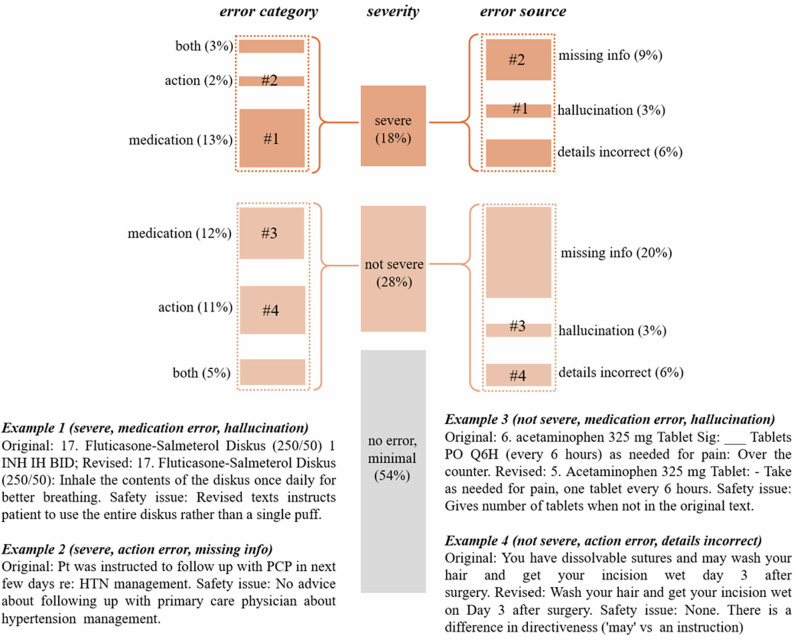
Patient-centred instructions on discharge can improve adherence and outcomes. Using GPT-3.5 to generate patient-centred discharge instructions, we evaluated responses for safety, accuracy and language simplification. When tested on 100 discharge summaries from MIMIC-IV, potentially harmful safety issues attributable to the AI tool were found in 18%, including 6% with hallucinations and 3% with new medications. AI tools can generate patient-centred discharge instructions, but careful implementation is needed to avoid harms.
Overview
The claims and statistics of this paper haven’t been checked yet.
Free: it reads the open-access text and checks the first 5 claims that cite a source we can check. Create a free account to check every claim.
Integrity signals
Registry
Cites
Statistics
Figures
Verification
Claims the paper makes
The claims and statistics of this paper haven’t been checked yet.
Free: it reads the open-access text and checks the first 5 claims that cite a source we can check. Create a free account to check every claim.
Claims other papers make about this one
Each is checked against this paper’s own text: does it say what the citing paper says it does?
The source backs part of the claim, not all of it — or backs it for a different population, condition or comparison.
In the citing paper
“To counterbalance this, engineering techniques such as fine-tuning, disease knowledge bases, and prompt engineering, as applied in this study, are essential to enhance the local model’s capabilities in patient simulation38.”
From A large language model digital patient system enhances ophthalmology history taking skills (2025) · cites this paper as [38]
Experimental — accuracy not yet measuredThe source backs part of the claim, not all of it — or backs it for a different population, condition or comparison.
In the citing paper
“By processing extensive medical literature and electronic health records (EHRs), LLMs has demonstrated the ability to extract detailed clinical information from patient discharge summaries38.”
From A large language model digital patient system enhances ophthalmology history taking skills (2025) · cites this paper as [38]
Experimental — accuracy not yet measuredThe check wasn’t confident either way, so it gives no verdict — never disputed.
In the citing paper
“Another study J o u r n a l P r e -p r o o f reported 61.8% reproducibility for ChatGPT-3.5 after retesting on a different day.58”
From Large Language Models in Pharmacist-Led Direct Patient Care: A Rapid Review of Published Evaluations (2026) · cites this paper as [58]
Experimental — accuracy not yet measuredThe check wasn’t confident either way, so it gives no verdict — never disputed.
In the citing paper
“LLM response reproducibility refers to the consistency of its outputs to the same query and has been shown to differ on repeat assessment.58,59,66”
From Large Language Models in Pharmacist-Led Direct Patient Care: A Rapid Review of Published Evaluations (2026) · cites this paper as [58]
Experimental — accuracy not yet measured
Self-check
Percentages, sums and reported differences re-computed from the paper’s own numbers.
The self-check needs the paper’s full text.
Citations
Cites
Goldberger, A. L., Amaral, L. A. N., Glass, L., Hausdorff, J. M., Ivanov, P. C., Mark, R. G., Mietus, J. E., Moody, G. B., Peng, C.-K., & Stanley, H. E. (2000) · Circulation · doi:10.1161/01.cir.101.23.e215 · Cited by 14,809
MIMIC-IV, a freely accessible electronic health record dataset
Johnson, A. E. W., Bulgarelli, L., Shen, L., Gayles, A., Shammout, A., Horng, S., Pollard, T. J., Hao, S., Moody, B., Gow, B., et al. (2023) · Scientific Data · doi:10.1038/s41597-022-01899-x · Cited by 3,401
A governance model for the application of AI in health care
Reddy, S., Allan, S., Coghlan, S., & Cooper, P. (2020) · Journal of the American Medical Informatics Association · doi:10.1093/jamia/ocz192 · Cited by 979
Health literacy interventions and outcomes: an updated systematic review.
Berkman, N. D., Sheridan, S., Donahue, K. E., Halpern, D. J., Viera, A. J., Crotty, K., Holland, A. L., Brasure, M., Lohr, K. N., Harden, E. A., et al. (2011) · PubMed Central · Cited by 909
ChatGPT: the future of discharge summaries?
Patel, S. B., & Lam, K. (2023) · The Lancet Digital Health · doi:10.1016/s2589-7500(23)00021-3 · Cited by 728
Johnson, A., Bulgarelli, L., Pollard, T., Gow, B., Moody, B., Horng, S., Celi, L. A., & Mark, R. (2024) · PhysioNet · doi:10.13026/07hj-2a80 · Cited by 524
Johnson, A., Bulgarelli, L., Pollard, T., Horng, S., Celi, L. A., & Mark, R. (2023) · PhysioNet · doi:10.13026/s6n6-xd98 · Cited by 524
Interventions for Individuals with Low Health Literacy: A Systematic Review
Sheridan, S. L., Halpern, D. J., Viera, A. J., Berkman, N. D., Donahue, K. E., & Crotty, K. (2011) · Journal of Health Communication · doi:10.1080/10810730.2011.604391 · Cited by 495
Lyu, Q., Tan, J., Zapadka, M. E., Ponnatapura, J., Niu, C., Myers, K. J., Wang, G., & Whitlow, C. T. (2023) · arXiv · doi:10.48550/arxiv.2303.09038 · Cited by 393
Using ChatGPT to write patient clinic letters
Ali, S. R., Dobbs, T. D., Hutchings, H. A., & Whitaker, I. S. (2023) · The Lancet Digital Health · doi:10.1016/s2589-7500(23)00048-1 · Cited by 375
Lyu, Q., Tan, J., Zapadka, M. E., Ponnatapura, J., Niu, C., Myers, K. J., Wang, G., & Whitlow, C. T. (2023) · Visual Computing for Industry, Biomedicine, and Art · doi:10.1186/s42492-023-00136-5 · Cited by 367
Improving Patient Understanding of Prescription Drug Label Instructions
Davis, T. C., Federman, A. D., Bass, P. F., Jackson, R. H., Middlebrooks, M., Parker, R. M., & Wolf, M. S. (2009) · Journal of General Internal Medicine · doi:10.1007/s11606-008-0833-4 · Cited by 197
Lindquist, L. A., Go, L., Fleisher, J., Jain, N., Friesema, E., & Baker, D. W. (2012) · Journal of General Internal Medicine · doi:10.1007/s11606-011-1886-3 · Cited by 179
Hoek, A. E., Anker, S. C. P., van Beeck, E. F., Burdorf, A., Rood, P. P. M., & Haagsma, J. A. (2020) · Annals of Emergency Medicine · doi:10.1016/j.annemergmed.2019.06.008 · Cited by 162
Ayre, J., Mac, O., McCaffery, K., McKay, B. R., Liu, M., Shi, Y., Rezwan, A., & Dunn, A. G. (2024) · Journal of General Internal Medicine · doi:10.1007/s11606-023-08469-w · Cited by 124
Self-citationUsing the Health Literacy Universal Precautions Toolkit to Improve the Quality of Patient Materials
Brega, A. G., Freedman, M. A. G., LeBlanc, W. G., Barnard, J., Mabachi, N. M., Cifuentes, M., Albright, K., Weiss, B. D., Brach, C., & West, D. R. (2015) · Journal of Health Communication · doi:10.1080/10810730.2015.1081997 · Cited by 123
A Patient-Centered Prescription Drug Label to Promote Appropriate Medication Use and Adherence
Wolf, M. S., Davis, T. C., Curtis, L. M., Bailey, S. C., Knox, J. P., Bergeron, A. R., Abbet, M., Shrank, W. H., Parker, R. M., & Wood, A. J. J. (2016) · Journal of General Internal Medicine · doi:10.1007/s11606-016-3816-x · Cited by 113
Wolf, M. S., Davis, T. C., Curtis, L. M., Webb, J. A., Bailey, S. C., Shrank, W. H., Lindquist, L., Ruo, B., Bocchini, M. V., Parker, R. M., et al. (2011) · Medical Care · doi:10.1097/mlr.0b013e3181f38174 · Cited by 102
Characteristics Associated With Postdischarge Medication Errors
Mixon, A. S., Myers, A. P., Leak, C. L., Jacobsen, J. M. L., Cawthon, C. R., Goggins, K. M., Nwosu, S., Schildcrout, J. S., Schnelle, J. F., Speroff, T., et al. (2014) · Mayo Clinic Proceedings · doi:10.1016/j.mayocp.2014.04.023 · Cited by 100
Comparison Between ChatGPT and Google Search as Sources of Postoperative Patient Instructions
Ayoub, N. F., Lee, Y.-J., Grimm, D., & Balakrishnan, K. (2023) · JAMA Otolaryngology–Head & Neck Surgery · doi:10.1001/jamaoto.2023.0704 · Cited by 93
Weetman, K., Spencer, R. A., Dale, J. R., Scott, E. J., & Schnurr, S. (2021) · BMC Health Services Research · doi:10.1186/s12913-021-06345-z · Cited by 88
Evaluation of Language Concordant, Patient-Centered Drug Label Instructions
Bailey, S. C., Sarkar, U., Chen, A. H., Schillinger, D., & Wolf, M. S. (2012) · Journal of General Internal Medicine · doi:10.1007/s11606-012-2035-3 · Cited by 80
Review article: Components of a good quality discharge summary: A systematic review
Wimsett, J., Harper, A., & Jones, P. (2014) · Emergency Medicine Australasia · doi:10.1111/1742-6723.12285 · Cited by 79
Bridging the literacy gap for surgical consents: an AI-human expert collaborative approach
Ali, R., Connolly, I. D., Tang, O. Y., Mirza, F. N., Johnston, B., Abdulrazeq, H. F., Lim, R. K., Galamaga, P. F., Libby, T. J., Sodha, N. R., et al. (2024) · npj Digital Medicine · doi:10.1038/s41746-024-01039-2 · Cited by 78
Spallek, S., Birrell, L., Kershaw, S., Devine, E. K., & Thornton, L. (2023) · JMIR Medical Education · doi:10.2196/51243 · Cited by 77
Artificial intelligence and health literacy—proceed with caution
Nutbeam, D. (2023) · Health Literacy and Communication Open · doi:10.1080/28355245.2023.2263355 · Cited by 75
Ayre, J., Bonner, C., Muscat, D. M., Dunn, A. G., Harrison, E., Dalmazzo, J., Mouwad, D., Aslani, P., Shepherd, H. L., & McCaffery, K. J. (2023) · JMIR Formative Research · doi:10.2196/40645 · Cited by 69
Self-citationClough, R. A. J., Sparkes, W. A., Clough, O. T., Sykes, J. T., Steventon, A. T., & King, K. (2024) · BJGP Open · doi:10.3399/bjgpo.2023.0116 · Cited by 64
What generative AI means for trust in health communications
Dunn, A. G., Shih, I., Ayre, J., & Spallek, H. (2023) · Journal of Communication in Healthcare · doi:10.1080/17538068.2023.2277489 · Cited by 48
Self-citationChoudhry, A. J., Younis, M., Ray-Zack, M. D., Glasgow, A. E., Haddad, N. N., Habermann, E. B., Jenkins, D. H., Heller, S. F., Schiller, H. J., & Zielinski, M. D. (2018) · Surgery · doi:10.1016/j.surg.2018.10.014 · Cited by 41
Prevalence of Universal Medication Schedule prescribing and links to adherence
Wolf, M. S., Taitel, M. S., Jiang, J., Curtis, L. M., Wismer, G. A., Wallia, A., & Parker, R. M. (2020) · American Journal of Health-System Pharmacy · doi:10.1093/ajhp/zxz305 · Cited by 11
Bridging the Literacy Gap for Surgical Consents: An AI-Human Expert Collaborative ApproachPreprint
Ali, R., Connolly, I. D., Tang, O. Y., et al. (2023) · medRxiv · doi:10.1101/2023.05.06.23289615 · Cited by 11
Scarfo, N. L., Dehghanian, S., Duong, M. H., Woodman, R. J., Shetty, P., Lu, H. H., & Phillips, C. J. (2023) · Australian Health Review · doi:10.1071/ah23072 · Cited by 4
Research works printed but not linked: 1
- Johnson, A. et al. MIMIC-IV. PhysioNet 10.13026/RRGF-XW32. · DOI
Cited by
A large language model digital patient system enhances ophthalmology history taking skills
Luo, M.-J., Bi, S., Pang, J., Liu, L., Tsui, C.-K., Lai, Y., Chen, W., Yang, Y., Xu, K., Zhao, L., et al. (2025) · npj Digital Medicine · doi:10.1038/s41746-025-01841-6 · Cited by 39
“By processing extensive medical literature and electronic health records (EHRs), LLMs has demonstrated the ability to extract detailed clinical information from patient discharge summaries 38 .”
Artificial Intelligence Techniques and Health Literacy: A Systematic Review
Abeo, A. N. A., Armstrong, S., Scriney, M., & Goss, H. R. (2025) · Mayo Clinic Proceedings Digital Health · doi:10.1016/j.mcpdig.2025.100269 · Cited by 37
“16,17 20 For example, AI has been used in health literacy through chatbots built on large language models to provide educational support and enhance understanding of medical topics like vaccination 21 and to automatically identify and curate understandable and medically relevant health information,…”
Kewalramani, D., Jawa, R. S., Martin, C. A., Gosain, A., Wan, D. C., Varghese, T. K., Boland, G. M., Dream, S. Y., Sifri, Z. C., Mollen, K. P., et al. (2025) · Surgery · doi:10.1016/j.surg.2025.109849 · Cited by 24
Ethical Assessment of Generative AI Tools for Clinical Summarization Tasks
Char, D. S., Downing, N. L., Youssef, A., & Mello, M. M. (2026) · The American Journal of Bioethics · doi:10.1080/15265161.2026.2657875 · Cited by 17
“Errors in output may also be clinically significant but easily overlooked (e.g., a digital scribe records “more pain” rather than “no pain” as a symptom) (Goodman et al. 2024; Stanceski et al. 2024).”
MedReadCtrl: Personalizing medical text generation with readability-controlled instruction learningPreprint
Tran, H., Yao, Z., Jang, W. S., Sultana, S., Chang, A., Zhang, Y., & Hong, Y. (2025) · medRxiv · doi:10.1101/2025.07.09.25331239 · Cited by 16
“These improvements are more than stylistic; they translate directly into better comprehension for patients who may otherwise misinterpret discharge instructions, medication labels, or follow-up plans 23 .”
Metadata
- Authors
- Stanceski, K., Zhong, S., Zhang, X., Khadra, S., Tracy, M., Koria, L., Lo, S., Naganathan, V., Kim, J., Dunn, A. G., & Ayre, J.
- Affiliations
- The University of Sydney (AU)
- Royal Prince Alfred Hospital (AU)
- Concord Repatriation General Hospital (AU)
- Corresponding author
- Dunn, Adam G.
- ORCID
- Venue
- npj Digital Medicine
- Published
- 2024-11-20
- Volume
- 7
- Issue
- 1
- Pages
- 329-329
- ISSN
- 2398-6352 (ISSN-L)
- PMC
- PMC11579500
- OpenAlex
- W4404562099
- Cited by
- 45
- References
- 30
- Citations by year
- 2026: 28 · 2025: 16 · 2024: 1
- FWCI
- 4.21
- Type
- journal article
- Language
- en
- Open access
- gold
- doi.org
- Licence
- cc-by-nc-nd
- creativecommons.org/licenses/by-nc-nd/4.0 (tdm)
- creativecommons.org/licenses/by-nc-nd/4.0 (vor)
- Locations
- npj Digital Medicine (publishedVersion, cc-by-nc-nd)
- PubMed Central (publishedVersion, cc-by-nc-nd)
- PubMed (publishedVersion)
- DOAJ (DOAJ: Directory of Open Access Journals) (submittedVersion, cc-by-sa)
- Topics
- Health Sciences › Medicine › Health Informatics › Artificial Intelligence in Healthcare and Education
- Physical Sciences › Computer Science › Artificial Intelligence › Machine Learning in Healthcare
- Health Sciences › Health Professions › Health Information Management › Electronic Health Records Systems
- Keywords
- generative AI, discharge instructions, patient-centered care, GPT-3.5, hallucinations, language simplification, medication errors, MIMIC-IV, discharge summaries
About these checks
Registry, retraction, Cites and statistics results are computed, not judged, with one exception: a printed reference that no index lists is read once by a model before it counts as a citation error. Claims are extracted by a model and kept only when their quote appears verbatim in the text; each cited source is then checked, with a model’s help, for whether it says what the claim relies on. Those verdicts can be wrong — read the claim’s quote and the cited source before relying on one.
Statistics and arithmetic are recomputed, not judged.
Confidence bands are shown only for fields calibrated on our annotated test set. None is calibrated yet, so no band is shown.
What counts as a claim ›How we measure confidence ›How we check this ›
Are you an author, or do you see a problem with this page? Request a review
Data sources
Bibliographic data: Semantic Scholar, OpenAlex, Crossref.
Contains information from the Semantic Scholar Academic Graph Datasets, made available under the ODC Attribution License (ODC-BY 1.0).
Semantic Scholar’s data is described in: Kinney, R., et al. (2023). The Semantic Scholar Open Data Platform. arXiv:2301.10140.
