

The DOI matches its Crossref record; 14 of the 14 references it cites were found in a registry or an index.
Implementing large language models in healthcare while balancing control, collaboration, costs and security
Open accessAbstract
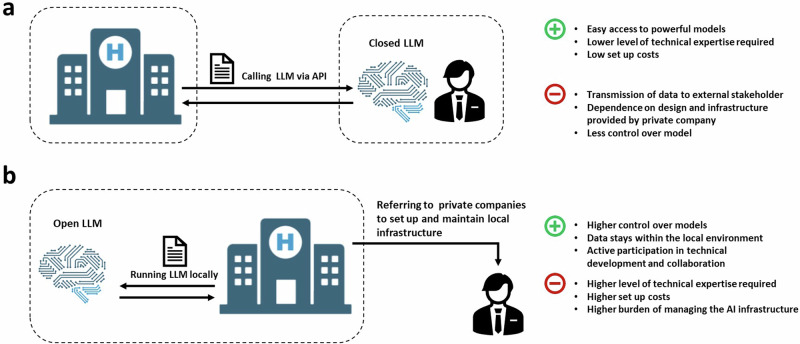
Integrating Large Language Models (LLMs) into healthcare promises substantial advancements but requires careful consideration of technical, ethical, and regulatory challenges. Closed LLMs of private companies offer ease of deployment but pose risks related to data privacy and vendor dependence. Open LLMs deployed on local hardware enable greater model customization but demand resources and technical expertise. Balancing these approaches, with collaboration among clinicians, researchers, and companies is crucial to ensure effective, secure, and ethical implementation.
Overview
The claims and statistics of this paper haven’t been checked yet.
Run the check — free, no account needed. It reads the open-access text and checks the sources it cites.
Integrity signals
Registry
Cites
Statistics
Figures
Verification
Claims the paper makes
The claims and statistics of this paper haven’t been checked yet.
Run the check — free, no account needed. It reads the open-access text and checks the sources it cites.
Claims other papers make about this one
Each is checked against this paper’s own text: does it say what the citing paper says it does?
The source backs part of the claim, not all of it — or backs it for a different population, condition or comparison.
In the citing paper
“Deploying large language models (LLMs) in clinical settings is limited by security, reliability, latency, and accessibility concerns that favor smaller, on-device or on-premise models.”
From The economics of accuracy for medical reasoning with large language models (2026) · cites this paper as [3]
Experimental — accuracy not yet measured
Self-check
Percentages, sums and reported differences re-computed from the paper’s own numbers.
The self-check needs the paper’s full text.
Citations
Cites
The future landscape of large language models in medicine
Clusmann, J., Kolbinger, F. R., Muti, H. S., Carrero, Z. I., Eckardt, J.-N., Laleh, N. G., Löffler, C. M. L., Schwarzkopf, S.-C., Unger, M., Veldhuizen, G. P., et al. (2023) · Communications Medicine · doi:10.1038/s43856-023-00370-1 · Cited by 1,045
Using ChatGPT to write patient clinic letters
Ali, S. R., Dobbs, T. D., Hutchings, H. A., & Whitaker, I. S. (2023) · The Lancet Digital Health · doi:10.1016/s2589-7500(23)00048-1 · Cited by 375
Leveraging large language models for decision support in personalized oncology
Benary, M., Wang, X. D., Schmidt, M., Soll, D., Hilfenhaus, G., Nassir, M., Sigler, C., Knödler, M., Keller, U., Beule, D., et al. (2023) · JAMA Network Open · doi:10.1001/jamanetworkopen.2023.43689 · Cited by 306
A critical assessment of using ChatGPT for extracting structured data from clinical notes
Huang, J., Yang, D. M., Rong, R., Nezafati, K., Treager, C., Chi, Z., Wang, S., Cheng, X., Guo, Y., Klesse, L. J., et al. (2024) · npj Digital Medicine · doi:10.1038/s41746-024-01079-8 · Cited by 298
The Role of Large Language Models in Medical Education: Applications and Implications
Safranek, C. W., Sidamon-Eristoff, A. E., Gilson, A., & Chartash, D. (2023) · JMIR Medical Education · doi:10.2196/50945 · Cited by 233
Embracing Large Language Models for Medical Applications: Opportunities and Challenges
Karabacak, M., & Margetis, K. D. (2023) · Cureus · doi:10.7759/cureus.39305 · Cited by 217
Dennstädt, F., Zink, J., Putora, P. M., Hastings, J., & Čihorić, N. (2024) · Systematic Reviews · doi:10.1186/s13643-024-02575-4 · Cited by 191
Self-citationA systematic analysis of failures in protecting personal health data: A scoping review
Pool, J., Akhlaghpour, S., Fatehi, F., & Burton‐Jones, A. (2023) · International Journal of Information Management · doi:10.1016/j.ijinfomgt.2023.102719 · Cited by 181
Hallucinations in Large Multilingual Translation Models
Guerreiro, N. M., Alves, D. M., Waldendorf, J., Haddow, B., Birch, A., Colombo, P., & Martins, A. F. T. (2023) · Transactions of the Association for Computational Linguistics · doi:10.1162/tacl_a_00615 · Cited by 124
Unmasking and quantifying racial bias of large language models in medical report generation
Yang, Y., Liu, X., Jin, Q., Huang, F., & Lu, Z. (2024) · Communications Medicine · doi:10.1038/s43856-024-00601-z · Cited by 105
Research works printed but not linked: 1
- The HIPAA Journal: Managed care of North America hacking incident impacts 8.9 million individuals. http://www.hipaajournal.com/managed-care-of-north-america-hacking-incident-impacts-8-9-million-individuals/.
Cited by
Sorted by citations
The use of large language models in clinical documentation: A scoping review
Woo, B., Cato, K., Cho, H., You, S. B., & Song, J. (2025) · International Journal of Nursing Studies · doi:10.1016/j.ijnurstu.2025.105322 · Cited by 37
An LLM chatbot to facilitate primary-to-specialist care transitions: a randomized controlled trial
Tao, X., Zhou, S., Ding, K., Li, S., Li, Y., Wu, B., Huang, Q., Chen, W., Shen, M., Meng, E., et al. (2026) · Nature Medicine · doi:10.1038/s41591-025-04176-7 · Cited by 40
Pan, G., Chodnekar, V., Roy, A., & Wang, H. (2025) · IEEE International Conference on Big Data (BigData) · doi:10.1109/bigdata66926.2025.11400957 · Cited by 30
Clinical applications of large language models in medicine and surgery: A scoping review
Liang, E. N., Pei, S., Staibano, P., & van der Woerd, B. D. (2025) · Journal of International Medical Research · doi:10.1177/03000605251347556 · Cited by 28
Prompt Engineering for Large Language Models in Interventional Radiology
Dietrich, N. T., Bradbury, N., & Loh, C. (2025) · American Journal of Roentgenology · doi:10.2214/ajr.25.32956 · Cited by 26
Metadata
- Authors
- Dennstädt, F., Hastings, J., Putora, P. M., Schmerder, M., & Cihoric, N.
- Affiliations
- University of Bern (CH)
- SIB Swiss Institute of Bioinformatics (CH)
- Corresponding author
- Dennstädt, Fabio
- Venue
- npj Digital Medicine
- Published
- 2025-03-06
- Volume
- 8
- Issue
- 1
- Pages
- 143-143
- ISSN
- 2398-6352 (ISSN-L)
- PMC
- PMC11885444
- OpenAlex
- W4408197148
- Cited by
- 144
- References
- 14
- Citations by year
- 2026: 90 · 2025: 54
- FWCI
- 34.42
- Type
- journal article
- Language
- en
- Open access
- gold
- doi.org
- Licence
- Locations
- npj Digital Medicine (publishedVersion, cc-by-nc-nd)
- PubMed Central (publishedVersion, cc-by-nc-nd)
- PubMed (publishedVersion)
- DOAJ (DOAJ: Directory of Open Access Journals) (submittedVersion, cc-by-sa)
- Open Access CRIS of the University of Bern
- Topics
- Health Sciences › Medicine › Health Informatics › Artificial Intelligence in Healthcare and Education
- Physical Sciences › Computer Science › Artificial Intelligence › Machine Learning in Healthcare
- Physical Sciences › Computer Science › Artificial Intelligence › Ethics and Social Impacts of AI
- Keywords
- large language models, data privacy, open-source LLMs, model customization, AI security, ethical considerations, regulatory challenges, clinician collaboration
About these checks
Registry, retraction, Cites and statistics results are computed, not judged, with one exception: a printed reference that no index lists is read once by a model before it counts as a citation error. Claims are extracted by a model and kept only when their quote appears verbatim in the text; each cited source is then checked, with a model’s help, for whether it says what the claim relies on. Those verdicts can be wrong — read the claim’s quote and the cited source before relying on one.
Statistics and arithmetic are recomputed, not judged.
Confidence bands are shown only for fields calibrated on our annotated test set. None is calibrated yet, so no band is shown.
What counts as a claim ›How we measure confidence ›How we check this ›
Are you an author, or do you see a problem with this page? Request a review
