

Serotonin modulates asymmetric learning from reward and punishment in healthy human volunteers
Open accessThe DOI matches its Crossref record; 74 of the 74 references it cites were found in a registry or an index.
Abstract
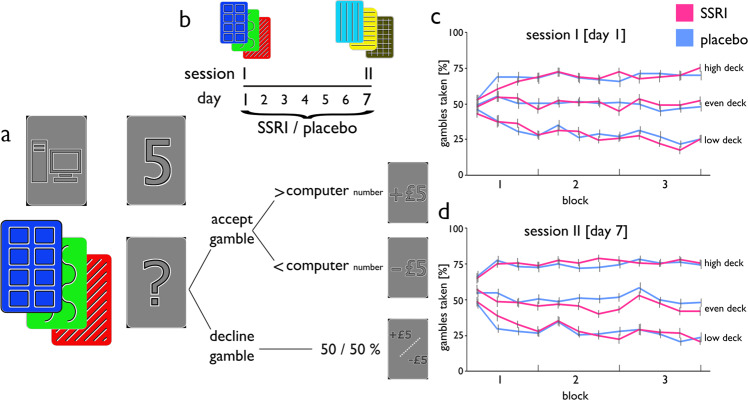
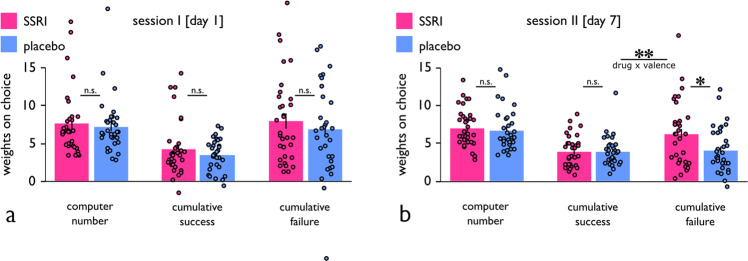
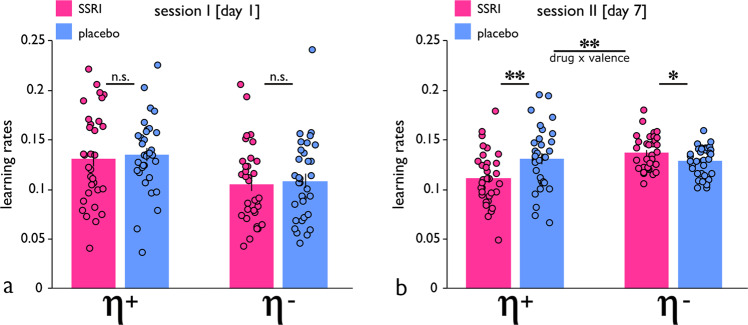
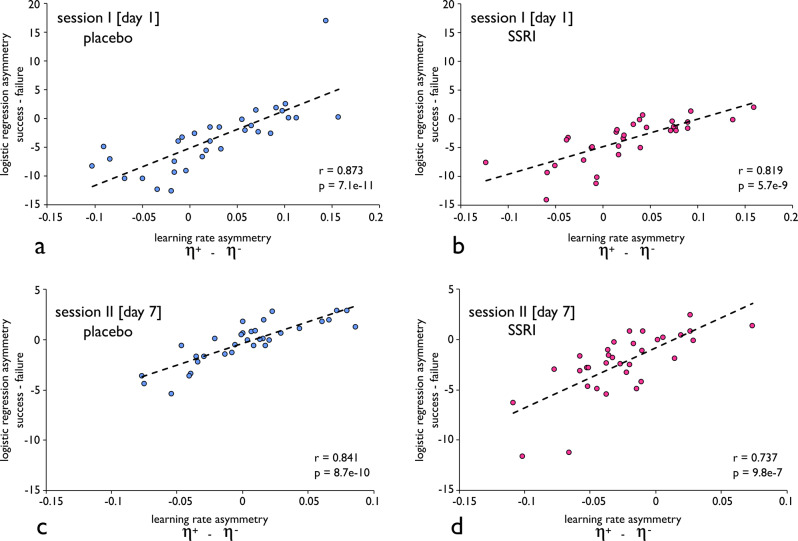
Instrumental learning is driven by a history of outcome success and failure. Here, we examined the impact of serotonin on learning from positive and negative outcomes. Healthy human volunteers were assessed twice, once after acute (single-dose), and once after prolonged (week-long) daily administration of the SSRI citalopram or placebo. Using computational modelling, we show that prolonged boosting of serotonin enhances learning from punishment and reduces learning from reward. This valence-dependent learning asymmetry increases subjects’ tendency to avoid actions as a function of cumulative failure without leading to detrimental, or advantageous, outcomes. By contrast, no significant modulation of learning was observed following acute SSRI administration. However, differences between the effects of acute and prolonged administration were not significant. Overall, these findings may help explain how serotonergic agents impact on mood disorders.
Overview
The claims and statistics of this paper haven’t been checked yet.
Free: it reads the open-access text and checks the first 5 claims that cite a source we can check. Create a free account to check every claim.
Integrity signals
Registry
Cites
Statistics
Figures
Verification
Claims the paper makes
The claims and statistics of this paper haven’t been checked yet.
Free: it reads the open-access text and checks the first 5 claims that cite a source we can check. Create a free account to check every claim.
Claims other papers make about this one
Each is checked against this paper’s own text: does it say what the citing paper says it does?
The source backs part of the claim, not all of it — or backs it for a different population, condition or comparison.
In the citing paper
“A recent study examined both the acute and short-term effects of SSRIs. The results showed that acute administration did not affect reinforcement learning, but short-term administration resulted in increased learning from punishment, with reduced learning from reward [25].”
From Chronic escitalopram in healthy volunteers has specific effects on reinforcement sensitivity: a double-blind, placebo-controlled semi-randomised study (2023) · cites this paper as [25]
Experimental — accuracy not yet measuredThe cited source says what the claim attributes to it.
In the citing paper
“Currently, only a few studies have examined SSRIs administered sub-chronically, over approximately 7 days [24, 25].”
From Chronic escitalopram in healthy volunteers has specific effects on reinforcement sensitivity: a double-blind, placebo-controlled semi-randomised study (2023) · cites this paper as [25]
Self-check
Percentages, sums and reported differences re-computed from the paper’s own numbers.
The self-check needs the paper’s full text.
Citations
Cites
Development and validation of brief measures of positive and negative affect: The PANAS scales.
Watson, D., Clark, L. A., & Tellegen, A. (1988) · Journal of Personality and Social Psychology · doi:10.1037/0022-3514.54.6.1063 · Cited by 32,433
Beck, A. T., Steer, R. A., & Brown, G. (2011) · PsycTESTS Dataset · doi:10.1037/t00742-000 · Cited by 7,535
By Carrot or by Stick: Cognitive Reinforcement Learning in Parkinsonism
Frank, M. J., Seeberger, L. C., & O'Reilly, R. C. (2004) · Science · doi:10.1126/science.1102941 · Cited by 1,964
A scale for the assessment of hedonic tone the Snaith-Hamilton pleasure scale
Snaith, R. P., Hamilton, M., Morley, S., Humayan, A., Hargreaves, D., & Trigwell, P. (1995) · British Journal of Psychiatry · doi:10.1192/bjp.167.1.99 · Cited by 1,778
The antidepressant fluoxetine restores plasticity in the adult visual cortex
Vetencourt, J. F. M., Sale, A., Viegi, A., Baroncelli, L., De Pasquale, R., F. O'Leary, O., Castrén, E., & Maffei, L. (2008) · Science · doi:10.1126/science.1150516 · Cited by 890
Opponent interactions between serotonin and dopamine
Daw, N. D., Kakade, S., & Dayan, P. (2002) · Neural Networks · doi:10.1016/s0893-6080(02)00052-7 · Cited by 844
Neural mechanisms mediating optimism bias
Sharot, T., Riccardi, A. M., Raio, C. M., & Phelps, E. A. (2007) · Nature · doi:10.1038/nature06280 · Cited by 659 · cited 1×
“…with its limitations, clearer: “A related line of work shows that healthy individuals learn more from positive, relative to negative, information leading to an ‘optimism bias’ (Sharot et al., 2007, 2012), where the latter is lacking in depressed patients (Korn et al., 2014; Garrett et al., 2014).”
BackgroundLinking Molecules to Mood: New Insight Into the Biology of Depression
Krishnan, V., & Nestler, E. J. (2010) · American Journal of Psychiatry · doi:10.1176/appi.ajp.2009.10030434 · Cited by 643
How do antidepressants work? New perspectives for refining future treatment approaches
Harmer, C. J., Duman, R. S., & Cowen, P. J. (2017) · The Lancet Psychiatry · doi:10.1016/s2215-0366(17)30015-9 · Cited by 616
Reward and Punishment Processing in Depression
Eshel, N., & Roiser, J. P. (2010) · Biological Psychiatry · doi:10.1016/j.biopsych.2010.01.027 · Cited by 575 · cited 1×
“…to interindividual variability in brain structure and function (Eldar et al., 2016; Lefebvre et al., 2017), and are thought to play a role in the emergence of mood disorders, often characterised in terms of aberrant processing of reward and punishment (Murphy et al., 2003; Eshel & Roiser, 2010).””
Background
Research works printed but not linked: 3
- Palminteri, S. & Pessiglione, M. In Decision Neuroscience (eds. Dreher, J. C. & Tremblay, L.) (Academic Press, 2017).
- Spielberger, C. D., Gorsuch, R. L., Lushene, R., Vagg, P. R. & Jacobs, G. A. Manual for the State-Trait Anxiety Inventory. (Consulting Psychologists Press, 1983).
- Bishop, C. M. Pattern Recognition and Machine Learning. (Springer, 2006).
Cited by
Valence biases in reinforcement learning shift across adolescence and modulate subsequent memory
Rosenbaum, G. M., Grassie, H. L., & Hartley, C. A. (2022) · eLife · doi:10.7554/elife.64620 · Cited by 72
Langley, C., Armand, S., Luo, Q., Savulich, G., Segerberg, T., Søndergaard, A., Pedersen, E. B., Svart, N., Overgaard-Hansen, O., Johansen, A., et al. (2023) · Neuropsychopharmacology · doi:10.1038/s41386-022-01523-x · Cited by 58
“The results showed that acute administration did not affect reinforcement learning, but short-term administration resulted in increased learning from punishment, with reduced learning from reward [25].”
BackgroundDopamine and serotonin interplay for valence-based spatial learning
Wert-Carvajal, C., Reneaux, M., Tchumatchenko, T., & Clopath, C. (2022) · Cell Reports · doi:10.1016/j.celrep.2022.110645 · Cited by 35
Flexibility in valenced reinforcement learning computations across development
Nussenbaum, K., Velez, J. A., Washington, B. T., Hamling, H. E., & Hartley, C. A. (2022) · Child Development · doi:10.1111/cdev.13791 · Cited by 37
Bagozzi, R. P. (2024) · Journal of Global Marketing · doi:10.1080/08911762.2024.2386970 · Cited by 30
“In particular, serotonin enhances learning from punishment and reduced learning from reward (Michely et al., 2022).”
Monoaminergic Modulation of Learning and Cognitive Function in the Prefrontal Cortex
Boyle, N., Betts, S., & Lü, H. (2024) · Brain Sciences · doi:10.3390/brainsci14090902 · Cited by 34
Humans perseverate on punishment avoidance goals in multigoal reinforcement learning
Sharp, P. B., Russek, E. M., Huys, Q. J. M., Dolan, R. J., & Eldar, E. (2022) · eLife · doi:10.7554/elife.74402 · Cited by 29
Self-citationUnderstanding the development of reward learning through the lens of meta-learning
Nussenbaum, K., & Hartley, C. A. (2024) · Nature Reviews Psychology · doi:10.1038/s44159-024-00304-1 · Cited by 45
“Setting asymmetric learning rates might involve the engagement of different neuromodulatory systems, including those that control dopamine 64,67,75 and serotonin 76–79 .”
Lan, D. C. L., & Browning, M. D. (2022) · Computational Psychiatry · doi:10.5334/cpsy.83 · Cited by 22
Direct serotonin release in humans shapes aversive learning and inhibition
Colwell, M., Tagomori, H., Shang, F., Cheng, H. I., Wigg, C., Browning, M. D., Cowen, P. J., Murphy, S. E., & Harmer, C. J. (2024) · Nature Communications · doi:10.1038/s41467-024-50394-x · Cited by 28
“Despite the shared purpose of increasing synaptic 5-HT, SSRI administration has been associated with decreased sensitivity for rewarding outcomes in some studies 14,15,70 .”
BackgroundTowards formal models of psychopathological traits that explain symptom trajectories
Sharp, P. B., Miller, G. A., Dolan, R. J., & Eldar, E. (2020) · BMC Medicine · doi:10.1186/s12916-020-01725-4 · Cited by 16
Self-citationMkrtchian, A., Qiu, Z., Abir, Y., Erdmann, T., Dercon, Q., Sedlinská, T., Browning, M. D., Costello, H., & Huys, Q. J. M. (2025) · JAMA Psychiatry · doi:10.1001/jamapsychiatry.2025.0839 · Cited by 19
Applying Reinforcement Learning to Rodent Stress Research
Liao, C., & Kwan, A. C. (2021) · Chronic Stress · doi:10.1177/2470547020984732 · Cited by 12
The involvement of serotonin in major depression: nescience in disguise?
Arnone, D., Wise, T., Fitzgerald, P. B., & Harmer, C. J. (2024) · Molecular Psychiatry · doi:10.1038/s41380-024-02459-y · Cited by 17
“However, there are also reports of decreased reward learning after SSRI treatment [15, 19] and understanding individual differences in the effects of SSRI treatment on rewarded decision making will be important for a more complete understanding of how these treatments work and when and how they…”
Boosting Serotonin Increases Information Gathering by Reducing Subjective Cognitive Costs
Michely, J., Martin, I. M., Dolan, R. J., & Hauser, T. U. (2023) · Journal of Neuroscience · doi:10.1523/jneurosci.1416-22.2023 · Cited by 13
“Data from different tasks of the same participants were already published elsewhere (Michely et al., 2020a; Michely et al., 2020b).”
BackgroundSelf-citationRole of Serotonin in the Neurobiology of Schizophrenia and Association With Negative Symptoms
Osugo, M., Whitehurst, T., Erritzøe, D., Carr, R., Ashok, A. H., Maccioni, L., Onwordi, E. C., Rutigliano, G., Rahaman, N., Arumuham, A., et al. (2025) · JAMA Psychiatry · doi:10.1001/jamapsychiatry.2025.3430 · Cited by 11
Dissociable effects of psilocybin and escitalopram for depression on processing of musical surprises
Harding, R., Singer, N., Wall, M. B., Hendler, T., Erritzøe, D., Nutt, D. J., Carhart-Harris, R. L., & Roseman, L. (2025) · Molecular Psychiatry · doi:10.1038/s41380-025-03035-8 · Cited by 12
A cognitive neuroscience approach to understanding aggression and its treatment
Blair, J., Habel, U., Votinov, M., Wagels, L., & Denson, T. F. (2025) · Neuroscience & Biobehavioral Reviews · doi:10.1016/j.neubiorev.2025.106386 · Cited by 11
Malamud, J., Lewis, G., Moutoussis, M., Duffy, L., Bone, J. K., Srinivasan, R., Lewis, G., & Huys, Q. J. M. (2024) · Psychological Medicine · doi:10.1017/s0033291724000837 · Cited by 9
“…of anxiety and depression are sensitive to SSRIs (e.g. Geurts, Huys, den Ouden, & Cools, 2013a; Guitart-Masip, Duzel, Dolan, & Dayan, 2014; Harmer, 2013; Michely, Eldar, Erdman, Martin, & Dolan, 2022; Michely, Eldar, Martin, & Dolan, 2020; Roiser, Elliott, & Sahakian, 2012a; Roiser et al., 2012b).”
Hervig, M. E.-S., Zühlsdorff, K., Olesen, S. F., Phillips, B. U., Božič, T., Dalley, J. W., Cardinal, R. N., Alsiö, J., & Robbins, T. W. (2024) · Psychopharmacology · doi:10.1007/s00213-024-06586-w · Cited by 7
“In healthy human participants, short-term admin - istration of the SSRI citalopram results in increased pun - ishment learning and reduced reward learning (Michely et al. 2022 ).”
BackgroundLeveraging Decision Science to Characterize Depression
Mukherjee, D., van Geen, C., & Kable, J. W. (2023) · Current Directions in Psychological Science · doi:10.1177/09637214231194962 · Cited by 11
“Serotonin, on the other hand, has been linked to reward and punishment signaling (Lan & Browning, 2022), and sustained intake of serotonin reuptake inhibitors leads to changes in reinforcement learning parameters (Michely et al., 2022).”
BackgroundEggan, P., Gordon, S. E., & Zagotta, W. N. (2024) · eLife · doi:10.7554/elife.99854.3 · Cited by 7
Experience-based risk taking is primarily shaped by prior learning rather than by decision-making
Erdman, A., Gouwy, A., Sananes, G., Salman, M., Eizenstien, L., Eliav, S., & Eldar, E. (2025) · Nature Communications · doi:10.1038/s41467-025-61609-0 · Cited by 7
“Indeed, biases in learning from gains and losses have been linked to depression 45 – 47 , bipolar disorder 48 , anxiety 49 , and addiction 50 .”
Self-citationLangley, C., Murray, G. K., Armand, S., Knolle, F., Cardinal, R. N., Johansen, A., Jensen, P. S., Feng, J., Stenbæk, D. S., Knudsen, G. M., et al. (2025) · Translational Psychiatry · doi:10.1038/s41398-025-03392-6 · Cited by 5
“The present study and that of Michely et al. [19] for example differ in the dosage and length of SSRI administration.”
InfluentialActive information sampling in health and disease
Attaallah, B., Petitet, P., & Husain, M. (2025) · Neuroscience & Biobehavioral Reviews · doi:10.1016/j.neubiorev.2025.106197 · Cited by 3
The influence of psilocybin on subconscious and conscious emotional learning
Casanova, A. F., Ort, A., Smallridge, J. W., Preller, K. H., Seifritz, E., & Vollenweider, F. X. (2024) · iScience · doi:10.1016/j.isci.2024.110034 · Cited by 4
“28 Themesocorticolimbic DA system plays a pivotal role in learning by capturing novelty through reward prediction errors (PE), measured by characteristic dopaminergic firing patterns.”
BackgroundGene-by-environment Interactions and Adaptive Body Size Variation in Mice From the Americas
Mack, K. L., Landino, N. P., Tertyshnaia, M., Longo, T. C., Vera, S. A., Crew, L., McDonald, K., & Phifer‐Rixey, M. (2025) · Molecular Biology and Evolution · doi:10.1093/molbev/msaf078 · Cited by 5
Mkrtchian, A., Qiu, Z., Abir, Y., Erdmann, T., Dercon, Q., Sedlinská, T., Browning, M. D., Costello, H., & Huys, Q. J. M. (2025) · bioRxiv (Cold Spring Harbor Laboratory) · doi:10.1101/2025.01.08.631868 · Cited by 2
Gain modulation of probabilistic selection without synaptic relearning
Ersöz, E. K., Chossat, P., & Lavigne, F. (2025) · PLoS ONE · doi:10.1371/journal.pone.0333350 · Cited by 4
Malamud, J., Lewis, G., Moutoussis, M., Duffy, L., Bone, J. K., Srinivasan, R., Lewis, G., & Huys, Q. J. M. (2023) · Research Square · doi:10.21203/rs.3.rs-2776498/v1
Malamud, J., Lewis, G., Moutoussis, M., Duffy, L., Bone, J. K., Srinivasan, R., Lewis, G., & Huys, Q. J. M. (2023) · Research Square · doi:10.21203/rs.3.rs-2776498/v2
Malamud, J., Lewis, G., Moutoussis, M., Duffy, L., Bone, J. K., Srinivasan, R., Lewis, G., & Huys, Q. J. M. (2023) · PsyArXiv (OSF Preprints) · doi:10.31234/osf.io/y4uxq
Computational Phenotyping of Electroconvulsive Therapy Outcomes in Treatment-Resistant DepressionPreprint
Jones, R. E., Sands, L. P., Trattner, J. D., Jiang, A., Johnson, C. K., Gligorovic, P. V., Douglas, H. E., Ramos, R., & Kishida, K. T. (2024) · medRxiv · doi:10.1101/2024.10.02.24314373
“Further, antidepressant studies also report increased 36 , decreased 37 , or no change 38,39 in patients’ punishment learning when considering ‘negative reward prediction errors’ and the punishment signal.”
BackgroundDissociable neurofunctional and molecular characterizations of reward and punishment sensitivityPreprint
Xu, T., Zhu, C., Zhou, X., Chen, Z., Gan, X., Cui, X., Zhou, F., Zhang, R., Zhao, W., Zhang, X., et al. (2024) · bioRxiv (Cold Spring Harbor Laboratory) · doi:10.1101/2024.12.30.630747
Xiang, L., Liu, M., & Li, W. (2025) · bioRxiv (Cold Spring Harbor Laboratory) · doi:10.1101/2025.10.09.681320
“Reward learning relies on mesolimbic dopaminergic projections, whereas punishment learning is associated with serotonergic projections 2–5 .”
Theory-driven computational psychiatry and its challenges: An optimistic outlook
Fisher, E. L., Sajid, N., Convertino, L., & Hohwy, J. (2026) · Neuroscience & Biobehavioral Reviews · doi:10.1016/j.neubiorev.2026.106923
Berkovitch, L., Vinckier, F., Salvador, A., Pessiglione, M., Deakin, J. F. W., DAWSON, G. E., Harmer, C. J., Goodwin, G. M., & Gaillard, R. (2026) · medRxiv · doi:10.64898/2025.12.30.25342896
“For instance, a study found that acute administration of a SSRI had no significant effect on RL in healthy participants, whereas one week of treatment enhanced learning from punishment and reduces learning from reward [36].”
Decoding serotonin: From neurobiological mechanisms to neurofinance insights
Polat, Y. (2026) · İşletme · doi:10.57116/isletme.1714949
Xiang, L., Li, B., Liu, M., & Li, W. (2026) · iScience · doi:10.1016/j.isci.2026.116473
Goset-Poblete, J., Amador, R. R., & Ramírez-Barrantes, R. (2026) · Frontiers in Human Neuroscience · doi:10.3389/fnhum.2026.1820271
“Social component as neurobiological regulator: Socio-emotional mediation modulates autonomic responses and regulates serotonergic stress (Colwell et al., 2024; Michely et al., 2022).”
EEG biomarkers of reinforcement learning and motivation: A multi-task batteryPreprint
Qiu, Z., Wang, M., Lu, H., Abir, Y., Zharmakhan, R., Singh, N., Poppe, M., Degni, L., & Huys, Q. J. M. (2026) · bioRxiv (Cold Spring Harbor Laboratory) · doi:10.64898/2026.06.28.735051
Serotonin reuptake inhibition rapidly enhances affect-reward coupling and improves mood over timePreprint
Mills, R., Durand, A., Croal, M., Rutledge, R. B., & Mason, L. (2026) · bioRxiv (Cold Spring Harbor Laboratory) · doi:10.64898/2026.07.03.736315
Metadata
- Authors
- Michely, J., Eldar, E., Erdman, A., Martin, I. M., & Dolan, R. J.
- Affiliations
- Wellcome Centre for Human Neuroimaging (GB)
- Hebrew University of Jerusalem (IL)
- Corresponding author
- Michely, Jochen
- Venue
- Communications Biology
- Published
- 2022-08-12
- Volume
- 5
- Issue
- 1
- Pages
- 812-812
- ISSN
- 2399-3642 (ISSN-L)
- PMC
- PMC9374781
- OpenAlex
- W4290860874
- Cited by
- 43
- References
- 72
- Citations by year
- 2026: 7 · 2025: 11 · 2024: 12 · 2023: 6 · 2022: 4
- FWCI
- 3.65
- Type
- journal article
- Language
- en
- Open access
- gold
- doi.org
- Licence
- cc-by
- creativecommons.org/licenses/by/4.0 (tdm)
- creativecommons.org/licenses/by/4.0 (vor)
- Locations
- Communications Biology (publishedVersion, cc-by)
- PubMed Central (publishedVersion, cc-by)
- PubMed (publishedVersion)
- DOAJ (DOAJ: Directory of Open Access Journals) (submittedVersion, cc-by-sa)
- UCL Discovery (University College London) (submittedVersion)
- Refubium (Universitätsbibliothek der Freien Universität Berlin) (submittedVersion, cc-by)
- Universitätsbibliothek der FU Berlin Hochschulschriftenstelle u. Dokumentenserver (cc-by)
- Funders
- Deutsche Forschungsgemeinschaft
- Charité – Universitätsmedizin Berlin
- Topics
- Life Sciences › Neuroscience › Cellular and Molecular Neuroscience › Neurotransmitter Receptor Influence on Behavior
- Life Sciences › Neuroscience › Cognitive Neuroscience › Neural and Behavioral Psychology Studies
- Life Sciences › Neuroscience › Cognitive Neuroscience › Memory and Neural Mechanisms
- Keywords
- serotonin, operant conditioning, reward learning, punishment learning, citalopram, selective serotonin reuptake inhibitors, avoidance behavior, mood disorders
- MeSH terms
- Humans, Punishment, Reward, Serotonin, Selective Serotonin Reuptake Inhibitors, Healthy Volunteers
About these checks
Registry, retraction, Cites and statistics results are computed, not judged, with one exception: a printed reference that no index lists is read once by a model before it counts as a citation error. Claims are extracted by a model and kept only when their quote appears verbatim in the text; each cited source is then checked, with a model’s help, for whether it says what the claim relies on. Those verdicts can be wrong — read the claim’s quote and the cited source before relying on one.
Statistics and arithmetic are recomputed, not judged.
Confidence bands are shown only for fields calibrated on our annotated test set. None is calibrated yet, so no band is shown.
What counts as a claim ›How we measure confidence ›How we check this ›
Are you an author, or do you see a problem with this page? Request a review
Data sources
Bibliographic data: Semantic Scholar, OpenAlex, Crossref.
Contains information from the Semantic Scholar Academic Graph Datasets, made available under the ODC Attribution License (ODC-BY 1.0).
Semantic Scholar’s data is described in: Kinney, R., et al. (2023). The Semantic Scholar Open Data Platform. arXiv:2301.10140.
