

Serotonin modulates asymmetric learning from reward and punishment in healthy human volunteers
Open accessThe DOI matches its Crossref record; 74 of the 74 references it cites were found in a registry or an index.
Abstract
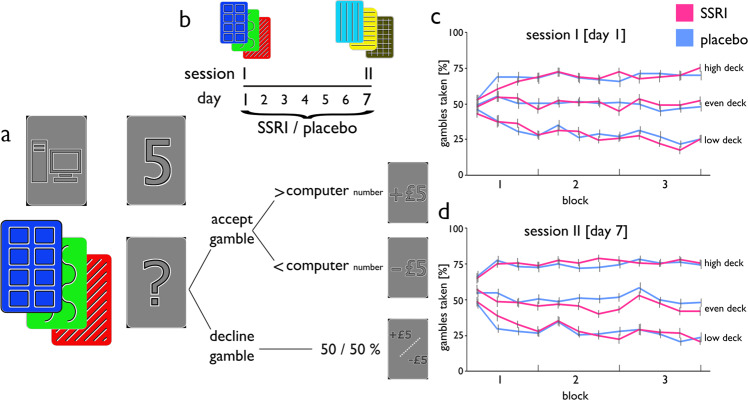
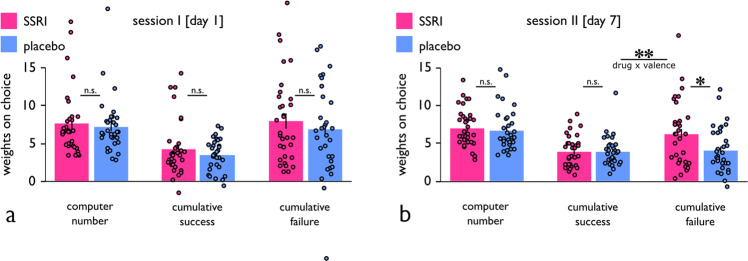
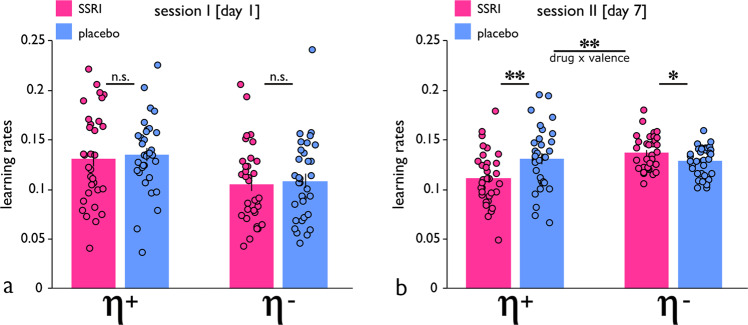
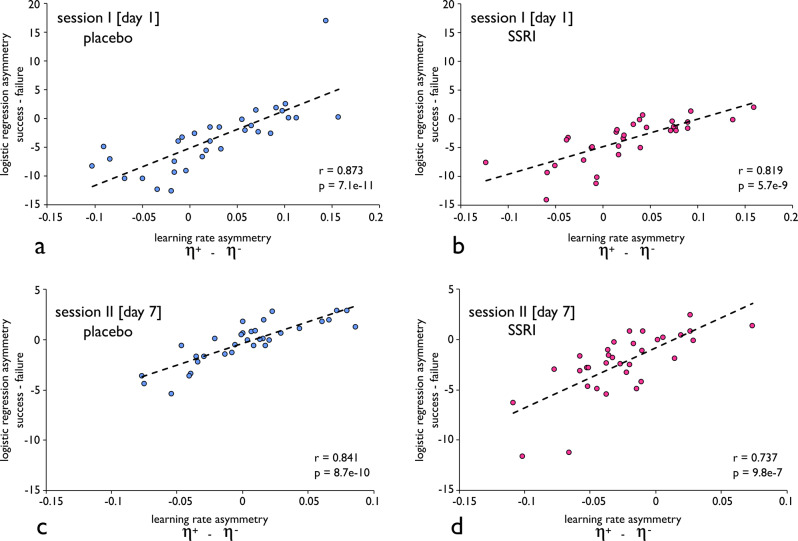
Instrumental learning is driven by a history of outcome success and failure. Here, we examined the impact of serotonin on learning from positive and negative outcomes. Healthy human volunteers were assessed twice, once after acute (single-dose), and once after prolonged (week-long) daily administration of the SSRI citalopram or placebo. Using computational modelling, we show that prolonged boosting of serotonin enhances learning from punishment and reduces learning from reward. This valence-dependent learning asymmetry increases subjects’ tendency to avoid actions as a function of cumulative failure without leading to detrimental, or advantageous, outcomes. By contrast, no significant modulation of learning was observed following acute SSRI administration. However, differences between the effects of acute and prolonged administration were not significant. Overall, these findings may help explain how serotonergic agents impact on mood disorders.
Overview
The claims and statistics of this paper haven’t been checked yet.
Free: it reads the open-access text and checks the first 5 claims that cite a source we can check. Create a free account to check every claim.
Integrity signals
Registry
Cites
Statistics
Figures
Verification
Claims the paper makes
The claims and statistics of this paper haven’t been checked yet.
Free: it reads the open-access text and checks the first 5 claims that cite a source we can check. Create a free account to check every claim.
Claims other papers make about this one
Each is checked against this paper’s own text: does it say what the citing paper says it does?
The source backs part of the claim, not all of it — or backs it for a different population, condition or comparison.
In the citing paper
“A recent study examined both the acute and short-term effects of SSRIs. The results showed that acute administration did not affect reinforcement learning, but short-term administration resulted in increased learning from punishment, with reduced learning from reward [25].”
From Chronic escitalopram in healthy volunteers has specific effects on reinforcement sensitivity: a double-blind, placebo-controlled semi-randomised study (2023) · cites this paper as [25]
Experimental — accuracy not yet measuredThe cited source says what the claim attributes to it.
In the citing paper
“Currently, only a few studies have examined SSRIs administered sub-chronically, over approximately 7 days [24, 25].”
From Chronic escitalopram in healthy volunteers has specific effects on reinforcement sensitivity: a double-blind, placebo-controlled semi-randomised study (2023) · cites this paper as [25]
Self-check
Percentages, sums and reported differences re-computed from the paper’s own numbers.
The self-check needs the paper’s full text.
Citations
Cites
Development and validation of brief measures of positive and negative affect: The PANAS scales.
Watson, D., Clark, L. A., & Tellegen, A. (1988) · Journal of Personality and Social Psychology · doi:10.1037/0022-3514.54.6.1063 · Cited by 32,433
Beck, A. T., Steer, R. A., & Brown, G. (2011) · PsycTESTS Dataset · doi:10.1037/t00742-000 · Cited by 7,535
By Carrot or by Stick: Cognitive Reinforcement Learning in Parkinsonism
Frank, M. J., Seeberger, L. C., & O'Reilly, R. C. (2004) · Science · doi:10.1126/science.1102941 · Cited by 1,964
A scale for the assessment of hedonic tone the Snaith-Hamilton pleasure scale
Snaith, R. P., Hamilton, M., Morley, S., Humayan, A., Hargreaves, D., & Trigwell, P. (1995) · British Journal of Psychiatry · doi:10.1192/bjp.167.1.99 · Cited by 1,778
The antidepressant fluoxetine restores plasticity in the adult visual cortex
Vetencourt, J. F. M., Sale, A., Viegi, A., Baroncelli, L., De Pasquale, R., F. O'Leary, O., Castrén, E., & Maffei, L. (2008) · Science · doi:10.1126/science.1150516 · Cited by 890
Opponent interactions between serotonin and dopamine
Daw, N. D., Kakade, S., & Dayan, P. (2002) · Neural Networks · doi:10.1016/s0893-6080(02)00052-7 · Cited by 844
Neural mechanisms mediating optimism bias
Sharot, T., Riccardi, A. M., Raio, C. M., & Phelps, E. A. (2007) · Nature · doi:10.1038/nature06280 · Cited by 659 · cited 1×
“…with its limitations, clearer: “A related line of work shows that healthy individuals learn more from positive, relative to negative, information leading to an ‘optimism bias’ (Sharot et al., 2007, 2012), where the latter is lacking in depressed patients (Korn et al., 2014; Garrett et al., 2014).”
BackgroundLinking Molecules to Mood: New Insight Into the Biology of Depression
Krishnan, V., & Nestler, E. J. (2010) · American Journal of Psychiatry · doi:10.1176/appi.ajp.2009.10030434 · Cited by 643
How do antidepressants work? New perspectives for refining future treatment approaches
Harmer, C. J., Duman, R. S., & Cowen, P. J. (2017) · The Lancet Psychiatry · doi:10.1016/s2215-0366(17)30015-9 · Cited by 616
Reward and Punishment Processing in Depression
Eshel, N., & Roiser, J. P. (2010) · Biological Psychiatry · doi:10.1016/j.biopsych.2010.01.027 · Cited by 575 · cited 1×
“…to interindividual variability in brain structure and function (Eldar et al., 2016; Lefebvre et al., 2017), and are thought to play a role in the emergence of mood disorders, often characterised in terms of aberrant processing of reward and punishment (Murphy et al., 2003; Eshel & Roiser, 2010).””
BackgroundNeurochemical Modulation of Response Inhibition and Probabilistic Learning in Humans
Chamberlain, S. R., Müller, U., Blackwell, A. D., Clark, L., Robbins, T. W., & Sahakian, B. J. (2006) · Science · doi:10.1126/science.1121218 · Cited by 573
Thinking like a trader selectively reduces individuals' loss aversion
Sokol-Hessner, P., Hsu, M., Curley, N. G., Delgado, M. R., Camerer, C. F., & Phelps, E. A. (2009) · Proceedings of the National Academy of Sciences · doi:10.1073/pnas.0806761106 · Cited by 452 · cited 2×
“…risky decision-making models are typically used in experiments in which the decision variables are presented to subjects explicitly (e.g., Sokol-Hessner et al., 2009, PNAS; Rutledge et al., 2014, PNAS), whereas our task involves decision variables that need to be learned by trial and…”
BackgroundMethodA computational and neural model of momentary subjective well-being
Rutledge, R. B., Skandali, N., Dayan, P., & Dolan, R. J. (2014) · Proceedings of the National Academy of Sciences · doi:10.1073/pnas.1407535111 · Cited by 444 · cited 5×
“…modelling decisions with respect to risky decisionmaking literature: “Note that although our task involves gambling, it contrasts with typical risky decision-making paradigms (e.g., Sokol-Hessner et al., 2009; Rutledge et al., 2014) in that decision variables need to be learned by trial and error.”
BackgroundMethodInfluentialSelf-citationHuys, Q. J. M., Eshel, N., O'Nions, E., Sheridan, L., Dayan, P., & Roiser, J. P. (2012) · PLoS Computational Biology · doi:10.1371/journal.pcbi.1002410 · Cited by 439
Disentangling the Roles of Approach, Activation and Valence in Instrumental and Pavlovian Responding
Huys, Q. J. M., Cools, R., Gölzer, M., Friedel, E., Heinz, A., Dolan, R. J., & Dayan, P. (2011) · PLoS Computational Biology · doi:10.1371/journal.pcbi.1002028 · Cited by 416
Self-citationTaylor, M. J., Freemantle, N., Geddes, J. R., & Bhagwagar, Z. (2006) · Archives of General Psychiatry · doi:10.1001/archpsyc.63.11.1217 · Cited by 406
Mood as representation of momentum
Eldar, E., Rutledge, R. B., Dolan, R. J., & Niv, Y. (2016) · Trends in Cognitive Sciences · doi:10.1016/j.tics.2015.07.010 · Cited by 383 · cited 12×
“…variability in human learning asymmetries, it is tempting to speculate that serotonergic agents may act preferentially in the striatum and prefrontal cortex to alter the relative degree of impact from positive and negative outcomes (Macoveanu, 2014; Eldar et al., 2016; Lefebvre et al., 2017).””
BackgroundMethodResultSelf-citationFear erasure in mice requires synergy between antidepressant drugs and extinction training
Karpova, N. N., Pickenhagen, A., Lindholm, J., Tiraboschi, E., Kulesskaya, N., Ágústsdóttir, A., Antila, H., Popova, D., Akamine, Y., Sullivan, R., et al. (2011) · Science · doi:10.1126/science.1214592 · Cited by 382
Cools, R., Frank, M. J., Gibbs, S. E., Miyakawa, A., Jagust, W., & D'Esposito, M. (2009) · The Journal of Neuroscience · doi:10.1523/jneurosci.4467-08.2009 · Cited by 364
Bodi, N., Keri, S., Nagy, H., Moustafa, A., Myers, C. E., Daw, N., Dibo, G., Takats, A., Bereczki, D., & Gluck, M. A. (2009) · Brain · doi:10.1093/brain/awp094 · Cited by 363
Neural prediction errors reveal a risk-sensitive reinforcement-learning process in the human brain
Niv, Y., Edlund, J. A., Dayan, P., & O'Doherty, J. P. (2012) · The Journal of Neuroscience · doi:10.1523/jneurosci.5498-10.2012 · Cited by 356 · cited 2×
“For this we designed our study such that the feedback from which subjects learn is unequivocal, as is typically applied in the basic reinforcement learning literature (Niv et al., 2012; Gershman, 2015; Eldar et al., 2016).”
MethodResultKorn, C. W., Sharot, T., Walter, H., Heekeren, H. R., & Dolan, R. J. (2014) · Psychological Medicine · doi:10.1017/s0033291713001074 · Cited by 334 · cited 2×
“In the latter literature, the assayed learning typically involves updating expectations about oneself given information about the average person (cf. Korn et al., 2014, Psychol Med; Garrett et al., 2014, Front Hum Neurosci).”
BackgroundSelf-citationBari, A., Theobald, D. E., Caprioli, D., Mar, A. C., Aidoo-Micah, A., Dalley, J. W., & Robbins, T. W. (2010) · Neuropsychopharmacology · doi:10.1038/npp.2009.233 · Cited by 325
Functionally dissociable influences on learning rate in a dynamic environment
McGuire, J. T., Nassar, M. R., Gold, J. I., & Kable, J. W. (2014) · Neuron · doi:10.1016/j.neuron.2014.10.013 · Cited by 299
MURPHY, F. C., MICHAEL, A., ROBBINS, T. W., & SAHAKIAN, B. J. (2003) · Psychological Medicine · doi:10.1017/s0033291702007018 · Cited by 298 · cited 1×
“…to interindividual variability in brain structure and function (Eldar et al., 2016; Lefebvre et al., 2017), and are thought to play a role in the emergence of mood disorders, often characterised in terms of aberrant processing of reward and punishment (Murphy et al., 2003; Eshel & Roiser, 2010).””
BackgroundBehavioural and neural characterization of optimistic reinforcement learning
Lefebvre, G., Lebreton, M., Meyniel, F., Bourgeois-Gironde, S., & Palminteri, S. (2017) · Nature Human Behaviour · doi:10.1038/s41562-017-0067 · Cited by 290 · cited 7×
“…variability in human learning asymmetries, it is tempting to speculate that serotonergic agents may act preferentially in the striatum and prefrontal cortex to alter the relative degree of impact from positive and negative outcomes (Macoveanu, 2014; Eldar et al., 2016; Lefebvre et al., 2017).””
BackgroundResultInfluentialContextual modulation of value signals in reward and punishment learning
Palminteri, S., Khamassi, M., Joffily, M., & Coricelli, G. (2015) · Nature Communications · doi:10.1038/ncomms9096 · Cited by 286
Action versus valence in decision making
Guitart-Masip, M., Duzel, E., Dolan, R., & Dayan, P. (2014) · Trends in Cognitive Sciences · doi:10.1016/j.tics.2014.01.003 · Cited by 270
Self-citationDissociable Effects of Dopamine and Serotonin on Reversal Learning
den Ouden, H. E. M., Daw, N. D., Fernandez, G., Elshout, J. A., Rijpkema, M., Hoogman, M., Franke, B., & Cools, R. (2013) · Neuron · doi:10.1016/j.neuron.2013.08.030 · Cited by 255
Serotonin: A never-ending story
Olivier, B. (2015) · European Journal of Pharmacology · doi:10.1016/j.ejphar.2014.10.031 · Cited by 253
Burghardt, N. S., Sullivan, G. M., McEwen, B. S., Gorman, J. M., & LeDoux, J. E. (2004) · Biological Psychiatry · doi:10.1016/j.biopsych.2004.02.029 · Cited by 246
Critical Roles for Anterior Insula and Dorsal Striatum in Punishment-Based Avoidance Learning
Palminteri, S., Justo, D., Jauffret, C., Pavlicek, B., Dauta, A., Delmaire, C., Czernecki, V., Karachi, C., Capelle, L., Durr, A., et al. (2012) · Neuron · doi:10.1016/j.neuron.2012.10.017 · Cited by 242 · cited 1×
“, [4, 5, 6] to [5, 6, 7]), in each subsequent set of 15 trials, if subjects took two thirds or more of the gambles against these numbers in the previous 15 trials, or decreased by one if participants took a third or less of the gambles.”
BackgroundDopaminergic Modulation of Decision Making and Subjective Well-Being
Rutledge, R. B., Skandali, N., Dayan, P., & Dolan, R. J. (2015) · Journal of Neuroscience · doi:10.1523/jneurosci.0702-15.2015 · Cited by 217
Self-citationHow Dopamine Enhances an Optimism Bias in Humans
Sharot, T., Guitart-Masip, M., Korn, C. W., Chowdhury, R., & Dolan, R. J. (2012) · Current Biology · doi:10.1016/j.cub.2012.05.053 · Cited by 215 · cited 1×
“…with its limitations, clearer: “A related line of work shows that healthy individuals learn more from positive, relative to negative, information leading to an ‘optimism bias’ (Sharot et al., 2007, 2012), where the latter is lacking in depressed patients (Korn et al., 2014; Garrett et al., 2014).”
BackgroundSelf-citationDifferential Effect of Reward and Punishment on Procedural Learning
Wächter, T., Lungu, O. V., Liu, T., Willingham, D. T., & Ashe, J. (2009) · The Journal of Neuroscience · doi:10.1523/jneurosci.4132-08.2009 · Cited by 205 · cited 1×
“, [4, 5, 6] to [5, 6, 7]), in each subsequent set of 15 trials, if subjects took two thirds or more of the gambles against these numbers in the previous 15 trials, or decreased by one if participants took a third or less of the gambles.”
BackgroundInteraction between emotional state and learning underlies mood instability
Eldar, E., & Niv, Y. (2015) · Nature Communications · doi:10.1038/ncomms7149 · Cited by 193
Self-citationTwenty-Five Lessons from Computational Neuromodulation
Dayan, P. (2012) · Neuron · doi:10.1016/j.neuron.2012.09.027 · Cited by 190
Losing the rose tinted glasses: neural substrates of unbiased belief updating in depression
Garrett, N., Sharot, T., Faulkner, P., Korn, C. W., Roiser, J. P., & Dolan, R. J. (2014) · Frontiers in Human Neuroscience · doi:10.3389/fnhum.2014.00639 · Cited by 174
Self-citationCools, R., Robinson, O. J., & Sahakian, B. (2008) · Neuropsychopharmacology · doi:10.1038/sj.npp.1301598 · Cited by 172
Do learning rates adapt to the distribution of rewards?
Gershman, S. J. (2015) · Psychonomic Bulletin & Review · doi:10.3758/s13423-014-0790-3 · Cited by 156 · cited 6×
“However, we tested this possibility (cf. comment #3.5), and the effects in our data seem to be better explained by asymmetric learning, which has been shown to capture risk aversion adequately in the context of trial-and-error learning (Niv el al., 2012, J Neurosci; Eldar et al., 2016, PNAS).”
MethodInfluentialPharmacological modulation of subliminal learning in Parkinson's and Tourette's syndromes
Palminteri, S., Lebreton, M., Worbe, Y., Grabli, D., Hartmann, A., & Pessiglione, M. (2009) · Proceedings of the National Academy of Sciences · doi:10.1073/pnas.0904035106 · Cited by 154
Mechanism of acute tryptophan depletion: is it only serotonin?
van Donkelaar, E. L., Blokland, A., Ferrington, L., Kelly, P. A. T., Steinbusch, H. W. M., & Prickaerts, J. (2011) · Molecular Psychiatry · doi:10.1038/mp.2011.9 · Cited by 141
Reward and punishment act as distinct factors in guiding behavior
Kubanek, J., Snyder, L. H., & Abrams, R. A. (2015) · Cognition · doi:10.1016/j.cognition.2015.03.005 · Cited by 140
Correia, P. A., Lottem, E., Banerjee, D., Machado, A. S., Carey, M. R., & Mainen, Z. F. (2017) · eLife · doi:10.7554/elife.20975 · Cited by 138
Burghardt, N. S., & Bauer, E. P. (2013) · Neuroscience · doi:10.1016/j.neuroscience.2013.05.050 · Cited by 125
Adaptive properties of differential learning rates for positive and negative outcomes
Cazé, R. D., & van der Meer, M. A. A. (2013) · Biological Cybernetics · doi:10.1007/s00422-013-0571-5 · Cited by 123
Godlewska, B. R., & Harmer, C. J. (2021) · Psychopharmacology · doi:10.1007/s00213-019-05448-0 · Cited by 123
Monosov, I. E., & Hikosaka, O. (2012) · The Journal of Neuroscience · doi:10.1523/jneurosci.1801-12.2012 · Cited by 117 · cited 1×
“, [4, 5, 6] to [5, 6, 7]), in each subsequent set of 15 trials, if subjects took two thirds or more of the gambles against these numbers in the previous 15 trials, or decreased by one if participants took a third or less of the gambles.”
BackgroundGuitart-Masip, M., Economides, M., Huys, Q. J. M., Frank, M. J., Chowdhury, R., Duzel, E., Dayan, P., & Dolan, R. J. (2014) · Psychopharmacology · doi:10.1007/s00213-013-3313-4 · Cited by 107
Self-citationSerotonin and Dopamine Play Complementary Roles in Gambling to Recover Losses
Campbell-Meiklejohn, D. K., Wakeley, J., Herbert, V., Cook, J. L., Scollo, P., Ray, M. K., Selvaraj, S., Passingham, R. E., Cowen, P. J., & Rogers, R. D. (2010) · Neuropsychopharmacology · doi:10.1038/npp.2010.170 · Cited by 93
Affective bias as a rational response to the statistics of rewards and punishments
Pulcu, E., & Browning, M. (2017) · eLife · doi:10.7554/elife.27879 · Cited by 93
Faulkner, P., & Deakin, J. F. W. (2014) · Neuroscience & Biobehavioral Reviews · doi:10.1016/j.neubiorev.2014.07.024 · Cited by 90
Skandali, N., Rowe, J. B., Voon, V., Deakin, J. B., Cardinal, R. N., Cormack, F., Passamonti, L., Bevan-Jones, W. R., Regenthal, R., Chamberlain, S. R., et al. (2018) · Neuropsychopharmacology · doi:10.1038/s41386-018-0229-z · Cited by 89
Temporal dynamics of real-world emotion are more strongly linked to prediction error than outcome.
Villano, W. J., Otto, A. R., Ezie, C. E. C., Gillis, R., & Heller, A. S. (2020) · Journal of Experimental Psychology General · doi:10.1037/xge0000740 · Cited by 87 · cited 2×
“…lead to greater positive surprise, and as a consequence lead (as has been shown) to a more positive mood (Rutledge et al., 2014, PNAS; Eldar et al., 2015, Nat Commun; Eldar et al., 2016, TICS; Otto et al., 2018, PLoS One; Vinckier et al., 2018, Nat Commun; Villano et al., 2020, J Exp Psychol Gen).”
BackgroundNoble, S., & Benfield, P. (1997) · CNS Drugs · doi:10.2165/00023210-199708050-00009 · Cited by 86
Decodability of Reward Learning Signals Predicts Mood Fluctuations
Eldar, E., Roth, C., Dayan, P., & Dolan, R. J. (2018) · Current Biology · doi:10.1016/j.cub.2018.03.038 · Cited by 83
Self-citationConverging evidence for central 5-HT effects in acute tryptophan depletion
Crockett, M. J., Clark, L., Roiser, J. P., Robinson, O. J., Cools, R., Chase, H. W., den Ouden, H. E. M., Apergis-Schoute, A. M., Campbell-Meiklejohn, D. K., Seymour, B., et al. (2011) · Molecular Psychiatry · doi:10.1038/mp.2011.106 · Cited by 82
Striatal structure and function predict individual biases in learning to avoid pain
Eldar, E., Hauser, T. U., Dayan, P., & Dolan, R. J. (2016) · Proceedings of the National Academy of Sciences · doi:10.1073/pnas.1519829113 · Cited by 79 · cited 13×
“…variability in human learning asymmetries, it is tempting to speculate that serotonergic agents may act preferentially in the striatum and prefrontal cortex to alter the relative degree of impact from positive and negative outcomes (Macoveanu, 2014; Eldar et al., 2016; Lefebvre et al., 2017).””
BackgroundMethodResultInfluentialSelf-citationA mechanistic account of serotonin’s impact on mood
Michely, J., Eldar, E., Martin, I. M., & Dolan, R. J. (2020) · Nature Communications · doi:10.1038/s41467-020-16090-2 · Cited by 72
Self-citationBaldinger, P., Kranz, G. S., Haeusler, D., Savli, M., Spies, M., Philippe, C., Hahn, A., Höflich, A., Wadsak, W., Mitterhauser, M., et al. (2014) · NeuroImage · doi:10.1016/j.neuroimage.2013.10.002 · Cited by 67
Serotonin Affects Association of Aversive Outcomes to Past Actions
Tanaka, S. C., Shishida, K., Schweighofer, N., Okamoto, Y., Yamawaki, S., & Doya, K. (2009) · The Journal of Neuroscience · doi:10.1523/jneurosci.2799-09.2009 · Cited by 64
Palminteri, S., Clair, A.-H., Mallet, L., & Pessiglione, M. (2012) · Biological Psychiatry · doi:10.1016/j.biopsych.2011.12.028 · Cited by 60
Scholl, J., Kolling, N., Nelissen, N., Browning, M., Rushworth, M. F. S., & Harmer, C. J. (2017) · PLOS Biology · doi:10.1371/journal.pbio.2000756 · Cited by 58
Serotonergic modulation of reward and punishment: evidence from pharmacological fMRI studies
Macoveanu, J. (2014) · Brain Research · doi:10.1016/j.brainres.2014.02.003 · Cited by 55 · cited 2×
“Note that Macoveanu, 2014, Brain Res, indicates a meta-analysis of serotonergic effects on the neural basis of human reward and punishment processing.”
BackgroundReal-world unexpected outcomes predict city-level mood states and risk-taking behavior
Otto, A. R., & Eichstaedt, J. C. (2018) · PLoS ONE · doi:10.1371/journal.pone.0206923 · Cited by 47
Macoveanu, J., Rowe, J. B., Hornboll, B., Elliott, R., Paulson, O. B., Knudsen, G. M., & Siebner, H. R. (2013) · European Neuropsychopharmacology · doi:10.1016/j.euroneuro.2012.09.006 · Cited by 44
Hieronymus, F., Lisinski, A., Nilsson, S., & Eriksson, E. (2018) · Molecular Psychiatry · doi:10.1038/mp.2017.147 · Cited by 44
Serotonin and aversive processing in affective and social decision-making
Crockett, M. J., & Cools, R. (2015) · Current Opinion in Behavioral Sciences · doi:10.1016/j.cobeha.2015.08.005 · Cited by 43
Steady‐State Pharmacokinetics of Citalopram in Young and Elderly Subjects
Gutierrez, M., & Abramowitz, W. (2000) · Pharmacotherapy: The Journal of Human Pharmacology and Drug Therapy · doi:10.1592/phco.20.19.1441.34851 · Cited by 40
Neural Mechanisms of Harm-Avoidance Learning: A Model for Obsessive-Compulsive Disorder?
Hauser, T. U., Eldar, E., & Dolan, R. J. (2016) · JAMA Psychiatry · doi:10.1001/jamapsychiatry.2016.1938 · Cited by 30 · cited 2×
“This can result in an aversion to risktaking and action over time, and potentially maladaptive risk-avoidant behaviour (Hauser et al., 2016).”
BackgroundSelf-citationMacoveanu, J., Fisher, P. M., Haahr, M. E., Frøkjær, V. G., Knudsen, G. M., & Siebner, H. R. (2014) · NeuroImage · doi:10.1016/j.neuroimage.2014.05.040 · Cited by 28 · cited 1×
“However, studies specifically assessing the impact of serotonin on human risktaking have, thus far, proven inconclusive (Campbell-Meiklejohn et al, 2011; Macoveanu et al., 2013, 2014; Faulkner & Deakin, 2014).”
BackgroundMoustafa, A. A., Gluck, M. A., Herzallah, M. M., & Myers, C. E. (2015) · Frontiers in Behavioral Neuroscience · doi:10.3389/fnbeh.2015.00153 · Cited by 17
Boosting Serotonin Increases Information Gathering by Reducing Subjective Cognitive Costs
Michely, J., Martin, I. M., Dolan, R. J., & Hauser, T. U. (2023) · Journal of Neuroscience · doi:10.1523/jneurosci.1416-22.2023 · Cited by 13 · cited 1×
“Reviewer #2 (Remarks to the Author): Review of revision by Michely et al 2021 I would like to thank the authors for doing detailed analysis and their responses on my previous recommendations.”
BackgroundSelf-citationBoosting serotonin increases information gathering by reducing subjective cognitive costsPreprint
Michely, J., Martin, I. M., Dolan, R. J., et al. (2021) · bioRxiv (Cold Spring Harbor Laboratory) · doi:10.1101/2021.12.08.471843 · Cited by 2
Self-citation
Research works printed but not linked: 3
- Palminteri, S. & Pessiglione, M. In Decision Neuroscience (eds. Dreher, J. C. & Tremblay, L.) (Academic Press, 2017).
- Spielberger, C. D., Gorsuch, R. L., Lushene, R., Vagg, P. R. & Jacobs, G. A. Manual for the State-Trait Anxiety Inventory. (Consulting Psychologists Press, 1983).
- Bishop, C. M. Pattern Recognition and Machine Learning. (Springer, 2006).
Cited by
Valence biases in reinforcement learning shift across adolescence and modulate subsequent memory
Rosenbaum, G. M., Grassie, H. L., & Hartley, C. A. (2022) · eLife · doi:10.7554/elife.64620 · Cited by 72
Langley, C., Armand, S., Luo, Q., Savulich, G., Segerberg, T., Søndergaard, A., Pedersen, E. B., Svart, N., Overgaard-Hansen, O., Johansen, A., et al. (2023) · Neuropsychopharmacology · doi:10.1038/s41386-022-01523-x · Cited by 58
“The results showed that acute administration did not affect reinforcement learning, but short-term administration resulted in increased learning from punishment, with reduced learning from reward [25].”
BackgroundDopamine and serotonin interplay for valence-based spatial learning
Wert-Carvajal, C., Reneaux, M., Tchumatchenko, T., & Clopath, C. (2022) · Cell Reports · doi:10.1016/j.celrep.2022.110645 · Cited by 35
Flexibility in valenced reinforcement learning computations across development
Nussenbaum, K., Velez, J. A., Washington, B. T., Hamling, H. E., & Hartley, C. A. (2022) · Child Development · doi:10.1111/cdev.13791 · Cited by 37
Metadata
- Authors
- Michely, J., Eldar, E., Erdman, A., Martin, I. M., & Dolan, R. J.
- Affiliations
- Wellcome Centre for Human Neuroimaging (GB)
- Hebrew University of Jerusalem (IL)
- Corresponding author
- Michely, Jochen
- Venue
- Communications Biology
- Published
- 2022-08-12
- Volume
- 5
- Issue
- 1
- Pages
- 812-812
- ISSN
- 2399-3642 (ISSN-L)
- PMC
- PMC9374781
- OpenAlex
- W4290860874
- Cited by
- 43
- References
- 72
- Citations by year
- 2026: 7 · 2025: 11 · 2024: 12 · 2023: 6 · 2022: 4
- FWCI
- 3.65
- Type
- journal article
- Language
- en
- Open access
- gold
- doi.org
- Licence
- cc-by
- creativecommons.org/licenses/by/4.0 (tdm)
- creativecommons.org/licenses/by/4.0 (vor)
- Locations
- Communications Biology (publishedVersion, cc-by)
- PubMed Central (publishedVersion, cc-by)
- PubMed (publishedVersion)
- DOAJ (DOAJ: Directory of Open Access Journals) (submittedVersion, cc-by-sa)
- UCL Discovery (University College London) (submittedVersion)
- Refubium (Universitätsbibliothek der Freien Universität Berlin) (submittedVersion, cc-by)
- Universitätsbibliothek der FU Berlin Hochschulschriftenstelle u. Dokumentenserver (cc-by)
- Funders
- Deutsche Forschungsgemeinschaft
- Charité – Universitätsmedizin Berlin
- Topics
- Life Sciences › Neuroscience › Cellular and Molecular Neuroscience › Neurotransmitter Receptor Influence on Behavior
- Life Sciences › Neuroscience › Cognitive Neuroscience › Neural and Behavioral Psychology Studies
- Life Sciences › Neuroscience › Cognitive Neuroscience › Memory and Neural Mechanisms
- Keywords
- serotonin, operant conditioning, reward learning, punishment learning, citalopram, selective serotonin reuptake inhibitors, avoidance behavior, mood disorders
- MeSH terms
- Humans, Punishment, Reward, Serotonin, Selective Serotonin Reuptake Inhibitors, Healthy Volunteers
About these checks
Registry, retraction, Cites and statistics results are computed, not judged, with one exception: a printed reference that no index lists is read once by a model before it counts as a citation error. Claims are extracted by a model and kept only when their quote appears verbatim in the text; each cited source is then checked, with a model’s help, for whether it says what the claim relies on. Those verdicts can be wrong — read the claim’s quote and the cited source before relying on one.
Statistics and arithmetic are recomputed, not judged.
Confidence bands are shown only for fields calibrated on our annotated test set. None is calibrated yet, so no band is shown.
What counts as a claim ›How we measure confidence ›How we check this ›
Are you an author, or do you see a problem with this page? Request a review
Data sources
Bibliographic data: Semantic Scholar, OpenAlex, Crossref.
Contains information from the Semantic Scholar Academic Graph Datasets, made available under the ODC Attribution License (ODC-BY 1.0).
Semantic Scholar’s data is described in: Kinney, R., et al. (2023). The Semantic Scholar Open Data Platform. arXiv:2301.10140.
