

Prenatal linguistic exposure shapes language brain responses at birth
Open accessThe DOI matches its Crossref record; 81 of the 81 references it cites were found in a registry or an index; 1 of the 106 sources its claims cite were checked for support.
Abstract
Newborns have an immature brain network responsible for speech processing that resembles the adult language network. However, it remains unclear how prenatal experience modulates this network. To test this, we exposed 39 fetuses to a story in their native language and in a foreign language during the last month of gestation, while another group of 21 fetuses received no experimental prenatal exposure. Within 3 days of life, neonates' brain responses were recorded using functional near-infrared spectroscopy (fNIRS) whilst they listened to the same story in their native language and in two foreign languages, one of which neonates had been prenatally exposed to. Results revealed that brain responses to the native language and the prenatally exposed foreign language were similar, whereas they differed in the left temporal and right prefrontal regions when listening to a prenatally unexposed foreign language. Findings indicate that foetuses' linguistic environment influences speech processing at birth.
Overview
CoChat Summary
TL;DR
In a fNIRS study, newborns prenatally exposed to a foreign-language story showed brain responses to that language similar to their native language, while responses to a prenatally unexposed foreign language differed. The findings suggest that brief prenatal linguistic exposure can shape speech-processing networks at birth.
Key findings
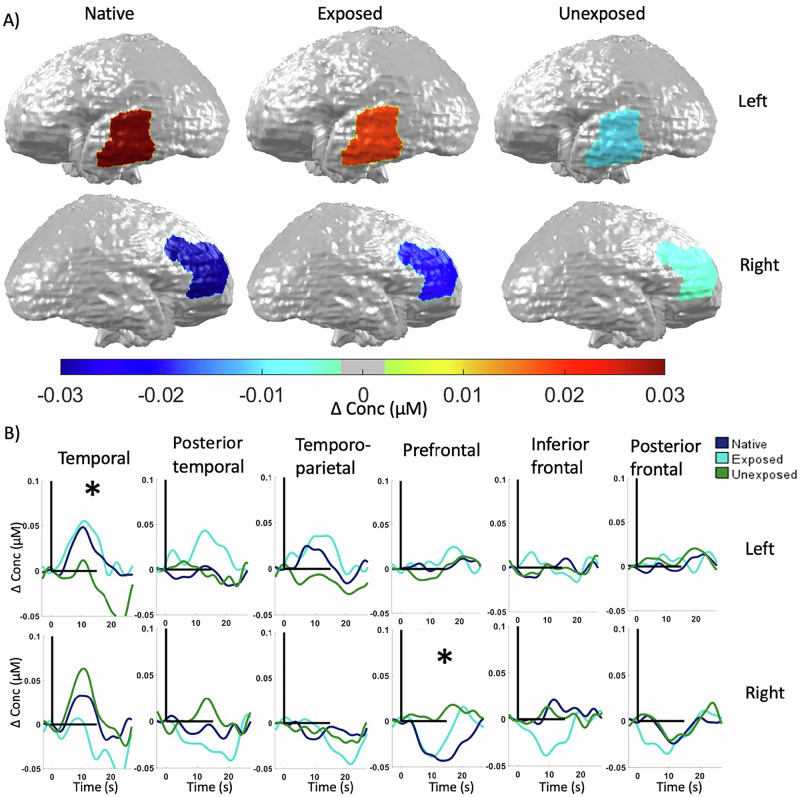
- Among 60 newborns, native versus unexposed foreign language differed in the left temporal region (native 0.034 ± 0.011 vs unexposed −0.010 ± 0.011; P = 0.018) and right prefrontal region (native −0.038 ± 0.010 vs unexposed −0.004 ± 0.011; P = 0.045).
- No significant difference was found between the native and prenatally exposed foreign language conditions, nor between the exposed and unexposed conditions.
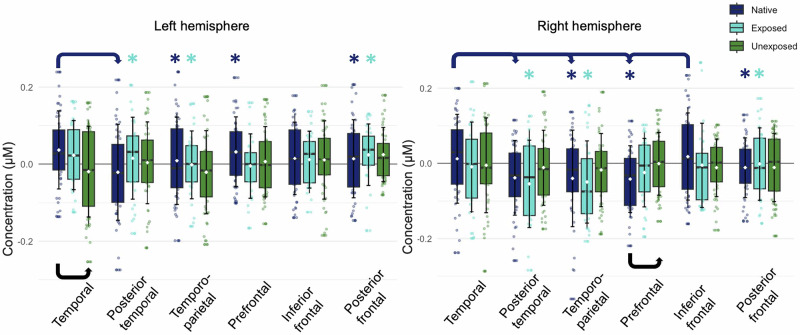
- Native and exposed conditions showed left-greater-than-right responses in several regions; the unexposed condition showed no significant hemispheric difference. Native: temporo-parietal P = 0.004, prefrontal P < 0.001, posterior frontal P = 0.032. Exposed: posterior temporal P < 0.001, temporo-parietal P = 0.013, posterior frontal P = 0.042.
- Correlational analyses found no significant correlation between the amount of prenatal exposure and HbO concentration amplitude in any ROI, hemisphere, or language familiarity condition.
Methods
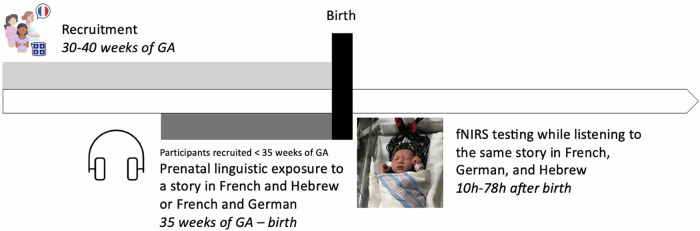
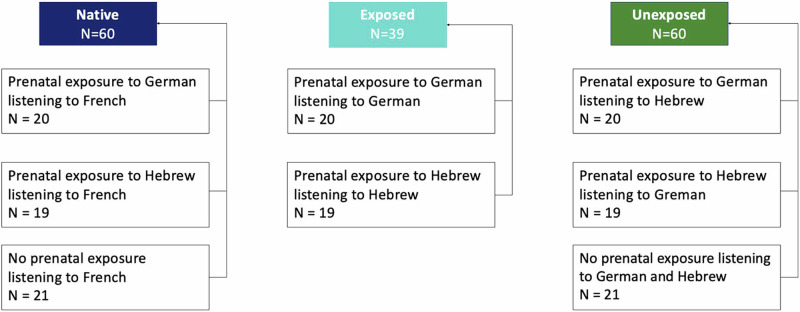
- Seventy-seven pregnant people were recruited; 60 newborns were analyzed. Thirty-nine were prenatally exposed from ≤35 weeks gestational age to French plus German (N = 20) or Hebrew (N = 19), and 21 recruited after 35 weeks received no experimental foreign-language exposure.
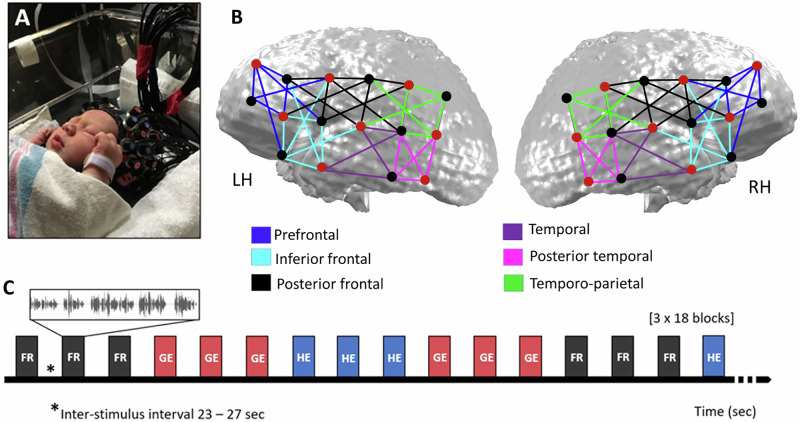
- Prenatal exposure consisted of daily 20-min sessions from 35 weeks GA (mean 25.3 ± 8.8 sessions), using the same multilingual female speaker. Within 3 days after birth, newborns passively listened to the same story in French, German, and Hebrew during fNIRS recording.
- Main analysis was a repeated-measures ANOVA on HbO concentration changes with between-subjects factor Condition (Native, Exposed, Unexposed) and within-subjects factors ROI and Hemisphere, followed by Bonferroni-corrected post hoc tests; Pearson correlations tested exposure amount against HbO.
Limitations
- Stated: the relatively small sample size limits detection to medium-sized effects, and the exposed condition was smaller than the native and unexposed conditions; sample size also precluded comparing brain responses to each foreign language separately in exposed and unexposed conditions.
- Stated: the native condition included participants with different levels of French exposure (natural environment only vs experimental plus natural), though no significant differences were found between French subgroups; correlational analyses also found no significant relationship between amount of prenatal exposure and HbO amplitude.
- Evident from the text: the control group had no experimental prenatal exposure to German or Hebrew and heard only French naturally, and all families were monolingual French-speaking, so generalization beyond this population and these specific languages, story, and speaker is uncertain.
Model-written summary. Check it against the paper before relying on it.
Integrity signals
Registry
Cites
Statistics
Figures
Verification
Claims the paper makes
1 Valid · 1 Not valid · 42 Not checked · 59 Own results and interpretations
The cited sources support only part of this claim — read each source’s verdict below.
In the paper
“Newborns have an immature brain network responsible for speech processing that resembles the adult language network.”
- Also stated in: § Introduction · plain
“The newborn brain has a functional network dedicated to speech and language processing that recruits very similar brain regions to those that are associated with adults’ language brain network.”
§ Prenatal linguistic exposure shapes language brain responses at birth > Abstract
What the sources say
- Not checked yetcites [1] Byers-Heinlein, K. & Fennell, C. T. Perceptual narrowing in the context of increased variation: insights from bilingual infants. Dev. Psychobiol. 56, 274–291 (2014). 24114364 source
A check is scheduled.
- Not checked yetcites [2] Hervé, P.-Y., Zago, L., Petit, L., Mazoyer, B. & Tzourio-Mazoyer, N. Revisiting human hemispheric specialization with neuroimaging. Trends Cogn. Sci. 17, 69–80 (2013). 23317751 source
A check is scheduled.
- Partly supportedcites [3] Kuhl, P. K. Brain mechanisms in early language acquisition. Neuron 67, 713–727 (2010). 20826304 PMC2947444 sourceExperimental — accuracy not yet measured
The review supports adult-like language networks only for infants beyond the newborn period: 'Windows to the Young Brain' states that pioneering fMRI studies 'show remarkable similarity in the structures responsive to language in infants and adults (Dehaene-Lambertz et al., 2002, 2006)', and 'Neural Signatures of Early Learning' says infant brain systems 'appear to reflect adult language processing, even early in infancy'. For newborns specifically, however, 'The "Social Brain" and Language Learning Mechanisms' reports that Imada et al. (2006) newborns 'showed no activation in motor speech areas for any signals, whereas auditory areas responded robustly to all signals', with synchronized auditory–motor activation appearing only at 6 and 12 months. So the newborn-specific extension of the claim (a speech-processing network already resembling the adult language network at birth) is not what this paper says; only the auditory component and the general infant-level resemblance are supported. (LLM, conf=0.72)
- Not checked yetcites [4] Wang, D., Buckner, R. L. & Liu, H. Functional specialization in the human brain estimated by intrinsic hemispheric interaction. J. Neurosci. 34, 12341–12352 (2014). 25209275 PMC4160771 source
A check is scheduled.
plainstates an association- Asserted: passes — The authors put it forward as true.
- Checkable: passes — It can be checked against evidence.
- Load-bearing: passes — The paper’s conclusions depend on it.
- Based: passes — The paper gives a reason why it holds.
- Also stated in: § Introduction · plain
A result the paper reports from its own data — it cites no other source for it, so there is none to check. The quote shows it is in the paper.
In the paper
“None of the post hoc analyses on ROI was significant for the exposed and unexposed conditions.”
§ Prenatal linguistic exposure shapes language brain responses at birth > Results > The influence of prenatal experience on hemodynamic responses
plain- Asserted: passes — The authors put it forward as true.
- Checkable: passes — It can be checked against evidence.
- Load-bearing: unclear — It is unclear whether the paper’s conclusions depend on it.
- Based: passes — The paper gives a reason why it holds.
A result the paper reports from its own data — it cites no other source for it, so there is none to check. The quote shows it is in the paper.
In the paper
“An increase in HbO concentration was seen for channels located in the left temporal regions in response to the native and exposed conditions (see Fig. 2B for channels and ROI distribution).”
§ Prenatal linguistic exposure shapes language brain responses at birth > Results > Concentration changes according to language familiarity at birth
plainstates an association- Asserted: passes — The authors put it forward as true.
- Checkable: passes — It can be checked against evidence.
- Load-bearing: passes — The paper’s conclusions depend on it.
- Based: passes — The paper gives a reason why it holds.
A result the paper reports from its own data — it cites no other source for it, so there is none to check. The quote shows it is in the paper.
In the paper
“a significant triple interaction (F8.53, 153 = 2.617, P = 0.007, effect size = 0.032)”
§ Prenatal linguistic exposure shapes language brain responses at birth > Results > The influence of prenatal experience on hemodynamic responses
plainstates an association- Asserted: passes — The authors put it forward as true.
- Checkable: passes — It can be checked against evidence.
- Load-bearing: passes — The paper’s conclusions depend on it.
- Based: passes — The paper gives a reason why it holds.
A result the paper reports from its own data — it cites no other source for it, so there is none to check. The quote shows it is in the paper.
In the paper
“Post hoc analysis on ROI showed that, in the native condition, the hemodynamic concentration change in the left temporal region (0.034 ± 0.011, P = 0.002) was higher than in the left posterior temporal region (−0.017 ± 0.012).”
§ Prenatal linguistic exposure shapes language brain responses at birth > Results > The influence of prenatal experience on hemodynamic responses
plain- Asserted: passes — The authors put it forward as true.
- Checkable: passes — It can be checked against evidence.
- Load-bearing: unclear — It is unclear whether the paper’s conclusions depend on it.
- Based: passes — The paper gives a reason why it holds.
36 more claims
Create a free account to see all 103 claims and to verify the 105 references still open.
- It may state two separate claims as one. 36
- Probably not a substantial claim. 38
- The quote only partly states this claim. 1
Self-check
Percentages, sums and reported differences re-computed from the paper’s own numbers.
Each contradiction between two passages listed here was confirmed by an independent check.
Rated minor: it would not touch a result — a value no result rests on, a p-value that stays on the same side of the significance level, or a conflict that is clerical, resolved elsewhere in the paper, or outside its own findings.
In the paper
§ Prenatal linguistic exposure shapes language brain responses at birth > Materials and methods > Procedure
“All newborns underwent an fNIRS recording within their first three days of life”
§ Prenatal linguistic exposure shapes language brain responses at birth > Materials and methods > Procedure
“Age at recording ranged between 10 and 78 h after birth”
Citations
Cites
Faul, F., Erdfelder, E., Lang, A.-G., & Buchner, A. (2007) · Behavior Research Methods · doi:10.3758/bf03193146 · Cited by 65,971
Functional connectivity in the motor cortex of resting human brain using echo‐planar mri
Biswal, B., Zerrin Yetkin, F., Haughton, V. M., & Hyde, J. S. (1995) · Magnetic Resonance in Medicine · doi:10.1002/mrm.1910340409 · Cited by 9,812 · cited 1×
“Variations in blood oxygenation re fl ect 34,36,37 .”
Descriptive statistics and normality tests for statistical data
Gupta, A., Mishra, P., Pandey, C., Singh, U., Sahu, C., & Keshri, A. (2019) · Annals of Cardiac Anaesthesia · doi:10.4103/aca.aca_157_18 · Cited by 2,628
Habituation: a model phenomenon for the study of neuronal substrates of behavior
Thompson, R. F., & Spencer, W. A. (1966) · Psychological Review · doi:10.1037/h0022681 · Cited by 2,608 · cited 1×
“Habituation is considered to be a basic form of memory and learning 50 .”
Deconvolution of Impulse Response in Event-Related BOLD fMRI1
Glover, G. H. (1999) · NeuroImage · doi:10.1006/nimg.1998.0419 · Cited by 1,386 · cited 3×
“The use of trial rejection exclusively to address motion artifacts has been discouraged in the fNIRS literature, includingstudiesinvolvinginfants,asitreducesthenumberofvalidtrials and impacts the accuracy of the hemodynamic response function (HRF) recovery 68,69 .”
A Handbook of Statistical Analyses Using SPSS
Landau, S., & Everitt, B. S. (2003) · Chapman & Hall/CRC eBooks · doi:10.1201/9780203009765 · Cited by 1,036 · cited 1×
“Mauchy ’ s spherical assumptions were not respected, therefore the Greenhouse-Geisser correction was applied 80 .”
Brain mechanisms in early language acquisition
Kuhl, P. K. (2010) · Neuron · doi:10.1016/j.neuron.2010.08.038 · Cited by 798
Two-day-olds prefer their native language
Moon, C., Cooper, R. P., & Fifer, W. P. (1993) · Infant Behavior and Development · doi:10.1016/0163-6383(93)80007-u · Cited by 773
Sounds and silence: An optical topography study of language recognition at birth
Peña, M., Maki, A., Kovac̆ić, D., Dehaene-Lambertz, G., Koizumi, H., Bouquet, F., & Mehler, J. (2003) · Proceedings of the National Academy of Sciences · doi:10.1073/pnas.1934290100 · Cited by 735 · cited 2×
“Thecurrenthemisphericasymmetryfoundinour studyconcurswith fi ndings from others highlighting a structural and functional left lateralization to native speech at birth and during early postnatal development 8,11,48,51,52 .”
IFCN standards for digital recording of clinical EEG
Nuwer, M. R., Comi, G., Emerson, R., Fuglsang-Frederiksen, A., Guérit, J.-M., Hinrichs, H., Ikeda, A., Jose C. Luccas, F., & Rappelsburger, P. (1998) · Electroencephalography and Clinical Neurophysiology · doi:10.1016/s0013-4694(97)00106-5 · Cited by 671
Research works printed but not linked: 1
- Penny, W. D., Friston, K. J., Ashburner, J. T., Kiebel, S. J. & Nichols, T. E. Statistical parametric mapping: the analysis of functional brain images (Elsevier, 2011).
Cited by
Paillereau, N., Mádrová, S., & Wüstenberg, T. (2026) · NeuroImage · doi:10.1016/j.neuroimage.2026.122006 · Cited by 1
Rossi, S., Thurner, I., Rackl, A., Tippmann, J., & Obrig, H. (2026) · Developmental Cognitive Neuroscience · doi:10.1016/j.dcn.2026.101758
“This pattern of results is in accord with previous fNIRS studies in newborns and 3-month-olds showing larger activations, primarily in prefrontal regions, for unfamiliar/new stimuli compared to familiar ones (Nakano et al., 2009; Ren ´ e et al., 2025).”
Mustieles, V., Rolland, M., Pérez-Cantero, A., Bayat, S., Valmary‐Degano, S., Thomsen, C., Sakhi, A. K., Slama, R., Guichardet, K., & Philippat, C. (2026) · Environmental Health Perspectives · doi:10.1021/ehp.6c00297
Nature Talks: Developing Language and Communication in the Outdoors
Jones, A., & Feast, J. (2026) · Routledge eBooks · doi:10.4324/9781003659099
Alit, I. N., Suryawan, I. A. J., & Gata, I. W. (2026) · Journal of English Language and Education · doi:10.31004/jele.v11i4.2616
“…(EEG) demonstrates that healthy fetuses can learn to recognize the sounds, rhythms, and prosodic patterns of their mother's language from 30 weeks of gestation, with newborns showing distinct neural responses to familiar prenatal speech stimuli compared to unfamiliar sounds (Rene et al., 2025).”
Prenatal and Neonatal Samskaras: An Ayurvedic Perspective with Scientific Insights
PrajnaRao, G., Seetharamu, M. S., Ashvini Kumar, M., & Meher, S. (2026) · Journal of Ayurveda and Integrated Medical Sciences · doi:10.21760/jaims.11.9.23
Metadata
- Authors
- René, A., Caron-Desrochers, L., Tremblay, J., Vannasing, P., Roger, K., Fourdain, S., Petitpas, L., Taillefer, C., Boucoiran, I., Gervain, J., Paquette, N., & Gallagher, A.
- Affiliations
- Centre Hospitalier Universitaire Sainte-Justine (CA)
- Centre National de la Recherche Scientifique (FR)
- Corresponding author
- Gallagher, Anne
- ORCID
- Venue
- Communications Biology
- Published
- 2025-08-05
- Volume
- 8
- Issue
- 1
- Pages
- 1155-1155
- ISSN
- 2399-3642 (ISSN-L)
- PMC
- PMC12325983
- OpenAlex
- W4412994708
- Cited by
- 6
- References
- 81
- Citations by year
- 2026: 6
- FWCI
- 3.49
- Type
- journal article
- Language
- en
- Open access
- gold
- doi.org
- Licence
- cc-by-nc-nd
- creativecommons.org/licenses/by-nc-nd/4.0 (tdm)
- creativecommons.org/licenses/by-nc-nd/4.0 (vor)
- Locations
- Communications Biology (publishedVersion, cc-by-nc-nd)
- PubMed Central (publishedVersion, cc-by-nc-nd)
- PubMed (publishedVersion)
- DOAJ (DOAJ: Directory of Open Access Journals) (submittedVersion)
- Padua Research Archive (University of Padova) (submittedVersion, cc-by-nc-nd)
- Funders
- Canadian Network for Research and Innovation in Machining Technology, Natural Sciences and Engineering Research Council of Canada (RGPIN-2020-05029)
- Canada Research Chairs (950-232661)
- Topics
- Social Sciences › Psychology › Developmental and Educational Psychology › Language Development and Disorders
- Life Sciences › Neuroscience › Cognitive Neuroscience › Neurobiology of Language and Bilingualism
- Life Sciences › Neuroscience › Cognitive Neuroscience › Neuroscience and Music Perception
- Keywords
- prenatal language exposure, native language advantage, foreign language listening, left temporal cortex, prefrontal cortex, speech perception development, functional near-infrared spectroscopy
- MeSH terms
- Brain, Female, Humans, Infant, Newborn, Language, Linguistics, Male, Pregnancy, Prenatal Exposure Delayed Effects, Speech Perception, Spectroscopy, Near-Infrared
About these checks
Registry, retraction, Cites and statistics results are computed, not judged, with one exception: a printed reference that no index lists is read once by a model before it counts as a citation error. Claims are extracted by a model and kept only when their quote appears verbatim in the text; each cited source is then checked, with a model’s help, for whether it says what the claim relies on. Those verdicts can be wrong — read the claim’s quote and the cited source before relying on one.
The claim verdicts this report counts are experimental: their accuracy is not yet measured.
A language model drew the claims from the paper on 2026-11-27, under version 3 of the claim definition (model deepseek-v4.1-flash, prompt extract-v3).
A second model labelled each claim on 2026-11-27 (model jev-1.13-20260917, definition revision gold-guideline-v0.2).
Cited sources are checked with a language model’s help (qwen3.8-omni-flash).
Statistics and arithmetic are recomputed, not judged.
Confidence bands are shown only for fields calibrated on our annotated test set. None is calibrated yet, so no band is shown.
What counts as a claim ›How we measure confidence ›How we check this ›
Are you an author, or do you see a problem with this page? Request a review
Data sources
Bibliographic data: Semantic Scholar, OpenAlex, Crossref.
Contains information from the Semantic Scholar Academic Graph Datasets, made available under the ODC Attribution License (ODC-BY 1.0).
Semantic Scholar’s data is described in: Kinney, R., et al. (2023). The Semantic Scholar Open Data Platform. arXiv:2301.10140.
