

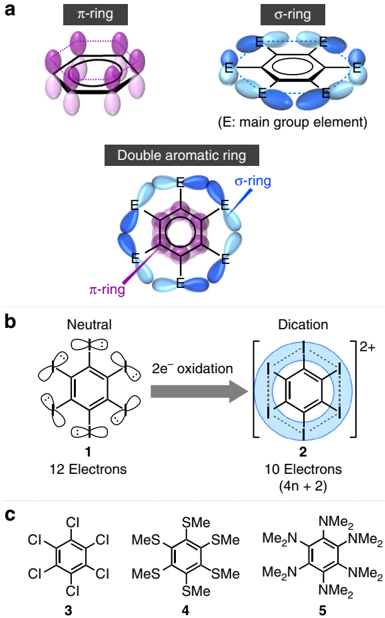
Double aromaticity arising from σ- and π-rings
Open accessThe DOI matches its Crossref record; 57 of the 57 references it cites were found in a registry or an index; 1 of the 10 sources its claims cite were checked for support.
Abstract
Reports synthesis and isolation of dication of hexakis(phenylselenyl)benzene with double aromaticity based on structural, energetic, and magnetic criteria. Cyclic sigma-symmetric and pi-symmetric delocalized orbitals occupied by 10 and 6 electrons respectively, both following 4n+2 Hückel rule.
Overview
CoChat Summary
## TL;DR
The paper reports the synthesis, isolation, and structural characterization of the dication of hexakis(phenylselenyl)benzene (7) as a bench-stable example of double aromaticity. Using X-ray, computational, magnetic, and solid-state NMR evidence, the authors argue that 7 exhibits both σ- and π-aromaticity.
## Key findings
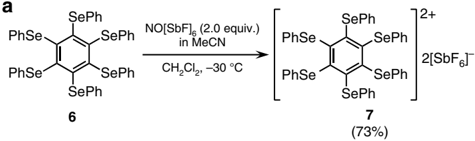
- Dication 7 was obtained by two-electron oxidation of precursor 6 with nitrosonium hexafluoroantimonate in 73% yield as a blue-green solid and was “sufficiently stable” to be stored under ambient conditions.
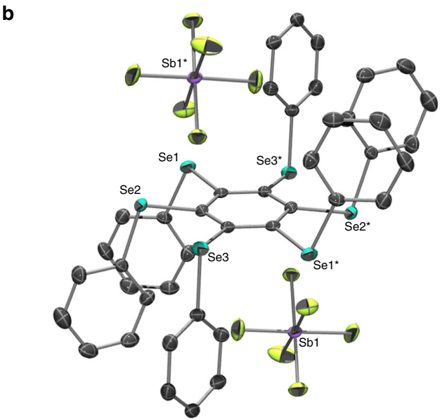
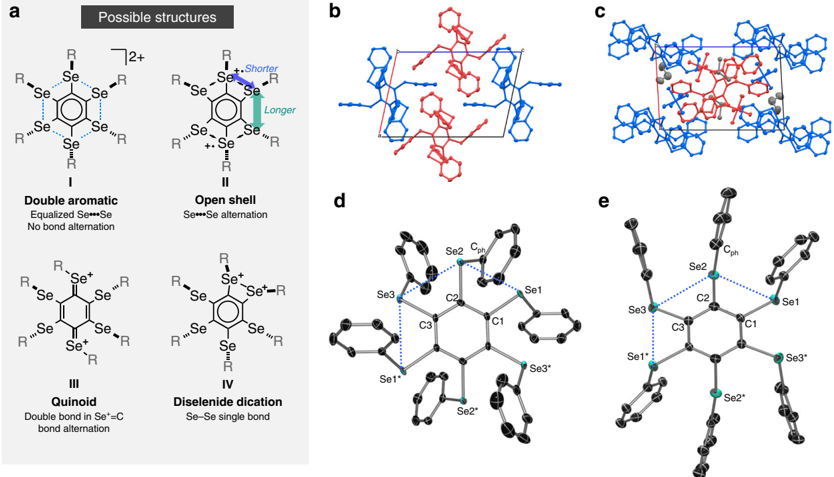
- Single-crystal X-ray diffraction showed averaged Se···Se distances of 3.240(1)–3.338(1) Å and nearly unchanged core C–C bonds of 1.382(7)–1.399(7) Å, supporting delocalization rather than bond alternation.
- EPR signals were not observed, consistent with a singlet ground state rather than a triplet state.
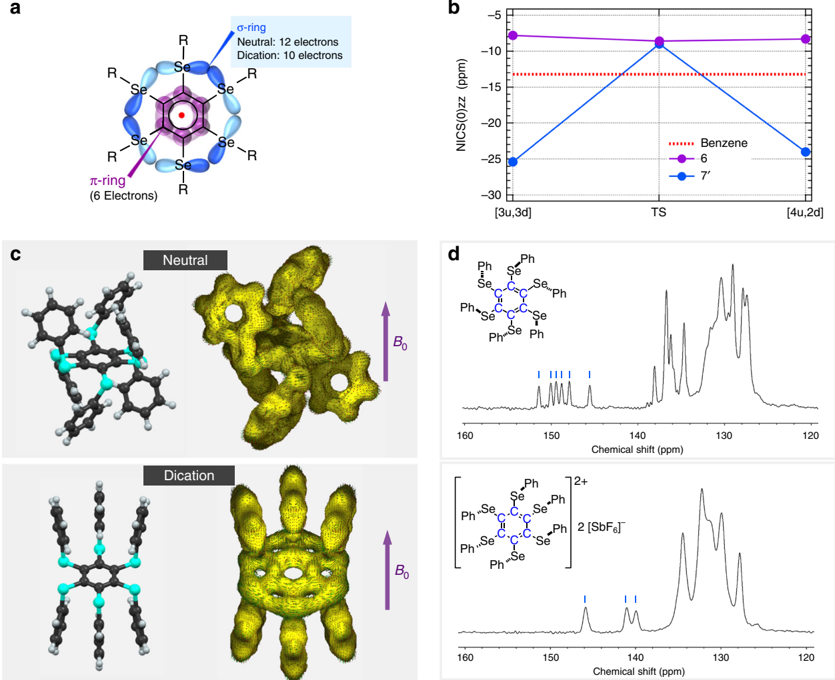
- Magnetic and NMR evidence supported double aromaticity: calculated NICS(0)zz for 7′-[3u,3d] was −25.4 ppm (vs −7.8 ppm for 6-[3u,3d] and −13.2 ppm for benzene), and 13C CP/MAS NMR of 7 showed three signals at 145.84, 141.02, and 139.93 ppm compared with six signals for 6.
## Methods
- The study combined synthesis and isolation of the dication 7 from precursor 6, followed by single-crystal X-ray diffraction, EPR, solid-state 13C CP/MAS NMR, and computational analysis.
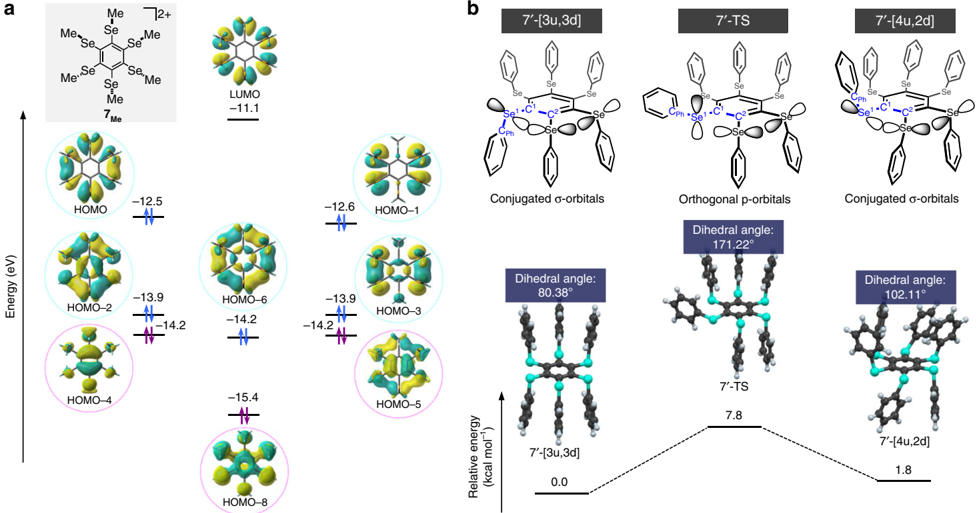
- DFT calculations were performed on the cationic part 7′ and on the model compound 7Me and its conformers, including geometric optimization, energetics with zero-point corrections, NICS(0)zz, CMO-NICS, AIM, and ACID analyses.
- Structural comparisons were made against neutral 6 and alternative resonance/conformational pictures to test σ- and π-delocalization.
## Limitations
- The paper itself notes that double aromaticity had been theoretically predicted for over 20 years but was “not well explored by experiment”; this frames the study as addressing an unmet experimental gap.
- The Methods section says several details are in Supplementary Methods/Figures/Tables, so the main text does not fully specify all experimental and computational procedures. (Evident from the text.)
- The article’s own comparison of resonance energies for σ-delocalization uses conformational isomers and model systems rather than a direct experimental measurement of an isolated σ-aromatic stabilization energy. (Evident from the text.)
Model-written summary. Check it against the paper before relying on it.
Integrity signals
Registry
Cites
Statistics
Figures
Verification
Claims the paper makes
1 Valid · 0 Not valid · 8 Not checked · 68 Own results and interpretations
Every source the paper cites for this claim was checked and supports it.
In the paper
“The decrease of the electron density on the C atoms should cause a down fi eld resonance of the C nuclei 30 .”
What the sources say
- Supportedcites [30] 30. Martin, J. C. & Schaad, L. J. Sigma-delocalized aromatic species formed from cyclic arrays of hypervalent main-group element species. Pure Appl. Chem. 62 , 547 -550 (2005). source
The opening discussion section of our copy states exactly this point: 'The decrease in electron density at the carbons would probably result in a downfield shift of the 13C NMR peak' (p. 1, unheaded discussion preceding the sigma-delocalization argument). The citing paraphrase preserves the same modal hedging ('should cause' for the source's 'would probably result in') and the same content — decreased carbon electron density implying a downfield 13C resonance — used in the source to argue that the observed 42.6 ppm upfield shift is inconsistent with simple two-electron removal from the pi system. (LLM, conf=0.90)
hedgedstates a cause- Asserted: passes — The authors put it forward as true.
- Checkable: passes — It can be checked against evidence.
- Load-bearing: passes — The paper’s conclusions depend on it.
- Based: passes — The paper gives a reason why it holds.
- Supported
A result the paper reports from its own data — it cites no other source for it, so there is none to check. The quote shows it is in the paper.
In the paper
“Theoretical calculations using a dispersion-corrected density functional theory (DFT) method on model dication 7Me , which contains six methyl instead of six phenyl groups, revealed that the double aromaticity in the dication is caused by fi ve pairs of circularly arranged σ -type orbitals in the periphery of the benzene core and three pairs of π -type orbitals on the benzene core.”
plainstates a cause- Asserted: passes — The authors put it forward as true.
- Checkable: passes — It can be checked against evidence.
- Load-bearing: passes — The paper’s conclusions depend on it.
- Based: passes — The paper gives a reason why it holds.
- Rests on an assumption not shown here.
A result the paper reports from its own data — it cites no other source for it, so there is none to check. The quote shows it is in the paper.
In the paper
“Treatment of 6 with two equivalents of nitrosonium hexafl uoroantimonate afforded the targeted dication 7 in 73% yield as a blue-green solid (Fig. 2a).”
plainstates a cause- Asserted: passes — The authors put it forward as true.
- Checkable: passes — It can be checked against evidence.
- Load-bearing: passes — The paper’s conclusions depend on it.
- Based: passes — The paper gives a reason why it holds.
A result the paper reports from its own data — it cites no other source for it, so there is none to check. The quote shows it is in the paper.
In the paper
“An X-ray diffraction analysis of these single crystals revealed that the molecular structure contains two hexa fl uoroantimonate counter anions, indicating a dicationic nature for the hexasubstituted benzene unit (Fig. 2b and Supplementary Data 1).”
hedgedstates an associationSingle case- Asserted: passes — The authors put it forward as true.
- Checkable: passes — It can be checked against evidence.
- Load-bearing: passes — The paper’s conclusions depend on it.
- Based: passes — The paper gives a reason why it holds.
A result the paper reports from its own data — it cites no other source for it, so there is none to check. The quote shows it is in the paper.
In the paper
“The most stable σ -type orbital, derived from the 4 p orbitals of the Se atoms (HOMO-6), corresponds to the π -orbital with no nodes in the π -aromatic compound.”
plainstates an association- Asserted: passes — The authors put it forward as true.
- Checkable: passes — It can be checked against evidence.
- Load-bearing: passes — The paper’s conclusions depend on it.
- Based: passes — The paper gives a reason why it holds.
49 more claims
Create a free account to see all 77 claims and to verify the 1 reference still open.
- It may state two separate claims as one. 19
- Probably not a substantial claim. 3
- The quote only partly states this claim. 2
Citations
Cites
Geuenich, D., Hess, K., Köhler, F., & Herges, R. (2005) · Chemical Reviews · doi:10.1021/cr0300901 · Cited by 1,675
Which NICS Aromaticity Index for Planar π Rings Is Best?
Fallah-Bagher-Shaidaei, H., Wannere, C. S., Corminboeuf, C., Puchta, R., & Schleyer, P. V. R. (2006) · Organic Letters · doi:10.1021/ol0529546 · Cited by 1,257
von Schleyer, P. R., & Jiao, H. (1996) · Pure and Applied Chemistry · doi:10.1351/pac199668020209 · Cited by 971
Hydrocarbon analogues of boron clusters — planarity, aromaticity and antiaromaticity
Zhai, H.-J., Kiran, B., Li, J., & Wang, L.-S. (2003) · Nature Materials · doi:10.1038/nmat1012 · Cited by 764
Baird, N. C. (1972) · Journal of the American Chemical Society · doi:10.1021/ja00769a025 · Cited by 680
Observation of All-Metal Aromatic Molecules
Li, X., Kuznetsov, A. E., Zhang, H.-F., Boldyrev, A. I., & Wang, L.-S. (2001) · Science · doi:10.1126/science.291.5505.859 · Cited by 653
Small Carbon Clusters: Spectroscopy, Structure, and Energetics
Van Orden, A., & Saykally, R. J. (1998) · Chemical Reviews · doi:10.1021/cr970086n · Cited by 611
All-Metal Aromaticity and Antiaromaticity
Boldyrev, A. I., & Wang, L.-S. (2005) · Chemical Reviews · doi:10.1021/cr030091t · Cited by 608
Zhai, H., Alexandrova, A. N., Birch, K. A., Boldyrev, A. I., & Wang, L. (2003) · Angewandte Chemie International Edition · doi:10.1002/anie.200351874 · Cited by 561
Rosenberg, M., Dahlstrand, C., Kilså, K., & Ottosson, H. (2014) · Chemical Reviews · doi:10.1021/cr300471v · Cited by 505
Romanescu, C., Galeev, T. R., Li, W.-L., Boldyrev, A. I., & Wang, L.-S. (2013) · Accounts of Chemical Research · doi:10.1021/ar300149a · Cited by 306
What is… aromaticity: a critique of the concept of aromaticity—can it really be defined?
Stanger, A. (2009) · Chemical Communications · doi:10.1039/b816811c · Cited by 228
Aromaticity and antiaromaticity in transition-metal systems
Zubarev, D. Y., Averkiev, B. B., Zhai, H.-J., Wang, L.-S., & Boldyrev, A. I. (2008) · Phys. Chem. Chem. Phys. · doi:10.1039/b713646c · Cited by 217
Exciting excited-state aromaticity
Ottosson, H. (2012) · Nature Chemistry · doi:10.1038/nchem.1518 · Cited by 214
Alexandrova, A. N., Zhai, H.-J., Wang, L.-S., & Boldyrev, A. I. (2004) · Inorganic Chemistry · doi:10.1021/ic049706a · Cited by 177
Heine, T., Schleyer, P. V. R., Corminboeuf, C., Seifert, G., Reviakine, R., & Weber, J. (2003) · The Journal of Physical Chemistry A · doi:10.1021/jp035163z · Cited by 160
Double aromaticity: aromaticity in orthogonal planes. The 3,5-dehydrophenyl cation.
Chandrasekhar, J., Jemmis, E. D., & von Ragué Schleyer, P. (1979) · Tetrahedron Letters · doi:10.1016/s0040-4039(01)95503-0 · Cited by 154
Evidence for d Orbital Aromaticity in Square Planar Coinage Metal Clusters
Wannere, C. S., Corminboeuf, C., Wang, Z.-X., Wodrich, M. D., King, R. B., & Schleyer, P. V. R. (2005) · Journal of the American Chemical Society · doi:10.1021/ja042716q · Cited by 150
Zhai, H., Аверкиев, Б. Б., Zubarev, D. Y., Wang, L., & Boldyrev, A. I. (2007) · Angewandte Chemie International Edition · doi:10.1002/anie.200700442 · Cited by 149
Zhu, C., Zhou, X., Xing, H., An, K., Zhu, J., & Xia, H. (2015) · Angewandte Chemie International Edition · doi:10.1002/anie.201411220 · Cited by 145
Double Aromaticity in the 3,5-Dehydrophenyl Cation and in Cyclo[6]carbon
Schleyer, P. V. R., Jiao, H., Glukhovtsev, M. N., Chandrasekhar, J., & Kraka, E. (1994) · Journal of the American Chemical Society · doi:10.1021/ja00101a035 · Cited by 130
The Many Guises of Aromaticity
Hoffmann, R. (2014) · American Scientist · doi:10.1511/2015.112.18 · Cited by 120
Feixas, F., Matito, E., Poater, J., & Solà, M. (2013) · WIREs Computational Molecular Science · doi:10.1002/wcms.1115 · Cited by 108
Zhai, H., Аверкиев, Б. Б., Zubarev, D. Y., Wang, L., & Boldyrev, A. I. (2007) · Angewandte Chemie · doi:10.1002/ange.200700442 · Cited by 108
Double Aromaticity and Ring Currents in All‐Carbon Rings
Fowler, P. W., Mizoguchi, N., Bean, D. E., & Havenith, R. W. A. (2009) · Chemistry – A European Journal · doi:10.1002/chem.200900322 · Cited by 99
Tsipis, A. C., Kefalidis, C. E., & Tsipis, C. A. (2008) · Journal of the American Chemical Society · doi:10.1021/ja802344z · Cited by 87
The crystal structure of diphenyl diselenide
Marsh, R. E. (1952) · Acta Crystallographica · doi:10.1107/s0365110x52001349 · Cited by 82
Double Aromaticity in Monocyclic Carbon, Boron, and Borocarbon Rings Based on Magnetic Criteria
Wodrich, M. D., Corminboeuf, C., Park, S. S., & Schleyer, P. V. R. (2007) · Chemistry - A European Journal · doi:10.1002/chem.200700154 · Cited by 71
Rauhalahti, M., Taubert, S., Sundholm, D., & Liégeois, V. (2017) · Physical Chemistry Chemical Physics · doi:10.1039/c7cp00194k · Cited by 61
Unverzagt, M., Subramanian, G., Hofmann, M., Schleyer, P. V. R., Berger, S. T. A., Harms, K., Massa, W., & Berndt, A. (1997) · Angewandte Chemie International Edition in English · doi:10.1002/anie.199714691 · Cited by 60
Dipositive ion of hexachlorobenzene. Ground-state triplet
Wasserman, E., Hutton, R. S., Kuck, V. J., & Chandross, E. A. (1974) · Journal of the American Chemical Society · doi:10.1021/ja00813a068 · Cited by 58
The stable singlet ground state dication of hexaiodobenzene: possibly a .sigma.-delocalized dication
Sagl, D. J., & Martin, J. C. (1988) · Journal of the American Chemical Society · doi:10.1021/ja00225a038 · Cited by 56
Zhang, X., Liu, G., Ganteför, G. F., Bowen, K. H., & Alexandrova, A. N. (2014) · The Journal of Physical Chemistry Letters · doi:10.1021/jz500322n · Cited by 55
Hofmann, M., & Berndt, A. (2006) · Heteroatom Chemistry · doi:10.1002/hc.20225 · Cited by 53
Stereochemistry of hexakis(dimethylamino)benzene and its dication
Chance, J. M., Kahr, B., Buda, A. B., Toscano, J. P., & Mislow, K. (1988) · The Journal of Organic Chemistry · doi:10.1021/jo00249a016 · Cited by 47
Zhu, C., Zhou, X., Xing, H., An, K., Zhu, J., & Xia, H. (2015) · Angewandte Chemie · doi:10.1002/ange.201411220 · Cited by 44
Double aromaticity and anti-aromaticity in small carbon rings
Martín-Santamaría, S., & Rzepa, H. S. (2000) · Chemical Communications · doi:10.1039/b002922j · Cited by 40
Are the DmhSymmetric HxqRings with 4 n+ 2 σ-Electrons and Hydrogen Clusters Aromatic?
Jiao, H., Schleyer, P. V. R., & Glukhovtsev, M. N. (1996) · The Journal of Physical Chemistry · doi:10.1021/jp961031c · Cited by 37
Wang, Y., Deyris, P., Cañeque, T., et al. (2015) · Chemistry - A European Journal · doi:10.1002/chem.201501239 · Cited by 29
RITTER, S. K. (2015) · Chemical & Engineering News · doi:10.1021/cen-09308-scitech1 · Cited by 17
Ou, T., Tian, W., You, X., Wang, Y., Wang, K., & Zhai, H. (2015) · Physical Chemistry Chemical Physics · doi:10.1039/c5cp04519c · Cited by 16
Martin, J. C., & Schaad, L. J. (1990) · Pure and Applied Chemistry · doi:10.1351/pac199062030547 · Cited by 16
Reinvestigation on the synthesis of hexakis(phenylseleno)benzene
Saito, M., & Kanatomi, Y. (2009) · Journal of Sulfur Chemistry · doi:10.1080/17415990903148083 · Cited by 14
Self-citationσ-Aromaticity in Hexa-Group 16 Atom-Substituted Benzene Dications: A Theoretical Study
Hatanaka, M., Saito, M., Fujita, M., & Morokuma, K. (2014) · The Journal of Organic Chemistry · doi:10.1021/jo500098h · Cited by 14
Self-citationKobayashi, K., Takahashi, O., Namatame, K., Kikuchi, O., & Furukawa, N. (1998) · Chemistry Letters · doi:10.1246/cl.1998.515 · Cited by 13
A Structural Study of Selenobenzamides: Crystal Structures and Dynamic 13C NMR
Otten, P. A., Gorter, S., & Gen, A. V. D. (1997) · Chemische Berichte · doi:10.1002/cber.19971300108 · Cited by 11
Geuenich, D., Heß, K., Koehler, F., & Herges, R. (2006) · ChemInform · doi:10.1002/chin.200604280 · Cited by 8
Small Carbon Clusters: Spectroscopy, Structure, and Energetics
Orden, A. V., & Saykally, R. (1998) · doi:10.1002/chin.199849310 · Cited by 7
Gribanova, T. N., Minyaev, R. M., & Minkin, V. I. (2016) · Structural Chemistry · doi:10.1007/s11224-016-0748-3 · Cited by 5
All‐Metal Aromaticity and Antiaromaticity
Boldyrev, A. I., & Wang, L. (2006) · ChemInform · doi:10.1002/chin.200604274 · Cited by 4
(1990) · Illinois Digital Environment for Access to Learning and Scholarship (University of Illinois at Urbana-Champaign) · Cited by 1
Lim, X. (2015) · Chemical & Engineering News · doi:10.1021/cen-09337-scitech1 · Cited by 1
Evidence for d Orbital Aromaticity in Square Planar Coinage Metal Clusters.
Wannere, C. S., Corminbœuf, C., Wang, Z., et al. (2005) · ChemInform · doi:10.1002/chin.200525001
Sagl, D. J., & Martin, J. C. (1988) · ChemInform · doi:10.1002/chin.198849120
DIPOSITIVE ION OF HEXACHLOROBENZENE, A GROUND-STATE TRIPLET
Wasserman, E., Hutton, R., Kuck, V., & Chandross, E. (1974) · doi:10.1002/chin.197422071
ChemInform Abstract: Stereochemistry of Hexakis(dimethylamino)benzene and Its Dication.
Chance, J. M., Kahr, B. E., Buda, A. B., Toscano, J. P., & Mislow, K. (1988) · ChemInform · doi:10.1002/chin.198851067
Zhai, H., Alexandrova, A. N., Birch, K. A., et al. (2004) · ChemInform · doi:10.1002/chin.200410002
Cited by
Towards understanding π-stacking interactions between non-aromatic rings
Molčanov, K., & Kojić‐Prodić, B. (2019) · IUCrJ · doi:10.1107/s2052252519000186 · Cited by 95
Fedik, N., Kulichenko, M., Steglenko, D., & Boldyrev, A. I. (2020) · Chemical Communications · doi:10.1039/c9cc09483k · Cited by 70
Weng, T., Baryshnikov, G., Deng, C., Li, X., Wu, B., Wu, H., Ågren, H., Zou, Q., Zeng, T., & Zhu, L. (2020) · Small · doi:10.1002/smll.201906475 · Cited by 70
Comprehensive insight into surfactant modified-PBAT physico-chemical and biodegradability properties
Camani, P. H., Souza, A. G., Barbosa, R. F. S., Zanini, N. C., Mulinari, D. R., & Rosa, D. D. S. (2020) · Chemosphere · doi:10.1016/j.chemosphere.2020.128708 · Cited by 56
Single─Not Double─3D-Aromaticity in an Oxidized Closo Icosahedral Dodecaiodo-Dodecaborate Cluster
Poater, J., Escayola, S., Poater, A., Teixidor, F., Ottosson, H., Viñas, C., & Solà, M. (2023) · Journal of the American Chemical Society · doi:10.1021/jacs.3c07335 · Cited by 60
Metadata
- Authors
- Furukawa, S., Fujita, M., Kanatomi, Y., Minoura, M., Hatanaka, M., Morokuma, K., Ishimura, K., & Saito, M.
- Affiliations
- Saitama University (JP)
- Rikkyo University (JP)
- Japan Science and Technology Agency (JP)
- Kyoto University (JP)
- Institute for Molecular Science (JP)
- Corresponding author
- Saito, Masaichi
- Venue
- Communications Chemistry
- Published
- 2018-09-27
- Volume
- 1
- Issue
- 1
- ISSN
- 2399-3669 (ISSN-L)
- OpenAlex
- W2890807822
- Cited by
- 73
- References
- 48
- Citations by year
- 2026: 10 · 2025: 16 · 2024: 10 · 2023: 5 · 2022: 8 · 2021: 8 · 2020: 11 · 2019: 5
- FWCI
- 2.46
- Type
- journal article
- Language
- en
- Open access
- gold
- doi.org
- Licence
- cc-by
- creativecommons.org/licenses/by/4.0 (tdm)
- creativecommons.org/licenses/by/4.0 (vor)
- Locations
- Communications Chemistry (publishedVersion, cc-by)
- DOAJ (DOAJ: Directory of Open Access Journals) (submittedVersion)
- Funders
- Ministry of Education, Culture, Sports, Science, and Technology (15H00918, 16K13945, 15H009382, 16K00175, JP26102006, 18H03908)
- Topics
- Physical Sciences › Chemistry › Organic Chemistry › Synthesis and Properties of Aromatic Compounds
- Physical Sciences › Chemistry › Inorganic Chemistry › Synthesis and characterization of novel inorganic/organometallic compounds
- Physical Sciences › Chemistry › Organic Chemistry › Organoselenium and organotellurium chemistry
- Keywords
- double aromaticity, Hückel rule, dication, electron delocalization, aromaticity, organoselenium compounds
About these checks
Registry, retraction, Cites and statistics results are computed, not judged, with one exception: a printed reference that no index lists is read once by a model before it counts as a citation error. Claims are extracted by a model and kept only when their quote appears verbatim in the text; each cited source is then checked, with a model’s help, for whether it says what the claim relies on. Those verdicts can be wrong — read the claim’s quote and the cited source before relying on one.
A language model drew the claims from the paper on 2026-10-10, under version 3 of the claim definition (model deepseek-v4.1-flash, prompt extract-v3).
A second model labelled each claim on 2026-10-10 (model jev-1.13-20260917, definition revision gold-guideline-v0.2).
Cited sources are checked with a language model’s help (qwen3.8-omni-flash).
Statistics and arithmetic are recomputed, not judged.
Confidence bands are shown only for fields calibrated on our annotated test set. None is calibrated yet, so no band is shown.
What counts as a claim ›How we measure confidence ›How we check this ›
Are you an author, or do you see a problem with this page? Request a review
Data sources
Bibliographic data: Semantic Scholar, OpenAlex, Crossref.
Contains information from the Semantic Scholar Academic Graph Datasets, made available under the ODC Attribution License (ODC-BY 1.0).
Semantic Scholar’s data is described in: Kinney, R., et al. (2023). The Semantic Scholar Open Data Platform. arXiv:2301.10140.
