

Variational quantum algorithms
Open accessThe DOI matches its Crossref record; 332 of the 333 references it cites were found in a registry or an index, and 1 are not checked yet; 179 of the 264 sources its claims cite were checked for support.
Abstract
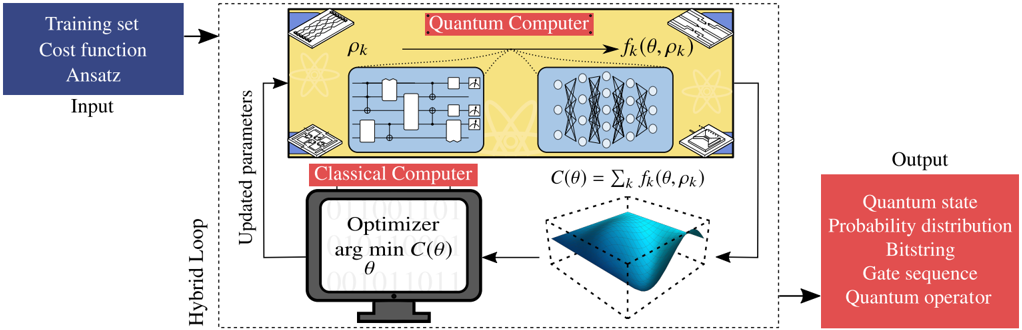
Applications such as simulating complicated quantum systems or solving large-scale linear algebra problems are very challenging for classical computers, owing to the extremely high computational cost. Quantum computers promise a solution, although fault-tolerant quantum computers will probably not be available in the near future. Current quantum devices have serious constraints, including limited numbers of qubits and noise processes that limit circuit depth. Variational quantum algorithms (VQAs), which use a classical optimizer to train a parameterized quantum circuit, have emerged as a leading strategy to address these constraints. VQAs have now been proposed for essentially all applications that researchers have envisaged for quantum computers, and they appear to be the best hope for obtaining quantum advantage. Nevertheless, challenges remain, including the trainability, accuracy and efficiency of VQAs. Here we overview the field of VQAs, discuss strategies to overcome their challenges and highlight the exciting prospects for using them to obtain quantum advantage. The advent of commercial quantum devices has ushered in the era of near-term quantum computing. Variational quantum algorithms are promising candidates to make use of these devices for achieving a practical quantum advantage over classical computers. Variational quantum algorithms (VQAs) are the leading proposal for achieving quantum advantage using near-term quantum computers. VQAs have been developed for a wide range of applications, including finding ground states of molecules, simulating dynamics of quantum systems and solving linear systems of equations. VQAs share a common structure, where a task is encoded into a parameterized cost function that is evaluated using a quantum computer, and a classical optimizer trains the parameters in the VQA. The adaptive nature of VQAs is well suited to handle the constraints of near-term quantum computers. Trainability, accuracy and efficiency are three challenges that arise when applying VQAs to large-scale applications, and strategies are currently being developed to address these challenges. Variational quantum algorithms (VQAs) are the leading proposal for achieving quantum advantage using near-term quantum computers. VQAs have been developed for a wide range of applications, including finding ground states of molecules, simulating dynamics of quantum systems and solving linear systems of equations. VQAs share a common structure, where a task is encoded into a parameterized cost function that is evaluated using a quantum computer, and a classical optimizer trains the parameters in the VQA. The adaptive nature of VQAs is well suited to handle the constraints of near-term quantum computers. Trainability, accuracy and efficiency are three challenges that arise when applying VQAs to large-scale applications, and strategies are currently being developed to address these challenges.
Verified 2026-11-22 · 1 reference not checked yet
Overview
CoChat Summary
TL;DR
Variational quantum algorithms (VQAs) train parametrized quantum circuits with a classical optimizer and are presented as the leading strategy for obtaining quantum advantage on noisy intermediate-scale quantum (NISQ) devices. The review surveys VQA components, applications, challenges, and prospects, emphasizing that trainability, accuracy, and efficiency remain central obstacles.
Key findings
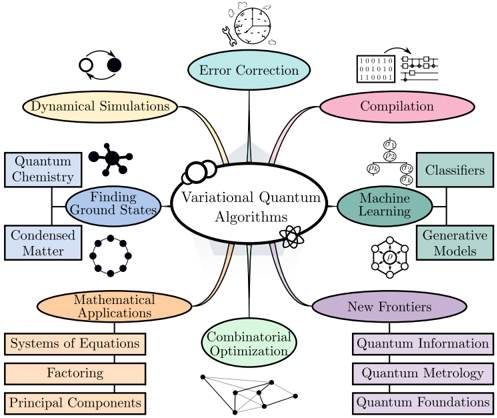
- VQAs have been proposed for essentially all applications envisioned for quantum computers, including finding ground and excited states, dynamical quantum simulation, combinatorial optimization, linear systems, compiling, error correction, machine learning, and metrology.
- Current state-of-the-art device size ranges from 50 to 100 qubits, and VQAs are argued to be the best hope for near-term quantum advantage because they keep circuit depth shallow and outsource parameter optimization to classical optimizers.
- Trainability is threatened by barren plateaus, where cost-function partial derivatives vanish exponentially with system size on average; noise can also induce barren plateaus regardless of the ansatz.
- Resource and scaling examples reported include: VQE requires \(O(1/\epsilon^2)\) measurements for precision \(\epsilon\), whereas quantum phase estimation requires \(O(\log(1/\epsilon))\); chemical Hamiltonians have Pauli-string counts scaling as \(n^4\), with commuting groupings reducing measurement scaling to \(n^3\); classical shadows scale logarithmically with \(n\); and a variational quantum linear solver study used \(n=10,\ldots,30\) qubits for Ising-inspired systems and \(n=2,\ldots,7\) qubits for random sparse linear systems.
Methods
- Design: narrative review/overview of the VQA field, not a primary experimental or theoretical study.
- Data or sample: no primary data or sample; the paper synthesizes prior literature and cites numerical and experimental results from other works.
- Main analysis: conceptual description of VQA architecture (cost function, ansatz, gradients, optimizers), applications, challenges, and opportunities for near-term quantum advantage.
Limitations
- The paper states that challenges remain including the trainability, accuracy, and efficiency of VQAs, and that barren plateaus could erase a potential quantum advantage.
- The paper states that the degree to which error mitigation can correct noise effects is still an open question, and that measurement efficiency is not guaranteed even without barren plateaus.
- Evident from the text: as a review, it presents no new experimental results, and many performance claims rely on cited heuristic or numerical studies rather than a systematic meta-analysis.
Model-written summary. Check it against the paper before relying on it.
Integrity signals
Registry
Cites
Statistics
Figures
Verification
Claims the paper makes
53 Valid · 74 Not valid · 51 Not checked · 84 Own results and interpretations
At least one cited source doesn’t support this claim or points to a different paper, and none confirmed it — see the verdicts below.
In the paper
“Hence, a VQA for factoring as a potential near-term alternative was introduced in Ref. [145].”
What the sources say
- Disputedcites [145] [147] Ryan LaRose, Arkin Tikku, Étude O'Neel-Judy, Lukasz Cincio, and Patrick J Coles, 'Variational quantum state diagonalization,' npj Quantum Information 5 , 110 (2019). - sourceExperimental — accuracy not yet measured
The Introduction says factoring is typically a longer-term application because of its high resource requirements, while identifying other applications as nearer term. The paper introduces variational quantum state diagonalization, not a variational algorithm for factoring. (LLM, conf=0.88)
Checked by a reasoning model — may be wrong.
plain- Asserted: passes — The authors put it forward as true.
- Checkable: passes — It can be checked against evidence.
- Load-bearing: unclear — It is unclear whether the paper’s conclusions depend on it.
- Based: passes — The paper gives a reason why it holds.
- Disputed
At least one cited source doesn’t support this claim or points to a different paper, and none confirmed it — see the verdicts below.
In the paper
“This qubit requirement can be reduced with the VQA of Ref. [113], which requires only n qubits.”
What the sources say
- Disputedcites [113] [114] Daochen Wang, Oscar Higgott, and Stephen Brierley, 'Accelerated variational quantum eigensolver,' Physical Review Letters 122 , 140504 (2019). - sourceExperimental — accuracy not yet measured
Section II B (p. 3) describes an (n+1)-qubit controlled sign flip in the proposed algorithm and says its cited implementation requires additional ancillas. That contradicts the claim that this VQA requires only n qubits; the paper discusses reductions in measurements and circuit depth, not a reduction to n qubits. (LLM, conf=0.84)
Checked by a reasoning model — may be wrong.
plainstates a cause- Asserted: passes — The authors put it forward as true.
- Checkable: passes — It can be checked against evidence.
- Load-bearing: unclear — It is unclear whether the paper’s conclusions depend on it.
- Based: passes — The paper gives a reason why it holds.
- Disputed
The cited sources that could be checked couldn’t confirm or dispute this claim.
In the paper
“The classical optimization problems associated with VQAs are expected to be NP-hard in general as they involve cost functions that can have many local minima [94].”
What the sources say
- Could not verifycites [94] [81] Maria Schuld, Ville Bergholm, Christian Gogolin, Josh Izaac, and Nathan Killoran, 'Evaluating analytic gradients on quantum hardware,' Phys. Rev. A 99 , 032331 (2019). - sourceExperimental — accuracy not yet measured
The Introduction (p. 1) describes hybrid quantum-classical cost functions and the need for gradients, but does not address the complexity of optimizing them. Searches for “NP-hard,” “local minima,” and related terms found no passage saying that VQA optimization is generally NP-hard or attributing that difficulty to many local minima. (LLM, conf=0.74)
hedgedstates a cause- Asserted: passes — The authors put it forward as true.
- Checkable: passes — It can be checked against evidence.
- Load-bearing: unclear — It is unclear whether the paper’s conclusions depend on it.
- Based: passes — The paper gives a reason why it holds.
- Could not verify
The cited sources that could be checked couldn’t confirm or dispute this claim.
In the paper
“Numerical simulations showed that QVECTOR can find quantum codes that outperform existing ones [152].”
What the sources say
- Could not verifycites [152] [154] Jacob Biamonte, Peter Wittek, Nicola Pancotti, Patrick Rebentrost, Nathan Wiebe, and Seth Lloyd, 'Quantum machine learning,' Nature 549 , 195-202 (2017). - sourceExperimental — accuracy not yet measured
The closest discussion in our copy, “Designing and controlling quantum systems” (p. 12), concerns machine-learning methods for improving quantum gates, not finding quantum codes. Searches for QVECTOR and for simulations of codes outperforming existing ones found no passage addressing the claim. (LLM, conf=0.76)
plainstates a cause- Asserted: passes — The authors put it forward as true.
- Checkable: passes — It can be checked against evidence.
- Load-bearing: passes — The paper’s conclusions depend on it.
- Based: passes — The paper gives a reason why it holds.
- Could not verify
The cited sources that could be checked couldn’t confirm or dispute this claim.
In the paper
“The importance of parameter initialization was made clear in Ref. [204] where it was noted that the optimal parameters in QAOA exhibit persistent patterns.”
What the sources say
- Could not verifycites [204] [206] Tyler Volkoff and Patrick J Coles, 'Large gradients via correlation in random parameterized quantum circuits,' Quantum Science and Technology 6 , 025008 (2021). - sourceExperimental — accuracy not yet measured
Appendix C (page unavailable) studies QAOA with parameters constrained to be equal across layers and describes that approach as suboptimal for the ring-of-disagrees problem. The Introduction and Conclusions discuss parameter correlation and trainability, but the passages found do not say that optimal QAOA parameters exhibit persistent patterns (searched: optimal parameters, QAOA patterns, initialization). (LLM, conf=0.76)
boosted- Asserted: passes — The authors put it forward as true.
- Checkable: passes — It can be checked against evidence.
- Load-bearing: passes — The paper’s conclusions depend on it.
- Based: passes — The paper gives a reason why it holds.
- Could not verify
125 more claims · 57 with their cited sources checked
Create a free account to see all 262 claims and to verify the 24 references still open.
- Probably not a substantial claim. 94
- It may state two separate claims as one. 57
Claims other papers make about this one
Each is checked against this paper’s own text: does it say what the citing paper says it does?
The source backs part of the claim, not all of it — or backs it for a different population, condition or comparison.
In the citing paper
“Google's recent proof of quantum supremacy is a major step forward for quantum computing [15].”
From Quantum Computing: Vision and Challenges (2025) · cites this paper as [15]
Experimental — accuracy not yet measuredThe cited source says what the claim attributes to it.
In the citing paper
“An important class of algorithms for NISQ hardware are socalled hybrid quantum-classical algorithms that partition the computational workload between a classical and a quantum computer.[124,125]”
From Quantum Computing for Molecular Biology** (2023) · cites this paper as [125]
The cited source says what the claim attributes to it.
In the citing paper
“In this regard, References [164] and [171] focus on gate-based algorithms that can be implemented on NISQ devices and therefore may be applied to various application areas with CO just as one example of those.”
From Quantum Combinatorial Optimization in the NISQ Era: A Systematic Mapping Study (2024) · cites this paper as [171]
Self-check
Percentages, sums and reported differences re-computed from the paper’s own numbers.
Each contradiction between two passages listed here was confirmed by an independent check.
Rated minor: it would not touch a result — a value no result rests on, a p-value that stays on the same side of the significance level, or a conflict that is clerical, resolved elsewhere in the paper, or outside its own findings.
In the paper
§ E. Error correction · p. 12
“two parametrized circuits V ( θ 1 ) (on n ≥ k qubits) and W ( θ 2 ) (on n + r qubits)”
§ E. Error correction · p. 12
“ρ out = W ( θ 1 ) V ( θ 1 )( ψ ⊗ | 0 〉〈 0 | ⊗ n -k + r ) V ( θ 1 ) † W ( θ 1 ) †”
Rated minor: it would not touch a result — a value no result rests on, a p-value that stays on the same side of the significance level, or a conflict that is clerical, resolved elsewhere in the paper, or outside its own findings.
In the paper
§ 1. Linear systems · p. 11
“the task is to prepare a normalized state | x 〉 such that A | x 〉 ∝ | b 〉”
§ 1. Linear systems · p. 11
“one can then construct a Hamiltonian whose ground state is the solution to the QLSP and apply a variational approach to minimize the cost C ( θ ) = 〈 ψ ( θ ) | H G | ψ ( ψ ) 〉 . Refs. [139-141] considered the Hamiltonian H G = A ( ✶ -| b 〉 〈 b | ) A †”
Citations
Cites
Adam: A Method for Stochastic Optimization
Kingma, D. P., & Ba, J. (2014) · arXiv · doi:10.48550/arxiv.1412.6980 · Cited by 98,946
Self-Consistent Equations Including Exchange and Correlation Effects
Kohn, W., & Sham, L. J. (1965) · Physical Review · doi:10.1103/physrev.140.a1133 · Cited by 64,135 · cited 1×
“Classical methods for materials simulations usually employ density-functional theory coupled with approximation methods, such as the local density approximation [234] to tackle weakly correlated materials.”
MethodQuantum Computing in the NISQ era and beyond
Preskill, J. (2018) · Quantum · doi:10.22331/q-2018-08-06-79 · Cited by 8,830 · cited 1×
“But excitement grew as to what could be done with these new devices, which have been called Noisy Intermediate-Scale Quantum (NISQ) computers [7].”
BackgroundAlgorithms for quantum computation: discrete logarithms and factoring
Shor, P. W. (2002) · Proceedings 35th Annual Symposium on Foundations of Computer Science · doi:10.1109/sfcs.1994.365700 · Cited by 8,713 · cited 1×
“Shor’s quantum algorithm was proposed to factor numbers with exponential speedup over classical methods [2], dynamical quantum simulation algorithms were developed [3], and quantum algorithms for solving linear systems of equations were identified [4].”
MethodQuantum Computation and Quantum Information: 10th Anniversary Edition
Nielsen, M. A., & Chuang, I. L. (2012) · doi:10.1017/cbo9780511976667 · Cited by 8,436
Quantum supremacy using a programmable superconducting processor
Arute, F., Arya, K., Babbush, R., Bacon, D., Bardin, J. C., Barends, R., Biswas, R., Boixo, S., Brandao, F. G. S. L., Buell, D. A., et al. (2019) · Nature · doi:10.1038/s41586-019-1666-5 · Cited by 7,720 · cited 1×
“This size actually allows one to achieve quantum supremacy, outperforming the best classical supercomputer, for certain contrived mathematical tasks [8, 9].”
BackgroundSelf-citationDensity matrix formulation for quantum renormalization groups
White, S. R. (1992) · Physical Review Letters · doi:10.1103/physrevlett.69.2863 · Cited by 7,702 · cited 1×
“These include approximate methods such as Hartree-Fock or density functional theory, or methods closely connected to quantum information, like the density matrix renormalization group approach that utilizes matrix product states as an ansatz [224, 225].”
MethodBiamonte, J., Wittek, P., Pancotti, N., Rebentrost, P., Wiebe, N., & Lloyd, S. (2017) · Nature · doi:10.1038/nature23474 · Cited by 4,779 · cited 1×
“to use quantum algorithms for machine learning applications [134, 148, 256, 257].”
MethodA variational eigenvalue solver on a photonic quantum processor
Peruzzo, A., McClean, J., Shadbolt, P., Yung, M.-H., Zhou, X.-Q., Love, P. J., Aspuru-Guzik, A., & O’Brien, J. L. (2014) · Nature Communications · doi:10.1038/ncomms5213 · Cited by 4,552 · cited 3×
“3, VQE is aimed at finding the ground state energy EG of a Hamiltonian H [16].”
BackgroundMethodSelf-citationQuantum Algorithm for Linear Systems of Equations
Harrow, A. W., Hassidim, A., & Lloyd, S. (2009) · Physical Review Letters · doi:10.1103/physrevlett.103.150502 · Cited by 3,325 · cited 2×
“The classical algorithmic complexity for this task scales polynomially in the dimension N , whereas the now-famous HHL quantum algorithm [4] has a complexity that scales logarithmically in N , with some scaling improvements having been proposed [113– 116].”
BackgroundMethodLloyd, S. (1996) · Science · doi:10.1126/science.273.5278.1073 · Cited by 3,088 · cited 1×
“Shor’s quantum algorithm was proposed to factor numbers with exponential speedup over classical methods [2], dynamical quantum simulation algorithms were developed [3], and quantum algorithms for solving linear systems of equations were identified [4].”
MethodHardware-efficient variational quantum eigensolver for small molecules and quantum magnets
Kandala, A., Mezzacapo, A., Temme, K., Takita, M., Brink, M., Chow, J. M., & Gambetta, J. M. (2017) · Nature · doi:10.1038/nature23879 · Cited by 2,982 · cited 1×
“The hardware efficient ansatz [10] is a generic name used for ansatze that are aimed at reducing the circuit depth needed to implement U(θ) when using a given quantum hardware.”
MethodSupervised learning with quantum-enhanced feature spaces
Havlíček, V., Córcoles, A. D., Temme, K., Harrow, A. W., Kandala, A., Chow, J. M., & Gambetta, J. M. (2019) · Nature · doi:10.1038/s41586-019-0980-2 · Cited by 2,572 · cited 3×
“[134, 135], instead of using a parametrized unitary U(θ) one can employ estimate products of quantum feature vectors 〈ψ0|V †(x′)V (x)|ψ0〉 to perform a kernel method.”
MethodProton-Coupled Electron Transfer
Weinberg, D. R., Gagliardi, C. J., Hull, J. F., Murphy, C. F., Kent, C. A., Westlake, B. C., Paul, A., Ess, D. H., McCafferty, D. G., & Meyer, T. J. (2012) · Chemical Reviews · doi:10.1021/cr200177j · Cited by 2,421
Quantum computational advantage using photons
Zhong, H.-S., Wang, H., Deng, Y.-H., Chen, M.-C., Peng, L.-C., Luo, Y.-H., Qin, J., Wu, D., Ding, X., Hu, Y., et al. (2020) · Science · doi:10.1126/science.abe8770 · Cited by 2,405 · cited 1×
“This size actually allows one to achieve quantum supremacy, outperforming the best classical supercomputer, for certain contrived mathematical tasks [8, 9].”
BackgroundBarren plateaus in quantum neural network training landscapes
McClean, J. R., Boixo, S., Smelyanskiy, V. N., Babbush, R., & Neven, H. (2018) · Nature Communications · doi:10.1038/s41467-018-07090-4 · Cited by 2,329 · cited 3×
“The phenomenon of BPs was originally discovered in [164] where it was shown that deep unstructured parametrized quantum circuits exhibit BPs when randomly initialized.”
BackgroundSelf-citationMultivariate stochastic approximation using a simultaneous perturbation gradient approximation
Spall, J. C. (1992) · IEEE Transactions on Automatic Control · doi:10.1109/9.119632 · Cited by 2,283 · cited 2×
“Moreover, it has been shown that for a restricted set of problems, SPSA has a faster theoretical convergence rate (in terms of the number of function calls) than SGD performed with finite differences [81].”
BackgroundMethodThe theory of variational hybrid quantum-classical algorithms
McClean, J. R., Romero, J., Babbush, R., & Aspuru-Guzik, A. (2016) · New Journal of Physics · doi:10.1088/1367-2630/18/2/023023 · Cited by 2,227 · cited 2×
“Indeed, this was the first method introduced [192].”
MethodSelf-citationQuantum Machine Learning in Feature Hilbert Spaces
Schuld, M., & Killoran, N. (2019) · Physical Review Letters · doi:10.1103/physrevlett.122.040504 · Cited by 1,840 · cited 3×
“In this sense, the unitary V (x) can be used as a quantum non-linear feature map, where the Hilbert space can be exploited for a feature space [134, 135].”
MethodA Quantum Approximate Optimization Algorithm
Farhi, E., Goldstone, J., & Gutmann, S. (2014) · arXiv · doi:10.48550/arxiv.1411.4028 · Cited by 1,789
Mitarai, K., Negoro, M., Kitagawa, M., & Fujii, K. (2018) · Physical Review A · doi:10.1103/physreva.98.032309 · Cited by 1,639 · cited 3×
“Surprisingly, there is a hardware-friendly protocol to evaluate the partial derivative of C(θ) with respect to θl often referred to as the parameter-shift rule [63–66].”
BackgroundMethodSelf-citationTrajectory Surface Hopping Approach to Nonadiabatic Molecular Collisions: The Reaction of H+ with D2
Tully, J. C., & Preston, R. K. (1971) · The Journal of Chemical Physics · doi:10.1063/1.1675788 · Cited by 1,636
Quantum computational chemistry
McArdle, S., Endo, S., Aspuru-Guzik, A., Benjamin, S. C., & Yuan, X. (2020) · Reviews of Modern Physics · doi:10.1103/revmodphys.92.015003 · Cited by 1,621 · cited 1×
“As discussed in Section IIIA the VQE algorithm [16] (and associated architectures) have shown promising advances towards the goal of performing molecular quantum chemistry on quantum computers [226], with large scale implementation already being executed [227].”
MethodSelf-citationQuantum Chemistry in the Age of Quantum Computing
Cao, Y., Romero, J., Olson, J. P., Degroote, M., Johnson, P. D., Kieferová, M., Kivlichan, I. D., Menke, T., Peropadre, B., Sawaya, N. P. D., et al. (2019) · Chemical Reviews · doi:10.1021/acs.chemrev.8b00803 · Cited by 1,560
Quantum convolutional neural networks
Cong, I., Choi, S., & Lukin, M. D. (2019) · Nature Physics · doi:10.1038/s41567-019-0648-8 · Cited by 1,517 · cited 2×
“[151] introduced a Quantum Convolutional Neural Networks (QCNN).”
MethodSimulated Quantum Computation of Molecular Energies
Aspuru-Guzik, A., Dutoi, A. D., Love, P. J., & Head-Gordon, M. (2005) · Science · doi:10.1126/science.1113479 · Cited by 1,418 · cited 1×
“Previous quantum algorithms to find the ground state of a given Hamiltonian H were based on adiabatic state preparation and quantum phase estimation subroutines [87, 88], both of which have circuit depth requirements beyond those available in the NISQ era.”
MethodQuantum principal component analysis
Lloyd, S., Mohseni, M., & Rebentrost, P. (2014) · Nature Physics · doi:10.1038/nphys3029 · Cited by 1,385 · cited 1×
“This idea was exploited in [124] to propose a quantum algorithm for PCA.”
MethodAn introduction to quantum machine learning
Schuld, M., Sinayskiy, I., & Petruccione, F. (2015) · Contemporary Physics · doi:10.1080/00107514.2014.964942 · Cited by 1,381 · cited 1×
“to use quantum algorithms for machine learning applications [134, 148, 256, 257].”
MethodError Mitigation for Short-Depth Quantum Circuits
Temme, K., Bravyi, S., & Gambetta, J. M. (2017) · Physical Review Letters · doi:10.1103/physrevlett.119.180509 · Cited by 1,379 · cited 4×
“First, Richardson extrapolation was proposed [74, 89, 205], and it was shown that single- and multi-exponential extrapolation work well for Markovian gate errors, with the latter subsequently shown to have very broad efficacy [206, 207].”
BackgroundMethodInfluentialBlack holes as mirrors: quantum information in random subsystems
Hayden, P., & Preskill, J. (2007) · Journal of High Energy Physics · doi:10.1088/1126-6708/2007/09/120 · Cited by 1,332
Predicting many properties of a quantum system from very few measurements
Huang, H.-Y., Kueng, R., & Preskill, J. (2020) · Nature Physics · doi:10.1038/s41567-020-0932-7 · Cited by 1,240 · cited 1×
“Another promising approach to efficient measurements is the construction of classical shadows [197], also know as shadow tomography.”
BackgroundBuhrman, H., Cleve, R., Watrous, J., & de Wolf, R. (2001) · Physical Review Letters · doi:10.1103/physrevlett.87.167902 · Cited by 1,190 · cited 1×
“The first term here is evaluated as in VQE, while the second term can be obtained by computing the state overlap between |ψ̃G〉 and |ψ(θ)〉 [91, 92].”
BackgroundWilde, M. M. (2013) · doi:10.1017/cbo9781139525343 · Cited by 1,138
The power of quantum neural networks
Abbas, A., Sutter, D., Zoufal, C., Lucchi, A., Figalli, A., & Woerner, S. (2021) · Nature Computational Science · doi:10.1038/s43588-021-00084-1 · Cited by 1,082 · cited 1×
“For instance, it has been shown that quantum neural networks can achieve a significantly better effective dimension than comparable classical neural networks [258].”
BackgroundEvaluating analytic gradients on quantum hardware
Schuld, M., Bergholm, V., Gogolin, C., Izaac, J., & Killoran, N. (2019) · Physical Review A · doi:10.1103/physreva.99.032331 · Cited by 1,072 · cited 1×
“Surprisingly, there is a hardware-friendly protocol to evaluate the partial derivative of C(θ) with respect to θl often referred to as the parameter-shift rule [63–66].”
MethodScalable Quantum Simulation of Molecular Energies
O’Malley, P. J. J., Babbush, R., Kivlichan, I. D., Romero, J., McClean, J. R., Barends, R., Kelly, J., Roushan, P., Tranter, A., Ding, N., et al. (2016) · Physical Review X · doi:10.1103/physrevx.6.031007 · Cited by 1,059 · cited 2×
“While this can increase the number of parameters, the additional flexibility may allow for on-the-fly calibration effects that have been seen to reduce the effects of coherent noise [35–37].”
BackgroundSelf-citationCircuit-centric quantum classifiers
Schuld, M., Bocharov, A., Svore, K. M., & Wiebe, N. (2020) · Physical Review A · doi:10.1103/physreva.101.032308 · Cited by 1,057 · cited 2×
“As shown in [133], parametrized quantum circuits can support linear transformations and non-linearity can be exploited from the tensor product structure of a quantum”
BackgroundMethodCost function dependent barren plateaus in shallow parametrized quantum circuits
Cerezo, M., Sone, A., Volkoff, T., Cincio, L., & Coles, P. J. (2021) · Nature Communications · doi:10.1038/s41467-021-21728-w · Cited by 1,047
Self-citationBravyi, S. B., & Kitaev, A. Y. (2002) · Annals of Physics · doi:10.1006/aphy.2002.6254 · Cited by 1,033
An adaptive variational algorithm for exact molecular simulations on a quantum computer
Grimsley, H. R., Economou, S. E., Barnes, E., & Mayhall, N. J. (2019) · Nature Communications · doi:10.1038/s41467-019-10988-2 · Cited by 1,033 · cited 3×
“In contrast, nearterm VQAs for analyzing strong correlation problem are aimed at reducing the circuit depth by using smart initializations [238], or by optimizing the circuit structure itself [29, 30].”
BackgroundMethodSim, S., Johnson, P. D., & Aspuru‐Guzik, A. (2019) · Advanced Quantum Technologies · doi:10.1002/qute.201900070 · Cited by 972 · cited 4×
“Other expressibility measures can be considered as well [61], and the expressibility of different ansatze is investigated further in [62].”
BackgroundMethodInfluentialZhou, L., Wang, S.-T., Choi, S., Pichler, H., & Lukin, M. D. (2020) · Physical Review X · doi:10.1103/physrevx.10.021067 · Cited by 913 · cited 2×
“Larger p requires improvements in the parametrization and optimization [175].”
BackgroundMethodError mitigation extends the computational reach of a noisy quantum processor
Kandala, A., Temme, K., Córcoles, A. D., Mezzacapo, A., Chow, J. M., & Gambetta, J. M. (2019) · Nature · doi:10.1038/s41586-019-1040-7 · Cited by 871 · cited 3×
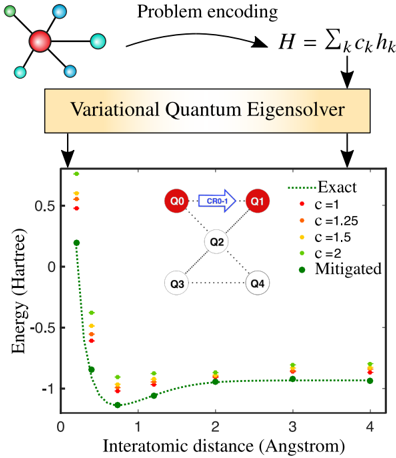
“Data and plot adapted from [89].”
BackgroundThe Density Matrix Renormalization Group in Quantum Chemistry
Chan, G. K.-L., & Sharma, S. (2011) · Annual Review of Physical Chemistry · doi:10.1146/annurev-physchem-032210-103338 · Cited by 822 · cited 1×
“These include approximate methods such as Hartree-Fock or density functional theory, or methods closely connected to quantum information, like the density matrix renormalization group approach that utilizes matrix product states as an ansatz [224, 225].”
MethodQuantum Algorithm Providing Exponential Speed Increase for Finding Eigenvalues and Eigenvectors
Abrams, D. S., & Lloyd, S. (1999) · Physical Review Letters · doi:10.1103/physrevlett.83.5162 · Cited by 817 · cited 1×
“Previous quantum algorithms to find the ground state of a given Hamiltonian H were based on adiabatic state preparation and quantum phase estimation subroutines [87, 88], both of which have circuit depth requirements beyond those available in the NISQ era.”
MethodNoise-Induced Barren Plateaus in Variational Quantum Algorithms
Wang, S., Fontana, E., Cerezo, M., Sharma, K., Sone, A., Cincio, L., & Coles, P. J. (2020) · arXiv · doi:10.48550/arxiv.2007.14384 · Cited by 791
Self-citationNoise-induced barren plateaus in variational quantum algorithms
Wang, S., Fontana, E., Cerezo, M., Sharma, K., Sone, A., Cincio, L., & Coles, P. J. (2021) · Nature Communications · doi:10.1038/s41467-021-27045-6 · Cited by 773 · cited 3×
“[173, 174] it was also shown that in the presence of local Pauli noise, the cost landscape concentrated exponentially with the depth of the ansatz around the value of the cost associated with the maximally mixed state.”
BackgroundSelf-citationFrom the Quantum Approximate Optimization Algorithm to a Quantum Alternating Operator Ansatz
Hadfield, S., Wang, Z., O’Gorman, B., Rieffel, E. G., Venturelli, D., & Biswas, R. (2019) · Algorithms · doi:10.3390/a12020034 · Cited by 772 · cited 3×
“As discussed in Section II B, the UCC ansatz for VQE of the quantum alternating operator ansatz [22, 23] for optimization are problem-inspired ansatze which are usually trainable even when randomly initialized.”
BackgroundMethodQuantum optimization using variational algorithms on near-term quantum devices
Moll, N., Barkoutsos, P., Bishop, L. S., Chow, J. M., Cross, A., Egger, D. J., Filipp, S., Fuhrer, A., Gambetta, J. M., Ganzhorn, M., et al. (2018) · Quantum Science and Technology · doi:10.1088/2058-9565/aab822 · Cited by 744 · cited 1×
“Here we discuss a different possibility where one employs a VQA to solve a classical optimization problem [105].”
BackgroundEffect of data encoding on the expressive power of variational quantum-machine-learning models
Schuld, M., Sweke, R., & Meyer, J. J. (2021) · Physical Review A · doi:10.1103/physreva.103.032430 · Cited by 739
PennyLane: Automatic differentiation of hybrid quantum-classical computations
Bergholm, V., Izaac, J., Schuld, M., Gogolin, C., Ahmed, S., Ajith, V., Alam, M. S., Alonso-Linaje, G., AkashNarayanan, B., Asadi, A., et al. (2018) · arXiv · doi:10.48550/arxiv.1811.04968 · Cited by 732
Strategies for quantum computing molecular energies using the unitary coupled cluster ansatz
Romero, J., Babbush, R., McClean, J. R., Hempel, C., Love, P. J., & Aspuru-Guzik, A. (2019) · Quantum Science and Technology · doi:10.1088/2058-9565/aad3e4 · Cited by 726 · cited 1×
“Gradient-based [109, 110], derivative-free [32, 111] as well as reinforcement learning [112] methods were investigated, and this still remains an active field to guarantee a good performance for the QAOA.”
MethodSelf-citationTraining deep quantum neural networks
Beer, K., Bondarenko, D., Farrelly, T., Osborne, T. J., Salzmann, R., Scheiermann, D., & Wolf, R. (2020) · Nature Communications · doi:10.1038/s41467-020-14454-2 · Cited by 726 · cited 1×
“[132, 149, 150] proposed perceptron-based QNNs.”
Progress towards practical quantum variational algorithms
Wecker, D., Hastings, M. B., & Troyer, M. (2015) · Physical Review A · doi:10.1103/physreva.92.042303 · Cited by 716 · cited 2×
“Indeed, early estimations of resource requirements suggested that the number of measurements that would be required for interesting quantum chemistry VQE problems would be astronomical, making addressing this issue essential for quantum advantage [26].”
BackgroundMethodData re-uploading for a universal quantum classifier
Pérez-Salinas, A., Cervera-Lierta, A., Gil-Fuster, E., & Latorre, J. I. (2020) · Quantum · doi:10.22331/q-2020-02-06-226 · Cited by 713
Wilde, M. (2013) · doi:10.1017/cbo9781139525343.010 · Cited by 713
Efficient Variational Quantum Simulator Incorporating Active Error Minimization
Li, Y., & Benjamin, S. C. (2017) · Physical Review X · doi:10.1103/physrevx.7.021050 · Cited by 686 · cited 7×
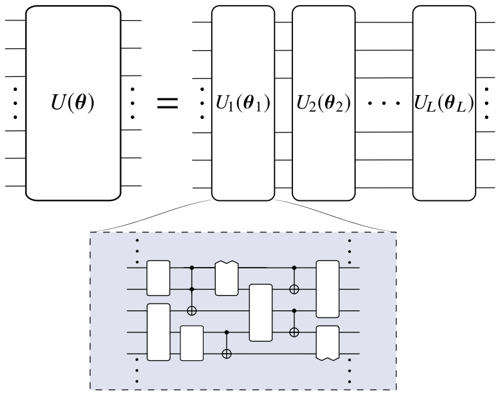
“U(θ)|ψ0〉 for some initial state |ψ0〉), are sometimes used in sophisticated optimization algorithms [71–73] (see Section IID) and variational quantum simulation [74–76]”
BackgroundMethodInfluentialSelf-citationChilds, A. M., Kothari, R., & Somma, R. D. (2017) · SIAM Journal on Computing · doi:10.1137/16m1087072 · Cited by 646
A variational solution of the time-dependent Schrodinger equation
McLachlan, A. D. (1964) · Molecular Physics · doi:10.1080/00268976400100041 · Cited by 616
Classification with Quantum Neural Networks on Near Term Processors
Farhi, E., & Neven, H. (2018) · arXiv · doi:10.48550/arxiv.1802.06002 · Cited by 598
Self-verifying variational quantum simulation of lattice models
Kokail, C., Maier, C., van Bijnen, R., Brydges, T., Joshi, M. K., Jurcevic, P., Muschik, C. A., Silvi, P., Blatt, R., Roos, C. F., et al. (2019) · Nature · doi:10.1038/s41586-019-1177-4 · Cited by 594 · cited 2×
“useful to study Hamiltonians that are similar to the device’s interactions [14].”
BackgroundMethodConnecting Ansatz Expressibility to Gradient Magnitudes and Barren Plateaus
Holmes, Z., Sharma, K., Cerezo, M., & Coles, P. J. (2022) · PRX Quantum · doi:10.1103/prxquantum.3.010313 · Cited by 570
Self-citationImproving the performance of doped π-conjugated polymers for use in organic light-emitting diodes
Gross, M., Müller, D. C., Nothofer, H.-G., Scherf, U., Neher, D., Bräuchle, C., & Meerholz, K. (2000) · Nature · doi:10.1038/35015037 · Cited by 568
Hybrid Quantum-Classical Algorithms and Quantum Error Mitigation
Endo, S., Cai, Z., Benjamin, S. C., & Yuan, X. (2021) · Journal of the Physical Society of Japan · doi:10.7566/jpsj.90.032001 · Cited by 566 · cited 1×
“Quantum Error Mitigation (QEM) generally suppress physical errors to expectation values of observables via classical post-processing of measurement outcomes [204].”
BackgroundSelf-citationZurek, W. H. (2009) · Nature Physics · doi:10.1038/nphys1202 · Cited by 564
Quantum approximate optimization of non-planar graph problems on a planar superconducting processor
Harrigan, M. P., Sung, K. J., Neeley, M., Satzinger, K. J., Arute, F., Arya, K., Atalaya, J., Bardin, J. C., Barends, R., Boixo, S., et al. (2021) · Nature Physics · doi:10.1038/s41567-020-01105-y · Cited by 564
Self-citationPractical Quantum Error Mitigation for Near-Future Applications
Endo, S., Benjamin, S. C., & Li, Y. (2018) · Physical Review X · doi:10.1103/physrevx.8.031027 · Cited by 562 · cited 3×
“First, Richardson extrapolation was proposed [74, 89, 205], and it was shown that single- and multi-exponential extrapolation work well for Markovian gate errors, with the latter subsequently shown to have very broad efficacy [206, 207].”
BackgroundMethodSelf-citationQuantum autoencoders for efficient compression of quantum data
Romero, J., Olson, J. P., & Aspuru-Guzik, A. (2017) · Quantum Science and Technology · doi:10.1088/2058-9565/aa8072 · Cited by 559 · cited 3×
“[138] introduced a VQA for quantum autoencoding, with the goal of compressing quantum data.”
BackgroundInfluentialVariational ansatz-based quantum simulation of imaginary time evolution
McArdle, S., Jones, T., Endo, S., Li, Y., Benjamin, S. C., & Yuan, X. (2019) · npj Quantum Information · doi:10.1038/s41534-019-0187-2 · Cited by 557
Self-citationHybrid quantum-classical hierarchy for mitigation of decoherence and determination of excited states
McClean, J. R., Kimchi-Schwartz, M. E., Carter, J., & de Jong, W. A. (2017) · Physical Review A · doi:10.1103/physreva.95.042308 · Cited by 516 · cited 3×
“A different approach is to use as ansatz a trainable linear combination of parametrized states |ψ({cμ},θ)〉 = ∑ μ cμ|ψμ(θμ)〉 with {cμ} classically optimizable coefficient [44–50].”
BackgroundMethodSelf-citationAn Application of Combinatorial Optimization to Statistical Physics and Circuit Layout Design
Barahona, F., Grötschel, M., Jünger, M., & Reinelt, G. (1988) · Operations Research · doi:10.1287/opre.36.3.493 · Cited by 504
Simulating lattice gauge theories within quantum technologies
Bañuls, M. C., Blatt, R., Catani, J., Celi, A., Cirac, J. I., Dalmonte, M., Fallani, L., Jansen, K., Lewenstein, M., Montangero, S., et al. (2020) · The European Physical Journal D · doi:10.1140/epjd/e2020-100571-8 · Cited by 500
Stokes, J., Izaac, J., Killoran, N., & Carleo, G. (2020) · Quantum · doi:10.22331/q-2020-05-25-269 · Cited by 473 · cited 2×
“U(θ)|ψ0〉 for some initial state |ψ0〉), are sometimes used in sophisticated optimization algorithms [71–73] (see Section IID) and variational quantum simulation [74–76]”
MethodSimulating Quantum Computation by Contracting Tensor Networks
Markov, I. L., & Shi, Y. (2008) · SIAM Journal on Computing · doi:10.1137/050644756 · Cited by 472 · cited 1×
“Moreover, as quantum circuits can be viewed as tensor networks [51], it is quite natural to combine the existing tensor network techniques with a quantum ansatz [52– 54].”
BackgroundVariational Quantum Computation of Excited States
Higgott, O., Wang, D., & Brierley, S. (2019) · Quantum · doi:10.22331/q-2019-07-01-156 · Cited by 463 · cited 1×
“Then, H ′ = H + a|ψ̃G〉〈ψ̃G| is a Hamiltonian whose ground state is the first excited state of H [90].”
Theory of variational quantum simulation
Yuan, X., Endo, S., Zhao, Q., Li, Y., & Benjamin, S. C. (2019) · Quantum · doi:10.22331/q-2019-10-07-191 · Cited by 458 · cited 7×
“U(θ)|ψ0〉 for some initial state |ψ0〉), are sometimes used in sophisticated optimization algorithms [71–73] (see Section IID) and variational quantum simulation [74–76]”
BackgroundMethodInfluentialSelf-citationVariational Quantum Circuits for Deep Reinforcement Learning
Chen, S. Y.-C., Yang, C.-H. H., Qi, J., Chen, P.-Y., Ma, X., & Goan, H.-S. (2020) · IEEE Access · doi:10.1109/access.2020.3010470 · Cited by 452
Generalized Unitary Coupled Cluster Wave functions for Quantum Computation
Lee, J., Huggins, W. J., Head-Gordon, M., & Whaley, K. B. (2019) · Journal of Chemical Theory and Computation · doi:10.1021/acs.jctc.8b01004 · Cited by 432 · cited 1×
“We remark that there are many variants of the UCC ansatz [17], with some of them reducing the circuit depth by considering more efficient methods for compiling the fermionic operators [18–21].”
MethodQuantum Simulation of Electronic Structure with Linear Depth and Connectivity
Kivlichan, I. D., McClean, J., Wiebe, N., Gidney, C., Aspuru-Guzik, A., Chan, G. K.-L., & Babbush, R. (2018) · Physical Review Letters · doi:10.1103/physrevlett.120.110501 · Cited by 431 · cited 2×
“We remark that there are many variants of the UCC ansatz [17], with some of them reducing the circuit depth by considering more efficient methods for compiling the fermionic operators [18–21].”
MethodSelf-citationTang, H. L., Shkolnikov, V. O., Barron, G. S., Grimsley, H. R., Mayhall, N. J., Barnes, E., & Economou, S. E. (2021) · PRX Quantum · doi:10.1103/prxquantum.2.020310 · Cited by 408
Tang, H. L., Shkolnikov, V. O., Barron, G. S., Grimsley, H. R., Mayhall, N. J., Barnes, E., & Economou, S. E. (2019) · arXiv · doi:10.48550/arxiv.1911.10205 · Cited by 408
An initialization strategy for addressing barren plateaus in parametrized quantum circuits
Grant, E., Wossnig, L., Ostaszewski, M., & Benedetti, M. (2019) · Quantum · doi:10.22331/q-2019-12-09-214 · Cited by 406
Local Random Quantum Circuits are Approximate Polynomial-Designs
Brandão, F. G. S. L., Harrow, A. W., & Horodecki, M. (2016) · Communications in Mathematical Physics · doi:10.1007/s00220-016-2706-8 · Cited by 404
Training Variational Quantum Algorithms Is NP-Hard
Bittel, L., & Kliesch, M. (2021) · Physical Review Letters · doi:10.1103/physrevlett.127.120502 · Cited by 398
Cloud Quantum Computing of an Atomic Nucleus
Dumitrescu, E. F., McCaskey, A. J., Hagen, G., Jansen, G. R., Morris, T. D., Papenbrock, T., Pooser, R. C., Dean, D. J., & Lougovski, P. (2018) · Physical Review Letters · doi:10.1103/physrevlett.120.210501 · Cited by 393 · cited 1×
“This was first demonstrated for computing the deuteron (H) binding energy [239], and has been extended to other light nuclei such as the triton (H), He, and an alpha particle (He) [240].”
BackgroundEncoding Electronic Spectra in Quantum Circuits with Linear T Complexity
Babbush, R., Gidney, C., Berry, D. W., Wiebe, N., McClean, J., Paler, A., Fowler, A., & Neven, H. (2018) · Physical Review X · doi:10.1103/physrevx.8.041015 · Cited by 383 · cited 1×
“Since long-term algorithms for material simulation require phase estimation [235–237], these lie beyond the scope of near-term devices.”
BackgroundSelf-citationQuantum-assisted quantum compiling
Khatri, S., LaRose, R., Poremba, A., Cincio, L., Sornborger, A. T., & Coles, P. J. (2019) · Quantum · doi:10.22331/q-2019-05-13-140 · Cited by 382 · cited 3×
“Hence, several VQAs have been introduced that can potentially be used to accelerate this task [103, 126–129].”
MethodSelf-citationA generative modeling approach for benchmarking and training shallow quantum circuits
Benedetti, M., Garcia-Pintos, D., Perdomo, O., Leyton-Ortega, V., Nam, Y., & Perdomo-Ortiz, A. (2019) · npj Quantum Information · doi:10.1038/s41534-019-0157-8 · Cited by 379 · cited 1×
“[146], cat and coherent thermal states were generated experimentally in this way from specific classical data sets.”
BackgroundPotential of quantum computing for drug discovery
Cao, Y., Romero, J., & Aspuru-Guzik, A. (2018) · IBM Journal of Research and Development · doi:10.1147/jrd.2018.2888987 · Cited by 357
Quantum approximate optimization algorithm for MaxCut: A fermionic view
Wang, Z., Hadfield, S., Jiang, Z., & Rieffel, E. G. (2018) · Physical Review A · doi:10.1103/physreva.97.022304 · Cited by 353 · cited 1×
“The most famous VQA for quantum-enhanced optimization is the Quantum Approximate Optimization Algorithm (QAOA) [22], originally introduced to approximately solve combinatorial problems such as ConstraintSatisfaction (SAT) [106] and Max-Cut problems [107].”
MethodMitigating measurement errors in multiqubit experiments
Bravyi, S., Sheldon, S., Kandala, A., Mckay, D. C., & Gambetta, J. M. (2021) · Physical Review A · doi:10.1103/physreva.103.042605 · Cited by 343 · cited 1×
“[219] introduced a method to mitigate expectation values against correlated measurement errors, while [220] implemented an error mitigation technique to suppress the effects of photon loss for a Gaussian Boson sampling device.”
MethodAbsence of Barren Plateaus in Quantum Convolutional Neural Networks
Pesah, A., Cerezo, M., Wang, S., Volkoff, T., Sornborger, A. T., & Coles, P. J. (2021) · Physical Review X · doi:10.1103/physrevx.11.041011 · Cited by 343 · cited 17×
“[27, 176] an initialization strategy was developed specifically to address BPs in deep circuits.”
BackgroundMethodInfluentialSelf-citation(2002) · Choice Reviews Online · doi:10.5860/choice.40-0966 · Cited by 343
Absence of Barren Plateaus in Quantum Convolutional Neural Networks
Pesah, A., Cerezo, M., Wang, S., Volkoff, T., Sornborger, A. T., & Coles, P. J. (2020) · arXiv · doi:10.48550/arxiv.2011.02966 · Cited by 343
Self-citationSubspace-search variational quantum eigensolver for excited states
Nakanishi, K. M., Mitarai, K., & Fujii, K. (2019) · Physical Review Research · doi:10.1103/physrevresearch.1.033062 · Cited by 337 · cited 2×
“The main idea behind subspace VQE is to train a unitary for preparing states in the lowest energy subspace of H [94].”
BackgroundMethodSelf-citationVariational quantum algorithms for nonlinear problems
Lubasch, M., Joo, J., Moinier, P., Kiffner, M., & Jaksch, D. (2020) · Physical Review A · doi:10.1103/physreva.101.010301 · Cited by 332 · cited 1×
“To address this, a VQA for such non-linear problems was proposed in [122].”
MethodQuantum Supremacy through the Quantum Approximate Optimization Algorithm
Farhi, E., & Harrow, A. W. (2016) · arXiv · doi:10.48550/arxiv.1602.07674 · Cited by 331
Classical simulation of noninteracting-fermion quantum circuits
Terhal, B. M., & DiVincenzo, D. P. (2002) · Physical Review A · doi:10.1103/physreva.65.032325 · Cited by 329 · cited 1×
“For instance, in quantum chemistry one can exploit the classical simulability of free fermion dynamics to apply quantum operations via classical post-processing [38–43].”
BackgroundRandom Quantum Circuits are Approximate 2-designs
Harrow, A. W., & Low, R. A. (2009) · Communications in Mathematical Physics · doi:10.1007/s00220-009-0873-6 · Cited by 324 · cited 1×
“The proof of this result relies on the fact that these unstructured ansatze become 2-designs when their depth grows polynomially with the number of qubits n [166, 167].”
BackgroundLayerwise learning for quantum neural networks
Skolik, A., McClean, J. R., Mohseni, M., van der Smagt, P., & Leib, M. (2021) · Quantum Machine Intelligence · doi:10.1007/s42484-020-00036-4 · Cited by 324 · cited 1×
“[178] introduced a method where one employs layerby-layer training.”
MethodSelf-citationExpressive power of parametrized quantum circuits
Du, Y., Hsieh, M.-H., Liu, T., & Tao, D. (2020) · Physical Review Research · doi:10.1103/physrevresearch.2.033125 · Cited by 318
Quantum Circuits That Can Be Simulated Classically in Polynomial Time
Valiant, L. G. (2002) · SIAM Journal on Computing · doi:10.1137/s0097539700377025 · Cited by 311 · cited 1×
“For instance, in quantum chemistry one can exploit the classical simulability of free fermion dynamics to apply quantum operations via classical post-processing [38–43].”
BackgroundTensorFlow Quantum: A Software Framework for Quantum Machine Learning
Broughton, M., Verdon, G., McCourt, T., Martinez, A. J., Yoo, J. H., Isakov, S. V., Massey, P., Halavati, R., Niu, M. Y., Zlokapa, A., et al. (2020) · arXiv · doi:10.48550/arxiv.2003.02989 · Cited by 308
Self-citationVariational Quantum Linear Solver
Bravo-Prieto, C., LaRose, R., Cerezo, M., Subasi, Y., Cincio, L., & Coles, P. J. (2019) · arXiv · doi:10.48550/arxiv.1909.05820 · Cited by 284
Self-citationLearning the quantum algorithm for state overlap
Cincio, L., Subaşı, Y., Sornborger, A. T., & Coles, P. J. (2018) · New Journal of Physics · doi:10.1088/1367-2630/aae94a · Cited by 282 · cited 1×
“The first term here is evaluated as in VQE, while the second term can be obtained by computing the state overlap between |ψ̃G〉 and |ψ(θ)〉 [91, 92].”
BackgroundSelf-citationQuantum Computation of Electronic Transitions Using a Variational Quantum Eigensolver
Parrish, R. M., Hohenstein, E. G., McMahon, P. L., & Martínez, T. J. (2019) · Physical Review Letters · doi:10.1103/physrevlett.122.230401 · Cited by 282 · cited 2×
“A different approach is to use as ansatz a trainable linear combination of parametrized states |ψ({cμ},θ)〉 = ∑ μ cμ|ψμ(θμ)〉 with {cμ} classically optimizable coefficient [44–50].”
BackgroundDifferentiable learning of quantum circuit Born machines
Liu, J.-G., & Wang, L. (2018) · Physical Review A · doi:10.1103/physreva.98.062324 · Cited by 279 · cited 2×
“, this corresponds then to a quantum circuit Born machine [145].”
MethodHybrid Quantum-Classical Approach to Quantum Optimal Control
Li, J., Yang, X., Peng, X., & Sun, C.-P. (2017) · Physical Review Letters · doi:10.1103/physrevlett.118.150503 · Cited by 278 · cited 2×
“[35, 36] have explored using variational quantum algorithms to construct optimal control sequences.”
BackgroundMethodObstacles to Variational Quantum Optimization from Symmetry Protection
Bravyi, S., Kliesch, A., Koenig, R., & Tang, E. (2020) · Physical Review Letters · doi:10.1103/physrevlett.125.260505 · Cited by 278
Quantum generalisation of feedforward neural networks
Wan, K. H., Dahlsten, O., Kristjánsson, H., Gardner, R., & Kim, M. S. (2017) · npj Quantum Information · doi:10.1038/s41534-017-0032-4 · Cited by 276 · cited 1×
“(See [139, 140] for alternative approaches to quantum autoencoders.”
BackgroundMeasurement optimization in the variational quantum eigensolver using a minimum clique cover
Verteletskyi, V., Yen, T.-C., & Izmaylov, A. F. (2020) · The Journal of Chemical Physics · doi:10.1063/1.5141458 · Cited by 269 · cited 1×
“The choice of the subsets is also of course non-unique and has been mapped onto the combinatorial problems of graph coloring [185, 186], finding the minimum clique cover [187–190], or finding the maximal flow in network flow graphs [191], which makes it possible to import the heuristics and formal results from those p…”
BackgroundGard, B. T., Zhu, L., Barron, G. S., Mayhall, N. J., Economou, S. E., & Barnes, E. (2020) · npj Quantum Information · doi:10.1038/s41534-019-0240-1 · Cited by 266 · cited 1×
“One of the main advantages of the hardware efficient ansatz is its versatility, as it can accommodate encoding symmetries [11, 12] and bringing correlated qubits closer for depth reduction [13], as well as being especially”
BackgroundVariational quantum algorithms for discovering Hamiltonian spectra
Jones, T., Endo, S., McArdle, S., Yuan, X., & Benjamin, S. C. (2019) · Physical Review A · doi:10.1103/physreva.99.062304 · Cited by 256 · cited 1×
“Moreover, it has been shown that incorporating imaginary time evolution can help to improve the calculation robustness [93].”
BackgroundSelf-citationEfficient and noise resilient measurements for quantum chemistry on near-term quantum computers
Huggins, W. J., McClean, J. R., Rubin, N. C., Jiang, Z., Wiebe, N., Whaley, K. B., & Babbush, R. (2021) · npj Quantum Information · doi:10.1038/s41534-020-00341-7 · Cited by 256 · cited 1×
“For using VQE on fermionic systems, this scaling can actually be brought down to either quadratic or, for simpler cases even linear in n [193].”
MethodSelf-citationQuantum Algorithm Implementations for Beginners
J., A., Adedoyin, A., Ambrosiano, J., Anisimov, P., Casper, W., Chennupati, G., Coffrin, C., Djidjev, H., Gunter, D., Karra, S., et al. (2018) · arXiv · doi:10.48550/arxiv.1804.03719 · Cited by 256
Self-citationNew perspectives on unitary coupled‐cluster theory
Taube, A. G., & Bartlett, R. J. (2006) · International Journal of Quantum Chemistry · doi:10.1002/qua.21198 · Cited by 254 · cited 1×
“Here, T = ∑ k Tk is the cluster operator [15, 16] and Tk are excitation operators.”
BackgroundLow-cost error mitigation by symmetry verification
Bonet-Monroig, X., Sagastizabal, R., Singh, M., & O'Brien, T. E. (2018) · Physical Review A · doi:10.1103/physreva.98.062339 · Cited by 250 · cited 2×
“One can also take a post-processing approach using the information of the symmetry with a larger sample number [215].”
MethodEffect of barren plateaus on gradient-free optimization
Arrasmith, A., Cerezo, M., Czarnik, P., Cincio, L., & Coles, P. J. (2021) · Quantum · doi:10.22331/q-2021-10-05-558 · Cited by 248 · cited 1×
“large precision to resolve against finite sampling noise and determine a cost-minimizing direction, with this being valid independently of using a gradient-based [68] or gradient-free optimization method [165].”
MethodSelf-citationError-Mitigated Digital Quantum Simulation
McArdle, S., Yuan, X., & Benjamin, S. (2019) · Physical Review Letters · doi:10.1103/physrevlett.122.180501 · Cited by 245 · cited 1×
“Symmetry verification is especially useful for ansatze that preserve symmetries such as particle and spin number [12, 214, 215].”
MethodSelf-citationQuantum Algorithm Implementations for Beginners
J., A., Adedoyin, A., Ambrosiano, J., Anisimov, P., Casper, W., Chennupati, G., Coffrin, C., Djidjev, H., Gunter, D., Karra, S., et al. (2022) · ACM Transactions on Quantum Computing · doi:10.1145/3517340 · Cited by 245
Self-citationAccelerated Variational Quantum Eigensolver
Wang, D., Higgott, O., & Brierley, S. (2019) · Physical Review Letters · doi:10.1103/physrevlett.122.140504 · Cited by 241 · cited 2×
“This motivated the Accelerated VQE algorithm, which interpolates between the VQE and QPE algorithms [98].”
BackgroundMethodVariational Quantum Simulation of General Processes
Endo, S., Sun, J., Li, Y., Benjamin, S. C., & Yuan, X. (2020) · Physical Review Letters · doi:10.1103/physrevlett.125.010501 · Cited by 237 · cited 3×
“An alternative approach [76] which reduces this overhead is to simulate the stochastic Schrödinger equation, which unravels the evolution of the density matrix into trajectories of pure states.”
BackgroundMethodSelf-citationLearning-Based Quantum Error Mitigation
Strikis, A., Qin, D., Chen, Y., Benjamin, S. C., & Li, Y. (2021) · PRX Quantum · doi:10.1103/prxquantum.2.040330 · Cited by 237 · cited 1×
“Taking this approach can allow one to implement a probabilistic error mitigation protocol without needing to construct a full error model for an experiment [211].”
MethodSelf-citationLearning-based quantum error mitigation
Strikis, A., Qin, D., Chen, Y., Benjamin, S. C., & Li, Y. (2020) · arXiv · doi:10.48550/arxiv.2005.07601 · Cited by 237
Self-citationExploring Entanglement and Optimization within the Hamiltonian Variational Ansatz
Wiersema, R., Zhou, C., de Sereville, Y., Carrasquilla, J. F., Kim, Y. B., & Yuen, H. (2020) · PRX Quantum · doi:10.1103/prxquantum.1.020319 · Cited by 235
Limitations of optimization algorithms on noisy quantum devices
Franca, D. S., & Garcia-Patron, R. (2020) · arXiv · doi:10.48550/arxiv.2009.05532 · Cited by 234
Variational fast forwarding for quantum simulation beyond the coherence time
Cîrstoiu, C., Holmes, Z., Iosue, J., Cincio, L., Coles, P. J., & Sornborger, A. (2020) · npj Quantum Information · doi:10.1038/s41534-020-00302-0 · Cited by 232 · cited 1×
“Similar to the subspace approach, variational fast forwarding [102] simulates the time evolution operation exp(−iHt) as U(θ∗)T (E, t)U†(θ∗) with”
Self-citationThe prospects of quantum computing in computational molecular biology
Outeiral, C., Strahm, M., Shi, J., Morris, G. M., Benjamin, S. C., & Deane, C. M. (2021) · WIREs Computational Molecular Science · doi:10.1002/wcms.1481 · Cited by 232
Self-citationSequential minimal optimization for quantum-classical hybrid algorithms
Nakanishi, K. M., Fujii, K., & Todo, S. (2020) · Physical Review Research · doi:10.1103/physrevresearch.2.043158 · Cited by 221 · cited 2×
“One can thus infer a classical model of the cost function, and minimise it, to offload more work from the quantum processor to the classical supervising system [69, 70].”
BackgroundMethodSelf-citationStochastic gradient descent for hybrid quantum-classical optimization
Sweke, R., Wilde, F., Meyer, J., Schuld, M., Faehrmann, P. K., Meynard-Piganeau, B., & Eisert, J. (2020) · Quantum · doi:10.22331/q-2020-08-31-314 · Cited by 219 · cited 1×
“However, for simplified landscapes, SGD convergence guarantees have been derived which are similar to those provided in the machine learning literature [84, 85].”
MethodOptimizing Variational Quantum Algorithms Using Pontryagin’s Minimum Principle
Yang, Z.-C., Rahmani, A., Shabani, A., Neven, H., & Chamon, C. (2017) · Physical Review X · doi:10.1103/physrevx.7.021027 · Cited by 210 · cited 3×
“It was also shown that “bang-bang” evolution that motivates QAOA ansatz is the optimal approach given fixed quantum computation time [32].”
BackgroundMethodZhu, L., Tang, H. L., Barron, G. S., Calderon-Vargas, F. A., Mayhall, N. J., Barnes, E., & Economou, S. E. (2022) · Physical Review Research · doi:10.1103/physrevresearch.4.033029 · Cited by 209
Virtual Distillation for Quantum Error Mitigation
Huggins, W. J., McArdle, S., O’Brien, T. E., Lee, J., Rubin, N. C., Boixo, S., Whaley, K. B., Babbush, R., & McClean, J. R. (2021) · Physical Review X · doi:10.1103/physrevx.11.041036 · Cited by 205 · cited 1×
“A distinct approach was introduced in [217, 218] which comes at the cost of increasing the number of qubits.”
BackgroundSelf-citationMatchgates and classical simulation of quantum circuits
Jozsa, R., & Miyake, A. (2008) · Proceedings of the Royal Society A: Mathematical, Physical and Engineering Sciences · doi:10.1098/rspa.2008.0189 · Cited by 204
Variational quantum state diagonalization
LaRose, R., Tikku, A., O’Neel-Judy, É., Cincio, L., & Coles, P. J. (2019) · npj Quantum Information · doi:10.1038/s41534-019-0167-6 · Cited by 199 · cited 2×
“Several VQAs have been introduced to extract the entanglement spectrum of a quantum state [97, 125, 159].”
BackgroundSelf-citationQuantum embeddings for machine learning
Lloyd, S., Schuld, M., Ijaz, A., Izaac, J., & Killoran, N. (2020) · arXiv · doi:10.48550/arxiv.2001.03622 · Cited by 198
Noise resilience of variational quantum compiling
Sharma, K., Khatri, S., Cerezo, M., & Coles, P. J. (2020) · New Journal of Physics · doi:10.1088/1367-2630/ab784c · Cited by 196 · cited 4×
“Finally, it is worth noting that both FUMC and FISC exhibit resilience to hardware noise, in that the global minimum of the cost landscape is unaffected by various types of noise [128].”
BackgroundMethodInfluentialSelf-citationMixed quantum-classical equilibrium: Surface hopping
Schmidt, J. R., Parandekar, P. V., & Tully, J. C. (2008) · The Journal of Chemical Physics · doi:10.1063/1.2955564 · Cited by 194
XY mixers: Analytical and numerical results for the quantum alternating operator ansatz
Wang, Z., Rubin, N. C., Dominy, J. M., & Rieffel, E. G. (2020) · Physical Review A · doi:10.1103/physreva.101.012320 · Cited by 190 · cited 1×
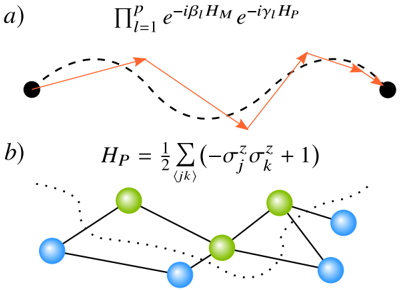
“The goal of the QAOA is to map an input state |ψ0〉, to the ground-state of a given problem Hamiltonian HP by sequentially applying a problem unitary e−iγlHp and a mixer unitary e−iβlHM [25].”
MethodEfficient quantum measurement of Pauli operators in the presence of finite sampling error
Crawford, O., Straaten, B. V., Wang, D., Parks, T., Campbell, E., & Brierley, S. (2021) · Quantum · doi:10.22331/q-2021-01-20-385 · Cited by 188
Romero, J., & Aspuru‐Guzik, A. (2021) · Advanced Quantum Technologies · doi:10.1002/qute.202000003 · Cited by 186 · cited 2×
“to use quantum algorithms for machine learning applications [134, 148, 256, 257].”
BackgroundMethodSolving nonlinear differential equations with differentiable quantum circuits
Kyriienko, O., Paine, A. E., & Elfving, V. E. (2021) · Physical Review A · doi:10.1103/physreva.103.052416 · Cited by 185
Solving nonlinear differential equations with differentiable quantum circuits
Kyriienko, O., Paine, A. E., & Elfving, V. E. (2020) · arXiv · doi:10.48550/arxiv.2011.10395 · Cited by 185
Quantum Algorithms for Systems of Linear Equations Inspired by Adiabatic Quantum Computing
Subaşı, Y., Somma, R. D., & Orsucci, D. (2019) · Physical Review Letters · doi:10.1103/physrevlett.122.060504 · Cited by 183 · cited 1×
“[118–120] considered the Hamiltonian HG = A(1− |b〉〈b|)A† (which was also considered outside of the variational setting [121]).”
BackgroundA Multireference Quantum Krylov Algorithm for Strongly Correlated Electrons
Stair, N. H., Huang, R., & Evangelista, F. A. (2020) · Journal of Chemical Theory and Computation · doi:10.1021/acs.jctc.9b01125 · Cited by 183 · cited 1×
“A different approach is to use as ansatz a trainable linear combination of parametrized states |ψ({cμ},θ)〉 = ∑ μ cμ|ψμ(θμ)〉 with {cμ} classically optimizable coefficient [44–50].”
Yen, T.-C., Verteletskyi, V., & Izmaylov, A. F. (2020) · Journal of Chemical Theory and Computation · doi:10.1021/acs.jctc.0c00008 · Cited by 178 · cited 2×
“The choice of the subsets is also of course non-unique and has been mapped onto the combinatorial problems of graph coloring [185, 186], finding the minimum clique cover [187–190], or finding the maximal flow in network flow graphs [191], which makes it possible to import the heuristics and formal results from those p…”
BackgroundStrategies for solving the Fermi-Hubbard model on near-term quantum computers
Cade, C., Mineh, L., Montanaro, A., & Stanisic, S. (2020) · Physical Review B · doi:10.1103/physrevb.102.235122 · Cited by 178
Low rank representations for quantum simulation of electronic structure
Motta, M., Ye, E., McClean, J. R., Li, Z., Minnich, A. J., Babbush, R., & Chan, G. K.-L. (2018) · arXiv · doi:10.48550/arxiv.1808.02625 · Cited by 173
Self-citationLow rank representations for quantum simulation of electronic structure
Motta, M., Ye, E., McClean, J. R., Li, Z., Minnich, A. J., Babbush, R., & Chan, G. K.-L. (2021) · npj Quantum Information · doi:10.1038/s41534-021-00416-z · Cited by 171
Self-citationIzmaylov, A. F., Yen, T.-C., Lang, R. A., & Verteletskyi, V. (2020) · Journal of Chemical Theory and Computation · doi:10.1021/acs.jctc.9b00791 · Cited by 171 · cited 2×
“The choice of the subsets is also of course non-unique and has been mapped onto the combinatorial problems of graph coloring [185, 186], finding the minimum clique cover [187–190], or finding the maximal flow in network flow graphs [191], which makes it possible to import the heuristics and formal results from those p…”
BackgroundVariational quantum eigensolver with fewer qubits
Liu, J.-G., Zhang, Y.-H., Wan, Y., & Wang, L. (2019) · Physical Review Research · doi:10.1103/physrevresearch.1.023025 · Cited by 166 · cited 1×
“[52, 57] have proposed a method to variationally obtain a purification |ψ〉 = ∑”
MethodTakeshita, T., Rubin, N. C., Jiang, Z., Lee, E., Babbush, R., & McClean, J. R. (2020) · Physical Review X · doi:10.1103/physrevx.10.011004 · Cited by 165 · cited 1×
“For instance, in quantum chemistry one can exploit the classical simulability of free fermion dynamics to apply quantum operations via classical post-processing [38–43].”
BackgroundSelf-citationQuantum computers that can be simulated classically in polynomial time
Valiant, L. G. (2001) · ACM Symposium on Theory of Computing (STOC) · doi:10.1145/380752.380785 · Cited by 165
Sokolov, I. O., Barkoutsos, P. K., Ollitrault, P. J., Greenberg, D., Rice, J., Pistoia, M., & Tavernelli, I. (2020) · The Journal of Chemical Physics · doi:10.1063/1.5141835 · Cited by 164
Charge-Transfer State Dynamics Following Hole and Electron Transfer in Organic Photovoltaic Devices
Bakulin, A. A., Dimitrov, S. D., Rao, A., Chow, P. C. Y., Nielsen, C. B. O., Schroeder, B. C., McCulloch, I. A., Bakker, H. J., Durrant, J. R., & Friend, R. H. (2012) · The Journal of Physical Chemistry Letters · doi:10.1021/jz301883y · Cited by 164
Variational algorithms for linear algebra
Xu, X., Sun, J., Endo, S., Li, Y., Benjamin, S. C., & Yuan, X. (2021) · Science Bulletin · doi:10.1016/j.scib.2021.06.023 · Cited by 163
Self-citationEstimating the gradient and higher-order derivatives on quantum hardware
Mari, A., Bromley, T. R., & Killoran, N. (2021) · Physical Review A · doi:10.1103/physreva.103.012405 · Cited by 159 · cited 1×
“Explicit formulas can be found in [67, 68].”
Performance of the Quantum Approximate Optimization Algorithm on the Maximum Cut Problem
Crooks, G. E. (2018) · arXiv · doi:10.48550/arxiv.1811.08419 · Cited by 158
Yao.jl: Extensible, Efficient Framework for Quantum Algorithm Design
Luo, X.-Z., Liu, J.-G., Zhang, P., & Wang, L. (2020) · Quantum · doi:10.22331/q-2020-10-11-341 · Cited by 157
The Born supremacy: quantum advantage and training of an Ising Born machine
Coyle, B., Mills, D., Danos, V., & Kashefi, E. (2020) · npj Quantum Information · doi:10.1038/s41534-020-00288-9 · Cited by 155 · cited 1×
“Finally, it has been shown that quantum circuit Born machines can simulate the restricted Boltzmann machine and perform a sampling task that is hard for a classical computer [147].”
BackgroundApplication of fermionic marginal constraints to hybrid quantum algorithms
Rubin, N. C., Babbush, R., & McClean, J. (2018) · New Journal of Physics · doi:10.1088/1367-2630/aab919 · Cited by 152 · cited 1×
“Instead, the optimal approach is to give each Pauli operator a number of shots proportional to |ci| √ Var(σi), where Var(σi) is the variance of 〈σi〉 [194].”
BackgroundSelf-citationA non-orthogonal variational quantum eigensolver
Huggins, W. J., Lee, J., Baek, U., O’Gorman, B., & Whaley, K. B. (2020) · New Journal of Physics · doi:10.1088/1367-2630/ab867b · Cited by 148 · cited 1×
“A different approach is to use as ansatz a trainable linear combination of parametrized states |ψ({cμ},θ)〉 = ∑ μ cμ|ψμ(θμ)〉 with {cμ} classically optimizable coefficient [44–50].”
Exponential Error Suppression for Near-Term Quantum Devices
Koczor, B. (2021) · Physical Review X · doi:10.1103/physrevx.11.031057 · Cited by 147 · cited 1×
“A distinct approach was introduced in [217, 218] which comes at the cost of increasing the number of qubits.”
BackgroundIterative qubit-excitation based variational quantum eigensolver
Yordanov, Y., Armaos, V., Barnes, C., & Arvidsson-Shukur, D. (2021) · doi:10.21203/rs.3.rs-404173/v1 · Cited by 145
Qubit-excitation-based adaptive variational quantum eigensolver
(2021) · doi:10.1038/s42005-021-00730-0 · Cited by 145
Large gradients via correlation in random parameterized quantum circuits
Volkoff, T., & Coles, P. J. (2021) · Quantum Science and Technology · doi:10.1088/2058-9565/abd891 · Cited by 143 · cited 1×
“For instance, the proposal of [177] showed that correlating the parameters in the ansatz effectively reduces the dimension of the hyperparameter space and can lead to large cost function gradients.”
BackgroundSelf-citationAn Adaptive Optimizer for Measurement-Frugal Variational Algorithms
Kübler, J. M., Arrasmith, A., Cincio, L., & Coles, P. J. (2020) · Quantum · doi:10.22331/q-2020-05-11-263 · Cited by 141 · cited 2×
“For example, it was heuristically observed that the noise-free cost achieves lower values with noise-free training than with noisy training [79, 195, 201].”
BackgroundSelf-citationImproved techniques for preparing eigenstates of fermionic Hamiltonians
Berry, D. W., Kieferová, M., Scherer, A., Sanders, Y. R., Low, G. H., Wiebe, N., Gidney, C., & Babbush, R. (2018) · npj Quantum Information · doi:10.1038/s41534-018-0071-5 · Cited by 140
Self-citationMethodology for replacing indirect measurements with direct measurements
Mitarai, K., & Fujii, K. (2019) · Physical Review Research · doi:10.1103/physrevresearch.1.013006 · Cited by 139 · cited 1×
“However, as shown in [77], those can also be reduced to the parametershift technique.”
BackgroundSelf-citationEfficient variational simulation of non-trivial quantum states
Ho, W. W., & Hsieh, T. H. (2019) · SciPost Physics · doi:10.21468/scipostphys.6.3.029 · Cited by 139 · cited 1×
“Due to its versatility, the variational Hamiltonian ansatz has been implemented for quantum chemistry [20, 27], optimization [23], and for quantum simulation problems [28].”
MethodUnified approach to data-driven quantum error mitigation
Lowe, A., Gordon, M. H., Czarnik, P., Arrasmith, A., Coles, P. J., & Cincio, Ł. (2021) · Physical Review Research · doi:10.1103/physrevresearch.3.033098 · Cited by 136
Self-citationVariational Spin-Squeezing Algorithms on Programmable Quantum Sensors
Kaubruegger, R., Silvi, P., Kokail, C., van Bijnen, R., Rey, A. M., Ye, J., Kaufman, A. M., & Zoller, P. (2019) · Physical Review Letters · doi:10.1103/physrevlett.123.260505 · Cited by 133 · cited 1×
“[160, 162, 163] while optical tweezer arrays are considered in [161].”
BackgroundA Quantum Approximate Optimization Algorithm Applied to a Bounded Occurrence Constraint Problem
Farhi, E., Goldstone, J., & Gutmann, S. (2014) · arXiv · doi:10.48550/arxiv.1412.6062 · Cited by 131
Simulating quantum field theory with a quantum computerPreprint
Preskill, J. P. (2018) · arXiv (Cornell University) · doi:10.48550/arxiv.1811.10085 · Cited by 130
Measurements of Quantum Hamiltonians with Locally-Biased Classical Shadows
Hadfield, C., Bravyi, S., Raymond, R., & Mezzacapo, A. (2020) · arXiv · doi:10.48550/arxiv.2006.15788 · Cited by 129
Chakraborty, S., Gilyén, A., & Jeffery, S. (2019) · Schloss Dagstuhl – Leibniz-Zentrum für Informatik · doi:10.4230/lipics.icalp.2019.33 · Cited by 127
Decoding quantum errors with subspace expansions
McClean, J. R., Jiang, Z., Rubin, N. C., Babbush, R., & Neven, H. (2020) · Nature Communications · doi:10.1038/s41467-020-14341-w · Cited by 126 · cited 1×
“In an alternative and complementary approach, the subspace expansion method was also shown to be useful for QEM in [216].”
MethodSelf-citationOn barren plateaus and cost function locality in variational quantum algorithms
Uvarov, A. V., & Biamonte, J. D. (2021) · Journal of Physics A: Mathematical and Theoretical · doi:10.1088/1751-8121/abfac7 · Cited by 126 · cited 1×
“These results have been numerically verified in [168] and further extended in [169].”
ResultBarren Plateaus Preclude Learning Scramblers
Holmes, Z., Arrasmith, A., Yan, B., Coles, P. J., Albrecht, A., & Sornborger, A. T. (2021) · Physical Review Letters · doi:10.1103/physrevlett.126.190501 · Cited by 125 · cited 1×
“In addition, it has been shown that BPs can arise in more general problems such as learning a scrambler [170] where for any choice of variational ansatz will lead to, with high probability, a BP.”
BackgroundSelf-citationBarren plateaus preclude learning scramblers
Holmes, Z., Arrasmith, A., Yan, B., Coles, P. J., Albrecht, A., & Sornborger, A. T. (2020) · arXiv · doi:10.48550/arxiv.2009.14808 · Cited by 125
Self-citationMeasurement reduction in variational quantum algorithms
Zhao, A., Tranter, A., Kirby, W. M., Ung, S. F., Miyake, A., & Love, P. J. (2020) · Physical Review A · doi:10.1103/physreva.101.062322 · Cited by 121 · cited 2×
“The choice of the subsets is also of course non-unique and has been mapped onto the combinatorial problems of graph coloring [185, 186], finding the minimum clique cover [187–190], or finding the maximal flow in network flow graphs [191], which makes it possible to import the heuristics and formal results from those p…”
BackgroundHarrow, A. W., & Napp, J. C. (2021) · Physical Review Letters · doi:10.1103/physrevlett.126.140502 · Cited by 121 · cited 2×
“Furthermore, within a convex region about a minimum, SGD methods using gradients calculated via the parameter-shift rule have been shown to have smaller upper bounds on the optimization complexity than methods using only objective values (including finite difference methods) [84].”
MethodExpressibility of the alternating layered ansatz for quantum computation
Nakaji, K., & Yamamoto, N. (2021) · Quantum · doi:10.22331/q-2021-04-19-434 · Cited by 119 · cited 1×
“Other expressibility measures can be considered as well [61], and the expressibility of different ansatze is investigated further in [62].”
BackgroundHigher order derivatives of quantum neural networks with barren plateaus
Cerezo, M., & Coles, P. J. (2021) · Quantum Science and Technology · doi:10.1088/2058-9565/abf51a · Cited by 118
Self-citationLearning to Optimize Variational Quantum Circuits to Solve Combinatorial Problems
Khairy, S., Shaydulin, R., Cincio, L., Alexeev, Y., & Balaprakash, P. (2020) · Proceedings of the AAAI Conference on Artificial Intelligence · doi:10.1609/aaai.v34i03.5616 · Cited by 117
Variational Quantum Fidelity Estimation
Cerezo, M., Poremba, A., Cincio, L., & Coles, P. J. (2020) · Quantum · doi:10.22331/q-2020-03-26-248 · Cited by 116 · cited 1×
“[158] introduced a VQA to estimate the quantum fidelity between an arbitrary state σ and a low-rank state ρ.”
BackgroundSelf-citationOrbital optimized unitary coupled cluster theory for quantum computer
Mizukami, W., Mitarai, K., Nakagawa, Y. O., Yamamoto, T., Yan, T., & Ohnishi, Y.-Y. (2020) · Physical Review Research · doi:10.1103/physrevresearch.2.033421 · Cited by 116 · cited 1×
“For instance, in quantum chemistry one can exploit the classical simulability of free fermion dynamics to apply quantum operations via classical post-processing [38–43].”
BackgroundSelf-citationMagann, A. B., Arenz, C., Grace, M. D., Ho, T.-S., Kosut, R. L., McClean, J. R., Rabitz, H. A., & Sarovar, M. (2021) · PRX Quantum · doi:10.1103/prxquantum.2.010101 · Cited by 116
Self-citationParallel quantum simulation of large systems on small NISQ computers
Barratt, F., Dborin, J., Bal, M., Stojevic, V., Pollmann, F., & Green, A. G. (2021) · npj Quantum Information · doi:10.1038/s41534-021-00420-3 · Cited by 111
Machine Learning of Noise-Resilient Quantum Circuits
Cincio, L., Rudinger, K., Sarovar, M., & Coles, P. J. (2021) · PRX Quantum · doi:10.1103/prxquantum.2.010324 · Cited by 111
Self-citationMultistart Methods for Quantum Approximate optimization
Shaydulin, R., Safro, I., & Larson, J. (2019) · 2019 IEEE High Performance Extreme Computing Conference (HPEC) · doi:10.1109/hpec.2019.8916288 · Cited by 110 · cited 1×
“Finding optimal values γ and β is a hard problem since the optimization landscape in QAOA is non-convex with many local optima [108].”
BackgroundQuantum computing for neutrino-nucleus scattering
Roggero, A., Li, A. C. Y., Carlson, J., Gupta, R., & Perdue, G. (2020) · Physical review. D/Physical review. D. · doi:10.1103/physrevd.101.074038 · Cited by 110
Superfast encodings for fermionic quantum simulation
Setia, K., Bravyi, S., Mezzacapo, A., & Whitfield, J. D. (2019) · Physical Review Research · doi:10.1103/physrevresearch.1.033033 · Cited by 107 · cited 1×
“We remark that there are many variants of the UCC ansatz [17], with some of them reducing the circuit depth by considering more efficient methods for compiling the fermionic operators [18–21].”
MethodMitigating Realistic Noise in Practical Noisy Intermediate-Scale Quantum Devices
Sun, J., Yuan, X., Tsunoda, T., Vedral, V., Benjamin, S. C., & Endo, S. (2021) · Physical Review Applied · doi:10.1103/physrevapplied.15.034026 · Cited by 105 · cited 1×
“Furthermore, based on probabilistic error cancellation, stochastic error mitigation which works for general continuous systems such as analog quantum simulators as well as digital quantum computers was introduced [210].”
BackgroundSelf-citationAnschuetz, E., Olson, J., Aspuru-Guzik, A., & Cao, Y. (2019) · Lecture Notes in Computer Science · doi:10.1007/978-3-030-14082-3_7 · Cited by 104 · cited 1×
“Hence, a VQA for factoring as a potential near-term alternative was introduced in [123].”
Background$O(N^3)$ Measurement Cost for Variational Quantum Eigensolver on Molecular Hamiltonians
Gokhale, P., Angiuli, O., Ding, Y., Gui, K., Tomesh, T., Suchara, M., Martonosi, M., & Chong, F. T. (2020) · IEEE Transactions on Quantum Engineering · doi:10.1109/tqe.2020.3035814 · Cited by 104
Adaptive Variational Quantum Dynamics Simulations
Yao, Y., Gomes, N., Zhang, F., Wang, C., Ho, K., Iadecola, T., & Orth, P. P. (2021) · Iowa State University Digital Repository (Iowa State University) · Cited by 104
$O(N^3)$ Measurement Cost for Variational Quantum Eigensolver on Molecular Hamiltonians
Gokhale, P., & Chong, F. T. (2019) · arXiv · doi:10.48550/arxiv.1908.11857 · Cited by 104
Compilation of Fault-Tolerant Quantum Heuristics for Combinatorial Optimization
Sanders, Y. R., Berry, D. W., Costa, P. C. S., Tessler, L. W., Wiebe, N., Gidney, C., Neven, H., & Babbush, R. (2020) · PRX Quantum · doi:10.1103/prxquantum.1.020312 · Cited by 103
Self-citationUniversal variational quantum computation
Biamonte, J. (2021) · Physical Review A · doi:10.1103/physreva.103.l030401 · Cited by 102 · cited 1×
“This has lead to VQAs being proposed for essentially all applications envisioned for quantum computers, and in fact, it has been shown that VQAs allow for universal quantum computing [86].”
Background
Research works printed but not linked: 12
- [4] 'IBM Makes Quantum Computing Available on IBM Cloud to Accelerate Innovation,' (2016), press release at https://www-03.ibm.com/press/us/ en/pressrelease/49661.wss . -
- Bilkis, M., Cerezo, M., Verdon, G., Coles, P. J. & Cincio, L. A semi-agnostic ansatz with variable structure for quantum machine learning. Preprint at https://arxiv.org/abs/2103.06712 (2021). · arXiv
- [35] Arthur G Rattew, Shaohan Hu, Marco Pistoia, Richard Chen, and Steve Wood, 'A domain-agnostic, noiseresistant, hardware-efficient evolutionary variational quantum eigensolver,' arXiv preprint arXiv:1910.09694 (2019). - · arXiv
- [115] Guoming Wang, Dax Enshan Koh, Peter D Johnson, and Yudong Cao, 'Minimizing estimation runtime on noisy quantum computers,' Phys. Rev. X Quantum 2 , 010346 (2021). -
- [134] A Ambainis, 'Variable time amplitude amplification and a faster quantum algorithm for solving systems of linear equations 29th int,' in Symp. Theoretical Aspects of Computer Science (STACS 2012) , Vol. 14 (2012) pp. 636-47. -
- [159] Edwin Stoudenmire and David J Schwab, 'Supervised learning with tensor networks,' in Advances in Neural Information Processing Systems (2016) pp. 4799-4807. -
- [178] Lukas Franken and Bogdan Georgiev, 'Explorations in quantum neural networks with intermediate measurements,' in Proceedings of ESANN (2020). -
- [264] Bela Bauer, Dave Wecker, Andrew J Millis, Matthew B Hastings, and Matthias Troyer, 'Hybrid quantumclassical approach to correlated materials,' Physical Review X 6 , 031045 (2016). -
- [269] Hsuan-Hao Lu, Natalie Klco, Joseph M Lukens, Titus D Morris, Aaina Bansal, Andreas Ekström, Gaute Hagen, Thomas Papenbrock, Andrew M Weiner, Martin J Savage, et al. , 'Simulations of subatomic manybody physics on a quantum frequency processor,' Physical Review A 100 , 012320 (2019). -
- [271] Julian Bender, Erez Zohar, Alessandro Farace, and J Ignacio Cirac, 'Digital quantum simulation of lattice gauge theories in three spatial dimensions,' New Journal of Physics 20 , 093001 (2018). -
- [277] A Avkhadiev, PE Shanahan, and RD Young, 'Accelerating lattice quantum field theory calculations via interpolator optimization using noisy intermediate-scale quantum computing,' Physical Review Letters 124 , 080501 (2020). -
- [293] Yuval R Sanders, Dominic W Berry, Pedro CS Costa, Louis W Tessler, Nathan Wiebe, Craig Gidney, Hartmut Neven, and Ryan Babbush, 'Compilation of faulttolerant quantum heuristics for combinatorial optimization,' Physical Review X Quantum 1 , 020312 (2020).
Cited by
The Variational Quantum Eigensolver: A review of methods and best practices
Tilly, J., Chen, H., Cao, S., Picozzi, D., Setia, K., Li, Y., Grant, E., Wossnig, L., Rungger, I., Booth, G. H., et al. (2022) · Physics Reports · doi:10.1016/j.physrep.2022.08.003 · Cited by 1,031
Noise-Induced Barren Plateaus in Variational Quantum Algorithms
Wang, S., Fontana, E., Cerezo, M., Sharma, K., Sone, A., Cincio, L., & Coles, P. J. (2020) · arXiv · doi:10.48550/arxiv.2007.14384 · Cited by 791
Self-citationNoise-induced barren plateaus in variational quantum algorithms
Wang, S., Fontana, E., Cerezo, M., Sharma, K., Sone, A., Cincio, L., & Coles, P. J. (2021) · Nature Communications · doi:10.1038/s41467-021-27045-6 · Cited by 773
“At the heart of this discussion are Variational Quantum Algorithms (VQAs), which are believed to be the best hope for near-term quantum advantage [2–4].”
BackgroundSelf-citationChallenges and opportunities in quantum machine learning
Cerezo, M., Verdon, G., Huang, H.-Y., Cincio, L., & Coles, P. J. (2022) · Nature Computational Science · doi:10.1038/s43588-022-00311-3 · Cited by 689
“These involve a sequence of unitary gates acting on the quantum data states | ψ j (cid:105) , some of which have free parameters θ that will be trained to solve the problem at hand [38].”
BackgroundSelf-citationPractical quantum advantage in quantum simulation
Daley, A. J., Bloch, I., Kokail, C., Flannigan, S., Pearson, N., Troyer, M., & Zoller, P. (2022) · Nature · doi:10.1038/s41586-022-04940-6 · Cited by 669
Metadata
- Authors
- Cerezo, M., Arrasmith, A., Babbush, R., Benjamin, S. C., Endo, S., Fujii, K., McClean, J. R., Mitarai, K., Yuan, X., Cincio, L., & Coles, P. J.
- Affiliations
- Los Alamos National Laboratory (US)
- Google (United States) (US)
- University of Oxford (GB)
- NTT (Japan) (JP)
- RIKEN (JP)
- Japan Science and Technology Agency (JP)
- Peking University (CN)
- Corresponding author
- Cerezo, M.
- Coles, Patrick J.
- Venue
- Nature Reviews Physics
- Published
- 2021-08-12
- Volume
- 3
- Issue
- 9
- Pages
- 625-644
- ISSN
- 2522-5820 (ISSN-L)
- OpenAlex
- W3111162498
- Semantic Scholar
- c1cf657d1e13149ee575b5ca779e898938ada60a
- Cited by
- 3,385
- References
- 200
- Citations by year
- 2026: 874 · 2025: 896 · 2024: 699 · 2023: 521 · 2022: 317 · 2021: 78
- FWCI
- 29.21
- Type
- journal article
- Language
- en
- Open access
- green
- arxiv.org
- Licence
- www.springernature.com/gp/researchers/text-and-data-mining (tdm)
- www.springernature.com/gp/researchers/text-and-data-mining (vor)
- Locations
- Nature Reviews Physics (publishedVersion)
- arXiv (Cornell University) (publishedVersion)
- OSTI OAI (U.S. Department of Energy Office of Scientific and Technical Information) (submittedVersion, cc-by)
- arXiv (Cornell University)
- Funders
- U.S. Department of Energy (#89233218CNA000001, KA2401032, DE-AC52-06NA2-5396, AC52-06NA25396, 20190065DR)
- Ministry of Education, Culture, Sports, Science and Technology (JPMXS0118068682, JPMXS0118067394, JP-MXS0120319794, CREST)
- Office of Science (89233218CNA000001, KA2401032, DE-AC52-06NA25396)
- National Nuclear Security Administration (DEAC52- 06NA25396, 89233218C-NA000001)
- Horizon 2020 Framework Programme (820495)
- Engineering and Physical Sciences Research Council (820495, M013243/1, EP/T001062/1, EP/M013243/1, T001062, H2020)
- Japan Society for the Promotion of Science (JPMXS0118067394, 20K22330, JPMJER1601, JPMXS0120319794, CREST, 16H02211)
- Advanced Scientific Computing Research (DE-AC52-06NA25396, 89233218CNA000001)
- Laboratory Directed Research and Development (20200056DR, DE-AC52-06NA2-5396, 89233218CNA000001, 20190065DR, 20180628ECR)
- Core Research for Evolutional Science and Technology (JPMJCR1673)
- Precursory Research for Embryonic Science and Technology (JPMJPR2019)
- Exploratory Research for Advanced Technology (JPMJER1601)
- Los Alamos National Laboratory (20200056DR, 89233218CNA 000001, KA2401032, AC52-06NA25396, 20180628ECR, 20190065DR, DE-AC52-06NA25396)
- Topics
- Physical Sciences › Computer Science › Artificial Intelligence › Quantum Computing Algorithms and Architecture
- Physical Sciences › Physics and Astronomy › Atomic and Molecular Physics, and Optics › Quantum many-body systems
- Physical Sciences › Physics and Astronomy › Atomic and Molecular Physics, and Optics › Quantum Information and Cryptography
- Keywords
- variational quantum algorithms, variational quantum circuits, quantum advantage, near-term quantum computing, quantum chemistry simulation, quantum linear algebra, trainability, noisy quantum hardware, classical optimization
About these checks
Registry, retraction, Cites and statistics results are computed, not judged, with one exception: a printed reference that no index lists is read once by a model before it counts as a citation error. Claims are extracted by a model and kept only when their quote appears verbatim in the text; each cited source is then checked, with a model’s help, for whether it says what the claim relies on. Those verdicts can be wrong — read the claim’s quote and the cited source before relying on one.
The claim verdicts this report counts are experimental: their accuracy is not yet measured.
A language model drew the claims from the paper on 2026-10-10, under version 3 of the claim definition (model deepseek-v4.1-flash, prompt extract-v3).
A second model labelled each claim on 2026-10-10 (model jev-1.13-20260917, definition revision gold-guideline-v0.2).
Cited sources are checked with a language model’s help (gpt-6-sol).
Statistics and arithmetic are recomputed, not judged.
Confidence bands are shown only for fields calibrated on our annotated test set. None is calibrated yet, so no band is shown.
What counts as a claim ›How we measure confidence ›How we check this ›
Are you an author, or do you see a problem with this page? Request a review
Data sources
Bibliographic data: Semantic Scholar, OpenAlex, Crossref.
Contains information from the Semantic Scholar Academic Graph Datasets, made available under the ODC Attribution License (ODC-BY 1.0).
Semantic Scholar’s data is described in: Kinney, R., et al. (2023). The Semantic Scholar Open Data Platform. arXiv:2301.10140.
