

Variational quantum algorithms
Open accessThe DOI matches its Crossref record; 333 of the 334 references it cites were found in a registry or an index, and 1 are not checked yet; 179 of the 264 sources its claims cite were checked for support.
Abstract
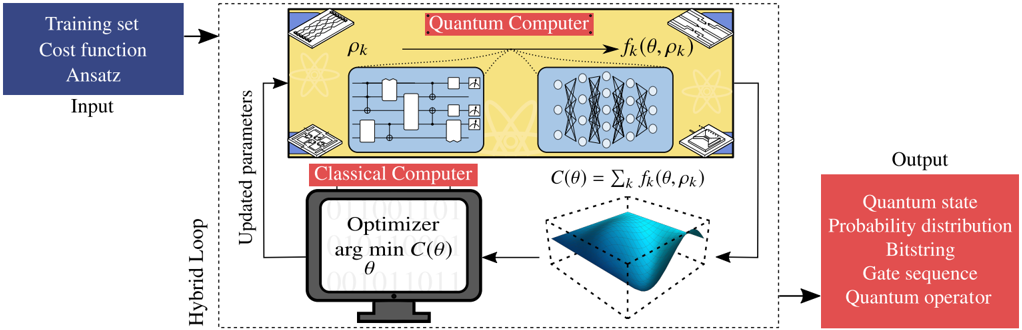
Applications such as simulating complicated quantum systems or solving large-scale linear algebra problems are very challenging for classical computers, owing to the extremely high computational cost. Quantum computers promise a solution, although fault-tolerant quantum computers will probably not be available in the near future. Current quantum devices have serious constraints, including limited numbers of qubits and noise processes that limit circuit depth. Variational quantum algorithms (VQAs), which use a classical optimizer to train a parameterized quantum circuit, have emerged as a leading strategy to address these constraints. VQAs have now been proposed for essentially all applications that researchers have envisaged for quantum computers, and they appear to be the best hope for obtaining quantum advantage. Nevertheless, challenges remain, including the trainability, accuracy and efficiency of VQAs. Here we overview the field of VQAs, discuss strategies to overcome their challenges and highlight the exciting prospects for using them to obtain quantum advantage. The advent of commercial quantum devices has ushered in the era of near-term quantum computing. Variational quantum algorithms are promising candidates to make use of these devices for achieving a practical quantum advantage over classical computers. Variational quantum algorithms (VQAs) are the leading proposal for achieving quantum advantage using near-term quantum computers. VQAs have been developed for a wide range of applications, including finding ground states of molecules, simulating dynamics of quantum systems and solving linear systems of equations. VQAs share a common structure, where a task is encoded into a parameterized cost function that is evaluated using a quantum computer, and a classical optimizer trains the parameters in the VQA. The adaptive nature of VQAs is well suited to handle the constraints of near-term quantum computers. Trainability, accuracy and efficiency are three challenges that arise when applying VQAs to large-scale applications, and strategies are currently being developed to address these challenges. Variational quantum algorithms (VQAs) are the leading proposal for achieving quantum advantage using near-term quantum computers. VQAs have been developed for a wide range of applications, including finding ground states of molecules, simulating dynamics of quantum systems and solving linear systems of equations. VQAs share a common structure, where a task is encoded into a parameterized cost function that is evaluated using a quantum computer, and a classical optimizer trains the parameters in the VQA. The adaptive nature of VQAs is well suited to handle the constraints of near-term quantum computers. Trainability, accuracy and efficiency are three challenges that arise when applying VQAs to large-scale applications, and strategies are currently being developed to address these challenges.
Verified 2026-11-25 · 1 reference not checked yet
Overview
CoChat Summary
TL;DR
Variational quantum algorithms (VQAs) train parametrized quantum circuits with a classical optimizer and are presented as the leading strategy for obtaining quantum advantage on noisy intermediate-scale quantum (NISQ) devices. The review surveys VQA components, applications, challenges, and prospects, emphasizing that trainability, accuracy, and efficiency remain central obstacles.
Key findings
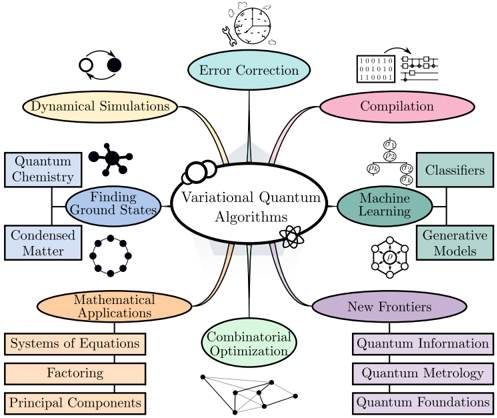
- VQAs have been proposed for essentially all applications envisioned for quantum computers, including finding ground and excited states, dynamical quantum simulation, combinatorial optimization, linear systems, compiling, error correction, machine learning, and metrology.
- Current state-of-the-art device size ranges from 50 to 100 qubits, and VQAs are argued to be the best hope for near-term quantum advantage because they keep circuit depth shallow and outsource parameter optimization to classical optimizers.
- Trainability is threatened by barren plateaus, where cost-function partial derivatives vanish exponentially with system size on average; noise can also induce barren plateaus regardless of the ansatz.
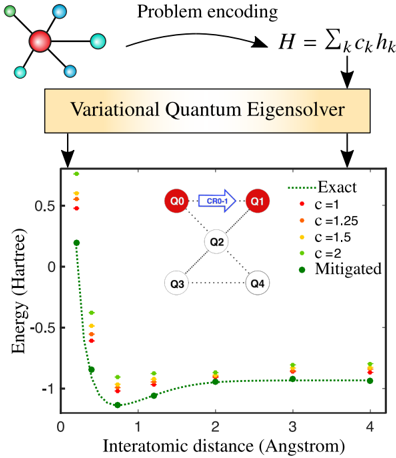
- Resource and scaling examples reported include: VQE requires \(O(1/\epsilon^2)\) measurements for precision \(\epsilon\), whereas quantum phase estimation requires \(O(\log(1/\epsilon))\); chemical Hamiltonians have Pauli-string counts scaling as \(n^4\), with commuting groupings reducing measurement scaling to \(n^3\); classical shadows scale logarithmically with \(n\); and a variational quantum linear solver study used \(n=10,\ldots,30\) qubits for Ising-inspired systems and \(n=2,\ldots,7\) qubits for random sparse linear systems.
Methods
- Design: narrative review/overview of the VQA field, not a primary experimental or theoretical study.
- Data or sample: no primary data or sample; the paper synthesizes prior literature and cites numerical and experimental results from other works.
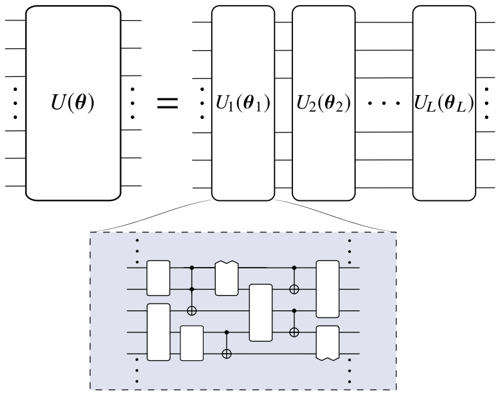
- Main analysis: conceptual description of VQA architecture (cost function, ansatz, gradients, optimizers), applications, challenges, and opportunities for near-term quantum advantage.
Limitations
- The paper states that challenges remain including the trainability, accuracy, and efficiency of VQAs, and that barren plateaus could erase a potential quantum advantage.
- The paper states that the degree to which error mitigation can correct noise effects is still an open question, and that measurement efficiency is not guaranteed even without barren plateaus.
- Evident from the text: as a review, it presents no new experimental results, and many performance claims rely on cited heuristic or numerical studies rather than a systematic meta-analysis.
Model-written summary. Check it against the paper before relying on it.
Integrity signals
Registry
Cites
Statistics
Figures
Verification
Claims the paper makes
53 Valid · 74 Not valid · 51 Not checked · 84 Own results and interpretations
At least one cited source doesn’t support this claim or points to a different paper, and none confirmed it — see the verdicts below.
In the paper
“Hence, a VQA for factoring as a potential near-term alternative was introduced in Ref. [145].”
What the sources say
- Disputedcites [145] [145] Eric Anschuetz, Jonathan Olson, Alán Aspuru-Guzik, and Yudong Cao, 'Variational quantum factoring,' in International Workshop on Quantum Technology and Optimization Problems (Springer, 2019) pp. 74-85. - sourceExperimental — accuracy not yet measured
The Introduction says factoring is typically a longer-term application because of its high resource requirements, while identifying other applications as nearer term. The paper introduces variational quantum state diagonalization, not a variational algorithm for factoring. (LLM, conf=0.88)
Checked by a reasoning model — may be wrong.
plain- Asserted: passes — The authors put it forward as true.
- Checkable: passes — It can be checked against evidence.
- Load-bearing: unclear — It is unclear whether the paper’s conclusions depend on it.
- Based: passes — The paper gives a reason why it holds.
- Disputed
At least one cited source doesn’t support this claim or points to a different paper, and none confirmed it — see the verdicts below.
In the paper
“This qubit requirement can be reduced with the VQA of Ref. [113], which requires only n qubits.”
What the sources say
- Disputedcites [113] [113] M. Cerezo, Kunal Sharma, Andrew Arrasmith, and Patrick J Coles, 'Variational quantum state eigensolver,' arXiv preprint arXiv:2004.01372 (2020). - sourceExperimental — accuracy not yet measured
Section II B (p. 3) describes an (n+1)-qubit controlled sign flip in the proposed algorithm and says its cited implementation requires additional ancillas. That contradicts the claim that this VQA requires only n qubits; the paper discusses reductions in measurements and circuit depth, not a reduction to n qubits. (LLM, conf=0.84)
Checked by a reasoning model — may be wrong.
plainstates a cause- Asserted: passes — The authors put it forward as true.
- Checkable: passes — It can be checked against evidence.
- Load-bearing: unclear — It is unclear whether the paper’s conclusions depend on it.
- Based: passes — The paper gives a reason why it holds.
- Disputed
The cited sources that could be checked couldn’t confirm or dispute this claim.
In the paper
“The classical optimization problems associated with VQAs are expected to be NP-hard in general as they involve cost functions that can have many local minima [94].”
What the sources say
- Could not verifycites [94] [94] Lennart Bittel and Martin Kliesch, 'Training variational quantum algorithms is np-hard-even for logarithmically many qubits and free fermionic systems,' arXiv preprint arXiv:2101.07267 (2021). - sourceExperimental — accuracy not yet measured
The Introduction (p. 1) describes hybrid quantum-classical cost functions and the need for gradients, but does not address the complexity of optimizing them. Searches for “NP-hard,” “local minima,” and related terms found no passage saying that VQA optimization is generally NP-hard or attributing that difficulty to many local minima. (LLM, conf=0.74)
hedgedstates a cause- Asserted: passes — The authors put it forward as true.
- Checkable: passes — It can be checked against evidence.
- Load-bearing: unclear — It is unclear whether the paper’s conclusions depend on it.
- Based: passes — The paper gives a reason why it holds.
- Could not verify
The cited sources that could be checked couldn’t confirm or dispute this claim.
In the paper
“Numerical simulations showed that QVECTOR can find quantum codes that outperform existing ones [152].”
What the sources say
- Could not verifycites [152] [152] Peter D Johnson, Jonathan Romero, Jonathan Olson, Yudong Cao, and Alán Aspuru-Guzik, 'Qvector: an algorithm for device-tailored quantum error correction,' arXiv preprint arXiv:1711.02249 (2017). - sourceExperimental — accuracy not yet measured
The closest discussion in our copy, “Designing and controlling quantum systems” (p. 12), concerns machine-learning methods for improving quantum gates, not finding quantum codes. Searches for QVECTOR and for simulations of codes outperforming existing ones found no passage addressing the claim. (LLM, conf=0.76)
plainstates a cause- Asserted: passes — The authors put it forward as true.
- Checkable: passes — It can be checked against evidence.
- Load-bearing: passes — The paper’s conclusions depend on it.
- Based: passes — The paper gives a reason why it holds.
- Could not verify
The cited sources that could be checked couldn’t confirm or dispute this claim.
In the paper
“The importance of parameter initialization was made clear in Ref. [204] where it was noted that the optimal parameters in QAOA exhibit persistent patterns.”
What the sources say
- Could not verifycites [204] [204] Leo Zhou, Sheng-Tao Wang, Soonwon Choi, Hannes Pichler, and Mikhail D Lukin, 'Quantum approximate optimization algorithm: Performance, mechanism, and implementation on near-term devices,' Physical Review X 10 , 021067 (2020). - sourceExperimental — accuracy not yet measured
Appendix C (page unavailable) studies QAOA with parameters constrained to be equal across layers and describes that approach as suboptimal for the ring-of-disagrees problem. The Introduction and Conclusions discuss parameter correlation and trainability, but the passages found do not say that optimal QAOA parameters exhibit persistent patterns (searched: optimal parameters, QAOA patterns, initialization). (LLM, conf=0.76)
boosted- Asserted: passes — The authors put it forward as true.
- Checkable: passes — It can be checked against evidence.
- Load-bearing: passes — The paper’s conclusions depend on it.
- Based: passes — The paper gives a reason why it holds.
- Could not verify
125 more claims · 57 with their cited sources checked
Create a free account to see all 262 claims and to verify the 42 references still open.
- Probably not a substantial claim. 94
- It may state two separate claims as one. 57
Claims other papers make about this one
Each is checked against this paper’s own text: does it say what the citing paper says it does?
The source backs part of the claim, not all of it — or backs it for a different population, condition or comparison.
In the citing paper
“Google's recent proof of quantum supremacy is a major step forward for quantum computing [15].”
From Quantum Computing: Vision and Challenges (2025) · cites this paper as [15]
Experimental — accuracy not yet measuredThe cited source says what the claim attributes to it.
In the citing paper
“An important class of algorithms for NISQ hardware are socalled hybrid quantum-classical algorithms that partition the computational workload between a classical and a quantum computer.[124,125]”
From Quantum Computing for Molecular Biology** (2023) · cites this paper as [125]
The cited source says what the claim attributes to it.
In the citing paper
“In this regard, References [164] and [171] focus on gate-based algorithms that can be implemented on NISQ devices and therefore may be applied to various application areas with CO just as one example of those.”
From Quantum Combinatorial Optimization in the NISQ Era: A Systematic Mapping Study (2024) · cites this paper as [171]
Self-check
Percentages, sums and reported differences re-computed from the paper’s own numbers.
Each contradiction between two passages listed here was confirmed by an independent check.
Rated minor: it would not touch a result — a value no result rests on, a p-value that stays on the same side of the significance level, or a conflict that is clerical, resolved elsewhere in the paper, or outside its own findings.
In the paper
§ E. Error correction · p. 12
“two parametrized circuits V ( θ 1 ) (on n ≥ k qubits) and W ( θ 2 ) (on n + r qubits)”
§ E. Error correction · p. 12
“ρ out = W ( θ 1 ) V ( θ 1 )( ψ ⊗ | 0 〉〈 0 | ⊗ n -k + r ) V ( θ 1 ) † W ( θ 1 ) †”
Rated minor: it would not touch a result — a value no result rests on, a p-value that stays on the same side of the significance level, or a conflict that is clerical, resolved elsewhere in the paper, or outside its own findings.
In the paper
§ 1. Linear systems · p. 11
“the task is to prepare a normalized state | x 〉 such that A | x 〉 ∝ | b 〉”
§ 1. Linear systems · p. 11
“one can then construct a Hamiltonian whose ground state is the solution to the QLSP and apply a variational approach to minimize the cost C ( θ ) = 〈 ψ ( θ ) | H G | ψ ( ψ ) 〉 . Refs. [139-141] considered the Hamiltonian H G = A ( ✶ -| b 〉 〈 b | ) A †”
Citations
Cites
Adam: A Method for Stochastic Optimization
Kingma, D. P., & Ba, J. (2014) · arXiv · doi:10.48550/arxiv.1412.6980 · Cited by 98,946
Self-Consistent Equations Including Exchange and Correlation Effects
Kohn, W., & Sham, L. J. (1965) · Physical Review · doi:10.1103/physrev.140.a1133 · Cited by 64,135 · cited 1×
“Classical methods for materials simulations usually employ density-functional theory coupled with approximation methods, such as the local density approximation [234] to tackle weakly correlated materials.”
MethodQuantum Computing in the NISQ era and beyond
Preskill, J. (2018) · Quantum · doi:10.22331/q-2018-08-06-79 · Cited by 8,830 · cited 1×
“But excitement grew as to what could be done with these new devices, which have been called Noisy Intermediate-Scale Quantum (NISQ) computers [7].”
BackgroundAlgorithms for quantum computation: discrete logarithms and factoring
Shor, P. W. (2002) · Proceedings 35th Annual Symposium on Foundations of Computer Science · doi:10.1109/sfcs.1994.365700 · Cited by 8,713 · cited 1×
“Shor’s quantum algorithm was proposed to factor numbers with exponential speedup over classical methods [2], dynamical quantum simulation algorithms were developed [3], and quantum algorithms for solving linear systems of equations were identified [4].”
MethodQuantum Computation and Quantum Information: 10th Anniversary Edition
Nielsen, M. A., & Chuang, I. L. (2012) · doi:10.1017/cbo9780511976667 · Cited by 8,436
Quantum supremacy using a programmable superconducting processor
Arute, F., Arya, K., Babbush, R., Bacon, D., Bardin, J. C., Barends, R., Biswas, R., Boixo, S., Brandao, F. G. S. L., Buell, D. A., et al. (2019) · Nature · doi:10.1038/s41586-019-1666-5 · Cited by 7,720 · cited 1×
“This size actually allows one to achieve quantum supremacy, outperforming the best classical supercomputer, for certain contrived mathematical tasks [8, 9].”
BackgroundSelf-citationDensity matrix formulation for quantum renormalization groups
White, S. R. (1992) · Physical Review Letters · doi:10.1103/physrevlett.69.2863 · Cited by 7,702 · cited 1×
“These include approximate methods such as Hartree-Fock or density functional theory, or methods closely connected to quantum information, like the density matrix renormalization group approach that utilizes matrix product states as an ansatz [224, 225].”
MethodBiamonte, J., Wittek, P., Pancotti, N., Rebentrost, P., Wiebe, N., & Lloyd, S. (2017) · Nature · doi:10.1038/nature23474 · Cited by 4,779 · cited 1×
“to use quantum algorithms for machine learning applications [134, 148, 256, 257].”
MethodA variational eigenvalue solver on a photonic quantum processor
Peruzzo, A., McClean, J., Shadbolt, P., Yung, M.-H., Zhou, X.-Q., Love, P. J., Aspuru-Guzik, A., & O’Brien, J. L. (2014) · Nature Communications · doi:10.1038/ncomms5213 · Cited by 4,552 · cited 3×
“3, VQE is aimed at finding the ground state energy EG of a Hamiltonian H [16].”
BackgroundMethodSelf-citationQuantum Algorithm for Linear Systems of Equations
Harrow, A. W., Hassidim, A., & Lloyd, S. (2009) · Physical Review Letters · doi:10.1103/physrevlett.103.150502 · Cited by 3,325 · cited 2×
“The classical algorithmic complexity for this task scales polynomially in the dimension N , whereas the now-famous HHL quantum algorithm [4] has a complexity that scales logarithmically in N , with some scaling improvements having been proposed [113– 116].”
BackgroundMethod
Research works printed but not linked: 12
- [4] 'IBM Makes Quantum Computing Available on IBM Cloud to Accelerate Innovation,' (2016), press release at https://www-03.ibm.com/press/us/ en/pressrelease/49661.wss . -
- Bilkis, M., Cerezo, M., Verdon, G., Coles, P. J. & Cincio, L. A semi-agnostic ansatz with variable structure for quantum machine learning. Preprint at https://arxiv.org/abs/2103.06712 (2021). · arXiv
- [35] Arthur G Rattew, Shaohan Hu, Marco Pistoia, Richard Chen, and Steve Wood, 'A domain-agnostic, noiseresistant, hardware-efficient evolutionary variational quantum eigensolver,' arXiv preprint arXiv:1910.09694 (2019). - · arXiv
- [115] Guoming Wang, Dax Enshan Koh, Peter D Johnson, and Yudong Cao, 'Minimizing estimation runtime on noisy quantum computers,' Phys. Rev. X Quantum 2 , 010346 (2021). -
- [134] A Ambainis, 'Variable time amplitude amplification and a faster quantum algorithm for solving systems of linear equations 29th int,' in Symp. Theoretical Aspects of Computer Science (STACS 2012) , Vol. 14 (2012) pp. 636-47. -
- [159] Edwin Stoudenmire and David J Schwab, 'Supervised learning with tensor networks,' in Advances in Neural Information Processing Systems (2016) pp. 4799-4807. -
- [178] Lukas Franken and Bogdan Georgiev, 'Explorations in quantum neural networks with intermediate measurements,' in Proceedings of ESANN (2020). -
- [264] Bela Bauer, Dave Wecker, Andrew J Millis, Matthew B Hastings, and Matthias Troyer, 'Hybrid quantumclassical approach to correlated materials,' Physical Review X 6 , 031045 (2016). -
- [269] Hsuan-Hao Lu, Natalie Klco, Joseph M Lukens, Titus D Morris, Aaina Bansal, Andreas Ekström, Gaute Hagen, Thomas Papenbrock, Andrew M Weiner, Martin J Savage, et al. , 'Simulations of subatomic manybody physics on a quantum frequency processor,' Physical Review A 100 , 012320 (2019). -
- [271] Julian Bender, Erez Zohar, Alessandro Farace, and J Ignacio Cirac, 'Digital quantum simulation of lattice gauge theories in three spatial dimensions,' New Journal of Physics 20 , 093001 (2018). -
- [277] A Avkhadiev, PE Shanahan, and RD Young, 'Accelerating lattice quantum field theory calculations via interpolator optimization using noisy intermediate-scale quantum computing,' Physical Review Letters 124 , 080501 (2020). -
- [293] Yuval R Sanders, Dominic W Berry, Pedro CS Costa, Louis W Tessler, Nathan Wiebe, Craig Gidney, Hartmut Neven, and Ryan Babbush, 'Compilation of faulttolerant quantum heuristics for combinatorial optimization,' Physical Review X Quantum 1 , 020312 (2020).
Cited by
Items 2,501–2,600 of 3,232
A useful metric for the NISQ era: Qubit error probability and its role in zero noise extrapolation
Sobrino, N., Aseginolaza, U., Jornet-Somoza, J., & Borge, J. (2026) · AVS Quantum Science · doi:10.1116/5.0287324 · Cited by 3
Erol, V. (2025) · SSRN Electronic Journal · doi:10.2139/ssrn.5634697
QEMOS: a scalable quantum error mitigation method to overcome qubit sensitivity
Tu, Z., Xu, J., Zhou, X., Zhu, Y., Liu, Y., Du, Q., Lian, H., & Zhou, B. (2025) · Machine Learning Science and Technology · doi:10.1088/2632-2153/ae16fc · Cited by 2
Yusuff, T. A., Iloeje, K. F., Peteranaba, S. F., Akinlolu, V. S., Kassim, N., & Hamidu, Z. (2025) · International Journal of Scientific Research and Modern Technology. · doi:10.38124/ijsrmt.v4i10.921 · Cited by 4
Du, Y., Wang, X., Guo, N., Yu, Z., Qian, Y., Zhang, K., Hsieh, M.-H., Rebentrost, P., & Tao, D. (2025) · Springer eBooks · doi:10.1007/978-981-95-1284-3_2
Du, Y., Wang, X., Guo, N., Yu, Z., Qian, Y., Zhang, K., Hsieh, M.-H., Rebentrost, P., & Tao, D. (2025) · Springer eBooks · doi:10.1007/978-981-95-1284-3_1
Quantum-enhanced learning with a controllable bosonic variational sensor network
Liao, P., Zhang, B., & Zhuang, Q. (2025) · Optica Sensing Congress · doi:10.1364/qsm.2025.qw3b.1
Motor imagery classification for EEG using quantum approach
Dixit, K. K., Singh, K., Bhatt, C., & Srivastava, S. C. (2025) · AIP conference proceedings · doi:10.1063/5.0286573
Studies of quantum combinatorial optimization algorithms: <?A3B2 pi6?>a review
Li, Z., Wu, Y., Zhang, R., Wen, J., Wang, T., & Wang, C. (2025) · Chinese Science Bulletin (Chinese Version) · doi:10.1360/csb-2025-5565
Quantum Image Representations based Quantum Neural Networks for Binary ClassificationPreprint
Tiwari, A., Siyanwal, S., Sakhuja, S., Kumar, S., & Tyagi, P. (2025) · Research Square · doi:10.21203/rs.3.rs-7621070/v1
GroverAttention: Quantum-Enhanced Attention Mechanism for Effcient TransformersPreprint
Chikhaoui, B. (2025) · Research Square · doi:10.21203/rs.3.rs-7301044/v1
Construction and optimization of quantum modular exponentiation circuits based on the V gate
Zhang, X., Rong, X., & Li, Z. (2025) · Quantum Information Processing · doi:10.1007/s11128-025-04968-3
“However, for applications where complete quantum states are not needed in the later stages, such as in variational quantum algorithms [41] or certain reversible circuits in the final step before measurement, the two irreversible schemes proposed in this paper can be utilized to reduce the quantum…”
Quantum Information Technology and the Law
Perrier, E., & Aboy, M. (2026) · Perspectives in law, business and innovation · doi:10.1007/978-981-95-8371-3_2 · Cited by 1
Non-Markovian noise limits for sustaining entanglement in multiparty quantum states
Goswami, S., & Sen, U. (2025) · Physical Review A · doi:10.1103/s963-rsm5 · Cited by 1
Mandl, A., Barzen, J., Leymann, F., & Vietz, D. (2025) · Quantum Machine Intelligence · doi:10.1007/s42484-025-00328-7 · Cited by 4
“As for classical neural networks, there are various architectures for QNNs [8–10] and their trainability [11,12], expressibility [13– 15], and general performance [5,16,17] are a topic of active research.”
Quantum machine learning for state tomography using classical data
Jabeen, S., Kurdydyk, D., Palnitkar, A., Talati, M., Yan, J., & Yang, J. (2026) · Quantum Machine Intelligence · doi:10.1007/s42484-026-00345-0 · Cited by 1
“By using parametrized gates as the trainable part of the circuit, one can construct a variational quantum circuit, thus constructing a quantum machine learning model (Cerezo et al. 2021 ; Romero and Aspuru-Guzik 2019 ; Schuld et al. 2020 ; Chen et al. 2020).”
Fan, Z.-C., Tian, C., Xiao, B., & Ma, H. (2025) · International Journal of Theoretical Physics · doi:10.1007/s10773-025-06188-y · Cited by 2
“However, current quantum hardware platforms face critical challenges, including qubit decoherence [7], control inaccuracies [8], and limited connectivity [9–12].”
Matrix-Product Entanglement Characterizing the Optimality of State-Preparation Quantum Circuits
Shuo, Q., Li, W.-J., Su, G., & Ran, S.-J. (2025) · Physical Review Letters · doi:10.1103/6y5p-mp7q
Generative reconstruction for irrecoverable erasure errors in quantum-corrupted images
Roy, P. C., Barua, S., Tanvir, M. R. I., Zanain, F., & Mahdy, M. R. C. (2025) · Quantum Machine Intelligence · doi:10.1007/s42484-025-00329-6
“A variational quantum circuit serves as a latent-space generative model, learning the data manifold from un-erased features to enable coherent reconstructions (Cerezo et al. 2021).”
InfluentialPower and Limitations of Distributed Quantum State Purification
Zhao, B., Chen, Y.-A., Zhao, X., Zhu, C., Chiribella, G., & Wang, X. (2026) · Physical Review Letters · doi:10.1103/3bb1-pmtp · Cited by 13
“To solve this problem, we utilize the parametrized quantum circuits (PQCs) [47] to represent the local unitaries U ( θ ) and V ( ζ ) , and apply gradient-based optimization method [48] to search the optimal parameters θ , ζ in the PQCs U ( θ ) and V ( ζ ) .”
An Efficient Mapping Framework for 2D Quantum Architecture
Chen, J., Li, C., & Tsang, K. F. (2025) · Communications in computer and information science · doi:10.1007/978-981-95-3736-5_2
Accelerated spin-adapted ground-state preparation with nonvariational quantum algorithms
Kobori, T., Kosugi, T., Nishi, H., Todo, S., & Matsushita, Y. (2026) · Physical Review A · doi:10.1103/lldh-d7y1 · Cited by 2
Ho, M., Khoo, J. Y., Mak, A. M., & Carrazza, S. (2026) · Quantum Science and Technology · doi:10.1088/2058-9565/ae6a1c · Cited by 1
“As a result, despite variational quantum algorithms being the most prevalent type of quantum algorithm for NISQ computers [10, 13–15], with the exception of simple toy problems, it is unfeasible for most users to perform the definitive routine of quantum circuit parameter optimization directly on…”
Leveraging Quantum Machine Learning for Precision Nutrient Management in Sustainable Crop Production
Ghosh, S., & Raj, R. (2025) · IGI Global eBooks · doi:10.4018/979-8-3373-3957-3.ch004
Variational Algorithms: Theory
Raisuddin, O. M., & De, S. (2025) · Springer eBooks · doi:10.1007/978-3-032-03325-3_35
Sornsaeng, A., Arad, I., & Poletti, D. (2026) · Physical review. E · doi:10.1103/2p2k-3j2s
Design and Wireless Characterisation of Cryogenic RF Oscillators
Webers, F., Tavernier, F., & Reynaert, P. (2025) · European Microwave Integrated Circuits Conference · doi:10.23919/eumic65284.2025.11233874
“This is of great importance to many types of quantum error correction and variational quantum algorithms [4].”
Evolutionary Weight Optimization for Variational Quantum Classifiers
Costa, M., & Neto, F. M. D. P. (2025) · International Joint Conference on Neural Networks (IJCNN) · doi:10.1109/ijcnn64981.2025.11227638
“Within this . perspective, variational quantum circuits (VQC) emerge [4].”
Quantum Artificial Intelligence for Critical Infrastructure: A Survey and Vision
Chen, S. Y.-C., & Chen, K. (2025) · International Joint Conference on Neural Networks (IJCNN) · doi:10.1109/ijcnn64981.2025.11227684 · Cited by 4
“Among these developments, hybrid quantum-classical algorithms have garnered substantial interest [11], [12].”
Position Paper: Quantum Neural Networks - A Paradigm Shift in AI or a Theoretical Promise?
Kashif, M., & Shafique, M. (2025) · International Joint Conference on Neural Networks (IJCNN) · doi:10.1109/ijcnn64981.2025.11227994 · Cited by 6
Hybrid and hardware-oriented approaches for quantum diffusion models
Cacioppo, A., Colantonio, L., Bordoni, S., & Giagu, S. (2025) · International Joint Conference on Neural Networks (IJCNN) · doi:10.1109/ijcnn64981.2025.11227283 · Cited by 1
Erol, V. (2025) · SSRN Electronic Journal · doi:10.2139/ssrn.5765711
Quantum algorithms for causal estimands
Goel, R. S., Myers, C. R., & Shrapnel, S. (2025) · Quantum Science and Technology · doi:10.1088/2058-9565/ae20b8 · Cited by 1
“…has been a considerable effort to develop noisy intermediate-scale quantum (NISQ) algorithms for QML tasks in the form of variational circuits [19, 20], but there has also been significant progress in designing fault tolerant QML algorithms [21] that take advantage of quantum computing’s…”
Yalçın, Ş., & Uysal, A. K. (2025) · Journal of Physics G Nuclear and Particle Physics · doi:10.1088/1361-6471/ae20b0 · Cited by 1
Variational quantum generative modeling by sampling expectation values of tunable observables
Shen, K., Kurkin, A., Pérez-Salinas, A., Shishenina, E., Dunjko, V., & Wang, H. (2025) · npj Quantum Information · doi:10.1038/s41534-025-01121-x · Cited by 8
“EVSs are generative models built on parameterized quantum circuits (PQCs) [37–39], designed for learning continuous distributions.”
Mirzakhani, M., & Moon, K. (2025) · EPJ Quantum Technology · doi:10.1140/epjqt/s40507-025-00439-x · Cited by 1
“Recent quantum simulations, particularly in quantum chemistry and materials science, have widely employed VQE (Variational Quantum Eigensolver) [28, 29] and QAOA (Quantum Approximate Optimization Algorithm) [30] for quantum many-body systems like the Hubbard model [24, 26, 31, 32].”
Quantum Chebyshev probabilistic models for fragmentation functions
de Lejarza, J. J. M., Wu, H., Kyriienko, O., Rodrigo, G., & Grossi, M. (2025) · Communications Physics · doi:10.1038/s42005-025-02361-1 · Cited by 8
Gori, M., Sarkis, M., & Tkatchenko, A. (2025) · Journal of Physics A Mathematical and Theoretical · doi:10.1088/1751-8121/ae21a9 · Cited by 5
“In particular, Gaussian states constitute a manifold of states in (projective) Hilbert space often used to approximate ground states for complicated Hamiltonians through variational methods [41–44].”
Sharma, S., Sharma, L., & Gandhi, T. K. (2025) · Computer Methods and Programs in Biomedicine · doi:10.1016/j.cmpb.2025.109175 · Cited by 3
Galvão, L. Q., Rosa, A. C. P., Moret, M. A., & Cruz, C. (2025) · Physical review. E · doi:10.1103/z126-zcq6 · Cited by 2
Imaginary time spectral transforms for excited-state preparation
Millar, D. A., Anderson, L. W., Altamura, E., Wallis, O., Sahin, M., Crain, J. N., & Thomson, S. J. (2026) · Physical Review Research · doi:10.1103/v4rc-gmcx · Cited by 2
“Similar variational methods have been widely used in many proposed near-term quantum algorithms [60,61], including in the case of imaginary time evolution [62,63].”
Dai, J., Vidwans, A., Wan, E. H., Miller, A. X., & Soley, M. B. (2026) · Journal of Chemical Theory and Computation · doi:10.1021/acs.jctc.5c01939 · Cited by 1
“…wave functions suggests the three-layer efficient SU(2) Ansatz is sufficient for analysis of the benchmark molecular system of interest; however, a key question is how to maintain this expressibility and efficiency upon the addition of parameters and entanglement between large numbers of qubits.”
Quantum speed limit for observables from quantum asymmetry
Budiyono, A., Moody, M. P., Prihadi, H. L., Rahmawati, R., & Deffner, S. (2026) · Physical Review A · doi:10.1103/tfnt-58sw · Cited by 4
“Such optimizations can be implemented using the presently available NISQ hardware using hybrid quantum-classical variational quantum algorithm [71].”
Taghavi, M., & Vahidi, J. (2025) · Quantum Machine Intelligence · doi:10.1007/s42484-025-00335-8 · Cited by 7
“Numerous works have benchmarked VQAs against classical optimizers and have highlighted both their potential and limitations in the absence of provable quantum advantage (Farhi et al. 2014b; Cerezo et al. 2021 ; McClean et al. 2018 ).”
Hu, S., Li, X., Ruan, B., & Liu, Z. (2025) · Physica A Statistical Mechanics and its Applications · doi:10.1016/j.physa.2025.131155 · Cited by 6
Exploring fixed points and eigenstates of quantum systems with reinforcement learning
Olivera‐Atencio, M. L., Casado‐Pascual, J., & Lacroix, D. (2026) · Physical Review Research · doi:10.1103/vl66-7flb
“Variational meth-ods based on parametrized trial wavefunctions have been extensively explored in different areas of physics and chemistry [38, 39], offering the advantage, particularly for near-term applications, of being easier to implement on imperfect quantum devices.”
Adaptive quantum optimization algorithms for programmable atom-cavity systems
Luo, Y., Li, X., & Lin, J. H. (2025) · Physical Review A · doi:10.1103/515w-htjp · Cited by 2
“Meantime, the classical optimization cost also becomes too heavy for a deep quantum circuit because of the infamous bar-ren plateau problem [10].”
InfluentialAccelerating Quantum State Encoding with SIMD: Design, Implementation, and Benchmarking
Syah, R. A., Kautsar, I. A., Witjaksono, G., et al. (2025) · doi:10.1109/iceeie66203.2025.11252216
“Experimental libraries such as ( std::simd) and ( packed_simd , simdeez ) provide portable vector types that specialize at compile time for SSE, AVX, or ARM Neon [18], [25].”
Quantum Patches for Efficient Learning
Ban, T. Q., Luong, C., & Mengel, S. A. (2025) · Lecture notes in computer science · doi:10.1007/978-981-95-4957-3_8 · Cited by 1
Minervini, M., Chin, M., Kupperman, J., Liu, N., Luo, I., Ly, M., Rethinasamy, S., Wang, K., & Wilde, M. M. (2026) · Physical Review A · doi:10.1103/4ds8-1jt8 · Cited by 5
“Some of these algorithms have guaranteed runtimes [4–8, 10, 11, 16], while others are heuristic in nature [9, 12–15], falling under the umbrella of variational quantum algorithms [17].”
Sampling-Based Quantum Optimization Algorithm with Quantum Relaxation
Matsuyama, H., & Yamashiro, Y. (2025) · IEEE International Conference on Quantum Computing and Engineering (QCE) · doi:10.1109/qce65121.2025.00253 · Cited by 4
Exploring Beamforming Solutions Using Recursive Quantum Approximate Optimization Algorithm
Dhara, B., Agrawal, M., & Roy, S. D. (2025) · IEEE International Conference on Quantum Computing and Engineering (QCE) · doi:10.1109/qce65121.2025.00014
“Variational quantum algorithms (VQAs), which use a classical optimizer to train a parameterized quantum circuit, have emerged as a leading strategy to address these constraints [7].”
A Formalization of Measurement-Commuting Unitaries
de Muelenaere, U., Pehlivanoglu, S., Sabry, A., et al. (2025) · IEEE International Conference on Quantum Computing and Engineering (QCE) · doi:10.1109/qce65121.2025.00056
“…quantum coherence and enabling timely classical feedback, both of which are crucial for the practical realization of algorithms like variational quantum eigensolvers (VQE) [4], [5], quantum approximate optimization algorithms (QAOA) [6], [7], and other variational or measurement-based protocols.”
Towards Efficient Hybrid Quantum-Classical Learning Models
McCollum, A., Bogaraju, S. V., McLaughlin, J. A., et al. (2025) · IEEE International Conference on Quantum Computing and Engineering (QCE) · doi:10.1109/qce65121.2025.10494
“The gate-based model is one of the most popular approaches to QML [1], making use of parametrised quantum circuits (PQCs), which serve as the basis for QNNs. Quantum hardware limitations in the current NISQ era [2] are a result of unavoidable interactions with the environment, known as decoherence,…”
Combinatorial Optimization with Few Qubits
Raymond, R., Buts, A., & Pistoia, M. (2025) · IEEE International Conference on Quantum Computing and Engineering (QCE) · doi:10.1109/qce65121.2025.00015 · Cited by 1
“Quantum algorithms utilizing parameterized quantum circuits in the form of Variational Quantum Eigen-solver (VQE) [3], [4] and Quantum Approximate Optimization Algorithm (QAOA) [5] are popular for optimization that promise quantum advantages under noisy and limitation of near-term quantum devices…”
Generative Modeling of Measurement Data for Quantum Parameter Adaptation
Liu, C.-Y., Chen, S. Y.-C., Chen, K., Huang, W., Huang, W.-H., & Chang, Y.-J. (2025) · IEEE International Conference on Quantum Computing and Engineering (QCE) · doi:10.1109/qce65121.2025.00187
“Typically, L scales as O ( N ) or in some cases O ( N 2 ) [52], [53], though a more general polynomial scaling, O ( poly ( N )) , is also possible.”
Dynamic Software Product Lines for Run-Time Adaptations in Quantum Software
Sepúlveda, S., Pérez‐Castillo, R., & Piattini, M. G. (2025) · IEEE International Conference on Quantum Computing and Engineering (QCE) · doi:10.1109/qce65121.2025.10312 · Cited by 1
“The rise of quantum–classical hybrid systems is under-pinned by Variational Quantum Algorithms (VQAs), which interleave classical optimization with quantum circuits and account for most of the cases in chemistry, optimization, and machine learning [1]–[3].”
Kojima, R., Kamoshita, M., & Kanno, K. (2025) · IEEE International Conference on Quantum Computing and Engineering (QCE) · doi:10.1109/qce65121.2025.00250 · Cited by 5
“The large number of terms in molecular Hamiltonians is a major bottleneck when applying quantum algorithms to quantum chemistry.”
Direct Entanglement Ansatz Learning (DEAL) with ZNE on Error-Prone Superconducting Qubits
Guo, Z., Rayan, S., Hu, W., & Pan, Z. (2025) · IEEE International Conference on Quantum Computing and Engineering (QCE) · doi:10.1109/qce65121.2025.10343 · Cited by 1
“In contrast, quantum Ising models [13] allow the efficient exploration of high-dimensional Hilbert spaces via variational and gate-based circuits [14] with unitary evolutions [15].”
Efficient Quantum Gradient and Higher-Order Derivative Estimation Via Generalized Hadamard Test
Li, D., Dulal, D., Ohorodnikov, M., Wang, H., & Ding, Y. (2025) · IEEE International Conference on Quantum Computing and Engineering (QCE) · doi:10.1109/qce65121.2025.00024 · Cited by 12
“It is an implicit assumption of PQCs that the cost function cannot be efficiently computed by classical computers but is easy to evaluate with a quantum circuit [31].”
Towards Solving Large QUBO Problems Using Quantum Algorithms: Improving the LogQ Scheme
Chatterjee, Y., & Messud, J. (2025) · IEEE International Conference on Quantum Computing and Engineering (QCE) · doi:10.1109/qce65121.2025.00218 · Cited by 2
“Hybrid quantum-classical algorithms have been intensively studied for such tasks [7]–[9], the Quantum Approximate Optimization Algorithm (QAOA) probably being the most popular [10], [11].”
Variational Quantum Sensing for Structured Linear Estimation Function
Srivastava, P., Kumar, V., Dutt, G., & Seshadreesan, K. P. (2025) · IEEE International Conference on Quantum Computing and Engineering (QCE) · doi:10.1109/qce65121.2025.10455 · Cited by 1
“We address this using a variational quantum algorithm (VQA) [5], with shallow circuits based on dipolar interactions.”
Towards a Pulse-Level Intermediate Representation for Diverse Quantum Control Systems
Alnas, J., Dalvi, A. S., & Brown, K. R. (2025) · IEEE International Conference on Quantum Computing and Engineering (QCE) · doi:10.1109/qce65121.2025.00057
“We run benchmarks inspired by two common applications in trapped-ion quantum systems: side-band cooling (SBC) [27] and variational quantum algorithms (VQA) [28].”
Quantum Computing-Enabled Contingency Analysis for Power Systems
Jiang, Y., Liang, Z., Li, Y., Guan, Q., & Venayagamoorthy, G. K. (2025) · IEEE International Conference on Quantum Computing and Engineering (QCE) · doi:10.1109/qce65121.2025.00211 · Cited by 4
“The QAOA algorithm seamlessly integrates quantum and classical computational paradigms [21].”
On Quantum Bsde Solver for High-Dimensional Parabolic Pdes
Su, H., & Tseng, H.-H. (2025) · IEEE International Conference on Quantum Computing and Engineering (QCE) · doi:10.1109/qce65121.2025.10320 · Cited by 1
“Advances in quantum computing have introduced promising tools for numerical scientific computing, notably through the development of variational quantum algorithms [7].”
A Hybrid Metaheuristic for Route Optimization in Quantum Repeater Networks
Aliyu, S. O., & Yang, H. (2025) · IEEE International Conference on Quantum Computing and Engineering (QCE) · doi:10.1109/qce65121.2025.00115
“This loop is compatible with variational quantum frameworks [19] like quantum approximate optimization algorithm (QAOA) and variation quantum eigen solver (VQE).”
Kodanganti, K. K., & Kodanganti, D. (2025) · IEEE India Council International Subsections Conference (INDISCON) · doi:10.1109/indiscon66021.2025.11254748 · Cited by 1
Afaq, M. (2025) · IEEE Open Journal of the Communications Society · doi:10.1109/ojcoms.2025.3639435
“Theoretical study of QNN by Cerezo et al. also demonstrate that QNN is able to capture complex data patterns [41].”
Three Birds with One Stone: Improving Performance, Convergence, and System Throughput with NEST
Huo, Y., Quiroga, D., Kyrillidis, A., & Patel, T. (2025) · ACM SIGMETRICS Performance Evaluation Review · doi:10.1145/3771580 · Cited by 2
“They parameterize a quantum circuit 𝑈 ( 𝜽 ) and train its parameters 𝜽 to minimize a cost function 𝐶 ( 𝜽 ) , typically the expectation value of a Hamiltonian with respect to the state produced by the circuit [11].”
InfluentialAnderson, D. Z., Chomaz, P., Takeuchi, S., Arakawa, Y., Baba, Y., Benson, O. J., Soderberg, K.-A., Diamanti, E., Elkouss, D., Fujii, K., et al. (2026) · Journal of Physics B Atomic Molecular and Optical Physics · doi:10.1088/1361-6455/ae271a
Self-citationMeasuring incompatible observables with quantum neural networks
Yang, M., Huang, Y., & Zhou, D. L. (2025) · Physical review. B./Physical review. B · doi:10.1103/qz9c-m3z4
“Quantum machine learning (QML) and quantum neural networks (QNNs) [17–23] represent a novel intersection of quantum information and artificial intelligence, promising substantial improvements in quantum information processing capabilities.”
Agu, C. O. (2025) · British Journal of Computer Networking and Information Technology · doi:10.52589/bjcnit-58fgrjwo · Cited by 1
Chaplart, T. B. (2025) · Research Square · doi:10.21203/rs.3.rs-7400540/v1
Applications of Gaussian Boson Sampling to Solve Some Chemistry Problems
Novir, S. B. (2025) · Quantum Reports · doi:10.3390/quantum7040056 · Cited by 1
“…hybrid quantum–classical approaches designed to solve optimization problems and simulate quantum systems, which, because of their hybrid quantum–classical nature and their resistance to noise, have been intro‑ duced as an important approach to obtain a quantum advantage on NISQ devices [139,140].”
Gradient scalability and Taylor surrogation of quantum cost landscapes
Meyer, S., Scala, F., Tacchino, F., & Lucchi, A. (2026) · Physical Review Research · doi:10.1103/l9bp-dccf · Cited by 5
Haukisalmi, A., Ramos, D. P., Raasakka, M., Marchesin, A., Ylinen, L., & Tittonen, I. J. (2025) · Physical Review Research · doi:10.1103/x9t3-64wm · Cited by 1
Superior resilience to poisoning and amenability to unlearning in quantum machine learning
Chen, Y., & Zhang, S. (2026) · Nature Communications · doi:10.1038/s41467-026-70420-4 · Cited by 11
“As the fi eld of quantum computing evolves rapidly 16 – 18 , quantum machine learning (QML) has emerged as a promising paradigm with the potential to solve problems intractable for classical computers 19 – 30 .”
Li, X., & Yin, Z. (2026) · Physical review. B./Physical review. B · doi:10.1103/fq4j-2p2l · Cited by 1
“In particular, the Variational Quantum Eigensolver (VQE) [6–10] enables approximate ground state preparation without requiring fault-tolerant error correction, opening new pathways for studying QPTs on near-term quantum hardware [11, 12].”
Measurement-efficient ADAPT-VQE with the SOAP parameter optimizer
Jiang, X., Sheng, Z., Gong, C., Li, W., & Shuai, Z. (2025) · The Journal of Chemical Physics · doi:10.1063/5.0296397
Evaluating Variational Quantum Circuit for Simulating Power System Dynamics
Tasnin, F., Hiếu, N. T., & Ngo, A. P. (2025) · North American Power Symposium (NAPS) · doi:10.1109/naps66256.2025.11272198
“However, these aforementioned studies basically map the classical numerical methods of solving ODEs into quantum computers, in which the update step is cast as a linear equation solved by quantum linear solvers such as HHL [3] and VQA [4].”
Digital controllability of transverse-field Ising chains
Arezzo, V. R., Wang, R., Thengil, K., Pecci, G., & Santoro, G. E. (2026) · Physical Review A · doi:10.1103/5shr-v96l · Cited by 3
“[19] and references therein).”
Extended parameter-shift rules with minimal derivative variance for parameterized quantum circuits
Lai, Z., Hu, J., An, D., & Wen, Z. (2026) · Physical Review Applied · doi:10.1103/f57b-q28w · Cited by 1
“Parameterized quantum circuits (PQCs) serve as the foundational components of many hybrid quantum-classical approaches, particularly within variational quantum algorithms (VQAs) [1, 2] and quantum machine learning (QML) [3, 4].”
Variational quantum algorithm for generalized eigenvalue problems of non-Hermitian systems
Li, J., Fan, Z., Yao, H., Yang, C., Fei, S.-M., Zhou, Z.-T., Dou, M.-H., & Ma, T.-Y. (2026) · Physical Review A · doi:10.1103/n7fj-lvx5
“Both VQE and VQGE belong to the family of variational quantum algorithm (VQA) [19], which minimize or maximize the expectation value of observables through parameterized a quantum circuits (PQC) or simply an ansatz.”
Preparing spin squeezed states via adaptive genetic algorithm
Zhao, Y. M., Chen, L. B., Zhang, W. Z., Wang, Y., Ma, H. Y., & Zhao, X. L. (2025) · Physical review. E · doi:10.1103/grts-pv61 · Cited by 1
“Inspired by recent advances in VQCs for state preparation [19–23] and exploration of controlling different Hamiltonian items [32–36], we employ a control paradigm based on alternating the native one-axis twisting interaction ( ∝ ˆ J 2 z ) with a transverse control field ( ∝ ˆ J x ).”
Anai, K., Suzuki, Y., Tokunaga, Y., Matsuzaki, Y., Takeda, S., & Endo, S. (2025) · Physical Review Research · doi:10.1103/q15h-nmq9 · Cited by 4
Self-citationHybrid quantum neural network models for fruit quality assessment
Khairi, D. U., Ahsan, K., Ali, S. Z., Alhalabi, W., Albaradei, S., & Anwar, M. S. (2025) · PLoS ONE · doi:10.1371/journal.pone.0332528
“This approach is actively being explored across diverse domains, including regression tasks, satellite mission planning, and personalized medicine, demonstrating its broad potential [15–18].”
Shallow entangled circuits for quantum time series prediction on IBM devices
Laskar, M. R., & Goel, R. (2025) · Scientific Reports · doi:10.1038/s41598-025-28512-6 · Cited by 1
“Additionally, dynamical decoupling and pulse-level error suppression, supported by IBM hardware, may further stabilize temporal circuit execution, for longer coherent evolutions in parametric QTS versions.”
Hybrid Analog-Digital Quantum Processor Architecture for Mid-Scale Fault TolerancePreprint
Papachappa, H. M. (2025) · Research Square · doi:10.21203/rs.3.rs-8089366/v1
Quantum Machine Learning for Climate Modelling
Schwabe, M., Pastori, L., Sarandrea, V., & Eyring, V. (2025) · IEEE International Conference on Quantum Artificial Intelligence (QAI) · doi:10.1109/qai63978.2025.00019 · Cited by 2
“For QNNs implemented on a physical quantum device, the parameters θ , summarizing the trainable parameters ϑ , φ , w and b , are trained in a quantum-classical feedback loop [29], [30]: The QNN is run on the quantum computer for a given set of θ , and a cost function is calculated.”
Unbiased observable estimation with approximate channels in fault-tolerant quantum computation
Khitrin, D., Brown, K. R., & Anand, A. (2026) · Quantum Science and Technology · doi:10.1088/2058-9565/ae2efa · Cited by 4
LABRIKI, F. E., Elassad, Z. E. A., Meslouhi, O. E., et al. (2025) · SSRN Electronic Journal · doi:10.2139/ssrn.5525974
Variational Quantum Factorization on a Silicon Photonic Chip
Baldazzi, A., Sanna, M., Azzini, S., & Pavesi, L. (2025) · Conference on Lasers and Electro-Optics · doi:10.1364/cleo_fs.2025.ff105_6
A Noisy Optimization Mechanism for Variational Quantum ClassifiersPreprint
Lung, R. I., & Duma, F. S. (2025) · SSRN Electronic Journal · doi:10.2139/ssrn.5573448
Shibah, S. R. M. (2025) · SSRN Electronic Journal · doi:10.2139/ssrn.5733442
QFARE: Quantum Feedforward Adaptive Reinforcement Ensemble for MNIST Classification
Xie, Y. (2025) · International Joint Conference on Neural Networks (IJCNN) · doi:10.1109/ijcnn64981.2025.11227872
“As the number of qubits and circuit layers grows, gradients can vanish exponentially, a problem termed the barren plateau phenomenon [17], [21].”
Scheduling Microgrid Energy Flows with Few QubitsPreprint
Asueta, D. C., Alonso, M., Rodríguez, G. R., Díez-Valle, P., Gil, G. B., & Àlvarez, P. T. (2025) · SSRN Electronic Journal · doi:10.2139/ssrn.5784128
Açıklanabilir kuantum destekli hibrit öğrenme ile meme kanseri sınıflandırması
Uysal, İ. (2025) · Gümüşhane Üniversitesi Fen Bilimleri Enstitüsü Dergisi · doi:10.17714/gumusfenbil.1715840
Q-GEAR: Improving quantum simulation framework
Guo, Z., Balewski, J. T., & Pan, Z. (2025) · Proceedings of the International Conference on Parallel Processing · doi:10.1145/3754598.3754608 · Cited by 7
“Modern QCS tackles a diverse range of tasks, including variational quantum algorithms [5–7] and hybrid quantum-classical frameworks [8–10].”
Q-GEAR: Improving quantum simulation framework
Guo, Z., Balewski, J. T., & Pan, Z. (2025) · International Conference on Parallel Processing Workshops (ICPPW) · doi:10.1145/3750720.3757302
Kai-Cheng, H., Yang, P.-Y., Chou, J.-P., & Pao, C. (2026) · PRX Energy · doi:10.1103/j1lk-1cvs
Metadata
- Authors
- Cerezo, M., Arrasmith, A., Babbush, R., Benjamin, S. C., Endo, S., Fujii, K., McClean, J. R., Mitarai, K., Yuan, X., Cincio, L., & Coles, P. J.
- Affiliations
- Los Alamos National Laboratory (US)
- Google (United States) (US)
- University of Oxford (GB)
- NTT (Japan) (JP)
- RIKEN (JP)
- Japan Science and Technology Agency (JP)
- Peking University (CN)
- Corresponding author
- Cerezo, M.
- Coles, Patrick J.
- Venue
- Nature Reviews Physics
- Published
- 2021-08-12
- Volume
- 3
- Issue
- 9
- Pages
- 625-644
- ISSN
- 2522-5820 (ISSN-L)
- OpenAlex
- W3111162498
- Semantic Scholar
- c1cf657d1e13149ee575b5ca779e898938ada60a
- Cited by
- 3,385
- References
- 200
- Citations by year
- 2026: 874 · 2025: 896 · 2024: 699 · 2023: 521 · 2022: 317 · 2021: 78
- FWCI
- 29.21
- Type
- journal article
- Language
- en
- Open access
- green
- arxiv.org
- Licence
- www.springernature.com/gp/researchers/text-and-data-mining (tdm)
- www.springernature.com/gp/researchers/text-and-data-mining (vor)
- Locations
- Nature Reviews Physics (publishedVersion)
- arXiv (Cornell University) (publishedVersion)
- OSTI OAI (U.S. Department of Energy Office of Scientific and Technical Information) (submittedVersion, cc-by)
- arXiv (Cornell University)
- Funders
- U.S. Department of Energy (#89233218CNA000001, KA2401032, DE-AC52-06NA2-5396, AC52-06NA25396, 20190065DR)
- Ministry of Education, Culture, Sports, Science and Technology (JPMXS0118068682, JPMXS0118067394, JP-MXS0120319794, CREST)
- Office of Science (89233218CNA000001, KA2401032, DE-AC52-06NA25396)
- National Nuclear Security Administration (DEAC52- 06NA25396, 89233218C-NA000001)
- Horizon 2020 Framework Programme (820495)
- Engineering and Physical Sciences Research Council (820495, M013243/1, EP/T001062/1, EP/M013243/1, T001062, H2020)
- Japan Society for the Promotion of Science (JPMXS0118067394, 20K22330, JPMJER1601, JPMXS0120319794, CREST, 16H02211)
- Advanced Scientific Computing Research (DE-AC52-06NA25396, 89233218CNA000001)
- Laboratory Directed Research and Development (20200056DR, DE-AC52-06NA2-5396, 89233218CNA000001, 20190065DR, 20180628ECR)
- Core Research for Evolutional Science and Technology (JPMJCR1673)
- Precursory Research for Embryonic Science and Technology (JPMJPR2019)
- Exploratory Research for Advanced Technology (JPMJER1601)
- Los Alamos National Laboratory (20200056DR, 89233218CNA 000001, KA2401032, AC52-06NA25396, 20180628ECR, 20190065DR, DE-AC52-06NA25396)
- Topics
- Physical Sciences › Computer Science › Artificial Intelligence › Quantum Computing Algorithms and Architecture
- Physical Sciences › Physics and Astronomy › Atomic and Molecular Physics, and Optics › Quantum many-body systems
- Physical Sciences › Physics and Astronomy › Atomic and Molecular Physics, and Optics › Quantum Information and Cryptography
- Keywords
- variational quantum algorithms, variational quantum circuits, quantum advantage, near-term quantum computing, quantum chemistry simulation, quantum linear algebra, trainability, noisy quantum hardware, classical optimization
About these checks
Registry, retraction, Cites and statistics results are computed, not judged, with one exception: a printed reference that no index lists is read once by a model before it counts as a citation error. Claims are extracted by a model and kept only when their quote appears verbatim in the text; each cited source is then checked, with a model’s help, for whether it says what the claim relies on. Those verdicts can be wrong — read the claim’s quote and the cited source before relying on one.
The claim verdicts this report counts are experimental: their accuracy is not yet measured.
A language model drew the claims from the paper on 2026-10-10, under version 3 of the claim definition (model deepseek-v4.1-flash, prompt extract-v3).
A second model labelled each claim on 2026-10-10 (model jev-1.13-20260917, definition revision gold-guideline-v0.2).
Cited sources are checked with a language model’s help (gpt-6-sol).
Statistics and arithmetic are recomputed, not judged.
Confidence bands are shown only for fields calibrated on our annotated test set. None is calibrated yet, so no band is shown.
What counts as a claim ›How we measure confidence ›How we check this ›
Are you an author, or do you see a problem with this page? Request a review
Data sources
Bibliographic data: Semantic Scholar, OpenAlex, Crossref.
Contains information from the Semantic Scholar Academic Graph Datasets, made available under the ODC Attribution License (ODC-BY 1.0).
Semantic Scholar’s data is described in: Kinney, R., et al. (2023). The Semantic Scholar Open Data Platform. arXiv:2301.10140.
