

Variational quantum algorithms
Open accessThe DOI matches its Crossref record; 333 of the 334 references it cites were found in a registry or an index, and 1 are not checked yet; 179 of the 264 sources its claims cite were checked for support.
Abstract
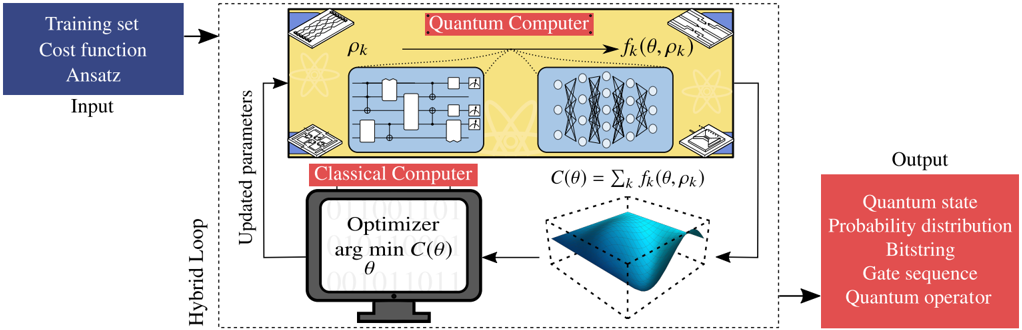
Applications such as simulating complicated quantum systems or solving large-scale linear algebra problems are very challenging for classical computers, owing to the extremely high computational cost. Quantum computers promise a solution, although fault-tolerant quantum computers will probably not be available in the near future. Current quantum devices have serious constraints, including limited numbers of qubits and noise processes that limit circuit depth. Variational quantum algorithms (VQAs), which use a classical optimizer to train a parameterized quantum circuit, have emerged as a leading strategy to address these constraints. VQAs have now been proposed for essentially all applications that researchers have envisaged for quantum computers, and they appear to be the best hope for obtaining quantum advantage. Nevertheless, challenges remain, including the trainability, accuracy and efficiency of VQAs. Here we overview the field of VQAs, discuss strategies to overcome their challenges and highlight the exciting prospects for using them to obtain quantum advantage. The advent of commercial quantum devices has ushered in the era of near-term quantum computing. Variational quantum algorithms are promising candidates to make use of these devices for achieving a practical quantum advantage over classical computers. Variational quantum algorithms (VQAs) are the leading proposal for achieving quantum advantage using near-term quantum computers. VQAs have been developed for a wide range of applications, including finding ground states of molecules, simulating dynamics of quantum systems and solving linear systems of equations. VQAs share a common structure, where a task is encoded into a parameterized cost function that is evaluated using a quantum computer, and a classical optimizer trains the parameters in the VQA. The adaptive nature of VQAs is well suited to handle the constraints of near-term quantum computers. Trainability, accuracy and efficiency are three challenges that arise when applying VQAs to large-scale applications, and strategies are currently being developed to address these challenges. Variational quantum algorithms (VQAs) are the leading proposal for achieving quantum advantage using near-term quantum computers. VQAs have been developed for a wide range of applications, including finding ground states of molecules, simulating dynamics of quantum systems and solving linear systems of equations. VQAs share a common structure, where a task is encoded into a parameterized cost function that is evaluated using a quantum computer, and a classical optimizer trains the parameters in the VQA. The adaptive nature of VQAs is well suited to handle the constraints of near-term quantum computers. Trainability, accuracy and efficiency are three challenges that arise when applying VQAs to large-scale applications, and strategies are currently being developed to address these challenges.
Verified 2026-11-25 · 1 reference not checked yet
Overview
CoChat Summary
TL;DR
Variational quantum algorithms (VQAs) train parametrized quantum circuits with a classical optimizer and are presented as the leading strategy for obtaining quantum advantage on noisy intermediate-scale quantum (NISQ) devices. The review surveys VQA components, applications, challenges, and prospects, emphasizing that trainability, accuracy, and efficiency remain central obstacles.
Key findings
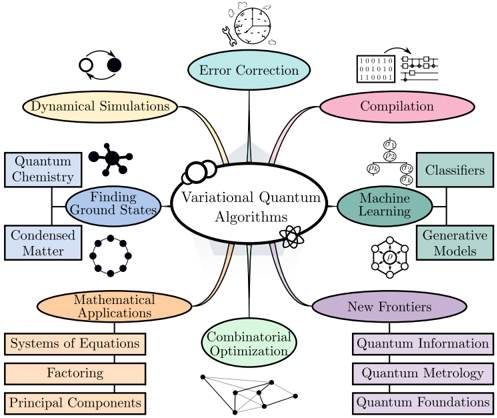
- VQAs have been proposed for essentially all applications envisioned for quantum computers, including finding ground and excited states, dynamical quantum simulation, combinatorial optimization, linear systems, compiling, error correction, machine learning, and metrology.
- Current state-of-the-art device size ranges from 50 to 100 qubits, and VQAs are argued to be the best hope for near-term quantum advantage because they keep circuit depth shallow and outsource parameter optimization to classical optimizers.
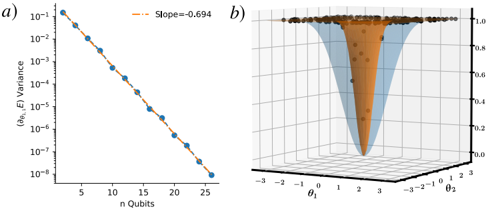
- Trainability is threatened by barren plateaus, where cost-function partial derivatives vanish exponentially with system size on average; noise can also induce barren plateaus regardless of the ansatz.
- Resource and scaling examples reported include: VQE requires \(O(1/\epsilon^2)\) measurements for precision \(\epsilon\), whereas quantum phase estimation requires \(O(\log(1/\epsilon))\); chemical Hamiltonians have Pauli-string counts scaling as \(n^4\), with commuting groupings reducing measurement scaling to \(n^3\); classical shadows scale logarithmically with \(n\); and a variational quantum linear solver study used \(n=10,\ldots,30\) qubits for Ising-inspired systems and \(n=2,\ldots,7\) qubits for random sparse linear systems.
Methods
- Design: narrative review/overview of the VQA field, not a primary experimental or theoretical study.
- Data or sample: no primary data or sample; the paper synthesizes prior literature and cites numerical and experimental results from other works.
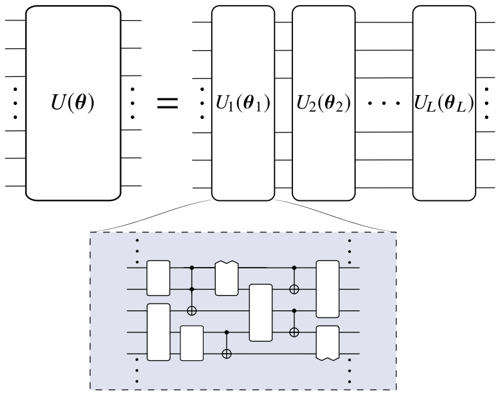
- Main analysis: conceptual description of VQA architecture (cost function, ansatz, gradients, optimizers), applications, challenges, and opportunities for near-term quantum advantage.
Limitations
- The paper states that challenges remain including the trainability, accuracy, and efficiency of VQAs, and that barren plateaus could erase a potential quantum advantage.
- The paper states that the degree to which error mitigation can correct noise effects is still an open question, and that measurement efficiency is not guaranteed even without barren plateaus.
- Evident from the text: as a review, it presents no new experimental results, and many performance claims rely on cited heuristic or numerical studies rather than a systematic meta-analysis.
Model-written summary. Check it against the paper before relying on it.
Integrity signals
Registry
Cites
Statistics
Figures
Verification
Claims the paper makes
53 Valid · 74 Not valid · 51 Not checked · 84 Own results and interpretations
At least one cited source doesn’t support this claim or points to a different paper, and none confirmed it — see the verdicts below.
In the paper
“Hence, a VQA for factoring as a potential near-term alternative was introduced in Ref. [145].”
What the sources say
- Disputedcites [145] [145] Eric Anschuetz, Jonathan Olson, Alán Aspuru-Guzik, and Yudong Cao, 'Variational quantum factoring,' in International Workshop on Quantum Technology and Optimization Problems (Springer, 2019) pp. 74-85. - sourceExperimental — accuracy not yet measured
The Introduction says factoring is typically a longer-term application because of its high resource requirements, while identifying other applications as nearer term. The paper introduces variational quantum state diagonalization, not a variational algorithm for factoring. (LLM, conf=0.88)
Checked by a reasoning model — may be wrong.
plain- Asserted: passes — The authors put it forward as true.
- Checkable: passes — It can be checked against evidence.
- Load-bearing: unclear — It is unclear whether the paper’s conclusions depend on it.
- Based: passes — The paper gives a reason why it holds.
- Disputed
At least one cited source doesn’t support this claim or points to a different paper, and none confirmed it — see the verdicts below.
In the paper
“This qubit requirement can be reduced with the VQA of Ref. [113], which requires only n qubits.”
What the sources say
- Disputedcites [113] [113] M. Cerezo, Kunal Sharma, Andrew Arrasmith, and Patrick J Coles, 'Variational quantum state eigensolver,' arXiv preprint arXiv:2004.01372 (2020). - sourceExperimental — accuracy not yet measured
Section II B (p. 3) describes an (n+1)-qubit controlled sign flip in the proposed algorithm and says its cited implementation requires additional ancillas. That contradicts the claim that this VQA requires only n qubits; the paper discusses reductions in measurements and circuit depth, not a reduction to n qubits. (LLM, conf=0.84)
Checked by a reasoning model — may be wrong.
plainstates a cause- Asserted: passes — The authors put it forward as true.
- Checkable: passes — It can be checked against evidence.
- Load-bearing: unclear — It is unclear whether the paper’s conclusions depend on it.
- Based: passes — The paper gives a reason why it holds.
- Disputed
The cited sources that could be checked couldn’t confirm or dispute this claim.
In the paper
“The classical optimization problems associated with VQAs are expected to be NP-hard in general as they involve cost functions that can have many local minima [94].”
What the sources say
- Could not verifycites [94] [94] Lennart Bittel and Martin Kliesch, 'Training variational quantum algorithms is np-hard-even for logarithmically many qubits and free fermionic systems,' arXiv preprint arXiv:2101.07267 (2021). - sourceExperimental — accuracy not yet measured
The Introduction (p. 1) describes hybrid quantum-classical cost functions and the need for gradients, but does not address the complexity of optimizing them. Searches for “NP-hard,” “local minima,” and related terms found no passage saying that VQA optimization is generally NP-hard or attributing that difficulty to many local minima. (LLM, conf=0.74)
hedgedstates a cause- Asserted: passes — The authors put it forward as true.
- Checkable: passes — It can be checked against evidence.
- Load-bearing: unclear — It is unclear whether the paper’s conclusions depend on it.
- Based: passes — The paper gives a reason why it holds.
- Could not verify
The cited sources that could be checked couldn’t confirm or dispute this claim.
In the paper
“Numerical simulations showed that QVECTOR can find quantum codes that outperform existing ones [152].”
What the sources say
- Could not verifycites [152] [152] Peter D Johnson, Jonathan Romero, Jonathan Olson, Yudong Cao, and Alán Aspuru-Guzik, 'Qvector: an algorithm for device-tailored quantum error correction,' arXiv preprint arXiv:1711.02249 (2017). - sourceExperimental — accuracy not yet measured
The closest discussion in our copy, “Designing and controlling quantum systems” (p. 12), concerns machine-learning methods for improving quantum gates, not finding quantum codes. Searches for QVECTOR and for simulations of codes outperforming existing ones found no passage addressing the claim. (LLM, conf=0.76)
plainstates a cause- Asserted: passes — The authors put it forward as true.
- Checkable: passes — It can be checked against evidence.
- Load-bearing: passes — The paper’s conclusions depend on it.
- Based: passes — The paper gives a reason why it holds.
- Could not verify
The cited sources that could be checked couldn’t confirm or dispute this claim.
In the paper
“The importance of parameter initialization was made clear in Ref. [204] where it was noted that the optimal parameters in QAOA exhibit persistent patterns.”
What the sources say
- Could not verifycites [204] [204] Leo Zhou, Sheng-Tao Wang, Soonwon Choi, Hannes Pichler, and Mikhail D Lukin, 'Quantum approximate optimization algorithm: Performance, mechanism, and implementation on near-term devices,' Physical Review X 10 , 021067 (2020). - sourceExperimental — accuracy not yet measured
Appendix C (page unavailable) studies QAOA with parameters constrained to be equal across layers and describes that approach as suboptimal for the ring-of-disagrees problem. The Introduction and Conclusions discuss parameter correlation and trainability, but the passages found do not say that optimal QAOA parameters exhibit persistent patterns (searched: optimal parameters, QAOA patterns, initialization). (LLM, conf=0.76)
boosted- Asserted: passes — The authors put it forward as true.
- Checkable: passes — It can be checked against evidence.
- Load-bearing: passes — The paper’s conclusions depend on it.
- Based: passes — The paper gives a reason why it holds.
- Could not verify
125 more claims · 57 with their cited sources checked
Create a free account to see all 262 claims and to verify the 42 references still open.
- Probably not a substantial claim. 94
- It may state two separate claims as one. 57
Claims other papers make about this one
Each is checked against this paper’s own text: does it say what the citing paper says it does?
The source backs part of the claim, not all of it — or backs it for a different population, condition or comparison.
In the citing paper
“Google's recent proof of quantum supremacy is a major step forward for quantum computing [15].”
From Quantum Computing: Vision and Challenges (2025) · cites this paper as [15]
Experimental — accuracy not yet measuredThe cited source says what the claim attributes to it.
In the citing paper
“An important class of algorithms for NISQ hardware are socalled hybrid quantum-classical algorithms that partition the computational workload between a classical and a quantum computer.[124,125]”
From Quantum Computing for Molecular Biology** (2023) · cites this paper as [125]
The cited source says what the claim attributes to it.
In the citing paper
“In this regard, References [164] and [171] focus on gate-based algorithms that can be implemented on NISQ devices and therefore may be applied to various application areas with CO just as one example of those.”
From Quantum Combinatorial Optimization in the NISQ Era: A Systematic Mapping Study (2024) · cites this paper as [171]
Self-check
Percentages, sums and reported differences re-computed from the paper’s own numbers.
Each contradiction between two passages listed here was confirmed by an independent check.
Rated minor: it would not touch a result — a value no result rests on, a p-value that stays on the same side of the significance level, or a conflict that is clerical, resolved elsewhere in the paper, or outside its own findings.
In the paper
§ E. Error correction · p. 12
“two parametrized circuits V ( θ 1 ) (on n ≥ k qubits) and W ( θ 2 ) (on n + r qubits)”
§ E. Error correction · p. 12
“ρ out = W ( θ 1 ) V ( θ 1 )( ψ ⊗ | 0 〉〈 0 | ⊗ n -k + r ) V ( θ 1 ) † W ( θ 1 ) †”
Rated minor: it would not touch a result — a value no result rests on, a p-value that stays on the same side of the significance level, or a conflict that is clerical, resolved elsewhere in the paper, or outside its own findings.
In the paper
§ 1. Linear systems · p. 11
“the task is to prepare a normalized state | x 〉 such that A | x 〉 ∝ | b 〉”
§ 1. Linear systems · p. 11
“one can then construct a Hamiltonian whose ground state is the solution to the QLSP and apply a variational approach to minimize the cost C ( θ ) = 〈 ψ ( θ ) | H G | ψ ( ψ ) 〉 . Refs. [139-141] considered the Hamiltonian H G = A ( ✶ -| b 〉 〈 b | ) A †”
Citations
Cites
Adam: A Method for Stochastic Optimization
Kingma, D. P., & Ba, J. (2014) · arXiv · doi:10.48550/arxiv.1412.6980 · Cited by 98,946
Self-Consistent Equations Including Exchange and Correlation Effects
Kohn, W., & Sham, L. J. (1965) · Physical Review · doi:10.1103/physrev.140.a1133 · Cited by 64,135 · cited 1×
“Classical methods for materials simulations usually employ density-functional theory coupled with approximation methods, such as the local density approximation [234] to tackle weakly correlated materials.”
MethodQuantum Computing in the NISQ era and beyond
Preskill, J. (2018) · Quantum · doi:10.22331/q-2018-08-06-79 · Cited by 8,830 · cited 1×
“But excitement grew as to what could be done with these new devices, which have been called Noisy Intermediate-Scale Quantum (NISQ) computers [7].”
BackgroundAlgorithms for quantum computation: discrete logarithms and factoring
Shor, P. W. (2002) · Proceedings 35th Annual Symposium on Foundations of Computer Science · doi:10.1109/sfcs.1994.365700 · Cited by 8,713 · cited 1×
“Shor’s quantum algorithm was proposed to factor numbers with exponential speedup over classical methods [2], dynamical quantum simulation algorithms were developed [3], and quantum algorithms for solving linear systems of equations were identified [4].”
MethodQuantum Computation and Quantum Information: 10th Anniversary Edition
Nielsen, M. A., & Chuang, I. L. (2012) · doi:10.1017/cbo9780511976667 · Cited by 8,436
Quantum supremacy using a programmable superconducting processor
Arute, F., Arya, K., Babbush, R., Bacon, D., Bardin, J. C., Barends, R., Biswas, R., Boixo, S., Brandao, F. G. S. L., Buell, D. A., et al. (2019) · Nature · doi:10.1038/s41586-019-1666-5 · Cited by 7,720 · cited 1×
“This size actually allows one to achieve quantum supremacy, outperforming the best classical supercomputer, for certain contrived mathematical tasks [8, 9].”
BackgroundSelf-citationDensity matrix formulation for quantum renormalization groups
White, S. R. (1992) · Physical Review Letters · doi:10.1103/physrevlett.69.2863 · Cited by 7,702 · cited 1×
“These include approximate methods such as Hartree-Fock or density functional theory, or methods closely connected to quantum information, like the density matrix renormalization group approach that utilizes matrix product states as an ansatz [224, 225].”
MethodBiamonte, J., Wittek, P., Pancotti, N., Rebentrost, P., Wiebe, N., & Lloyd, S. (2017) · Nature · doi:10.1038/nature23474 · Cited by 4,779 · cited 1×
“to use quantum algorithms for machine learning applications [134, 148, 256, 257].”
MethodA variational eigenvalue solver on a photonic quantum processor
Peruzzo, A., McClean, J., Shadbolt, P., Yung, M.-H., Zhou, X.-Q., Love, P. J., Aspuru-Guzik, A., & O’Brien, J. L. (2014) · Nature Communications · doi:10.1038/ncomms5213 · Cited by 4,552 · cited 3×
“3, VQE is aimed at finding the ground state energy EG of a Hamiltonian H [16].”
BackgroundMethodSelf-citationQuantum Algorithm for Linear Systems of Equations
Harrow, A. W., Hassidim, A., & Lloyd, S. (2009) · Physical Review Letters · doi:10.1103/physrevlett.103.150502 · Cited by 3,325 · cited 2×
“The classical algorithmic complexity for this task scales polynomially in the dimension N , whereas the now-famous HHL quantum algorithm [4] has a complexity that scales logarithmically in N , with some scaling improvements having been proposed [113– 116].”
BackgroundMethod
Research works printed but not linked: 12
- [4] 'IBM Makes Quantum Computing Available on IBM Cloud to Accelerate Innovation,' (2016), press release at https://www-03.ibm.com/press/us/ en/pressrelease/49661.wss . -
- Bilkis, M., Cerezo, M., Verdon, G., Coles, P. J. & Cincio, L. A semi-agnostic ansatz with variable structure for quantum machine learning. Preprint at https://arxiv.org/abs/2103.06712 (2021). · arXiv
- [35] Arthur G Rattew, Shaohan Hu, Marco Pistoia, Richard Chen, and Steve Wood, 'A domain-agnostic, noiseresistant, hardware-efficient evolutionary variational quantum eigensolver,' arXiv preprint arXiv:1910.09694 (2019). - · arXiv
- [115] Guoming Wang, Dax Enshan Koh, Peter D Johnson, and Yudong Cao, 'Minimizing estimation runtime on noisy quantum computers,' Phys. Rev. X Quantum 2 , 010346 (2021). -
- [134] A Ambainis, 'Variable time amplitude amplification and a faster quantum algorithm for solving systems of linear equations 29th int,' in Symp. Theoretical Aspects of Computer Science (STACS 2012) , Vol. 14 (2012) pp. 636-47. -
- [159] Edwin Stoudenmire and David J Schwab, 'Supervised learning with tensor networks,' in Advances in Neural Information Processing Systems (2016) pp. 4799-4807. -
- [178] Lukas Franken and Bogdan Georgiev, 'Explorations in quantum neural networks with intermediate measurements,' in Proceedings of ESANN (2020). -
- [264] Bela Bauer, Dave Wecker, Andrew J Millis, Matthew B Hastings, and Matthias Troyer, 'Hybrid quantumclassical approach to correlated materials,' Physical Review X 6 , 031045 (2016). -
- [269] Hsuan-Hao Lu, Natalie Klco, Joseph M Lukens, Titus D Morris, Aaina Bansal, Andreas Ekström, Gaute Hagen, Thomas Papenbrock, Andrew M Weiner, Martin J Savage, et al. , 'Simulations of subatomic manybody physics on a quantum frequency processor,' Physical Review A 100 , 012320 (2019). -
- [271] Julian Bender, Erez Zohar, Alessandro Farace, and J Ignacio Cirac, 'Digital quantum simulation of lattice gauge theories in three spatial dimensions,' New Journal of Physics 20 , 093001 (2018). -
- [277] A Avkhadiev, PE Shanahan, and RD Young, 'Accelerating lattice quantum field theory calculations via interpolator optimization using noisy intermediate-scale quantum computing,' Physical Review Letters 124 , 080501 (2020). -
- [293] Yuval R Sanders, Dominic W Berry, Pedro CS Costa, Louis W Tessler, Nathan Wiebe, Craig Gidney, Hartmut Neven, and Ryan Babbush, 'Compilation of faulttolerant quantum heuristics for combinatorial optimization,' Physical Review X Quantum 1 , 020312 (2020).
Cited by
Items 301–400 of 3,232
Sushmit, M. M., & Mahbubul, I. M. (2023) · Energy Conversion and Management · doi:10.1016/j.enconman.2023.117555 · Cited by 42
A Conceptual Architecture for a Quantum-HPC Middleware
Saurabh, N., Jha, S., & Luckow, A. (2023) · IEEE International Conference on Quantum Software (QSW) · doi:10.1109/qsw59989.2023.00023 · Cited by 58
“For example, variational algorithms [2] depend on classical optimization and quantum error correction codes require significant classical computation of the syndrome measurements.”
BackgroundMethodPaving the way to hybrid quantum–classical scientific workflows
Cranganore, S. S., Maio, V. D., Brandić, I., & Deelman, E. (2024) · Future Generation Computer Systems · doi:10.1016/j.future.2024.04.030 · Cited by 55
“…3c) represents computations involving interaction between classic and quantum hardware, similar to what happens with Variational Quantum Algorithms [44], where a quantum state modeling the solution to a specific problem is modeled as a parametrized quantum circuit with a vector of parameters ⃗ Θ ,…”
BackgroundMethodInfluentialCharacterizing Grover search algorithm on large-scale superconducting quantum computers
AbuGhanem, M. (2025) · Scientific Reports · doi:10.1038/s41598-024-80188-6 · Cited by 63
Unitary Selective Coupled-Cluster Method
Fedorov, D. A., Alexeev, Y., Gray, S. K., & Otten, M. (2022) · Quantum · doi:10.22331/q-2022-05-02-703 · Cited by 53
“A more detailed description can be found in several recent, comprehensive reviews.[7, 9, 10, 40] The”
BackgroundShkolnikov, V. O., Mayhall, N. J., Economou, S. E., & Barnes, E. (2023) · Quantum · doi:10.22331/q-2023-06-12-1040 · Cited by 81
High-fidelity realization of the AKLT state on a NISQ-era quantum processor
Chen, T., Shen, R., Lee, C. H., & Yang, B. (2023) · SciPost Physics · doi:10.21468/scipostphys.15.4.170 · Cited by 58
“On today’s NISQ-era quantum computers, we are aware that the Variational Quantum Algorithms (VQAs) are effective methods for the current NISQ-era device [76, 77] with reduced number of gates.”
Hybrid Quantum-Classical Recurrent Neural Networks for Time Series Prediction
Ceschini, A., Rosato, A., & Panella, M. (2022) · International Joint Conference on Neural Networks (IJCNN) · doi:10.1109/ijcnn55064.2022.9892441 · Cited by 40
“Variational Quantum Circuits (VQCs) are currently the most straightforward yet effective way to take advantage of near-term quantum computers [9]–[11].”
BackgroundMethodChoi, S., Loaiza, I., & Izmaylov, A. F. (2023) · Quantum · doi:10.22331/q-2023-01-03-889 · Cited by 51
Exponential data encoding for quantum supervised learning
Shin, S., Teo, Y. S., & Jeong, H. (2023) · Physical Review A · doi:10.1103/physreva.107.012422 · Cited by 76
Investigating the effect of circuit cutting in QAOA for the MaxCut problem on NISQ devices
Bechtold, M., Barzen, J., Leymann, F., Mandl, A., Obst, J., Truger, F., & Weder, B. (2023) · Quantum Science and Technology · doi:10.1088/2058-9565/acf59c · Cited by 60
“This includes the class of Variational Quantum Algorithms (VQAs) that repeatedly run a parameterized quantum circuit, the so-called ansatz , on a quantum device and utilize a classical optimizer for parameter optimization [6].”
BackgroundMethodDeep Quantum-Transformer Networks for Multimodal Beam Prediction in ISAC Systems
Tariq, S., Arfeto, B. E., Khalid, U., Kim, S., Duong, T. Q., & Shin, H. (2024) · IEEE Internet of Things Journal · doi:10.1109/jiot.2024.3420455 · Cited by 55
“The classical position-based data is processed using parameterized quantum circuits (PQCs) [37].”
MethodTwo quantum algorithms for solving the one-dimensional advection–diffusion equation
Ingelmann, J., Bharadwaj, S. S., Pfeffer, P., Sreenivasan, K. R., & Schumacher, J. (2024) · Computers & Fluids · doi:10.1016/j.compfluid.2024.106369 · Cited by 53
“The optimal parameter set ( λ ∗ 0 , λ ∗ ) initializes the ansatz function such that the solution of the given problem can be observed [38].”
BackgroundInfluentialHybrid Quantum-Classical Neural Networks for Downlink Beamforming Optimization
Zhang, J., Zheng, G., Koike–Akino, T., Wong, K., & Burton, F. A. (2024) · IEEE Transactions on Wireless Communications · doi:10.1109/twc.2024.3442091 · Cited by 44
“In this regard, variational quantum algorithms (VQA) [44], [45] have been proposed as a promising method to achieve quantum advantages on the NISQ devices.”
Structural risk minimization for quantum linear classifiers
Gyurik, C., Vreumingen, V. D., & Dunjko, V. (2023) · Quantum · doi:10.22331/q-2023-01-13-893 · Cited by 56
“It has been argued that some of the most promising NISQ-suitable algorithms are those that rely on parameterized quantum circuits (also called variational quantum circuits) [5, 6].”
BackgroundQuantum approximate optimization algorithm with adaptive bias fields
Yu, Y., Cao, C., Dewey, C., Wang, X., Shannon, N., & Joynt, R. (2022) · Physical Review Research · doi:10.1103/physrevresearch.4.023249 · Cited by 52
Optimal Tuning of Quantum Generative Adversarial Networks for Multivariate Distribution Loading
Agliardi, G., & Prati, E. (2022) · Quantum Reports · doi:10.3390/quantum4010006 · Cited by 39
Lumia, L., Torta, P., Mbeng, G. B., Santoro, G. E., Ercolessi, E., Burrello, M., & Wauters, M. M. (2022) · PRX Quantum · doi:10.1103/prxquantum.3.020320 · Cited by 48
BEINIT: Avoiding Barren Plateaus in Variational Quantum Algorithms
Kulshrestha, A., & Safro, I. (2022) · IEEE International Conference on Quantum Computing and Engineering (QCE) · doi:10.1109/qce53715.2022.00039 · Cited by 75
“Although our results are derived for the specific case of QNN, we believe that these results are general enough for any VQA application.”
BackgroundInfluentialTammaro, A., Galli, D. E., Rice, J. E., & Motta, M. (2023) · The Journal of Physical Chemistry A · doi:10.1021/acs.jpca.2c07653 · Cited by 37
Perturbative Quantum Simulation
Sun, J., Endo, S., Lin, H., Hayden, P. M., Vedral, V., & Yuan, X. (2022) · Physical Review Letters · doi:10.1103/physrevlett.129.120505 · Cited by 48
Self-citationUkpabi, D. C., Karjaluoto, H., Bötticher, A., Nikiforova, A., Petrescu, D., Schindler, P., Valtenbergs, V., & Lehmann, L. (2023) · Futures · doi:10.1016/j.futures.2023.103277 · Cited by 38
Rice Yield Forecasting Using Hybrid Quantum Deep Learning Model
Setiadi, D. R. I. M., Susanto, A., Nugroho, K., Muslikh, A. R., Ojugo, A. A., & Gan, H. (2024) · Computers · doi:10.3390/computers13080191 · Cited by 59
Variational Quantum Simulation: A Case Study for Understanding Warm Starts
Puig, R., Drudis, M., Thanasilp, S., & Holmes, Z. (2025) · PRX Quantum · doi:10.1103/prxquantum.6.010317 · Cited by 89
“Then we can expand the function f around the point y as for some z = c x + (1 − c ) y with some c ∈ [0 , 1].”
Quantum Gate for a Kerr Nonlinear Parametric Oscillator Using Effective Excited States
Kanao, T., Masuda, S., Kawabata, S., & Goto, H. (2022) · Physical Review Applied · doi:10.1103/physrevapplied.18.014019 · Cited by 42
Variational quantum eigensolver techniques for simulating carbon monoxide oxidation
Sapova, M. D., & Fedorov, A. K. (2022) · Communications Physics · doi:10.1038/s42005-022-00982-4 · Cited by 49
Variational quantum attacks threaten advanced encryption standard based symmetric cryptography
Wang, Z., Wei, S., Long, G., & Hanzo, L. (2022) · Science China Information Sciences · doi:10.1007/s11432-022-3511-5 · Cited by 43
“Under these restrictions, various classical-quantum hybrid algorithms, including the variational quantum algorithm (VQA) [19–22], and the Quantum Approximate Optimization Algorithm (QAOA) [23] have been proposed.”
Non-trivial symmetries in quantum landscapes and their resilience to quantum noise
Fontana, E., Cerezo, M., Arrasmith, A., Rungger, I., & Coles, P. J. (2022) · Quantum · doi:10.22331/q-2022-09-15-804 · Cited by 67
“Arguably, the leading role has been played by Parametrized Quantum Circuits (PQCs), which are exploited for both Variational Quantum Algorithms [2, 3, 4, 5, 6, 7, 8, 9, 10, 11, 12, 13, 14] and Quantum Neural Networks [15, 16, 17, 18, 19].”
MethodSelf-citationPeptide conformational sampling using the Quantum Approximate Optimization Algorithm
Boulebnane, S., Lucas, X., Meyder, A., Adaszewski, S., & Montanaro, A. (2023) · npj Quantum Information · doi:10.1038/s41534-023-00733-5 · Cited by 32
“QAOA is a variational quantum algorithm [18] designed to (approximately) minimize a classical cost function H(x) depending on n binary variables x ∈ {0, 1}.”
BackgroundNon-trivial symmetries in quantum landscapes and their resilience to quantum noise
Fontana, E., Cerezo, M., Arrasmith, A., Rungger, I., & Coles, P. J. (2020) · arXiv · doi:10.48550/arxiv.2011.08763 · Cited by 32
Self-citationNoisy intermediate-scale quantum algorithm for semidefinite programming
Bharti, K., Haug, T., Vedral, V., & Kwek, L. C. (2022) · Physical Review A · doi:10.1103/physreva.105.052445 · Cited by 46
Solving various NP-hard problems using exponentially fewer qubits on a quantum computer
Chatterjee, Y., Bourreau, E., & Rančić, M. J. (2024) · Physical Review A · doi:10.1103/physreva.109.052441 · Cited by 57
Climate Change Through Quantum Lens: Computing and Machine Learning
Rahman, S. M., Alkhalaf, O. H., Alam, M. S., Tiwari, S. P., Shafiullah, M., Al-Judaibi, S. M., & Al–Ismail, F. S. (2024) · Earth Systems and Environment · doi:10.1007/s41748-024-00411-2 · Cited by 44
“Generative adversarial networks (GANs), consisting of competing generator and discriminator, are cornerstone constructs in classical machine learning, primordial for tasks necessitating understanding and replicating data set distributions.”
InfluentialNonlinear dynamics as a ground-state solution on quantum computers
Pool, A. J., Somoza, A. D., Keever, C. M., Lubasch, M., & Horstmann, B. (2024) · Physical Review Research · doi:10.1103/physrevresearch.6.033257 · Cited by 57
“On NISQ devices, variational quantum algorithms (VQAs) have become a popular approach to solving PDEs [39].”
MethodSimulating Noisy Variational Quantum Algorithms: A Polynomial Approach
Shao, Y., Wei, F., Cheng, S., & Liu, Z. (2024) · Physical Review Letters · doi:10.1103/physrevlett.133.120603 · Cited by 102
“In the current Noisy Intermediate-Scale Quantum (NISQ) era [1–3], Variational Quantum Algorithms (VQAs) [4–6] play a significant role in diverse fields like combinatorial optimization [7, 8], quantum chemistry [9– 11], quantum machine learning [12–15], quantum circuit compilation [16], and quantum…”
BackgroundAifer, M., Donatella, K., Gordon, M. H., Duffield, S., Ahle, T. D., Simpson, D., Crooks, G. E., & Coles, P. J. (2024) · npj Unconventional Computing · doi:10.1038/s44335-024-00014-0 · Cited by 59
“More generally building large-scale quantum hardware has remained difficult [7], and variational quantum algorithms for linear algebra [8–10] have battled with vanishing gradient issues [11–13].”
BackgroundSelf-citationWiersema, R., Kökcü, E., Kemper, A. F., & Bakalov, B. (2024) · npj Quantum Information · doi:10.1038/s41534-024-00900-2 · Cited by 122
QSAN: A Near-Term Achievable Quantum Self-Attention Network
Shi, J., Zhao, R.-X., Wang, W., Zhang, S., & Li, X. (2024) · IEEE Transactions on Neural Networks and Learning Systems · doi:10.1109/tnnls.2024.3504828 · Cited by 72
“Till 2022, a Gaussian projection-based neural network first utilizing Variational Quantum Algorithm (VQA) [22] to construct the SAM was successful in a text categorization task, ushering in a new era of QAM deployment on noisy intermediate-scale quantum (NISQ) [23] devices [24].”
Quantum Algorithms and Applications for Open Quantum Systems
Delgado-Granados, L. H., Krogmeier, T. J., Sager-Smith, L. M., Avdic, I., Hu, Z., Sajjan, M., Abbasi, M., Smart, S. E., Narang, P., Kais, S., et al. (2025) · Chemical Reviews · doi:10.1021/acs.chemrev.4c00428 · Cited by 68
How quantum computing can enhance biomarker discovery
Flöther, F. F., Blankenberg, D. J., Demidik, M., Jansen, K., Krishnakumar, R., Krishnakumar, R., Laanait, N., Parida, L., Saab, C. Y., & Utro, F. (2025) · Patterns · doi:10.1016/j.patter.2025.101236 · Cited by 62
“Specifically, the embedding of classical data into Hilbert space and subsequent operations should be tailored to an application and available hardware.”
Improving Quantum Measurements by Introducing “Ghost” Pauli Products
Choi, S., Yen, T.-C., & Izmaylov, A. F. (2022) · Journal of Chemical Theory and Computation · doi:10.1021/acs.jctc.2c00837 · Cited by 47
Pulse based Variational Quantum Optimal Control for hybrid quantum computing
de Keijzer, R., Tse, O. T. C., & Kokkelmans, S. J. J. M. F. (2023) · Quantum · doi:10.22331/q-2023-01-26-908 · Cited by 51
Problem-Dependent Power of Quantum Neural Networks on Multiclass Classification
Du, Y., Yang, Y., Tao, D., & Hsieh, M.-H. (2023) · Physical Review Letters · doi:10.1103/physrevlett.131.140601 · Cited by 74
Quantum Graph Neural Network Models for Materials Search
Ryu, J.-Y., Elala, E., & Rhee, J. K. (2023) · Materials · doi:10.3390/ma16124300 · Cited by 48
“Such a 146 Variational quantum algorithms are hybrid algorithms where a quantum computer and a classical computer work together in an iterative fashion to solve a problem [48]. data samples to output predictions or loss function values.”
MethodAli, M., & Kabel, M. (2023) · Physical Review Applied · doi:10.1103/physrevapplied.20.014054 · Cited by 53
“Hybrid methods have gained a lot of attention [9] as the class of methods for NISQ devices, including applications to PDEs [10–12].”
MethodInfluentialRecent Advances in Deep Learning for Channel Coding: A Survey
Matsumine, T., & Ochiai, H. (2024) · IEEE Open Journal of the Communications Society · doi:10.1109/ojcoms.2024.3472094 · Cited by 46
“…noisy intermediate-scale quantum (NISQ) era [445], where the fidelity of quantum gates is limited by noise and decoherence, hybrid quantum-classical algorithms such as variational quantum eigensolver (VQE) [446] and quantum approximate optimization algorithm (QAOA) [447] are promising [448], [449].”
Classically Estimating Observables of Noiseless Quantum Circuits
Angrisani, A., Schmidhuber, A., Rudolph, M. S., Cerezo, M., Holmes, Z., & Huang, H.-Y. (2025) · Physical Review Letters · doi:10.1103/lh6x-7rc3 · Cited by 173
“(E45) imply that We emphasize that the first part of Lemma 28 hold for generic – possibly non-local – observables, and thus Lemma 28 might outperform Lemma 26 whenever there exists a non-trivial bound for ∥ O (low) ∥ .”
Self-citationMitarai, K., Suzuki, Y., Mizukami, W., Nakagawa, Y. O., & Fujii, K. (2022) · Physical Review Research · doi:10.1103/physrevresearch.4.033012 · Cited by 39
Self-citationEstimating distinguishability measures on quantum computers
Rethinasamy, S., Agarwal, R., Sharma, K., & Wilde, M. M. (2023) · Physical Review A · doi:10.1103/physreva.108.012409 · Cited by 60
Pastori, L., Olsacher, T., Kokail, C., & Zoller, P. (2022) · PRX Quantum · doi:10.1103/prxquantum.3.030324 · Cited by 62
“The development of quantum simulators is presently considered to be one of the most promising near term goals in quantum technologies, where problems of practical relevance from condensed matter physics [3] to high energy physics [4] or quantum chemistry [5, 6] can be addressed in regimes potentially beyond the abilit…”
BackgroundA GNN-based predictor for quantum architecture search
He, Z., Zhang, X., Chen, C., Huang, Z., Zhou, Y., & Situ, H. (2023) · Quantum Information Processing · doi:10.1007/s11128-023-03881-x · Cited by 46
“Variational quantum algorithms (VQAs) [2, 3] have been the leading strategy to obtain quantum advantage in the NISQ era due to their resilience to errors and high flexibility with respect to quantum resource requirements including circuit depth and the number of qubits [2, 4–7].”
BackgroundBudiyono, A. (2023) · Physical Review A · doi:10.1103/physreva.108.012431 · Cited by 38
Variational Quantum Simulators Based on Waveguide QED
Tabares, C., Heras, A. M. D. L., Tagliacozzo, L., Porras, D., & González-Tudela, A. (2023) · Physical Review Letters · doi:10.1103/physrevlett.131.073602 · Cited by 44
Quantum-Empowered Federated Learning in Space-Air-Ground Integrated Networks
Wang, T., Li, P., Wu, Y., Qian, L., Su, Z., & Lu, R. (2023) · IEEE Network · doi:10.1109/mnet.2023.3318083 · Cited by 35
Variational quantum simulation of U(1) lattice gauge theories with qudit systems
Popov, P. P., Meth, M., Lewenstein, M., Hauke, P., Ringbauer, M., Zohar, E., & Kasper, V. (2024) · Physical Review Research · doi:10.1103/physrevresearch.6.013202 · Cited by 47
Variational quantum algorithm for experimental photonic multiparameter estimation
Cimini, V., Valeri, M., Piacentini, S., Ceccarelli, F., Corrielli, G., Osellame, R., Spagnolo, N., & Sciarrino, F. (2024) · npj Quantum Information · doi:10.1038/s41534-024-00821-0 · Cited by 53
“Variational Quantum Algorithms (VQAs) are emerging as a promising solution to achieve quantum advantage on the currently available Noisy Intermediate-Scale Quantum (NISQ) devices 1 .”
Designing quantum annealing schedules using Bayesian optimization
Finžgar, J. R., Schuetz, M. J. A., Brubaker, J. K., Nishimori, H., & Katzgraber, H. G. (2024) · Physical Review Research · doi:10.1103/physrevresearch.6.023063 · Cited by 52
Noisy intermediate-scale quantum simulation of the one-dimensional wave equation
Wright, L., Keever, C. M., First, J. T., Johnston, R., Tillay, J., Chaney, S., Rosenkranz, M., & Lubasch, M. (2024) · Physical Review Research · doi:10.1103/physrevresearch.6.043169 · Cited by 58
“Appendix B: Parameterised Quantum Circuits for state preparation Parameterised Quantum Circuits (PQCs) allow shallow but accurate representations of otherwise deep quantum circuits to be found variationally [58].”
BackgroundExplaining quantum circuits with Shapley values: towards explainable quantum machine learning
Heese, R., Gerlach, T., Mücke, S., Müller, S., Jakobs, M., & Piatkowski, N. (2025) · Quantum Machine Intelligence · doi:10.1007/s42484-025-00254-8 · Cited by 77
“Since the variational circuit is of central importance, this kind of hybrid ML pipeline is also referred to as variational quantum algorithm (VQA) (Cerezo et al. 2021).”
InfluentialVariational Quantum Circuits for Machine Learning. An Application for the Detection of Weak Signals
Griol-Barres, I., Milla, S., Cebrián, A., Mansoori, Y., & Millet, J. (2021) · Applied Sciences · doi:10.3390/app11146427 · Cited by 40
“…will be required. quantum algorithms (VQAs) [46–49] use classical optimizers to train quantum circuits and represent an advancement in quantum computing These quantum computers are not yet available, but noisy intermediate-scale quantum (NISQ) computers can already be used [45]. computers [50].”
BackgroundQuantum information scrambling: from holography to quantum simulators
Bhattacharyya, A., Joshi, L. K., & Sundar, B. (2022) · The European Physical Journal C · doi:10.1140/epjc/s10052-022-10377-y · Cited by 38
Quantum expectation-value estimation by computational basis sampling
Kohda, M., Imai, R., Kanno, K., Mitarai, K., Mizukami, W., & Nakagawa, Y. O. (2022) · Physical Review Research · doi:10.1103/physrevresearch.4.033173 · Cited by 52
“To reduce the total number of measurements, or equivalently, to suppress the standard deviation , a plenty of studies have been performed given the estimation of the expectation values is an indispensable subroutine of many variational quantum algorithms [2, 3].”
MethodSelf-citationTamiya, S., & Yamasaki, H. (2022) · npj Quantum Information · doi:10.1038/s41534-022-00592-6 · Cited by 57
“To compare the performance of the SGLBO with other state-ofthe-art optimizers, we numerically investigated two situations: (1) when the system size increases and (2) when the hardware noise is present.”
MethodInfluentialProbing many-body localization by excited-state variational quantum eigensolver
Liu, S., Zhang, S., Hsieh, C., Zhang, S., & Yao, H. (2023) · Physical review. B./Physical review. B · doi:10.1103/physrevb.107.024204 · Cited by 44
Large-Scale Simulation of Quantum Computational Chemistry on a New Sunway Supercomputer
Shang, H., Li, S., Fan, Y., Xu, Z., Guo, C., Liu, J., Zhou, W., Ma, H., Lin, R., Yang, Y., et al. (2022) · International Conference for High Performance Computing, Networking, Storage and Analysis (SC) · doi:10.1109/sc41404.2022.00019 · Cited by 59
“In the short term, variational quantum eigensolver (VQE) provides a promising heuristic algorithm on noisy quantum computers [4,5].”
BackgroundRobustness of quantum reinforcement learning under hardware errors
Skolik, A., Mangini, S., Bäck, T., Macchiavello, C., & Dunjko, V. (2023) · EPJ Quantum Technology · doi:10.1140/epjqt/s40507-023-00166-1 · Cited by 54
“The variational quantum algorithms (VQAs) that are used for this are trained in a hybrid fashion, where a classical optimizer is used to tune the parameters of a quantum circuit [2, 3].”
BackgroundMethodPolicy gradients using variational quantum circuits
Sequeira, A., Santos, L. P., & Barbosa, L. S. (2023) · Quantum Machine Intelligence · doi:10.1007/s42484-023-00101-8 · Cited by 59
“The main advantage of this family of ansatze is its versatility, accommodating encoding symmetries and bringing correlated qubits closer for depth reduction (Cerezo et al. 2021).”
BackgroundQuantum phase processing and its applications in estimating phase and entropies
Wang, Y., Zhang, L., Yu, Z., & Wang, X. (2023) · Physical Review A · doi:10.1103/physreva.108.062413 · Cited by 65
Liu, Z., Shen, P.-X., Li, W., Duan, L.-M., & Deng, D.-L. (2022) · Quantum Science and Technology · doi:10.1088/2058-9565/aca55d · Cited by 34
“The first sub-QNN is the parameterized quantum circuit (PQC), which has been widely used as a standard ansatz for quantum classifiers [57–63].”
Network intrusion detection based on variational quantum convolution neural network
Gong, C., Guan, W., Zhu, H., Gani, A., & Qi, H. (2024) · The Journal of Supercomputing · doi:10.1007/s11227-024-05919-y · Cited by 44
“Therefore, a hybrid quantum-classical algorithm was proposed to solve this problem [40, 41].”
Emulating two qubits with a four-level transmon qudit for variational quantum algorithms
Cao, S., Bakr, M. S., Campanaro, G., Fasciati, S. D., Wills, J., Lall, D., Shteynas, B., Chidambaram, V., Rungger, I., & Leek, P. (2024) · Quantum Science and Technology · doi:10.1088/2058-9565/ad37d4 · Cited by 51
Quantum machine learning for drowsiness detection with EEG signals
Lins, I. D., Araújo, L. M. M., Maior, C. B. S., Ramos, P. M. D. S., Moura, M. J. D. C., Ferreira–Martins, A. J., Chaves, R., & Canabarro, A. (2024) · Process Safety and Environmental Protection · doi:10.1016/j.psep.2024.04.032 · Cited by 38
West, M. T., Nakhl, A. C., Heredge, J., Creevey, F. M., Hollenberg, L. C. L., Sevior, M. E., & Usman, M. (2024) · Intelligent Computing · doi:10.34133/icomputing.0100 · Cited by 46
Robust Estimation of the Quantum Fisher Information on a Quantum Processor
Vitale, V., Rath, A., Jurcevic, P., Elben, A., Branciard, C., & Vermersch, B. (2024) · PRX Quantum · doi:10.1103/prxquantum.5.030338 · Cited by 62
Tight and Efficient Gradient Bounds for Parameterized Quantum Circuits
Letcher, A., Woerner, S., & Zoufal, C. (2024) · Quantum · doi:10.22331/q-2024-09-25-1484 · Cited by 54
“In this paper, we study optimization problems that can be formulated as a VQA [35], i.e., that can be reduced to the minimization of a loss function L ( θ ) = Tr U ( θ ) ρU † ( θ ) H , (1) induced by an n -qubit parameterized quantum circuit U ( θ ) , an initial state ρ , and a Hermitian observable…”
BackgroundEvolutionary Algorithms and Quantum Computing: Recent Advances, Opportunities, and Challenges
Rehman, J. U., Ulum, M. S., Shaffar, A. W., Hakim, A. A., Mujirin, Abdullah, Z., Al-Hraishawi, H., Chatzinotas, S., & Shin, H. (2025) · IEEE Access · doi:10.1109/access.2025.3530952 · Cited by 40
SpinQ Gemini: a desktop quantum computing platform for education and research
Hou, S., Feng, G., Wu, Z., Zou, H., Shi, W., Zeng, J., Cao, C., Yü, S., Sheng, Z., Rao, X., et al. (2021) · EPJ Quantum Technology · doi:10.1140/epjqt/s40507-021-00109-8 · Cited by 48
“Variational quantum algorithms (VQA) [72–78], a class of algorithms under the hybrid quantum-classical framework, are more promising to have practical applications on noisy intermediate-scale quantum computers [79].”
BackgroundBenchmarking variational quantum eigensolvers for the square-octagon-lattice Kitaev model
Li, A. C. Y., Alam, M. S., Iadecola, T., Jahin, A., Job, J., Kürkçüog̃lu, D. M., Li, R., Orth, P. P., Özgüler, A. B., Perdue, G., et al. (2023) · Physical Review Research · doi:10.1103/physrevresearch.5.033071 · Cited by 39
Quantum integration of elementary particle processes
Agliardi, G., Grossi, M., Pellen, M., & Prati, E. (2022) · Physics Letters B · doi:10.1016/j.physletb.2022.137228 · Cited by 52
CNOT-Efficient Circuits for Arbitrary Rank Many-Body Fermionic and Qubit Excitations
Magoulas, I., & Evangelista, F. A. (2023) · Journal of Chemical Theory and Computation · doi:10.1021/acs.jctc.2c01016 · Cited by 39
Challenges in the Use of Quantum Computing Hardware-Efficient Ansätze in Electronic Structure Theory
D’Cunha, R., Crawford, T. D., Motta, M., & Rice, J. E. (2023) · The Journal of Physical Chemistry A · doi:10.1021/acs.jpca.2c08430 · Cited by 40
An invitation to distributed quantum neural networks
Pira, L., & Ferrie, C. (2023) · Quantum Machine Intelligence · doi:10.1007/s42484-023-00114-3 · Cited by 46
Multidimensional Fourier series with quantum circuits
Casas, B., & Cervera-Lierta, A. (2023) · Physical Review A · doi:10.1103/physreva.107.062612 · Cited by 45
Çalıkyılmaz, U., Groppe, S., Groppe, J., Winker, T., Prestel, S., Shagieva, F., Arya, D., Preis, F., & Gruenwald, L. (2023) · Proceedings of the VLDB Endowment · doi:10.14778/3598581.3598603 · Cited by 47
“Variational quantum algorithms (VQA) [23] are hybrid algorithms where parameterized quantum circuits, known as variational quantum circuits (VQC), are run and measured repeatedly by changing the values of the parameters.”
BackgroundError mitigation with Clifford quantum-circuit data
Czarnik, P., Arrasmith, A., Coles, P. J., & Cincio, L. (2021) · Quantum · doi:10.22331/q-2021-11-26-592 · Cited by 27
“It also includes variational quantum algorithms [3, 10, 18, 34, 40], some of which can be used to remove the effects of in-coherent noise [9, 29–31 , 42].”
MethodSelf-citationA Distributed Learning Scheme for Variational Quantum Algorithms
Du, Y., Qian, Y., Wu, X., & Tao, D. (2022) · IEEE Transactions on Quantum Engineering · doi:10.1109/tqe.2022.3175267 · Cited by 37
Fourier expansion in variational quantum algorithms
Nemkov, N. A., Kiktenko, E. O., & Fedorov, A. K. (2023) · Physical Review A · doi:10.1103/physreva.108.032406 · Cited by 53
Pirnay, N., Ulitzsch, V. Q., Wilde, F., Eisert, J., & Seifert, J. (2024) · Science Advances · doi:10.1126/sciadv.adj5170 · Cited by 66
Overcoming the coherence time barrier in quantum machine learning on temporal data
Hu, F., Khan, S. A., Bronn, N. T., Angelatos, G., Rowlands, G. E., Ribeill, G. J., & Türeci, H. E. (2024) · Nature Communications · doi:10.1038/s41467-024-51162-7 · Cited by 86
Lie-algebraic classical simulations for quantum computing
Goh, M. L., Larocca, M., Cincio, Ł., Cerezo, M., & Sauvage, F. (2025) · Physical Review Research · doi:10.1103/3y65-f5w6 · Cited by 147
“These encompass variational quantum algorithms (VQAs) [7, 8] and quantum machine learning (QML) methods [9–12], that most typically rely on the ability to optimize over parameters of quantum circuits.”
Self-citationFiltering states with total spin on a quantum computer
Siwach, P., & Lacroix, D. (2021) · Physical Review A · doi:10.1103/physreva.104.062435 · Cited by 39
Preparing exact eigenstates of the open XXZ chain on a quantum computer
Dyke, J. S. V., Barnes, E., Economou, S. E., & Nepomechie, R. I. (2021) · Journal of Physics A Mathematical and Theoretical · doi:10.1088/1751-8121/ac4640 · Cited by 36
“While there is a large ongoing effort to develop near-term algorithms, such as variational quantum eigensolvers (VQEs) [11, 12], to solve many-bodyproblems, it is not clear whether a quantum advantage can be achieved by VQEs on near-term hardware.”
Quantum neural network autoencoder and classifier applied to an industrial case study
Mangini, S., Marruzzo, A., Piantanida, M., Gerace, D., Bajoni, D., & Macchiavello, C. (2022) · Quantum Machine Intelligence · doi:10.1007/s42484-022-00070-4 · Cited by 44
Local Variational Quantum Compilation of Large-Scale Hamiltonian Dynamics
Mizuta, K., Nakagawa, Y. O., Mitarai, K., & Fujii, K. (2022) · PRX Quantum · doi:10.1103/prxquantum.3.040302 · Cited by 39
Self-citationEntanglement entropy production in Quantum Neural Networks
Ballarin, M., Mangini, S., Montangero, S., Macchiavello, C., & Mengoni, R. (2023) · Quantum · doi:10.22331/q-2023-05-31-1023 · Cited by 44
“the name of Quantum Machine Learning (QML) has recently begun to combine quantum computing and machine learning techniques in various ways, with the hope of achieving improvements in both fields [7, 8, 9, 10, 11].”
BackgroundArchitectural Vision for Quantum Computing in the Edge-Cloud Continuum
Furutanpey, A., Barzen, J., Bechtold, M., Dustdar, S., Leymann, F., Raith, P., & Truger, F. (2023) · IEEE International Conference on Quantum Software (QSW) · doi:10.1109/qsw59989.2023.00021 · Cited by 40
“The authors propose a set of microservices that model the typical quantum workflow based on Variational Quantum Algorithms (VQAs) [12].”
BackgroundQuantum Circuit Compiler for a Shuttling-Based Trapped-Ion Quantum Computer
Kreppel, F., Melzer, C., Millán, D. O., Wagner, J., Hilder, J., Poschinger, U., Schmidt‐Kaler, F., & Brinkmann, A. (2023) · Quantum · doi:10.22331/q-2023-11-08-1176 · Cited by 48
“Important applications of quantum processors in the NISQ era include quantum machine learning [42] and Variational Quantum Eigensolver (VQE) algorithms [43].”
Prediction of the neutron drip line in oxygen isotopes using quantum computation
Sarma, C., Matteo, O. D., Abhishek, A., & Srivastava, P. C. (2023) · Physical Review C · doi:10.1103/physrevc.108.064305 · Cited by 39
“It is well-described in many other works (see, e.g., [5, 42, 43]), so it is outlined here only at a high level.”
BackgroundNAPA: Intermediate-Level Variational Native-Pulse Ansatz for Variational Quantum Algorithms
Liang, Z., Cheng, J., Ren, H., Wang, H., Hua, F., Song, Z., Ding, Y., Chong, F. T., Han, S., Qian, X., et al. (2024) · IEEE Transactions on Computer-Aided Design of Integrated Circuits and Systems · doi:10.1109/tcad.2024.3355277 · Cited by 71
“Variational quantum algorithms [13], [35] have shown great noise resilience, and are considered as hybrid algorithms, where some parts are performed on a quantum device and others on a classical computer.”
BackgroundHaldar, S., Barge, P. J., Khatri, S., & Lee, H. (2024) · Physical Review Applied · doi:10.1103/physrevapplied.21.024041 · Cited by 53
“…on making the best use of noisy quantum resources, has already been the focus of recent theoretical and experimental research on noisy intermediate-scale quantum computing [29–31], particularly in the context of noise resilience [32–34], quantum error mitigation [35], and quantum advantage [36].”
Background
Metadata
- Authors
- Cerezo, M., Arrasmith, A., Babbush, R., Benjamin, S. C., Endo, S., Fujii, K., McClean, J. R., Mitarai, K., Yuan, X., Cincio, L., & Coles, P. J.
- Affiliations
- Los Alamos National Laboratory (US)
- Google (United States) (US)
- University of Oxford (GB)
- NTT (Japan) (JP)
- RIKEN (JP)
- Japan Science and Technology Agency (JP)
- Peking University (CN)
- Corresponding author
- Cerezo, M.
- Coles, Patrick J.
- Venue
- Nature Reviews Physics
- Published
- 2021-08-12
- Volume
- 3
- Issue
- 9
- Pages
- 625-644
- ISSN
- 2522-5820 (ISSN-L)
- OpenAlex
- W3111162498
- Semantic Scholar
- c1cf657d1e13149ee575b5ca779e898938ada60a
- Cited by
- 3,385
- References
- 200
- Citations by year
- 2026: 874 · 2025: 896 · 2024: 699 · 2023: 521 · 2022: 317 · 2021: 78
- FWCI
- 29.21
- Type
- journal article
- Language
- en
- Open access
- green
- arxiv.org
- Licence
- www.springernature.com/gp/researchers/text-and-data-mining (tdm)
- www.springernature.com/gp/researchers/text-and-data-mining (vor)
- Locations
- Nature Reviews Physics (publishedVersion)
- arXiv (Cornell University) (publishedVersion)
- OSTI OAI (U.S. Department of Energy Office of Scientific and Technical Information) (submittedVersion, cc-by)
- arXiv (Cornell University)
- Funders
- U.S. Department of Energy (#89233218CNA000001, KA2401032, DE-AC52-06NA2-5396, AC52-06NA25396, 20190065DR)
- Ministry of Education, Culture, Sports, Science and Technology (JPMXS0118068682, JPMXS0118067394, JP-MXS0120319794, CREST)
- Office of Science (89233218CNA000001, KA2401032, DE-AC52-06NA25396)
- National Nuclear Security Administration (DEAC52- 06NA25396, 89233218C-NA000001)
- Horizon 2020 Framework Programme (820495)
- Engineering and Physical Sciences Research Council (820495, M013243/1, EP/T001062/1, EP/M013243/1, T001062, H2020)
- Japan Society for the Promotion of Science (JPMXS0118067394, 20K22330, JPMJER1601, JPMXS0120319794, CREST, 16H02211)
- Advanced Scientific Computing Research (DE-AC52-06NA25396, 89233218CNA000001)
- Laboratory Directed Research and Development (20200056DR, DE-AC52-06NA2-5396, 89233218CNA000001, 20190065DR, 20180628ECR)
- Core Research for Evolutional Science and Technology (JPMJCR1673)
- Precursory Research for Embryonic Science and Technology (JPMJPR2019)
- Exploratory Research for Advanced Technology (JPMJER1601)
- Los Alamos National Laboratory (20200056DR, 89233218CNA 000001, KA2401032, AC52-06NA25396, 20180628ECR, 20190065DR, DE-AC52-06NA25396)
- Topics
- Physical Sciences › Computer Science › Artificial Intelligence › Quantum Computing Algorithms and Architecture
- Physical Sciences › Physics and Astronomy › Atomic and Molecular Physics, and Optics › Quantum many-body systems
- Physical Sciences › Physics and Astronomy › Atomic and Molecular Physics, and Optics › Quantum Information and Cryptography
- Keywords
- variational quantum algorithms, variational quantum circuits, quantum advantage, near-term quantum computing, quantum chemistry simulation, quantum linear algebra, trainability, noisy quantum hardware, classical optimization
About these checks
Registry, retraction, Cites and statistics results are computed, not judged, with one exception: a printed reference that no index lists is read once by a model before it counts as a citation error. Claims are extracted by a model and kept only when their quote appears verbatim in the text; each cited source is then checked, with a model’s help, for whether it says what the claim relies on. Those verdicts can be wrong — read the claim’s quote and the cited source before relying on one.
The claim verdicts this report counts are experimental: their accuracy is not yet measured.
A language model drew the claims from the paper on 2026-10-10, under version 3 of the claim definition (model deepseek-v4.1-flash, prompt extract-v3).
A second model labelled each claim on 2026-10-10 (model jev-1.13-20260917, definition revision gold-guideline-v0.2).
Cited sources are checked with a language model’s help (gpt-6-sol).
Statistics and arithmetic are recomputed, not judged.
Confidence bands are shown only for fields calibrated on our annotated test set. None is calibrated yet, so no band is shown.
What counts as a claim ›How we measure confidence ›How we check this ›
Are you an author, or do you see a problem with this page? Request a review
Data sources
Bibliographic data: Semantic Scholar, OpenAlex, Crossref.
Contains information from the Semantic Scholar Academic Graph Datasets, made available under the ODC Attribution License (ODC-BY 1.0).
Semantic Scholar’s data is described in: Kinney, R., et al. (2023). The Semantic Scholar Open Data Platform. arXiv:2301.10140.
