

Towards a business case for CO2 mineralisation in the cement industry
Open accessPublished version of a preprint
The DOI matches its Crossref record; 55 of the 55 references it cites were found in a registry or an index.
Abstract
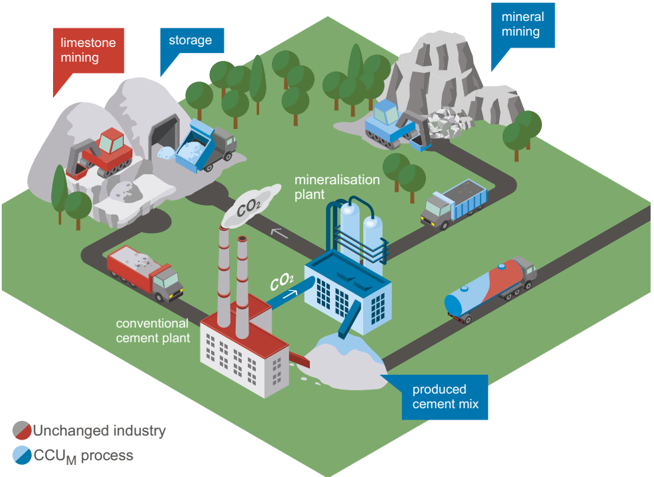
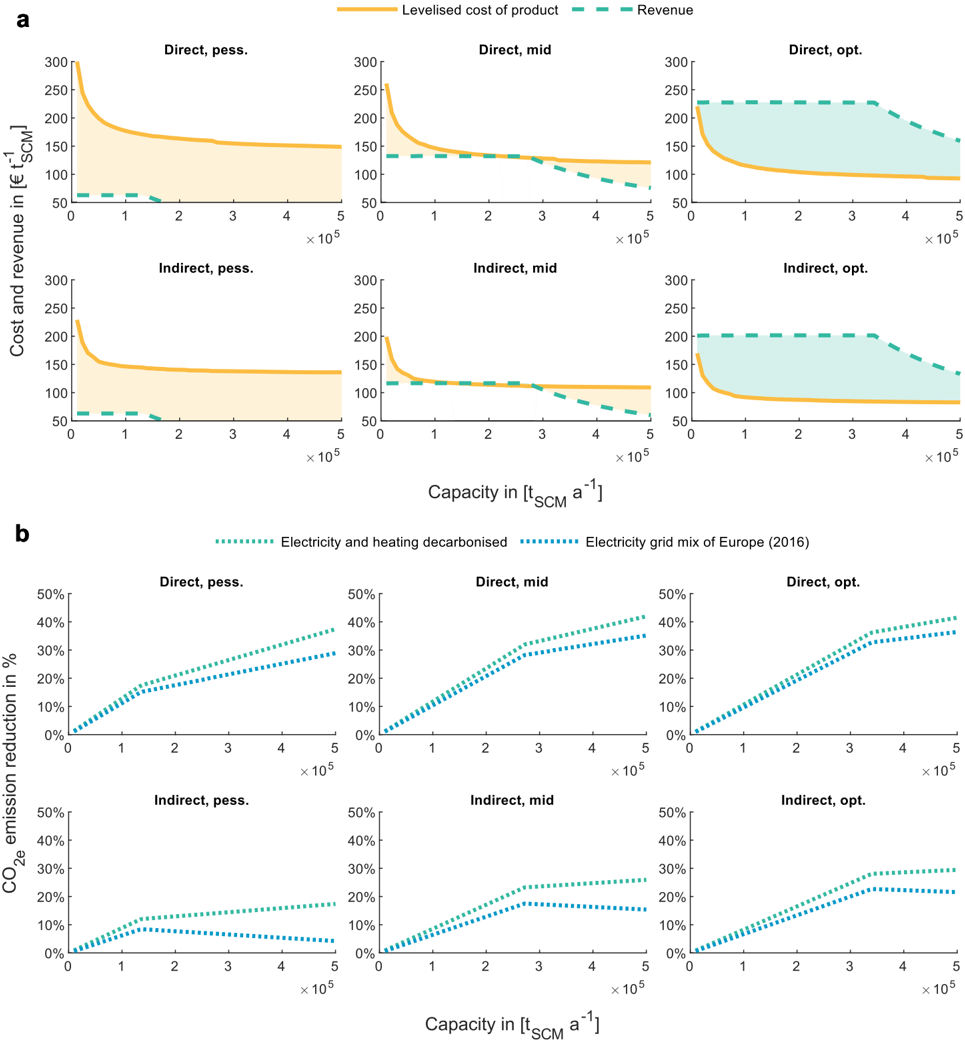
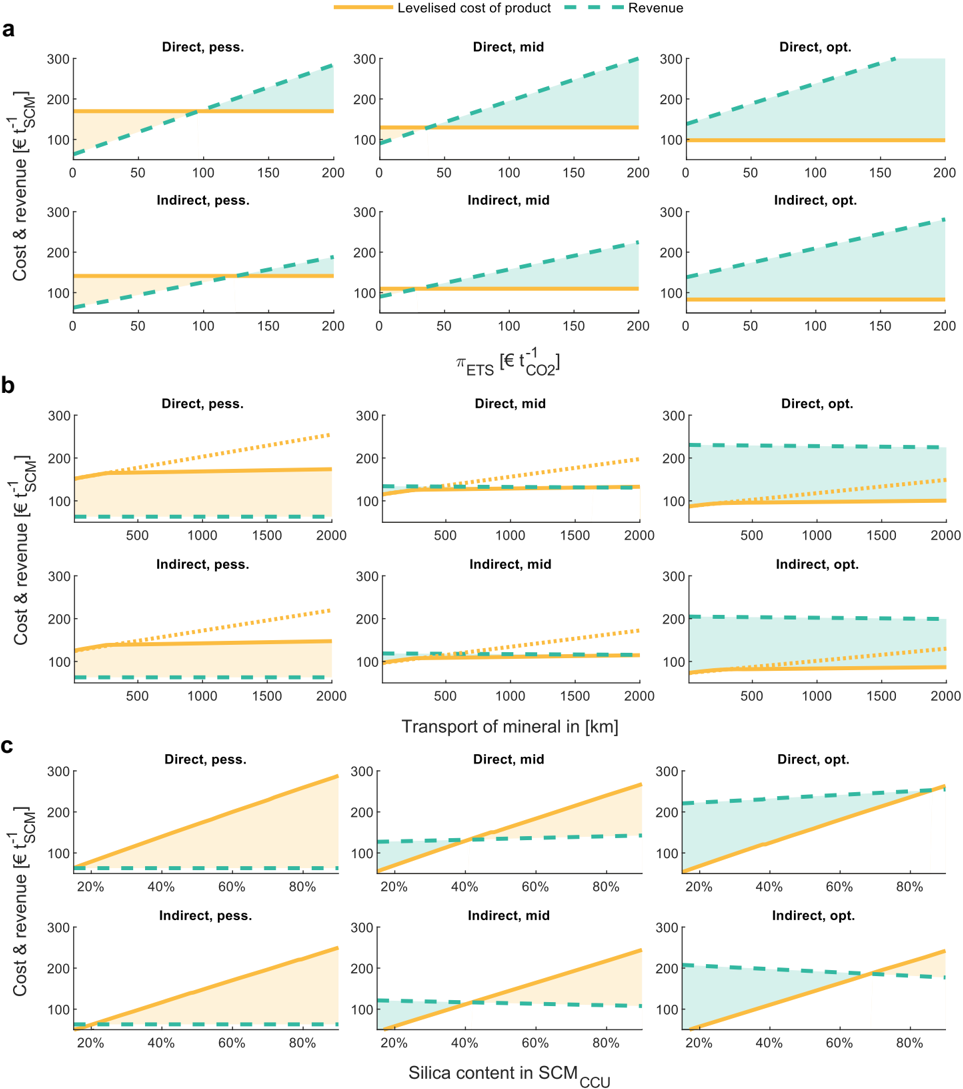
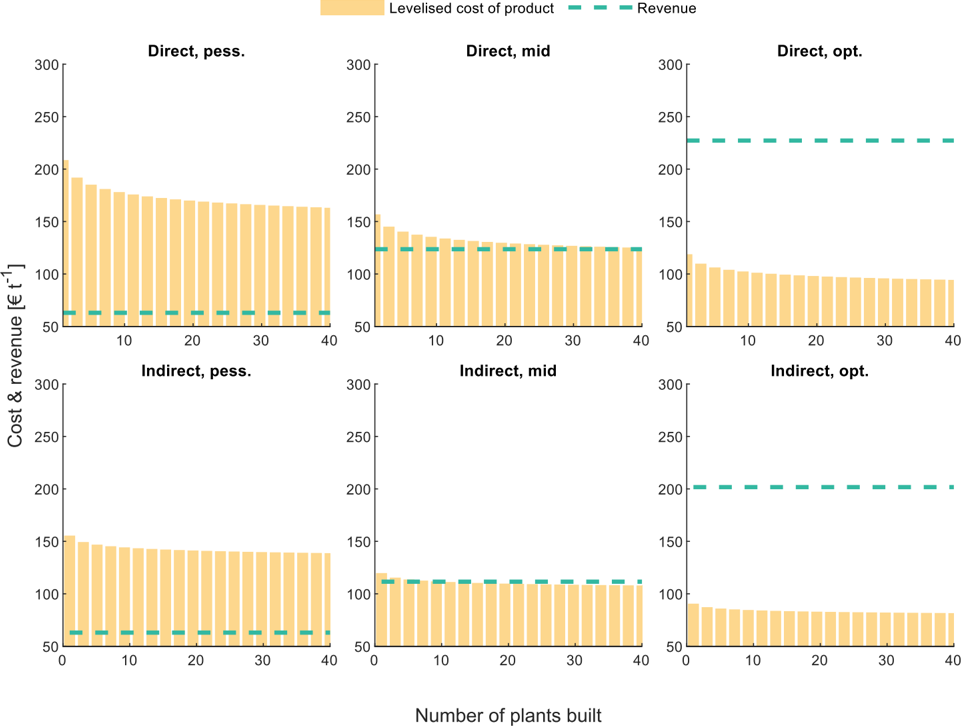
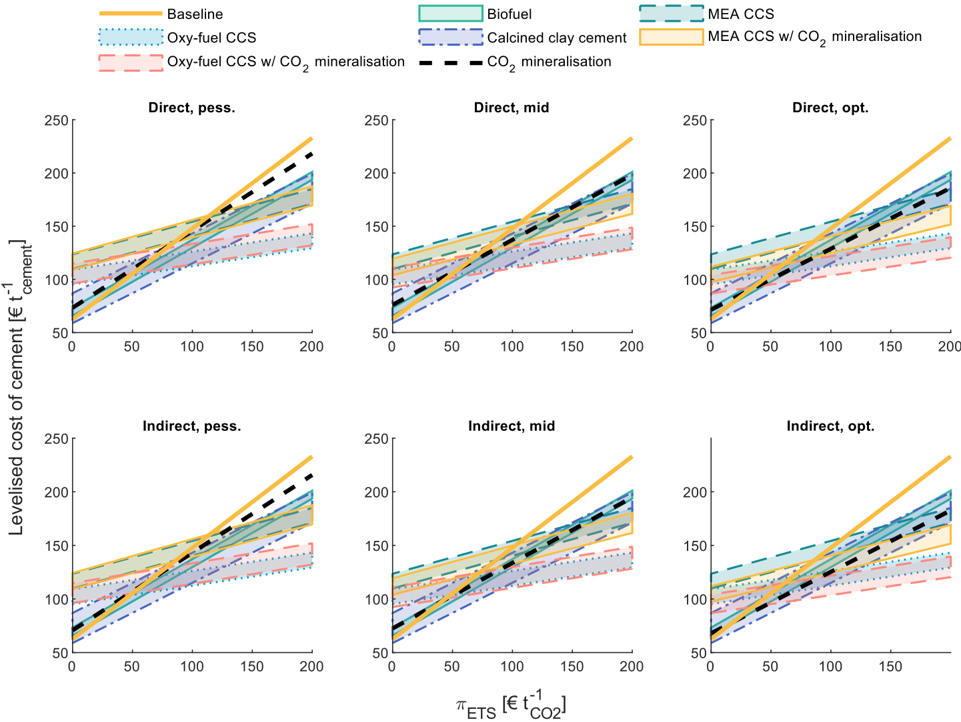
The cement industry, an industry characterised by low margins, is responsible for approximately 7% of anthropogenic CO 2 equivalent (CO 2e ) emissions and holds the highest carbon intensity of any industry per unit of revenue. To encourage complete decarbonisation of the cement industry, strategies must be found in which CO 2e emission reductions are incentivised. Here we show through integrated techno-economic modelling that CO 2 mineralisation of silicate minerals, aiming to store CO 2 in solid form, results in CO 2e emission reductions of 8–33% while generating additional profit of up to €32 per tonne of cement. To create positive CO 2 mineralisation business cases two conditions are paramount: the resulting products must be used as a supplementary material in cement blends in the construction industry (e.g., for bridges or buildings) and the storage of CO 2 in minerals must be eligible for emission certificates or similar. Additionally, mineral transport and composition of the product are decisive.
Overview
The claims and statistics of this paper haven’t been checked yet.
Free: it reads the open-access text and checks the first 5 claims that cite a source we can check. Create a free account to check every claim.
Integrity signals
Registry
Cites
Statistics
Figures
Verification
Claims the paper makes
The claims and statistics of this paper haven’t been checked yet.
Free: it reads the open-access text and checks the first 5 claims that cite a source we can check. Create a free account to check every claim.
Claims other papers make about this one
Each is checked against this paper’s own text: does it say what the citing paper says it does?
The cited source doesn’t support the claim as written.
In the citing paper
“The costs of mineral carbonation are still too high for large scale production (around 39.03-78.07€ per ton CO 2 ) compared to geological sequestration.”
From Mechanisms of Mg carbonates precipitation and implications for CO 2 capture and utilization/storage (2023) · cites this paper as [5]
Checked by a reasoning model — may be wrong.
Experimental — accuracy not yet measuredThe source backs part of the claim, not all of it — or backs it for a different population, condition or comparison.
In the citing paper
“Among all methods proposed for mineral carbonation, only the routes using Mg silicate precursors are seen as economically feasible although the profitability of the method is still to be demonstrated at technology readiness level (TRL) 7 of higher.5”
From Mechanisms of Mg carbonates precipitation and implications for CO 2 capture and utilization/storage (2023) · cites this paper as [5]
Experimental — accuracy not yet measuredThe source backs part of the claim, not all of it — or backs it for a different population, condition or comparison.
In the citing paper
“The routes of CO 2 mineralization currently available still faces hurdles of too high energy demands, challenging profitable business models unless supported by the economy of scale.5”
From Mechanisms of Mg carbonates precipitation and implications for CO 2 capture and utilization/storage (2023) · cites this paper as [5]
Experimental — accuracy not yet measuredThe source backs part of the claim, not all of it — or backs it for a different population, condition or comparison.
In the citing paper
“In this scenario, the state-of-art technologies have the forecast of being able to reduce the current global CO 2e emissions by 8-33% per year while generating a profit up to 32 € per tonne of cement.5”
From Mechanisms of Mg carbonates precipitation and implications for CO 2 capture and utilization/storage (2023) · cites this paper as [5]
Experimental — accuracy not yet measuredThe source backs part of the claim, not all of it — or backs it for a different population, condition or comparison.
In the citing paper
“Few start-up companies have initiated field trials in the European Union, Australia and in North America, 5,125 but the profitability of the process can only be enabled via high-volume applications of the carbonate products.”
From Mechanisms of Mg carbonates precipitation and implications for CO 2 capture and utilization/storage (2023) · cites this paper as [5]
Experimental — accuracy not yet measured
2 more claims about this paper
Create a free account to see every claim other papers make about this one.
Self-check
Percentages, sums and reported differences re-computed from the paper’s own numbers.
The self-check needs the paper’s full text.
Citations
Cites
International Organization for Standardization (ISO)
Nahler, G. (2009) · Dictionary of Pharmaceutical Medicine · doi:10.1007/978-3-211-89836-9_723 · Cited by 3,677
Paris Agreement climate proposals need a boost to keep warming well below 2 °C
Rogelj, J., den Elzen, M., Höhne, N., Fransen, T., Fekete, H., Winkler, H., Schaeffer, R., Sha, F., Riahi, K., & Meinshausen, M. (2016) · Nature · doi:10.1038/nature18307 · Cited by 3,637
Le Quéré, C., Andrew, R. M., Friedlingstein, P., Sitch, S., Hauck, J., Pongratz, J., Pickers, P. A., Korsbakken, J. I., Peters, G. P., Canadell, J. G., et al. (2018) · Earth System Science Data · doi:10.5194/essd-10-2141-2018 · Cited by 1,645
Global CO 2 emissions from cement production
Andrew, R. M. (2018) · Earth System Science Data · doi:10.5194/essd-10-195-2018 · Cited by 1,583
A review of mineral carbonation technologies to sequester CO 2
Sanna, A., Uibu, M., Caramanna, G., Kuusik, R., & Maroto-Valer, M. M. (2014) · Chem. Soc. Rev. · doi:10.1039/c4cs00035h · Cited by 1,258
UQLab: A Framework for Uncertainty Quantification in Matlab
Marelli, S., & Sudret, B. (2014) · Vulnerability, Uncertainty, and Risk · doi:10.1061/9780784413609.257 · Cited by 899
Ex situ aqueous mineral carbonation
Gerdemann, S. J., O'Connor, W. K., Dahlin, D. C., Penner, L. R., & Rush, H. (2007) · Environmental Science & Technology · doi:10.1021/es0619253 · Cited by 633
A review of learning rates for electricity supply technologies
Rubin, E. S., Azevedo, I. M. L., Jaramillo, P., & Yeh, S. (2015) · Energy Policy · doi:10.1016/j.enpol.2015.06.011 · Cited by 606
Gartner, E., & Sui, T. (2018) · Cement and Concrete Research · doi:10.1016/j.cemconres.2017.02.002 · Cited by 580
Maddalena, R., Roberts, J. J., & Hamilton, A. (2018) · Journal of Cleaner Production · doi:10.1016/j.jclepro.2018.02.138 · Cited by 532
Research works printed but not linked: 8
- 8. Hoddinott, P. The role of cement in the 2050 low carbon economy. Proceedings of the European Cement Association (2013).
- 36. Porterfield, W. W. Inorganic chemistry. (Academic press, 2013).
- 51. Manns, W., Thielen, G. & Laskowski, C. Evaluation of the results of tests for building inspectorate approvals for Portland Limestone cements., (Verein Deutscher Zementwerke e.V./Forschungsinstitut der Zementindustrie (Eds.), 2000).
- 60. Towler, G. & Sinnott, R. Chemical engineering design: principles, practice and economics of plant and process design. (Elsevier, 2012).
- 63. Smith, R. Chemical process: design and integration. (John Wiley & Sons, 2005).
- 64. Towler, G. & Sinnott, R. K. Chemical engineering design: principles, practice and economics of plant and process design. (Elsevier, 2012).
- 65. Pinkerton, A. P. & Klima, M. S. Evaluation of a solid-bowl centrifuge for ultrafine size separations. Mining Metall. Explor. 18, 162-166 (2001).
- 70. Peters, M. S., Timmerhaus, K. D. & West, R. E. Plant design and economics for chemical engineers. International edition (1991).
Cited by
Barbhuiya, S., Kanavaris, F., Das, B. B., & Idrees, M. (2024) · Journal of Building Engineering · doi:10.1016/j.jobe.2024.108861 · Cited by 378
Griffiths, S., Sovacool, B. K., Furszyfer Del Rio, D. D., Foley, A. M., Bazilian, M. D., Kim, J., & Uratani, J. M. (2023) · Renewable and Sustainable Energy Reviews · doi:10.1016/j.rser.2023.113291 · Cited by 222
Zhang, T., Chen, M., Wang, Y., & Zhang, M. (2023) · Cement and Concrete Composites · doi:10.1016/j.cemconcomp.2023.104994 · Cited by 208
Paving the way for sustainable decarbonization of the European cement industry
Cavalett, O., Watanabe, M. D. B., Voldsund, M., Roussanaly, S., & Cherubini, F. (2024) · Nature Sustainability · doi:10.1038/s41893-024-01320-y · Cited by 163
“For example, the captured CO 2 can react with activated minerals or industrial wastes to form solid carbonate minerals (mineralization), which can be used in various applications and potentially achieve up to 30% emissions reductions 46 .”
Mechanisms of Mg carbonates precipitation and implications for CO 2 capture and utilization/storage
Santos, H. S., Nguyen, H., Venâncio, F., Ramteke, D., Zevenhoven, R., & Kinnunen, P. (2023) · Inorganic Chemistry Frontiers · doi:10.1039/d2qi02482a · Cited by 108
A path to carbon neutrality in construction: An overview of recent progress in recycled cement usage
Shivaprasad, K. N., Yang, H.-M., & Singh, J. K. (2024) · Journal of CO2 Utilization · doi:10.1016/j.jcou.2024.102816 · Cited by 126
Rosa, L., Becattini, V., Gabrielli, P., Andreotti, A., & Mazzotti, M. (2022) · Resources Conservation and Recycling · doi:10.1016/j.resconrec.2022.106436 · Cited by 111
A comparative analysis of the efficiency, timing, and permanence of CO 2 removal pathways
Chiquier, S., Patrizio, P., Bui, M., Sunny, N., & Dowell, N. M. (2022) · Energy & Environmental Science · doi:10.1039/d2ee01021f · Cited by 114
Schneider, M., Hoenig, V., Ruppert, J., & Rickert, J. (2023) · Cement and Concrete Research · doi:10.1016/j.cemconres.2023.107290 · Cited by 105
Process-informed adsorbent design guidelines for direct air capture
Young, J., Mcilwaine, F., Smit, B., García, S., & van der Spek, M. W. (2022) · Chemical Engineering Journal · doi:10.1016/j.cej.2022.141035 · Cited by 98
Bacatelo, M., Capucha, F., Ferrão, P., & Margarido, F. (2022) · Journal of CO2 Utilization · doi:10.1016/j.jcou.2022.102375 · Cited by 72
Subraveti, S. G., Angel, E. R., Ramírez, A., & Roussanaly, S. (2023) · Environmental Science & Technology · doi:10.1021/acs.est.2c05724 · Cited by 66
Faber, G., Ruttinger, A., Strunge, T., Langhorst, T., Zimmermann, A., van der Hulst, M., Bensebaa, F., Moni, S., & Tao, L. (2022) · Frontiers in Climate · doi:10.3389/fclim.2022.820261 · Cited by 55
“For the techno-economic part of the case study, capacity and CapEx data for the FOAK plant were adapted from Anantharaman et al. (2018) and Strunge et al. (2022), leading to a TDC FOAK of around $150 per metric ton of mineral product.”
BackgroundMethodSelf-citationCarbon dioxide reduction through mineral carbonation by steel slag
Zhang, Y., Ying, Y., Xing, L., Zhan, G., Deng, Y., Chen, Z., & Li, J. (2024) · Journal of Environmental Sciences · doi:10.1016/j.jes.2024.06.016 · Cited by 52
Ferrara, G., Belli, A., Keulen, A., Tulliani, J., & Palmero, P. (2023) · Construction and Building Materials · doi:10.1016/j.conbuildmat.2023.133384 · Cited by 53
Transitioning towards Net-Zero Emissions in Chemical and Process Industries: A Holistic Perspective
Glavič, P., Pintarič, Z. N., Levičnik, H., Dragojlović, V., & Bogataj, M. (2023) · Processes · doi:10.3390/pr11092647 · Cited by 53
Potential of Reducing CO 2 Emissions in Cement Production through Altering Clinker Compositions
Williams, F., & Yang, A. (2024) · Industrial & Engineering Chemistry Research · doi:10.1021/acs.iecr.4c01885 · Cited by 46
Khair, S., Rahman, S. A., Shaikh, F. U. A., & Sarker, P. K. (2023) · Case Studies in Construction Materials · doi:10.1016/j.cscm.2023.e02822 · Cited by 65
CO2 Utilization and Market Size Projection for CO2-treated Construction Materials
Sick, V., Stokes, G. M., & Mason, F. C. (2022) · Frontiers in Climate · doi:10.3389/fclim.2022.878756 · Cited by 47
Hamedi, H., Gonzales‐Calienes, G., & Shadbahr, J. (2025) · Clean Technologies · doi:10.3390/cleantechnol7020044 · Cited by 46
Strunge, T., Naims, H., Ostovari, H., & Olfe-Kräutlein, B. (2022) · Journal of Cleaner Production · doi:10.1016/j.jclepro.2022.130712 · Cited by 43
Self-citationZhang, N., & Moment, A. J. (2023) · ACS Sustainable Chemistry & Engineering · doi:10.1021/acssuschemeng.2c04241 · Cited by 36
Kremer, D., Dertmann, C., Etzold, S., Telle, R., Friedrich, B. G., & Wotruba, H. (2022) · Journal of CO2 Utilization · doi:10.1016/j.jcou.2022.101928 · Cited by 40
Assessment of technologies and economics for carbon dioxide removal from a portfolio perspective
Mühlbauer, A., Keiner, D., Gerhards, C., Caldera, U., Sterner, M., & Breyer, C. (2025) · International journal of greenhouse gas control · doi:10.1016/j.ijggc.2024.104297 · Cited by 39
Capacity planning with uncertain endogenous technology learning
Rathi, T., & Zhang, Q. (2022) · Computers & Chemical Engineering · doi:10.1016/j.compchemeng.2022.107868 · Cited by 33
“Recently, a hybrid approach for estimating the cost of an Nth-of-a-kind plant (Rubin, 2019) was utilized for estimating future cost projections of CO2 mineralization plants that can potentially help decarbonize the cement industry (Strunge et al., 2022).”
BackgroundWoźniak, Z. Z., Chajec, A., & Sadowski, Ł. (2022) · Materials · doi:10.3390/ma15249066 · Cited by 29
“Cement production produces carbon dioxide CO2, which is responsible for 5% of the total anthropogenic carbon dioxide emissions [4], with some sources even giving a value of 7% [6] or 8% [7].”
BackgroundOstovari, H., Kuhrmann, L., Mayer, F., Minten, H., & Bardow, A. (2023) · Journal of CO2 Utilization · doi:10.1016/j.jcou.2023.102496 · Cited by 37
Jang, K., Choi, W., Moulay, I., Lee, D.-W., & Park, J. (2023) · Journal of environmental chemical engineering · doi:10.1016/j.jece.2023.111746 · Cited by 27
Reyes, G., Vega‐Coloma, M., Antonova, A., Ajdary, R., Jonveaux, S., Flanigan, C., Lautenbacher, N., & Rojas, O. J. (2023) · Advanced Materials · doi:10.1002/adma.202209327 · Cited by 32
Strunge, T., Renforth, P., & van der Spek, M. W. (2023) · Frontiers in Energy Research · doi:10.3389/fenrg.2023.1182969 · Cited by 32
Self-citationMühlbauer, A., Keiner, D., & Breyer, C. (2024) · Energy & Environmental Science · doi:10.1039/d4ee03166k · Cited by 29
Enhanced Nesquehonite Formation and Stability in the Presence of Dissolved Silica
Pokharel, R., Popa, I. C., de Kok, Y., & King, H. E. (2023) · Environmental Science & Technology · doi:10.1021/acs.est.3c06939 · Cited by 26
Qader, D. N., Jamil, A. W. M., Bahrami, A., Ali, M., & Arunachalam, K. P. (2025) · REVIEWS ON ADVANCED MATERIALS SCIENCE · doi:10.1515/rams-2024-0076 · Cited by 40
Williams, J. M., Zhao, D., Zhang, N., Zheng, A., Greenbaum, S., Kawashima, S., & Moment, A. J. (2024) · Chemical Engineering Journal · doi:10.1016/j.cej.2024.149013 · Cited by 23
Zaccardi, Y. V., Ellwood, L., Perumal, P., Torrenti, J., Zhao, Z., Bernard, E., Hanein, T., Ling, T., Wang, W., Zhang, Z., et al. (2024) · Materials and Structures · doi:10.1617/s11527-024-02489-6 · Cited by 24
“Moreover, the CO 2 stored in these aggregates during the process can be valorised [120].”
Kremer, D., Strunge, T., Skoček, J., Schabel, S., Kostka, M., Hopmann, C., & Wotruba, H. (2022) · Journal of CO2 Utilization · doi:10.1016/j.jcou.2022.102067 · Cited by 20
Self-citationTamta, S., Chaudhury, R., Sharma, U., Hanifa, M., Thapliyal, P. C., & Singh, L. P. (2025) · Construction and Building Materials · doi:10.1016/j.conbuildmat.2025.140476 · Cited by 31
Zhu, X., Wang, T., Yi, Z., Yu, Z., Luo, K., & Gao, X. (2024) · Construction and Building Materials · doi:10.1016/j.conbuildmat.2024.139363 · Cited by 16
Internal carbonation of calcium silicate cement incorporated with Na2CO3 and NaHCO3
Bersisa, A., Moon, K.-Y., Kim, G. M., Cho, J.-S., & Park, S. (2025) · Construction and Building Materials · doi:10.1016/j.conbuildmat.2024.139732 · Cited by 16
Bremen, A. M., Strunge, T., Ostovari, H., Spütz, H., Mhamdi, A., Renforth, P., van der Spek, M. W., Bardow, A., & Mitsos, A. (2022) · Industrial & Engineering Chemistry Research · doi:10.1021/acs.iecr.2c00984 · Cited by 14
Self-citationJang, K., Moulay, I., Lee, D.-W., Myung, J., Oh, S., Kim, S.-H., Choi, W., & Park, J. (2024) · Journal of environmental chemical engineering · doi:10.1016/j.jece.2024.115099 · Cited by 17
CO2 capture initiatives: are governments, society, industry and the financial sector ready?
Perreault, P., Kummamuru, N. B., González‐Quiroga, A., & Lenaerts, S. (2022) · Current Opinion in Chemical Engineering · doi:10.1016/j.coche.2022.100874 · Cited by 14
Carbon-neutral cement: The role of green hydrogen
Bacatelo, M., Capucha, F., Ferrão, P., Margarido, F., & Bordado, J. C. (2024) · International Journal of Hydrogen Energy · doi:10.1016/j.ijhydene.2024.03.028 · Cited by 19
Moges, K. A., Dalila, N., Plaskota, P., & Pyo, S. (2024) · Journal of Building Engineering · doi:10.1016/j.jobe.2024.110468 · Cited by 22
Effect of Ammonium Sulfate on the Precipitation Mechanism of Mg Carbonates
Santos, H. S., Nguyen, H., Illikainen, S., Alzeer, M. I. M., Cunha, S. D. D., & Kinnunen, P. (2024) · Crystal Growth & Design · doi:10.1021/acs.cgd.4c00700 · Cited by 13
Aghaee, K. (2025) · Carbon Capture Science & Technology · doi:10.1016/j.ccst.2025.100503 · Cited by 28
Abdelshafy, A., Strunge, T., Stephan, D. A., & Walther, G. (2025) · Journal of CO2 Utilization · doi:10.1016/j.jcou.2025.103092 · Cited by 14
Self-citationTu, W. H., Chan, G. H., Wong, S. I., Chan, W. P., de Smit, E., Abubakar, S. M., & Lisak, G. (2025) · Water Research · doi:10.1016/j.watres.2025.125040 · Cited by 11
CO 2 Capture, Utilization, and Storage using Amino Acids
Sheikh, M. S., Sui, J., Wang, B., & Wang, X. (2025) · Advanced Sustainable Systems · doi:10.1002/adsu.202501422 · Cited by 10
Substituting fossil fuels in cement production with solar energy to reduce carbon emissions
Williams, F., & Yang, A. (2026) · Renewable Energy · doi:10.1016/j.renene.2026.125227 · Cited by 9
A Parameterized Lifecycle Assessment of Ex Situ CO 2 Mineralization, Using Olivine as a Case Study
Lunstrum, A. M., Wyckoff, A., Wallace, A., Pelton, R. E. O., & O’Rourke, A. (2026) · Environmental Science & Technology · doi:10.1021/acs.est.5c02627 · Cited by 10
Najm, O. F., Mohamed, O. A., & Alzard, M. H. H. (2023) · Materials Today Proceedings · doi:10.1016/j.matpr.2023.03.185 · Cited by 9
A critical review of current conversion facilities and research output on carbon dioxide utilization
Aimikhe, V. J., & Adeyemi, M. A. (2023) · MRS Energy & Sustainability · doi:10.1557/s43581-023-00073-z · Cited by 9
Son, Y., Min, J., Jang, I., Park, J., Yi, C., & Park, W. (2024) · Cell Reports Physical Science · doi:10.1016/j.xcrp.2024.102098 · Cited by 16
Strunge, T., Küng, L., Sunny, N., Shah, N., Renforth, P., & van der Spek, M. W. (2024) · RSC Sustainability · doi:10.1039/d4su00373j · Cited by 12
Self-citationBack, J., Ismailov, A., Sreenivasan, H., Smått, J., Santos, H. S., Nguyen, H., Levänen, E., Zevenhoven, R., & Kinnunen, P. (2025) · Emergent Materials · doi:10.1007/s42247-024-00968-8 · Cited by 9
Comparative study of biochar and charcoal and their application in the construction industry
Yadav, K., & Sharma, R. L. (2023) · Asian Journal of Civil Engineering · doi:10.1007/s42107-023-00835-7 · Cited by 10
“The manufacturing of cement is responsible for a considerable amount of CO 2 release, contributing to more than 7–8% of the total carbon emissions in the year 2021 (Johannes Gutenberg Universitaet Mainz, 2021; Strunge et al., 2022).”
Williams, J. M., Zhao, D., Zhang, N., Kawashima, S., & Moment, A. J. (2025) · Industrial Chemistry and Materials · doi:10.1039/d4im00025k · Cited by 12
Techno-economic analysis for the integration of ex situ CO2 mineralization and mineral mining
Gomes, K. V., Psarras, P. C., Liguori, S., Lin, F., Caulfield, B., Smith, T. A., Wilcox, J. L., & Prigiobbe, V. (2025) · Discover Civil Engineering · doi:10.1007/s44290-025-00238-4 · Cited by 9
“Moreover, the possibility to integrate CO 2 mineralization with the formation of valuable materials has been proposed [13, 32, 86], but the current process does not include systems to generate highpurity products (e.g., carbonates and critical minerals) suitable for the market.”
Zhao, Q., Mo, L., Hu, L., & Xu, M. (2024) · Journal of Industrial and Engineering Chemistry · doi:10.1016/j.jiec.2024.11.022 · Cited by 7
Implications of the EU ETS on the level-playing field between carbon capture storage & utilisation
Verbist, F., Meus, J., Moncada, J. A., Valkering, P., & Delarue, E. D. (2024) · International journal of greenhouse gas control · doi:10.1016/j.ijggc.2024.104165 · Cited by 6
Toward net-zero cement: linking demand-side measures with plant-level technology strategies
Song, X., An, K., Wang, R., Liu, G., & Wang, C. (2025) · Resources Conservation and Recycling · doi:10.1016/j.resconrec.2025.108339 · Cited by 5
Pandey, A., & Bhaduri, G. A. (2023) · Chemical Engineering Research and Design · doi:10.1016/j.cherd.2023.10.040 · Cited by 5
Meddah, M. S., Abdel‐Gawwad, H. A., & Najjar, O. (2024) · Environmental Science and Pollution Research · doi:10.1007/s11356-024-33387-7 · Cited by 5
“The cement industry is responsible for 8% of global CO 2 emissions (Scrivener et al. 2018; Strunge et al. 2022).”
Baki, V. A., Skevi, L., & Ke, X. (2025) · Journal of environmental chemical engineering · doi:10.1016/j.jece.2025.116902 · Cited by 4
Perception of carbon capture and utilization - a framing analysis of German-speaking media
Fürst, K., & Strunge, T. (2024) · Frontiers in Energy Research · doi:10.3389/fenrg.2024.1424865 · Cited by 7
Self-citationImmobilisation of chromium in magnesium carbonate minerals
Lacinska, A., Bateman, K., Chenery, S. R., Kemp, S. J., Liddy, T. J., Rushton, J. C., Saha, D., & Schroeder, S. L. M. (2024) · Mineralogical Magazine · doi:10.1180/mgm.2023.91 · Cited by 6
CO2 utilization: a brief review of main routes and the potential to Brazilian scenario industry
Alves, V. R. S., & Meyer, D. C. (2022) · Revista IPT/Revista do IPT - Pesquisa e Tecnologia · doi:10.29327/2152495.6.21-1 · Cited by 4
Bersisa, A., Seifu, M. N., Park, S., & Park, S. (2026) · Journal of Building Engineering · doi:10.1016/j.jobe.2026.115635 · Cited by 3
CO2 mineralization feedstock types
Vakylabad, A. B., & Saberi, A. (2024) · Elsevier eBooks · doi:10.1016/b978-0-443-19231-9.00021-1 · Cited by 4
Simulation and optimization of CO2 mineralization for sustainable cement production
Shahbaz, R., & Bahadori, F. (2025) · Sustainable Chemistry and Pharmacy · doi:10.1016/j.scp.2025.102099 · Cited by 3
Effect of lithium slag on freeze-thaw resistance of concrete
Mao, Y., zhai, W., & Qi, L. (2025) · Materials Research Express · doi:10.1088/2053-1591/adb090 · Cited by 3
Huang, J., Zhao, D., & Zhao, P. (2025) · Discover Sustainability · doi:10.1007/s43621-025-02006-x · Cited by 7
“Business case research demonstrated that CO 2 mineralization of silicate minerals reduces CO 2 emissions by 8–33% and increases profits by up to €32 per tonne of cement which is seemingly a lucrative number for the industry [51].”
Woźniak, Z. Z. (2023) · Proceedings in engineering mechanics · doi:10.1007/978-3-031-26797-0_1 · Cited by 2
Barragán-Ocaña, A., Silva-Borjas, P., Cecilio-Ayala, E., Guzmán-Guzmán, H. E., Bilyaminu, A. M., & Rene, E. R. (2024) · Environmental Research · doi:10.1016/j.envres.2024.119122 · Cited by 2
Zhang, J., Su, Y., & Gao, H. (2025) · Case Studies in Construction Materials · doi:10.1016/j.cscm.2025.e04957 · Cited by 2
Sewel, A., Knops, P. C. M., & Rackley, S. (2023) · Elsevier eBooks · doi:10.1016/b978-0-12-819663-2.00010-1 · Cited by 2
Producing Sustainable Construction Materials through Carbon Mineralization
Guteta, L. E., Andraju, N., der Watt, J. V., Gedafa, D. S., & Dockter, B. (2025) · ASCE International Airfield and Highway Pavements Conference · doi:10.1061/9780784486221.009 · Cited by 1
Literature review on environmental aspects of ESG performance in Vietnam's cement industry
Tran, T. N., Quang, H. N. T., Nguyen, T. T., & Van, N. T. (2025) · AIMS environmental science · doi:10.3934/environsci.2025042 · Cited by 1
Integrated valorization of blast furnace slag for dual production of zeolite X and CaCO3
Shin, S., & Kim, M.-J. (2026) · Chemical Engineering Journal Advances · doi:10.1016/j.ceja.2026.101192 · Cited by 1
Chajec, A., & Šavija, B. (2026) · Construction and Building Materials · doi:10.1016/j.conbuildmat.2026.146750 · Cited by 1
Mineral carbonation: Processes, mechanisms, and its role in the carbon–hydrogen cycle
Zhou, D., Cao, S., Li, X., Cheng, X., Liu, J., Dong, Y., Zhan, L., Wu, S., Jiang, S., & Shi, G. (2026) · Earth-Science Reviews · doi:10.1016/j.earscirev.2026.105549 · Cited by 2
Lee, S. (2026) · Minerals · doi:10.3390/min16070679 · Cited by 1
Javadpour, M., McCoy, S., & Sleep, S. (2026) · Environmental Research Letters · doi:10.1088/1748-9326/ae9968 · Cited by 1
Diesing, P., Scholz, J. H., Semb, J., Oei, P.-Y., Breyer, C., & Blechinger, P. (2026) · SSRN Electronic Journal · doi:10.2139/ssrn.6309342 · Cited by 1
Kremer, D., Strunge, T., Skoček, J., Schabel, S., Koska, M., Hopmann, C., & Wotruba, H. (2022) · SSRN Electronic Journal · doi:10.2139/ssrn.4055982
Self-citationMoudakkar, T., Vaudreuil, S., & Bounahmidi, T. (2023) · SSRN Electronic Journal · doi:10.2139/ssrn.4579141
Upscaling in ex-ante sustainability assessments of emerging chemical technologies: a scoping review
Rao, P. D., Dael, M. V., Lizin, S., & Passel, S. V. (2025) · Renewable and Sustainable Energy Reviews · doi:10.1016/j.rser.2025.116012 · Cited by 1
Roman Concrete Technique: Can It Be the Solution to Modern Concrete Technology?
Olofin, I. (2025) · Lecture notes in civil engineering · doi:10.1007/978-981-96-8990-3_4
Diesing, P., Scholz, J. H., Semb, J., Oei, P.-Y., Breyer, C., & Blechinger, P. (2026) · Sustainable Energy Technologies and Assessments · doi:10.1016/j.seta.2026.105097
Interrelations Between the EU ETS Carbon Price and the Associated CCU and CDR Technologies
Kasidoni, M. S., Christopoulos, K. P., & Loizidou, M. D. (2025) · Environmental Modeling & Assessment · doi:10.1007/s10666-025-10069-3 · Cited by 2
“For the cement industry case, Strunge et al. [91], identified the same requirement for a successful business cement CO 2 mineralization project.”
Gasós, A., Mazzotti, M., & Winnefeld, F. (2026) · Cleaner Materials · doi:10.1016/j.clema.2026.100369 · Cited by 6
Novel ambient-pressure CCUM concept based on nitrate-salt-catalyzed magnesite formation
Santos, H. S., Nguyễn, H. Q. H., Bojdys, M. J., Sirviö, J. A., & Kinnunen, P. (2026) · Chemical Engineering Science · doi:10.1016/j.ces.2026.123313
Gemeinsam stark für eine nachhaltige Beschaffung
Barisic, B. (2026) · Springer eBooks · doi:10.1007/978-3-662-71282-5_4-1
CO2 mineralization through local cement dust: A sustainable sequestration pathway
Khan, W. U., Wahdain, S. F., Alshammari, S., AlYousef, Z. A., & Hossain, M. M. (2026) · Next Sustainability · doi:10.1016/j.nxsust.2026.100327 · Cited by 1
Ambarita, M., Adam, F., Sinaga, Y. K., Pusparizkita, Y. M., Schmahl, W. W., Ismail, R., Jamari, J., & Bayuseno, A. P. (2026) · Next Sustainability · doi:10.1016/j.nxsust.2026.100346
Coal phaseout undermines co-benefits of fly ash as a clinker substitute
Li, H., Chen, B., Xie, H., Yu, H., Dai, M., Xue, M., Long, X., Ju, W., Han, Z., Sun, M., et al. (2026) · The Innovation · doi:10.1016/j.xinn.2026.101496
The effectiveness of using complex mineral binders to strengthen asphalt granulate
Lytkin, A. A., Dolgih, G. V., & Prolygin, A. S. (2026) · The Russian Automobile and Highway Industry Journal · doi:10.26518/2071-7296-2026-23-3-522-539
Wang, L., Lu, N., Qi, M., Nielsen, R. P., & Yu, H. (2026) · Processes · doi:10.3390/pr14142297
Enhancing cementitious materials with carbon black: a comprehensive review
Gunasekaran, N. K., Samadhiya, A., Arce, G., & Kumar, S. (2026) · Journal of Building Pathology and Rehabilitation · doi:10.1007/s41024-026-00880-0
Metadata
- Authors
- Strunge, T., Renforth, P., & Van der Spek, M.
- Affiliations
- Heriot-Watt University (GB)
- Corresponding author
- Strunge, Till
- Venue
- Communications Earth & Environment
- Published
- 2022-03-14
- Volume
- 3
- Issue
- 1
- ISSN
- 2662-4435 (ISSN-L)
- OpenAlex
- W4221098561
- Cited by
- 109
- References
- 55
- Citations by year
- 2026: 28 · 2025: 22 · 2024: 23 · 2023: 20 · 2022: 16
- FWCI
- 6.14
- Type
- journal article
- Language
- en
- Open access
- gold
- doi.org
- Licence
- cc-by
- creativecommons.org/licenses/by/4.0 (tdm)
- creativecommons.org/licenses/by/4.0 (vor)
- Locations
- Communications Earth & Environment (publishedVersion, cc-by)
- Research Square (acceptedVersion, cc-by)
- DOAJ (DOAJ: Directory of Open Access Journals) (submittedVersion, cc-by-sa)
- Publication Database IASS (Institute for Advanced Sustainability Studies (IASS)) (submittedVersion, other-oa)
- Funders
- Heriot-Watt University
- Bundesministerium für Bildung und Forschung (033RC014)
- RWTH Aachen University
- Engineering and Physical Sciences Research Council
- Natural Environment Research Council (NE/P019943/1, NE/P019943/2)
- Topics
- Physical Sciences › Environmental Science › Environmental Engineering › CO2 Sequestration and Geologic Interactions
- Physical Sciences › Engineering › Civil and Structural Engineering › Concrete and Cement Materials Research
- Physical Sciences › Chemical Engineering › Filtration and Separation › Carbon Dioxide Capture Technologies
- Keywords
- CO2 mineralization, cement industry, silicate minerals, supplementary cementitious materials, emission reduction, techno-economic analysis, carbon pricing, mineral transport, carbon capture and storage
About these checks
Registry, retraction, Cites and statistics results are computed, not judged, with one exception: a printed reference that no index lists is read once by a model before it counts as a citation error. Claims are extracted by a model and kept only when their quote appears verbatim in the text; each cited source is then checked, with a model’s help, for whether it says what the claim relies on. Those verdicts can be wrong — read the claim’s quote and the cited source before relying on one.
Statistics and arithmetic are recomputed, not judged.
Confidence bands are shown only for fields calibrated on our annotated test set. None is calibrated yet, so no band is shown.
What counts as a claim ›How we measure confidence ›How we check this ›
Are you an author, or do you see a problem with this page? Request a review
Data sources
Bibliographic data: Semantic Scholar, OpenAlex, Crossref.
Contains information from the Semantic Scholar Academic Graph Datasets, made available under the ODC Attribution License (ODC-BY 1.0).
Semantic Scholar’s data is described in: Kinney, R., et al. (2023). The Semantic Scholar Open Data Platform. arXiv:2301.10140.
