

Global perturbation of stratospheric water and aerosol burden by Hunga eruption
Open accessPublished version of a preprint
The DOI matches its Crossref record; 67 of the 67 references it cites were found in a registry or an index.
Abstract
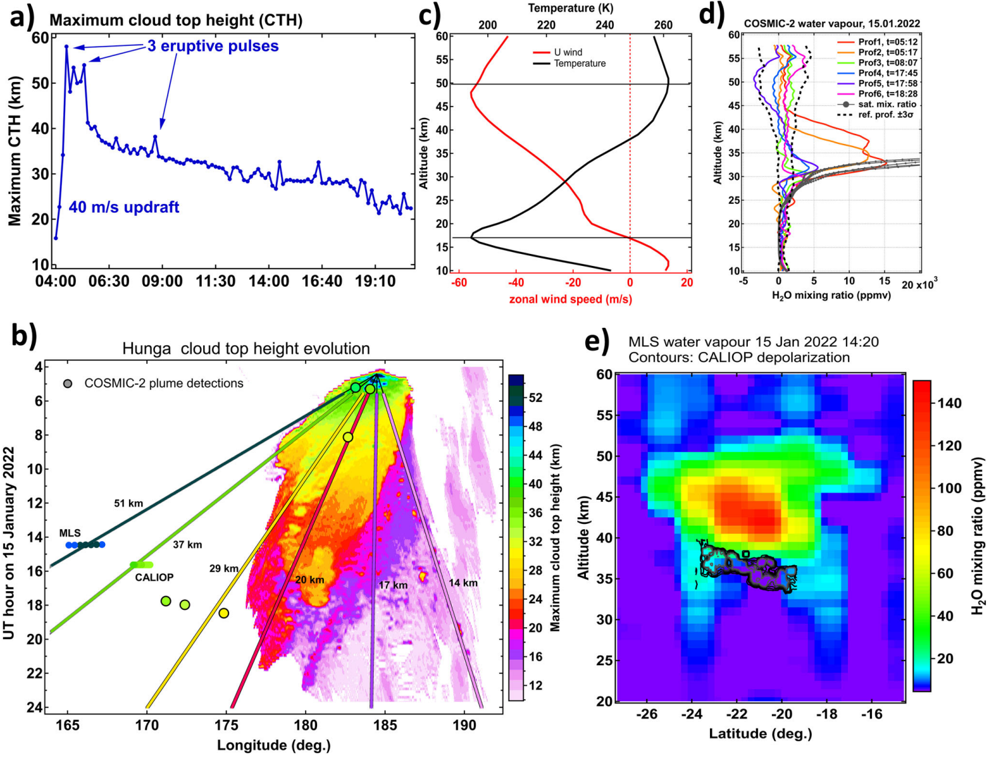
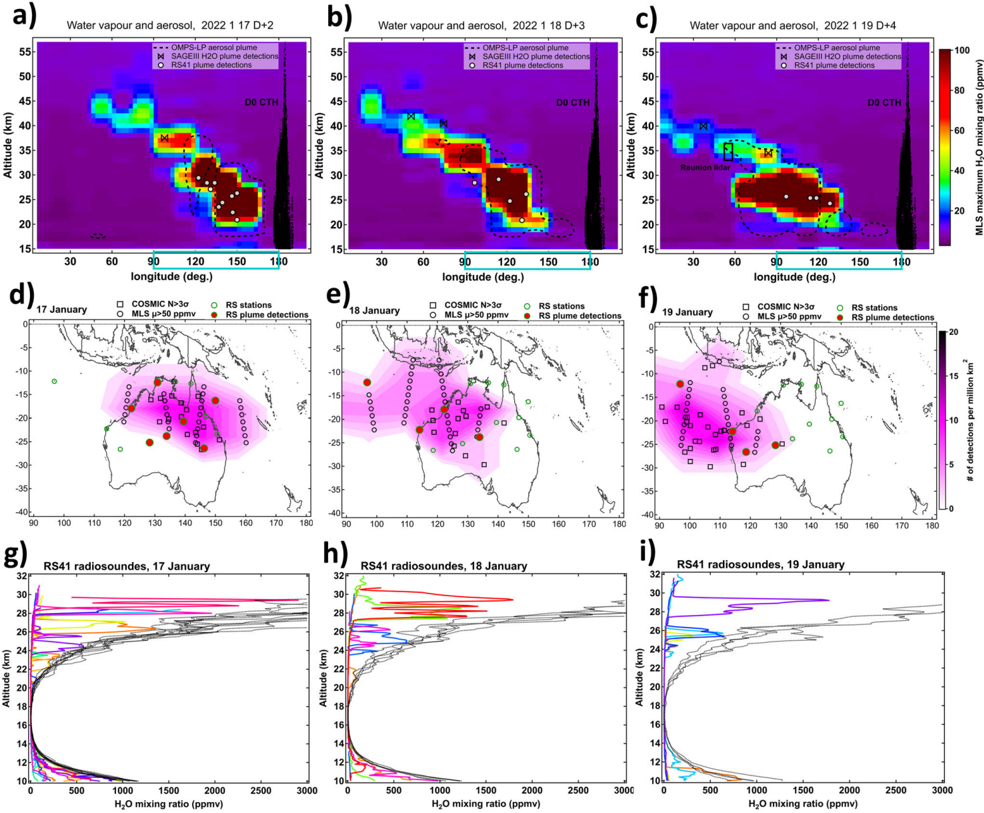
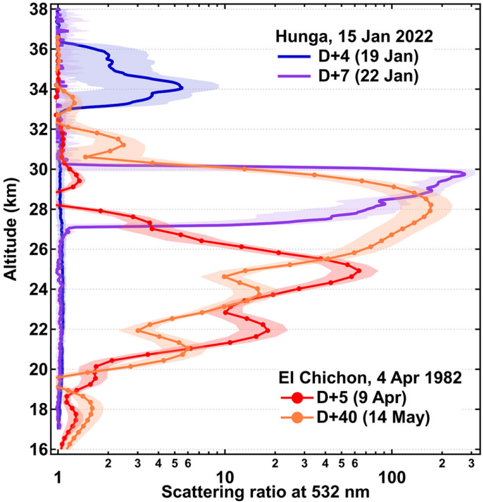
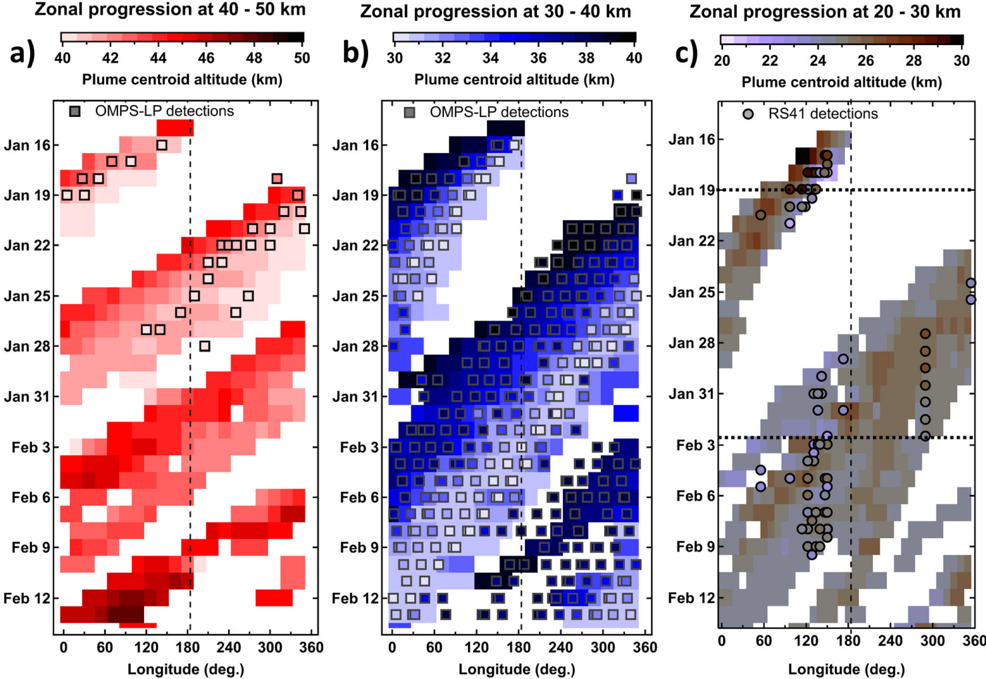
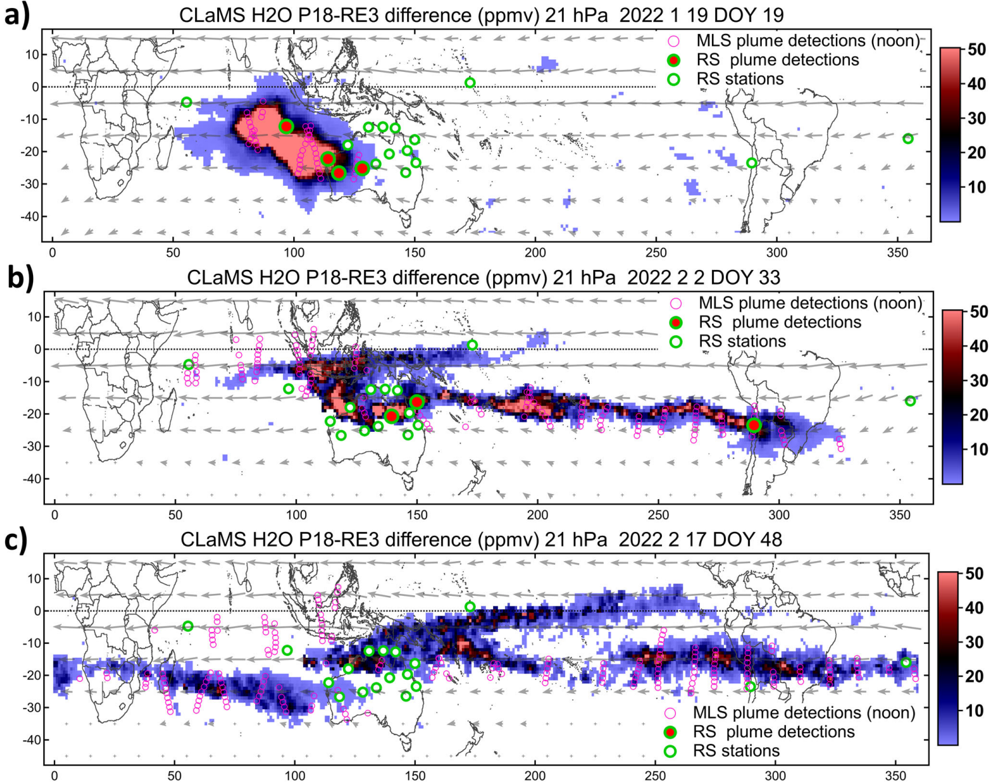
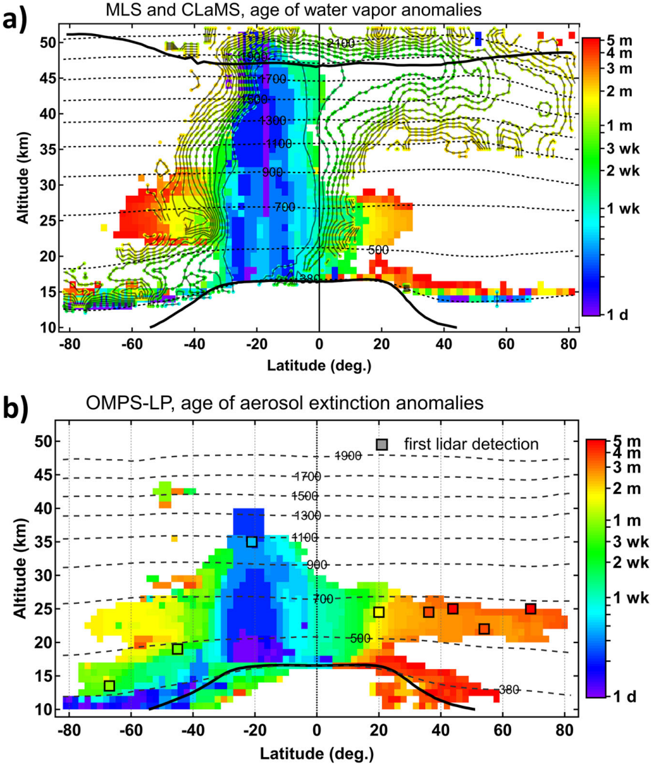
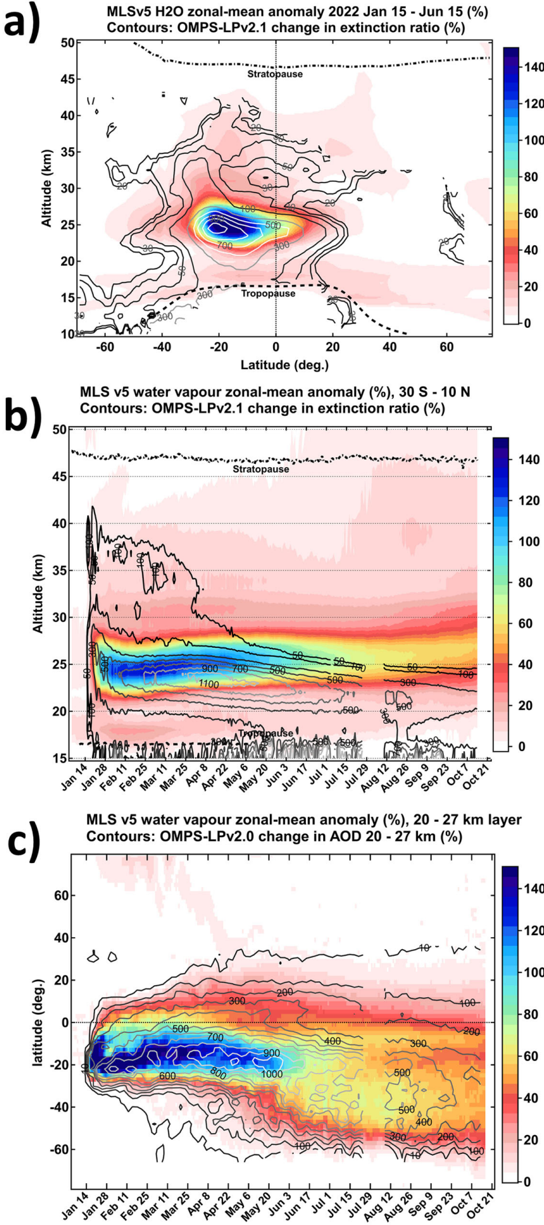
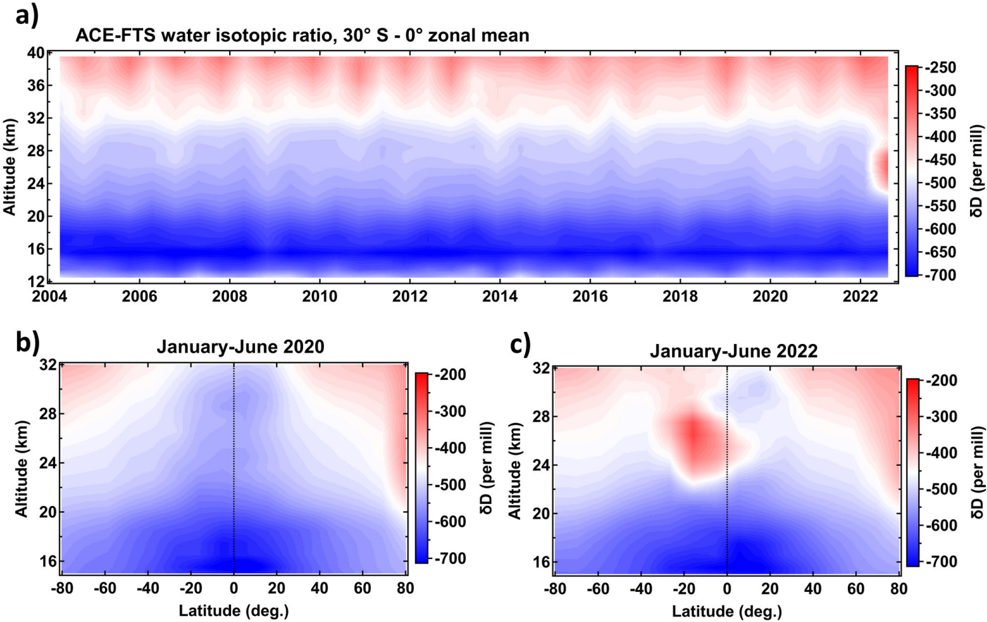
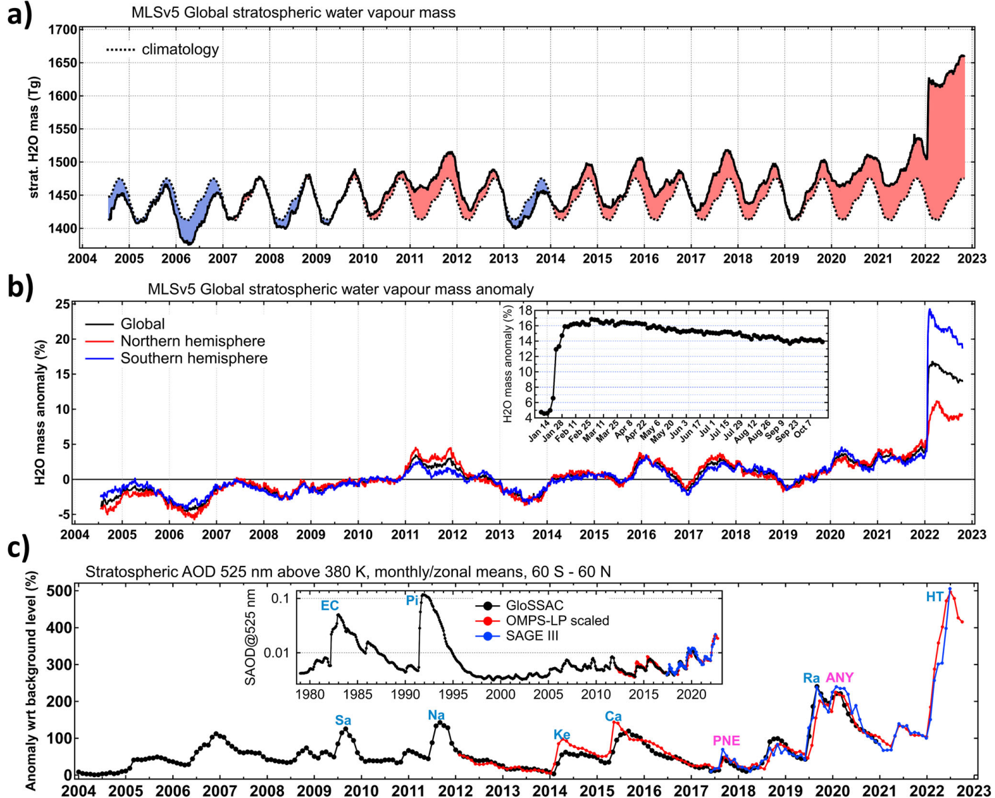
The eruption of the submarine Hunga volcano in January 2022 was associated with a powerful blast that injected volcanic material to altitudes up to 58 km. From a combination of various types of satellite and ground-based observations supported by transport modeling, we show evidence for an unprecedented increase in the global stratospheric water mass by 13% relative to climatological levels, and a 5-fold increase of stratospheric aerosol load, the highest in the last three decades. Owing to the extreme injection altitude, the volcanic plume circumnavigated the Earth in only 1 week and dispersed nearly pole-to-pole in three months. The unique nature and magnitude of the global stratospheric perturbation by the Hunga eruption ranks it among the most remarkable climatic events in the modern observation era, with a range of potential long-lasting repercussions for stratospheric composition and climate.
Overview
The claims and statistics of this paper haven’t been checked yet.
Free: it reads the open-access text and checks the first 5 claims that cite a source we can check. Create a free account to check every claim.
Integrity signals
Registry
Cites
Statistics
Figures
Verification
Claims the paper makes
The claims and statistics of this paper haven’t been checked yet.
Free: it reads the open-access text and checks the first 5 claims that cite a source we can check. Create a free account to check every claim.
Claims other papers make about this one
Each is checked against this paper’s own text: does it say what the citing paper says it does?
The cited source says what the claim attributes to it.
In the citing paper
“On 15 January 2022, the Hunga Tonga–Hunga Ha’apai (HTHH) underwater volcano (20.5° S, 175.4° W) erupted and injected a large amount of water vapour into the stratosphere, thereby increasing stratospheric water vapour concentration by about 10% [23–25].”
The cited source says what the claim attributes to it.
In the citing paper
“However, the amount of stratospheric aerosols resulting from the eruption of HTHH was small compared to other volcanic eruptions of similar magnitude (e.g., El Chichón in 1982 and Mt. Pinatubo in 1991).”
Self-check
Percentages, sums and reported differences re-computed from the paper’s own numbers.
The self-check needs the paper’s full text.
Citations
Cites
The Earth observing system microwave limb sounder (EOS MLS) on the aura Satellite
Waters, J. W., Froidevaux, L., Harwood, R. S., Jarnot, R. F., Pickett, H. M., Read, W. G., Siegel, P. H., Cofield, R. E., Filipiak, M. J., Flower, D. A., et al. (2006) · IEEE Transactions on Geoscience and Remote Sensing · doi:10.1109/tgrs.2006.873771 · Cited by 1,477
Observing Earth's atmosphere with radio occultation measurements using the Global Positioning System
Kursinski, E. R., Hajj, G. A., Schofield, J. T., Linfield, R. P., & Hardy, K. R. (1997) · Journal of Geophysical Research: Atmospheres · doi:10.1029/97jd01569 · Cited by 1,430
Brewer, A. W. (1949) · Quarterly Journal of the Royal Meteorological Society · doi:10.1002/qj.49707532603 · Cited by 1,313
Contributions of Stratospheric Water Vapor to Decadal Changes in the Rate of Global Warming
Solomon, S., Rosenlof, K. H., Portmann, R. W., Daniel, J. S., Davis, S. M., Sanford, T. J., & Plattner, G.-K. (2010) · Science · doi:10.1126/science.1182488 · Cited by 1,218
Winker, D. M., Pelon, J., Coakley, J. A., Ackerman, S. A., Charlson, R. J., Colarco, P. R., Flamant, P., Fu, Q., Hoff, R. M., Kittaka, C., et al. (2010) · Bulletin of the American Meteorological Society · doi:10.1175/2010bams3009.1 · Cited by 1,170
Journal of Geophysical Research: Atmospheres
(2018) · Journal of Geophysical Research Atmospheres · doi:10.1002/(issn)2169-8996 · Cited by 914
Mote, P. W., Rosenlof, K. H., McIntyre, M. E., Carr, E. S., Gille, J. C., Holton, J. R., Kinnersley, J. S., Pumphrey, H. C., Russell, J. M., & Waters, J. W. (1996) · Journal of Geophysical Research: Atmospheres · doi:10.1029/95jd03422 · Cited by 742 · cited 1×
“52 The dryness of the stratosphere is largely conditioned by the transit of the air masses through 53 the cold tropical tropopause where freeze-drying usually limits the amount of water entering the 54 stratosphere to a few ppmv (Brewer, 1949; Mote et al., 1996; Bonazzola and Haynes, 2004).”
BackgroundGlobal tracking of the SO2 clouds from the June, 1991 Mount Pinatubo eruptions
Bluth, G. J. S., Doiron, S. D., Schnetzler, C. C., Krueger, A. J., & Walter, L. S. (1992) · Geophysical Research Letters · doi:10.1029/91gl02792 · Cited by 579 · cited 4×
“…by a volcanic plume is remarkable compared to other major eruptions: the stratospheric plumes produced by 1982 El Chichon (Robock and Matson, 1983) and 1991 Pinatubo (Bluth et al., 1992) eruptions had circled the globe in three weeks, although their plumes were mostly confined to lower altitudes.”
BackgroundInfluentialStratospheric aerosol-Observations, processes, and impact on climate
Kremser, S., Thomason, L. W., von Hobe, M., Hermann, M., Deshler, T., Timmreck, C., Toohey, M., Stenke, A., Schwarz, J. P., Weigel, R., et al. (2016) · Reviews of Geophysics · doi:10.1002/2015rg000511 · Cited by 578
Self-citationVolcanic contribution to decadal changes in tropospheric temperature
Santer, B. D., Bonfils, C., Painter, J. F., Zelinka, M. D., Mears, C., Solomon, S., Schmidt, G. A., Fyfe, J. C., Cole, J. N. S., Nazarenko, L., et al. (2014) · Nature Geoscience · doi:10.1038/ngeo2098 · Cited by 459
Research works printed but not linked: 6
- Holland, H. D. The Chemistry of the Atmosphere and Oceans (Wiley- Interscience, New York, 1978).
- Aquila, V., Oman, L. D., Stolarski, R. S., Colarco, P. R. & Newman, P. A. Dispersion of the volcanic sulfate cloud from a Mount Pinatubo-like. eruption, J. Geophys. Res. 117, D06216 (2012).
- Khaykin, S. M. et al. Persistence of moist plumes from overshooting convection in the Asian monsoon anticyclone, Atmos. Chem. Phys. 22, 3169-3189 (2022).
- Jégou, F. et al. Stratospheric aerosols from the Sarychev volcano eruption in the 2009 Arctic summer, Atmos. Chem. Phys. 13, 6533-6552 (2013).
- Kloss, C. et al. Stratospheric aerosol layer perturbation caused by the 2019 Raikoke and Ulawun eruptions and their radiative forcing, Atmos. Chem. Phys. 21, 535-560 (2021).
- Survo, P., Leblanc, T., Kivi, R., Jauhiainen, H., & Lehtinen, R. Comparison of selected in-situ and remote sensing technologies for atmospheric humidity measurement. In Proc. 19th Conference on Integrated Observing and Assimilation Systems for the Atmosphere, Ocean and Land Surface (American Meteorological Society, 2015).
Cited by
Stratospheric Temperature and Ozone Impacts of the Hunga Tonga‐Hunga Ha'apai Water Vapor Injection
Fleming, E. L., Newman, P. A., Liang, Q., & Oman, L. D. (2024) · Journal of Geophysical Research: Atmospheres · doi:10.1029/2023jd039298 · Cited by 53
“The Southern Hemisphere (SH) polar vortex remained strong and isolated through much of spring 2022, confining the water vapor anomaly to latitudes equatorward of ∼60°S (Khaykin et al., 2022; Manney et al., 2023).”
BackgroundRatynski, M., Khaykin, S., Hauchecorne, A., Wing, R., Cammas, J., Hello, Y., & Keckhut, P. L. (2023) · Atmospheric measurement techniques · doi:10.5194/amt-16-997-2023 · Cited by 61
“The ground-based lidars show a higher random error in the uppermost bins because its precision decreases with air density (Khaykin et al., 2020).”
BackgroundSelf-citationBaron, A., Chazette, P., Khaykin, S., Payen, G., Marquestaut, N., Bègue, N., & Duflot, V. (2023) · Geophysical Research Letters · doi:10.1029/2022gl101751 · Cited by 63
“volcano and the power of the blast could have initially lifted water and gases suffering rapid thermodynamics changes that could result in a complex mixing of aerosol including non-spherical particles such as ashes and ice crystals (Khaykin et al., 2022; Sellitto et al., 2022).”
BackgroundSelf-citationManney, G. L., Santee, M. L., Lambert, A., Millán, L. F., Minschwaner, K., Werner, F., Lawrence, Z. D., Read, W. G., Livesey, N. J., & Wang, T. (2023) · Geophysical Research Letters · doi:10.1029/2023gl103855 · Cited by 48
Tomographic Retrievals of Hunga Tonga‐Hunga Ha'apai Volcanic Aerosol
Bourassa, A. E., Zawada, D. J., Rieger, L. A., Warnock, T. W., Toohey, M., & Degenstein, D. A. (2023) · Geophysical Research Letters · doi:10.1029/2022gl101978 · Cited by 47
“A truly remarkable feature of this eruption is the large amount of water vapor in the plume, which satellite measurements show accounts for an increase of 10%–13% in the global stratospheric water vapor mass (Khaykin et al., 2022; Millán et al., 2022), although work using balloon sondes estimates a value closer to 5%…”
BackgroundInfluentialSelf-citationOpinion: Stratospheric ozone – depletion, recovery and new challenges
Chipperfield, M. P., & Bekki, S. (2024) · Atmospheric chemistry and physics · doi:10.5194/acp-24-2783-2024 · Cited by 66
“January 2022”
BackgroundSelf-citationObservation of the Aerosol Plume From the 2022 Hunga Tonga—Hunga Ha'apai Eruption With SAGE III/ISS
Duchamp, C., Wrana, F., Legras, B., Sellitto, P., Belhadji, R., & von Savigny, C. (2023) · Geophysical Research Letters · doi:10.1029/2023gl105076 · Cited by 48
“…of the average size of the aerosols and63 of their evolution ranging from 0.2 µm to 1 µm have been provided from satellite retrievals64 and in situ measurements (Kloss et al., 2022; Schoeberl et al., 2022; Taha et al., 2022;65 Legras et al., 2022; Khaykin et al., 2022; Baron et al., 2023).”
BackgroundMethodInfluentialSelf-citationUnexpected self-lofting and dynamical confinement of volcanic plumes: the Raikoke 2019 case
Khaykin, S., de Laat, J., Godin-Beekmann, S. M., Hauchecorne, A., & Ratynski, M. (2022) · Scientific Reports · doi:10.1038/s41598-022-27021-0 · Cited by 53
Self-citationSantee, M. L., Lambert, A., Froidevaux, L., Manney, G. L., Schwartz, M. J., Millán, L. F., Livesey, N. J., Read, W. G., Werner, F., & Fuller, R. A. (2023) · Journal of Geophysical Research: Atmospheres · doi:10.1029/2023jd039169 · Cited by 39
“Khaykin et al. (2022) similarly found slightly earlier appearance of aerosol than water vapor anomalies in the SH midlatitudes, again based on OMPS-LP and MLS data.”
BackgroundInfluentialImpact of the Hunga Tonga volcanic eruption on stratospheric composition
Wilmouth, D. M., Østerstrøm, F. F., Smith, J. B., Anderson, J. G., & Salawitch, R. J. (2023) · Proceedings of the National Academy of Sciences · doi:10.1073/pnas.2301994120 · Cited by 47
“However, Khaykin et al. (29) also note that various higher initial mass estimates for injected water vapor are possible, up to 157 ± 7 Tg, depending on their methodology and which satellite data version is used.”
Zhou, X., Dhomse, S. S., Feng, W., Mann, G., Heddell, S., Pumphrey, H., Kerridge, B. J., Latter, B., Siddans, R., Ventress, L., et al. (2024) · Geophysical Research Letters · doi:10.1029/2023gl107630 · Cited by 31
“Microwave Limb Sounder (MLS) satellite measurements indicate that around 150 Tg of H 2 O was injected, increasing the stratospheric burden by around 10% (Khaykin et al., 2022; Millán et al., 2022; Xu et al., 2022), while the SO 2 injection was only 0.5 Tg.”
BackgroundInfluentialSelf-citationMesospheric Temperature and Circulation Response to the Hunga Tonga‐Hunga‐Ha'apai Volcanic Eruption
Yu, W., García, R. R., Yue, J., Smith, A. K., Wang, X., Randel, W. J., Qiao, Z., Zhu, Y., Harvey, V. L., Tilmes, S., et al. (2023) · Journal of Geophysical Research Atmospheres · doi:10.1029/2023jd039636 · Cited by 39
Neale, P. J., Hylander, S., Banaszak, A. T., Häder, D.-P., Rose, K. C., Vione, D., Wängberg, S.-Å., Jansen, M. A. K., Busquets, R., Andersen, M. P. S., et al. (2025) · Photochemical & Photobiological Sciences · doi:10.1007/s43630-025-00687-x · Cited by 32
“On 15 January 2022, the Hunga Tonga–Hunga Ha’apai (HTHH) underwater volcano (20.5° S, 175.4° W) erupted and injected a large amount of water vapour into the strato-sphere, thereby increasing stratospheric water vapour concentration by about 10% [23–25].”
InfluentialKnepp, T. N. N., Kovilakam, M., Thomason, L. W., & Miller, S. J. (2024) · Atmospheric measurement techniques · doi:10.5194/amt-17-2025-2024 · Cited by 39
Boichu, M., Grandin, R., Blarel, L., Torres, B., Derimian, Y., Goloub, P., Brogniez, C., Chiapello, I., Dubovik, О., Mathurin, T., et al. (2023) · Journal of Geophysical Research Atmospheres · doi:10.1029/2023jd039010 · Cited by 40
“…at Maido OPAR during the previous and following nights (respectively, 21–22 January and 22–23 January 2022) detect thick and dense volcanic layers from HT–HH at an altitude between 27 and 30 km (21–22 January) and 24–28 km (22–23 January), respectively (Baron et al., 2023; Khaykin et al., 2022).”
BackgroundMethodResultInfluentialStratospheric ozone depletion inside the volcanic plume shortly after the 2022 Hunga Tonga eruption
Zhu, Y., Portmann, R. W., Kinnison, D., Toon, O. B., Millán, L., Zhang, J., Vömel, H., Tilmes, S., Bardeen, C. G., Wang, X., et al. (2023) · Atmospheric Chemistry and Physics · doi:10.5194/acp-23-13355-2023 · Cited by 24
The Evolution of the Hunga Hydration in a Moistening Stratosphere
Millán, L., Read, W. G., Santee, M. L., Lambert, A., Manney, G. L., Neu, J. L., Pitts, M. C., Werner, F., Livesey, N. J., & Schwartz, M. J. (2024) · Geophysical Research Letters · doi:10.1029/2024gl110841 · Cited by 19
“In addition, we use ice PSC volume calculated from measurements by the Cloud‐Aerosol Lidar with Orthogonal Polarization (CALIOP; D. M. Winker et al., 2009) instrument on the Cloud‐Aerosol Lidar and Infrared Pathfinder Satellite Observations (CALIPSO) satellite.”
InfluentialRandel, W. J., Johnston, B., Braun, J. J., Sokolovskiy, S. V., Vömel, H., Podglajen, A., & Legras, B. (2023) · Remote Sensing · doi:10.3390/rs15082167 · Cited by 27
Self-citationSellitto, P., Siddans, R., Belhadji, R., Carboni, E., Legras, B., Podglajen, A., Duchamp, C., & Kerridge, B. J. (2024) · Geophysical Research Letters · doi:10.1029/2023gl105565 · Cited by 37
“The whole Southern Hemisphere is still perturbed by December 2022, except for very high latitudes.”
InfluentialSelf-citationNiemeier, U., Wallis, S., Timmreck, C., Pham, T. V., & von Savigny, C. (2023) · Geophysical Research Letters · doi:10.1029/2023gl106482 · Cited by 30
Santee, M. L., Manney, G. L., Lambert, A., Millán, L. F., Livesey, N. J., Pitts, M. C., Froidevaux, L., Read, W. G., & Fuller, R. A. (2024) · Journal of Geophysical Research: Atmospheres · doi:10.1029/2023jd040687 · Cited by 17
“…or HT‐HH, in some prior publications) in the South Pacific (20.54°S, 175.38°W) injected an unprecedented amount of H 2 O directly into the stratosphere, increasing the stratospheric H 2 O burden by ∼ 10% (e.g., Khaykin et al., 2022; Millán et al., 2022; Vömel et al., 2022; Xu et al., 2022).”
InfluentialInchin, P. A., Bhatt, A., Cummer, S. A., Eckermann, S. D., Harding, B. J., Kuhl, D. D., Ma, J., Makela, J. J., Sabatini, R., & Snively, J. B. (2023) · AGU Advances · doi:10.1029/2023av000870 · Cited by 20
“The reports suggest complex and nonlinear AGW dynamics in the atmosphere, impacting the state of the strat-osphere (Khaykin et al., 2022; Millan et al., 2022) and ionosphere (Astafyeva et al., 2022; Harding et al., 2022; 10.1029/2023AV000870 3 of 27 He et al., 2023; Li et al., 2023; Vadas et al.,…”
BackgroundInfluentialTrickl, T., Vogelmann, H., Fromm, M. D., Jäger, H., Perfahl, M., & Steinbrecht, W. (2024) · Atmospheric chemistry and physics · doi:10.5194/acp-24-1997-2024 · Cited by 28
Connolly, R., Soon, W., Connolly, M., Baliunas, S. L., Berglund, J., Butler, C. J., Cionco, R. G., Elias, A. G., Федоров, В. М., Harde, H., et al. (2023) · Research in Astronomy and Astrophysics · doi:10.1088/1674-4527/acf18e · Cited by 16
Horváth, Á., Vadas, S. L., Stephan, C. C., & Buehler, S. A. (2024) · Journal of Geophysical Research Atmospheres · doi:10.1029/2023jd039329 · Cited by 17
Strong persistent cooling of the stratosphere after the Hunga eruption
Stocker, M., Steiner, A. K., Ladstädter, F., Foelsche, U., & Randel, W. J. (2024) · Communications Earth & Environment · doi:10.1038/s43247-024-01620-3 · Cited by 20
“This makes it one of the most signi fi cant climatic events in recentdecades 13,22 alsoaffectingglobalsurfacetemperaturesbycausinganet positive radiative forcing 10,23 .”
InfluentialDynamics, Monitoring, and Forecasting of Tephra in the Atmosphere
Pardini, F., Barsotti, S., Bonadonna, C., Vitturi, M. D. M., Folch, A., Mastin, L. G., Osores, S., & Prata, A. T. (2024) · Reviews of Geophysics · doi:10.1029/2023rg000808 · Cited by 19
Long‐Term Temperature Impacts of the Hunga Volcanic Eruption in the Stratosphere and Above
Randel, W. J., Wang, X., Starr, J., García, R. R., & Kinnison, D. E. (2024) · Geophysical Research Letters · doi:10.1029/2024gl111500 · Cited by 21
“The Hunga injection increased the global stratospheric H 2 O burden by ∼ 10%, and the majority of the H 2 O plume has dispersed globally and remains in the upper atmosphere through early 2024 (Khaykin et al., 2022; Millan et al., 2022; Nedoluha et al., 2024; Zhou et al., 2024).”
Sicard, M., Baron, A., Ranaivombola, M., Gantois, D., Millet, T., Sellitto, P., Bègue, N., Benchérif, H., Payen, G., Marquestaut, N., et al. (2025) · Atmospheric chemistry and physics · doi:10.5194/acp-25-367-2025 · Cited by 14
Self-citationMicrophysical Simulation of the 2022 Hunga Volcano Eruption Using a Sectional Aerosol Model
Li, C., Peng, Y., Asher, E., Baron, A., Todt, M. A., Thornberry, T., Evan, S., Brioude, J., Smale, P., Querel, R., et al. (2024) · Geophysical Research Letters · doi:10.1029/2024gl108522 · Cited by 17
“The Hunga eruption resulted in a four‐fold to five‐fold increase in the global mean sAOD, exceeding the optical depth of any volcanic or wildfire event in the last three decades by far (Khaykin et al., 2022).”
BackgroundSelf-citationThe January 2022 Hunga eruption cooled the southern hemisphere in 2022 and 2023
Gupta, A. K., Mittal, T., Fauria, K. E., Bennartz, R., & Kok, J. F. (2025) · Communications Earth & Environment · doi:10.1038/s43247-025-02181-9 · Cited by 24
“However, within a few months after the eruption, the data showed that fi ne-mode stratospheric aerosols became dominant in aerosol extinction 13,67 .”
InfluentialRevisiting the greenhouse effect – a hydrological perspective
Koutsoyiannis, D., & Vournas, C. (2023) · Hydrological Sciences Journal · doi:10.1080/02626667.2023.2287047 · Cited by 14
Measurements of Stratospheric Water Vapor at Mauna Loa and the Effect of the Hunga Tonga Eruption
Nedoluha, G. E., Gomez, R. M., Boyd, I. S., Neal, H., Allen, D. R., Lambert, A., & Livesey, N. J. (2023) · Journal of Geophysical Research Atmospheres · doi:10.1029/2022jd038100 · Cited by 13
Sulfate aerosol properties derived from combining coincident ACE-FTS and SAGE III/ISS measurements
Boone, C. D., Bernath, P. F., Pastorek, A., & Lecours, M. J. (2023) · Journal of Quantitative Spectroscopy and Radiative Transfer · doi:10.1016/j.jqsrt.2023.108815 · Cited by 12
Dodangodage, R., Bernath, P. F., Wyatt, M., & Boone, C. D. (2024) · Journal of Quantitative Spectroscopy and Radiative Transfer · doi:10.1016/j.jqsrt.2024.109333 · Cited by 10
Effects of the Hunga Tonga‐Hunga Ha'apai Eruption on MODIS‐Retrieved Sea Surface Temperatures
Jia, C., & Minnett, P. J. (2023) · Geophysical Research Letters · doi:10.1029/2023gl104297 · Cited by 8
“The early evolution and dispersion of the HTHH volcanic plume have been discussed previously (Khaykin et al., 2022; Legras et al., 2022; Sellitto et al., 2022) using satellite observations.”
BackgroundMethodInfluentialSellitto, P., Siddans, R., Belhadji, R., Carboni, E., Legras, B., Podglajen, A., Duchamp, C., & Kerridge, B. J. (2023) · doi:10.22541/essoar.169091894.48592907/v1 · Cited by 8
Self-citationBian, J., Li, D., Bai, Z., Xu, J., Li, Q., Wang, H., Vömel, H., Wienhold, F. G., & Peter, T. (2023) · 中国科学通报:英文版 · doi:10.1016/j.scib.2023.03.002 · Cited by 9
Stenchikov, G. L., Ukhov, A., & Osipov, S. (2025) · Journal of Geophysical Research Atmospheres · doi:10.1029/2024jd041940 · Cited by 19
“Aerosol particles reached their maximum size three to four weeks after the Hunga eruption, compared to six months after the 1991 Pinatubo eruption (Bernath et al., 2023; Khaykin et al., 2022; Legras et al., 2022; Russell et al., 1993; Stenchikov et al., 1998).”
InfluentialDynamics of diabatically forced anticyclonic plumes in the stratosphere
Podglajen, A., Legras, B., Lapeyre, G., Plougonven, R., Zeitlin, V., Brémaud, V., & Sellitto, P. (2024) · Quarterly Journal of the Royal Meteorological Society · doi:10.1002/qj.4658 · Cited by 9
“Again, the mixing ratio 𝜒 of A is conserved following the flow, except for numerical and explicit diffusion, and follows Equation (17b), but with this time ( 𝜒 ) standing for an (anisotropic) 3D diffusion operator, which includes both parametrised and numerical contributions.”
BackgroundSelf-citationThomason, L. W., & Knepp, T. N. N. (2023) · Atmospheric chemistry and physics · doi:10.5194/acp-23-10361-2023 · Cited by 13
Yook, S., Solomon, S., & Wang, X. (2025) · Journal of Geophysical Research Atmospheres · doi:10.1029/2024jd042943 · Cited by 10
“…the Hunga eruption injected a substantial amount of water vapor ( > 150 Tg) into the stratosphere, resulting in a ∼ 10% increase in the stratospheric water vapor burden (Khaykin et al., 2022; Millán et al., 2022; Vömel et al., 2022), which was unprecedented in the available observational record.”
The Impact of the Hunga Tonga–Hunga Ha’apai Volcanic Eruption on the Stratospheric Environment
Sun, Q., Lu, T., Li, D., & Xu, J. (2024) · Atmosphere · doi:10.3390/atmos15040483 · Cited by 6
Tonga volcanic eruption triggered anomalous Arctic warming in early 2022
Bao, Y., Song, Y., Shu, Q., He, Y., & Qiao, F. (2023) · Ocean Modelling · doi:10.1016/j.ocemod.2023.102258 · Cited by 6
Mesospheric Water Vapor in 2022
Nedoluha, G. E., Gomez, R. M., Boyd, I. S., Neal, H., Allen, D. R., Lambert, A., & Livesey, N. J. (2023) · Journal of Geophysical Research Atmospheres · doi:10.1029/2023jd039196 · Cited by 8
Kroll, C., & Schmidt, A. (2024) · Communications Earth & Environment · doi:10.1038/s43247-024-01651-w · Cited by 8
“(Remarks to the Author): Review of comment: “Indirect stratospheric moisture increase after Pinatubo-magnitude eruption at least as large as direct increase after 2022 Hunga”, Kroll & Schmidt Dear Editor, dear Authors, In this comment, the Authors discuss on the possible indirect injections of…”
Chen, X., Wang, J., Zhou, M., Lu, Z., Jaeglé, L., Oman, L. D., & Taha, G. (2025) · npj Climate and Atmospheric Science · doi:10.1038/s41612-025-01056-2 · Cited by 10
“HT ’ sWVinjection of150-160Tg,showninFig.1C, 14,19 ,wascomparableto,evenmorethanthat (75-150TgWV)speculatedforthe1991Mt.”
Bruckert, J., Chopra, S., Siddans, R., Wedler, C., & Hoshyaripour, G. A. (2025) · Atmospheric chemistry and physics · doi:10.5194/acp-25-9859-2025 · Cited by 8
“Observations in the following days reveal the main transport altitude to be above 25 km (Asher et al., 2023; Taha et al., 2022; Khaykin et al., 2022) The observed water vapor emission ranges between more than 50 Tg (Vömel et al., 2022) and around 139–150 Tg (Mil-lán et al., 2022; Xu et al., 2022;…”
Crowdsourcing human observations expands and enhances volcano monitoring records
Clive, M. A. T., Lawson, R., Lamb, O. D., Potter, S., Kilgour, G., Jarvis, P. A., Harrison, S., Scott, B. J., & Charlton, D. (2024) · Communications Earth & Environment · doi:10.1038/s43247-024-01747-3 · Cited by 5
Romeo, F., Mereu, L., & Scollo, S. (2025) · Journal of Geophysical Research Atmospheres · doi:10.1029/2024jd041196 · Cited by 6
“Due to the underwater eruptive crater, a huge amount of water vapor was injected in the atmosphere (Khaykin et al., 2022; Millan et al., 2022; Sellitto et al., 2022).”
Sakai, T., Uchino, O., Nagai, T., Liley, B., Querel, R., Morino, I., Jin, Y., Fujimoto, T., Oikawa, E., & Oshima, N. (2025) · Journal of Geophysical Research Atmospheres · doi:10.1029/2024jd041329 · Cited by 10
Self-citationBabu, S. R., & Lin, N. (2023) · Atmosphere · doi:10.3390/atmos14010121 · Cited by 4
Khaykin, S., Sicard, M., Leblanc, T., Sakai, T., Balugin, N. V., Berthet, G., Chevrier, S., Chouza, F., Feofilov, A., Gantois, D., et al. (2026) · Atmospheric chemistry and physics · doi:10.5194/acp-26-607-2026 · Cited by 15
Self-citationSellitto, P., Belhadji, R., Legras, B., Podglajen, A., & Duchamp, C. (2025) · Atmospheric chemistry and physics · doi:10.5194/acp-25-6353-2025 · Cited by 7
Self-citationStratospheric Injection Lifetimes
Schoeberl, M. R., Toohey, M., Wang, Y., & Ueyama, R. (2025) · Journal of Geophysical Research Atmospheres · doi:10.1029/2025jd043928 · Cited by 10
“Using observations of the aerosol plume height change over 7 months, we estimate the particle median radius as ∼ 0.28 μm, which is consistent with size estimates by Knepp et al. (2024), Khaykin, de Laat, et al. (2022), Khaykin, Podglajen, et al. (2022), and Duchamp et al. (2023).”
InfluentialFactors Contributing to the Unusually Low Antarctic Springtime Ozone in 2020–2023
Wargan, K., Manney, G. L., & Livesey, N. J. (2025) · Journal of Geophysical Research Atmospheres · doi:10.1029/2025jd043621 · Cited by 5
“Wang et al. (2023) suggested that volcanic aerosols from the Hunga eruption in 2022 (Khaykin et al., 2022; Millán et al., 2022) contributed to low Antarctic ozone between September and November that year.”
Formation of H 3 O + and OH by CO 2 and N 2 O trace gases in the atmospheric environment
Catone, D., Castrovilli, M. C., Nicolanti, F., Satta, M., & Cartoni, A. (2023) · Physical Chemistry Chemical Physics · doi:10.1039/d3cp02427j · Cited by 4
Chau, J. L., Poblet, F. L., Liu, H., Liu, A. Z., Gulbrandsen, N., Jacobi, C., Rodríguez, R., Scipión, D., & Tsutsumi, M. (2024) · Radio Science · doi:10.1029/2024rs008013 · Cited by 4
“A significant amount of global strato-spheric water and aerosol load increments were detected after the eruption, which dispersed through many degrees in latitude in 3 months (Khaykin et al., 2022).”
The Sensitivity of Moisture Flux Partitioning in the Cold‐Point Tropopause to External Forcing
Kroll, C., Fueglistaler, S. A., Schmidt, H., Kornblueh, L., & Timmreck, C. (2023) · Geophysical Research Letters · doi:10.1029/2022gl102262 · Cited by 5
Organics in the stratosphere: new insights from weather balloon flights conducted in France
Benoit, R., Vernier, H., Vernier, J., Joly, L., Dumelié, N., Krysztofiak, G., Vieille, L., Delpeux, S., Crévoisier, C., Dagaut, P., et al. (2025) · npj Climate and Atmospheric Science · doi:10.1038/s41612-025-01106-9 · Cited by 3
Knowland, K. E., Wales, P., Wargan, K., Weir, B., Pawson, S., Damadeo, R., & Flittner, D. E. (2025) · Geophysical Research Letters · doi:10.1029/2024gl112610 · Cited by 5
Gerasimov, V. V., Zuev, V. V., Savelieva, E. S., & Nevzorov, А. V. (2024) · International Journal of Remote Sensing · doi:10.1080/01431161.2024.2377833 · Cited by 2
“As noted in (Khaykin et al. 2022; Korshunov and Zubachev 2017), aerosol from the HTHH eruption began to appear in the UTLS and MS of the mid-and high-latitudes of the northern hemisphere at altitudes of 10–15 km and 20–24 km from April 2022 due to the lower and upper branches of the Brewer-Dobson…”
InfluentialThe role of submarine volcanism in atmospheric chemistry
Colombier, M., Bonifacie, M., Brenna, M., Burke, A., Cimarelli, C., Cronin, S. J., Delmelle, P., Dingwell, D. B., Hess, K., Huebsch, M., et al. (2025) · Earth and Planetary Science Letters · doi:10.1016/j.epsl.2025.119690 · Cited by 3
Indirect climate impacts of the Hunga eruption
Bednarz, E., Butler, A. H., Wang, X., Zhuo, Z., Yu, W., Stenchikov, G. L., Toohey, M., & Zhu, Y. (2026) · Atmospheric chemistry and physics · doi:10.5194/acp-26-197-2026 · Cited by 9
“The enhanced heterogeneous processing on sulfate aerosols in turn contributed to the strong stratospheric ozone depletion observed at the Southern Hemisphere mid-latitudes in the austral winter of 2022 (Zhang et al., 2024) The state-of the art climate models participating in the Hunga Tonga-Hunga…”
Wang, Y., Schoeberl, M. R., & Taha, G. (2025) · Journal of Quantitative Spectroscopy and Radiative Transfer · doi:10.1016/j.jqsrt.2025.109560 · Cited by 3
Atmospheric effects of the Tonga volcanic sulfate aerosols
Raymond, N., Bernath, P. F., & Boone, C. D. (2024) · Journal of Quantitative Spectroscopy and Radiative Transfer · doi:10.1016/j.jqsrt.2024.109056 · Cited by 2
Evidence of a transient ozone depletion event in the early Hunga plume above the Indian Ocean
Millet, T., Benchérif, H., Portafaix, T., Bègue, N., Baron, A., Duflot, V., Clerbaux, C., Coheur, P.-F., Pazmiño, A., Sicard, M., et al. (2025) · Atmospheric chemistry and physics · doi:10.5194/acp-25-10887-2025 · Cited by 5
Self-citationManney, G. L., Santee, M. L., Lambert, A., Millan, L. F., Minschwaner, K. R., Werner, F., Lawrence, Z. D., Read, W. G., Livesey, N. J., & Wang, T. (2023) · doi:10.22541/essoar.168057560.00140372/v1 · Cited by 2
Deshler, T., Kalnajs, L., Norgren, M., Zhu, Y., & Zhang, J. (2024) · Geophysical Research Letters · doi:10.1029/2024gl111388 · Cited by 6
“The southern extent of this layer was near 60˚S by October (Khaykin et al., 2022) and appears to have not entered the polar vortex in 2022 (Manney et al., 2023).”
Lukyanov, A., Vargin, P. N., & Yushkov, V. (2025) · Atmospheric Research · doi:10.1016/j.atmosres.2025.108235 · Cited by 1
Martinsson, B. G., Friberg, J., & Sporre, M. K. (2025) · Atmospheric chemistry and physics · doi:10.5194/acp-25-10677-2025 · Cited by 2
Extension of the Complete Data Fusion algorithm to tomographic retrieval products
Tirelli, C., Ceccherini, S., Bianco, S. D., Funke, B., Höpfner, M., Cortesi, U., & Raspollini, P. (2025) · Atmospheric measurement techniques · doi:10.5194/amt-18-5619-2025 · Cited by 1
Spurr, R. J. D., Christi, M., Krotkov, N. A., Choi, W.-E., Carn, S., Li, C., Kramarova, N. A., Haffner, D., Yang, E., Gorkavyi, N., et al. (2026) · Atmospheric measurement techniques · doi:10.5194/amt-19-993-2026 · Cited by 1
“This section describes measurement data.”
Detectable global temperature responses to wildfires and volcanic eruptions
Li, Y., Santer, B. D., Solomon, S., Thompson, D. W. J., & Fu, Q. (2026) · Proceedings of the National Academy of Sciences · doi:10.1073/pnas.2525500123 · Cited by 3
“This is consistent with the substantial strato-spheric water vapor injection from Hunga Tonga (2, 28–30).”
Aerosol Composition and Extinction of the 2022 Hunga Plume Using CALIOP
Duchamp, C., Legras, B., Podglajen, A., Sellitto, P., Bourassa, A. E., Rozanov, A. V., Taha, G., & Zawada, D. J. (2026) · Atmospheric measurement techniques · doi:10.5194/amt-19-1675-2026 · Cited by 5
“The ash/ice component rapidly dissipated, likely due to sedimentation (Sellitto et al., 2022; Khaykin et al., 2022).”
Self-citationServa, F., Liberto, L. D., Colao, F., Bracci, A., Cairo, F., Pitts, M. C., & Snels, M. (2026) · Antarctic Science · doi:10.1017/s0954102026100601 · Cited by 3
“Manney et al. (2023) noted that the observed water vapour anomalies in the Southern Hemisphere polar region are expected to persist for several years (see also Khaykin et al. 2022, Millán et al. 2022, 2024).”
Continuing the MLS water vapor record with OMPS LP using neural networks
Himes, M. D., Kramarova, N. A., Wargan, K., Davis, S., & Jaross, G. (2026) · Atmospheric measurement techniques · doi:10.5194/amt-19-3601-2026 · Cited by 1
“2 we investigate the sensitivity of LP to water vapor under conditions before and after the Hunga Tonga–Hunga Ha’apai (hereafter Hunga) eruption, which injected more than 50 Tg of water into the stratosphere (e.g., Millán et al., 2022; Vömel et al., 2022; Khaykin et al., 2022; APARC, 2025).”
Bondur, V. G., & Voronova, O. S. (2024) · Izvestiya Atmospheric and Oceanic Physics · doi:10.1134/s0001433825700203 · Cited by 1
“These data are comparable with the results obtained in the works (Muser et al., 2020; Kloss et al., 2021; De Leeuw et al., 2021; Khaykin et al., 2022b), which ranged from 1.4 to 2.1 Tg.”
InfluentialHorváth, Á., Adams, D. K., Liu, M., Sepúlveda, I., Sakradžija, M., & Buehler, S. A. (2025) · Geophysical Research Letters · doi:10.1029/2025gl115935 · Cited by 1
“…of ∼ 57 km (Carr et al., 2022), the most intense lightning activity (Bór et al., 2023; Van Eaton et al., 2023), the highest volumetric flow rate (Prata et al., 2025), and the largest stratospheric water vapor injection (Khaykin et al., 2022; Millán et al., 2022; Randel et al., 2023) ever measured.”
A systematic comparison of ACE-FTS δ D retrievals with airborne in situ sampling
Clouser, B., KleinStern, C., Desmoulin, A., Singer, C. E., Clair, J. M. S., Hanisco, T. F., Sayres, D. S., & Moyer, E. J. (2026) · Atmospheric measurement techniques · doi:10.5194/amt-19-1147-2026 · Cited by 1
Self-citationZhou, X., Dhomse, S. S., Feng, W., Mann, G. W., Heddell, S. G., Pumphrey, H. C., Kerridge, B. J., Latter, B. G., Siddans, R., Ventress, L. J., et al. (2024) · doi:10.22541/essoar.170603848.83725516/v1 · Cited by 1
Self-citationZhu, Y. (2023) · doi:10.5194/egusphere-2023-1334-ac2
Zhu, Y. (2023) · doi:10.5194/egusphere-2023-1334-ac1
(2023) · Atmospheric measurement techniques · doi:10.5194/amt-2023-207-rc3
Coy, L., & Orbe, C. (2024) · Elsevier eBooks · doi:10.1016/b978-0-323-96026-7.00026-6
Zhang, T., Xie, F., Xia, Y., Wang, Y., Zhou, L., Xiang, X., & Niu, Y. (2024) · Theoretical and Applied Climatology · doi:10.1007/s00704-024-05276-z · Cited by 2
“Recent study has demonstrated that the Tonga volcano eruption accelerated stratospheric ozone depletion through chemical processes (Khaykin et al. 2022; Evan et al. 2023.”
Millet, T. (2024) · doi:10.5194/egusphere-2024-2350-ac3
Volcanic eruptions as a cause of extreme weather with special focus on Hong Kong
Wong, A., Roy, I., Yim, W. W. S., & Roy, A. (2025) · Elsevier eBooks · doi:10.1016/b978-0-443-23965-6.00012-5
Volcanoes: Composition of Emissions
Martin, E., Balcone‐Boissard, H., & Bekki, S. (2025) · Elsevier eBooks · doi:10.1016/b978-0-323-96026-7.00223-x
Self-citationAnalysis of the 2022 HTHH eruption cycle using geostationary satellite thermal infrared spectroscopy
Thompson, J. O., Williams, D. B., Realmuto, V. J., & Ramsey, M. S. (2025) · Bulletin of Volcanology · doi:10.1007/s00445-025-01901-5
Transient ice ring observed during the 15 January 2022 eruption of Hunga volcano
Prata, A. T., Grainger, R. G., Taylor, I. A., & Lambert, A. (2025) · Communications Earth & Environment · doi:10.1038/s43247-025-02875-0
Residence time of Hunga stratospheric water vapour perturbation quantified at 9 years
Zhou, X., Chen, Q., Feng, W., Heddell, S. G., Dhomse, S. S., Mann, G. W., Pumphrey, H. C., Millan, L. F., Santee, M. L., & Chipperfield, M. P. (2026) · Communications Earth & Environment · doi:10.1038/s43247-026-03216-5 · Cited by 3
“Up to now, there has been a large uncertainty in the esti-mationofresidencetimeofHEWinthestratosphere,withtheprojectionsof itsreturntopre-Hungaconditionsrangingfromasearlyas2025(over3 years 20 ) to more than a decade 19 .”
Decadal variability in mid-atmosphere temperature derived from continuous lidar observations
Louro, P. D. C., Keckhut, P. L., Hauchecorne, A., Wing, R., Baumgarten, G., Gerding, M., Leblanc, T., Kaifler, B., Kaifler, N., Steinbrecht, W., et al. (2026) · Journal of Atmospheric and Solar-Terrestrial Physics · doi:10.1016/j.jastp.2026.106760 · Cited by 1
Self-citationFilinis, A., Bell, A., Murk, A., & Stober, G. (2026) · Atmospheric measurement techniques · doi:10.5194/amt-19-1783-2026 · Cited by 3
“Satellites like MLS on EOS/Aura (Waters et al., 2006), MIPAS on ENVISAT (Milz et al., 2005), and ODIN (Murtagh et al., 2002) provide both vertical and global data coverage, while ground-based instruments offer vertical profiles at specific locations.”
InfluentialVernier, H. (2023) · theses.fr (ABES) · doi:10.70675/4fb7cca6z7da1z4063z8b26za05ac5f353fe · Cited by 1
Gerasimov, V. V., Maslennikova, E. A., & Pavlinsky, A. V. (2026) · Atmospheric Environment · doi:10.1016/j.atmosenv.2026.122045
Response of Mesospheric Temperature and Water Vapor to Volcanic Activity
Sheng, X., Sheng, Z., & Feng, S. (2026) · Climate · doi:10.3390/cli14090178
“They were also modulated by stronger planetary wave activity that affects the polar vortex [11].”
Metadata
- Authors
- Khaykin, S., Podglajen, A., Ploeger, F., Grooß, J.-U., Tence, F., Bekki, S., Khlopenkov, K., Bedka, K., Rieger, L., Baron, A., Godin-Beekmann, S., Legras, B., Sellitto, P., Sakai, T., Barnes, J., Uchino, O., Morino, I., Nagai, T., Wing, R., Baumgarten, G., Gerding, M., Duflot, V., Payen, G., Jumelet, J., Querel, R., Liley, B., Bourassa, A., Clouser, B., Feofilov, A., Hauchecorne, A., & Ravetta, F.
- Affiliations
- Centre National de la Recherche Scientifique (FR)
- Forschungszentrum Jülich (DE)
- Langley Research Center (US)
- University of Saskatchewan (CA)
- Meteorological Research Institute (JP)
- National Oceanic and Atmospheric Administration (US)
- National Institute for Environmental Studies (JP)
- Leibniz Institute of Atmospheric Physics at the Rostock University (DE)
- University of Reunion Island (RE)
- National Institute of Water and Atmospheric Research (NZ)
- University of Chicago (US)
- Corresponding author
- Khaykin, Sergey
- ORCID
- Khaykin, Sergey
- Podglajen, Aurelien
- Ploeger, Felix
- Grooß, Jens-Uwe
- Tence, Florent
- Bekki, Slimane
- Khlopenkov, Konstantin
- Bedka, Kristopher
- Rieger, Landon
- Baron, Alexandre
- Godin-Beekmann, Sophie
- Legras, Bernard
- Sellitto, Pasquale
- Sakai, Tetsu
- Barnes, John
- Morino, Isamu
- Wing, Robin
- Baumgarten, Gerd
- Gerding, Michael
- Duflot, Valentin
- Payen, Guillaume
- Jumelet, Julien
- Querel, Richard
- Liley, Ben
- Bourassa, Adam
- Clouser, Benjamin
- Feofilov, Artem
- Hauchecorne, Alain
- Ravetta, François
- Venue
- Communications Earth & Environment
- Published
- 2022-12-14
- Volume
- 3
- Issue
- 1
- Pages
- 316
- ISSN
- 2662-4435 (ISSN-L)
- OpenAlex
- W4311481315
- Semantic Scholar
- 29609f2a930b9f059ad45fd687c6ba9077e3a133
- Cited by
- 101
- References
- 66
- Citations by year
- 2026: 14 · 2025: 26 · 2024: 27 · 2023: 33 · 2022: 1
- FWCI
- 8.32
- Type
- journal article
- Language
- en
- Open access
- gold
- doi.org
- Licence
- cc-by
- creativecommons.org/licenses/by/4.0 (tdm)
- creativecommons.org/licenses/by/4.0 (vor)
- Locations
- Communications Earth & Environment (publishedVersion, cc-by)
- HAL (submittedVersion, cc-by)
- CU Scholar (University of Colorado Boulder) (submittedVersion, cc-by)
- HAL (submittedVersion, cc-by-nc)
- DOAJ (DOAJ: Directory of Open Access Journals) (submittedVersion, cc-by-sa)
- NOAA Institutional Repository (submittedVersion, cc-by)
- Knowledge@UChicago (University of Chicago) (submittedVersion)
- Funders
- Agence Nationale de la Recherche
- Topics
- Physical Sciences › Earth and Planetary Sciences › Atmospheric Science › Atmospheric Ozone and Climate
- Physical Sciences › Environmental Science › Global and Planetary Change › Atmospheric aerosols and clouds
- Physical Sciences › Earth and Planetary Sciences › Atmospheric Science › Atmospheric chemistry and aerosols
- Keywords
- submarine eruption, stratospheric aerosols, volcanic plumes, stratospheric composition
About these checks
Registry, retraction, Cites and statistics results are computed, not judged, with one exception: a printed reference that no index lists is read once by a model before it counts as a citation error. Claims are extracted by a model and kept only when their quote appears verbatim in the text; each cited source is then checked, with a model’s help, for whether it says what the claim relies on. Those verdicts can be wrong — read the claim’s quote and the cited source before relying on one.
Statistics and arithmetic are recomputed, not judged.
Confidence bands are shown only for fields calibrated on our annotated test set. None is calibrated yet, so no band is shown.
What counts as a claim ›How we measure confidence ›How we check this ›
Are you an author, or do you see a problem with this page? Request a review
Data sources
Bibliographic data: Semantic Scholar, OpenAlex, Crossref.
Contains information from the Semantic Scholar Academic Graph Datasets, made available under the ODC Attribution License (ODC-BY 1.0).
Semantic Scholar’s data is described in: Kinney, R., et al. (2023). The Semantic Scholar Open Data Platform. arXiv:2301.10140.
