

On the foundations of Earth foundation models
Open accessThe DOI matches its Crossref record; 124 of the 128 references it cites were found in a registry or an index, and 1 are not checked yet.
Abstract
Foundation models have enormous potential in advancing Earth sciences. However, current approaches may not be optimal, as they focus only on a few basic features of a desirable Earth foundation model. Crafting the ideal Earth foundation model, we define eleven features which would allow such a foundation model to be beneficial for any geoscientific downstream application in an environmental- and human-centric manner. We further shed light on the way forward to achieve the ideal model and to evaluate Earth foundation models. What comes after foundation models? Energy efficient adaptation, adversarial defenses, and interpretability are among the emerging directions.
Overview
The claims and statistics of this paper haven’t been checked yet.
Free: it reads the open-access text and checks the first 5 claims that cite a source we can check. Create a free account to check every claim.
Integrity signals
Registry
Cites
Statistics
Figures
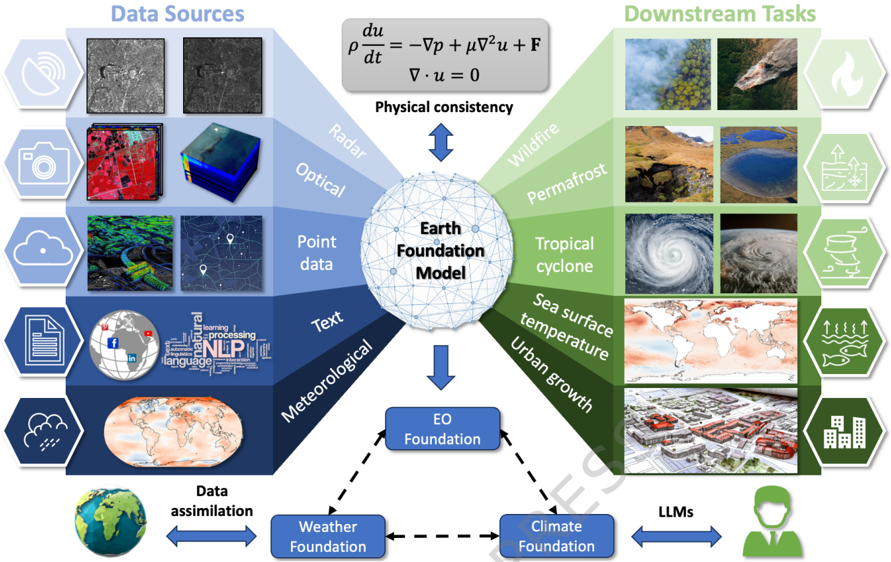
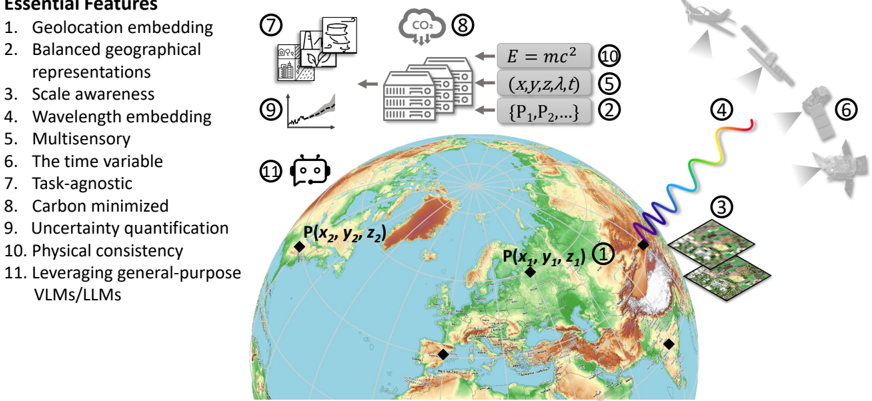
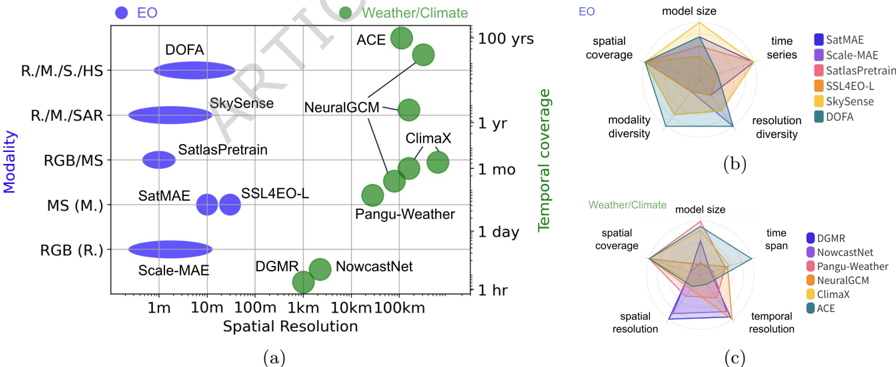
Verification
Claims the paper makes
The claims and statistics of this paper haven’t been checked yet.
Free: it reads the open-access text and checks the first 5 claims that cite a source we can check. Create a free account to check every claim.
Self-check
Percentages, sums and reported differences re-computed from the paper’s own numbers.
The self-check needs the paper’s full text.
Citations
Cites
Hersbach, H., Bell, B., Berrisford, P., Hirahara, S., Horányi, A., Muñoz‐Sabater, J., Nicolas, J., Peubey, C., Radu, R., Schepers, D., et al. (2020) · Quarterly Journal of the Royal Meteorological Society · doi:10.1002/qj.3803 · Cited by 31,882
Eyring, V., Bony, S., Meehl, G. A., Senior, C. A., Stevens, B., Stouffer, R. J., & Taylor, K. E. (2016) · Geoscientific Model Development · doi:10.5194/gmd-9-1937-2016 · Cited by 11,981 · cited 2×
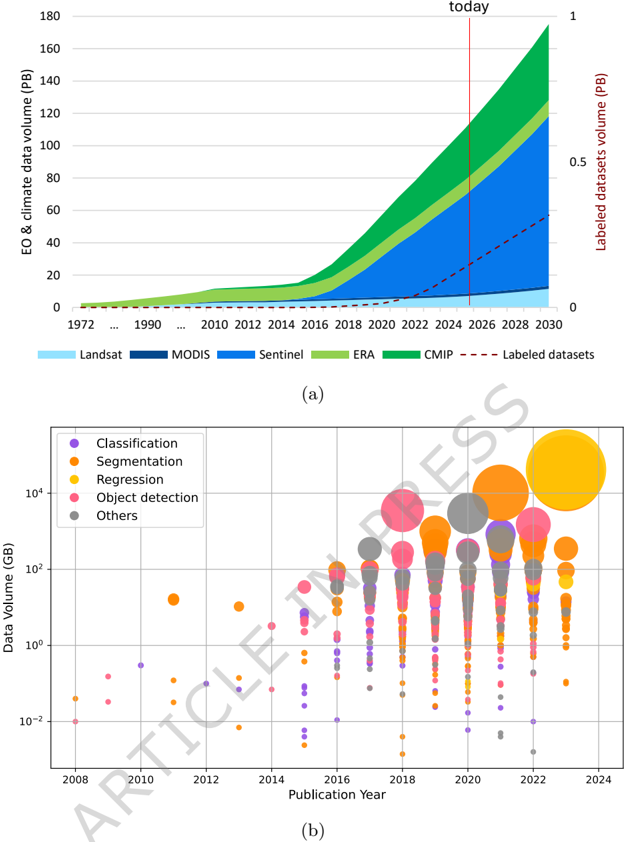
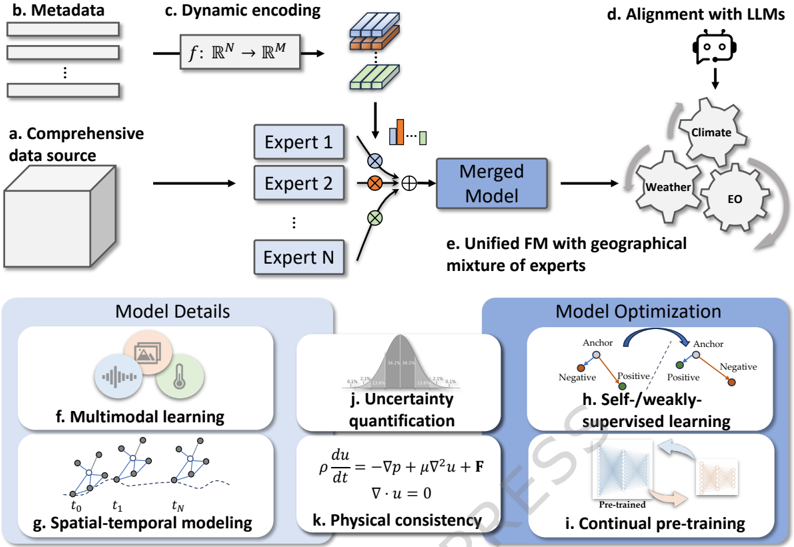
“Furthermore, climate models like CMIP6 27 and MERRA-2 28 offer simulations of past, present, and future climate scenarios built on strong physical understandings of the climate system that are valuable to climate FMs. Figure 2a highlights a number of these datasets.”
Kirillov, A., Mintun, E., Ravi, N., Mao, H., Rolland, C., Gustafson, L., Xiao, T., Whitehead, S., Berg, A. C., Lo, W.-Y., et al. (2023) · 2023 IEEE/CVF International Conference on Computer Vision (ICCV) · doi:10.1109/iccv51070.2023.00371 · Cited by 11,953
The Modern-Era Retrospective Analysis for Research and Applications, Version 2 (MERRA-2)
Gelaro, R., McCarty, W., Suárez, M. J., Todling, R., Molod, A., Takacs, L., Randles, C. A., Darmenov, A., Bosilovich, M. G., Reichle, R., et al. (2017) · Journal of Climate · doi:10.1175/jcli-d-16-0758.1 · Cited by 9,010 · cited 1×
“Furthermore, climate models like CMIP6 27 and MERRA-2 28 offer simulations of past, present, and future climate scenarios built on strong physical understandings of the climate system that are valuable to climate FMs. Figure 2a highlights a number of these datasets.”
Physics-informed machine learning
Karniadakis, G. E., Kevrekidis, I. G., Lu, L., Perdikaris, P., Wang, S., & Yang, L. (2021) · Nature Reviews Physics · doi:10.1038/s42254-021-00314-5 · Cited by 8,718 · cited 1×
“Physics-informed neural networks 111,112 incorporate these equations into the neural network ’ s loss function, enabling unsupervised learning for understanding physical processes.”
Overcoming catastrophic forgetting in neural networks
Kirkpatrick, J., Pascanu, R., Rabinowitz, N., Veness, J., Desjardins, G., Rusu, A. A., Milan, K., Quan, J., Ramalho, T., Grabska-Barwinska, A., et al. (2017) · Proceedings of the National Academy of Sciences · doi:10.1073/pnas.1611835114 · Cited by 7,899
The JRA-55 Reanalysis: General Specifications and Basic Characteristics
KOBAYASHI, S., OTA, Y., HARADA, Y., EBITA, A., MORIYA, M., ONODA, H., ONOGI, K., KAMAHORI, H., KOBAYASHI, C., ENDO, H., et al. (2015) · Journal of the Meteorological Society of Japan. Ser. II · doi:10.2151/jmsj.2015-001 · Cited by 4,760 · cited 1×
“23 , JRA-55 24 , NCEP 25 , and HRRR 26 are already widely used for FM pre-training.”
LLaMA: Open and Efficient Foundation Language Models
Touvron, H., Lavril, T., Izacard, G., Martinet, X., Lachaux, M.-A., Lacroix, T., Rozière, B., Goyal, N., Hambro, E., Azhar, F., et al. (2023) · arXiv · doi:10.48550/arxiv.2302.13971 · Cited by 4,602 · cited 1×
“4.”
Koenker, R., & Hallock, K. F. (2001) · Journal of Economic Perspectives · doi:10.1257/jep.15.4.143 · Cited by 4,413
Energy and Policy Considerations for Deep Learning in NLP
Strubell, E., Ganesh, A., & McCallum, A. (2019) · arXiv · doi:10.48550/arxiv.1906.02243 · Cited by 3,735 · cited 5×
“Earth AI 91 supports multiple tasks related to population and environmental dynamics, fostering task-agnostic Earth FMs. OceanGPT 92 , the fi rst LLM for ocean science, demonstrates expertise across various ocean applications.”
Influential
Research works printed but not linked: 29
- Radford, A., Kim, J.W., Hallacy, C., Ramesh, A., Goh, G., Agarwal, S., Sastry, G., Askell, A., Mishkin, P., Clark, J., et al.: Learning transferable visual models from natural language supervision. In: International Conference on Machine Learning, pp. 8748-8763 (2021)
- Stewart, A., Lehmann, N., Corley, I., Wang, Y., Chang, Y.-C., Ait Ali Braham, N.A., Sehgal, S., Robinson, C., Banerjee, A.: SSL4EO-L: Datasets and foundation models for Landsat imagery. In: Advances in Neural Information Processing Systems, vol. 36 (2024)
- Takamoto, M., Praditia, T., Leiteritz, R., MacKinlay, D., Alesiani, F., Pflüger, D., Niepert, M.: PDEBench: An extensive benchmark for scientific machine learning. Advances in Neural Information Processing Systems 35, 1596-1611 (2022)
- Hu, E.J., Shen, Y., Wallis, P., Allen-Zhu, Z., Li, Y., Wang, S., Wang, L., Chen, W., et al.: LoRA: Low-rank adaptation of large language models. ICLR 1(2), 3 (2022)
- Cong, Y., Khanna, S., Meng, C., Liu, P., Rozi, E., He, Y., Burke, M., Lobell, D., Ermon, S.: SatMAE: Pre-training transformers for temporal and multi-spectral satellite imagery. In: Advances in Neural Information Processing Systems, vol. 35, pp. 197-211 (2022)
- Liu, F., Chen, D., Guan, Z., Zhou, X., Zhu, J., Ye, Q., Fu, L., Zhou, J.: RemoteClip: A vision language foundation model for remote sensing. IEEE Transactions on Geoscience and Remote Sensing 62, 1-16 (2024)
- Zeng, C., Bertsimas, D.: Global flood prediction: a multimodal machine learning approach. In: ICLR Workshop on Tackling Climate Change with Machine Learning (2023)
- Zhan, Y., Xiong, Z., Yuan, Y.: RSVG: Exploring data and models for visual grounding on remote sensing data. IEEE Transactions on Geoscience and Remote Sensing 61, 1-13 (2023)
- Yuan, Z., Xiong, Z., Mou, L., Zhu, X.X.: ChatEarthNet: A global-scale image-text dataset empow- ering vision-language geo-foundation models. Earth System Science Data Discussions 2024, 1-24 (2024)
- Nguyen, T., Brandstetter, J., Kapoor, A., Gupta, J.K., Grover, A.: ClimaX: A foundation model for weather and climate. In: Proceedings of the 40th International Conference on Machine Learning, pp. 25904-25938 (2023)
- Verma, Y., Heinonen, M., Garg, V.: ClimODE: Climate and weather forecasting with physics- informed neural odes. In: The Twelfth International Conference on Learning Representations (2024)
- Bonev, B., Kurth, T., Hundt, C., Pathak, J., Baust, M., Kashinath, K., Anandkumar, A.: Spherical Fourier neural operators: Learning stable dynamics on the sphere. In: International Conference on Machine Learning, pp. 2806-2823 (2023). PMLR
- Subramanian, S., Harrington, P., Keutzer, K., Bhimji, W., Morozov, D., Mahoney, M.W., Gholami, A.: Towards foundation models for scientific machine learning: Characterizing scaling and transfer behavior. In: Advances in Neural Information Processing Systems, vol. 36 (2024)
- Darlow, L.N., Deng, Q., Hassan, A., Asenov, M., Singh, R., Joosen, A., Barker, A., Storkey, A.: DAM: A foundation model for forecasting. In: The Twelfth International Conference on Learning Representations (2023)
- Kuo, W., Cui, Y., Gu, X., Piergiovanni, A., Angelova, A.: Open-vocabulary object detection upon frozen vision and language models. In: The Eleventh International Conference on Learning Representations (2023)
- Fuller, A., Millard, K., Green, J.: CROMA: Remote sensing representations with contrastive radar- optical masked autoencoders. In: Advances in Neural Information Processing Systems, vol. 36 (2024)
- Snelson, E., Ghahramani, Z.: Sparse Gaussian processes using pseudo-inputs. In: Advances in Neural Information Processing Systems, vol. 18 (2005)
- Oquab, M., Darcet, T., Moutakanni, T., Vo, H.V., Szafraniec, M., Khalidov, V., Fernandez, P., HAZIZA, D., Massa, F., El-Nouby, A., et al.: DINOv2: Learning robust visual features without supervision. Transactions on Machine Learning Research (2024)
- Yeh, C., Meng, C., Wang, S., Driscoll, A., Rozi, E., Liu, P., Lee, J.J., Burke, M., Lobell, D.B., Ermon, S.: SustainBench: Benchmarks for monitoring the sustainable development goals with machine learning. In: Proceedings of the Neural Information Processing Systems Track on Datasets and Benchmarks (2021)
- Lacoste, A., Lehmann, N., Rodriguez, P., Sherwin, E., Kerner, H., Lütjens, B., Irvin, J., Dao, D., Alemohammad, H., Drouin, A., et al.: Geo-Bench: Toward foundation models for Earth monitoring. In: Advances in Neural Information Processing Systems, vol. 36 (2024)
- Racah, E., Beckham, C., Maharaj, T., Ebrahimi Kahou, S., Prabhat, M., Pal, C.: ExtremeWeather: A large-scale climate dataset for semi-supervised detection, localization, and understanding of extreme weather events. In: Advances in Neural Information Processing Systems, vol. 30 (2017)
- Nguyen, T., Jewik, J., Bansal, H., Sharma, P., Grover, A.: ClimateLearn: Benchmarking machine learning for weather and climate modeling. In: Advances in Neural Information Processing Systems, vol. 36 (2024)
- Xu, Y., Ghamisi, P.: Universal adversarial examples in remote sensing: Methodology and benchmark. IEEE Transactions on Geoscience and Remote Sensing 60, 1-15 (2022)
- Zhu, L., Liao, B., Zhang, Q., Wang, X., Liu, W., Wang, X.: Vision Mamba: efficient visual repre- sentation learning with bidirectional state space model. In: Proceedings of the 41st International Conference on Machine Learning, pp. 62429-62442 (2024)
- Chen, R., Liu, Y., Kong, L., Chen, N., Zhu, X., Ma, Y., Liu, T., Wang, W.: Towards label-free scene understanding by vision foundation models. In: Advances in Neural Information Processing Systems, vol. 36, pp. 75896-75910 (2023)
- Truhn, D., Eckardt, J.-N., Ferber, D., Kather, J.N.: Large language models and multimodal foundation models for precision oncology. NPJ Precision Oncology 8(1), 1-4 (2024)
- Lewis, P., Perez, E., Piktus, A., Petroni, F., Karpukhin, V., Goyal, N., Küttler, H., Lewis, M., Yih, W.-t., Rocktäschel, T., et al.: Retrieval-augmented generation for knowledge-intensive NLP tasks. In: Advances in Neural Information Processing Systems, vol. 33, pp. 9459-9474 (2020)
- Wang, Y., Xiong, Z., Liu, C., Stewart, A.J., Dujardin, T., Bountos, N.I., Zavras, A., Gerken, F., Papoutsis, I., Leal-Taixé, L., et al.: Towards a unified copernicus foundation model for earth vision. arXiv preprint arXiv:2503.11849 (2025) · arXiv
- Petrie, R., Denvil, S., Ames, S., Levavasseur, G., Fiore, S., Allen, C., Antonio, F., Berger, K., Bretonnière, P.-A., Cinquini, L., et al.: Coordinating an operational data distribution network for CMIP6 data. Geoscientific Model Development Discussions 2020, 1-22 (2020)
Cited by
Zhan, Y., Xiong, Z., & Yuan, Y. (2025) · ISPRS Journal of Photogrammetry and Remote Sensing · doi:10.1016/j.isprsjprs.2025.01.020 · Cited by 336
Self-citationFoundation Models for Remote Sensing and Earth Observation: A survey
Xiao, A., Xuan, W., Wang, J., Huang, J., Tao, D., Lu, S., & Yokoya, N. (2025) · IEEE Geoscience and Remote Sensing Magazine · doi:10.1109/mgrs.2025.3576766 · Cited by 262
Large-scale flood modeling and forecasting with FloodCast
Xu, Q., Shi, Y., Bamber, J. L., Ouyang, C., & Zhu, X. X. (2024) · Water Research · doi:10.1016/j.watres.2024.122162 · Cited by 74
Self-citationWhen Geoscience Meets Foundation Models: Toward a general geoscience artificial intelligence system
Zhang, H., Xu, J., Cui, H., Li, L., Yang, Y., Tang, C., & Boers, N. (2024) · IEEE Geoscience and Remote Sensing Magazine · doi:10.1109/mgrs.2024.3496478 · Cited by 84
TorchGeo: Deep Learning With Geospatial Data
Stewart, A. J., Robinson, C., Corley, I., Ortiz, A., Ferres, J. L., & Banerjee, A. (2025) · ACM Transactions on Spatial Algorithms and Systems · doi:10.1145/3707459 · Cited by 78
Self-citation
Metadata
- Authors
- Zhu, X. X., Xiong, Z., Wang, Y., Stewart, A. J., Heidler, K., Wang, Y., Yuan, Z., Dujardin, T., Xu, Q., & Shi, Y.
- Affiliations
- Munich Center for Machine Learning (DE)
- Technical University of Munich (DE)
- Corresponding author
- Zhu, Xiao Xiang
- ORCID
- Venue
- Communications Earth & Environment
- Published
- 2026-01-08
- Volume
- 7
- Issue
- 1
- ISSN
- 2662-4435 (ISSN-L)
- OpenAlex
- W7119541039
- Semantic Scholar
- 39f86b974c7325e3ddefdd53b414e6bc5202ea19
- Cited by
- 26
- References
- 108
- Citations by year
- 2026: 25
- FWCI
- 86.36
- Type
- journal article
- Language
- en
- Open access
- gold
- doi.org
- Licence
- cc-by
- creativecommons.org/licenses/by/4.0 (tdm)
- creativecommons.org/licenses/by/4.0 (vor, 22 d)
- Locations
- Communications Earth & Environment (publishedVersion, cc-by)
- DOAJ (DOAJ: Directory of Open Access Journals) (submittedVersion, cc-by-sa)
- Funders
- European Commission (101091374)
- Bundesministerium für Umwelt, Naturschutz, Bau und Reaktorsicherheit (67KI32002B)
- Bundesministerium für Wirtschaft und Energie (50EE2201C)
- Technische Universität München
- Topics
- Physical Sciences › Computer Science › Artificial Intelligence › Artificial Intelligence Applications
- Physical Sciences › Physics and Astronomy › Statistical and Nonlinear Physics › Model Reduction and Neural Networks
- Social Sciences › Decision Sciences › Information Systems and Management › Scientific Computing and Data Management
- Keywords
- foundation models, earth sciences, model evaluation, adversarial defense, interpretability
About these checks
Registry, retraction, Cites and statistics results are computed, not judged, with one exception: a printed reference that no index lists is read once by a model before it counts as a citation error. Claims are extracted by a model and kept only when their quote appears verbatim in the text; each cited source is then checked, with a model’s help, for whether it says what the claim relies on. Those verdicts can be wrong — read the claim’s quote and the cited source before relying on one.
Statistics and arithmetic are recomputed, not judged.
Confidence bands are shown only for fields calibrated on our annotated test set. None is calibrated yet, so no band is shown.
What counts as a claim ›How we measure confidence ›How we check this ›
Are you an author, or do you see a problem with this page? Request a review
Data sources
Bibliographic data: Semantic Scholar, OpenAlex, Crossref.
Contains information from the Semantic Scholar Academic Graph Datasets, made available under the ODC Attribution License (ODC-BY 1.0).
Semantic Scholar’s data is described in: Kinney, R., et al. (2023). The Semantic Scholar Open Data Platform. arXiv:2301.10140.
