

The DOI matches its Crossref record; 5 of the 5 references it cites were found in a registry or an index.
A soil food web approach to integrate soil fauna into multitrophic biogeochemistry
Open accessAbstract
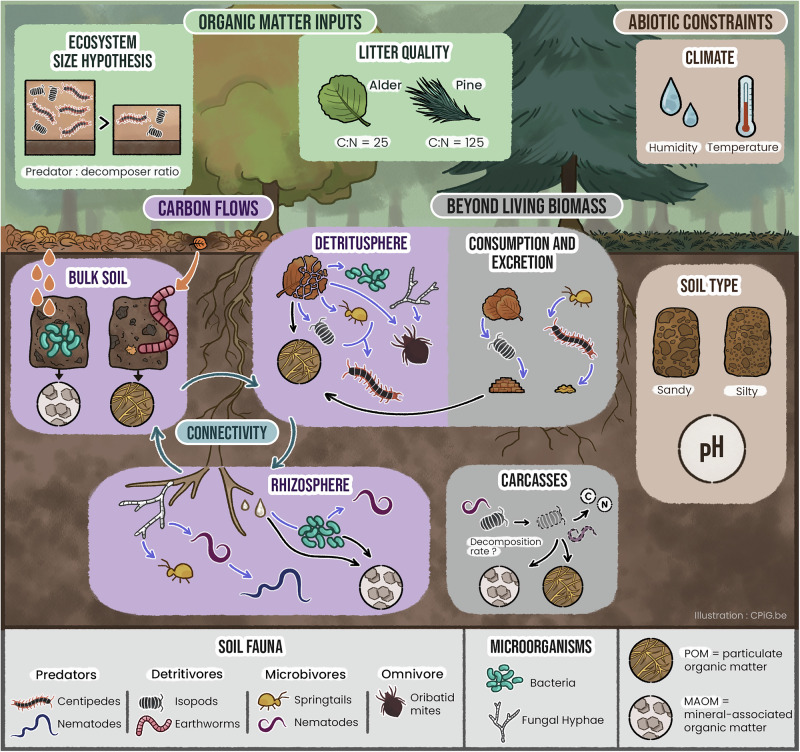
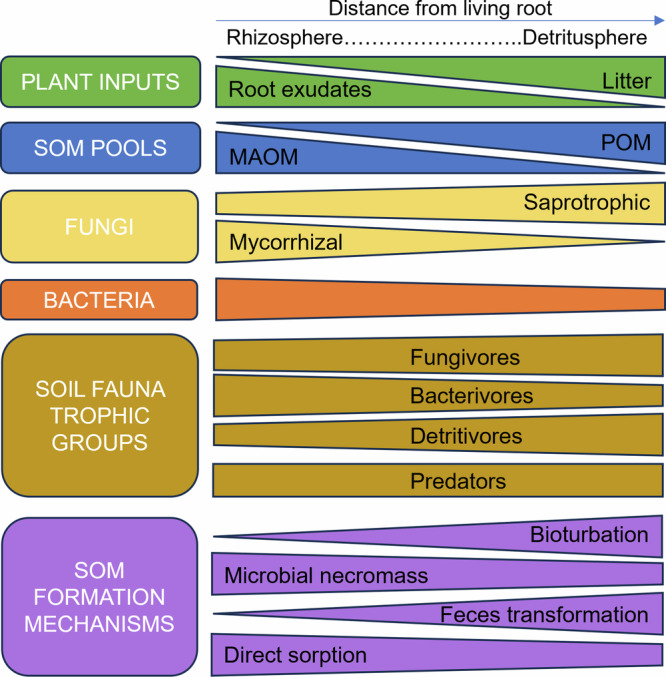
Soil fauna is essential in mediating the formation and turnover of soil organic matter, the largest terrestrial pool of organic carbon, yet remains absent from nearly all existing biogeochemical conceptual frameworks. Soil fauna impacts element cycling via trophic (microbivory, herbivory, detritivory, predation) and non-trophic (bioturbation, dispersal, waste products) pathways. These effects should be integrated into multitrophic biogeochemistry by considering the environmental context (abiotic constraints, quality and quantity of carbon inputs), by including soil food web structure, and by accounting for the role of soil fauna as agents of connectivity. We highlight the need for better quantification of soil fauna and consideration of carcasses and feces as substantial carbon flows. Based on a soil food web approach, these concepts will improve the quantification of the impact of soil fauna on carbon cycling and help to predict how soil fauna will affect carbon cycling under future global change scenarios.
Overview
The claims and statistics of this paper haven’t been checked yet.
Run the check — free, no account needed. It reads the open-access text and checks the sources it cites.
Integrity signals
Registry
Cites
Statistics
Figures
Verification
Claims the paper makes
The claims and statistics of this paper haven’t been checked yet.
Run the check — free, no account needed. It reads the open-access text and checks the sources it cites.
Self-check
Percentages, sums and reported differences re-computed from the paper’s own numbers.
The self-check needs the paper’s full text.
Citations
Cites
Soil carbon storage informed by particulate and mineral-associated organic matter
Cotrufo, M. F., Ranalli, M. G., Haddix, M. L., Six, J., & Lugato, E. (2019) · Nature Geoscience · doi:10.1038/s41561-019-0484-6 · Cited by 1,901
Formation of soil organic matter via biochemical and physical pathways of litter mass loss
Cotrufo, M. F., Soong, J. L., Horton, A. J., Campbell, E. E., Haddix, M. L., Wall, D. H., & Parton, W. J. (2015) · Nature Geoscience · doi:10.1038/ngeo2520 · Cited by 1,874
García‐Palacios, P., Maestre, F. T., Kattge, J., & Wall, D. H. (2013) · Ecology Letters · doi:10.1111/ele.12137 · Cited by 679
Animals and the zoogeochemistry of the carbon cycle
Schmitz, O. J., Wilmers, C. C., Leroux, S. J., Doughty, C. E., Atwood, T. B., Galetti, M., Davies, A. B., & Goetz, S. J. (2018) · Science · doi:10.1126/science.aar3213 · Cited by 372
Population energetics of bacterial-feeding nematodes: Carbon and nitrogen budgets
Ferris, H., Venette, R. C., & Lau, S. S. (1997) · Soil Biology and Biochemistry · doi:10.1016/s0038-0717(97)00035-7 · Cited by 176
Research works printed but not linked: 190
- Jobbágy, E. G., Jackson, R. B., Jobbagy, E. G. & Jackson, R. B. The vertical distribution of soil organic carbon and its relation to climate and vegetation. Ecol. Appl. 10, 423–436 (2000). · DOI
- Bossio, D. A. et al. The role of soil carbon in natural climate solutions. Nat. Sustain. 3, 391–398 (2020). · DOI · Paper page
- Cotrufo, M. F., Wallenstein, M. D., Boot, C. M., Denef, K. & Paul, E. The Microbial Efficiency-Matrix Stabilization (MEMS) framework integrates plant litter decomposition with soil organic matter stabilization: do labile plant inputs form stable soil organic matter? Glob. Change Biol. 19, 988–995 (2013). · DOI · Paper page
- Kallenbach, C. M., Frey, S. D. & Grandy, A. S. Direct evidence for microbial-derived soil organic matter formation and its ecophysiological controls. Nat. Commun. 7, 1–10 (2016). · DOI
- de Vries, F. T. et al. Soil food web properties explain ecosystem services across European land use systems. Proc. Natl. Acad. Sci. USA 110, 14296–14301 (2013). · DOI
- Zhang, C. et al. An integrated fast–slow plant and nematode economics spectrum predicts soil organic carbon dynamics during natural restoration. N. Phytol. 245, 2467–2479 (2024). · DOI
- Wiesmeier, M. et al. Soil organic carbon storage as a key function of soils - a review of drivers and indicators at various scales. Geoderma 333, 149–162 (2019). · DOI
- Bonkowski, M. Protozoa and plant growth: the microbial loop in soil revisited. N. Phytol. 162, 617–631 (2004). · DOI
- Fierer, N., Strickland, M. S., Liptzin, D., Bradford, M. A. & Cleveland, C. C. Global patterns in belowground communities. Ecol. Lett. 12, 1238–1249 (2009). · DOI
- Trap, J., Bonkowski, M., Plassard, C., Villenave, C. & Blanchart, E. Ecological importance of soil bacterivores for ecosystem functions. Plant Soil 398, 1–24 (2016). · DOI
- Bardgett, R. D., Cook, R., Yeates, G. W. & Denton, C. S. The influence of nematodes on below-ground processes in grassland ecosystems. Plant Soil 212, 23–33 (1999). · DOI
- Haase, S., Ruess, L., Neumann, G., Marhan, S. & Kandeler, E. Low-level herbivory by root-knot nematodes (Meloidogyne incognita) modifies root hair morphology and rhizodeposition in host plants (Hordeum vulgare). Plant Soil 301, 151–164 (2007). · DOI
- Angst, G. et al. Conceptualizing soil fauna effects on labile and stabilized soil organic matter. Nat. Commun. 15, 1–16 (2024). · DOI
- Filser, J. et al. Soil fauna: key to new carbon models. Soil 2, 565–582 (2016). · DOI
- Grandy, A. S., Wieder, W. R., Wickings, K. & Kyker-Snowman, E. Beyond microbes: are fauna the next frontier in soil biogeochemical models? Soil Biol. Biochem. 102, 40–44 (2016). · DOI
- Bonfanti, J. et al. Linking effect traits of soil fauna to processes of organic matter transformation. Funct. Ecol. 39, 446–461 (2025). · DOI
- Bradford, M. A. Re-visioning soil food webs. Soil Biol. Biochem. 102, 1–3 (2016). · DOI
- Wieder, W. R., Grandy, A. S., Kallenbach, C. M. & Bonan, G. B. Integrating microbial physiology and physio-chemical principles in soils with the MIcrobial-MIneral Carbon Stabilization (MIMICS) model. Biogeosciences 11, 3899–3917 (2014). · DOI
- Wu, D., Du, E., Eisenhauer, N., Mathieu, J. & Chu, C. Global engineering effects of soil invertebrates on ecosystem functions. Nature 640, 120–129 (2025). · DOI
- Zhang, Y. et al. Simulating measurable ecosystem carbon and nitrogen dynamics with the mechanistically defined MEMS 2.0 model. Biogeosciences 18, 3147–3171 (2021). · DOI
- Barrett, J. E., Virginia, R. A., Wall, D. H. & Adams, B. J. Decline in a dominant invertebrate species contributes to altered carbon cycling in a low-diversity soil ecosystem. Glob. Change Biol. 14, 1–11 (2008). · DOI
- Postma-Blaauw, M. B., De Goede, R. G. M., Bloem, J., Faber, J. H. & Brussaard, L. Soil biota community structure and abundance under agricultural intensification and extensification. Ecology 91, 460–473 (2010). · DOI
- Tsiafouli, M. A. et al. Intensive agriculture reduces soil biodiversity across Europe. Glob. Change Biol. 21, 973–985 (2015). · DOI · Paper page
- Koltz, A. M., Asmus, A., Gough, L., Pressler, Y. & Moore, J. C. The detritus-based microbial-invertebrate food web contributes disproportionately to carbon and nitrogen cycling in the Arctic. Polar Biol. 41, 1531–1545 (2018). · DOI
- Potapov, A. M., Klarner, B., Sandmann, D., Widyastuti, R. & Scheu, S. Linking size spectrum, energy flux and trophic multifunctionality in soil food webs of tropical land-use systems. J. Anim. Ecol. 88, 1845–1859 (2019). · DOI
- Whalen, E. D. et al. Clarifying the evidence for microbial- and plant-derived soil organic matter, and the path toward a more quantitative understanding. Glob. Change Biol. 00, 1–19 (2022).
- Buckeridge, K. M., Creamer, C. & Whitaker, J. Deconstructing the microbial necromass continuum to inform soil carbon sequestration. Funct. Ecol. 36, 1396–1410 (2022). · DOI
- Liang, C., Amelung, W., Lehmann, J. & Kästner, M. Quantitative assessment of microbial necromass contribution to soil organic matter. Glob. Change Biol. 25, 3578–3590 (2019). · DOI
- Lavallee, J. M., Soong, J. L. & Cotrufo, M. F. Conceptualizing soil organic matter into particulate and mineral-associated forms to address global change in the 21st century. Glob. Change Biol. 26, 261–273 (2020). · DOI · Paper page
- Chang, Y. et al. A stoichiometric approach to estimate sources of mineral-associated soil organic matter. Glob. Change Biol. 30, 1–14 (2024).
- Pausch, J. et al. Small but active – pool size does not matter for carbon incorporation in below-ground food webs. Funct. Ecol. 30, 479–489 (2016). · DOI
- Sokol, N. W. et al. Global distribution, formation and fate of mineral-associated soil organic matter under a changing climate: a trait-based perspective. Funct. Ecol. 36, 1411–1429 (2022). · DOI
- Prescott, C. E. & Vesterdal, L. Decomposition and transformations along the continuum from litter to soil organic matter in forest soils. Ecol. Manag. 498, 1–14 (2021). · DOI
- Witzgall, K. et al. Particulate organic matter as a functional soil component for persistent soil organic carbon. Nat. Commun. 12, 1–10 (2021). · DOI
- Kane, J. L., Kotcon, J. B., Freedman, Z. B. & Morrissey, E. M. Fungivorous nematodes drive microbial diversity and carbon cycling in soil. Ecology 104, e3844 (2023). · DOI
- Mielke, L. et al. Nematode grazing increases the allocation of plant-derived carbon to soil bacteria and saprophytic fungi, and activates bacterial species of the rhizosphere. Pedobiol. J. Soil Ecol. 90, 150787–150787 (2022).
- Wang, Y. et al. Protist size-dependent shifts of bacterial communities can reduce litter decomposition. ISME Commun. 5, ycaf231 (2025). · DOI
- Crowther, T. W. et al. Top-down control of soil fungal community composition by a globally distributed keystone consumer. Ecology 94, 2518–2528 (2013). · DOI
- Hannula, S. E., Jongen, R. & Morriën, E. Grazing by collembola controls fungal induced soil aggregation. Fungal Ecol. 65, 1–9 (2023). · DOI
- Schröter, D., Wolters, V. & de Ruiter, P. C. C and N mineralisation in the decomposer food webs of a European forest transect. Oikos 102, 294–308 (2003). · DOI
- Postma-Blaauw, M. B. et al. Within-trophic group interactions of bacterivorous nematode species and their effects on the bacterial community and nitrogen mineralization. Oecologia 142, 428–439 (2005). · DOI
- Crowther, T. W., Boddy, L. & Jones, T. H. Species-specific effects of soil fauna on fungal foraging and decomposition. Oecologia 167, 535–545 (2011). · DOI
- Bonkowski, M., Villenave, C. & Griffiths, B. Rhizosphere fauna: the functional and structural diversity of intimate interactions of soil fauna with plant roots. Plant Soil 321, 213–233 (2009). · DOI
- Sabatini, M. A. & Innocenti, G. Effects of Collembola on plant-pathogenic fungus interactions in simple experimental systems. Biol. Fertil. Soils 33, 62–66 (2001). · DOI
- de Vries, F. T. & Caruso, T. Eating from the same plate? Revisiting the role of labile carbon inputs in the soil food web. Soil Biol. Biochem 102, 4–9 (2016). · DOI
- Wardle, D. A. The influence of biotic interactions on soil biodiversity. Ecol. Lett. 9, 870–886 (2006). · DOI
- Joly, F.-X. et al. Detritivore conversion of litter into faeces accelerates organic matter turnover. Commun. Biol. 3, 1–9 (2020). · DOI
- Heděnec, P. et al. Global distribution of soil fauna functional groups and their estimated litter consumption across biomes. Sci. Rep. 12, 1–14 (2022). · DOI
- Guidi, C. et al. Soil fauna drives vertical redistribution of soil organic carbon in a long-term irrigated dry pine forest. Glob. Change Biol. 28, 3145–3160 (2022). · DOI
- Tan, B. et al. Temperature and moisture modulate the contribution of soil fauna to litter decomposition via different pathways. Ecosystems 24, 1142–1156 (2021). · DOI
- Fujii, S., Makita, N., Mori, A. S. & Takeda, H. Plant species control and soil faunal involvement in the processes of above- and below-ground litter decomposition. Oikos 125, 883–892 (2016). · DOI
- Song, X. et al. The contributions of soil mesofauna to leaf and root litter decomposition of dominant plant species in grassland. Appl. Soil Ecol. 155, 1–8 (2020). · DOI
- Ulyshen, M. D. Wood decomposition as influenced by invertebrates. Biol. Rev. 91, 70–85 (2016). · DOI
- David, J. F. The role of litter-feeding macroarthropods in decomposition processes: a reappraisal of common views. Soil Biol. Biochem. 76, 109–118 (2014). · DOI
- Joly, F.-X., Coq, S., Coulis, M., Nahmani, J. & Hättenschwiler, S. Litter conversion into detritivore faeces reshuffles the quality control over C and N dynamics during decomposition. Funct. Ecol. 32, 2605–2614 (2018). · DOI
- Wickings, K. & Grandy, A. S. The oribatid mite Scheloribates moestus (Acari: Oribatida) alters litter chemistry and nutrient cycling during decomposition. Soil Biol. Biochem. 43, 351–358 (2011). · DOI
- Angst, G. et al. Earthworms act as biochemical reactors to convert labile plant compounds into stabilized soil microbial necromass. Commun. Biol. 2, 1–7 (2019). · DOI
- Vidal, A. et al. Earthworm cast formation and development: a shift from plant litter to mineral associated organic matter. Front. Environ. Sci. 7, 1–15 (2019). · DOI
- Coq, S. et al. Faeces traits as unifying predictors of detritivore effects on organic matter turnover. Geoderma 422, 1–9 (2022). · DOI
- Roy, S. N. & Joy, V. C. Dietary effects of non-nutrients in the leaf litter of forest trees on assimilation, growth and tissue composition of the detritivorous soil arthropod Anoplodesmus saussurei (Humb.) (Polydesmida: Diplopoda). Appl. Soil Ecol. 43, 53–60 (2009). · DOI
- Coulis, M. et al. Functional dissimilarity across trophic levels as a driver of soil processes in a Mediterranean decomposer system exposed to two moisture levels. Oikos 124, 1304–1316 (2015). · DOI
- Cárcamo, H. A., Abe, T. A., Prescott, C. E., Holl, F. B. & Chanway, C. P. Influence of millipedes on litter decomposition, N mineralization, and microbial communities in a coastal forest in British Columbia, Canada. Can. J. Res. 30, 817–826 (2000). · DOI
- Hedlund, K. & Öhrn, M. S. Tritrophic interactions in a soil community enhance decomposition rates. Oikos 88, 585–591 (2000). · DOI
- Hogle, S. L., Hepolehto, I., Ruokolainen, L., Cairns, J. & Hiltunen, T. Effects of phenotypic variation on consumer coexistence and prey community structure. Ecol. Lett. 25, 307–319 (2022). · DOI
- Liu, S. et al. Functional redundancy dampens the trophic cascade effect of a web-building spider in a tropical forest floor. Soil Biol. Biochem. 98, 22–29 (2016). · DOI
- Schmitz, O. J. Effects of predator hunting mode on grassland ecosystem function. Science 319, 952–954 (2008). · DOI
- Thakur, M. P., van Groenigen, J. W., Kuiper, I. & De Deyn, G. B. Interactions between microbial-feeding and predatory soil fauna trigger N2O emissions. Soil Biol. Biochem. 70, 256–262 (2014). · DOI
- Lucas, J. M., McBride, S. G. & Strickland, M. S. Trophic level mediates soil microbial community composition and function. Soil Biol. Biochem. 143, 1–10 (2020). · DOI
- Lenoir, L., Persson, T., Bengtsson, J., Wallander, H. & Wirén, A. Bottom–up or top–down control in forest soil microcosms? Effects of soil fauna on fungal biomass and C/N mineralisation. Biol. Fertil. Soils 43, 281–294 (2007). · DOI
- Zaitsev, A. S., Birkhofer, K., Ekschmitt, K. & Wolters, V. Belowground tritrophic food chain modulates soil respiration in grasslands. Pedosphere 28, 114–123 (2018). · DOI
- Thakur, M. P. & Eisenhauer, N. Plant community composition determines the strength of top-down control in a soil food web motif. Sci. Rep. 5, 9134 (2015). · DOI
- Lang, B., Rall, B. C., Scheu, S. & Brose, U. Effects of environmental warming and drought on size-structured soil food webs. Oikos 123, 1224–1233 (2014). · DOI
- Adamczyk, M., Rüthi, J. & Frey, B. Root exudates increase soil respiration and alter microbial community structure in alpine permafrost and active layer soils. Environ. Microbiol. 23, 2152–2168 (2021). · DOI
- Gan, H. & Wickings, K. Root herbivory and soil carbon cycling: shedding “green” light onto a “brown” world. Soil Biol. Biochem. 150, 1–9 (2020). · DOI
- van der Putten, W. H., Vet, L. E. M., Harvey, J. A. & Wäckers, F. L. Linking above- and belowground multitrophic interactions of plants, herbivores, pathogens, and their antagonists. Trends Ecol. Evol. 16, 547–554 (2001). · DOI
- van der Putten, W. H. & van der Stoel, C. D. Plant parasitic nematodes and spatio-temporal variation in natural vegetation. Appl. Soil Ecol. 10, 253–262 (1998). · DOI
- Wurst, S., Wagenaar, R., Biere, A. & van der Putten, W. H. Microorganisms and nematodes increase levels of secondary metabolites in roots and root exudates of Plantago lanceolata. Plant Soil 329, 117–126 (2010). · DOI
- Potapov, A. M., Tiunov, A. V. & Scheu, S. Uncovering trophic positions and food resources of soil animals using bulk natural stable isotope composition. Biol. Rev. 94, 37–59 (2019). · DOI
- Asplund, J., Bokhorst, S. & Wardle, D. A. Secondary compounds can reduce the soil micro-arthropod effect on lichen decomposition. Soil Biol. Biochem. 66, 10–16 (2013). · DOI
- Bossuyt, H., Six, J. & Hendrix, P. F. Protection of soil carbon by microaggregates within earthworm casts. Soil Biol. Biochem. 37, 251–258 (2005). · DOI
- Jouquet, P., Dauber, J., Lagerlöf, J., Lavelle, P. & Lepage, M. Soil invertebrates as ecosystem engineers: intended and accidental effects on soil and feedback loops. Appl. Soil Ecol. 32, 153–164 (2006). · DOI
- Lavelle, P. Faunal activities and soil processes: adaptive strategies that determine ecosystem function. Adv. Ecol. Res. 27, 93–132 (1997). · DOI
- Ehrle, A., Kolle, O., Tischer, A., Trumbore, S. E. & Michalzik, B. Effects of mound building Lasius flavus on organic carbon and nutrient fluxes in soils of temperate grassland ecosystems. Pedobiologia 84, 1–13 (2021). · DOI
- Lejoly, J., Quideau, S. & Laganière, J. Invasive earthworms affect soil morphological features and carbon stocks in boreal forests. Geoderma 404, 1–13 (2021). · DOI
- Desie, E. et al. Positive feedback loop between earthworms, humus form and soil pH reinforces earthworm abundance in European forests. Funct. Ecol. 34, 2598–2610 (2020). · DOI
- Shuster, W. D., Subler, S. & McCoy, E. L. Foraging by deep-burrowing earthworms degrades surface soil structure of a fluventic Hapludoll in Ohio. Soil Tillage Res. 54, 179–189 (2000). · DOI
- Lejoly, J. et al. Effects of termite sheetings on soil properties under two contrasting soil management practices. Pedobiologia 76, 1–8 (2019). · DOI
- Le Mer, G. et al. Age matters: dynamics of earthworm casts and burrows produced by the anecic Amynthas khami and their effects on soil water infiltration. Geoderma 382, 114709 (2021). · DOI
- Frouz, J. & Jilková, V. The effect of ants on soil properties and processes (Hymenoptera: Formicidae). Myrmecol N. 11, 191–199 (2008).
- Vion-Guibert, L. et al. The effects of earthworm species on organic matter transformations and soil microbial communities are only partially related to their bioturbation activity. Soil Biol. Biochem. 199, 109606 (2024). · DOI
- Dang, H. X., Pham, Q. V., Tran, T. M., Rumpel, C. & Bottinelli, N. Earthworm impacts on soil carbon storage: the importance of quantifying all drilosphere compartments. Appl. Soil Ecol. 215, 106448 (2025). · DOI
- Chen, C., Singh, A. K., Yang, B., Wang, H. & Liu, W. Effect of termite mounds on soil microbial communities and microbial processes: Implications for soil carbon and nitrogen cycling. Geoderma 431, 1–11 (2023). · DOI
- Frouz, J. Plant-soil feedback across spatiotemporal scales from immediate effects to legacy. Soil Biol. Biochem. 189, 1–13 (2024). · DOI
- Harvey, G. L. et al. Global diversity and energy of animals shaping the Earth’s surface. Proc. Natl. Acad. Sci. USA 122, e2415104122 (2025). · DOI
- Mujinya, B. B. et al. Spatial patterns and morphology of termite (Macrotermes falciger) mounds in the Upper Katanga, D.R. Congo. Catena 114, 97–106 (2014). · DOI
- Harit, A., Shanbhag, R., Chaudhary, E., Cheik, S. & Jouquet, P. Properties and functional impact of termite sheetings. Biol. Fertil. Soils 53, 743–749 (2017). · DOI
- Sitters, J. & Olde Venterink, H. The need for a novel integrative theory on feedbacks between herbivores, plants and soil nutrient cycling. Plant Soil 396, 421–426 (2015). · DOI
- Barton, P. S. et al. Towards quantifying carrion biomass in ecosystems. Trends Ecol. Evol. 34, 950–961 (2019). · DOI
- El-Ayouty, E. Y., Ghabbour, S. I. & El-Sayyed, N. A. M. Rôle of litter and the excreta of soil fauna in the nitrogen status of desert soils. J. Arid Environ. 1, 145–155 (1978). · DOI
- Frouz, J., Novotná, K., Čermáková, L. & Pivokonský, M. Soil fauna reduce soil respiration by supporting N leaching from litter. Appl. Soil Ecol. 153, 1–8 (2020). · DOI
- Zang, H., Wang, J. & Kuzyakov, Y. N fertilization decreases soil organic matter decomposition in the rhizosphere. Appl. Soil Ecol. 108, 47–53 (2016). · DOI
- Guhra, T., Stolze, K., Schweizer, S. & Totsche, K. U. Earthworm mucus contributes to the formation of organo-mineral associations in soil. Soil Biol. Biochem. 145, 1–10 (2020). · DOI
- Chertov, O. G. Quantification of soil fauna metabolites and dead mass as humification sources in forest soils. Eurasia. Soil Sci. 49, 77–88 (2016). · DOI
- Frost, C. J. & Hunter, M. D. Insect canopy herbivory and frass deposition affect soil nutrient dynamics and export in oak mesocosms. Ecology 85, 3335–3347 (2004). · DOI
- Kos, M. et al. After-life effects: living and dead invertebrates differentially affect plants and their associated above- and belowground multitrophic communities. Oikos 126, 888–899 (2017). · DOI
- Lin, J. et al. Earthworms exert long lasting afterlife effects on soil microbial communities. Geoderma 420, 115906–115906 (2022). · DOI
- Crotty, F. V. & Adl, S. M. Competition and predation in soil fungivorous microarthropods using stable isotope ratio mass spectrometry. Front. Microbiol. 10, 1–10 (2019). · DOI
- Seastedt, T. R. & Tate, C. M. Decomposition rates and nutrient contents of arthropod remains in forest litter. Ecology 62, 13–19 (1981). · DOI
- Bastow, J. L. Facilitation and predation structure a grassland detrital food web: the responses of soil nematodes to isopod processing of litter. J. Anim. Ecol. 80, 947–957 (2011). · DOI
- D’Hervilly, C. & Frouz, J. Interactions between litter-feeders and the burrowing earthworm A. caliginosa do not affect mineral-associated C addition in recent spoil material. Appl. Soil Ecol. 218, 106687 (2026). · DOI
- Lubbers, I. M., Berg, M. P., De Deyn, G. B., van der Putten, W. H. & van Groenigen, J. W. Soil fauna diversity increases CO2 but suppresses N2O emissions from soil. Glob. Change Biol. 26, 1886–1898 (2020). · DOI
- Phillips, H. R. P. et al. Global distribution of earthworm diversity. Science 366, 480–485 (2019). · DOI
- Potapov, A. M. et al. Globally invariant metabolism but density-diversity mismatch in springtails. Nat. Commun. 14, 674 (2023). · DOI
- van den Hoogen, J. et al. Soil nematode abundance and functional group composition at a global scale. Nature 572, 194–198 (2019). · DOI
- Irshad, S. & Frouz, J. How the effect of earthworms on soil organic matter mineralization and stabilization is affected by litter quality and stage of soil development. Biogeochemistry 167, 1425–1436 (2024). · DOI
- Wright, D. A., Killham, K., Glover, L. A. & Prosser, J. I. Role of pore size location in determining bacterial activity during predation by protozoa in soil. Appl. Environ. Microbiol. 61, 3537–3543 (1995). · DOI
- Erktan, A., Or, D. & Scheu, S. The physical structure of soil: determinant and consequence of trophic interactions. Soil Biol. Biochem. 148, 107876 (2020). · DOI
- Sokol, N. W., Sanderman, J. & Bradford, M. A. Pathways of mineral-associated soil organic matter formation: integrating the role of plant carbon source, chemistry, and point of entry. Glob. Change Biol. 25, 12–24 (2019). · DOI
- Angst, G., Mueller, K. E., Nierop, K. G. J. & Simpson, M. J. Plant- or microbial-derived? A review on the molecular composition of stabilized soil organic matter. Soil Biol. Biochem. 156, 108189 (2021). · DOI · Paper page
- Soares, M. & Rousk, J. Microbial growth and carbon use efficiency in soil: Links to fungal-bacterial dominance, SOC-quality and stoichiometry. Soil Biol. Biochem. 131, 195–205 (2019). · DOI
- Ostle, N. et al. Isotopic detection of recent photosynthate carbon flow into grassland rhizosphere fauna. Soil Biol. Biochem. 39, 768–777 (2007). · DOI
- Bernier, N. Hotspots of biodiversity in the underground: A matter of humus form? Appl. Soil Ecol. 123, 305–312 (2018). · DOI
- Liu, J., Li, F., Tian, T. & Xiao, H. Unraveling the influence of litter identity, diversity and rhizodeposition on nematode communities. Plant Soil 505, 63–777 (2024). · DOI
- Burtis, J. C., Pipes, G. T. & Yavitt, J. B. How do soil fauna mediate leaf litter decomposition in north temperate forest ecosystems? Pedobiologia 105, 150975 (2024). · DOI
- Liao, J. et al. Earthworms regulate soil microbial and plant residues through decomposition. Geoderma 450, 117040 (2024). · DOI
- Soong, J. L. & Nielsen, U. N. The role of microarthropods in emerging models of soil organic matter. Soil Biol. Biochem. 102, 37–39 (2016). · DOI
- Song, C. et al. Land use determines the composition and stability of organic carbon in earthworm casts under tropical conditions. Soil Biol. Biochem. 190, 109291 (2024). · DOI
- Kaspari, M. & Yanoviak, S. P. Biogeochemistry and the structure of tropical brown food webs. Ecology 90, 3342–3351 (2009). · DOI
- Elek, Z., Růžičková, J. & Ódor, P. Functional plasticity of carabids can presume better the changes in community composition than taxon-based descriptors. Ecol. Appl. 32, e02460 (2022). · DOI
- Post, D. M., Pace, M. L. & Hairston, N. G. Ecosystem size determines food-chain length in lakes. Nature 405, 1047–1049 (2000). · DOI
- Fox, O., Vetter, S., Ekschmitt, K. & Wolters, V. Soil fauna modifies the recalcitrance-persistence relationship of soil carbon pools. Soil Biol. Biochem. 38, 1353–1363 (2006). · DOI
- Joly, F.-X., Coq, S. & Subke, J.-A. Soil fauna precipitate the convergence of organic matter quality during decomposition. Oikos e09497, 1–10 (2022).
- Jochum, M. et al. For flux’s sake: general considerations for energy-flux calculations in ecological communities. Ecol. Evol. 11, 12948–12969 (2021). · DOI
- Osler, G. H. R. & Sommerkorn, M. Toward a complete soil C and N cycle: Incorporating the soil fauna. Ecology 88, 1611–1621 (2007). · DOI
- Frouz, J. Effects of soil macro- and mesofauna on litter decomposition and soil organic matter stabilization. Geoderma 332, 161–172 (2018). · DOI
- Salazar-Fillippo, A. A. et al. Effects of microarthropod density on soil fungal community composition in nutrient-poor ecosystems. Funct. Ecol. 39, 432–445 (2025). · DOI
- Jiang, Y. et al. Nematodes and their bacterial prey improve phosphorus acquisition by wheat. N. Phytol. 237, 974–986 (2023). · DOI
- Ngosong, C., Gabriel, E. & Ruess, L. Collembola grazing on arbuscular mycorrhiza fungi modulates nutrient allocation in plants. Pedobiologia 57, 171–179 (2014). · DOI
- Steinaker, D. F. & Wilson, S. D. Scale and density dependent relationships among roots, mycorrhizal fungi and collembola in grassland and forest. Oikos 117, 703–710 (2008). · DOI
- Crowther, T. W., Boddy, L. & Hefin Jones, T. Functional and ecological consequences of saprotrophic fungus-grazer interactions. ISME J. 6, 1992–2001 (2012). · DOI
- Thakur, M. P. et al. Cascading effects of belowground predators on plant communities are density-dependent. Ecol. Evol. 5, 4300–4314 (2015). · DOI
- Lundberg, J. & Moberg, F. Mobile link organisms and ecosystem functioning: implications for ecosystem resilience and management. Ecosystems 6, 0087–0098 (2003). · DOI
- Reddell, P. & Spain, A. V. Earthworms as vectors of viable propagules of mycorrhizal fungi. Soil Biol. Biochem. 23, 767–774 (1991). · DOI
- Thorpe, I. S., Killham, K., Prosser, J. I. & Glover, L. A. The role of the earthworm Lumbricus terrestris in the transport of bacterial inocula through soil. Biol. Fertil. Soils 23, 132–139 (1996). · DOI
- Monteux, S., Mariën, J. & Krab, E. J. Dispersal of bacteria and stimulation of permafrost decomposition by Collembola. Biogeosciences 19, 4089–4105 (2022). · DOI
- Vašutová, M. et al. Taxi drivers: the role of animals in transporting mycorrhizal fungi. Mycorrhiza 29, 413–434 (2019). · DOI
- van Sluijs, L. et al. Nematodes vector bacteriophages in compost and soil. Soil Biol. Biochem. 205, 109785 (2025). · DOI
- Wu, A. et al. Changes in litter chemical properties mediate the effects of soil arthropods on the microbial community during litter decomposition in a subalpine forest. Appl. Soil Ecol. 217, 106578 (2026). · DOI
- Shi, J.-H. et al. Earthworms promote crop growth by enhancing the connections among soil microbial communities. J. Appl. Ecol. 61, 1867–1880 (2024). · DOI
- Rousk, J. Biomass or growth? How to measure soil food webs to understand structure and function. Soil Biol. Biochem. 102, 45–47 (2016). · DOI
- Buchkowski, R. W., Schmitz, O. J. & Bradford, M. A. Microbial stoichiometry overrides biomass as a regulator of soil carbon and nitrogen cycling. Ecology 96, 11 (2015). · DOI
- Rizzuto, M., Leroux, S. J. & Schmitz, O. J. Rewiring the carbon cycle: a theoretical framework for animal-driven ecosystem carbon sequestration. J. Geophys. Res. Biogeosci. 129, e2024JG008026 (2024). · DOI
- Elser, J. J. et al. Growth rate–stoichiometry couplings in diverse biota. Ecol. Lett. 6, 936–943 (2003). · DOI
- Hessen, D. O. et al. Carbon sequestration in ecosystems: the role of stoichiometry. Ecology 85, 1179–1192 (2004). · DOI
- Prescott, C. E. Do rates of litter decomposition tell us anything we really need to know? Ecol. Manag. 220, 66–74 (2005). · DOI
- Frouz, J., Roubíčková, A., Heděnec, P. & Tajovský, K. Do soil fauna really hasten litter decomposition? A meta-analysis of enclosure studies. Eur. J. Soil Biol. 68, 18–24 (2015). · DOI
- Boulanger, Y. et al. Climate change impacts on forest landscapes along the Canadian southern boreal forest transition zone. Landsc. Ecol. 32, 1415–1431 (2017). · DOI
- Kurz, W. A. et al. Carbon in Canada’s boreal forest — A synthesis. Environ. Rev. 292, 260–292 (2013). · DOI
- Krause, A. et al. Shift in trophic niches of soil microarthropods with conversion of tropical rainforest into plantations as indicated by stable isotopes (15N, 13C). PLOS ONE 14, e0224520 (2019). · DOI
- Schwarz, B. et al. Warming alters energetic structure and function but not resilience of soil food webs. Nat. Clim. Change 7, 895–900 (2017). · DOI
- Yin, R. et al. Warmer temperature promotes the contribution of invertebrate fauna to litter components release in an alpine meadow on the Qinghai-Tibetan Plateau. CATENA 231, 107334 (2023). · DOI
- Han, X. et al. Warming decreased plant litter decomposition by modulating soil fauna interactions in a Tibetan alpine meadow. Sci. Total Environ. 954, 176332 (2024). · DOI
- Dahl, M. B. et al. Long-term warming-induced trophic downgrading in the soil microbial food web. Soil Biol. Biochem. 181, 109044 (2023). · DOI
- Sünnemann, M. et al. Sustainable land use strengthens microbial and herbivore controls in soil food webs in current and future climates. Glob. Change Biol. 30, e17554 (2024). · DOI
- Blankinship, J. C., Niklaus, P. A. & Hungate, B. A. A meta-analysis of responses of soil biota to global change. Oecologia 165, 553–565 (2011). · DOI
- Meehan, M. L. et al. Response of soil fauna to simulated global change factors depends on ambient climate conditions. Pedobiologia 83, 150672 (2020). · DOI
- Aupic-Samain, A. et al. Water availability rather than temperature control soil fauna community structure and prey–predator interactions. Funct. Ecol. 35, 1550–1559 (2021). · DOI
- Schlüter, S., Gil, E., Doniger, T., Applebaum, I. & Steinberger, Y. Abundance and community composition of free-living nematodes as a function of soil structure under different vineyard managements. Appl. Soil Ecol. 170, 104291 (2022). · DOI
- Lang, B., Ehnes, R. B., Brose, U. & Rall, B. C. Temperature and consumer type dependencies of energy flows in natural communities. Oikos 126, 1717–1725 (2017). · DOI
- Pérez-Izquierdo, L. et al. Impacts of canopy disturbances by tree logging on soil biota increase with organism size. Glob. Change Biol. 31, e70287 (2025). · DOI
- Blume-Werry, G., Klaminder, J., Krab, E. J. & Monteux, S. Ideas and perspectives: alleviation of functional limitations by soil organisms is key to climate feedbacks from arctic soils. Biogeosciences 20, 1979–1990 (2023). · DOI
- Crowther, T. W., Jones, T. H., Boddy, L. & Baldrian, P. Invertebrate grazing determines enzyme production by basidiomycete fungi. Soil Biol. Biochem 43, 2060–2068 (2011). · DOI
- Gómez-Brandón, M., Lazcano, C., Lores, M. & Domínguez, J. Detritivorous earthworms modify microbial community structure and accelerate plant residue decomposition. Appl. Soil Ecol. 44, 237–244 (2010). · DOI
- Des Marteaux, L. E., Kullik, S. A., Habash, M. & Schmidt, J. M. Terrestrial isopods Porcellio scaber and Oniscus asellus (Crustacea: Isopoda) increase bacterial abundance and modify microbial community structure in leaf litter microcosms: a short-term decomposition study. Microb. Ecol. 80, 690–702 (2020). · DOI · Paper page
- Wang, S. et al. Earthworms increase soil carbon dioxide emissions through changing microbial community structure and activity under high nitrogen addition. Appl. Soil Ecol. 196, 105297 (2024). · DOI
- Yang, X., Shao, M. & Li, T. Effects of terrestrial isopods on soil nutrients during litter decomposition. Geoderma 376, 114546 (2020). · DOI
- Digel, C., Curtsdotter, A., Riede, J., Klarner, B. & Brose, U. Unravelling the complex structure of forest soil food webs: higher omnivory and more trophic levels. Oikos 123, 1157–1172 (2014). · DOI
- Potapov, A. M. et al. Feeding habits and multifunctional classification of soil-associated consumers from protists to vertebrates. Biol. Rev. 97, 1057–1117 (2022). · DOI
- Wolkovich, E. M. Reticulated channels in soil food webs. Soil Biol. Biochem. 102, 18–21 (2016). · DOI
- Korotkevich, A. Y., Potapov, A. M., Tiunov, A. V. & Kuznetsova, N. A. Collapse of trophic-niche structure in belowground communities under anthropogenic disturbance. Ecosphere 9, e02528 (2018). · DOI
- Gan, H., Zak, D. R. & Hunter, M. D. Trophic stability of soil oribatid mites in the face of environmental change. Soil Biol. Biochem. 68, 71–77 (2014). · DOI
- Pollierer, M. M. & Scheu, S. Stable isotopes of amino acids indicate that soil decomposer microarthropods predominantly feed on saprotrophic fungi. Ecosphere 12, e03425 (2021). · DOI
- Lux, J. et al. Trophic positions of soil microarthropods in forests increase with elevation, but energy channels remain unchanged. Ecosphere 15, e4747 (2024). · DOI
- Lejoly, J. et al. Earthworm-invaded boreal forest soils harbour distinct microbial communities. Soil 9, 461–478 (2023). · DOI
- Blume-Werry, G. et al. Invasive earthworms unlock arctic plant nitrogen limitation. Nat. Commun. 11, 1–10 (2020). · DOI
- Hale, C. M., Frelich, L. E. & Reich, P. B. Changes in hardwood forest understory plant communities in response to European earthworm invasions. Ecology 87, 1637–1649 (2006). · DOI
- Jochum, M. et al. Earthworm invasion causes declines across soil fauna size classes and biodiversity facets in northern North American forests. Oikos 130, 766–780 (2021). · DOI
- McAdams, B. N., Quideau, S. A., Swallow, M. J. B., Lejoly, J. & Lumley, L. M. The influence of nonnative earthworms (Annelida: Crassiclitellata: Lumbricidae) on oribatid mite communities in a boreal forest stand. Can. Entomol. 157, e22 (2025). · DOI
- Jochum, M. et al. Aboveground impacts of a belowground invader: how invasive earthworms alter aboveground arthropod communities in a northern North American forest. Biol. Lett. 18, 1–7 (2021).
- Qiu, Y. et al. Field experiment reveals varied earthworm densities boost soil organic carbon more than they increase carbon dioxide emissions. Geoderma 456, 117251 (2025). · DOI
Metadata
- Authors
- Lejoly, J. D. M., Mason-Jones, K., & Veen, G. F. C.
- Affiliations
- Netherlands Institute of Ecology (NL)
- Corresponding author
- Lejoly, Justine D. M.
- Venue
- Communications Earth & Environment
- Published
- 2026-02-28
- Volume
- 7
- Issue
- 1
- Pages
- 322-322
- ISSN
- 2662-4435 (ISSN-L)
- PMC
- PMC13065481
- OpenAlex
- W7132851949
- Cited by
- 16
- References
- 5
- Citations by year
- 2026: 16
- FWCI
- 9.74
- Type
- journal article
- Language
- en
- Open access
- gold
- doi.org
- Licence
- Locations
- Communications Earth & Environment (publishedVersion, cc-by)
- PubMed Central (publishedVersion, cc-by)
- PubMed (publishedVersion)
- DOAJ (DOAJ: Directory of Open Access Journals) (submittedVersion, cc-by-sa)
- KNAW Research Portal (The Royal Netherlands Academy of Arts and Sciences) (submittedVersion, cc-by)
- Funders
- European Commission (101105509)
- Deutsche Forschungsgemeinschaft (521889691)
- Nederlandse Organisatie voor Wetenschappelijk Onderzoek
- Research Executive Agency
- H2020 Marie Skłodowska-Curie Actions
- Topics
- Life Sciences › Agricultural and Biological Sciences › Soil Science › Soil Carbon and Nitrogen Dynamics
- Life Sciences › Agricultural and Biological Sciences › Ecology, Evolution, Behavior and Systematics › Invertebrate Taxonomy and Ecology
- Life Sciences › Agricultural and Biological Sciences › Plant Science › Mycorrhizal Fungi and Plant Interactions
- Keywords
- soil fauna, soil food webs, soil organic matter turnover, soil carbon cycling, element cycling, bioturbation, herbivory, detritivory, predation, global change
About these checks
Registry, retraction, Cites and statistics results are computed, not judged, with one exception: a printed reference that no index lists is read once by a model before it counts as a citation error. Claims are extracted by a model and kept only when their quote appears verbatim in the text; each cited source is then checked, with a model’s help, for whether it says what the claim relies on. Those verdicts can be wrong — read the claim’s quote and the cited source before relying on one.
Statistics and arithmetic are recomputed, not judged.
Confidence bands are shown only for fields calibrated on our annotated test set. None is calibrated yet, so no band is shown.
What counts as a claim ›How we measure confidence ›How we check this ›
Are you an author, or do you see a problem with this page? Request a review
