

Leveraging electronic health records and knowledge networks for Alzheimer's disease prediction and sex-specific biological insights
Open accessThe DOI matches its Crossref record; 107 of the 107 references it cites were found in a registry or an index.
Abstract
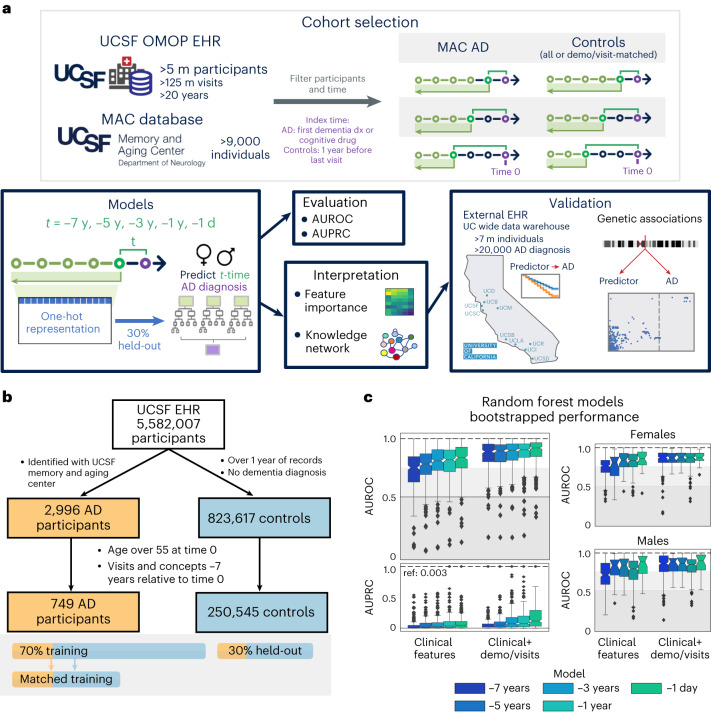
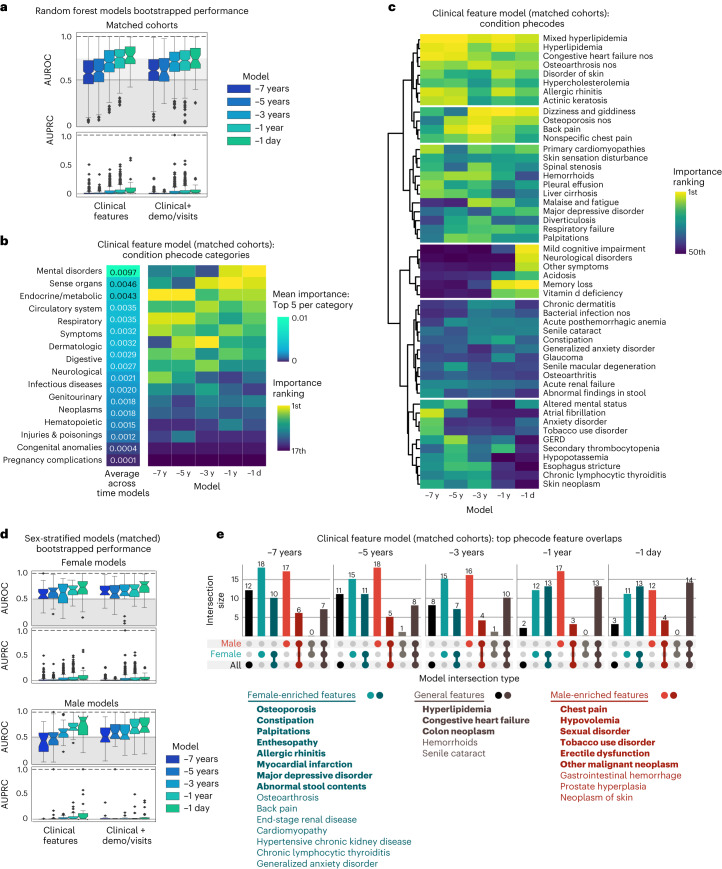
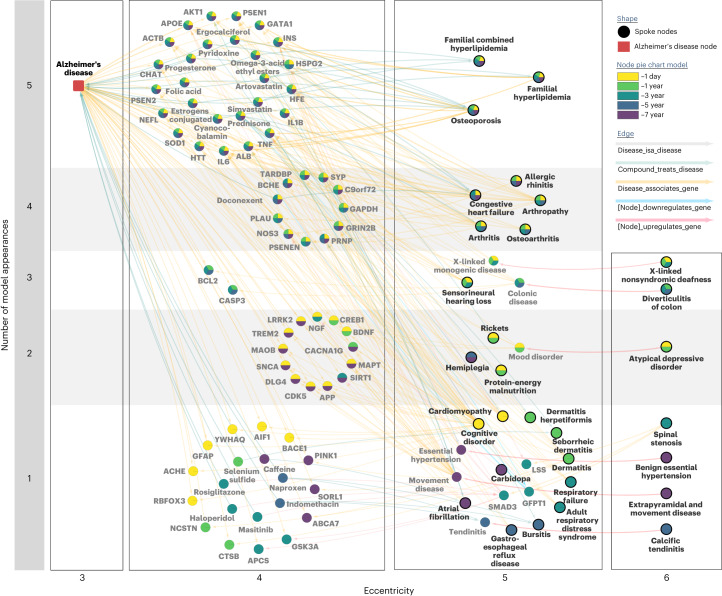
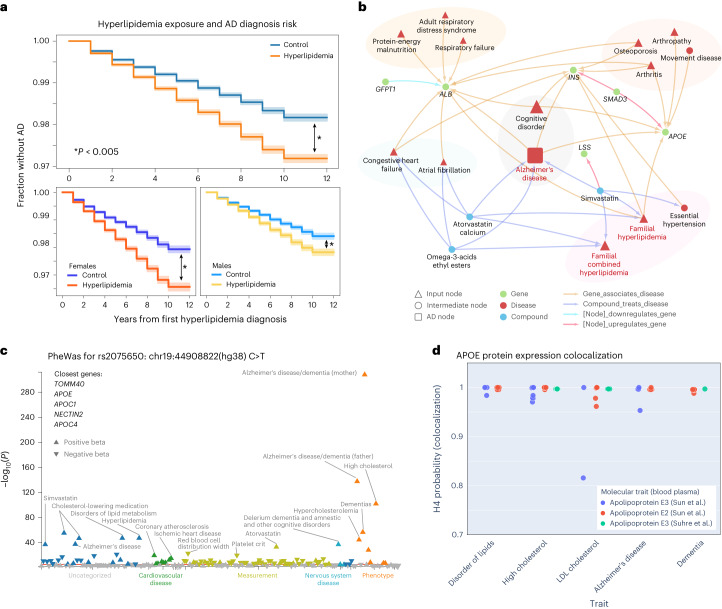
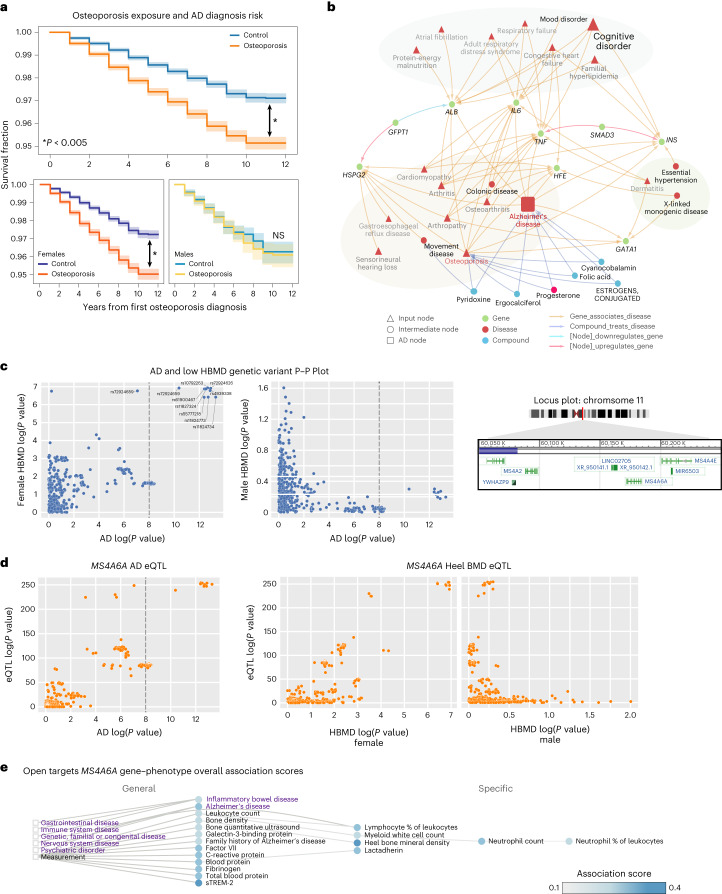
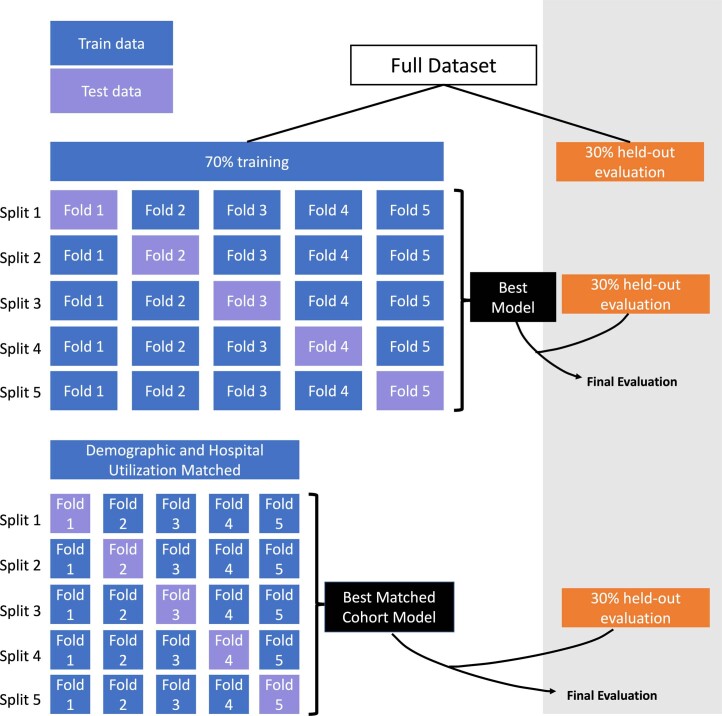
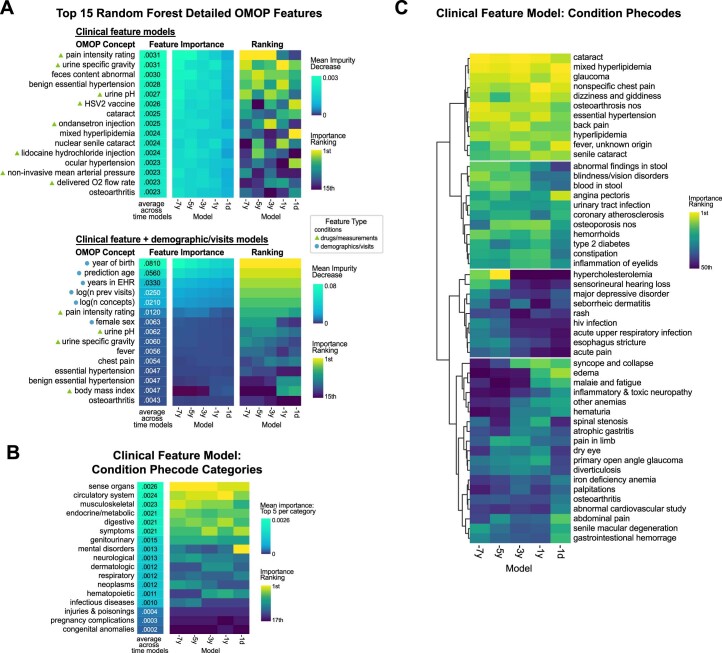
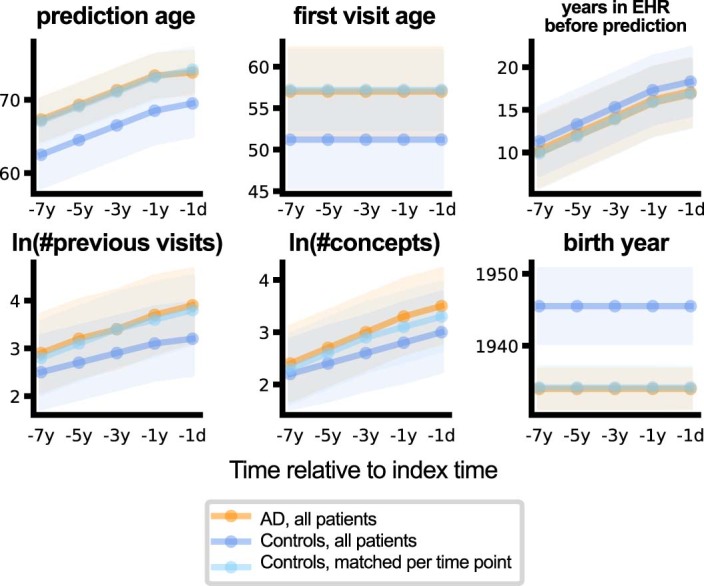
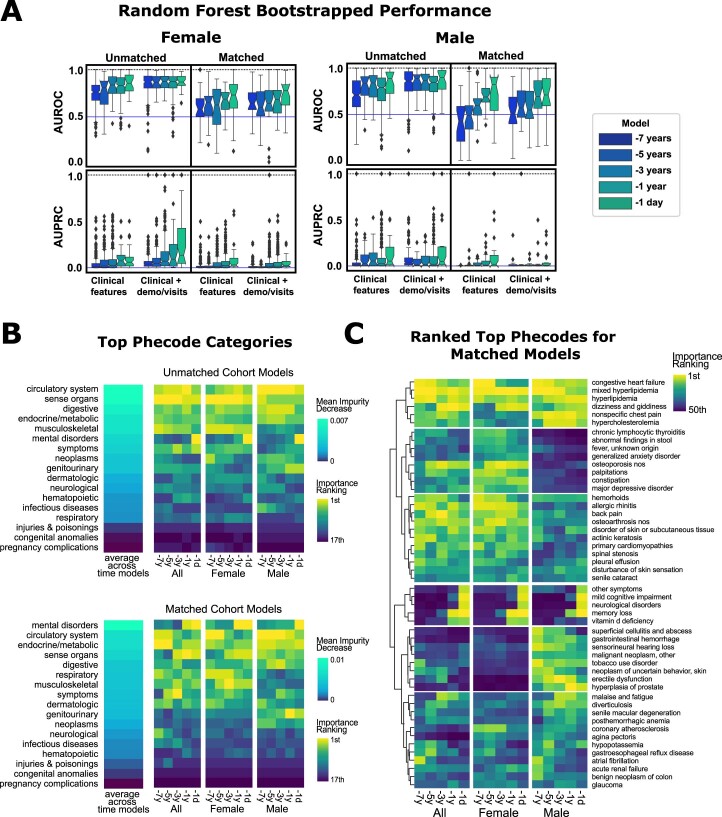
Identification of Alzheimer’s disease (AD) onset risk can facilitate interventions before irreversible disease progression. We demonstrate that electronic health records from the University of California, San Francisco, followed by knowledge networks (for example, SPOKE) allow for (1) prediction of AD onset and (2) prioritization of biological hypotheses, and (3) contextualization of sex dimorphism. We trained random forest models and predicted AD onset on a cohort of 749 individuals with AD and 250,545 controls with a mean area under the receiver operating characteristic of 0.72 (7 years prior) to 0.81 (1 day prior). We further harnessed matched cohort models to identify conditions with predictive power before AD onset. Knowledge networks highlight shared genes between multiple top predictors and AD (for example, APOE , ACTB , IL6 and INS ). Genetic colocalization analysis supports AD association with hyperlipidemia at the APOE locus, as well as a stronger female AD association with osteoporosis at a locus near MS4A6A . We therefore show how clinical data can be utilized for early AD prediction and identification of personalized biological hypotheses.
Overview
The claims and statistics of this paper haven’t been checked yet.
Free: it reads the open-access text and checks the first 5 claims that cite a source we can check. Create a free account to check every claim.
Integrity signals
Registry
Cites
Statistics
Figures
Verification
Claims the paper makes
The claims and statistics of this paper haven’t been checked yet.
Free: it reads the open-access text and checks the first 5 claims that cite a source we can check. Create a free account to check every claim.
Claims other papers make about this one
Each is checked against this paper’s own text: does it say what the citing paper says it does?
The source backs part of the claim, not all of it — or backs it for a different population, condition or comparison.
In the citing paper
“These technologies can capture multi-domain clinical data reflecting cognitive, behavioral, social, and physical function without any added patient burden, allowing for the development of digital biomarkers of ADRD.110”
From Review of Artificial Intelligence for Clinical Use in Alzheimer's Disease and Related Dementias (2026) · cites this paper as [110]
Experimental — accuracy not yet measuredThe source backs part of the claim, not all of it — or backs it for a different population, condition or comparison.
In the citing paper
“At the population level, ML and AI can identify high-risk subgroups and distinct disease trajectories associated with specific combinations of early life exposures, socioeconomic factors, and health behaviors [4, 9, 16, 30, 31].”
From Integrating machine learning and artificial intelligence in life-course epidemiology: pathways to innovative public health solutions (2024) · cites this paper as [16]
Experimental — accuracy not yet measuredIn the citing paper
“By integrating neuroimaging, genetic, and clinical data, researchers have developed models that can identify individuals at high risk of developing Alzheimer’s disease [15–18].”
From Integrating machine learning and artificial intelligence in life-course epidemiology: pathways to innovative public health solutions (2024) · cites this paper as [16]
Self-check
Percentages, sums and reported differences re-computed from the paper’s own numbers.
The self-check needs the paper’s full text.
Citations
Cites
Breiman, L. (2001) · Machine Learning · doi:10.1023/a:1010933404324 · Cited by 133,538
Scikit-learn: Machine Learning in Python
Pedregosa, F., Varoquaux, G., Gramfort, A., Michel, V., Thirion, B., Grisel, O., Blondel, M., Müller, A., Nothman, J., Louppe, G., et al. (2012) · arXiv · doi:10.48550/arxiv.1201.0490 · Cited by 71,016
Austin, P. C. (2011) · Multivariate Behavioral Research · doi:10.1080/00273171.2011.568786 · Cited by 12,242 · cited 1×
“…features (age, first visit age, years in EHR, log(number of prior visits), log(number of prior concepts), log(days since first clinical event)) utilizing propensity score matching 87 (propensity score estimated based upon a logistic regression model, nearest-neighbor matching without replacement).”
NIA‐AA Research Framework: Toward a biological definition of Alzheimer's disease
Jack, C. R., Bennett, D. A., Blennow, K., Carrillo, M. C., Dunn, B., Haeberlein, S. B., Holtzman, D. M., Jagust, W., Jessen, F., Karlawish, J., et al. (2018) · Alzheimer's & Dementia · doi:10.1016/j.jalz.2018.02.018 · Cited by 10,537
Self-citationCorder, E. H., Saunders, A. M., Strittmatter, W. J., Schmechel, D. E., Gaskell, P. C., Small, G. W., Roses, A. D., Haines, J. L., & Pericak-Vance, M. A. (1993) · Science · doi:10.1126/science.8346443 · Cited by 9,429 · cited 1×
“In particular, APOE is a well-established associated genetic locus 70 , and APOE polymorphism is known to modify AD risk, particularly in individuals carrying the ε4 allele 71 .”
Scikit-learn: Machine Learning in Python
(2011) · Journal of Machine Learning Research · doi:10.5555/1953048.2078195 · Cited by 8,539
Giambartolomei, C., Vukcevic, D., Schadt, E. E., Franke, L., Hingorani, A. D., Wallace, C., & Plagnol, V. (2014) · PLoS Genetics · doi:10.1371/journal.pgen.1004383 · Cited by 4,261
Hearing loss and cognitive decline in older adults
Lin, F. R., Yaffe, K., Xia, J., Xue, Q.-L., Harris, T. B., Purchase-Helzner, E., Satterfield, S., Ayonayon, H. N., Ferrucci, L., Simonsick, E. M., et al. (2013) · JAMA Internal Medicine · doi:10.1001/jamainternmed.2013.1868 · Cited by 4,017
Willer (2013) · doi:10.1038/ng.2797 · Cited by 2,983
Võsa, U., Claringbould, A., Westra, H.-J., Bonder, M. J., Deelen, P., Zeng, B., Kirsten, H., Saha, A., Kreuzhuber, R., Yazar, S., et al. (2021) · Nature Genetics · doi:10.1038/s41588-021-00913-z · Cited by 2,607
Self-citation
Cited by
Items 101–110 of 110
Wang, J., Li, Z., Wang, T., Jiang, L., Sharif, A., Takechi, R., Li, T., Chong, L. H., Fang, F., Pang, Z., et al. (2026) · Acta Pharmaceutica Sinica B · doi:10.1016/j.apsb.2026.09.013
AI for Opportunistic Identification of BMD and Bone Microarchitecture: A Narrative Review
Ziegeler, K., & Majumdar, S. (2026) · Calcified Tissue International · doi:10.1007/s00223-026-01597-5
Li, Y., Yang, Q., Zhou, J., Hu, Z., Lou, Y., 冉孟芹, & Jiao, Y. (2026) · International Conference on Health Big Data · doi:10.1145/3833450.3833474
Self-citationWang, Q., Qu, H., Jin, S., Wang, J., Li, Z., Zhao, G., Liu, J., Huang, Y., Ji, X., & Pan, X. (2026) · Signal Transduction and Targeted Therapy · doi:10.1038/s41392-026-03081-w
Li, R., Du, X., Wang, X., Berlowitz, D. R., Mez, J., Silver, B., Lin, H., Marshall, G. A., Zhou, L., & Yu, H. (2026) · SSRN Electronic Journal · doi:10.2139/ssrn.7517080
Farzana, S., Arian, A., Desvarieux, M., Rundek, T., & Ahsan, H. (2026) · Research Square · doi:10.21203/rs.3.rs-10988118/v1
Yapılandırılmış Klinik Verilerle Alzheimer Hastalığının Makine Öğrenmesi Tabanlı Sınıflandırılması
Çalışkan, A. (2026) · International Journal of Advanced Natural Sciences and Engineering Researches
TRACER, a time-to-event EHR foundation model for disease detection across health systemsPreprint
Pleasure, M., Redekop, E., Ivezić, V., Kulkarni, R., Chin, A., Speier, W. F., & Arnold, C. W. (2026) · arXiv (Cornell University) · doi:10.48550/arxiv.2610.40536
PREDICTIVE ANALYTICS IN HEALTHCARE: A REVIEW OF ARTIFICIAL INTELLIGENCE TECHNIQUES USING EHR DATA
Dondeti, R., & Babu, G. R. M. (2026) · ITEGAM- Journal of Engineering and Technology for Industrial Applications (ITEGAM-JETIA) · doi:10.5935/jetia.v12i61.3477
Multiple Disease Prediction in Low-Power Edge Devices
Priya, M. M. A., Nivethitha, M., Priyanka, S., & Kumar, S. S. (2026) · International Conference on Inventive Systems and Control (ICISC) · doi:10.1109/icisc69558.2026.11681065
Metadata
- Authors
- Tang, A. S., Rankin, K. P., Cerono, G., Miramontes, S., Mills, H., Roger, J., Zeng, B., Nelson, C., Soman, K., Woldemariam, S., Li, Y., Lee, A., Bove, R., Glymour, M., Aghaeepour, N., Oskotsky, T. T., Miller, Z., Allen, I. E., Sanders, S. J., Baranzini, S., & Sirota, M.
- Affiliations
- University of California, San Francisco (US)
- Stanford Medicine (US)
- Corresponding author
- Tang, Alice S.
- Sirota, Marina
- ORCID
- Tang, Alice S.
- Rankin, Katherine P.
- Cerono, Gabriel
- Miramontes, Silvia
- Mills, Hunter
- Roger, Jacquelyn
- Zeng, Billy
- Nelson, Charlotte
- Soman, Karthik
- Woldemariam, Sarah
- Li, Yaqiao
- Bove, Riley
- Glymour, Maria
- Aghaeepour, Nima
- Oskotsky, Tomiko T.
- Miller, Zachary
- Allen, Isabel E.
- Sanders, Stephan J.
- Baranzini, Sergio
- Sirota, Marina
- Venue
- Nature Aging
- Published
- 2024-02-21
- Volume
- 4
- Issue
- 3
- Pages
- 379-395
- ISSN
- 2662-8465 (ISSN-L)
- PMC
- PMC10950787
- OpenAlex
- W4392003803
- Cited by
- 86
- References
- 106
- Citations by year
- 2026: 31 · 2025: 42 · 2024: 13
- FWCI
- 25.17
- Type
- journal article
- Language
- en
- Open access
- hybrid
- doi.org
- Licence
- cc-by
- creativecommons.org/licenses/by/4.0 (tdm)
- creativecommons.org/licenses/by/4.0 (vor)
- Locations
- Nature Aging (publishedVersion, cc-by)
- PubMed Central (publishedVersion, cc-by)
- PubMed (publishedVersion)
- eScholarship (California Digital Library) (submittedVersion, cc-by)
- Funders
- U.S. Department of Health & Human Services | National Institutes of Health (R01AG060393, T32GM007618, P30-AG062422, R35GM138353 and RF1AG077443.)
- National Multiple Sclerosis Society
- National Science Foundation
- Heidrich Family and Friends Endownment
- Topics
- Health Sciences › Medicine › Psychiatry and Mental health › Dementia and Cognitive Impairment Research
- Physical Sciences › Computer Science › Artificial Intelligence › Machine Learning in Healthcare
- Life Sciences › Neuroscience › Cellular and Molecular Neuroscience › Alzheimer's disease research and treatments
- Keywords
- Alzheimer's disease, electronic health records, knowledge networks, sex differences, sexual dimorphism, apolipoprotein E, hyperlipidemia, osteoporosis, MS4A6A, genetic colocalization, shared genetic risk
- MeSH terms
- Alzheimer Disease, Apolipoproteins E, Female, Humans, Male, San Francisco, Electronic Health Records
About these checks
Registry, retraction, Cites and statistics results are computed, not judged, with one exception: a printed reference that no index lists is read once by a model before it counts as a citation error. Claims are extracted by a model and kept only when their quote appears verbatim in the text; each cited source is then checked, with a model’s help, for whether it says what the claim relies on. Those verdicts can be wrong — read the claim’s quote and the cited source before relying on one.
Statistics and arithmetic are recomputed, not judged.
Confidence bands are shown only for fields calibrated on our annotated test set. None is calibrated yet, so no band is shown.
What counts as a claim ›How we measure confidence ›How we check this ›
Are you an author, or do you see a problem with this page? Request a review
Data sources
Bibliographic data: Semantic Scholar, OpenAlex, Crossref.
Contains information from the Semantic Scholar Academic Graph Datasets, made available under the ODC Attribution License (ODC-BY 1.0).
Semantic Scholar’s data is described in: Kinney, R., et al. (2023). The Semantic Scholar Open Data Platform. arXiv:2301.10140.
