Cited by 11Alzheimer's disease research and treatmentsDementia and Cognitive Impairment ResearchAmyotrophic Lateral Sclerosis Research

The DOI matches its Crossref record; 5 of the 5 references it cites were found in a registry or an index.

Exploratory analyses of clinical outcomes from the BIIB080 phase 1b study in mild Alzheimer’s disease

Open access

Abstract

This study conducted exploratory analyses of the effects of BIIB080, a MAPT (microtubule-associated protein tau)-targeting antisense oligonucleotide, in participants with mild Alzheimer’s disease. A multicenter, randomized, double-blind, phase 1b trial was conducted as a placebo-controlled, multiple-ascending dose (MAD) study followed by an open-label, long-term extension (LTE). During the MAD study, participants were randomized and received either intrathecal placebo or BIIB080 10 mg (n = 6), 30 mg (n = 6) or 60 mg (n = 9) every 4 weeks or 115 mg (n = 13) every 12 weeks (Q12W). During the LTE, participants received high-dose BIIB080 (60 mg (n = 7) or 115 mg (n = 9) Q12W). BIIB080 was generally well tolerated. Here we present findings from exploratory analyses, which showed a consistent trend of slowed decline on cognitive, functional and global measures favoring BIIB080 high-dose groups at the end of both study periods. This favorable trend is supported by reported reductions from baseline in brain neurofibrillary tangles measured with tau positron emission tomography. Trial registration: ClinicalTrials.gov identifier: NCT03186989 . This exploratory analysis of a phase 1b study evaluating BIIB080, a MAPT-targeting antisense oligonucleotide, in mild Alzheimer’s disease indicates favorable trends of high-dose BIIB080 in slowing cognitive and functional decline, supporting the need for future trials evaluating clinical efficacy of BIIB080 in mild Alzheimer’s disease.

Overview

The claims and statistics of this paper haven’t been checked yet.

Run the check — free, no account needed. It reads the open-access text and checks the sources it cites.

A few free checks a day · papers already verified open instantly · results are public

Integrity signals

Registry

Crossref · 10.1038/s43587-025-01031-9

Cites

5 of 5 references verified0 citation errors · 0 not checkable

Statistics

Figures

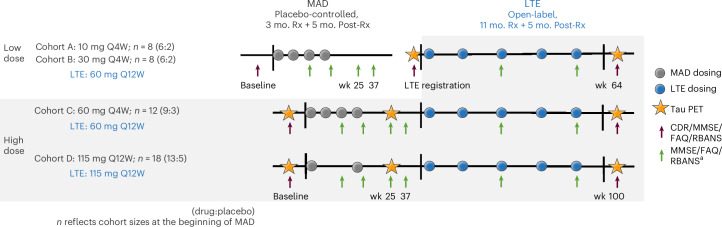
Fig. 1 MAD and LTE study design, dosing schema and clinical and tau PET measurements. For cohorts A and B, week 64 was counted from LTE registration. In cohorts C and D, week 100 was counted from MAD screening. Cohorts A and B had a gap (5−19 months) between completion of the MAD treatment period and commencement of the LTE treatment period; cohorts C and D had a seamless transition between the MAD and LTE. CDR, MMSE, FAQ and RBANS were also assessed at the safety follow-up visit at week 72 for the low-dose groups and at week 100 for the high-dose groups. a FAQ was not collected at week 9. mo., months; Post-Rx, posttreatment period; Rx, treatment period; wk, week.
Fig. 1 MAD and LTE study design, dosing schema and clinical and tau PET measurements. For cohorts A and B, week 64 was counted from LTE registration. In cohorts C and D, week 100 was counted from MAD screening. Cohorts A and B had a gap (5−19 months) between completion of the MAD treatment period and commencement of the LTE treatment period; cohorts C and D had a seamless transition between the MAD and LTE. CDR, MMSE, FAQ and RBANS were also assessed at the safety follow-up visit at week 72 for the low-dose groups and at week 100 for the high-dose groups. a FAQ was not collected at week 9. mo., months; Post-Rx, posttreatment period; Rx, treatment period; wk, week.CC BY-NC-ND · PubMed Central
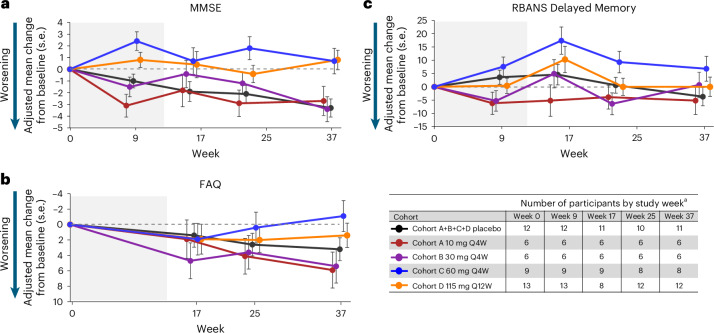
Fig. 2 Longitudinal change in clinical outcomes from baseline in MAD. Gray shading indicates the 13-week treatment period. Results at each visit were based on an ANCOVA model, fitted with change from baseline as a dependent variable, and with treatment group, baseline value and baseline CDR-GS as independent variables. Error bars reflect s.e. No statistical testing or multiple comparison adjustments were performed. a Number of participants by study week based on MMSE. Small differences in n were seen for RBANS and FAQ. FAQ was not collected at week 9. In a, at baseline, the number of participants with MMSE scores in the placebo group was n = 12; BIIB080 10 mg Q4W had an n = 6; BIIB080 30 mg Q4W had an n = 6; BIIB080 60 mg Q4W had an n = 9; and BIIB080 115 mg Q12W had an n = 13. In b, at baseline, the number of participants with RBANS scores in the placebo group was n = 12; BIIB080 10 mg Q4W had an n = 6; BIIB080 30 mg Q4W had an n = 6; BIIB080 60 mg Q4W had an n = 9; and BIIB080 115 mg Q12W had an n = 13. In c, at baseline, the number of participants with FAQ scores in the placebo group was n = 12; BIIB080 10 mg Q4W had an n = 6; BIIB080 30 mg Q4W had an n = 6; BIIB080 60 mg Q4W had an n = 9; and BIIB080 115 mg Q12W had an n = 13. Source data
Fig. 2 Longitudinal change in clinical outcomes from baseline in MAD. Gray shading indicates the 13-week treatment period. Results at each visit were based on an ANCOVA model, fitted with change from baseline as a dependent variable, and with treatment group, baseline value and baseline CDR-GS as independent variables. Error bars reflect s.e. No statistical testing or multiple comparison adjustments were performed. a Number of participants by study week based on MMSE. Small differences in n were seen for RBANS and FAQ. FAQ was not collected at week 9. In a, at baseline, the number of participants with MMSE scores in the placebo group was n = 12; BIIB080 10 mg Q4W had an n = 6; BIIB080 30 mg Q4W had an n = 6; BIIB080 60 mg Q4W had an n = 9; and BIIB080 115 mg Q12W had an n = 13. In b, at baseline, the number of participants with RBANS scores in the placebo group was n = 12; BIIB080 10 mg Q4W had an n = 6; BIIB080 30 mg Q4W had an n = 6; BIIB080 60 mg Q4W had an n = 9; and BIIB080 115 mg Q12W had an n = 13. In c, at baseline, the number of participants with FAQ scores in the placebo group was n = 12; BIIB080 10 mg Q4W had an n = 6; BIIB080 30 mg Q4W had an n = 6; BIIB080 60 mg Q4W had an n = 9; and BIIB080 115 mg Q12W had an n = 13. Source dataCC BY-NC-ND · PubMed Central
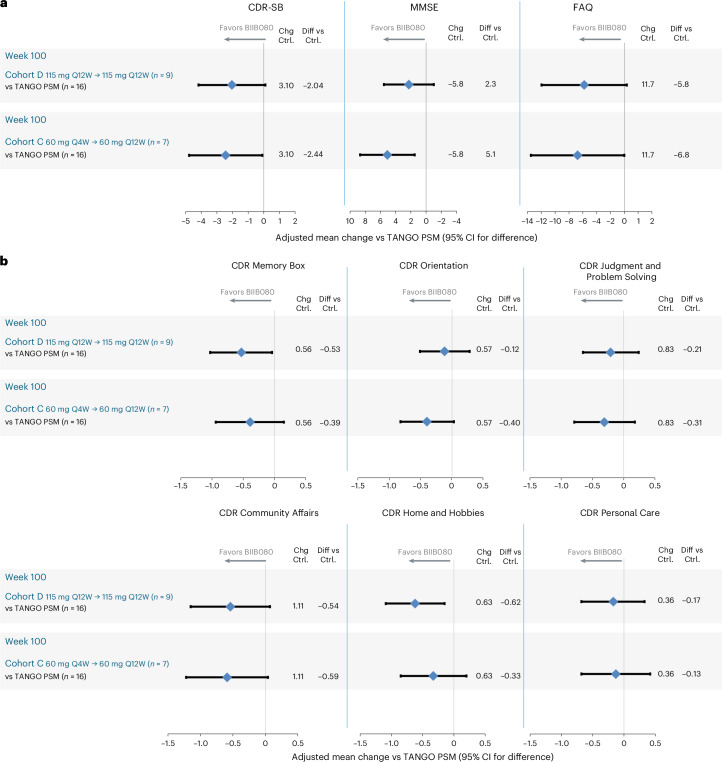
Fig. 3 Clinical outcomes in high → high groups versus TANGO PSM at week 100. For high → high groups, TANGO PSM used 1:1 match and adjusted for seven covariates: CDR-GS (exact match), CDR-SB, MMSE, FAQ, APOE, age and sex. In a and b, changes in clinical outcomes from the MAD baseline to the end of LTE (week 100) were analyzed, and results were based on an ANCOVA model, with treatment group, baseline value and baseline CDR-GS as independent variables. No statistical testing or multiple comparison adjustments were performed. In a, nine participants in cohort D, seven participants in cohort C and 16 participants in the TANGO PSM group had CDR-SB, MMSE and FAQ scores. In b, nine participants in cohort D, seven participants in cohort C and 16 participants in the TANGO PSM group had CDR Memory Box, Orientation, Judgment and Problem Solving, Community Affairs, Home and Hobbies and Personal Care scores. CI, confidence interval; Chg Ctrl., change in control; Diff vs Ctrl., difference versus control. Source data
Fig. 3 Clinical outcomes in high → high groups versus TANGO PSM at week 100. For high → high groups, TANGO PSM used 1:1 match and adjusted for seven covariates: CDR-GS (exact match), CDR-SB, MMSE, FAQ, APOE, age and sex. In a and b, changes in clinical outcomes from the MAD baseline to the end of LTE (week 100) were analyzed, and results were based on an ANCOVA model, with treatment group, baseline value and baseline CDR-GS as independent variables. No statistical testing or multiple comparison adjustments were performed. In a, nine participants in cohort D, seven participants in cohort C and 16 participants in the TANGO PSM group had CDR-SB, MMSE and FAQ scores. In b, nine participants in cohort D, seven participants in cohort C and 16 participants in the TANGO PSM group had CDR Memory Box, Orientation, Judgment and Problem Solving, Community Affairs, Home and Hobbies and Personal Care scores. CI, confidence interval; Chg Ctrl., change in control; Diff vs Ctrl., difference versus control. Source dataCC BY-NC-ND · PubMed Central
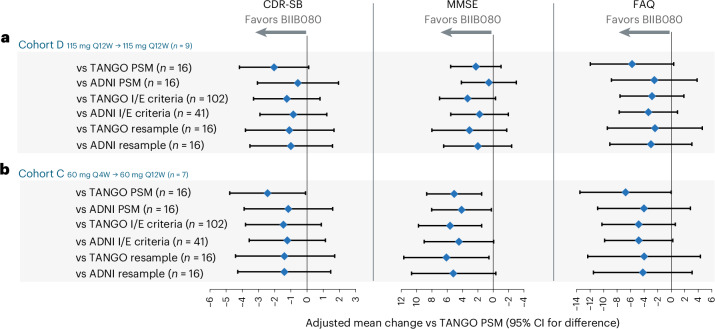
Fig. 4 Supplementary analyses of clinical outcomes in high → high groups versus external controls at week 100. At week 100, TANGO I/E criteria had an n = 101 for MMSE scores and an n = 99 for FAQ scores. At week 100, ADNI I/E criteria had an n = 40 for MMSE scores. TANGO PSM used 1:1 match and adjusted for seven covariates: CDR-GS (exact match), CDR-SB, MMSE, FAQ, APOE, age and sex. ADNI PSM used 1:1 match and adjusted for five covariates: CDR-GS (exact match), CDR-SB, MMSE, FAQ and APOE. The I/E criteria method selected participants by key inclusion criteria of the BIIB080 phase 1b study. The resample method randomly selected 16 participants from the I/E criteria set, and the results were summarized from 1,000 rounds of resampling. In a and b, changes in clinical outcomes from the MAD baseline to the end of the LTE (week 100) were analyzed, and results were based on an ANCOVA model, with treatment group, baseline value and baseline CDR-GS as independent variables. No statistical testing or multiple comparison adjustments were performed. CI, confidence interval. Source data
Fig. 4 Supplementary analyses of clinical outcomes in high → high groups versus external controls at week 100. At week 100, TANGO I/E criteria had an n = 101 for MMSE scores and an n = 99 for FAQ scores. At week 100, ADNI I/E criteria had an n = 40 for MMSE scores. TANGO PSM used 1:1 match and adjusted for seven covariates: CDR-GS (exact match), CDR-SB, MMSE, FAQ, APOE, age and sex. ADNI PSM used 1:1 match and adjusted for five covariates: CDR-GS (exact match), CDR-SB, MMSE, FAQ and APOE. The I/E criteria method selected participants by key inclusion criteria of the BIIB080 phase 1b study. The resample method randomly selected 16 participants from the I/E criteria set, and the results were summarized from 1,000 rounds of resampling. In a and b, changes in clinical outcomes from the MAD baseline to the end of the LTE (week 100) were analyzed, and results were based on an ANCOVA model, with treatment group, baseline value and baseline CDR-GS as independent variables. No statistical testing or multiple comparison adjustments were performed. CI, confidence interval. Source dataCC BY-NC-ND · PubMed Central
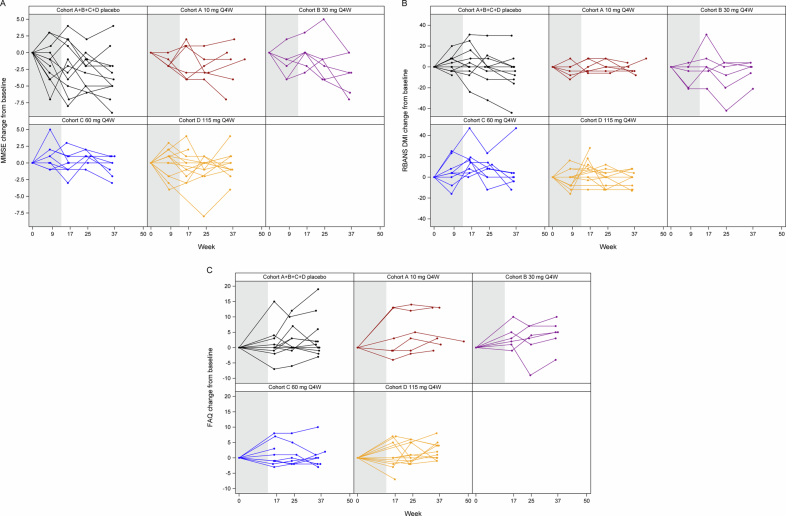
Extended Data Fig. 1 Spaghetti plots of MMSE (A), RBANS DMI (B), and FAQ (C) change from baseline during the MAD period. FAQ, Functional Activities Questionnaire; MAD, multiple–ascending dose; MMSE, Mini-Mental State Examination; Q4W, every 4 weeks; RBANS DMI, Repeatable Battery for the Assessment of Neuropsychological Status delayed memory index. FAQ was not collected at week 9. Grey shading indicates the 13-week treatment period.
Extended Data Fig. 1 Spaghetti plots of MMSE (A), RBANS DMI (B), and FAQ (C) change from baseline during the MAD period. FAQ, Functional Activities Questionnaire; MAD, multiple–ascending dose; MMSE, Mini-Mental State Examination; Q4W, every 4 weeks; RBANS DMI, Repeatable Battery for the Assessment of Neuropsychological Status delayed memory index. FAQ was not collected at week 9. Grey shading indicates the 13-week treatment period.CC BY-NC-ND · PubMed Central
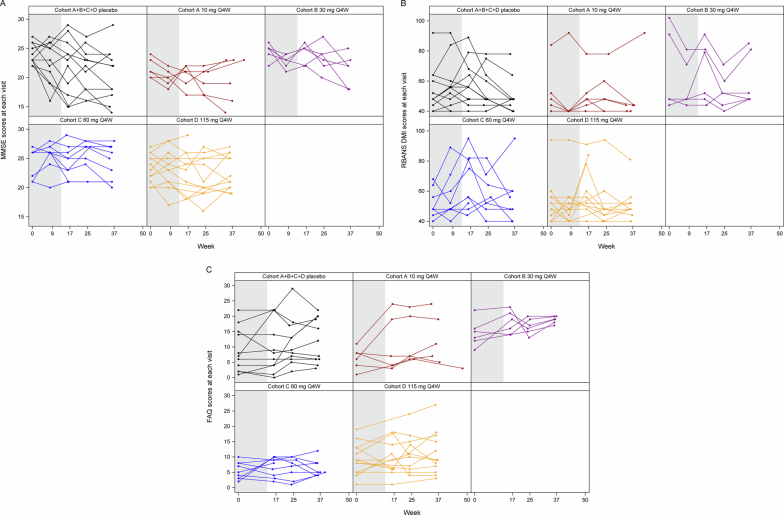
Extended Data Fig. 2 Spaghetti plots of MMSE (A), RBANS DMI (B), and FAQ (C) scores at each visit during the MAD period. FAQ, Functional Activities Questionnaire; MAD, multiple–ascending dose; MMSE, Mini-Mental State Examination; Q4W, every 4 weeks; RBANS DMI, Repeatable Battery for the Assessment of Neuropsychological Status delayed memory index. FAQ was not collected at week 9. Grey shading indicates the 13-week treatment period.
Extended Data Fig. 2 Spaghetti plots of MMSE (A), RBANS DMI (B), and FAQ (C) scores at each visit during the MAD period. FAQ, Functional Activities Questionnaire; MAD, multiple–ascending dose; MMSE, Mini-Mental State Examination; Q4W, every 4 weeks; RBANS DMI, Repeatable Battery for the Assessment of Neuropsychological Status delayed memory index. FAQ was not collected at week 9. Grey shading indicates the 13-week treatment period.CC BY-NC-ND · PubMed Central
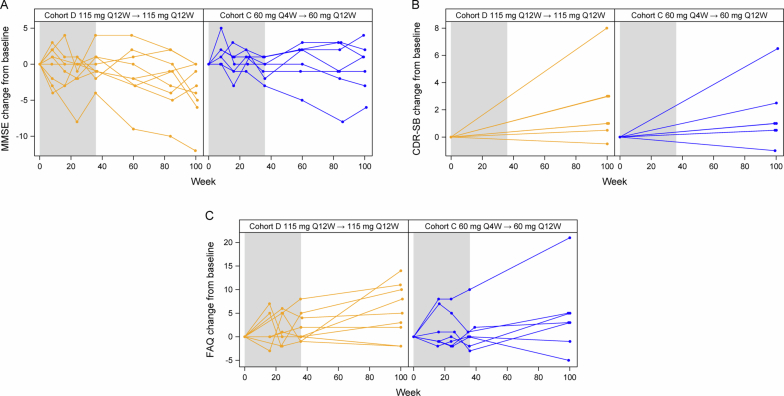
Extended Data Fig. 3 Spaghetti plots of MMSE (A), CDR-SB (B), and FAQ (C) change from baseline during the MAD and LTE periods. CDR-SB, Clinical Dementia Rating Scale–Sum of Boxes; FAQ, Functional Activities Questionnaire; LTE, long-term extension; MAD, multiple–ascending dose; MMSE, Mini-Mental State Examination; Q12W, every 12 weeks. Data from the MAD period up to Week 100 for CDR-SB, MMSE, and FAQ, is included for the 16 participants from the early C and D cohorts (n = 16 participants in the high→high groups). Grey shading indicates the MAD period.
Extended Data Fig. 3 Spaghetti plots of MMSE (A), CDR-SB (B), and FAQ (C) change from baseline during the MAD and LTE periods. CDR-SB, Clinical Dementia Rating Scale–Sum of Boxes; FAQ, Functional Activities Questionnaire; LTE, long-term extension; MAD, multiple–ascending dose; MMSE, Mini-Mental State Examination; Q12W, every 12 weeks. Data from the MAD period up to Week 100 for CDR-SB, MMSE, and FAQ, is included for the 16 participants from the early C and D cohorts (n = 16 participants in the high→high groups). Grey shading indicates the MAD period.CC BY-NC-ND · PubMed Central
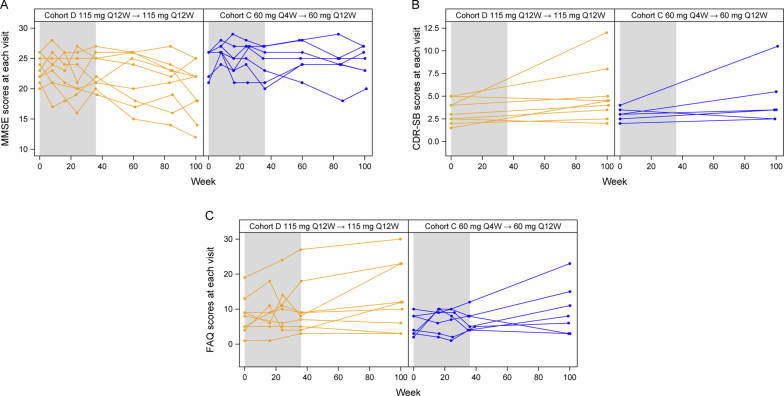
Extended Data Fig. 4 Spaghetti plots of MMSE (A), CDR-SB (B), and FAQ (C) scores at each visit during the MAD and LTE periods. CDR-SB, Clinical Dementia Rating Scale–Sum of Boxes; FAQ, Functional Activities Questionnaire; LTE, long-term extension; MAD, multiple–ascending dose; MMSE, Mini-Mental State Examination; Q12W, every 12 weeks. Data from the MAD period up to Week 100 for CDR-SB, MMSE, and FAQ, is included for the 16 participants from the early C and D cohorts (n = 16 participants in the high→high groups). Grey shading indicates the MAD period.
Extended Data Fig. 4 Spaghetti plots of MMSE (A), CDR-SB (B), and FAQ (C) scores at each visit during the MAD and LTE periods. CDR-SB, Clinical Dementia Rating Scale–Sum of Boxes; FAQ, Functional Activities Questionnaire; LTE, long-term extension; MAD, multiple–ascending dose; MMSE, Mini-Mental State Examination; Q12W, every 12 weeks. Data from the MAD period up to Week 100 for CDR-SB, MMSE, and FAQ, is included for the 16 participants from the early C and D cohorts (n = 16 participants in the high→high groups). Grey shading indicates the MAD period.CC BY-NC-ND · PubMed Central

Verification

Claims the paper makes

The claims and statistics of this paper haven’t been checked yet.

Run the check — free, no account needed. It reads the open-access text and checks the sources it cites.

A few free checks a day · papers already verified open instantly · results are public

Self-check

Percentages, sums and reported differences re-computed from the paper’s own numbers.

The self-check needs the paper’s full text.

Citations

Cites

Research works printed but not linked: 22

  1. Coomans, E. M. et al. A head-to-head comparison between plasma ptau181 and tau PET along the Alzheimer’s disease continuum. J. Nucl. Med. 64, 437–443 (2023). · DOI
  2. Mummery, C. J. et al. Tau-targeting antisense oligonucleotide MAPTRX in mild Alzheimer’s disease: a phase 1b, randomized, placebo-controlled trial. Nat. Med. 29, 1437–1447 (2023). · DOI · Paper page
  3. Budd Haeberlein, S. et al. Two randomized phase 3 studies of aducanumab in early Alzheimer’s disease. J. Prev. Alzheimers Dis. 9, 197–210 (2022). · DOI · Paper page
  4. Sims, J. R. et al. Donanemab in early symptomatic Alzheimer disease: the TRAILBLAZER-ALZ 2 randomized clinical trial. JAMA 330, 512–527 (2023). · DOI · Paper page
  5. Corsi, A. et al. Tau isoforms: gaining insight into MAPT alternative splicing. Int. J. Mol. Sci. 23, 15383 (2022). · DOI
  6. Yang, J. et al. Complicated role of post-translational modification and protease-cleaved fragments of tau in Alzheimer’s disease and other tauopathies. Mol. Neurobiol. 61, 4712–4731 (2024). · DOI
  7. Malpetti, M., Joie, R. & Rabinovici, G. D. Tau beats amyloid in predicting brain atrophy in Alzheimer disease: implications for prognosis and clinical trials. J. Nucl. Med. 63, 830–832 (2022). · DOI · Paper page
  8. van Dyck, C. H. et al. Lecanemab in early Alzheimer’s disease. N. Engl. J. Med. 388, 9–21 (2023). · DOI · Paper page
  9. Austin, P. C. An introduction to propensity score methods for reducing the effects of confounding in observational studies. Multivar. Behav. Res. 46, 399–424 (2011). · DOI · Paper page
  10. O’Bryant, S. E. et al. Staging dementia using Clinical Dementia Rating Scale Sum of Boxes scores: a Texas Alzheimer’s Research Consortium study. Arch. Neurol. 65, 1091–1095 (2008). · DOI
  11. DeVos, S. L. et al. Antisense reduction of tau in adult mice protects against seizures. J. Neurosci. 33, 12887–12897 (2013). · DOI · Paper page
  12. Albert, M. S. et al. The diagnosis of mild cognitive impairment due to Alzheimer’s disease: recommendations from the National Institute on Aging-Alzheimer’s Association workgroups on diagnostic guidelines for Alzheimer’s disease. Alzheimers Dement 7, 270–279 (2011). · DOI · Paper page
  13. Folstein, M. F., Folstein, S. E. & McHugh, P. R. ‘Mini-mental state’. A practical method for grading the cognitive state of patients for the clinician. J. Psychiatr. Res. 12, 189–198 (1975). · DOI · Paper page
  14. Kennedy, R. E. et al. Using baseline cognitive severity for enriching Alzheimer’s disease clinical trials: how does Mini-Mental State Examination predict rate of change? Alzheimers Dement. (N Y) 1, 46–52 (2015). · DOI
  15. Morris, J. C. The Clinical Dementia Rating (CDR): current version and scoring rules. Neurology 43, 2412–2414 (1993). · DOI · Paper page
  16. Marshall, G. A. et al. Executive function and instrumental activities of daily living in mild cognitive impairment and Alzheimer’s disease. Alzheimers Dement. 7, 300–308 (2011). · DOI
  17. Brown, P. J. et al. Functional impairment in elderly patients with mild cognitive impairment and mild Alzheimer disease. Arch. Gen. Psychiatry 68, 617–626 (2011). · DOI · Paper page
  18. Pfeffer, R. I. et al. Measurement of functional activities in older adults in the community. J. Gerontol. 37, 323–329 (1982). · DOI
  19. Randolph, C. et al. The Repeatable Battery for the Assessment of Neuropsychological Status (RBANS): preliminary clinical validity. J. Clin. Exp. Neuropsychol. 20, 310–319 (1998). · DOI · Paper page
  20. Duff, K. et al. Diagnostic accuracy of the RBANS in mild cognitive impairment: limitations on assessing milder impairments. Arch. Clin. Neuropsychol. 25, 429–441 (2010). · DOI
  21. Randolph, C. RBANS: Repeatable Battery for the Assessment of Neuropsychological Status: Manual (The Psychological Corporation, 1998). · DOI
  22. Shulman, M. et al. TANGO: a placebo-controlled randomized phase 2 study of efficacy and safety of the anti-tau monoclonal antibody gosuranemab in early Alzheimer’s disease. Nat. Aging 3, 1591–1601 (2023). · DOI

Metadata

Authors
Shulman, M., Wu, S., Ziogas, N., Edwards, A., Collins, J., Lin, L., Tien, I., Curiale, G., Li, Y., Mummery, C., Lane, R., Junge, C., Beaver, J., Tian, Y., Landen, J., Bullain, S., & Gallagher, D.
Affiliations
  • Biogen (United States) (US)
  • National Hospital for Neurology and Neurosurgery (GB)
  • Ionis Pharmaceuticals (United States) (US)
Corresponding author
Shulman, Melanie
Venue
Nature Aging
Published
2026-02-11
Volume
6
Issue
2
Pages
445-453
ISSN
2662-8465 (ISSN-L)
OpenAlex
W7128599889
Cited by
11
References
5
Citations by year
2026: 11
FWCI
40.86
Type
journal article
Language
en
Open access
Locations
  • Nature Aging (publishedVersion, cc-by-nc-nd)
  • PubMed (publishedVersion)
  • PubMed Central (publishedVersion, cc-by-nc-nd)
Funders
Ionis and Biogen Inc.
Topics
  • Life Sciences › Neuroscience › Cellular and Molecular Neuroscience › Alzheimer's disease research and treatments
  • Health Sciences › Medicine › Psychiatry and Mental health › Dementia and Cognitive Impairment Research
  • Health Sciences › Medicine › Clinical Neurology › Amyotrophic Lateral Sclerosis Research
Keywords
MAPT, mild Alzheimer's disease, intrathecal drug delivery, cognitive decline, functional decline, neurofibrillary tangles, tau PET, dose escalation, long-term extension study
MeSH terms
Aged, Aged, 80 and over, Alzheimer Disease, Cognition, Dose-Response Relationship, Drug, Double-Blind Method, Female, Humans, Indoles, Male, Oligonucleotides, Oligonucleotides, Antisense, tau Proteins, Treatment Outcome

About these checks

Registry, retraction, Cites and statistics results are computed, not judged, with one exception: a printed reference that no index lists is read once by a model before it counts as a citation error. Claims are extracted by a model and kept only when their quote appears verbatim in the text; each cited source is then checked, with a model’s help, for whether it says what the claim relies on. Those verdicts can be wrong — read the claim’s quote and the cited source before relying on one.

Statistics and arithmetic are recomputed, not judged.

Confidence bands are shown only for fields calibrated on our annotated test set. None is calibrated yet, so no band is shown.

What counts as a claim ›How we measure confidence ›How we check this ›

Are you an author, or do you see a problem with this page? Request a review