

Data-driven quantum approximate optimization algorithm for power systems
Open accessThe DOI matches its Crossref record; 53 of the 53 references it cites were found in a registry or an index; 4 of the 30 sources its claims cite were checked for support.
Abstract
Quantum technology provides a ground-breaking methodology to tackle challenging computational issues in power systems. It is especially promising for Distributed Energy Resources (DERs) dominant systems that have been widely developed to promote energy sustainability. In those systems, knowing the maximum sections of power and data delivery is essential for monitoring, operation, and control. However, high computational effort is required. By leveraging quantum resources, Quantum Approximate Optimization Algorithm (QAOA) provides a means to search for these sections efficiently. However, QAOA performance relies heavily on critical parameters, especially for weighted graphs. Here we present a data-driven QAOA, which transfers quasi-optimal parameters between weighted graphs based on the normalized graph density. We verify the strategy with 39,774 expectation value calculations. Without parameter optimization, our data-driven QAOA is comparable with the Goemans-Williamson algorithm. This work advances QAOA and pilots its practical application to power systems in noisy intermediate-scale quantum devices.
Overview
CoChat Summary
TL;DR
The paper proposes a data-driven Quantum Approximate Optimization Algorithm (QAOA) that transfers quasi-optimal parameters between weighted graphs using normalized graph density, avoiding expensive parameter optimization. It reports that the transferred parameters make QAOA comparable to the Goemans-Williamson algorithm on power-system Max-Cut instances and that near-term depolarizing noise is negligible for the method.
Key findings
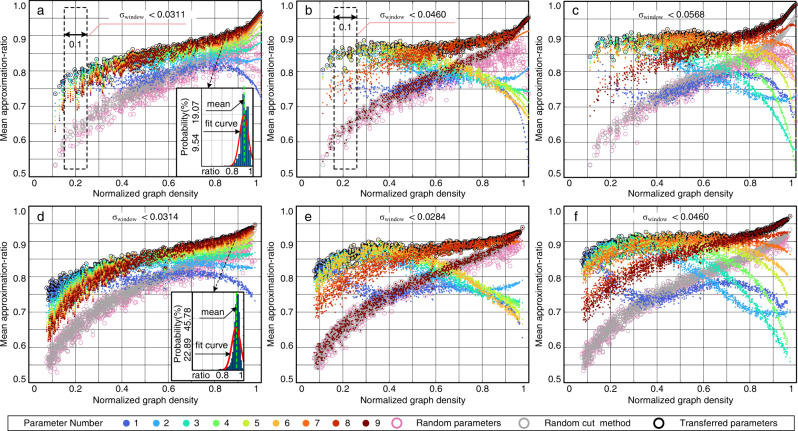
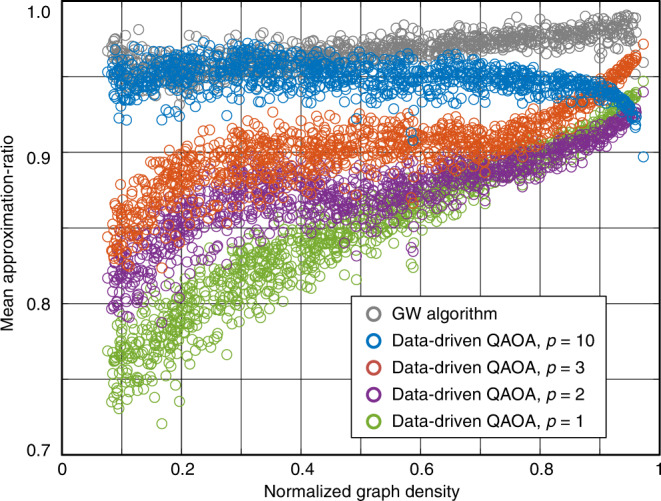
- Without parameter optimization, the data-driven QAOA with transferred parameters at p = 10 had a better mean approximation ratio than the Goemans-Williamson algorithm in 113 out of 996 graphs.
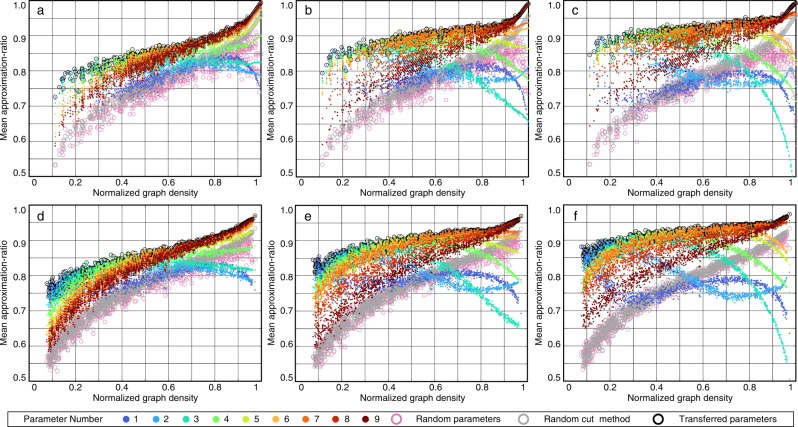
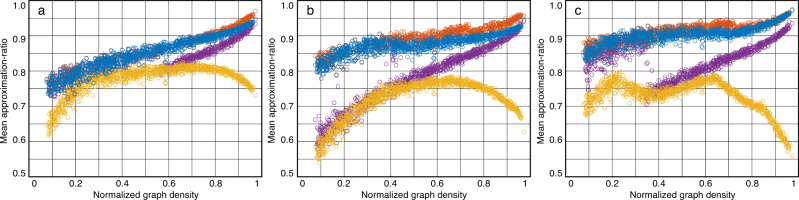
- Using parameters transferred from unweighted seed graphs with n_s1 = 10, the mean approximation ratios were 0.8501, 0.8911, and 0.9125 for p = 1, 2, and 3, respectively; after further optimization, better mean approximation ratios of 0.9569, 0.9499, and 0.9751 were obtained for the cases in Fig. 7a–c.
- On a modified IEEE 24-bus system with 11 DERs, four test graphs with normalized graph densities D = 0.0525, 0.1053, 0.1143, and 0.3280 were evaluated; Table 1 shows the best results were obtained with transferred parameters, and mean approximation ratio increased as p increased.
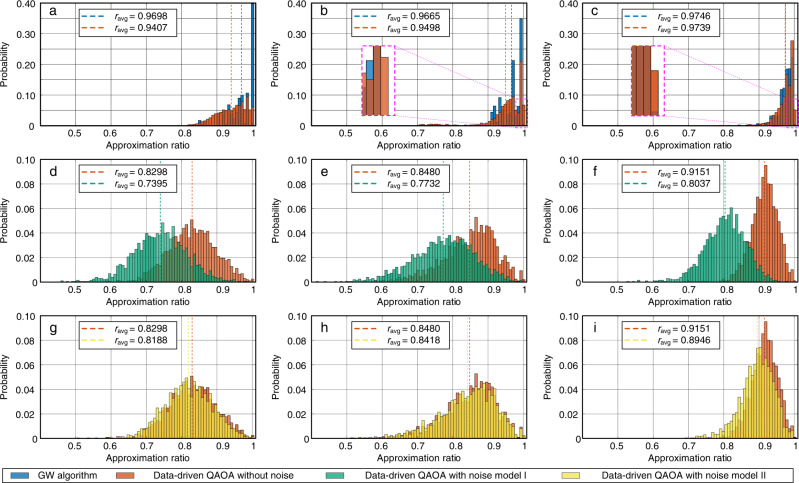
- With noise model II (0.01% depolarizing error on single-qubit gates and 0.1% on two-qubit gates), the reduction in mean approximation ratio was negligible; with noise model I (0.1% single-qubit and 1% two-qubit depolarizing error), mean approximation ratios dropped.
Methods
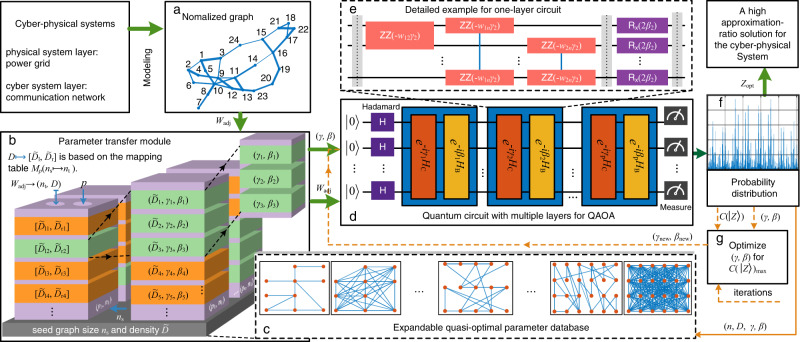
- The maximum power/data section problem is formulated as a weighted Max-Cut problem, solved with QAOA using p layers and parameters (γ, β); the data-driven QAOA transfers quasi-optimal parameters from seed graphs to target graphs via mapping tables based on normalized graph density D, with optional further optimization and database expansion.
- Numerical justification used 9 unweighted seed graphs with n_s1 = 10 and 9 weighted seed graphs with n_s2 = 24; 1710 non-planar target graphs with n_t = 24 (714 unweighted and 996 weighted); 39,744 QAOA expectation value calculations and at least 16,146,548,640 shots; circuits were built in the Qiskit simulator, with Newton, COBYLA, and Fourier heuristic strategies for parameter optimization.
- Power-system tests used a modified IEEE 24-bus system with 11 DERs; physical-layer edge weights came from power flow calculation, cyber-layer graphs were randomly generated 24-vertex communication networks, and depolarizing noise models were simulated in Qiskit.
Limitations
- The paper states that QAOA performance relies heavily on critical parameters, especially for weighted graphs, and that efficiently obtaining appropriate parameters remains an open question; it also states that rigorously estimating QAOA performance on generic weighted graphs is an open question, so the work relies on numerical examples.
- The paper states that the drop in approximation ratio at p = 10 in the large graph density regime is due to overfitting on seed graphs with D = 0.9111 and D = 1, and that the 20 parameters in 10-layer QAOA circuits could be excessive for some 10-vertex seed graphs; it suggests p = O(log(n)) could be sufficient and that overfitting could be resolved with larger seed graphs.
- Evident from the text: the demonstrations are simulations on graphs up to 24 vertices and a modified IEEE 24-bus system, not hardware executions; noise model I causes a drop in mean approximation ratio, and the transfer strategy depends on the seed graphs and mapping tables prepared in advance.
Model-written summary. Check it against the paper before relying on it.
Integrity signals
Registry
Cites
Statistics
Figures
Verification
Claims the paper makes
2 Valid · 5 Not valid · 17 Not checked · 67 Own results and interpretations
The cited sources that could be checked couldn’t confirm or dispute this claim.
In the paper
“However, researchers have not exhaustively explore the heuristic strategies on generic weighted graphs42.”
§ Data-driven quantum approximate optimization algorithm for power systems > Results > Data-driven QAOA
What the sources say
- Could not verifycites [42] Barak, B. & Marwaha, K. Classical algorithms and quantum limitations for maximum cut on high-girth graphs. 10.4230/LIPICS.ITCS.2022.14 (2021). sourceExperimental — accuracy not yet measured
Our copy of Barak & Marwaha (2022) treats only unweighted maximum cut on D-regular graphs of high girth (Sections 1.1, 2.2, 3), and its Conclusions (Section 5) list open questions such as improving the classical algorithm to 1/2 + P*/√D, extending the negative result to k-local algorithms for k > 1, generalizing beyond maximum cut, and understanding QAOA_p for slowly growing p — none of which concern heuristic strategies on generic weighted graphs. Searches for 'weighted graphs', 'generic weighted graphs', 'heuristic strategies', and 'open problems/future directions' returned no passage making or implying the attributed statement; the only 'heuristic' mention is a tree-broadcasting heuristic for local algorithms on regular high-girth graphs. Since the paper simply does not address weighted graphs, the claim can be neither confirmed nor contradicted from our copy. (LLM, conf=0.70)
plain- Asserted: passes — The authors put it forward as true.
- Checkable: passes — It can be checked against evidence.
- Load-bearing: passes — The paper’s conclusions depend on it.
- Based: passes — The paper gives a reason why it holds.
- Could not verify
A check of a cited source is scheduled, or we don’t hold its full text yet; the claim is checked once it runs.
In the paper
“To improve the resiliency of the system, it is critical to efficiently obtain the maximum sections of power energy in the physical layer and data traffic in the cyber layer20–22.”
§ Data-driven quantum approximate optimization algorithm for power systems > Introduction
What the sources say
- Not checked yetcites [20] Shariatzadeh F Vellaithurai CB Biswas SS Zamora R Srivastava AK Real-time implementation of intelligent reconfiguration algorithm for microgrid IEEE Transactions on sustainable energy 2014 5 598 607 10.1109/TSTE.2013.2289864 source
A check is scheduled.
- Not checked yetcites [21] Jing, H., Wang, Y. & Li, Y. Interoperation analysis of reconfigurable networked microgrids through quantum approximate optimization algorithm. In Proc. 2022 IEEE Power & Energy Society General Meeting (PESGM) 1-5 (IEEE, 2022). source
A check is scheduled.
- Could not verifycites [22] Newman ME Modularity and community structure in networks Proc. Natl. Acad. Sci. 2006 103 8577 8582 10.1073/pnas.0601602103 16723398 PMC1482622 sourceExperimental — accuracy not yet measured
Our copy of Newman (2006) is entirely about detecting community structure via modularity maximization (abstract, p. 1; 'The method of optimal modularity', pp. 2-3) and contains no discussion of cyber-physical systems, a physical power layer, a cyber data-traffic layer, or system resiliency. The closest it comes is listing 'communication and distribution networks' among generic examples of networked systems (Introduction, p. 1), which does not state the claim. Searched: power energy/cyber-physical resiliency, maximizing data traffic throughput, and resilience/robustness of infrastructure layers — no passage addresses the claim, and nothing in our copy contradicts it either. (LLM, conf=0.70)
plainstates a cause- Asserted: passes — The authors put it forward as true.
- Checkable: passes — It can be checked against evidence.
- Load-bearing: passes — The paper’s conclusions depend on it.
- Based: passes — The paper gives a reason why it holds.
- Not checked yet
The sources with a verdict support this claim; the rest weren’t checked yet, have no full text we could read, or their verdicts aren’t rated yet.
In the paper
“However, for specific instances, classical algorithms can only guarantee an approximation ratio of 0.87824,28.”
§ Data-driven quantum approximate optimization algorithm for power systems > Introduction
What the sources say
- Supportedcites [24] Goemans MX Williamson DP Improved approximation algorithms for maximum cut and satisfiability problems using semidefinite programming J. ACM (JACM) 1995 42 1115 1145 10.1145/227683.227684 source
The Abstract and Section 3 (Lemma 3.5, 'a > .87856'; PROOF, 'To formally prove the bound of 0.87856') establish 0.878 as the performance guarantee of the classical (semidefinite-programming rounding) Max-Cut algorithm, and Section 5 'Quality of the Relaxation' supplies the instance-specific tightness: 'there exist instances for which E[W]/Z* is very close to a, showing that the analysis of our algorithm is practically tight,' citing E[W]/Z* = .8787 for the Petersen graph and an unweighted instance with ratio below .8796. So the source supports both the 0.878 figure and the point that on specific instances the guarantee is no better than that. The only element the source does not assert is a class-wide impossibility for every classical algorithm — it presents 0.878 as its own algorithm's (practically tight) guarantee, and separately notes MAX SNP-hardness limiting any c-approximation (Bellare et al.'s 83/84 for MAX CUT). (LLM, conf=0.80)
- Not checked yetcites [28] Khot S Kindler G Mossel E O’Donnell R Optimal inapproximability results for max-cut and other 2-variable csps? SIAM Journal on Computing 2007 37 319 357 10.1137/S0097539705447372 source
Checked before — its earlier verdict is held back until a new check runs.
plain- Asserted: passes — The authors put it forward as true.
- Checkable: passes — It can be checked against evidence.
- Load-bearing: passes — The paper’s conclusions depend on it.
- Based: passes — The paper gives a reason why it holds.
- Supported
The sources with a verdict support this claim; the rest weren’t checked yet, have no full text we could read, or their verdicts aren’t rated yet.
In the paper
“Consequently, the parameters involved in the quantum circuit play an essential role in getting high-quality approximations32–34.”
§ Data-driven quantum approximate optimization algorithm for power systems > Introduction
What the sources say
- Supportedcites [32] Zhou L Wang S-T Choi S Pichler H Lukin MD Quantum approximate optimization algorithm: Performance, mechanism, and implementation on near-term devices Phys. Rev. X 2020 10 021067 source
The Abstract (p. 1) calls the outer-loop classical optimization of the QAOA parameters 'an essential but missing ingredient for understanding and deploying the QAOA', and Sec. II defines the p-level circuit as parameterized by 2p variational parameters γ_i, β_i whose best values are found by a classical optimizer to maximize ⟨H_C⟩. Sec. III ('OPTIMIZING VARIATIONAL PARAMETERS') states that searching for the best parameters via random initialization becomes exponentially difficult as p grows, and the Conclusion ties the achieved approximation ratio to finding quasi-optimal parameters. Together these passages support that the circuit parameters are essential to obtaining high-quality approximations. (LLM, conf=0.85)
- Not checked yetcites [33] Wang, H., Zhao, J., Wang, B. & Tong, L. A quantum approximate optimization algorithm with metalearning for maxcut problem and its simulation via tensorflow quantum. Mathematical Problems in Engineering 2021 (2021). source
A check is scheduled.
- Not checked yetcites [34] Yao, J., Bukov, M. & Lin, L. Policy gradient based quantum approximate optimization algorithm. In Proc. Mathematical and Scientific Machine Learning 605–634 (PMLR, 2020). source
A check is scheduled.
plainstates a cause- Asserted: passes — The authors put it forward as true.
- Checkable: passes — It can be checked against evidence.
- Load-bearing: passes — The paper’s conclusions depend on it.
- Based: passes — The paper gives a reason why it holds.
- Supported
A result the paper reports from its own data — it cites no other source for it, so there is none to check. The quote shows it is in the paper.
In the paper
“Figure 5 shows that after further optimizing the transferred parameters (blue scatters), the result (orange scatters) has no significant improvement.”
§ Data-driven quantum approximate optimization algorithm for power systems > Results > Numerical justification—comparison with using optimized parameters
plain- Asserted: passes — The authors put it forward as true.
- Checkable: passes — It can be checked against evidence.
- Load-bearing: passes — The paper’s conclusions depend on it.
- Based: passes — The paper gives a reason why it holds.
54 more claims
Create a free account to see all 91 claims and to verify the 25 references still open.
- Probably not a substantial claim. 20
- It may state two separate claims as one. 13
- The quote only partly states this claim. 2
Claims other papers make about this one
Each is checked against this paper’s own text: does it say what the citing paper says it does?
In the citing paper
“Nevertheless, practical limitations remain, including restricted qubit availability and noise sensitivity in Noisy Intermediate-Scale Quantum (NISQ) devices [35].”
From Optimal Distribution Network Reconfiguration with Renewable Generation Using a Hybrid Quantum–Classical QAOA for Power Loss Minimization (2026) · cites this paper as [35]
Self-check
Percentages, sums and reported differences re-computed from the paper’s own numbers.
Each contradiction between two passages listed here was confirmed by an independent check.
Rated minor: it would not touch a result — a value no result rests on, a p-value that stays on the same side of the significance level, or a conflict that is clerical, resolved elsewhere in the paper, or outside its own findings.
In the paper
§ Data-driven quantum approximate optimization algorithm for power systems > Abstract
“We verify the strategy with 39,774 expectation value calculations.”
§ Data-driven quantum approximate optimization algorithm for power systems > Results > Numerical justification of the parameter transfer strategy
“The justifications involve 39, 744 QAOA expectation value calculations and at least 16, 146, 548, 640 shots.”
Rated minor: it would not touch a result — a value no result rests on, a p-value that stays on the same side of the significance level, or a conflict that is clerical, resolved elsewhere in the paper, or outside its own findings.
In the paper
§ Data-driven quantum approximate optimization algorithm for power systems > Introduction
“The parameterized quantum circuit approximates the adiabatic evolution from an initial Hamiltonian, whose ground energy state is easy to prepare, to a final Hamiltonian, whose ground energy state encodes the solution of the Max-Cut problem.”
§ Data-driven quantum approximate optimization algorithm for power systems > Results > QAOA for max-cut problem
“The Max-Cut problem translates into finding the maximum energy state for the quantum system described by Hamiltonian HC.”
Citations
Cites
Modularity and community structure in networks
Newman, M. E. J. (2006) · Proceedings of the National Academy of Sciences · doi:10.1073/pnas.0601602103 · Cited by 12,256
Quantum Computing in the NISQ era and beyond
Preskill, J. (2018) · Quantum · doi:10.22331/q-2018-08-06-79 · Cited by 8,830 · cited 1×
“2 and also shown in (13) and (14), respectively.”
BackgroundQuantum Computation and Quantum Information: 10th Anniversary Edition
Nielsen, M. A., & Chuang, I. L. (2012) · doi:10.1017/cbo9780511976667 · Cited by 8,436
Goemans, M. X., & Williamson, D. P. (1995) · Journal of the ACM · doi:10.1145/227683.227684 · Cited by 3,587
Quantum Algorithm for Linear Systems of Equations
Harrow, A. W., Hassidim, A., & Lloyd, S. (2009) · Physical Review Letters · doi:10.1103/physrevlett.103.150502 · Cited by 3,325
Some simplified NP-complete graph problems
Garey, M. R., Johnson, D. S., & Stockmeyer, L. (1976) · Theoretical Computer Science · doi:10.1016/0304-3975(76)90059-1 · Cited by 2,059
A Quantum Approximate Optimization Algorithm
Farhi, E., Goldstone, J., & Gutmann, S. (2014) · arXiv · doi:10.48550/arxiv.1411.4028 · Cited by 1,789
Born, M., & Fock, V. (1928) · Zeitschrift f�r Physik · doi:10.1007/bf01343193 · Cited by 1,494
Simulated Quantum Computation of Molecular Energies
Aspuru-Guzik, A., Dutoi, A. D., Love, P. J., & Head-Gordon, M. (2005) · Science · doi:10.1126/science.1113479 · Cited by 1,418 · cited 1×
“Third, as shown in (1), the summation of the edge weights in C is the supremum of the edge summation of all possible collections C, which satisfy the first two properties.”
BackgroundScalable Quantum Simulation of Molecular Energies
O’Malley, P. J. J., Babbush, R., Kivlichan, I. D., Romero, J., McClean, J. R., Barends, R., Kelly, J., Roushan, P., Tranter, A., Ding, N., et al. (2016) · Physical Review X · doi:10.1103/physrevx.6.031007 · Cited by 1,059
Research works printed but not linked: 2
- Mahmoud, M. S., Khalid, H. M. & Hamdan, M. M. Cyberphysical infrastructures in power systems: architectures and vulnerabilities (Academic Press, 2021).
- Mei, S., Misiakiewicz, T., Montanari, A. & Oliveira, R. I. Solving sdps for synchronization and maxcut problems via the grothendieck inequality. In Proc. 2017 Conference on Learning Theory 1476–1515 (PMLR, 2017).
Cited by
IBM quantum computers: evolution, performance, and future directions
AbuGhanem, M. (2025) · The Journal of Supercomputing · doi:10.1007/s11227-025-07047-7 · Cited by 343
Digital technologies for a net-zero energy future: A comprehensive review
Ferdaus, M. M., Dam, T., Anavatti, S. G., & Das, S. (2024) · Renewable and Sustainable Energy Reviews · doi:10.1016/j.rser.2024.114681 · Cited by 126
AI AND QUANTUM COMPUTING FOR CARBON-NEUTRAL SUPPLY CHAINS: A SYSTEMATIC REVIEW OF INNOVATIONS
Vudugula, S., Chebrolu, S. K., Zaman, S., & Saha, R. (2025) · American Journal of Interdisciplinary Studies · doi:10.63125/nrdx7d32 · Cited by 79
Integration of Quantum Technologies into Metaverse: Applications, Potentials, and Challenges
Tuli, E. A., Lee, J., & Kim, D. (2024) · IEEE Access · doi:10.1109/access.2024.3366527 · Cited by 56
“Various quantum optimization algorithms, including QAOA, Quadratic Unconstrained Binary Optimization (QUBO), and Quantum Annealing Algorithm (QAA), are employed for solving the UC problem [173], [174], [175], [176].”
MethodQuantum neural networks for power flow analysis
Kaseb, Z., Möller, M., Balducci, G. T., Pálenský, P., & Vergara, P. P. (2024) · Electric Power Systems Research · doi:10.1016/j.epsr.2024.110677 · Cited by 41
“…11-bus/NPCC IBM HHL [7] FDPF 5-bus – HHL [19] ACPF 3-bus/5-bus IBM VQLS [12] ACPF 5-bus IBM HHL [10] SE 2-bus/4-bus – QAOA [20] UC 9-DER IBM QAOA [21] MS 24-bus – HHL [22] DCOPF 3-bus/14-bus – AQC VQC [23] FD 30-bus D-Wave QA [24] UC 2-TU D-Wave QA [13] ACOPF large number of quantum gates, even…”
Metadata
- Authors
- Jing, H., Wang, Y., & Li, Y.
- Affiliations
- Pennsylvania State University (US)
- Duke University (US)
- Corresponding author
- Wang, Ye
- Li, Yan
- Venue
- Communications Engineering
- Published
- 2023-03-09
- Volume
- 2
- Issue
- 1
- Pages
- 12
- ISSN
- 2731-3395 (ISSN-L)
- PMC
- PMC10955914
- OpenAlex
- W4360980914
- Cited by
- 72
- References
- 48
- Citations by year
- 2026: 27 · 2025: 24 · 2024: 15 · 2023: 6
- FWCI
- 5.76
- Type
- journal article
- Language
- en
- Open access
- gold
- doi.org
- Licence
- cc-by
- creativecommons.org/licenses/by/4.0 (tdm)
- creativecommons.org/licenses/by/4.0 (vor)
- Locations
- Communications Engineering (publishedVersion, cc-by)
- Research Square (submittedVersion, cc-by)
- PubMed Central (publishedVersion, cc-by)
- arXiv (submittedVersion, cc-by)
- OSTI OAI (U.S. Department of Energy Office of Scientific and Technical Information) (submittedVersion)
- Funders
- United States Department of Defense | United States Navy | Office of Naval Research (N00014-22-1-2504)
- Office of the Director of National Intelligence (W911NF-16-1-0082)
- U.S. Department of Energy (DE-SC0019449)
- Topics
- Physical Sciences › Computer Science › Artificial Intelligence › Quantum Computing Algorithms and Architecture
- Physical Sciences › Physics and Astronomy › Atomic and Molecular Physics, and Optics › Quantum Information and Cryptography
- Physical Sciences › Engineering › Electrical and Electronic Engineering › Optimal Power Flow Distribution
- Keywords
- quantum approximate optimization algorithm, weighted graphs, graph density, distributed energy resources, power system optimization, Goemans-Williamson algorithm, NISQ devices
About these checks
Registry, retraction, Cites and statistics results are computed, not judged, with one exception: a printed reference that no index lists is read once by a model before it counts as a citation error. Claims are extracted by a model and kept only when their quote appears verbatim in the text; each cited source is then checked, with a model’s help, for whether it says what the claim relies on. Those verdicts can be wrong — read the claim’s quote and the cited source before relying on one.
The claim verdicts this report counts are experimental: their accuracy is not yet measured.
A language model drew the claims from the paper on 2026-11-24, under version 3 of the claim definition (model deepseek-v4.1-flash, prompt extract-v3).
A second model labelled each claim on 2026-11-24 (model jev-1.13-20260917, definition revision gold-guideline-v0.2).
Cited sources are checked with a language model’s help (qwen3.8-omni-flash).
Statistics and arithmetic are recomputed, not judged.
Confidence bands are shown only for fields calibrated on our annotated test set. None is calibrated yet, so no band is shown.
What counts as a claim ›How we measure confidence ›How we check this ›
Are you an author, or do you see a problem with this page? Request a review
Data sources
Bibliographic data: Semantic Scholar, OpenAlex, Crossref.
Contains information from the Semantic Scholar Academic Graph Datasets, made available under the ODC Attribution License (ODC-BY 1.0).
Semantic Scholar’s data is described in: Kinney, R., et al. (2023). The Semantic Scholar Open Data Platform. arXiv:2301.10140.
