

The DOI matches its Crossref record; 37 of the 37 references it cites were found in a registry or an index.
The value of including boys in an HPV vaccination programme: a cost-effectiveness analysis in a low-resource setting
Open accessAbstract
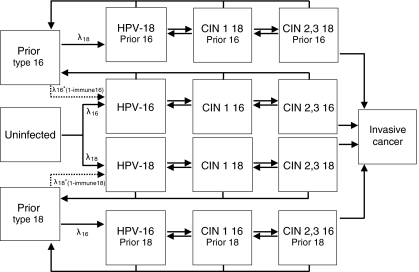
We assessed the cost-effectiveness of including boys vs girls alone in a pre-adolescent vaccination programme against human papillomavirus (HPV) types 16 and 18 in Brazil. Using demographic, epidemiological, and cancer data from Brazil, we developed a dynamic transmission model of HPV infection between males and females. Model-projected reductions in HPV incidence under different vaccination scenarios were applied to a stochastic model of cervical carcinogenesis to project lifetime costs and benefits. We assumed vaccination prevented HPV-16 and -18 infections in individuals not previously infected, and protection was lifelong. Coverage was varied from 0-90% in both genders, and cost per-vaccinated individual was varied from IUSD 25 to 400. At 90% coverage, vaccinating girls alone reduced cancer risk by 63%; including boys at this coverage level provided only 4% further cancer reduction. At a cost per-vaccinated individual of USD 50, vaccinating girls alone was <USD 200 per year of life saved (YLS), while including boys ranged from USD 810-18,650 per YLS depending on coverage. For all coverage levels, increasing coverage in girls was more effective and less costly than including boys in the vaccination programme. In a resource-constrained setting such as Brazil, our results support that the first priority in reducing cervical cancer mortality should be to vaccinate pre-adolescent girls.
Overview
The claims and statistics of this paper haven’t been checked yet.
Run the check — free, no account needed. It reads the open-access text and checks the sources it cites.
Integrity signals
Registry
Cites
Statistics
Figures
Verification
Claims the paper makes
The claims and statistics of this paper haven’t been checked yet.
Run the check — free, no account needed. It reads the open-access text and checks the sources it cites.
Claims other papers make about this one
Each is checked against this paper’s own text: does it say what the citing paper says it does?
The cited source doesn’t support the claim as written.
In the citing paper
“This was a purposeful decision as the former can simulate detailed screening strategies as well as vaccination, and includes other HPV types not targeted by the vaccine, enabling us to take advantage of all available data by calibrating to many epidemiological targets (Garnett et al, 2006).”
From Health and economic impact of HPV 16 and 18 vaccination and cervical cancer screening in India (2008) · cites this paper as Kim et al, 2007b
Checked by a reasoning model — may be wrong.
Experimental — accuracy not yet measuredThe source backs part of the claim, not all of it — or backs it for a different population, condition or comparison.
In the citing paper
“While our independent dynamic model (Kim et al, 2007b) has been previously used to include the herd immunity effects in an HPV vaccine policy analysis, sensitivity analyses that reduced incidence based on these findings, found the main policy results would be unlikely to change.”
From Health and economic impact of HPV 16 and 18 vaccination and cervical cancer screening in India (2008) · cites this paper as Kim et al, 2007b
Experimental — accuracy not yet measured
Self-check
Percentages, sums and reported differences re-computed from the paper’s own numbers.
The self-check needs the paper’s full text.
Citations
Cites
Cancer Incidence in Five Continents
Doll, R., Muir, C. S., & Waterhouse, J. A. H. (1970) · Springer eBooks · doi:10.1007/978-3-642-85851-2 · Cited by 8,485
Cost-Effectiveness in Health and Medicine
(1996) · doi:10.1093/oso/9780195108248.001.0001 · Cited by 7,193
Cancer incidence, mortality and prevalence worldwide
Ferlay, J. (2004) · Medical Entomology and Zoology · Cited by 3,796
Quadrivalent Vaccine against Human Papillomavirus to Prevent High-Grade Cervical Lesions
The FUTURE II Study Group (2007) · New England Journal of Medicine · doi:10.1056/nejmoa061741 · Cited by 2,079
Quadrivalent vaccine against human papillomavirus to prevent anogenital diseases
Garland, S. M., Hernandez-Avila, M., Wheeler, C. M., Perez, G., Harper, D. M., Leodolter, S., Tang, G. W. K., Ferris, D. G., Steben, M., Bryan, J., et al. (2007) · New England Journal of Medicine · doi:10.1056/nejmoa061760 · Cited by 1,886
Harper, D. M., Franco, E. L., Wheeler, C. M., Moscicki, A., Romanowski, B., Roteli-Martins, C. M., Jenkins, D., Schuind, A., Clemens, S. A. C., & Dubin, G. O. (2006) · The Lancet · doi:10.1016/s0140-6736(06)68439-0 · Cited by 1,629
Globocan 2000 : cancer incidence, mortality and prevalence worldwide
Ferlay, J., Pisani, P., & Parkin, D. M. (2001) · Medical Entomology and Zoology · Cited by 1,579
Human papillomavirus types in invasive cervical cancer worldwide: a meta-analysis
Clifford, G. M., Smith, J. S., Plummer, M., Muñóz, N., & Franceschi, S. (2003) · British Journal of Cancer · doi:10.1038/sj.bjc.6600688 · Cited by 1,562
Demographic and Health Surveys
Larmarange, J., Vallo, R., Yaro, S., Méda, N., Ferry, B., Larmarange, J., & Ird, D. (2008) · Choice Reviews Online · doi:10.5860/choice.45-6819 · Cited by 1,455
Chapter 2: The burden of HPV-related cancers
Parkin, D. M., & Bray, F. (2006) · Vaccine · doi:10.1016/j.vaccine.2006.05.111 · Cited by 1,391
Cited by
Sorted by citations
"Herd Immunity": A Rough Guide
Fine, P. E., Eames, K. T. D., & Heymann, D. (2011) · Clinical Infectious Diseases · doi:10.1093/cid/cir007 · Cited by 1,256
Health and Economic Implications of HPV Vaccination in the United States
Kim, J. J., & Goldie, S. J. (2008) · New England Journal of Medicine · doi:10.1056/nejmsa0707052 · Cited by 369
Self-citationHuman papillomavirus vaccines: WHO position paper
Who, 。. (2009) · Biologicals · doi:10.1016/j.biologicals.2009.04.005 · Cited by 357
Goldhaber‐Fiebert, J. D., Stout, N. K., Salomon, J. A., Kuntz, K. M., & Goldie, S. J. (2008) · JNCI Journal of the National Cancer Institute · doi:10.1093/jnci/djn019 · Cited by 288
Self-citationEconomic evaluation of human papillomavirus vaccination in the United Kingdom
Jit, M., Choi, Y. H., & Edmunds, W. J. (2008) · BMJ · doi:10.1136/bmj.a769 · Cited by 278
Metadata
- Authors
- Kim, J. J., Andres-Beck, B., & Goldie, S. J.
- Affiliations
- Harvard University (US)
- Corresponding author
- Kim, J J
- Venue
- British Journal of Cancer
- Published
- 2007-10-09
- Volume
- 97
- Issue
- 9
- Pages
- 1322-1328
- ISSN
- 0007-0920 (ISSN-L)
- 1532-1827
- PMC
- PMC2360471
- OpenAlex
- W2148968089
- Cited by
- 156
- References
- 37
- Citations by year
- 2025: 3 · 2024: 2 · 2023: 1 · 2022: 6 · 2021: 5 · 2020: 1 · 2019: 2 · 2018: 5 · 2017: 9 · 2016: 6 · 2015: 14 · 2014: 6 · 2013: 20 · 2012: 17
- FWCI
- 10.82
- Type
- journal article
- Language
- en
- Open access
- hybrid
- doi.org
- Licence
- cc-by-nc-sa
- www.springer.com/tdm (unspecified)
- Locations
- British Journal of Cancer (publishedVersion, cc-by-nc-sa)
- PubMed Central (publishedVersion, cc-by)
- PubMed (publishedVersion)
- Funders
- Bill and Melinda Gates Foundation (30505)
- National Cancer Institute (R01CA093435, R01-CA93435, CA93435)
- Topics
- Health Sciences › Medicine › Epidemiology › Cervical Cancer and HPV Research
- Social Sciences › Economics, Econometrics and Finance › Economics and Econometrics › Health Systems, Economic Evaluations, Quality of Life
- Health Sciences › Medicine › Surgery › Genital Health and Disease
- Keywords
- HPV vaccination, boys, girls, cost-effectiveness, HPV16, HPV 18, cervical cancer prevention, cervical carcinogenesis, vaccination coverage, resource-limited settings, Brazil
- MeSH terms
- Adolescent, Adult, Aged, Aged, 80 and over, Brazil, Uterine Cervical Dysplasia, Uterine Cervical Neoplasms, Child, Child, Preschool, Cost-Benefit Analysis, Female, Health Policy, Humans, Infant, Infant, Newborn, Male, Mass Screening, Middle Aged, Vaccination, Quality-Adjusted Life Years, Papillomavirus Infections, Human papillomavirus 18, Human papillomavirus 16
About these checks
Registry, retraction, Cites and statistics results are computed, not judged, with one exception: a printed reference that no index lists is read once by a model before it counts as a citation error. Claims are extracted by a model and kept only when their quote appears verbatim in the text; each cited source is then checked, with a model’s help, for whether it says what the claim relies on. Those verdicts can be wrong — read the claim’s quote and the cited source before relying on one.
Statistics and arithmetic are recomputed, not judged.
Confidence bands are shown only for fields calibrated on our annotated test set. None is calibrated yet, so no band is shown.
What counts as a claim ›How we measure confidence ›How we check this ›
Are you an author, or do you see a problem with this page? Request a review
