

The DOI matches its Crossref record; 40 of the 40 references it cites were found in a registry or an index.
Oxygen for relief of dyspnoea in mildly- or non-hypoxaemic patients with cancer: a systematic review and meta-analysis
Open accessAbstract
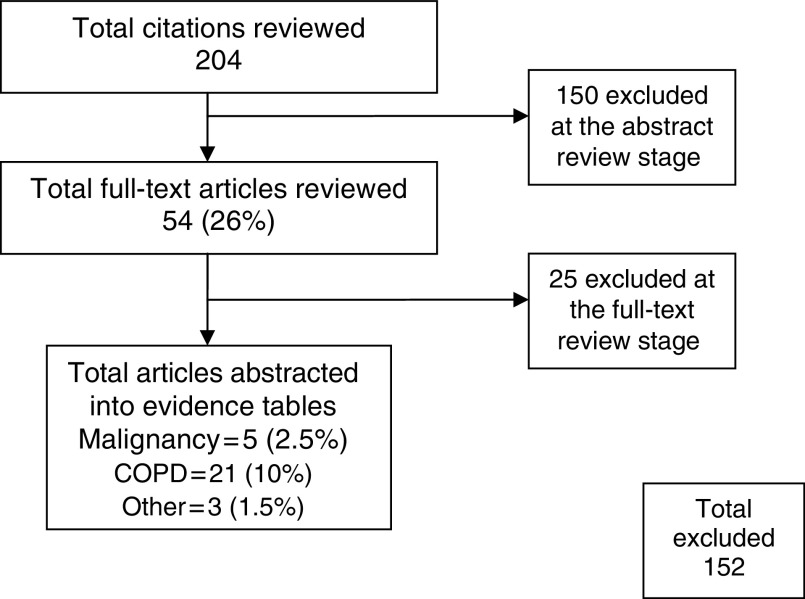
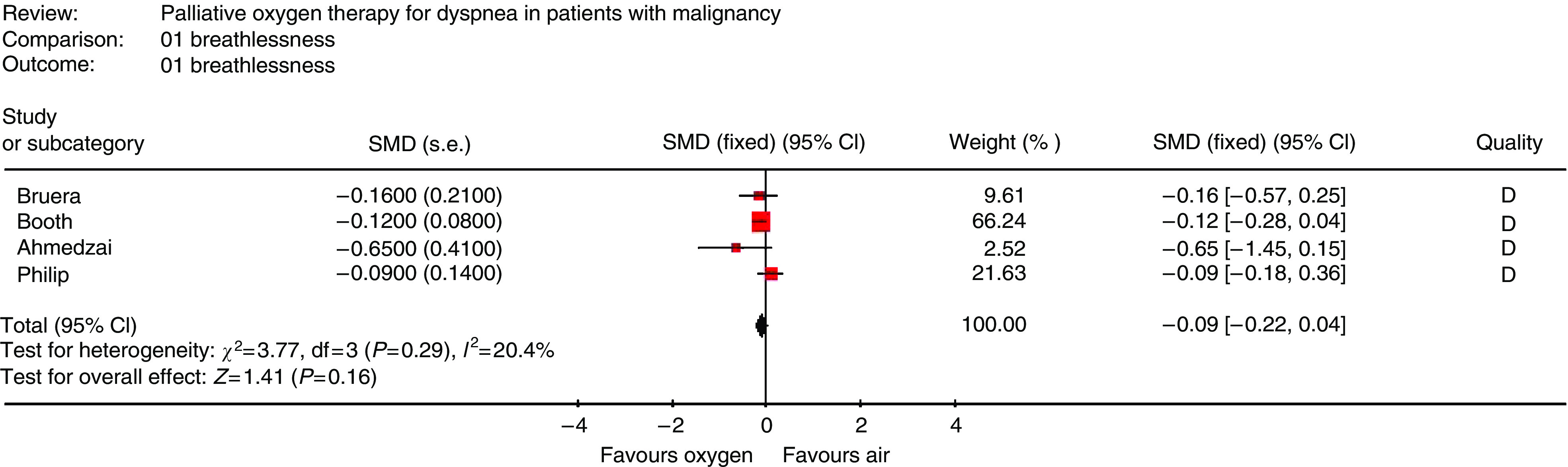
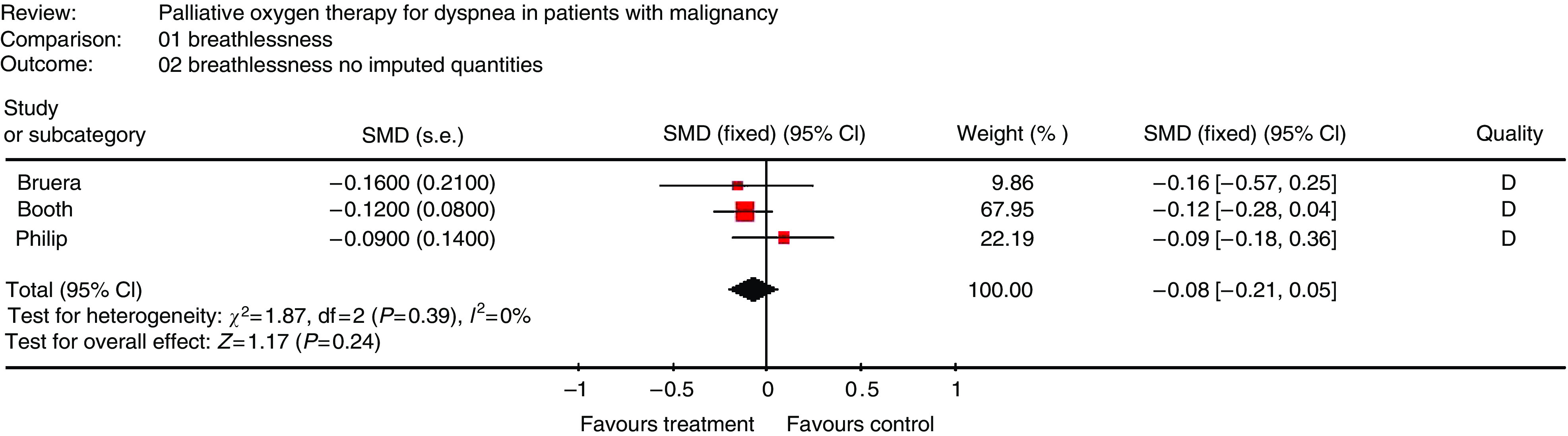
The aim of this study was to determine the efficacy of palliative oxygen for relief of dyspnoea in cancer patients. MEDLINE and EMBASE were searched for randomised controlled trials, comparing oxygen and medical air in cancer patients not qualifying for home oxygen therapy. Abstracts were reviewed and studies were selected using Cochrane methodology. The included studies provided oxygen at rest or during a 6-min walk. The primary outcome was dyspnoea. Standardised mean differences (SMDs) were used to combine scores. Five studies were identified; one was excluded from meta-analysis due to data presentation. Individual patient data were obtained from the authors of the three of the four remaining studies (one each from England, Australia, and the United States). A total of 134 patients were included in the meta-analysis. Oxygen failed to improve dyspnoea in mildly- or non-hypoxaemic cancer patients (SMD=-0.09, 95% confidence interval -0.22 to 0.04; P=0.16). Results were stable to a sensitivity analysis, excluding studies requiring the use of imputed quantities. In this small meta-analysis, oxygen did not provide symptomatic benefit for cancer patients with refractory dyspnoea, who would not normally qualify for home oxygen therapy. Further study of the use of oxygen in this population is warranted given its widespread use.
Overview
The claims and statistics of this paper haven’t been checked yet.
Run the check — free, no account needed. It reads the open-access text and checks the sources it cites.
Integrity signals
Registry
Cites
Statistics
Figures
Verification
Claims the paper makes
The claims and statistics of this paper haven’t been checked yet.
Run the check — free, no account needed. It reads the open-access text and checks the sources it cites.
Claims other papers make about this one
Each is checked against this paper’s own text: does it say what the citing paper says it does?
The source backs part of the claim, not all of it — or backs it for a different population, condition or comparison.
In the citing paper
“Oxygen therapy, although it reverses hypoxaemia, does not improve breathlessness in patients with cancer, and the marginal benefit seen in a meta-analysis of COPD patients is of dubious clinical significance.”
From The Breathing, Thinking, Functioning clinical model: a proposal to facilitate evidence-based breathlessness management in chronic respiratory disease (2017) · cites this paper as [16]
Experimental — accuracy not yet measured
Self-check
Percentages, sums and reported differences re-computed from the paper’s own numbers.
The self-check needs the paper’s full text.
Citations
Cites
Assessing the quality of reports of randomized clinical trials: Is blinding necessary?
Jadad, A. R., Moore, R. A., Carroll, D., Jenkinson, C., Reynolds, D. J. M., Gavaghan, D. J., & McQuay, H. J. (1996) · Controlled Clinical Trials · doi:10.1016/0197-2456(95)00134-4 · Cited by 17,582
Zhang, Q., Wang, C., Zheng, M., Li, Y., Li, J., Zhang, L., Shang, X., & Yan, C. (2014) · Cerebrovascular Diseases · doi:10.1159/000369778 · Cited by 11,609
Dong, Y., Hao, L., Shi, Z., Wang, G., Zhang, Z., & Han, C. (2013) · Urologia Internationalis · doi:10.1159/000351405 · Cited by 4,557
Systematic Reviews: Identifying relevant studies for systematic reviews
Dickersin, K., Scherer, R. W., & Lefebvre, C. (1994) · BMJ · doi:10.1136/bmj.309.6964.1286 · Cited by 2,255
Continuous or Nocturnal Oxygen Therapy in Hypoxemic Chronic Obstructive Lung Disease
NOCTURNAL OXYGEN THERAPY TRIAL GROUP (1980) · Annals of Internal Medicine · doi:10.7326/0003-4819-93-3-391 · Cited by 2,202
Variance imputation for overviews of clinical trials with continuous response
Follmann, D. A., Elliott, P., Suh, I., & Cutler, J. A. (1992) · Journal of Clinical Epidemiology · doi:10.1016/0895-4356(92)90054-q · Cited by 1,391
Dyspnea: Mechanisms, Assessment, and Management: A Consensus Statement
(1999) · American Journal of Respiratory and Critical Care Medicine · doi:10.1164/ajrccm.159.1.ats898 · Cited by 1,052
Dyspnea Mechanisms, Assessment and Management: A Consensus Statement
Editorial, A. (2005) · PULMONOLOGIYA · doi:10.18093/0869-0189-2005-0-2-9-36 · Cited by 859
Stuart, H., Bishop, J. F., Clark, T. J. H., Ac, D., Je, C., & Flenley, D. C. (1981) · PubMed · Cited by 845
Oxford Textbook of Palliative Medicine
Åhström, L. (1998) · Acta Paediatrica · doi:10.1080/08035259850157769 · Cited by 608
Abernethy, A. P., Currow, D. C., Frith, P., Fazekas, B. S., McHugh, A., & Bui, C. (2003) · BMJ · doi:10.1136/bmj.327.7414.523 · Cited by 521
Self-citationDyspnea in Terminally Ill Cancer Patients
Reuben, D. B., & Mor, V. (1986) · CHEST Journal · doi:10.1378/chest.89.2.234 · Cited by 362
Distinguishable Sensations of Breathlessness Induced in Normal Volunteers
Simon, P. M., Schwartzstein, R. M., Weiss, J. W., Lahive, K., Fencl, V., Teghtsoonian, M., & Weinberger, S. E. (1989) · American Review of Respiratory Disease · doi:10.1164/ajrccm/140.4.1021 · Cited by 244
Meta-analysis of arterial oxygen saturation monitoring by pulse oximetry in adults
Jensen, L. A., Onyskiw, J. E., & Prasad, N. G. N. (1998) · Heart & Lung · doi:10.1016/s0147-9563(98)90086-3 · Cited by 243
The Frequency and Correlates of Dyspnea in Patients with Advanced Cancer
Bruera, E. D., Schmitz, B., Pither, J., Neumann, C. M., & Hanson, J. (2000) · Journal of Pain and Symptom Management · doi:10.1016/s0885-3924(00)00126-3 · Cited by 234
Effects of oxygen on dyspnoea in hypoxaemic terminal-cancer patients
Bruera, E. D., de Stoutz, N., Velasco-Leiva, A., Schoeller, T., & Hanson, J. (1993) · The Lancet · doi:10.1016/0140-6736(93)91880-u · Cited by 225
Understanding controlled trials Crossover trials
Sibbald, B., & Roberts, C. (1998) · BMJ · doi:10.1136/bmj.316.7146.1719 · Cited by 216
Ambulatory oxygen improves quality of life of COPD patients: a randomised controlled study
Eaton, T., Garrett, J., Young, P., Fergusson, W., Kolbe, J., Rudkin, S. T., & Whyte, K. (2002) · European Respiratory Journal · doi:10.1183/09031936.02.00301002 · Cited by 201
Booth, S., Anderson, H., Swannick, M., Wade, R., Kite, S., & Johnson, M. J. (2004) · Respiratory Medicine · doi:10.1016/j.rmed.2003.08.008 · Cited by 181
Does Oxygen Help Dyspnea in Patients With Cancer?
Booth, S., Kelly, M., Cox, N., Adams, L. M., & Guz, A. (1996) · American Journal of Respiratory and Critical Care Medicine · doi:10.1164/ajrccm.153.5.8630595 · Cited by 168
Kvale, P. A., Simoff, M., & Prakash, U. B. S. (2003) · CHEST Journal · doi:10.1378/chest.123.1_suppl.284s · Cited by 166
Moulds, R. F. W. (1975) · The Lancet · doi:10.1016/s0140-6736(75)91782-1 · Cited by 152
Management of dyspnea in advanced cancer patients
Ripamonti, C. I. (1999) · Supportive Care in Cancer · doi:10.1007/s005200050255 · Cited by 136
A randomized controlled trial of supplemental oxygen versus air in cancer patients with dyspnea
Bruera, E. D., Sweeney, C., Willey, J. S., Palmer, J. L., Strasser, F., Morice, R. C., & Pisters, K. M. W. (2003) · Palliative Medicine · doi:10.1191/0269216303pm826oa · Cited by 124
The experience of dyspnea in late-stage cancer Patients?? and nurses?? perspectives
Roberts, D. K., Thorne, S. E., & Pearson, C. (1993) · Cancer Nursing · doi:10.1097/00002820-199308000-00008 · Cited by 109
Factors Correlated with Dyspnea in Advanced Lung Cancer Patients
Tanaka, K., Akechi, T., Okuyama, T., Nishiwaki, Y., & Uchitomi, Y. (2002) · Journal of Pain and Symptom Management · doi:10.1016/s0885-3924(02)00400-1 · Cited by 105
Bruera, E. D., Schoeller, T., & MacEachern, T. (1992) · Journal of Pain and Symptom Management · doi:10.1016/0885-3924(92)90091-u · Cited by 96
Philip, J. A. M., Gold, M., Milner, A. D., Iulio, J. D., Miller, B., & Spruyt, O. (2006) · Journal of Pain and Symptom Management · doi:10.1016/j.jpainsymman.2006.06.009 · Cited by 93
Dyspnea: Pathophysiology and assessment
Ripamonti, C. I., & Bruera, E. D. (1997) · Journal of Pain and Symptom Management · doi:10.1016/s0885-3924(96)00327-2 · Cited by 92
Tanaka, K., Akechi, T., Okuyama, T., Nishiwaki, Y., & Uchitomi, Y. (2002) · Journal of Pain and Symptom Management · doi:10.1016/s0885-3924(02)00394-9 · Cited by 84
Descriptors of Breathlessness in Healthy Individuals
Harver, A., Mahler, D. A., Schwartzstein, R. M., & Baird, J. C. (2000) · Chest · doi:10.1378/chest.118.3.679 · Cited by 80
Appropriateness of Domiciliary Oxygen Delivery
Guyatt, G. H., Mckim, D. A., Austin, P., BRYAN, R. E. J., Norgren, J., Weaver, B., & Goldstein, R. S. (2000) · CHEST Journal · doi:10.1378/chest.118.5.1303 · Cited by 75
Lung cancer and dyspnea: the patient's perception.
Brown, M. L., Carrieri, V., Janson-Bjerklie, & Mj, D. (1986) · PubMed · Cited by 74
Ahmedzai, S. H., Laude, E. A., Robertson, A., Troy, G., & Vora, V. (2004) · British Journal of Cancer · doi:10.1038/sj.bjc.6601527 · Cited by 63
Prescribing palliative oxygen: a clinician survey of expected benefit and patterns of use
Abernethy, A. P., Currow, D. C., Frith, P. A., & Fazekas, B. S. (2005) · Palliative Medicine · doi:10.1177/026921630501900219 · Cited by 59
Self-citationPrinciples and Practice of Supportive Oncology
Okuno, S. H. (1998) · Mayo Clinic Proceedings · doi:10.4065/73.10.1029-b · Cited by 42
Caring for the elderly patient with cancer.
Me, D. (1986) · PubMed · Cited by 40
Physician Practices for Prescribing Supplemental Oxygen in the Palliative Care Setting
Stringer, E., McParland, C., & Hernandez, P. (2004) · Journal of Palliative Care · doi:10.1177/082585970402000406 · Cited by 29
Oxygen Use—Patients Define Symptomatic Benefit Discerningly
Currow, D. C., Fazekas, B. S., & Abernethy, A. P. (2007) · Journal of Pain and Symptom Management · doi:10.1016/j.jpainsymman.2007.03.004 · Cited by 27
Self-citationAndie American Academy of Hospice and Palliative Medicine (2022) · Journal of Pain and Symptom Management · doi:10.1016/j.jpainsymman.2022.05.005 · Cited by 18
Research works printed but not linked: 1
- Storey P, Knight CF (2003) UNIPAC Four: Management of Selected Non-Pain Symptoms in the Terminally Ill, Vol. 83 Glenview, IL: American Academy of Hospice and Palliative Medicine
Cited by
Sorted by citations
Parshall, M. B., Schwartzstein, R. M., Adams, L., Banzett, R. B., Manning, H. L., Bourbeau, J., Calverley, P. M., Gift, A. G., Harver, A., Lareau, S. C., et al. (2012) · American Journal of Respiratory and Critical Care Medicine · doi:10.1164/rccm.201111-2042st · Cited by 1,844
BTS guideline for oxygen use in adults in healthcare and emergency settings
O’Driscoll, B. R., Howard, L., Earis, J. E., & Mak, V. H. F. (2017) · Thorax · doi:10.1136/thoraxjnl-2016-209729 · Cited by 710
Abernethy, A. P., McDonald, C. F., Frith, P. A., Clark, K., Herndon, J. E., Marcello, J. E., Young, I. H., Bull, J., Wilcock, A., Booth, S., et al. (2010) · The Lancet · doi:10.1016/s0140-6736(10)61115-4 · Cited by 494
Self-citationAhmed, I., Sutton, A. J., & Riley, R. D. (2012) · BMJ · doi:10.1136/bmj.d7762 · Cited by 404
British Thoracic Society guidelines for home oxygen use in adults: accredited by NICE
Hardinge, M., Annandale, J., Bourne, S. C., Cooper, B. G., Evans, A., Freeman, D., Green, A., Hippolyte, S., Knowles, V., MacNee, W., et al. (2015) · Thorax · doi:10.1136/thoraxjnl-2015-206865 · Cited by 326
Metadata
- Authors
- Uronis, H. E., Currow, D. C., McCrory, D. C., Samsa, G. P., & Abernethy, A. P.
- Affiliations
- Duke Medical Center (US)
- Flinders University (AU)
- Duke University (US)
- Corresponding author
- Abernethy, A P
- Venue
- British Journal of Cancer
- Published
- 2008-01
- Volume
- 98
- Issue
- 2
- Pages
- 294-299
- ISSN
- 0007-0920 (ISSN-L)
- 1532-1827
- PMC
- PMC2361446
- OpenAlex
- W2070591275
- Cited by
- 165
- References
- 40
- Citations by year
- 2026: 2 · 2025: 3 · 2024: 4 · 2023: 8 · 2022: 8 · 2021: 10 · 2020: 6 · 2019: 4 · 2018: 6 · 2017: 9 · 2016: 7 · 2015: 19 · 2014: 13 · 2013: 12 · 2012: 18
- FWCI
- 1.65
- Type
- journal article
- Language
- en
- Open access
- hybrid
- doi.org
- Licence
- cc-by-nc-sa
- www.springer.com/tdm (unspecified)
- Locations
- British Journal of Cancer (publishedVersion, cc-by-nc-sa)
- PubMed Central (publishedVersion, cc-by)
- PubMed (publishedVersion)
- Flinders Academic Commons (Flinders University) (submittedVersion)
- DukeSpace (Duke University) (submittedVersion, cc-by-nc-nd)
- Funders
- Agency for Healthcare Research and Quality (T32HS000079)
- Topics
- Health Sciences › Medicine › Public Health, Environmental and Occupational Health › Palliative Care and End-of-Life Issues
- Health Sciences › Medicine › Public Health, Environmental and Occupational Health › Palliative and Oncologic Care
- Health Sciences › Medicine › Anesthesiology and Pain Medicine › Pain Management and Opioid Use
- Keywords
- dyspnea, cancer, medical air, home oxygen therapy, symptom relief, 6-minute walk test
- MeSH terms
- Aged, Algorithms, Hypoxia, Dyspnea, Female, Humans, Male, Neoplasms, Oxygen, Oxygen Inhalation Therapy, Palliative Care, Randomized Controlled Trials as Topic, Treatment Outcome
About these checks
Registry, retraction, Cites and statistics results are computed, not judged, with one exception: a printed reference that no index lists is read once by a model before it counts as a citation error. Claims are extracted by a model and kept only when their quote appears verbatim in the text; each cited source is then checked, with a model’s help, for whether it says what the claim relies on. Those verdicts can be wrong — read the claim’s quote and the cited source before relying on one.
Statistics and arithmetic are recomputed, not judged.
Confidence bands are shown only for fields calibrated on our annotated test set. None is calibrated yet, so no band is shown.
What counts as a claim ›How we measure confidence ›How we check this ›
Are you an author, or do you see a problem with this page? Request a review
