

Long-term outcomes of breast cancer in women aged 30 years or younger, based on family history, pathology and BRCA1/BRCA2/TP53 status
Open accessThe DOI matches its Crossref record; 28 of the 29 references it cites were found in a registry or an index; none of the 24 sources its claims cite is checked for support yet.
Abstract
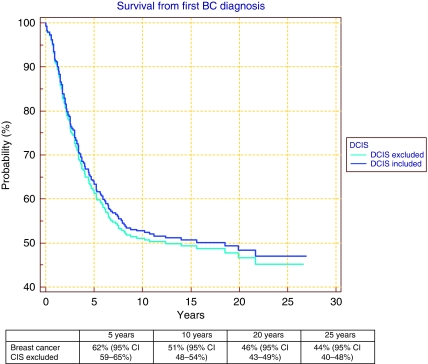
BACKGROUND: There are relatively few articles addressing long-term follow-up in women with breast cancer at very young ages. METHODS: We have updated and extended our population-based analysis of breast cancer diagnosed at the age < or =30 years in North-west England to include an extra 15 patients with mutation testing in BRCA1, BRCA2 and TP53, with 115 of 288 consecutive cases being tested. Kaplan-Meier curves were generated to assess overall survival, contralateral breast cancer and other second primaries. RESULTS: Survival analysis of all 288 patients showed poor overall survival, although this improved from a 15-year survival of only 46% in those diagnosed between 1980 and 1989 to 58% in those diagnosed between 1990 and 1997 (P=0.05). Contralateral breast cancer rates were at a steady rate of 0.6 per 1000, although the rates in mutation carriers were approximately 2 per 1000. Altogether, 16 BRCA1, 9 BRCA2 and 6 TP53 mutations have now been found among the 115 cases on whom DNA analysis has been performed. BRCAPRO accurately predicted the number of carriers for BRCA1 and BRCA2 and was sensitive and specific at the 10 and 20% threshold, respectively. However, BRCAPRO did not seem to give any weight to DCIS, which accounted for two BRCA1 carriers and three TP53 carriers and overpredicted mutations at the high end of the spectrum, with only 6 of 11 (54%) with a >90% probability having identifiable BRCA1/2 mutations. INTERPRETATION: Rates of new primaries are predicted to some extent by mutation status. BRCAPRO is useful at determining those patients aged < or =30 years to be tested.
Overview
CoChat Summary
## TL;DR
This population-based study of women diagnosed with breast cancer at age ≤30 years found poor long-term survival overall, with improvement over time and contralateral breast cancer occurring at about 0.6% per year. Mutation status and family history mattered: BRCA1, BRCA2, and TP53 mutations accounted for a substantial fraction of familial cases, and BRCAPRO was useful for identifying women in this age group who should be tested.
## Key findings
- Among all 288 patients, 15-year survival improved from 46% in those diagnosed in 1980–1989 to 58% in those diagnosed in 1990–1997 (P=0.05); in the post-1990 group, 5-, 10-, and 15-year survival was 69%, 58%, and 57%, compared with 61%, 49%, and 46% before 1990.
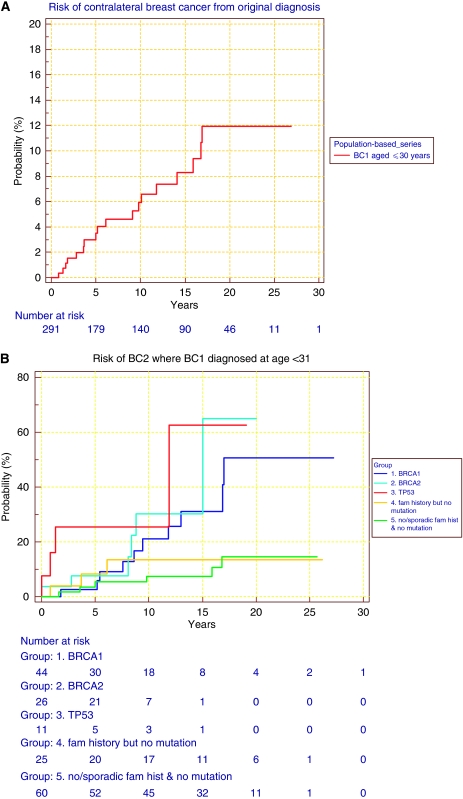
- Contralateral breast cancer incidence was 0.6% per year up to 20 years of follow-up; in the enriched mutation-carrier dataset, the annual risk was about 2% up to 15 years, with 19 contralateral cancers observed in follow-up.
- Pathogenic mutations were found in 31 women among the tested cohort: 16 BRCA1, 9 BRCA2, and 5 TP53; in the molecular analysis, mutations occurred in 26 of 53 (49%) familial cases versus 5 of 62 (8%) non-familial cases.
- BRCAPRO “accurately predicted” BRCA1/2 carriers overall and was sensitive and specific at the 10% and 20% thresholds, respectively, but it appeared to ignore DCIS and overpredicted at the high end: only 6 of 11 (54%) women with >90% predicted BRCA1/2 probability had an identifiable BRCA1/2 mutation.
## Methods
- Population-based follow-up of consecutive breast cancers diagnosed at age ≤30 years in North-west England/NWCIS between 1 January 1980 and 31 December 1997; the original series included 288 patients, and genetic status was established for 115 women, with 15 additional mutation-tested samples added since the previous report.
- Mutation testing covered BRCA1, BRCA2, and TP53; pathology review used original reports and a single pathologist review where tissue was available, with ER/PR/HER2 assessed by immunohistochemistry when possible.
- Main analyses used Kaplan–Meier curves for overall survival, contralateral breast cancer, and other second primaries, with χ² tests comparing groups and 95% confidence intervals for survival and contralateral tumour incidence; model performance for BRCAPRO, Myriad, and the Manchester score was assessed at 10% and 20% thresholds.
## Limitations
- The paper states that pathology reports before 1990 had little information on grade and no hormone receptor status, making reliable survival analysis by tumour grade impossible for those cases.
- The study also notes that some comparisons are limited by small numbers, especially for later contralateral cancer estimates in mutation carriers and high-probability model strata.
- Evident from the text: mutation testing was not performed on all 288 cases, so some mutation-status analyses are based on a subset rather than the full cohort.
Model-written summary. Check it against the paper before relying on it.
Integrity signals
Registry
Cites
Statistics
Figures
Verification
Claims the paper makes
0 Valid · 0 Not valid · 16 Not checked · 59 Own results and interpretations
A result the paper reports from its own data — it cites no other source for it, so there is none to check. The quote shows it is in the paper.
In the paper
“The incidence of contralateral breast cancer up to 20 years of follow-up is 0.6% per year.”
§ Long-term outcomes of breast cancer in women aged 30 years or younger, based on family history, pathology and BRCA1/BRCA2/TP53 status > Results > Contralateral breast cancer incidence
plain- Asserted: passes — The authors put it forward as true.
- Checkable: passes — It can be checked against evidence.
- Load-bearing: passes — The paper’s conclusions depend on it.
- Based: passes — The paper gives a reason why it holds.
A result the paper reports from its own data — it cites no other source for it, so there is none to check. The quote shows it is in the paper.
In the paper
“Altogether, 16 BRCA1, 9 BRCA2 and 6 TP53 mutations have now been found among the 115 cases on whom DNA analysis has been performed.”
§ Long-term outcomes of breast cancer in women aged 30 years or younger, based on family history, pathology and BRCA1/BRCA2/TP53 status > Abstract > Results:
plainn = 115- Asserted: passes — The authors put it forward as true.
- Checkable: passes — It can be checked against evidence.
- Load-bearing: passes — The paper’s conclusions depend on it.
- Based: passes — The paper gives a reason why it holds.
A result the paper reports from its own data — it cites no other source for it, so there is none to check. The quote shows it is in the paper.
In the paper
“In the enriched mutation carrier data set, there is a 2% annual risk of contralateral breast cancer up until 15 years, after which the number of patients is too small for any stable estimate (Figure 2B).”
§ Long-term outcomes of breast cancer in women aged 30 years or younger, based on family history, pathology and BRCA1/BRCA2/TP53 status > Results > Contralateral breast cancer incidence
plain- Asserted: passes — The authors put it forward as true.
- Checkable: passes — It can be checked against evidence.
- Load-bearing: unclear — It is unclear whether the paper’s conclusions depend on it.
- Based: passes — The paper gives a reason why it holds.
A result the paper reports from its own data — it cites no other source for it, so there is none to check. The quote shows it is in the paper.
In the paper
“Overall, pathogenic mutations in BRCA1, BRCA2 and TP53 were identified in 31 women: 26 of 53 (49%) familial and 5 of 62 (8%) non-familial cases (Tables 2, 3 and 4).”
§ Long-term outcomes of breast cancer in women aged 30 years or younger, based on family history, pathology and BRCA1/BRCA2/TP53 status > Results > Molecular analysis
plainn = 31- Asserted: passes — The authors put it forward as true.
- Checkable: passes — It can be checked against evidence.
- Load-bearing: passes — The paper’s conclusions depend on it.
- Based: passes — The paper gives a reason why it holds.
A result the paper reports from its own data — it cites no other source for it, so there is none to check. The quote shows it is in the paper.
In the paper
“Our population-based data confirm a similar 29% risk for young women (age <31 years).”
§ Long-term outcomes of breast cancer in women aged 30 years or younger, based on family history, pathology and BRCA1/BRCA2/TP53 status > Discussion This study has updated the previous comprehensive analysis of FH and mutation analysis for all three high-risk breast cancer genes in women diagnosed with breast cancer aged ⩽30 years to include an additional 15 patients with 5 new pathogenic mutations. The analysis of contralateral disease, non-breast primaries and survival has been enriched with additional patients diagnosed at the age of ⩽30 years from our mutation database. We have previously published the prevalence of both BRCA1/2 and TP53 mutations in this cohort (Lalloo et al, 2003), demonstrating a higher prevalence of TP53 mutations than previously expected. The mutation detection rate in familial breast cancer in these three genes is ∼50% (26 of 53), demonstrating the importance of accurately documenting a FH when estimating the likelihood of a mutation carrier. Few mutations were found in those women without a FH. These data would therefore not support the testing of BRCA1/2 in patients below the age of 31 years without a FH of breast cancer. In particular, even in sporadic cases with grade 3 cancers, the detection rate was only 5%. Among grade 3 triple-negative sporadic cases, the rate of mutation detection was only 12.5% (2 of 16). Lakhani et al (2005) reported data on the likelihood of breast cancer being caused by a BRCA1 mutation by pathological grade and ER status at various ages in women not selected by FH. These data were also from an unselected series. Women aged between 20 and 29 years with grade 3 ER-negative breast cancers had a 35% chance of a BRCA1 mutation, with a similarly high risk for women aged 30–34 years at 26.5%. Only after the age of 34 years did the risks fall below 10% (Lakhani et al, 2005). However, these figures include all women, even those with a FH. Unfortunately, it seems that some clinicians have misinterpreted these data and called for all women <35 years of age with pathological grade 3 and ER-negative breast cancer to be tested, or has offered testing on the basis of a 10–20% testing threshold. Our population-based data confirm a similar 29% risk for young women (age <31 years). This suggests that only triple-negative, pathological grade 3 breast cancers in women <31 years of age qualify for testing, irrespective of FH, on the basis of guidelines using a 10% threshold in outbred populations. Clearly, the CIs are wide on these numbers, and further studies to assess the rates of mutations in sporadic triple-negative patients will help inform models and scoring systems further. For instance, a recent North American study demonstrated mutations in 9% of triple-negative breast cancer patients aged <40 years without, or with minimal, FH of breast or ovarian cancer (Young et al, 2009). However, this study did not describe the FH. Nevertheless, use of pathology in our pathology-adjusted Manchester score (Evans et al, 2009) improved sensitivity at the 20% threshold by detecting two further mutations at the cost of testing only three further samples. The data in the current analysis demonstrate the improvement in survival in breast cancer, which is seen in many countries. In the United Kingdom, a more formal approach for breast surgery including axillary node dissection and treatment of all ipsilateral breast tissue (radiotherapy in those undergoing local excision) was highlighted in 1990 (Fentiman and Mansel, 1991). This more formalised treatment schedule may in part explain the significant improvement in survival from diagnosis with time. Nevertheless, overall survival is still poor in this group of young women. This is likely to be related to a more aggressive phenotype with less hormonally sensitive cancers (Figueiredo et al, 2007; Anders et al, 2008). The poor prognosis seems to particularly apply to breast cancer patients at age <35 years and is consistent between studies in the United Kingdom, North America and Asia (Nixon et al, 1994; Jmor et al, 2002; Han and Kang, 2010). The diagnosis of a second primary tumour should prompt the clinician to consider a TP53 mutation. One patient with a renal carcinoma and a de novo TP53 mutation went on to develop a sarcoma behind the remaining kidney that was subjected to regular screening radiation from intravenous urograms. An oesophageal cancer also occurred in a BRCA2 carrier. However, surprisingly, no ovarian cancers occurred in BRCA1/2 carriers, even though 21 women have lived beyond 40 years of age without an oophorectomy. Population studies have indicated that the subsequent ovarian cancer risk is higher if an individual is diagnosed with breast cancer at a young age, particularly if there is a FH of ovarian cancer (Bergfeldt et al, 2002). This is most likely to suggest a high probability of a BRCA1/2 mutation rather than another mechanism increasing ovarian cancer risk. The data from our study do not suggest a higher ovarian cancer risk in women with known mutations with early-onset breast cancer, compared with mutation carriers with later-onset disease. This study assessed the performance of mutation prediction models in this population-based data set. We chose to assess the models at last follow-up to determine how the models dealt with new contralateral disease. Direct comparisons with the Manchester scoring system are inappropriate, as this system was partly developed from the original data set at the time of diagnosis. Another model, BOADICEA, also used this data set in development (Antoniou et al, 2008). BRCAPRO (Parmigiani et al, 1998) performs well, especially in unilateral cases. As no non-Jewish sporadic case (even the adopted individuals) reached the 10% combined threshold even at the time of diagnosis, this supports the hypothesis that, in Western populations, the rates of BRCA1/2 mutations even in early-onset breast cancer cases without a FH are low. An adopted sporadic case would need to be diagnosed at the age of ⩽24 years to breach the threshold using BRCAPRO. Nevertheless, BRCAPRO does seem to overestimate the BRCA1/2 probabilities in bilateral cases. It is also interesting to note the handling of DCIS. Although both BRCA1 carriers with DCIS were identified using the 10% combined threshold, they were as likely to be a carrier as an unaffected sibling. It seems that no weight is given to DCIS to increase either the BRCA1 or BRCA2 probability of either the individual or the family in BRCAPRO. Ductal carcinoma in situ at the age of ⩽30 years is clearly an important diagnosis, as 45% of the 11 cases had a pathogenic mutation, with DCIS being a particular marker for a TP53 mutation. The myriad tables (Frank et al, 2002) do not have a specific readout for bilateral disease and therefore should probably not be used to assess families with this disease. No patient using the Myriad tables had a score above 39.2% for likelihood of a mutation. There also seems to be a degree of overestimation at the top end of the BRCAPRO model. The model does not allow for sensitivity of mutation techniques, as scores of up to 100% are possible. The model also does not allow for the possibility of other high-penetrance genes, as two of the TP53 carriers had scores above 94%, yet their FHs were consistent with LFS. We have estimated that a combined score of 40+ using the Manchester score suggests a very high probability of a BRCA1/2 mutation (Evans et al, 2009). Using this threshold, six of seven samples had a detectable mutation. The strengths of this study are that it is population based and has obtained DNA samples on the great majority of living cases. Overall death rates and second primary rates are secure because of the cancer intelligence service.
boostedstates an association- Asserted: passes — The authors put it forward as true.
- Checkable: passes — It can be checked against evidence.
- Load-bearing: passes — The paper’s conclusions depend on it.
- Based: passes — The paper gives a reason why it holds.
43 more claims
Create a free account to see all 75 claims and to verify the 24 references still open.
- It may state two separate claims as one. 21
- Probably not a substantial claim. 9
Claims other papers make about this one
Each is checked against this paper’s own text: does it say what the citing paper says it does?
In the citing paper
“Further studies have shown that germline p53 mutations are also found in the context of hereditary breast and ovarian cancer and in childhood cancers [126, 127, 128, 129].”
From The TP53 tumor suppressor gene: From molecular biology to clinical investigations (2025) · cites this paper as [128]
Citations
Cites
Genetic Heterogeneity and Penetrance Analysis of the BRCA1 and BRCA2 Genes in Breast Cancer Families
Ford, D., Easton, D. F., Stratton, M., Narod, S., Goldgar, D., Devilee, P., Bishop, D. T., Weber, B., Lenoir, G., Chang-Claude, J., et al. (1998) · The American Journal of Human Genetics · doi:10.1086/301749 · Cited by 3,037 · cited 1×
“These mutations confer a lifetime breast cancer risk of 43 –85% (Varley et al, 1997; Ford et al, 1998).”
BackgroundA cancer family syndrome in twenty-four kindreds.
Li, F. P., Fraumeni, J. F., Mulvihill, J. J., Blattner, W. A., Dreyfus, M., Tucker, M., & Miller, R. (1988) · PubMed · Cited by 1,293
Anders, C. K., Hsu, D. S., Broadwater, G., Acharya, C. R., Foekens, J. A., Zhang, Y., Wang, Y., Marcom, P. K., Marks, J. R., Febbo, P. G., et al. (2008) · Journal of Clinical Oncology · doi:10.1200/jco.2007.14.2471 · Cited by 911 · cited 1×
“This is likely to be related to a more aggressive phenotype with less hormonally sensitive cancers (Figueiredo et al, 2007; Anders et al, 2008).”
BackgroundPrevalence of BRCA1 and BRCA2 Gene Mutations in Patients With Early-Onset Breast Cancer
Peto, J., Collins, N., Barfoot, R., Seal, S., Warren, W., Rahman, N., Easton, D. F., Evans, C., Deacon, J., & Stratton, M. R. (1999) · JNCI Journal of the National Cancer Institute · doi:10.1093/jnci/91.11.943 · Cited by 873 · cited 2×
“Among breast cancer cases unselected for family history (FH), the prevalence of BRCA1/2 mutations is dependent on the population studied and on the age at diagnosis of malignancy (Fitzgerald et al, 1996; Krainer et al, 1997; Peto et al, 1999; Loman et al, 2001).”
BackgroundDetermining Carrier Probabilities for Breast Cancer–Susceptibility Genes BRCA1 and BRCA2
Parmigiani, G., Berry, D. A., & Aguilar, O. (1998) · The American Journal of Human Genetics · doi:10.1086/301670 · Cited by 753 · cited 1×
“BRCAPRO (Parmigiani et al, 1998) performs well, especially in unilateral cases.”
BackgroundLakhani, S. R., Reis-Filho, J. S., Fulford, L., Penault-Llorca, F., van der Vijver, M., Parry, S., Bishop, T., Benitez, J., Rivas, C., Bignon, Y.-J., et al. (2005) · Clinical Cancer Research · doi:10.1158/1078-0432.ccr-04-2424 · Cited by 611 · cited 2×
“Lakhani et al (2005) reported data on the likelihood of breast cancer being caused by a BRCA1 mutation by pathological grade and ER status at various ages in women not selected by FH.”
BackgroundSelf-citationNixon, A. J., Neuberg, D., Hayes, D. F., Gelman, R., Connolly, J. L., Schnitt, S., Abner, A., Recht, A., Vicini, F., & Harris, J. R. (1994) · Journal of Clinical Oncology · doi:10.1200/jco.1994.12.5.888 · Cited by 579 · cited 1×
“The poor prognosis seems to particularly apply to breast cancer patients at age o35 years and is consistent between studies in the United Kingdom, North America and Asia (Nixon et al, 1994; Jmor et al, 2002; Han and Kang, 2010).”
ResultFrank, T. S., Deffenbaugh, A. M., Reid, J. E., Hulick, M., Ward, B. E., Lingenfelter, B., Gumpper, K. L., Scholl, T., Tavtigian, S. V., Pruss, D. R., et al. (2002) · Journal of Clinical Oncology · doi:10.1200/jco.2002.20.6.1480 · Cited by 558 · cited 1×
“The myriad tables (Frank et al, 2002) do not have a specific readout for bilateral disease and therefore should probably not be used to Table 6 Sensitivity and specificity of BRCAPRO and Myriad tables at the 10 and 20% level for BRCA1, BRCA2 and both genes combined Model/scoring system Sensitivity…”
MethodThe BOADICEA model of genetic susceptibility to breast and ovarian cancers: updates and extensions
Antoniou, A. C., Cunningham, A. P., Peto, J., Evans, D. G., Lalloo, F., Narod, S. A., Risch, H. A., Eyfjord, J. E., Hopper, J. L., Southey, M. C., et al. (2008) · British Journal of Cancer · doi:10.1038/sj.bjc.6604305 · Cited by 525 · cited 2×
“Another model, BOADICEA, also used this data set in development (Antoniou et al, 2008).”
BackgroundMethodSelf-citationPrevalence and diversity of constitutional mutations in the p53 gene among 21 Li-Fraumeni families
Birch, Hartley, Tricker, Prosser, P., Condie, Kelsey, Harris, Jones, Binchy, Crowther, et al. (1994) · Cancer Research · Cited by 475
Cited by
Breast Cancer Epidemiology and Risk Factors
ROJAS, K., & STUCKEY, A. (2016) · Clinical Obstetrics & Gynecology · doi:10.1097/grf.0000000000000239 · Cited by 576
“Li Fraumeni (p53) Approximately 1% of women diagnosed with breast cancer before age 40 and 4% of those diagnosed before age 30 are estimated to have inherited a mutation in the tumor suppressor p53 gene.(138,139) Patients diagnosed with a p53 mutation have an increased risk of multiple cancers, including leukemias, sa…”
BackgroundLobular breast cancer: incidence and genetic and non-genetic risk factors
Dossus, L., & Benusiglio, P. R. (2015) · Breast Cancer Research · doi:10.1186/s13058-015-0546-7 · Cited by 188
“Little is known regarding the histological characteristics of breast cancers associated with germline TP53 mutations, but the two studies that have examined the issue have only shown tumors of the ductal type - and none of the lobular type - out of a total of 48 cancers in mutation carriers [80,81].”
BackgroundMRI breast screening in high-risk women: cancer detection and survival analysis
MARIBS Group, Evans, D. G., Kesavan, N., Lim, Y. Y., Gadde, S., Hurley, E., Massat, N. J., Maxwell, A., Ingham, S. L., Eeles, R. A., et al. (2014) · Breast Cancer Research and Treatment · doi:10.1007/s10549-014-2931-9 · Cited by 156
“Some poor prognosis tumors are related to germline mutations in the BRCA1, BRCA2, and TP53 genes [8, 9], and detection of these mutations predicates more intensive screening at a younger age.”
BackgroundTricoli, J. V., Blair, D. G., Anders, C. K., Bleyer, W. A., Boardman, L. A., Khan, J. I., Kummar, S., Hayes‐Lattin, B., Hunger, S. P., Merchant, M. S., et al. (2016) · Cancer · doi:10.1002/cncr.29871 · Cited by 156
Contribution of de novo and mosaic TP53 mutations to Li-Fraumeni syndrome
Renaux‐Petel, M., Charbonnier, F., Théry, J., Fermey, P., Lienard, G., Bou, J., Coutant, S., Vézain, M., Kasper, E., Fourneaux, S., et al. (2017) · Journal of Medical Genetics · doi:10.1136/jmedgenet-2017-104976 · Cited by 143
Li-Fraumeni syndrome: report of a clinical research workshop and creation of a research consortium
Mai, P. L., Malkin, D., Garber, J. E., Schiffman, J. D., Weitzel, J. N., Strong, L. C., Wyss, O., Locke, L., Means, V., Achatz, M. I., et al. (2012) · Cancer Genetics · doi:10.1016/j.cancergen.2012.06.008 · Cited by 104
“Based on this and other evidence, the estimated prevalence of a deleterious germline TP53 mutation in the United Kingdom was 1/10,000 to 1/25,000 live births (25).”
BackgroundSelf-citationvan den Broek, A. J., van ’t Veer, L. J., Hooning, M. J., Cornelissen, S., Broeks, A., Rutgers, E. J., Smit, V. T. H. B. M., Cornelisse, C. J., van Beek, M., Janssen-Heijnen, M. L., et al. (2016) · Journal of Clinical Oncology · doi:10.1200/jco.2015.62.3942 · Cited by 104
Ormondroyd, E., Donnelly, L. S., Moynihan, C., Savona, C., Bancroft, E. K., Evans, D. G., Eeles, R. A., Lavery, S. A., & Watson, M. (2011) · European Journal of Human Genetics · doi:10.1038/ejhg.2011.146 · Cited by 106
Self-citationMolina‐Montes, E., Perez-Nevot, B., Pollán, M., Sánchez‐Cantalejo, E., Espín, J., & Sánchez, M. (2014) · The Breast · doi:10.1016/j.breast.2014.10.005 · Cited by 100
“5 e e e e 15 e e e e e e e e 20 42.8 e 49.8 e e e e e Evans et al. 2010 [25] 5 0x 0e6 0# e 4.2x 0e12.”
BackgroundInfluentialPrevalence of BRCA1 and BRCA2 mutations in triple negative breast cancer
Evans, D. G., Howell, A., Ward, D., Lalloo, F. I., Jones, J. L., & Eccles, D. (2011) · Journal of Medical Genetics · doi:10.1136/jmedgenet-2011-100006 · Cited by 87
“Group 1 was a population based sample of all TNBCs ascertained in the Manchester”
BackgroundSelf-citationPathology update to the Manchester Scoring System based on testing in over 4000 families
Evans, D. G., Harkness, E. F., Plaskocinska, I., Wallace, A. J., Clancy, T., Woodward, E. R., Howell, A., Tischkowitz, M. D., & Lalloo, F. I. (2017) · Journal of Medical Genetics · doi:10.1136/jmedgenet-2017-104584 · Cited by 74
“Using MSS3 identified 37 more mutations than MSS1(9) 15 and 21 more mutations than MSS2.(16) Despite these changes, the specificity in familial cases remains unchanged.”
InfluentialSelf-citationBreast Cancer Risks and Risk Prediction Models
Engel, C., & Fischer, C. (2015) · Breast Care · doi:10.1159/000376600 · Cited by 81
Solano, A. R., Aceto, G. M., Delettieres, D., Veschi, S., Neuman, M. I., Alonso, E., Chialina, S., Chacon, R. D., Mariani‐Costantini, R., & Podesta, E. J. (2012) · SpringerPlus · doi:10.1186/2193-1801-1-20 · Cited by 57
“BRCA1/2 mutation status in subsets of BOC patients selected for age, BOC family history and ethnicity has been scarcely investigated outside Europe and North America [5,11-15], with few reports for South America, where Native American founder effects and the complex multiracial demography of recent immigration are pre…”
BackgroundBasu, N., Ingham, S. L., Hodson, J. A., Lalloo, F. I., Bulman, M., Howell, A., & Evans, D. G. (2015) · Familial Cancer · doi:10.1007/s10689-015-9825-9 · Cited by 66
Self-citationKasper, E., Angot, É., Colasse, É., Nicol, L., Sabourin, J., Adriouch, S., Lacoume, Y., Charbonnier, C., Raad, S., Frébourg, T., et al. (2018) · European Journal of Cancer · doi:10.1016/j.ejca.2018.06.011 · Cited by 62
Kúdela, E., Samec, M., Kubatka, P., Ňachajová, M., Laučeková, Z., Líšková, A., Dókuš, K., Biringer, K., Šímová, D., Gabonova, E., et al. (2019) · Cancers · doi:10.3390/cancers11111791 · Cited by 68
He, X., & Zou, D. (2017) · Scientific Reports · doi:10.1038/s41598-017-10729-9 · Cited by 50
The TP53 tumor suppressor gene: From molecular biology to clinical investigations
Baliakas, P., & Soussi, T. (2025) · Journal of Internal Medicine · doi:10.1111/joim.20106 · Cited by 50
Hereditary breast cancer: an update on risk assessment and genetic testing in 2015
Stuckey, A. R., & Onstad, M. A. (2015) · American Journal of Obstetrics and Gynecology · doi:10.1016/j.ajog.2015.03.003 · Cited by 63
The Manchester guidelines for contralateral risk-reducing mastectomy
Basu, N. N., Ross, G. L., Evans, D. G., & Barr, L. C. (2015) · World Journal of Surgical Oncology · doi:10.1186/s12957-015-0638-y · Cited by 45
“5)Level II evidence (Reiner AS JCO—2013) [18]”
BackgroundSelf-citationGermline TP53 Testing in Breast Cancers: Why, When and How?
Evans, D. G., Woodward, E. R., Bajalica‐Lagercrantz, S., Oliveíra, C., & Frébourg, T. (2020) · Cancers · doi:10.3390/cancers12123762 · Cited by 42
Self-citationfor the TFGT Collaborative Group, Watts, K., Meiser, B., Mitchell, G., Kirk, J., Saunders, C. M., Peate, M., Duffy, J., Kelly, P. J., Gleeson, M., et al. (2012) · BMC Cancer · doi:10.1186/1471-2407-12-320 · Cited by 35
“Compared with noncarriers, BRCA1 and BRCA2 mutation carriers have a substantially increased lifetime risk of contralateral breast cancer that is age dependent and can be up to 68%, if the age of the first cancer is <40 [3,4].”
BackgroundHyder, Z., Harkness, E. F., Woodward, E. R., Bowers, N. L., Pereira, M., Wallace, A. J., Howell, S. J., Howell, A., Lalloo, F. I., Newman, W. G., et al. (2020) · Cancers · doi:10.3390/cancers12020378 · Cited by 31
“We have previously reported that the risk of developing contralateral breast cancer is increased in BRCA1 PV carriers diagnosed with breast cancer at a very young age (<30 years at diagnosis) [8].”
BackgroundSelf-citationPetridis, C., Arora, I., Shah, V., Megalios, A., Moss, C. L., Mera, A., Clifford, A., Gillett, C., Pinder, S. E., Tomlinson, I. P. M., et al. (2019) · Breast Cancer Research · doi:10.1186/s13058-019-1143-y · Cited by 31
Germline TP53 mutational spectrum in French Canadians with breast cancer
Arcand, S. L., Akbari, M. R., Mes‐Masson, A., Provencher, D. M., Foulkes, W. D., Narod, S. A., & Tonin, P. N. (2015) · BMC Medical Genetics · doi:10.1186/s12881-015-0169-y · Cited by 31
“1/25,000 live births harboring pathogenic mutations was estimated [8].”
BackgroundInfluentialEvans, D. G., van Veen, E. M., Byers, H., Evans, S. J., Burghel, G. J., Woodward, E. R., Harkness, E. F., Eccles, D., Greville-Heygate, S. L., Ellingford, J. M., et al. (2021) · Journal of Medical Genetics · doi:10.1136/jmedgenet-2020-107347 · Cited by 27
“13 We also found a rate of 15.4% (4/26) for BRCA1/2 PVs in DCIS cases.”
InfluentialSelf-citationGallardo-Alvarado, L., Tusié‐Luna, T., Tussié-Luna, M. I., Díaz‐Chávez, J., Segura-Kato, Y., Bargalló‐Rocha, E., Villarreal-Garza, C. M., Herrera, L. A., Herrera-Medina, E. M., & de León, D. F. C. (2019) · BMC Cancer · doi:10.1186/s12885-019-5312-2 · Cited by 22
Contralateral Risk-Reducing Mastectomy: Review of Risk Factors and Risk-Reducing Strategies
Basu, N., Barr, L. C., Ross, G. L., & Evans, D. G. (2015) · International Journal of Surgical Oncology · doi:10.1155/2015/901046 · Cited by 26
“This paper reviews the current evidence base regarding contralateral breast cancer, assesses the various risk-reducing strategies, and evaluates the cost-effectiveness of contralateral risk-reducing mastectomy.”
BackgroundSelf-citationStaging, risk assessment and screening of breast cancer.
Yalçın, B. (2013) · PubMed · Cited by 27
Living With Genetic Vulnerability: a Life Course Perspective
Hamilton, R., Innella, N. A., & Bounds, D. T. (2015) · Journal of Genetic Counseling · doi:10.1007/s10897-015-9877-x · Cited by 25
“In addition to these increased lifetime risks, there are other notable differences for women with a BRCA mutation: 1) the onset of breast cancer is at a younger age, 2) bilateral cancer is more common, and 3) onset prior to age 25, while unusual, does occur (Evans et al. 2010).”
BackgroundCurrent knowledge of risk reducing mastectomy: Indications, techniques, results, benefits, harms
Baildam, A. D. (2019) · The Breast · doi:10.1016/j.breast.2019.03.011 · Cited by 18
Next generation sequencing is informing phenotype: a TP53 example
O’Shea, R., Clarke, R. C., Berkley, E., Giffney, C., Farrell, M., O’Donovan, E. M., & Gallagher, D. J. (2017) · Familial Cancer · doi:10.1007/s10689-017-0002-1 · Cited by 19
Rippinger, N., Fischer, C., Sinn, H., Dikow, N., Sutter, C., Rhiem, K., Grill, S., Cremer, F. W., Nguyen, H. P., Ditsch, N., et al. (2021) · Cancer Medicine · doi:10.1002/cam4.4300 · Cited by 15
Evans, D. G., & Woodward, E. R. (2020) · Familial Cancer · doi:10.1007/s10689-020-00207-z · Cited by 16
“Even using a 2% detection frequency from the lowest detection rate studies, this would equate to a 100-fold relative risk and a 10% cumulative risk [17]; the 5% rate [5, 9] would therefore equate to a 25% risk similar to that estimated from cohorts [41].”
BackgroundResultSelf-citationFrom BRCA1 to Polygenic Risk Scores: Mutation-Associated Risks in Breast Cancer-Related Genes
Woodward, E. R., van Veen, E. M., & Evans, D. G. (2021) · Breast Care · doi:10.1159/000515319 · Cited by 20
Self-citationBando, H. (2013) · Breast Cancer · doi:10.1007/s12282-013-0477-z · Cited by 11
Prevalence of germline TP53 mutation among early onset middle eastern breast cancer patients
Siraj, A. K., Masoodi, T., Bu, R., Parvathareddy, S. K., Iqbal, K., Azam, S., Al-Rasheed, M. M., Ajarim, D. S., Tulbah, A. M., Al‐Dayel, F., et al. (2021) · Hereditary Cancer in Clinical Practice · doi:10.1186/s13053-021-00206-w · Cited by 8
Nipple-sparing mastectomy in women at high risk of developing breast cancer
Lewis, R. S., George, A. J., & Rusby, J. E. (2018) · Gland Surgery · doi:10.21037/gs.2018.04.01 · Cited by 8
Familiärer Brustkrebs – empirische Erkrankungsrisiken und Risikoberechnungsmodelle
Engel, C., Zachariae, S., & Fischer, C. (2015) · Medizinische Genetik · doi:10.1007/s11825-015-0043-5 · Cited by 11
Extended gene panel testing in lobular breast cancer
van Veen, E. M., Evans, D. G., Harkness, E. F., Byers, H., Ellingford, J. M., Woodward, E. R., Bowers, N. L., Wallace, A. J., Howell, S. J., Howell, A., et al. (2021) · Familial Cancer · doi:10.1007/s10689-021-00241-5 · Cited by 6
Self-citationBreast cancer in reproductive age. The new plaque or just myth?
Stamatakos, M., Stefanaki, C., Xiromeritis, K., et al. (2011) · Surgical Oncology · doi:10.1016/j.suronc.2011.05.004 · Cited by 5
Hégo, F., Barthoulot, M., Chretien, S., Pierard, C., Boulaire, M., Bécourt, S., Boulanger, L., Ceugnart, L., Conoy, A.-L., Oca, F., et al. (2024) · Clinical Oncology · doi:10.1016/j.clon.2024.10.030 · Cited by 4
Ekram, S. N., & AlEissa, M. M. (2025) · Oncology Reviews · doi:10.3389/or.2025.1633387 · Cited by 4
Apostolou, P., Dellatola, V., Παπαθανασίου, Α., Kalfakakou, D., Fountzilas, E., Tryfonopoulos, D. J., Karageorgopoulou, S., Yannoukakos, D., Konstantopoulou, I., & Fostira, F. (2024) · Cancers · doi:10.3390/cancers16132368 · Cited by 3
Ding, W., Zeng, T., Wang, L., Lei, H., Ge, W., & Wang, Z. (2017) · Oncotarget · doi:10.18632/oncotarget.21453 · Cited by 3
“There were two studies which showed that out of total 48 breast cancers with TP53 mutations were all tumors of the ductal type but none of them were lobular type [10, 11].”
ResultThe genetics of breast cancer, risk-reducing surgery and prevention
Evans, D. G., Kwong, A., & Baildam, A. D. (2014) · Elsevier eBooks · doi:10.1016/b978-0-7020-4959-0.00008-4 · Cited by 3
Self-citationYi, M. S., Chávez‐MacGregor, M., Smith, B. D., et al. (2025) · Annals of Surgical Oncology · doi:10.1245/s10434-025-18030-0 · Cited by 1
Understanding the genetic test report
Mir, S. M., Javeed, T., & Mir, M. A. (2025) · Elsevier eBooks · doi:10.1016/b978-0-443-27801-3.00012-0
Ohashi, A., Förnvik, D., Bengtsson, Y., Zackrisson, S., & Kataoka, M. (2025) · Magnetic Resonance in Medical Sciences · doi:10.2463/mrms.rev.2025-0056 · Cited by 1
“39 Thus, the recommended MRI screening starting age in existing guidelines is 25 or 30.”
Imaging the Symptomatic Breast in the Pediatric, Young, Pregnant, Lactating, and Transgender Patient
Shetty, M. K., O’Connell, A. M., Kawakyu-O’Connor, D., & Sharma, N. (2021) · Springer eBooks · doi:10.1007/978-3-030-69476-0_1
Identification de nouvelles bases moléculaires des cancers précoces par séquençage à haut débit.
Fermey, P. (2017) · theses.fr (ABES) · doi:10.70675/260e919az44a3z474ezb57ez1792b4e8825e
Metadata
- Authors
- Evans, D. G. R., Moran, A., Hartley, R., Dawson, J., Bulman, B., Knox, F., Howell, A., & Lalloo, F.
- Affiliations
- Manchester Academic Health Science Centre (GB)
- The Christie NHS Foundation Trust (GB)
- Wythenshawe Hospital (GB)
- University of Manchester (GB)
- Corresponding author
- Evans, D G R
- Venue
- British Journal of Cancer
- Published
- 2010-03
- Volume
- 102
- Issue
- 7
- Pages
- 1091-1098
- ISSN
- 0007-0920 (ISSN-L)
- 1532-1827
- PMC
- PMC2853095
- OpenAlex
- W2138346386
- Cited by
- 52
- References
- 29
- Citations by year
- 2025: 5 · 2024: 2 · 2021: 6 · 2020: 3 · 2019: 4 · 2018: 2 · 2017: 6 · 2016: 2 · 2015: 10 · 2014: 3 · 2013: 2 · 2012: 3
- FWCI
- 1.62
- Type
- journal article
- Language
- en
- Open access
- hybrid
- doi.org
- Licence
- cc-by-nc-sa
- www.springer.com/tdm (unspecified)
- Locations
- British Journal of Cancer (publishedVersion, cc-by-nc-sa)
- Europe PMC (PubMed Central) (publishedVersion, cc-by)
- PubMed Central (publishedVersion, cc-by)
- PubMed (publishedVersion)
- Research Explorer (The University of Manchester) (publishedVersion)
- Funders
- National Institute for Health and Care Research
- Topics
- Life Sciences › Biochemistry, Genetics and Molecular Biology › Genetics › BRCA gene mutations in cancer
- Life Sciences › Biochemistry, Genetics and Molecular Biology › Cancer Research › Breast Cancer Treatment Studies
- Health Sciences › Medicine › Epidemiology › Multiple and Secondary Primary Cancers
- Keywords
- breast cancer, young women, BRCA1, BRCA2, TP53, germline mutation testing, BRCAPRO, family history (medicine), overall survival, contralateral breast cancer, secondary malignancies, ductal carcinoma in situ, long-term outcomes
- MeSH terms
- Adult, Breast Neoplasms, England, Female, Follow-Up Studies, Genetic Testing, Humans, Models, Biological, Mutation, Cohort Studies, Survival Analysis, Genes, p53, Survivors, Genes, BRCA1, Genetic Predisposition to Disease, Genes, BRCA2, Young Adult
About these checks
Registry, retraction, Cites and statistics results are computed, not judged, with one exception: a printed reference that no index lists is read once by a model before it counts as a citation error. Claims are extracted by a model and kept only when their quote appears verbatim in the text; each cited source is then checked, with a model’s help, for whether it says what the claim relies on. Those verdicts can be wrong — read the claim’s quote and the cited source before relying on one.
A language model drew the claims from the paper on 2026-10-11, under version 3 of the claim definition (model deepseek-v4.1-flash, prompt extract-v3).
A second model labelled each claim on 2026-10-11 (model jev-1.13-20260917, definition revision gold-guideline-v0.2).
Statistics and arithmetic are recomputed, not judged.
Confidence bands are shown only for fields calibrated on our annotated test set. None is calibrated yet, so no band is shown.
What counts as a claim ›How we measure confidence ›How we check this ›
Are you an author, or do you see a problem with this page? Request a review
Data sources
Bibliographic data: Semantic Scholar, OpenAlex, Crossref.
Contains information from the Semantic Scholar Academic Graph Datasets, made available under the ODC Attribution License (ODC-BY 1.0).
Semantic Scholar’s data is described in: Kinney, R., et al. (2023). The Semantic Scholar Open Data Platform. arXiv:2301.10140.
