

Surface code implementation of block code state distillation
Open accessThe DOI matches its Crossref record; 38 of the 38 references it cites were found in a registry or an index.
Abstract
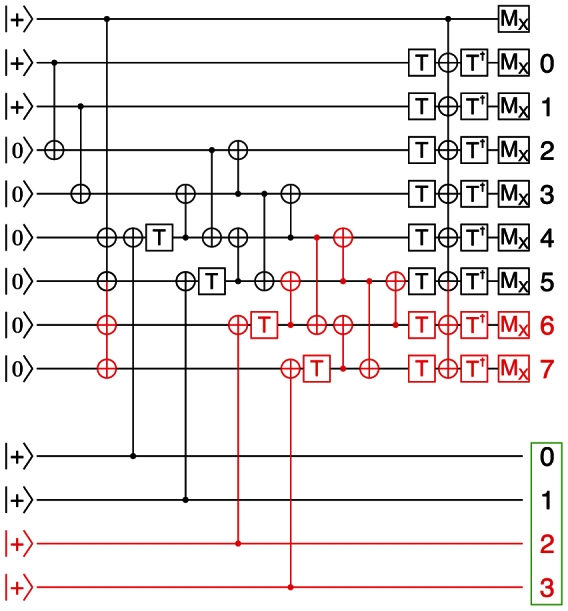
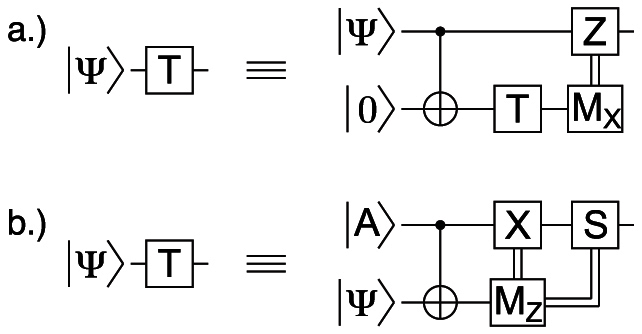
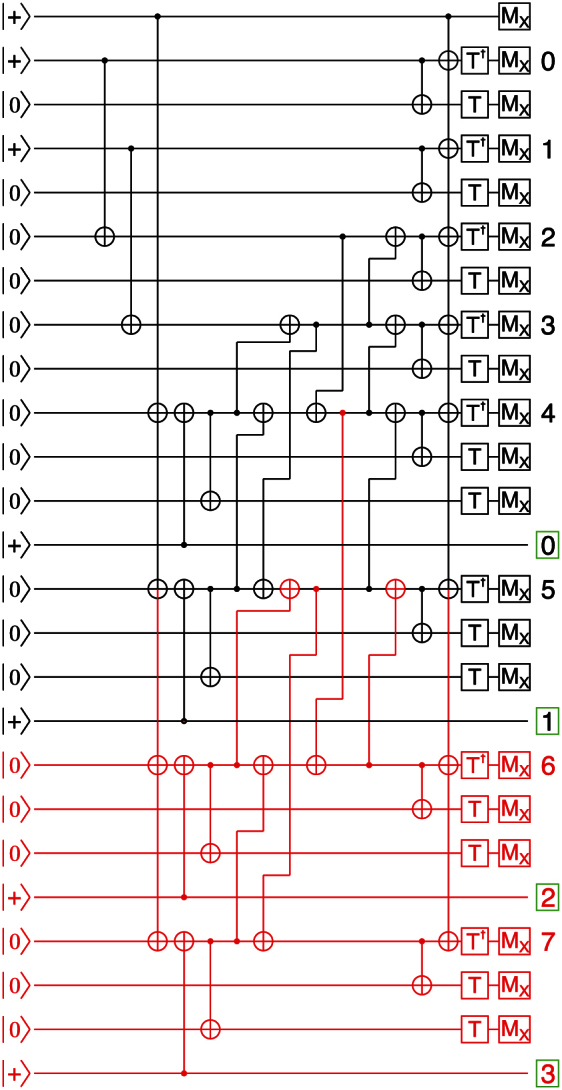
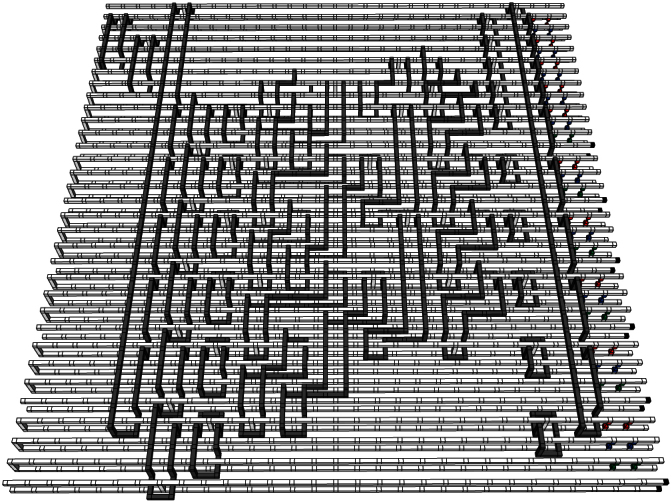
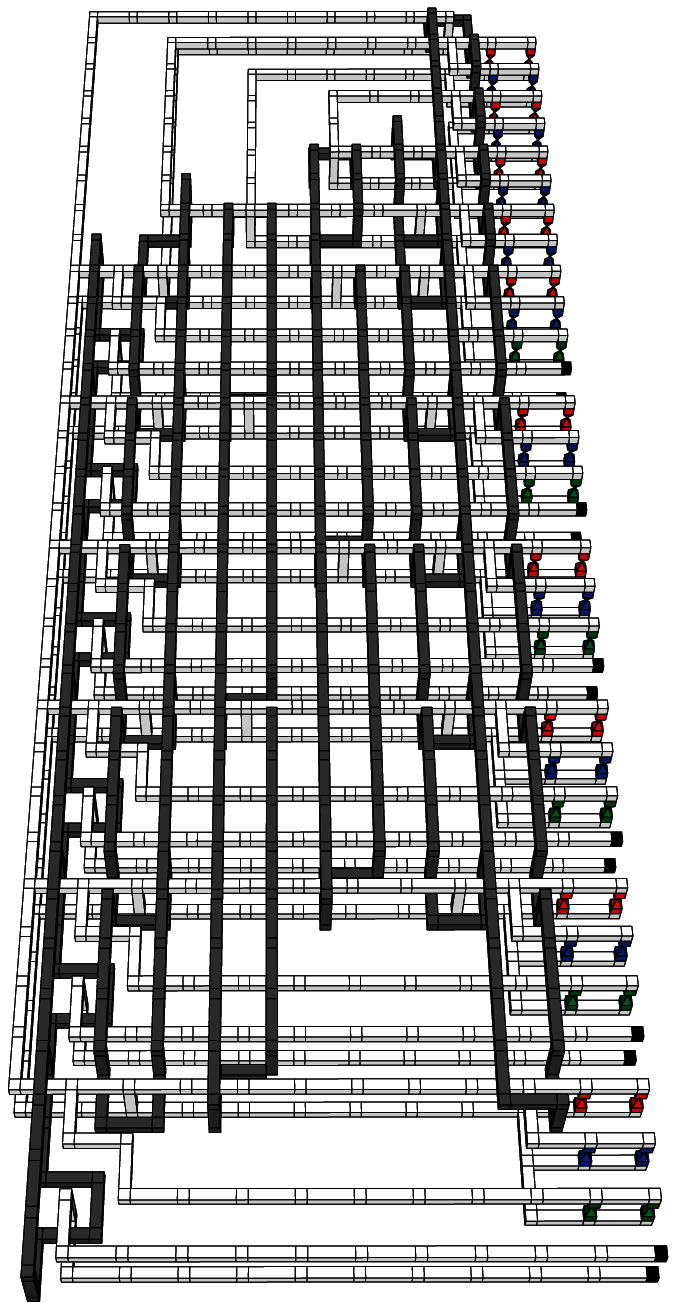
State distillation is the process of taking a number of imperfect copies of a particular quantum state and producing fewer better copies. Until recently, the lowest overhead method of distilling states produced a single improved [formula: see text] state given 15 input copies. New block code state distillation methods can produce k improved [formula: see text] states given 3k + 8 input copies, potentially significantly reducing the overhead associated with state distillation. We construct an explicit surface code implementation of block code state distillation and quantitatively compare the overhead of this approach to the old. We find that, using the best available techniques, for parameters of practical interest, block code state distillation does not always lead to lower overhead, and, when it does, the overhead reduction is typically less than a factor of three.
Overview
The claims and statistics of this paper haven’t been checked yet.
Free: it reads the open-access text and checks the first 5 claims that cite a source we can check. Create a free account to check every claim.
Integrity signals
Registry
Cites
Statistics
Figures
Verification
Claims the paper makes
The claims and statistics of this paper haven’t been checked yet.
Free: it reads the open-access text and checks the first 5 claims that cite a source we can check. Create a free account to check every claim.
Self-check
Percentages, sums and reported differences re-computed from the paper’s own numbers.
The self-check needs the paper’s full text.
Citations
Cites
Scheme for reducing decoherence in quantum computer memory
Shor, P. W. (1995) · Physical Review A · doi:10.1103/physreva.52.r2493 · Cited by 4,479
Surface codes: Towards practical large-scale quantum computation
Fowler, A. G., Mariantoni, M., Martinis, J. M., & Cleland, A. N. (2012) · Physical Review A · doi:10.1103/physreva.86.032324 · Cited by 3,059
Self-citationDennis, E., Kitaev, A., Landahl, A., & Preskill, J. (2002) · Journal of Mathematical Physics · doi:10.1063/1.1499754 · Cited by 1,768
Universal quantum computation with ideal Clifford gates and noisy ancillas
Bravyi, S., & Kitaev, A. (2005) · Physical Review A · doi:10.1103/physreva.71.022316 · Cited by 1,525 · cited 1×
“SCIENTIFIC REPORTS, 3 (1), https://doi.”
Dennis, E., Kitaev, A., Landahl, A., & Preskill, J. (2001) · CERN Document Server (European Organization for Nuclear Research) · Cited by 1,485
Multiple-particle interference and quantum error correction
(1996) · Proceedings of the Royal Society of London. Series A: Mathematical, Physical and Engineering Sciences · doi:10.1098/rspa.1996.0136 · Cited by 1,284
Quantum computing with realistically noisy devices
Knill, E. (2005) · Nature · doi:10.1038/nature03350 · Cited by 1,184
Perfect Quantum Error Correcting Code
Laflamme, R., Miquel, C., Paz, J. P., & Zurek, W. H. (1996) · Physical Review Letters · doi:10.1103/physrevlett.77.198 · Cited by 963
Multiple particle interference and quantum error correction
Steane, A. M. (1996) · Cited by 871
Fault-Tolerant Quantum Computation with High Threshold in Two Dimensions
Raussendorf, R., & Harrington, J. (2007) · Physical Review Letters · doi:10.1103/physrevlett.98.190504 · Cited by 812
Cited by
Items 101–109 of 109
Zulehner, A., & Wille, R. (2020) · Springer eBooks · doi:10.1007/978-3-030-41753-6_1
Zulehner, A., & Wille, R. (2023) · Springer eBooks · doi:10.1007/978-3-031-36751-9_1
Zulehner, A., & Wille, R. (2023) · Springer eBooks · doi:10.1007/978-3-031-36751-9_2
Blueprinting quantum computing systems
Devitt, S. J. (2022) · Journal and proceedings of the Royal Society of New South Wales · doi:10.5962/p.389578
“The details of how these gates actually enact logic operations can be found in several references (Fowler and Devitt 2012; Fowler, Devitt, and Jones 2013).”
BackgroundMethodSelf-citationCosting Adversaries on Quantum-secure Cryptography
Tiepelt, M. (2025) · Repository KITopen (Karlsruhe Institute of Technology) · doi:10.5445/ir/1000178687
Quantum Compilers for Reducing Non-Clifford Gate Counts
Heyfron, L. (2021) · White Rose eTheses Online (University of Leeds, The University of Sheffield, University of York) · Cited by 1
Concrete Quantum Sieve for Shortest Vector Problem With Application to Lattice-Based Cryptography
Kim, H., Jang, K., Baksi, A., Wang, S., Chakraborty, S., Chattopadhyay, A., & Seo, H. (2026) · IEEE Access · doi:10.1109/access.2026.3706759
“By employing Algorithm 3 (from [49], [51]), we obtain three distillation layers with code distances { d 1 , d 2 , d 3 } = { 57 , 22 , 10 } (top to bottom).”
Baradziej, S. (2026) · Frontiers in Computer Science · doi:10.3389/fcomp.2026.1914634
MagicFlow: Breaking the Magic State Bottleneck for Scalable Fault-Tolerant Quantum Computing
Wang, M., & Nair, P. J. (2026) · International Conference on Architectural Support for Programming Languages and Operating Systems (ASPLOS) · doi:10.1145/3845814.3850030
Metadata
- Authors
- Fowler, A. G., Devitt, S. J., & Jones, C.
- Affiliations
- The University of Melbourne (AU)
- National Institute of Informatics (JP)
- Stanford University (US)
- Corresponding author
- Fowler, Austin G.
- Venue
- Scientific Reports
- Published
- 2013-06-05
- Volume
- 3
- Issue
- 1
- Pages
- 1939-1939
- ISSN
- 2045-2322 (ISSN-L)
- PMC
- PMC3672884
- OpenAlex
- W1977033953
- Cited by
- 99
- References
- 36
- Citations by year
- 2026: 5 · 2025: 8 · 2024: 5 · 2023: 5 · 2022: 7 · 2021: 9 · 2020: 10 · 2019: 11 · 2018: 4 · 2017: 11 · 2016: 5 · 2015: 6 · 2014: 6 · 2013: 7
- FWCI
- 8.85
- Type
- journal article
- Language
- en
- Open access
- gold
- doi.org
- Licence
- cc-by-nc-nd
- creativecommons.org/licenses/by-nc-nd/3.0/ (tdm)
- creativecommons.org/licenses/by-nc-nd/3.0/ (vor)
- Locations
- Scientific Reports (publishedVersion, cc-by-nc-nd)
- Europe PMC (PubMed Central) (publishedVersion, cc-by-nc-nd)
- PubMed Central (publishedVersion, cc-by-nc-nd)
- PubMed (publishedVersion)
- arXiv (Cornell University) (submittedVersion)
- Minerva Access (University of Melbourne) (submittedVersion, cc-by-nc-nd)
- arXiv (Cornell University)
- Funders
- National Security Agency (W911NF-08-1-0527)
- Ministry of Education, Culture, Sports, Science and Technology
- Intelligence Advanced Research Projects Activity
- Australian Research Council (CE110001027)
- Japan Society for the Promotion of Science
- Centre of Excellence for Quantum Computation and Communication Technology, Australian Research Council (CE110001027)
- Army Research Office (W911NF-08-1, W911NF-08-1- 0527, W911NF)
- Topics
- Physical Sciences › Computer Science › Artificial Intelligence › Quantum Computing Algorithms and Architecture
- Physical Sciences › Physics and Astronomy › Atomic and Molecular Physics, and Optics › Quantum Information and Cryptography
- Physical Sciences › Physics and Astronomy › Atomic and Molecular Physics, and Optics › Quantum many-body systems
- Keywords
- surface code, quantum error correction, fault-tolerant quantum computing
- MeSH terms
- Computer Simulation, Electrons, Models, Chemical, Quantum Theory, Surface Properties
About these checks
Registry, retraction, Cites and statistics results are computed, not judged, with one exception: a printed reference that no index lists is read once by a model before it counts as a citation error. Claims are extracted by a model and kept only when their quote appears verbatim in the text; each cited source is then checked, with a model’s help, for whether it says what the claim relies on. Those verdicts can be wrong — read the claim’s quote and the cited source before relying on one.
Statistics and arithmetic are recomputed, not judged.
Confidence bands are shown only for fields calibrated on our annotated test set. None is calibrated yet, so no band is shown.
What counts as a claim ›How we measure confidence ›How we check this ›
Are you an author, or do you see a problem with this page? Request a review
Data sources
Bibliographic data: Semantic Scholar, OpenAlex, Crossref.
Contains information from the Semantic Scholar Academic Graph Datasets, made available under the ODC Attribution License (ODC-BY 1.0).
Semantic Scholar’s data is described in: Kinney, R., et al. (2023). The Semantic Scholar Open Data Platform. arXiv:2301.10140.
