

Surface code implementation of block code state distillation
Open accessThe DOI matches its Crossref record; 38 of the 38 references it cites were found in a registry or an index.
Abstract
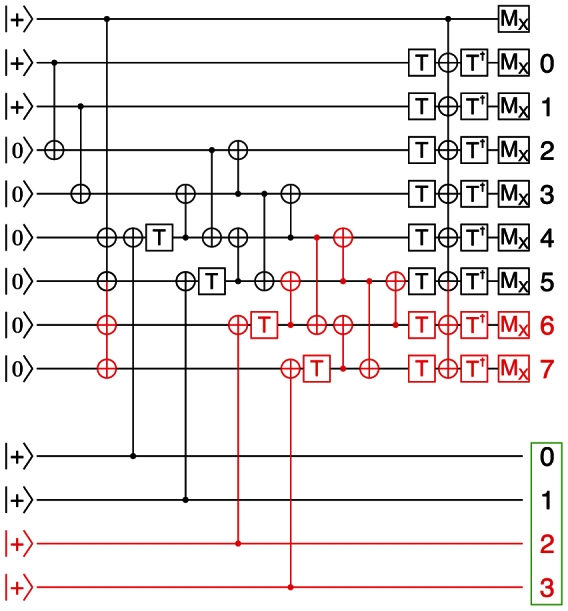
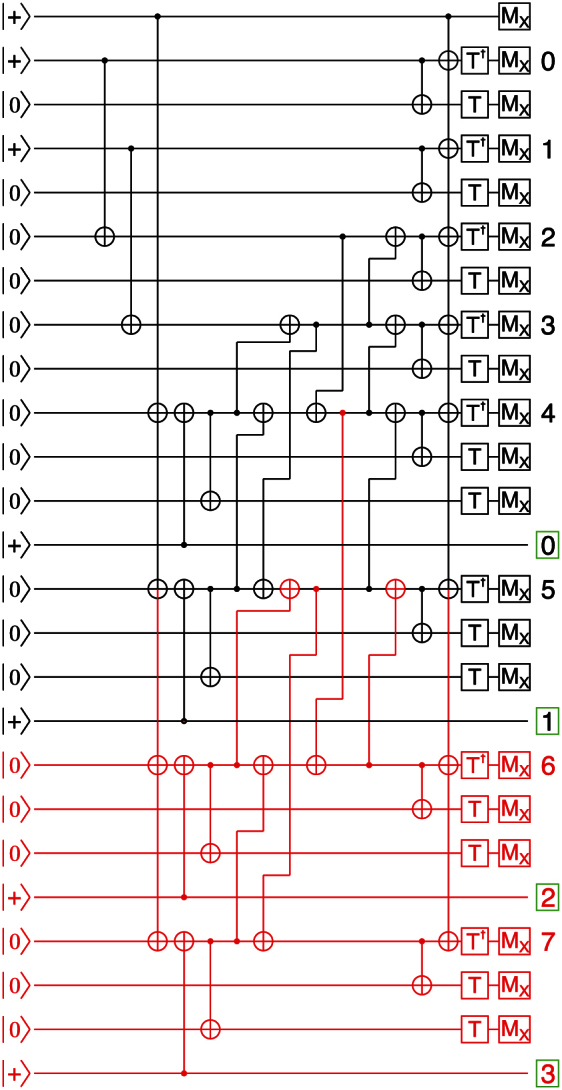
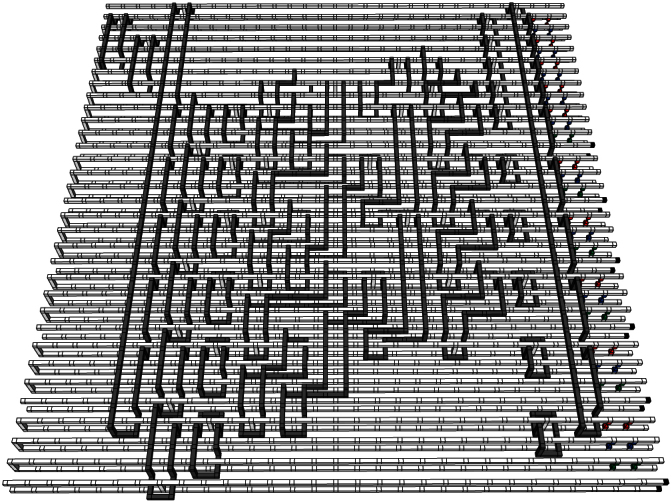
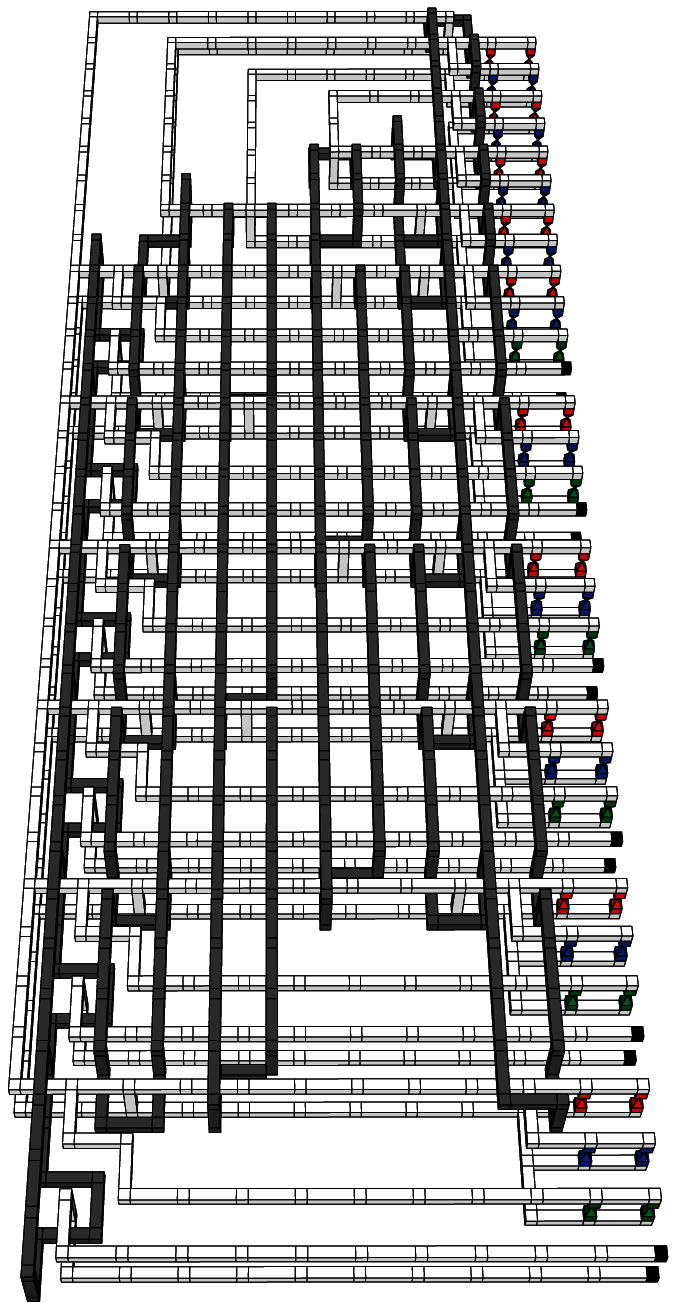
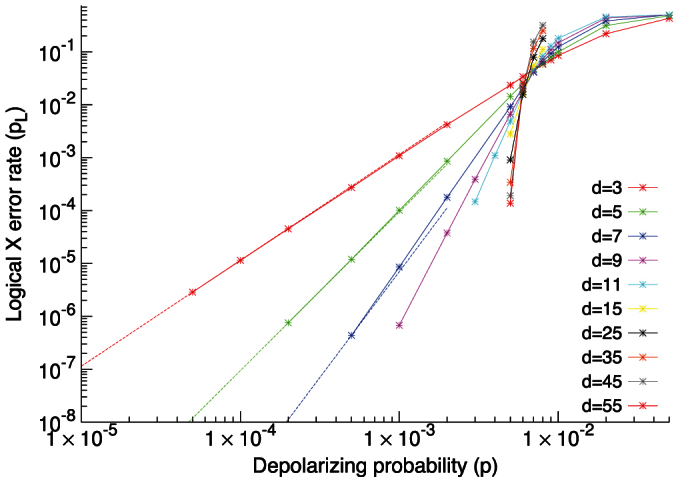
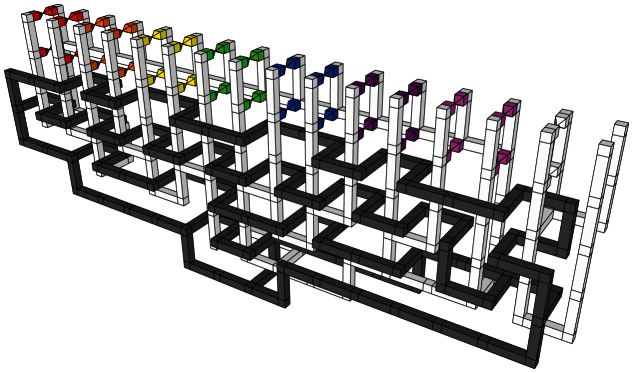
State distillation is the process of taking a number of imperfect copies of a particular quantum state and producing fewer better copies. Until recently, the lowest overhead method of distilling states produced a single improved [formula: see text] state given 15 input copies. New block code state distillation methods can produce k improved [formula: see text] states given 3k + 8 input copies, potentially significantly reducing the overhead associated with state distillation. We construct an explicit surface code implementation of block code state distillation and quantitatively compare the overhead of this approach to the old. We find that, using the best available techniques, for parameters of practical interest, block code state distillation does not always lead to lower overhead, and, when it does, the overhead reduction is typically less than a factor of three.
Overview
The claims and statistics of this paper haven’t been checked yet.
Free: it reads the open-access text and checks the first 5 claims that cite a source we can check. Create a free account to check every claim.
Integrity signals
Registry
Cites
Statistics
Figures
Verification
Claims the paper makes
The claims and statistics of this paper haven’t been checked yet.
Free: it reads the open-access text and checks the first 5 claims that cite a source we can check. Create a free account to check every claim.
Self-check
Percentages, sums and reported differences re-computed from the paper’s own numbers.
The self-check needs the paper’s full text.
Citations
Cites
Scheme for reducing decoherence in quantum computer memory
Shor, P. W. (1995) · Physical Review A · doi:10.1103/physreva.52.r2493 · Cited by 4,479
Surface codes: Towards practical large-scale quantum computation
Fowler, A. G., Mariantoni, M., Martinis, J. M., & Cleland, A. N. (2012) · Physical Review A · doi:10.1103/physreva.86.032324 · Cited by 3,059
Self-citationDennis, E., Kitaev, A., Landahl, A., & Preskill, J. (2002) · Journal of Mathematical Physics · doi:10.1063/1.1499754 · Cited by 1,768
Universal quantum computation with ideal Clifford gates and noisy ancillas
Bravyi, S., & Kitaev, A. (2005) · Physical Review A · doi:10.1103/physreva.71.022316 · Cited by 1,525 · cited 1×
“SCIENTIFIC REPORTS, 3 (1), https://doi.”
Dennis, E., Kitaev, A., Landahl, A., & Preskill, J. (2001) · CERN Document Server (European Organization for Nuclear Research) · Cited by 1,485
Multiple-particle interference and quantum error correction
(1996) · Proceedings of the Royal Society of London. Series A: Mathematical, Physical and Engineering Sciences · doi:10.1098/rspa.1996.0136 · Cited by 1,284
Quantum computing with realistically noisy devices
Knill, E. (2005) · Nature · doi:10.1038/nature03350 · Cited by 1,184
Perfect Quantum Error Correcting Code
Laflamme, R., Miquel, C., Paz, J. P., & Zurek, W. H. (1996) · Physical Review Letters · doi:10.1103/physrevlett.77.198 · Cited by 963
Multiple particle interference and quantum error correction
Steane, A. M. (1996) · Cited by 871
Fault-Tolerant Quantum Computation with High Threshold in Two Dimensions
Raussendorf, R., & Harrington, J. (2007) · Physical Review Letters · doi:10.1103/physrevlett.98.190504 · Cited by 812
Cited by
How to factor 2048 bit RSA integers in 8 hours using 20 million noisy qubits
Gidney, C., & Ekerå, M. (2021) · Quantum · doi:10.22331/q-2021-04-15-433 · Cited by 830
“In [43] it is stated that, for a physical gate error rate of 10−3, the probability of error in a logical qubit of distance d, per surface code cycle, is approximately 10−dd/2+1e.”
BackgroundRoads towards fault-tolerant universal quantum computation
Campbell, E. T., Terhal, B. M., & Vuillot, C. (2017) · Nature · doi:10.1038/nature23460 · Cited by 596
A Game of Surface Codes: Large-Scale Quantum Computing with Lattice Surgery
Litinski, D. (2019) · Quantum · doi:10.22331/q-2019-03-05-128 · Cited by 408
“Hole braiding [19, 35] 70d3 750d3 2344d3 Lattice surgery [36] 140d3 540d3 1134d3 Our framework 28d3 121d3 266d3”
ResultImproved Classical Simulation of Quantum Circuits Dominated by Clifford Gates
Bravyi, S., & Gosset, D. (2016) · Physical Review Letters · doi:10.1103/physrevlett.116.250501 · Cited by 320
Simulation of quantum circuits by low-rank stabilizer decompositions
Bravyi, S., Browne, D., Calpin, P., Campbell, E., Gosset, D., & Howard, M. (2019) · Quantum · doi:10.22331/q-2019-09-02-181 · Cited by 302
“This regime may be important for verification of first fault-tolerant quantum circuits where logical nonClifford gates are expected to be scarce due to their high implementation cost [23, 34].”
BackgroundTrading Classical and Quantum Computational Resources
Bravyi, S., Smith, G., & Smolin, J. A. (2016) · Physical Review X · doi:10.1103/physrevx.6.021043 · Cited by 299
Building a Fault-Tolerant Quantum Computer Using Concatenated Cat Codes
Chamberland, C., Noh, K., Arrangoiz-Arriola, P., Campbell, E. T., Hann, C. T., Iverson, J., Putterman, H., Bohdanowicz, T. C., Flammia, S. T., Keller, A., et al. (2022) · PRX Quantum · doi:10.1103/prxquantum.3.010329 · Cited by 281
Universal Fault-Tolerant Quantum Computation with Only Transversal Gates and Error Correction
Paetznick, A., & Reichardt, B. W. (2013) · Physical Review Letters · doi:10.1103/physrevlett.111.090505 · Cited by 242
Magic State Distillation: Not as Costly as You Think
Litinski, D. (2019) · Quantum · doi:10.22331/q-2019-12-02-205 · Cited by 220
“Many such protocols [8–19] have been developed since magic state distillation was first proposed [6], gradually decreasing the cost of distillation.”
BackgroundErasure conversion for fault-tolerant quantum computing in alkaline earth Rydberg atom arrays
Wu, Y., Kolkowitz, S., Puri, S., & Thompson, J. D. (2022) · Nature Communications · doi:10.1038/s41467-022-32094-6 · Cited by 196
Enhanced Fault-Tolerant Quantum Computing ind-Level Systems
Campbell, E. T. (2014) · Physical Review Letters · doi:10.1103/physrevlett.113.230501 · Cited by 184
Quantum computation with realistic magic-state factories
O'Gorman, J., & Campbell, E. T. (2017) · Physical Review A · doi:10.1103/physreva.95.032338 · Cited by 158
Repeat-Until-Success: Non-deterministic decomposition of single-qubit unitaries
Paetznick, A., & Svore, K. M. (2014) · Quantum Information and Computation · doi:10.26421/qic14.15-16-2 · Cited by 81
Efficient magic state factories with a catalyzed | C C Z ⟩ to 2 | T ⟩ transformation
Gidney, C., & Fowler, A. G. (2019) · Quantum · doi:10.22331/q-2019-04-30-135 · Cited by 152
“Over the past decade, thanks to techniques such as block codes [4, 16], bridge compression [14], and many others [19, 8, 9, 25], the cost of magic state distillation has steadily decreased.”
BackgroundSelf-citationMultilevel distillation of magic states for quantum computing
Jones, C. (2013) · Physical Review A · doi:10.1103/physreva.87.042305 · Cited by 126
Self-citationAn efficient quantum compiler that reduces T count
Heyfron, L. E., & Campbell, E. T. (2018) · Quantum Science and Technology · doi:10.1088/2058-9565/aad604 · Cited by 96
Quantum Computing 40 Years Later
Preskill, J. P. (2023) · CRC Press eBooks · doi:10.1201/9781003358817-7 · Cited by 188
Estimating the Cost of Generic Quantum Pre-image Attacks on SHA-2 and SHA-3
Amy, M., Di Matteo, O., Gheorghiu, V., Mosca, M., Parent, A., & Schanck, J. (2017) · Lecture Notes in Computer Science · doi:10.1007/978-3-319-69453-5_18 · Cited by 128
“As pointed out in [33] logical errors do not need to be fully eliminated.”
BackgroundYoder, T. J., & Kim, I. H. (2017) · Quantum · doi:10.22331/q-2017-04-25-2 · Cited by 98
“Braiding the holes results in logical operations on the encoded qubits [3, 18], and, using the technique of magic-state distillation [19, 20], can achieve universality [21] limited only by T -depth of the circuit [22].”
MethodResource Costs for Fault-Tolerant Linear Optical Quantum Computing
Li, Y., Humphreys, P. C., Mendoza, G. J., & Benjamin, S. C. (2015) · Physical Review X · doi:10.1103/physrevx.5.041007 · Cited by 113
A magic state’s fidelity can be superior to the operations that created it
Li, Y. (2015) · New Journal of Physics · doi:10.1088/1367-2630/17/2/023037 · Cited by 88
Campbell, E. T., & Howard, M. (2017) · Physical Review A · doi:10.1103/physreva.95.022316 · Cited by 91
Fault-tolerant, high-level quantum circuits: form, compilation and description
Paler, A., Polian, I., Nemoto, K., & Devitt, S. J. (2017) · Quantum Science and Technology · doi:10.1088/2058-9565/aa66eb · Cited by 99
“…is measured, rather than how it is constructed (i.e. the actual choice of algorithm only dictates the physical size of the lattice needed at the hardware level, nothing more) [39, 47, 48], with error correction decoding and correction occurring concurrently with algorithmic implementation [49, 50].”
BackgroundMethodInfluentialSelf-citationUniversal Fault-Tolerant Gates on Concatenated Stabilizer Codes
Yoder, T. J., Takagi, R., & Chuang, I. L. (2016) · Physical Review X · doi:10.1103/physrevx.6.031039 · Cited by 73
“Ideally, these magic states would be efficiently constructible themselves, but current so-called distillation procedures actually incur large overheads in terms of time and qubits [7,8].”
BackgroundChamberland, C., & Noh, K. (2020) · npj Quantum Information · doi:10.1038/s41534-020-00319-5 · Cited by 71
“Despite these various proposals, magic state distillation remains a leading candidate in the implementation of a universal fault-tolerant quantum computer [16–25].”
BackgroundResilience of Quantum Random Access Memory to Generic Noise
Hann, C. T., Lee, G., Girvin, S. M., & Jiang, L. (2021) · PRX Quantum · doi:10.1103/prxquantum.2.020311 · Cited by 123
Litinski, D., Kesselring, M. S., Eisert, J., & von Oppen, F. (2017) · Physical Review X · doi:10.1103/physrevx.7.031048 · Cited by 89
“Many such algorithms exists, such as a 15-to-1 protocol [30], a 10-to-2 protocol [67], or, more generally for an integer k, a 3kþ 8-to-k protocol [68,69].”
Fold-transversal surface code cultivation
Sahay, K., Tsai, P.-K., Chang, K., Su, Q. D., Smith, T. B., Singh, S., & Puri, S. (2026) · PRX Quantum · doi:10.1103/gpvl-lg4c · Cited by 90
“A major bottleneck for scalable quantum computation with the surface code is the cost to implement fault-tolerant non-Clifford operations [5].”
The impact of hardware specifications on reaching quantum advantage in the fault tolerant regime
Webber, M., Elfving, V., Weidt, S., & Hensinger, W. K. (2022) · AVS Quantum Science · doi:10.1116/5.0073075 · Cited by 40
“To create a sufficiently high quality magic state, a distillation protocol [55,56] can be used which essentially involves converting multiple low fidelity states into fewer higher fidelity states.”
MethodUnifying Gate Synthesis and Magic State Distillation
Campbell, E. T., & Howard, M. (2017) · Physical Review Letters · doi:10.1103/physrevlett.118.060501 · Cited by 53
Techniques to Reduce π/4-Parity-Phase Circuits, Motivated by the ZX Calculus
de Beaudrap, N., Bian, X., & Wang, Q. (2020) · Electronic Proceedings in Theoretical Computer Science · doi:10.4204/eptcs.318.9 · Cited by 60
Resilience of Quantum Random Access Memory to Generic Noise
Hann, C. T., Lee, G., Girvin, S. M., & Jiang, L. (2021) · University of Chicago · doi:10.6082/027wm-z2x67 · Cited by 57
LDPC-cat codes for low-overhead quantum computing in 2D
Ruiz, D., Guillaud, J., Leverrier, A., Mirrahimi, M., & Vuillot, C. (2025) · Nature Communications · doi:10.1038/s41467-025-56298-8 · Cited by 90
“For ϵ = 10 − 3 , a logical error rate ϵ L = 10 − 8 is achieved for a code distance d = 13.”
Error rates and resource overheads of repetition cat qubits
Guillaud, J., & Mirrahimi, M. (2021) · Physical Review A · doi:10.1103/physreva.103.042413 · Cited by 55
Brady, A. J., Eickbusch, A., Singh, S., Wu, J., & Zhuang, Q. (2024) · Progress in Quantum Electronics · doi:10.1016/j.pquantelec.2023.100496 · Cited by 91
T-Count Optimization and Reed–Muller Codes
Amy, M., & Mosca, M. (2019) · IEEE Transactions on Information Theory · doi:10.1109/tit.2019.2906374 · Cited by 49
“original T -par majority recursive Grover5 [34]3 9 140 52 52 52 Mod 54 [33] 5 28 16 16 16 VBE-Adder3 [35] 10 70 24 24 24 CSLA-MUX3 [36] 15 70 62 62 58 CSUM-MUX9 [36] 30 196 140 84 76 QCLA-Com7 [37] 24 203 95 94 153 QCLA-Mod7 [37] 26 413 249 238 299 QCLA-Adder10 [37] 36 238 162 – 188 Adder8 [38] 24 399 215 213 249 RC-A…”
Time-optimal quantum computation
Fowler, A. G. (2012) · arXiv · doi:10.48550/arxiv.1210.4626 · Cited by 45
Self-citationError Mitigation and Quantum-Assisted Simulation in the Error Corrected Regime
Lostaglio, M., & Ciani, A. (2021) · Physical Review Letters · doi:10.1103/physrevlett.127.200506 · Cited by 35
Real-time processing of stabilizer measurements in a bit-flip code
Ristè, D., Govia, L. C. G., Donovan, B., Fallek, S. D., Kalfus, W. D., Brink, M., Bronn, N. T., & Ohki, T. (2020) · npj Quantum Information · doi:10.1038/s41534-020-00304-y · Cited by 47
An efficient magic state approach to small angle rotations
Campbell, E. T., & O’Gorman, J. (2016) · Quantum Science and Technology · doi:10.1088/2058-9565/1/1/015007 · Cited by 38
Ding, Y., Holmes, A., Javadi-Abhari, A., Franklin, D., Martonosi, M., & Chong, F. T. (2018) · IEEE/ACM International Symposium on Microarchitecture (MICRO) · doi:10.1109/micro.2018.00072 · Cited by 55
“5: Example implementation [19, 29] of a single-level Bravyi-Haah distillation circuit generating K = 8 output magic states, in Scaffold language [30].”
BackgroundMethodInfluentialLimitations on transversal computation through quantum homomorphic encryption
Newman, M., & Shi, Y. (2018) · Quantum Information and Computation · doi:10.26421/qic18.11-12-3 · Cited by 48
Decoder for the Triangular Color Code by Matching on a Möbius Strip
Sahay, K., & Brown, B. J. (2022) · PRX Quantum · doi:10.1103/prxquantum.3.010310 · Cited by 38
“We compare the decoder performance at low p values to the ansatz [78] By fitting to the data collected, we get β = 0 .”
MethodGauge color codes in two dimensions
Jones, C., Brooks, P., & Harrington, J. (2016) · Physical Review A · doi:10.1103/physreva.93.052332 · Cited by 33
“Moreover, since all operations are local, the order of a triangular code can be increased arbitrarily in constant time, which is essentially the same process as defect movement in topological codes [6, 8, 9, 20].”
BackgroundSelf-citationFault-Tolerant Postselection for Low-Overhead Magic State Preparation
Bombín, H., Pant, M., Roberts, S., & Seetharam, K. (2024) · PRX Quantum · doi:10.1103/prxquantum.5.010302 · Cited by 67
Lattice surgery translation for quantum computation
Herr, D., Nori, F., & Devitt, S. J. (2017) · New Journal of Physics · doi:10.1088/1367-2630/aa5709 · Cited by 35
Self-citationA Fault-Tolerant Million Qubit-Scale Distributed Quantum Computer
Kim, J., Min, D., Cho, J., Jeong, H., Byun, I., Choi, J., Hong, J., & Kim, J. (2024) · International Conference on Architectural Support for Programming Languages and Operating Systems (ASPLOS) · doi:10.1145/3620665.3640388 · Cited by 45
Quantum circuit optimization by topological compaction in the surface codePreprint
Paetznick, A., & Fowler, A. G. (2013) · arXiv (Cornell University) · doi:10.48550/arxiv.1304.2807 · Cited by 30
“Recently there have been a number of proposals for improving the efficiency of distillation [MEK13, BH12, Jon12, FD12, FDJ13].”
BackgroundSelf-citationTranspiler-Architecture Co-Design to Curb Clifford Costs in Fault-Tolerant Quantum Computing
Wang, M., Liu, C., Stein, S., Ding, Y., Das, P., Nair, P. J., & Li, A. (2026) · Proceedings - International Symposium on Computer Architecture/Proceedings · doi:10.1109/isca66397.2026.00072 · Cited by 31
“Various distillation protocols have been proposed to prepare high-fidelity magic states using Reed-Muller code [13], [37], block codes [12], [28], [44], and recent optimizations [20], [32], [34], [52].”
Bravyi, S., & Cross, A. (2015) · arXiv · doi:10.48550/arxiv.1509.03239 · Cited by 27
“This large overhead stems from the state distillation subroutines which may require a thousand or more physical qubits to realize just a single logical T -gate [7, 8].”
BackgroundComposite Toffoli gate with two-round error detection
Jones, C. (2013) · Physical Review A · doi:10.1103/physreva.87.052334 · Cited by 32
Self-citationQuantum resource estimation for large scale quantum algorithms
Gheorghiu, V., & Mosca, M. (2024) · Future Generation Computer Systems · doi:10.1016/j.future.2024.107480 · Cited by 30
High-fidelity magic-state preparation with a biased-noise architecture
Singh, S., Darmawan, A. S., Brown, B. J., & Puri, S. (2022) · Physical Review A · doi:10.1103/physreva.105.052410 · Cited by 34
“Even with these considerable efforts, it remains that MSD is expected to occupy a large fraction of the resources of a SC architecture and it therefore presents a bottleneck in realizing quantum algorithms [19].”
BackgroundDistillation protocols for Fourier states in quantum computing
Jones, C. (2014) · Quantum Information and Computation · doi:10.26421/qic14.7-8-2 · Cited by 25
“Given that the cost of either T or Toffoli is much greater than a Clifford gate or ancilla qubit (by about two orders of magnitude [7,9]), there is considerable evidence that phase kickback is the current lowest-overhead construction for a fault-tolerant phase rotation.”
BackgroundSelf-citationUniversal limitations on implementing resourceful unitary evolutions
Takagi, R., & Tajima, H. (2020) · Physical Review A · doi:10.1103/physreva.101.022315 · Cited by 22
“[90] A.”
BackgroundLogic Synthesis for Fault-Tolerant Quantum ComputersPreprint
Jones, N. C. (2013) · arXiv (Cornell University) · doi:10.48550/arxiv.1310.7290 · Cited by 24
“e qubit is called an \injected state," because it was teleported into the code using faulty methods [14, 56, 57, 60, 95]. The error probability is a sum of error rates in the hardware. Reference [100] estimates an injection error that is 10 times the gate error probability p g, so the injected state could have er…”
BackgroundMethodInfluentialColor code decoder with improved scaling for correcting circuit-level noise
Lee, S.-H., Li, A., & Bartlett, S. D. (2025) · Quantum · doi:10.22331/q-2025-01-27-1609 · Cited by 16
Compilation of a simple chemistry application to quantum error correction primitives
Blunt, N. S., Gehér, G. P., & Moylett, A. E. (2024) · Physical Review Research · doi:10.1103/physrevresearch.6.013325 · Cited by 21
“In the case of the surface code, the probability of a logical error on a single logical qubit per code cycle assuming a depolarising noise model can be estimated as where p is the physical error probability [10, 12, 54].”
BackgroundSpatially parallel decoding for multi-qubit lattice surgery
Lin, S. F., Peterson, E., Sankar, K., & Sivarajah, P. (2025) · Quantum Science and Technology · doi:10.1088/2058-9565/adc6b6 · Cited by 24
“The logical error rate per cycle is roughly proportional to (100 p ) ( d +1) / 2 [16].”
BackgroundCode switching revisited: Low-overhead magic state preparation using color codes
Daguerre, L., & Kim, I. H. (2025) · Physical Review Research · doi:10.1103/physrevresearch.7.023080 · Cited by 38
Holmes, A. A., Ding, Y., Javadi-Abhari, A., Franklin, D. M., Martonosi, M., & Chong, F. T. (2019) · Microprocessors and Microsystems · doi:10.1016/j.micpro.2019.02.007 · Cited by 22
“In these cases, clearly squaring the input error rate will not achieve the required logical error rate to execute the program.”
BackgroundMethodInfluentialLSQCA: Resource-Efficient Load/Store Architecture for Limited-Scale Fault-Tolerant Quantum Computing
Kobori, T., Suzuki, Y., Ueno, Y., Tanimoto, T., Todo, S., & Tokunaga, Y. (2025) · IEEE International Symposium on High-Performance Computer Architecture (HPCA) · doi:10.1109/hpca61900.2025.00033 · Cited by 27
“Thus, the magic-state generation would be one of the dominant bottleneck factors in resource-restricted FTQC [15], [16], [27], [47].”
Step-by-step magic state encoding for efficient fault-tolerant quantum computation
Goto, H. (2014) · Scientific Reports · doi:10.1038/srep07501 · Cited by 26
Efficient Simulation of Logical Magic State Preparation Protocols
Surti, S., Daguerre, L., & Kim, I. H. (2026) · PRX Quantum · doi:10.1103/fby6-xjbm · Cited by 26
“12 and 13].”
Fault-tolerant conversion between adjacent Reed–Muller quantum codes based on gauge fixing
Quan, D.-X., Zhu, L.-L., Pei, C.-X., & Sanders, B. C. (2018) · Journal of Physics A Mathematical and Theoretical · doi:10.1088/1751-8121/aaad13 · Cited by 15
Low Overhead Qutrit Magic State Distillation
Prakash, S., & Saha, T. (2025) · Quantum · doi:10.22331/q-2025-06-12-1768 · Cited by 16
“We find that the [17 , 1 , 2] 3 code obtained from our construction when m = 2 and k = 1 has the highest depolarizing noise threshold, δ ∗ = 0 .”
Integrated Analysis of Performance and Resources in Large-Scale Quantum Computing
Hwang, Y., Kim, T., Baek, C., & Choi, B.-S. (2020) · Physical Review Applied · doi:10.1103/physrevapplied.13.054033 · Cited by 10
Programming quantum computers using 3-D puzzles, coffee cups, and doughnuts
Devitt, S. J. (2016) · XRDS Crossroads The ACM Magazine for Students · doi:10.1145/2983545 · Cited by 14
Self-citationWeakly fault-tolerant computation in a quantum error-detecting code
Gerhard, C., & Brun, T. A. (2026) · Physical Review A · doi:10.1103/7pv5-46nd · Cited by 9
“New meth-ods have been introduced in the past few years to reduce the cost of this procedure [10–13], but magic state distillation still considerably magnifies the size of the logical versions of quantum circuits.”
Magic state distillation and cost analysis in fault-tolerant universal quantum computation
Liu, Y., Ma, Z., Luo, L., Du, C., Fei, Y., Wang, H., Duan, Q., & Yang, J. (2023) · Quantum Science and Technology · doi:10.1088/2058-9565/ace6ca · Cited by 11
“This circuit can be rearranged into a more practical implementation based on surface codes [68].”
BackgroundMethodInfluentialDual-code quantum computation model
Choi, B.-S. (2015) · Quantum Information Processing · doi:10.1007/s11128-015-1022-0 · Cited by 12
“Fortunately, since the distillation performance is relatively good (e.g., f e → 35 f e 3 , where f e is the initial infidelity of the magic state at the lower level [19]), we only need one distillation at one level.”
BackgroundPaler, A. (2019) · arXiv (Cornell University) · doi:10.48550/arxiv.1902.02417 · Cited by 13
“After Clifford+T optimisation established as a research topic per se, some works started discussing the cost of protecting various distillation procedures by the surface code (e.g. [14]).”
Decoherence-Protected Implementation of Quantum Gates
Wu, C., Sun, C., Chen, J., & Yi, X. X. (2023) · Physical Review Applied · doi:10.1103/physrevapplied.19.034069 · Cited by 8
Quantum Toffoli gate in hybrid optomechanical system
Peng, L., Zhang, Y., Cheng, J., & Zhang, W.-Z. (2022) · Results in Physics · doi:10.1016/j.rinp.2022.105338 · Cited by 7
Blind Quantum Computation Using a Circuit-Based Quantum Computer
Sano, Y. (2021) · Journal of the Physical Society of Japan · doi:10.7566/jpsj.90.124001 · Cited by 7
“However, it is known that the H gates and the CNOT gates can implement error correction codes in a transversal manner (without spreading errors) [27,28].”
BackgroundResource optimization for fault-tolerant quantum computingPreprint
Paetznick, A. (2014) · arXiv (Cornell University) · doi:10.48550/arxiv.1410.5124 · Cited by 8
Charm: A Language for Closed-Form High-Level Architecture Modeling
Cui, W., Ding, Y., Dangwal, D., Holmes, A. A., McMahan, J., Javadi-Abhari, A., Tzimpragos, G., Chong, F. T., & Sherwood, T. (2018) · Proceedings - International Symposium on Computer Architecture/Proceedings · doi:10.1109/isca.2018.00023 · Cited by 6
Concatenated pieceable fault-tolerant scheme for universal quantum computation
Lin, C., & Yang, G. (2020) · Physical Review A · doi:10.1103/physreva.102.052415 · Cited by 8
Transversal switching between generic stabilizer codesPreprint
Huang, C., & Newman, M. (2017) · arXiv (Cornell University) · doi:10.48550/arxiv.1709.09282 · Cited by 5
New Results in Quantum Analysis of LED: Featuring One and Two Oracle Attacks
Wang, S., Jang, K., Baksi, A., Chakraborty, S., Lee, B., Chattopadhyay, A., & Seo, H. (2025) · Lecture notes in computer science · doi:10.1007/978-3-032-13301-4_15 · Cited by 4
On Forging SPHINCS$$^{+}$$-Haraka Signatures on a Fault-Tolerant Quantum Computer
Berger, R., & Tiepelt, M. (2021) · Lecture notes in computer science · doi:10.1007/978-3-030-88238-9_3 · Cited by 4
“For this, [12, Sec.”
BackgroundPost-quantum Digital Signature Scheme for Personal Data Security in Communication Network Systems
Iavich, M., Iashvili, G., Bocu, R., & Gnatyuk, S. (2021) · Advances in intelligent systems and computing · doi:10.1007/978-3-030-67133-4_28 · Cited by 1
An Evaluation of Computational Complexity of Shor’s Algorithm on Surface Codes for Factorization
Oonishi, K., & Kunihiro, N. (2026) · IEEE Access · doi:10.1109/access.2026.3665887 · Cited by 3
“In comparison to the aforementioned evaluation method, our study employs a model that integrates three evaluation methods [9], [19], [22] to conduct a comprehensive complexity evaluation.”
InfluentialUniversal fault-tolerant quantum computation using fault-tolerant conversion schemes
Luo, L., & Ma, Z. (2019) · New Journal of Physics · doi:10.1088/1367-2630/ab3378 · Cited by 3
Towards fault-tolerant quantum computation with higher-dimensional systems
Anwar, H. (2014) · UCL Discovery (University College London) · Cited by 8
Analysis of an Atom-Optical Architecture for Quantum Computation
Devitt, S. J., Stephens, A. M., Munro, W. J., & Nemoto, K. (2015) · Lecture notes in physics · doi:10.1007/978-4-431-55756-2_19 · Cited by 2
Self-citationOrchestrating multi-level magic state distillation: a dynamic pipeline architecturePreprint
Wang, J., & Murali, P. (2025) · arXiv (Cornell University) · doi:10.48550/arxiv.2509.24402 · Cited by 2
“Universal quantum computation on logical qubits requires both Clifford and non-Clifford gates [31], but typical QEC codes natively support only Clifford gates [24].”
InfluentialLow Spatial Cost CCZ Magic State FactoryPreprint
Kook, S., Kang, Y., Sohn, I., & Heo, J. (2026) · arXiv (Cornell University) · doi:10.48550/arxiv.2606.24170 · Cited by 2
“Including the input magic state contribution, the first stage CCZ output error is The first stage T state block is based on the [[15 , 1 , 3]] magic state distillation protocol [2, 5].”
InfluentialKim, J., Cho, J., Jeong, H., Min, D., Choi, J., Hong, J., & Kim, J. (2025) · IEEE/ACM International Symposium on Microarchitecture (MICRO) · doi:10.1145/3725843.3756026 · Cited by 1
“Note that this projection method is widely-used in various FTQC studies [24, 25, 27, 43].”
Can Quantum Break ZUC? Only with a Million Qubits and a Billion Years to Spare
Bhaumik, A., Dutta, S., Jang, K., Baksi, A., Wang, S., Saha, A., Seo, H., & Chattopadhyay, A. (2026) · Lecture notes in computer science · doi:10.1007/978-981-95-8034-7_16 · Cited by 1
“Fowler et al. [17] provides a framework for estimating the number of distillation rounds required to achieve a target output error rate, along with the minimum code distances necessary at each stage.”
Lin, C., Yang, G., & Wu, J. (2020) · IEEE International Conference on Artificial Intelligence and Computer Applications (ICAICA) · doi:10.1109/icaica50127.2020.9182439 · Cited by 1
“However, for most fault-tolerant schemes, additional resources are always required to provide universal quantum computation [10,11].”
BackgroundZulehner, A., & Wille, R. (2020) · Springer eBooks · doi:10.1007/978-3-030-41753-6_2 · Cited by 1
Compact Circuits for Constrained Quantum Evolutions of Sparse OperatorsPreprint
Fuchs, F. G., & Bassa, R. P. (2025) · arXiv (Cornell University) · doi:10.48550/arxiv.2504.09133 · Cited by 1
“On a fault-tolerant quantum device using the surface code performing a logical CX gate is much faster ( µs ) than magic state distillation ( ms ) in most practical scenarios [6, 14].”
Accurate resource estimation for quantum computation
Devitt, S. J., Stephens, A. M., Munro, W. J., & Nemoto, K. (2013) · Conference on Lasers and Electro-Optics Pacific Rim (CLEO-PR) · doi:10.1109/cleopr.2013.6600225
Self-citationAccurate modeling of noise in quantum error correcting circuits
Arguedas, M. G. (2015) · SMARTech Repository (Georgia Institute of Technology) · Cited by 1
Classical processing for topological quantum error correction
Whiteside, A. C. (2017) · Minerva Access (University of Melbourne) · Cited by 1
Visualization and Interaction System for Hologram-Like
Kim, J., & Jo, D. (2020) · International Conference on Information and Communication Technology Convergence (ICTC) · doi:10.1109/ictc49870.2020.9289324
“In the public, as in [7], quantum circuit visualization is performed in consideration of the arrangement between qubits and gates when constructing a quantum circuit, but the quantum circuit is visualized in different ways depending on the purpose to be visualized so that desired information can be better obtained .[1…”
MethodClassical Computation in the Quantum World
Huang, J. (2019) · Deep Blue (University of Michigan)
Lin, C., Yang, G., & Song, X. (2021) · arXiv (Cornell University)
Fault-tolerant fidelity based on few-qubit codes: parity-check circuits for biased error operators
Jiao, D., & Li, Y. (2022) · Quantum Information and Computation · doi:10.26421/qic22.5-6-3
Metadata
- Authors
- Fowler, A. G., Devitt, S. J., & Jones, C.
- Affiliations
- The University of Melbourne (AU)
- National Institute of Informatics (JP)
- Stanford University (US)
- Corresponding author
- Fowler, Austin G.
- Venue
- Scientific Reports
- Published
- 2013-06-05
- Volume
- 3
- Issue
- 1
- Pages
- 1939-1939
- ISSN
- 2045-2322 (ISSN-L)
- PMC
- PMC3672884
- OpenAlex
- W1977033953
- Cited by
- 99
- References
- 36
- Citations by year
- 2026: 5 · 2025: 8 · 2024: 5 · 2023: 5 · 2022: 7 · 2021: 9 · 2020: 10 · 2019: 11 · 2018: 4 · 2017: 11 · 2016: 5 · 2015: 6 · 2014: 6 · 2013: 7
- FWCI
- 8.85
- Type
- journal article
- Language
- en
- Open access
- gold
- doi.org
- Licence
- cc-by-nc-nd
- creativecommons.org/licenses/by-nc-nd/3.0/ (tdm)
- creativecommons.org/licenses/by-nc-nd/3.0/ (vor)
- Locations
- Scientific Reports (publishedVersion, cc-by-nc-nd)
- Europe PMC (PubMed Central) (publishedVersion, cc-by-nc-nd)
- PubMed Central (publishedVersion, cc-by-nc-nd)
- PubMed (publishedVersion)
- arXiv (Cornell University) (submittedVersion)
- Minerva Access (University of Melbourne) (submittedVersion, cc-by-nc-nd)
- arXiv (Cornell University)
- Funders
- National Security Agency (W911NF-08-1-0527)
- Ministry of Education, Culture, Sports, Science and Technology
- Intelligence Advanced Research Projects Activity
- Australian Research Council (CE110001027)
- Japan Society for the Promotion of Science
- Centre of Excellence for Quantum Computation and Communication Technology, Australian Research Council (CE110001027)
- Army Research Office (W911NF-08-1, W911NF-08-1- 0527, W911NF)
- Topics
- Physical Sciences › Computer Science › Artificial Intelligence › Quantum Computing Algorithms and Architecture
- Physical Sciences › Physics and Astronomy › Atomic and Molecular Physics, and Optics › Quantum Information and Cryptography
- Physical Sciences › Physics and Astronomy › Atomic and Molecular Physics, and Optics › Quantum many-body systems
- Keywords
- surface code, quantum error correction, fault-tolerant quantum computing
- MeSH terms
- Computer Simulation, Electrons, Models, Chemical, Quantum Theory, Surface Properties
About these checks
Registry, retraction, Cites and statistics results are computed, not judged, with one exception: a printed reference that no index lists is read once by a model before it counts as a citation error. Claims are extracted by a model and kept only when their quote appears verbatim in the text; each cited source is then checked, with a model’s help, for whether it says what the claim relies on. Those verdicts can be wrong — read the claim’s quote and the cited source before relying on one.
Statistics and arithmetic are recomputed, not judged.
Confidence bands are shown only for fields calibrated on our annotated test set. None is calibrated yet, so no band is shown.
What counts as a claim ›How we measure confidence ›How we check this ›
Are you an author, or do you see a problem with this page? Request a review
Data sources
Bibliographic data: Semantic Scholar, OpenAlex, Crossref.
Contains information from the Semantic Scholar Academic Graph Datasets, made available under the ODC Attribution License (ODC-BY 1.0).
Semantic Scholar’s data is described in: Kinney, R., et al. (2023). The Semantic Scholar Open Data Platform. arXiv:2301.10140.
