

Quantum Transport Enhancement by Time-Reversal Symmetry Breaking
Open accessThe DOI matches its Crossref record; 34 of the 34 references it cites were found in a registry or an index.
Abstract
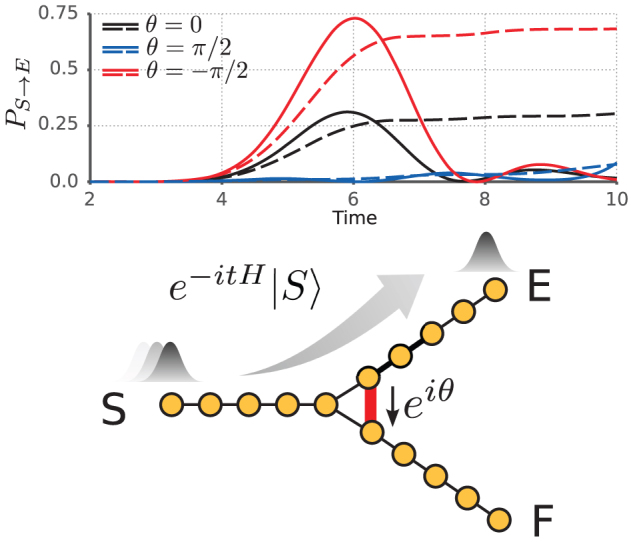
Quantum mechanics still provides new unexpected effects when considering the transport of energy and information. Models of continuous time quantum walks, which implicitly use time-reversal symmetric Hamiltonians, have been intensely used to investigate the effectiveness of transport. Here we show how breaking time-reversal symmetry of the unitary dynamics in this model can enable directional control, enhancement and suppression of quantum transport. Examples ranging from exciton transport to complex networks are presented. This opens new prospects for more efficient methods to transport energy and information.
Overview
The claims and statistics of this paper haven’t been checked yet.
Free: it reads the open-access text and checks the first 5 claims that cite a source we can check. Create a free account to check every claim.
Integrity signals
Registry
Cites
Statistics
Figures
Verification
Claims the paper makes
The claims and statistics of this paper haven’t been checked yet.
Free: it reads the open-access text and checks the first 5 claims that cite a source we can check. Create a free account to check every claim.
Claims other papers make about this one
Each is checked against this paper’s own text: does it say what the citing paper says it does?
The cited source doesn’t support the claim as written.
In the citing paper
“In the scenarios where the addition of complex phases affects transfer probabilities, the underlying system breaks timereversal symmetry and, consequently, the probability fl ow into the quantum system is biased.”
From Complex networks from classical to quantum (2019) · cites this paper as [65]
Checked by a reasoning model — may be wrong.
Experimental — accuracy not yet measuredThe cited source says what the claim attributes to it.
In the citing paper
“many works have compared properties of stochastic 68,69 and quantum random walks 63 -65 on complex networks 70 .”
From Complex networks from classical to quantum (2019) · cites this paper as [65]
The cited source says what the claim attributes to it.
In the citing paper
“Transport suppression is indeed possible however 65 .”
From Complex networks from classical to quantum (2019) · cites this paper as [65]
The cited source says what the claim attributes to it.
In the citing paper
“These results point to a subtle interplay between the topology of the underlying graph, giving rise to a new challenge for dynamical control of probability transfer when considering walks on complex networks 12,65,71,72 .”
From Complex networks from classical to quantum (2019) · cites this paper as [65]
The cited source says what the claim attributes to it.
In the citing paper
“These complex phases in many cases do not affect transfer probabilities: the theory explaining this fi nding was developed in refs. 12,65 , without relying on approximations or averaging.”
From Complex networks from classical to quantum (2019) · cites this paper as [65]
2 more claims about this paper
Create a free account to see every claim other papers make about this one.
Self-check
Percentages, sums and reported differences re-computed from the paper’s own numbers.
The self-check needs the paper’s full text.
Citations
Cites
Collective dynamics of ‘small-world’ networks
Watts, D. J., & Strogatz, S. H. (1998) · Nature · doi:10.1038/30918 · Cited by 43,060
Emergence of Scaling in Random Networks
Barabási, A.-L., & Albert, R. (1999) · Science · doi:10.1126/science.286.5439.509 · Cited by 36,135
Colloquium : Topological insulators
Hasan, M. Z., & Kane, C. L. (2010) · Reviews of Modern Physics · doi:10.1103/revmodphys.82.3045 · Cited by 19,930
On the generators of quantum dynamical semigroups
Lindblad, G. (1976) · Communications in Mathematical Physics · doi:10.1007/bf01608499 · Cited by 7,548
Energy levels and wave functions of Bloch electrons in rational and irrational magnetic fields
Hofstadter, D. R. (1976) · Physical Review B · doi:10.1103/physrevb.14.2239 · Cited by 3,495
Quantum Transport: Atom to Transistor
Datta, S. (2005) · Cambridge University Press eBooks · doi:10.1017/cbo9781139164313 · Cited by 3,227
On the evolution of random graphs
Erdös, P., & Rényi, A. (2011) · The Structure and Dynamics of Networks · doi:10.1515/9781400841356.38 · Cited by 1,757
Quantum random walks: An introductory overview
Kempe, J. (2003) · Contemporary Physics · doi:10.1080/00107151031000110776 · Cited by 1,413 · cited 2×
“In the standard literature on continuous time quantum walks [1, 2, 3, 4, 5], the time-independent walk Hamiltonian is defined by a real weighted adjacency matr ix J of an underlying undirected graph, HQW = sites”
BackgroundZur Theorie des Diamagnetismus von Leitungselektronen
Peierls, R. (1933) · Zeitschrift f�r Physik · doi:10.1007/bf01342591 · Cited by 1,380
Quantum computation and decision trees
Farhi, E., & Gutmann, S. (1998) · Physical Review A · doi:10.1103/physreva.58.915 · Cited by 1,215
Research works printed but not linked: 3
- Eisfeld A. Phase directed excitonic transport and its limitations due to environmental influence. J. Chem. Phys. 379, 33 (2011).
- Sarma S. D. & Pinczuk A. Perspectives in Quantum Hall Effects (Wiley-VCH, 2004).
- Dalibard J., Gerbier, F., Juzeliunas, G. & Öhberg, P. Topological Insulators. Rev. Mod. Phys. 82(4), 3045 (2011).
Cited by
Complex networks from classical to quantum
Biamonte, J., Faccin, M., & De Domenico, M. (2019) · Communications Physics · doi:10.1038/s42005-019-0152-6 · Cited by 149
Self-citationQuantum Simulation of Helium Hydride Cation in a Solid-State Spin Register
Wang, Y., Dolde, F., Biamonte, J., Babbush, R., Bergholm, V., Yang, S., Jakobi, I., Neumann, P., Aspuru-Guzik, A., Whitfield, J. D., et al. (2015) · ACS Nano · doi:10.1021/acsnano.5b01651 · Cited by 152
Self-citationSymmetry and the thermodynamics of currents in open quantum systems
Manzano, D., & Hurtado, P. I. (2014) · Physical Review B · doi:10.1103/physrevb.90.125138 · Cited by 80
Topologically protected excitons in porphyrin thin films
Yuen-Zhou, J., Saikin, S. K., Yao, N. Y., & Aspuru-Guzik, A. (2014) · Nature Materials · doi:10.1038/nmat4073 · Cited by 67
“Furthermore, connections between this work and theories of TRS breaking in quantum transport remain to be explored [53, 54].”
BackgroundHarnessing symmetry to control quantum transport
Manzano, D., & Hurtado, P. I. (2018) · Advances In Physics · doi:10.1080/00018732.2018.1519981 · Cited by 81
“Moreover, symmetries have been recently shown to constraint strongly the reduced density matrix associated to nonequilibrium steady states in open quantum systems [108], while violations of time-reversal symmetry lead to an enhancement of quantum transport in continuous-time quantum walks [109].”
Background
Metadata
- Authors
- Zimborás, Z., Faccin, M., Kádár, Z., Whitfield, J. D., Lanyon, B. P., & Biamonte, J.
- Affiliations
- Institute for Scientific Interchange (IT)
- Institute for Quantum Optics and Quantum Information Innsbruck (AT)
- Centre for Quantum Technologies (SG)
- Corresponding author
- Biamonte, Jacob
- Venue
- Scientific Reports
- Published
- 2013-08-06
- Volume
- 3
- Issue
- 1
- Pages
- 2361-2361
- ISSN
- 2045-2322 (ISSN-L)
- PMC
- PMC3734483
- OpenAlex
- W2122945217
- Cited by
- 64
- References
- 28
- Citations by year
- 2026: 4 · 2025: 7 · 2024: 5 · 2023: 8 · 2022: 5 · 2021: 5 · 2020: 2 · 2019: 4 · 2018: 4 · 2017: 4 · 2016: 5 · 2015: 5 · 2014: 4 · 2013: 2
- FWCI
- 5.89
- Type
- journal article
- Language
- en
- Open access
- gold
- doi.org
- Licence
- cc-by
- creativecommons.org/licenses/by/3.0/ (tdm)
- creativecommons.org/licenses/by/3.0/ (vor)
- Locations
- Scientific Reports (publishedVersion, cc-by)
- Europe PMC (PubMed Central) (publishedVersion, cc-by)
- PubMed Central (publishedVersion, cc-by)
- PubMed (publishedVersion)
- arXiv (Cornell University) (submittedVersion)
- National University of Singapore (submittedVersion)
- Phaidra (Universität Wien) (submittedVersion, cc-by-nc-nd)
- arXiv (Cornell University)
- Funders
- European Commission
- Engineering and Physical Sciences Research Council (EP/I038683/1)
- Topics
- Physical Sciences › Computer Science › Artificial Intelligence › Quantum Computing Algorithms and Architecture
- Physical Sciences › Physics and Astronomy › Condensed Matter Physics › Quantum and electron transport phenomena
- Physical Sciences › Physics and Astronomy › Atomic and Molecular Physics, and Optics › Quantum Mechanics and Applications
- Keywords
- time-reversal symmetry breaking, quantum transport, continuous-time quantum walks, transport enhancement, transport suppression, exciton transport, complex networks, unitary dynamics
- MeSH terms
- Algorithms, Computer Simulation, Energy Transfer, Models, Theoretical, Quantum Theory, Thermodynamics
About these checks
Registry, retraction, Cites and statistics results are computed, not judged, with one exception: a printed reference that no index lists is read once by a model before it counts as a citation error. Claims are extracted by a model and kept only when their quote appears verbatim in the text; each cited source is then checked, with a model’s help, for whether it says what the claim relies on. Those verdicts can be wrong — read the claim’s quote and the cited source before relying on one.
Statistics and arithmetic are recomputed, not judged.
Confidence bands are shown only for fields calibrated on our annotated test set. None is calibrated yet, so no band is shown.
What counts as a claim ›How we measure confidence ›How we check this ›
Are you an author, or do you see a problem with this page? Request a review
How to cite
Cite CoChat for the checks on this page, and the paper for its own findings.
- This page
- CoChat. (2026). Citation check: Quantum Transport Enhancement by Time-Reversal Symmetry Breaking. https://app.cochat.ai/papers/10.1038/srep02361
- The paper
- Zimborás, Z., Faccin, M., Kádár, Z., Whitfield, J. D., Lanyon, B. P., & Biamonte, J. (2013). Quantum Transport Enhancement by Time-Reversal Symmetry Breaking. Scientific Reports. https://doi.org/10.1038/srep02361
Data sources
Bibliographic data: Semantic Scholar, OpenAlex, Crossref.
Contains information from the Semantic Scholar Academic Graph Datasets, made available under the ODC Attribution License (ODC-BY 1.0).
Semantic Scholar’s data is described in: Kinney, R., et al. (2023). The Semantic Scholar Open Data Platform. arXiv:2301.10140.
