

Two-component Dirac-like Hamiltonian for generating quantum walk on one-, two- and three-dimensional lattices
Open accessThe DOI matches its Crossref record; 49 of the 49 references it cites were found in a registry or an index; none of the 1 sources its claims cite is checked for support yet.
Abstract
From the unitary operator used for implementing two-state discrete-time quantum walk on one-, two- and three- dimensional lattice we obtain a two-component Dirac-like Hamiltonian. In particular, using different pairs of Pauli basis as position translation states we obtain three different form of Hamiltonians for evolution on one-dimensional lattice. We extend this to two- and three-dimensional lattices using different Pauli basis states as position translation states for each dimension and show that the external coin operation, which is necessary for one-dimensional walk is not a necessary requirement for a walk on higher dimensions but can serve as an additional resource to control the dynamics. The two-component Hamiltonian we present here for quantum walk on different lattices can serve as a general framework to simulate, control, and study the dynamics of quantum systems governed by Dirac-like Hamiltonian.
Overview
CoChat Summary
TL;DR
Starting from the unitary operator for a two-state discrete-time quantum walk, the paper derives effective two-component Dirac-like Hamiltonians for walks on one-, two-, and three-dimensional lattices using different Pauli basis states as position translation states. The Hamiltonian is structurally Dirac-like for orthogonal-axis lattices (line, square, cubic), while triangular and kagome lattices produce second-order derivative terms that deviate from the Dirac-like form.
Key findings
- For 1D walks, using basis states of Pauli operators σx, σy, and σz as position translation states gives three different effective Hamiltonians whose differential forms are analogous to the two-component Dirac Hamiltonian, with mass equivalent terms m = sin(θ), m = −sin(θ), and m = sin(θ), and velocity equivalent c = 1; at θ = 0 all reduce to the massless Dirac Hamiltonian.
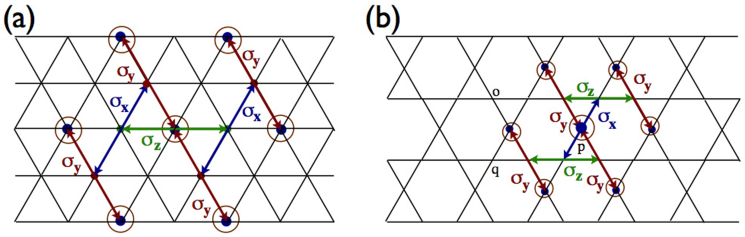
- The scheme extends to 2D square, triangular, kagome, and 3D cubic lattices by using different Pauli basis states as position translation states for each dimension. Square and cubic lattice Hamiltonians are structurally identical to the two-component Dirac Hamiltonian, while triangular and kagome lattice Hamiltonians contain second-order derivative terms and are not structurally Dirac-like due to non-orthogonal spatial axes.
- The external coin operation required for 1D walks is not necessary for 2D and 3D walks using Pauli basis states, but can serve as an additional control resource; an inherent coin effect of θ = π/4 appears when shifting between Pauli basis pairs. A 50-step square-lattice walk with θ = 0 gives a probability distribution identical to the Grover walk, while θ = π/12 squeezes the distribution toward the diagonal; 40-step triangular-lattice distributions for initial |↓⟩ and |↑⟩ are asymmetric but symmetric to each other, and an external coin along one quantization axis alters the distribution significantly.
Methods
- Theoretical/analytical derivation: each discrete-time quantum walk step is defined as a coin operation followed by a shift operator; the effective Hamiltonian is obtained by taking the logarithm of the unitary step operator, then converting to differential operator form in a unit spatial incremental setting using central-difference approximations and ignoring higher-order terms.
- For 2D and 3D lattices, evolution is composed along different axes using different Pauli basis states as position translation states; Hamiltonians are derived for square, cubic, triangular, and kagome lattices, with rotational invariance used to bring matrices into Pauli form where possible.
- Numerical probability distributions are reported for a 50-step square-lattice walk and a 40-step triangular-lattice walk; no experimental sample or empirical data are used.
Limitations
- Stated: the Dirac-like structural identity holds when the evolution axes are orthogonal (line, square, cubic); on the triangular lattice the Hamiltonian contains a second-order differential term deviating from the Dirac-like structure, and kagome lattice evolution depends on site-specific quantization axes.
- Stated: the derivation uses a unit spatial incremental setting and ignores higher-order terms in the expansion.
- Evident: the work is theoretical with numerical probability distributions only; no experimental implementation or empirical validation is reported, and numerical results are limited to specific step counts, initial states, and coin parameters.
Model-written summary. Check it against the paper before relying on it.
Integrity signals
Registry
Cites
Statistics
Figures



Verification
Claims the paper makes
0 Valid · 2 Not valid · 1 Not checked · 37 Own results and interpretations
A result the paper states — it cites no source for it, so there is none to check. The quote shows it is in the paper.
In the paper
“When the coin operation parameter θ = 0, all the three forms of Hamiltonian obtained for DQW evolution will be identical to the two-component Dirac Hamiltonian for the massless particle.”
§ Two-component Dirac-like Hamiltonian for generating quantum walk on one-, two- and three-dimensional lattices > Results > Hamiltonian for generating one-dimensional DQW
plain- Asserted: passes — The authors put it forward as true.
- Checkable: passes — It can be checked against evidence.
- Load-bearing: passes — The paper’s conclusions depend on it.
- Based: passes — The paper gives a reason why it holds.
A result the paper states — it cites no source for it, so there is none to check. The quote shows it is in the paper.
In the paper
“but from the 2D evolution operator we obtain an Hamiltonian which resembles the massless Dirac Hamiltonian even for non-zero value of θ.”
§ Two-component Dirac-like Hamiltonian for generating quantum walk on one-, two- and three-dimensional lattices > Results > The Hamiltonian for a walk on two- and three-dimensional lattice
plain- Asserted: passes — The authors put it forward as true.
- Checkable: passes — It can be checked against evidence.
- Load-bearing: passes — The paper’s conclusions depend on it.
- Based: passes — The paper gives a reason why it holds.
A result the paper reports from its own data — it cites no other source for it, so there is none to check. The quote shows it is in the paper.
In the paper
“However, the Hamiltonian with the second order differential operators can be effectively used to describes the two-state quantum walk on triangular lattice.”
- Also stated in: § Discussion · plain
“On triangular lattice we showed that and Hamiltonian contains a second order deferential term deviating from the Dirac-like structure.”
§ Two-component Dirac-like Hamiltonian for generating quantum walk on one-, two- and three-dimensional lattices > Results > The Hamiltonian for a walk on two- and three-dimensional lattice
plain- Asserted: passes — The authors put it forward as true.
- Checkable: passes — It can be checked against evidence.
- Load-bearing: passes — The paper’s conclusions depend on it.
- Based: passes — The paper gives a reason why it holds.
- Also stated in: § Discussion · plain
A result the paper states — it cites no source for it, so there is none to check. The quote shows it is in the paper.
In the paper
“The Hamiltonian given by Eq. (10) is identical to the two-component Dirac Hamiltonian, the mass equivalent term, m = sin(θ) and c = 1.”
§ Two-component Dirac-like Hamiltonian for generating quantum walk on one-, two- and three-dimensional lattices > Results > Hamiltonian for generating one-dimensional DQW
plainstates an association- Asserted: passes — The authors put it forward as true.
- Checkable: passes — It can be checked against evidence.
- Load-bearing: passes — The paper’s conclusions depend on it.
- Based: passes — The paper gives a reason why it holds.
A result the paper states — it cites no source for it, so there is none to check. The quote shows it is in the paper.
In the paper
“The Hamiltonian given by Eq. (17) is identical to the two-component Dirac Hamiltonian, with the mass equivalent term, m = −sin(θ) and the velocity equivalent term, c = 1.”
§ Two-component Dirac-like Hamiltonian for generating quantum walk on one-, two- and three-dimensional lattices > Results > Hamiltonian for generating one-dimensional DQW
plainstates an association- Asserted: passes — The authors put it forward as true.
- Checkable: passes — It can be checked against evidence.
- Load-bearing: passes — The paper’s conclusions depend on it.
- Based: passes — The paper gives a reason why it holds.
27 more claims
Create a free account to see all 40 claims and to verify the 1 reference still open.
- The quote only partly states this claim. 1
- It may state two separate claims as one. 5
- Probably not a substantial claim. 3
Claims other papers make about this one
Each is checked against this paper’s own text: does it say what the citing paper says it does?
The cited source says what the claim attributes to it.
In the citing paper
“In order to recover the DE for a non-zero mass particle from the QW evolution operator, the evolution was taken into continuum limit and the coordinate was changed to null coordinate48. DH for a non-zero mass particle was also recovered by taking each step evolution operators to continuous form and by introducing a rotation 47.”
From Dirac Cellular Automaton from Split-step Quantum Walk (2016) · cites this paper as [47]
Citations
Cites
Evidence for wavelike energy transfer through quantum coherence in photosynthetic systems
Engel, G. S., Calhoun, T. R., Read, E. L., Ahn, T.-K., Mančal, T., Cheng, Y.-C., Blankenship, R. E., & Fleming, G. R. (2007) · Nature · doi:10.1038/nature05678 · Cited by 3,315
Feynman, R. P. (1986) · Foundations of Physics · doi:10.1007/bf01886518 · Cited by 1,770
Aharonov, Y., Davidovich, L., & Zagury, N. (1993) · Physical Review A · doi:10.1103/physreva.48.1687 · Cited by 1,622
Quantum random walks: An introductory overview
Kempe, J. (2003) · Contemporary Physics · doi:10.1080/00107151031000110776 · Cited by 1,413
Environment-assisted quantum walks in photosynthetic energy transfer
Mohseni, M., Rebentrost, P., Lloyd, S., & Aspuru-Guzik, A. (2008) · The Journal of Chemical Physics · doi:10.1063/1.3002335 · Cited by 1,189
Controlling Spin Exchange Interactions of Ultracold Atoms in Optical Lattices
Duan, L.-M., Demler, E., & Lukin, M. D. (2003) · Physical Review Letters · doi:10.1103/physrevlett.91.090402 · Cited by 1,170
Quantum random-walk search algorithm
Shenvi, N., Kempe, J., & Whaley, K. B. (2003) · Physical Review A · doi:10.1103/physreva.67.052307 · Cited by 1,150
Quantum random walks - an introductory overview
Kempe, J., & Einstein, A. (2003) · Cited by 1,035
Quantum Walks of Correlated Photons
Peruzzo, A., Lobino, M., Matthews, J. C. F., Matsuda, N., Politi, A., Poulios, K., Zhou, X.-Q., Lahini, Y., Ismail, N., Wörhoff, K., et al. (2010) · Science · doi:10.1126/science.1193515 · Cited by 929
Exponential algorithmic speedup by a quantum walk
Childs, A. M., Cleve, R., Deotto, E., Farhi, E., Gutmann, S., & Spielman, D. A. (2003) · Proceedings of the thirty-fifth annual ACM symposium on Theory of computing · doi:10.1145/780542.780552 · Cited by 825
Research works printed but not linked: 1
- Lindsay J. M. & Parthasarathy K. R. The passage from random walk to diffusion in quantum probability II. Sankhyā: The Indian Journal of Statistics, Series A 50, 151– 170 (1988).
Cited by
Quantum walks as simulators of neutrino oscillations in a vacuum and matter
Molfetta, G. D., & Pérez, A. (2016) · New Journal of Physics · doi:10.1088/1367-2630/18/10/103038 · Cited by 70
Quantum walks and discrete gauge theories
Arnault, P., & Debbasch, F. (2016) · Physical Review A · doi:10.1103/physreva.93.052301 · Cited by 69
Entangling power of disordered quantum walks
Vieira, R., Amorim, E. P. M., & Rigolin, G. (2014) · Physical Review A · doi:10.1103/physreva.89.042307 · Cited by 59
Dynamic-disorder-induced enhancement of entanglement in photonic quantum walks
Wang, Q.-Q., Xu, X.-Y., Pan, W.-W., Sun, K., Xu, J.-S., Chen, G., Han, Y.-J., Li, C.-F., & Guo, G.-C. (2018) · Optica · doi:10.1364/optica.5.001136 · Cited by 50
Quantum walks and Dirac cellular automata on a programmable trapped-ion quantum computer
Huerta Alderete, C., Singh, S., Nguyen, N. H., Zhu, D., Balu, R., Monroe, C., Chandrashekar, C. M., & Linke, N. M. (2020) · Nature Communications · doi:10.1038/s41467-020-17519-4 · Cited by 48
Self-citation
Metadata
- Authors
- Chandrashekar, C. M.
- Affiliations
- Okinawa Institute of Science and Technology Graduate University (JP)
- Corresponding author
- Chandrashekar, C. M.
- ORCID
- Chandrashekar, C. M.
- Venue
- Scientific Reports
- Published
- 2013-10-03
- Volume
- 3
- Issue
- 1
- Pages
- 2829-2829
- ISSN
- 2045-2322 (ISSN-L)
- PMC
- PMC3789158
- OpenAlex
- W2084622437
- Semantic Scholar
- a6c8b78e7a933397a2ba17b2ea17ed472c2625a7
- Cited by
- 64
- References
- 48
- Citations by year
- 2025: 5 · 2024: 5 · 2023: 1 · 2021: 9 · 2020: 9 · 2019: 10 · 2018: 7 · 2017: 6 · 2016: 6 · 2015: 3 · 2014: 3
- FWCI
- 4.42
- Type
- journal article
- Language
- en
- Open access
- gold
- doi.org
- Licence
- cc-by-nc-sa
- creativecommons.org/licenses/by-nc-sa/3.0/ (tdm)
- creativecommons.org/licenses/by-nc-sa/3.0/ (vor)
- Locations
- Scientific Reports (publishedVersion, cc-by-nc-sa)
- arXiv (Cornell University) (publishedVersion)
- Europe PMC (PubMed Central) (publishedVersion, cc-by-nc-sa)
- PubMed Central (publishedVersion, cc-by-nc-sa)
- PubMed (publishedVersion)
- arXiv (Cornell University)
- Topics
- Physical Sciences › Computer Science › Artificial Intelligence › Quantum Computing Algorithms and Architecture
- Physical Sciences › Physics and Astronomy › Atomic and Molecular Physics, and Optics › Quantum Mechanics and Applications
- Physical Sciences › Physics and Astronomy › Atomic and Molecular Physics, and Optics › Quantum Information and Cryptography
- Keywords
- discrete-time quantum walks, one-dimensional lattice, two-dimensional lattice, three-dimensional lattice
About these checks
Registry, retraction, Cites and statistics results are computed, not judged, with one exception: a printed reference that no index lists is read once by a model before it counts as a citation error. Claims are extracted by a model and kept only when their quote appears verbatim in the text; each cited source is then checked, with a model’s help, for whether it says what the claim relies on. Those verdicts can be wrong — read the claim’s quote and the cited source before relying on one.
A language model drew the claims from the paper on 2026-10-07, under version 3 of the claim definition (model deepseek-v4.1-flash, prompt extract-v3).
A second model labelled each claim on 2026-10-07 (model jev-1.13-20260917, definition revision gold-guideline-v0.2).
Statistics and arithmetic are recomputed, not judged.
Confidence bands are shown only for fields calibrated on our annotated test set. None is calibrated yet, so no band is shown.
What counts as a claim ›How we measure confidence ›How we check this ›
Are you an author, or do you see a problem with this page? Request a review
How to cite
Cite CoChat for the checks on this page, and the paper for its own findings.
- This page
- CoChat. (2026). Citation check: Two-component Dirac-like Hamiltonian for generating quantum walk on one-, two- and three-dimensional lattices. https://app.cochat.ai/papers/10.1038/srep02829
- The paper
- Chandrashekar, C. M. (2013). Two-component Dirac-like Hamiltonian for generating quantum walk on one-, two- and three-dimensional lattices. Scientific Reports. https://doi.org/10.1038/srep02829
Data sources
Bibliographic data: Semantic Scholar, OpenAlex, Crossref.
Contains information from the Semantic Scholar Academic Graph Datasets, made available under the ODC Attribution License (ODC-BY 1.0).
Semantic Scholar’s data is described in: Kinney, R., et al. (2023). The Semantic Scholar Open Data Platform. arXiv:2301.10140.
