

The DOI matches its Crossref record; 52 of the 53 references it cites were found in a registry or an index; 6 of the 11 sources its claims cite were checked for support.
Dirac Cellular Automaton from Split-step Quantum Walk
Open accessAbstract
Simulations of one quantum system by an other has an implication in realization of quantum machine that can imitate any quantum system and solve problems that are not accessible to classical computers. One of the approach to engineer quantum simulations is to discretize the space-time degree of freedom in quantum dynamics and define the quantum cellular automata (QCA), a local unitary update rule on a lattice. Different models of QCA are constructed using set of conditions which are not unique and are not always in implementable configuration on any other system. Dirac Cellular Automata (DCA) is one such model constructed for Dirac Hamiltonian (DH) in free quantum field theory. Here, starting from a split-step discrete-time quantum walk (QW) which is uniquely defined for experimental implementation, we recover the DCA along with all the fine oscillations in position space and bridge the missing connection between DH-DCA-QW. We will present the contribution of the parameters resulting in the fine oscillations on the Zitterbewegung frequency and entanglement. The tuneability of the evolution parameters demonstrated in experimental implementation of QW will establish it as an efficient tool to design quantum simulator and approach quantum field theory from principles of quantum information theory.
Overview
CoChat Summary
## TL;DR
The paper shows that a one-dimensional split-step discrete-time quantum walk can exactly recover the Dirac cellular automaton, and from that the one-dimensional Dirac Hamiltonian, without invoking extra invariance assumptions. It also derives how the split-step parameters control fine oscillations, Zitterbewegung frequency, and entanglement.
## Key findings
- The authors state that choosing the split-step coin parameters \(\theta_1 = \phi_1 = \delta_1 = \delta_2 = 0\) recovers the Dirac cellular automaton (DCA) form from the split-step quantum walk.
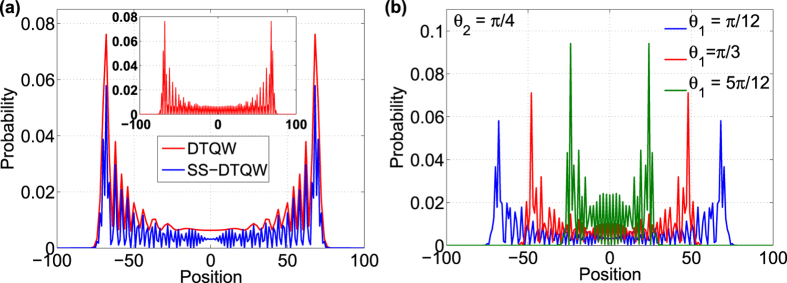
- For the DCA-equivalent configuration, they report that the walk reproduces non-zero probability amplitude at all positions within \(x=\pm na\), including the fine oscillations absent in conventional quantum walk.
- In the small-mass, small-momentum limit, the recovered Hamiltonian reduces to the one-dimensional Dirac Hamiltonian; they identify the effective mass in the general split-step walk as \(|\theta_1+\theta_2|\), and for the DCA case as \(\theta_2\) when \(\theta_1=0\).
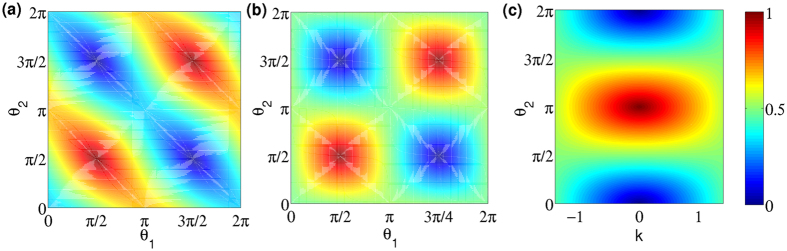
- For Zitterbewegung, they report that the oscillation frequency can be controlled by the split-step parameters; in Fig. 2, the maximum and minimum oscillation frequency occur for non-zero \(\theta_1\), and for the DCA configuration (\(\theta_1=0\)) the frequency varies with \(k\) and \(\theta_2\).
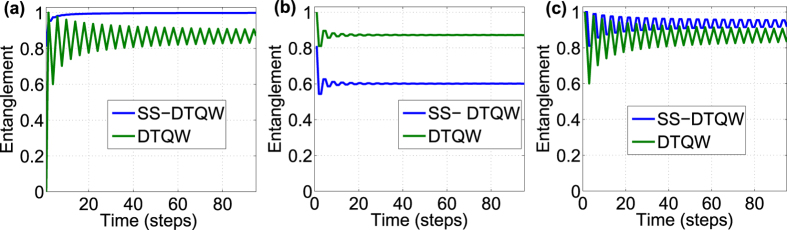
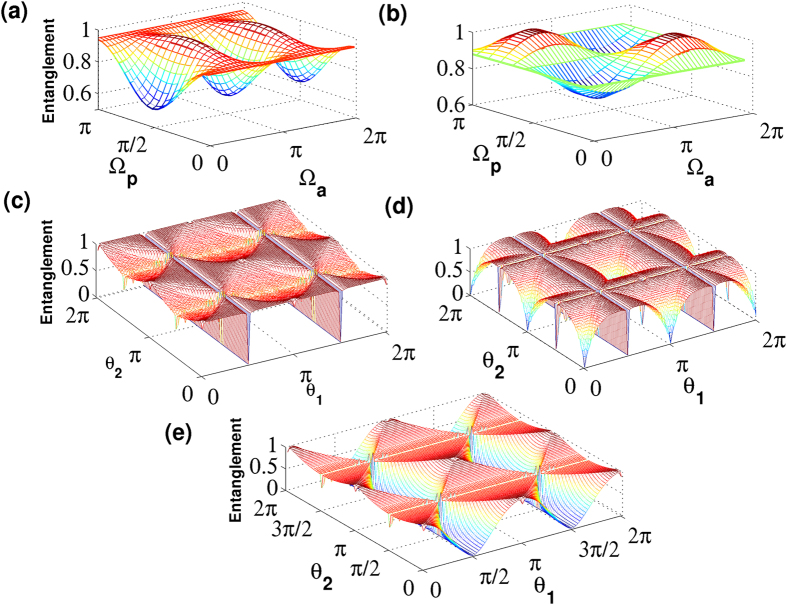
- For entanglement between position and coin space, they report that conventional QW shows roughly the same mean entanglement for three initial states, while split-step QW reaches maximum entanglement value 1 and shows a wider range of maximum/minimum values.
## Methods
- One-dimensional split-step discrete-time quantum walk with two coin operations and two half-shifts was analyzed analytically, and the authors chose coin parameters to match the operator form of the DCA.
- The paper derives the effective Hamiltonian by diagonalizing the split-step walk operator in momentum basis and then taking the small-\(k\), small-mass limit to recover the Dirac Hamiltonian.
- Zitterbewegung frequency was derived from the time-dependent phase between the two energy eigenstates of the split-step walk, and entanglement was computed using the reduced density matrix of the coin space after tracing out position space.
## Limitations
- The paper does not report a new experimental implementation; the results are analytical and illustrated with time-iterated plots from the walk operators.
- The text itself makes evident that some derivations depend on specific parameter choices and approximations, especially the small-mass and small-momentum limit for recovering the Dirac Hamiltonian.
- The paper states that the DCA recovery is obtained for a specific parameter choice; it does not claim that every split-step quantum walk configuration yields the DCA.
Model-written summary. Check it against the paper before relying on it.
Integrity signals
Registry
Cites
Statistics
Figures
Verification
Claims the paper makes
5 Valid · 3 Not valid · 5 Not checked · 33 Own results and interpretations
Every source the paper cites for this claim was checked and supports it.
In the paper
“For a very larger wavelength compared to Planck length ≈1.6162 × 10⁻³⁵ m and for a mass very much lesser than the Planck mass ≈2.1765 × 10⁻⁸ kg, the associated Hamiltonian with this unitary operator in momentum basis, produces Dirac Hamiltonian.”
§ Dirac Cellular Automaton from Split-step Quantum Walk > Dirac Cellular Automaton
What the sources say
- Supportedcites [11] Bisio, A., D’Ariano, G. M. & Tosini, A. Quantum field as a quantum cellular automaton: The Dirac free evolution in one dimension Annals of Physics 354, 244–264 (2015). source
Section 2.2 derives the automaton’s Hamiltonian in momentum space. Section 3 states that, for small momentum and mass, the leading term of that Hamiltonian is the Dirac Hamiltonian; it also identifies m = 1 with the Planck mass. The paper assumes a lattice spacing of one Planck length (Introduction), so small momentum corresponds to wavelengths much larger than that length. (LLM, conf=0.92)
plainstates a cause- Asserted: passes — The authors put it forward as true.
- Checkable: passes — It can be checked against evidence.
- Load-bearing: passes — The paper’s conclusions depend on it.
- Based: passes — The paper gives a reason why it holds.
- Supported
Every source the paper cites for this claim was checked and supports it.
In the paper
“Split-step QW which was first introduced to simulate various topological phases53, and this will establish the split-step QW as a generalization of conventional QW.”
§ Dirac Cellular Automaton from Split-step Quantum Walk > Results > DCA from Split-Step QW
What the sources say
- Supportedcites [53] Kitagawa, T., Rudner, M. S., Berg, E. & Demler, E. Exploring topological phases with quantum walks. Phys. Rev. A 82, 033429 (2010). source
In “Topological Phases in 1D” (p. 3), the paper says it constructs the split-step walk from the conventional DTQW by separating its spin-dependent translations and adding a spin rotation. That supports describing the split-step walk as a generalization of the conventional walk. (LLM, conf=0.93)
boostedstates a cause- Asserted: passes — The authors put it forward as true.
- Checkable: passes — It can be checked against evidence.
- Load-bearing: unclear — It is unclear whether the paper’s conclusions depend on it.
- Based: passes — The paper gives a reason why it holds.
- Supported
A result the paper states — it cites no source for it, so there is none to check. The quote shows it is in the paper.
In the paper
“For case with one-to-one correspondence with DCA, ZSQW reduces to,”
§ Dirac Cellular Automaton from Split-step Quantum Walk > Results > Zitterbewegung Oscillation
plainstates a cause- Asserted: passes — The authors put it forward as true.
- Checkable: passes — It can be checked against evidence.
- Load-bearing: passes — The paper’s conclusions depend on it.
- Based: passes — The paper gives a reason why it holds.
A result the paper reports from its own data — it cites no other source for it, so there is none to check. The quote shows it is in the paper.
In the paper
“In our study, we also derived the expression for the Zitterbewegung oscillation from the parameters that define the split-step QW.”
§ Dirac Cellular Automaton from Split-step Quantum Walk > Concluding Remarks
plainstates a cause- Asserted: passes — The authors put it forward as true.
- Checkable: passes — It can be checked against evidence.
- Load-bearing: passes — The paper’s conclusions depend on it.
- Based: passes — The paper gives a reason why it holds.
A result the paper states — it cites no source for it, so there is none to check. The quote shows it is in the paper.
In the paper
“In order to find out the mass term, we put k = 0 in the above eigenvalue equation (42), we get the magnitude of mass of the particle is equal to |θ1 + θ2|, more correctly |θ1 + θ2| + 2πn, where n is an integer.”
§ Dirac Cellular Automaton from Split-step Quantum Walk > Methods > Recovery of Dirac Hamiltonian from Split-step QW
plainstates an association- Asserted: passes — The authors put it forward as true.
- Checkable: passes — It can be checked against evidence.
- Load-bearing: passes — The paper’s conclusions depend on it.
- Based: passes — The paper gives a reason why it holds.
27 more claims
Create a free account to see all 46 claims and every source verdict.
- Probably not a substantial claim. 7
- It may state two separate claims as one. 7
- The quote only partly states this claim. 1
Claims other papers make about this one
Each is checked against this paper’s own text: does it say what the citing paper says it does?
The source backs part of the claim, not all of it — or backs it for a different population, condition or comparison.
In the citing paper
“Typical features of the Dirac equation in relativistic quantum mechanics, such as the Zitterbewegung40 and the Klein paradox48, are also dynamical features of the DCA, as well as the spreading of the probability distribution and the entanglement of localized positive-energy states.”
From Quantum walks and Dirac cellular automata on a programmable trapped-ion quantum computer (2020) · cites this paper as [40]
Experimental — accuracy not yet measuredThe cited source says what the claim attributes to it.
In the citing paper
“At the same time, by choosing θ1 = 0, the quantum walk operator given in Eq. (4) takes the form of the unitary operator for a DCA40,8”
From Quantum walks and Dirac cellular automata on a programmable trapped-ion quantum computer (2020) · cites this paper as [40]
The cited source says what the claim attributes to it.
In the citing paper
“The tunability of parameters θ1 and θ2 on the split-step QW permits the study of one-dimensional Dirac equations effectively, within the low momentum subspace, for spin-1/2 particles40,44.”
From Quantum walks and Dirac cellular automata on a programmable trapped-ion quantum computer (2020) · cites this paper as [40]
Citations
Cites
Simulating physics with computers
Feynman, R. P. (1982) · International Journal of Theoretical Physics · doi:10.1007/bf02650179 · Cited by 7,691 · cited 3×
“ i ka ln cos cos cos cos sin sin (42) k 1 1 2 1 2 ”
BackgroundWilson, K. G. (1974) · Physical Review D · doi:10.1103/physrevd.10.2445 · Cited by 4,507
Evidence for wavelike energy transfer through quantum coherence in photosynthetic systems
Engel, G. S., Calhoun, T. R., Read, E. L., Ahn, T.-K., Mančal, T., Cheng, Y.-C., Blankenship, R. E., & Fleming, G. R. (2007) · Nature · doi:10.1038/nature05678 · Cited by 3,315 · cited 1×
“By substituting them in USQW we get, θ θ θ θ = − − − + U T i I i I T cos( ) sin( ) sin( ) cos( ) , (25) SQW 2 2 2 2 which is in the same form as UDA where β θ = ≡ sin( ) mca 2 and α = cos(θ2).”
Thermodynamics of Spacetime: The Einstein Equation of State
Jacobson, T. (1995) · Physical Review Letters · doi:10.1103/physrevlett.75.1260 · Cited by 2,603
An introduction to lattice gauge theory and spin systems
Kogut, J. B. (1979) · Reviews of Modern Physics · doi:10.1103/revmodphys.51.659 · Cited by 2,029 · cited 1×
“τ = − H k a c kc mc mc kc ( ) (6) 2 2”
On the origin of gravity and the laws of Newton
Verlinde, E. (2011) · Journal of High Energy Physics · doi:10.1007/jhep04(2011)029 · Cited by 1,798 · cited 1×
“θ φ δ = − θ φ δ θ φ δ θ φ δ θ φ δ ⁎ ⁎ C F G G F ( , , ) , (14) 1 1 1 , , , , , , , , 1 1 1 1 1 1 1 1 1 1 1 1”
Feynman, R. P. (1986) · Foundations of Physics · doi:10.1007/bf01886518 · Cited by 1,770
Quantum simulations with trapped ions
Blatt, R., & Roos, C. F. (2012) · Nature Physics · doi:10.1038/nphys2252 · Cited by 1,629 · cited 1×
“1 cos( )cos( )cos sin( )sin( ) (39) k k ika 1 2 1 2”
Aharonov, Y., Davidovich, L., & Zagury, N. (1993) · Physical Review A · doi:10.1103/physreva.48.1687 · Cited by 1,622 · cited 1×
“One complete step of the split-step QW is defined as, θ φ δ θ φ δ = ⊗ ⊗ + − U S I C S I C ( ( , , )) ( ( , , )), (18) SQW 2 2 2 1 1 1 where”
Environment-assisted quantum walks in photosynthetic energy transfer
Mohseni, M., Rebentrost, P., Lloyd, S., & Aspuru-Guzik, A. (2008) · The Journal of Chemical Physics · doi:10.1063/1.3002335 · Cited by 1,189 · cited 1×
“1 cos( )cos cos( )sin 1 0 0 1 sin( ) 0 1 1 0 (26) SQW ka”
Research works printed but not linked: 6
- Neumann, J. von . Theory of Self-Reproducing Automata, University of Illinois Press, Urbana, London (1966).
- Riazanov, G. V. The Feynman path integral for the Dirac equation. Sov. Phys. JETP 6, 1107–1113 (1958).
- Hamada, M., Konno, N. & Segawa, E. Relation between coined quantum walks and quantum cellular automata. RIMS Kokyuroku, No. 1422, pp. 1–11 (2005).
- Nielsen, M. A. & Chuang, I. L. Quantum Computation and Quantum Information. (Cambridge University Press, 2000).
- Wheeler, J. A. Information, Physics, Quantum : The Search for Links. In Complexity Complexity, Entropy and the Physics of Information, Ed W. H. Zurek (Redwood City, CA: Addison-Wesley) (1990).
- Grossing, G. & Zeilinger, A. Quantum Cellular Automata. Complex Systems 2, 197–208 (1988).
Cited by
A review of Quantum Cellular Automata
Farrelly, T. (2020) · Quantum · doi:10.22331/q-2020-11-30-368 · Cited by 138
An overview of quantum cellular automata
Arrighi, P. J. (2019) · Natural Computing · doi:10.1007/s11047-019-09762-6 · Cited by 168
“The zitterbewegung effect is discussed in Mallick and Chandrashekar (2016).”
BackgroundQuantum walks and Dirac cellular automata on a programmable trapped-ion quantum computer
Huerta Alderete, C., Singh, S., Nguyen, N. H., Zhu, D., Balu, R., Monroe, C., Chandrashekar, C. M., & Linke, N. M. (2020) · Nature Communications · doi:10.1038/s41467-020-17519-4 · Cited by 48
Self-citationUniversal quantum computing using single-particle discrete-time quantum walk
Singh, S., Chawla, P., Sarkar, A., & Chandrashekar, C. M. (2021) · Scientific Reports · doi:10.1038/s41598-021-91033-5 · Cited by 60
Self-citationLocalization of a multi-dimensional quantum walk with one defect
Fuda, T., Funakawa, D., & Suzuki, A. (2017) · Quantum Information Processing · doi:10.1007/s11128-017-1653-4 · Cited by 32
Metadata
- Authors
- Mallick, A., & Chandrashekar, C. M.
- Affiliations
- Institute of Mathematical Sciences (IN)
- Corresponding author
- Mallick, Arindam
- Chandrashekar, C. M.
- ORCID
- Chandrashekar, C. M.
- Venue
- Scientific Reports
- Published
- 2016-05-17
- Volume
- 6
- Issue
- 1
- Pages
- 25779-25779
- ISSN
- 2045-2322 (ISSN-L)
- PMC
- PMC4868993
- OpenAlex
- W2949392700
- Semantic Scholar
- 48252e396405fa287ab8e92e96ee19cc4566d9a0
- Cited by
- 45
- References
- 51
- Citations by year
- 2026: 1 · 2025: 4 · 2024: 6 · 2023: 4 · 2022: 5 · 2021: 4 · 2020: 11 · 2019: 6 · 2018: 1 · 2017: 3
- FWCI
- 2.74
- Type
- journal article
- Language
- en
- Open access
- gold
- doi.org
- Licence
- cc-by
- creativecommons.org/licenses/by/4.0 (tdm)
- creativecommons.org/licenses/by/4.0 (vor)
- Locations
- Scientific Reports (publishedVersion, cc-by)
- arXiv (Cornell University) (publishedVersion)
- Europe PMC (PubMed Central) (publishedVersion, cc-by)
- PubMed Central (publishedVersion, cc-by)
- PubMed (publishedVersion)
- arXiv (Cornell University)
- Topics
- Physical Sciences › Computer Science › Artificial Intelligence › Quantum Computing Algorithms and Architecture
- Physical Sciences › Physics and Astronomy › Atomic and Molecular Physics, and Optics › Quantum Mechanics and Applications
- Physical Sciences › Computer Science › Computational Theory and Mathematics › Cellular Automata and Applications
- Keywords
- quantum cellular automata, Dirac Hamiltonian, quantum simulation, Zitterbewegung, entanglement, free quantum field theory, discrete-time quantum walks
About these checks
Registry, retraction, Cites and statistics results are computed, not judged, with one exception: a printed reference that no index lists is read once by a model before it counts as a citation error. Claims are extracted by a model and kept only when their quote appears verbatim in the text; each cited source is then checked, with a model’s help, for whether it says what the claim relies on. Those verdicts can be wrong — read the claim’s quote and the cited source before relying on one.
The claim verdicts this report counts are experimental: their accuracy is not yet measured.
A language model drew the claims from the paper on 2026-10-07, under version 3 of the claim definition (model deepseek-v4.1-flash, prompt extract-v3).
A second model labelled each claim on 2026-10-07 (model jev-1.13-20260917, definition revision gold-guideline-v0.2).
Cited sources are checked with a language model’s help (gpt-6-sol).
Statistics and arithmetic are recomputed, not judged.
Confidence bands are shown only for fields calibrated on our annotated test set. None is calibrated yet, so no band is shown.
What counts as a claim ›How we measure confidence ›How we check this ›
Are you an author, or do you see a problem with this page? Request a review
How to cite
Cite CoChat for the checks on this page, and the paper for its own findings.
- This page
- CoChat. (2026). Citation check: Dirac Cellular Automaton from Split-step Quantum Walk. https://app.cochat.ai/papers/10.1038/srep25779
- The paper
- Mallick, A., & Chandrashekar, C. M. (2016). Dirac Cellular Automaton from Split-step Quantum Walk. Scientific Reports. https://doi.org/10.1038/srep25779
Data sources
Bibliographic data: Semantic Scholar, OpenAlex, Crossref.
Contains information from the Semantic Scholar Academic Graph Datasets, made available under the ODC Attribution License (ODC-BY 1.0).
Semantic Scholar’s data is described in: Kinney, R., et al. (2023). The Semantic Scholar Open Data Platform. arXiv:2301.10140.
