

Quantum-enhanced metrology for multiple phase estimation with noise
Open accessThe DOI matches its Crossref record; 37 of the 37 references it cites were found in a registry or an index.
Abstract
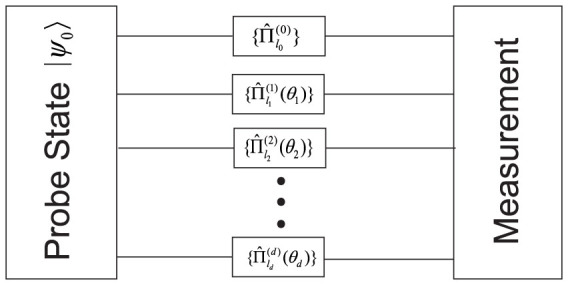
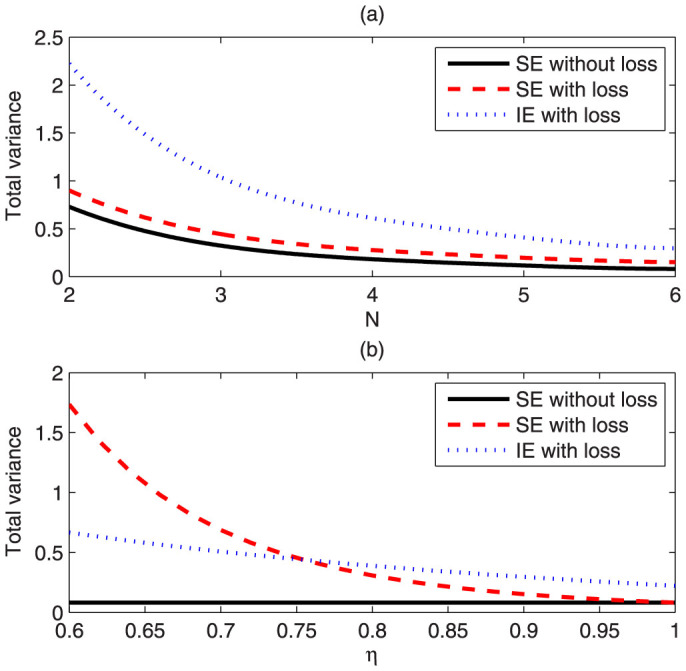
We present a general quantum metrology framework to study the simultaneous estimation of multiple phases in the presence of noise as a discretized model for phase imaging. This approach can lead to nontrivial bounds of the precision for multiphase estimation. Our results show that simultaneous estimation (SE) of multiple phases is always better than individual estimation (IE) of each phase even in noisy environment. The utility of the bounds of multiple phase estimation for photon loss channels is exemplified explicitly. When noise is low, those bounds possess the Heisenberg scale showing quantum-enhanced precision with the O(d) advantage for SE, where d is the number of phases. However, this O(d) advantage of SE scheme in the variance of the estimation may disappear asymptotically when photon loss becomes significant and then only a constant advantage over that of IE scheme demonstrates. Potential application of those results is presented.
Overview
The claims and statistics of this paper haven’t been checked yet.
Free: it reads the open-access text and checks the first 5 claims that cite a source we can check. Create a free account to check every claim.
Integrity signals
Registry
Cites
Statistics
Figures
Verification
Claims the paper makes
The claims and statistics of this paper haven’t been checked yet.
Free: it reads the open-access text and checks the first 5 claims that cite a source we can check. Create a free account to check every claim.
Claims other papers make about this one
Each is checked against this paper’s own text: does it say what the citing paper says it does?
The cited source says what the claim attributes to it.
In the citing paper
“However, the performance of the simultaneous estimation may be strongly affected by the noise [154,155] and the O(d) advantage may even disappear under the photon loss noise [156].”
From Quantum Fisher information matrix and multiparameter estimation (2020) · cites this paper as [156]
Self-check
Percentages, sums and reported differences re-computed from the paper’s own numbers.
The self-check needs the paper’s full text.
Citations
Cites
Quantum Computation and Quantum Information
Nielsen, M. A., Chuang, I., & Grover, L. K. (2002) · American Journal of Physics · doi:10.1119/1.1463744 · Cited by 21,895
Quantum computation and quantum information
Law, J. (2001) · ACM SIGSOFT Software Engineering Notes · doi:10.1145/505482.505499 · Cited by 18,842
Mathematical Methods of Statistics.
Geary, R. C., & Cramer, H. (1947) · The Economic Journal · doi:10.2307/2226151 · Cited by 5,927
Giovannetti, V., Lloyd, S., & Maccone, L. (2011) · Nature Photonics · doi:10.1038/nphoton.2011.35 · Cited by 3,894
Quantum detection and estimation theory
Helstrom, C. W. (1969) · Journal of Statistical Physics · doi:10.1007/bf01007479 · Cited by 3,776 · cited 4×
“[26] C.”
BackgroundInfluentialQuantum-mechanical noise in an interferometer
Caves, C. M. (1981) · Physical Review D · doi:10.1103/physrevd.23.1693 · Cited by 3,202
Quantum-Enhanced Measurements: Beating the Standard Quantum Limit
Giovannetti, V., Lloyd, S., & Maccone, L. (2004) · Science · doi:10.1126/science.1104149 · Cited by 3,038
Giovannetti, V., Lloyd, S., & Maccone, L. (2006) · Physical Review Letters · doi:10.1103/physrevlett.96.010401 · Cited by 2,440
Quantum Detection and Estimation Theory
(1976) · Mathematics in Science and Engineering · doi:10.1016/s0076-5392(08)x6017-5 · Cited by 2,426
Quantum estimation for quantum technology
PARIS, M. G. A. (2009) · International Journal of Quantum Information · doi:10.1142/s0219749909004839 · Cited by 1,632
Research works printed but not linked: 1
- Giovannetti V., Lloyd S. & Maccone L. Adavances in Quantum metrology. Nature Photon. 5, 222 (2011). · DOI · Paper page
Cited by
Quantum Fisher information matrix and multiparameter estimation
Liu, J., Yuan, H., Lu, X.-M., & Wang, X. (2020) · Journal of Physics A: Mathematical and Theoretical · doi:10.1088/1751-8121/ab5d4d · Cited by 802
Polino, E., Valeri, M., Spagnolo, N., & Sciarrino, F. (2020) · AVS Quantum Science · doi:10.1116/5.0007577 · Cited by 414
Multiparameter Estimation in Networked Quantum Sensors
Proctor, T. J., Knott, P. A., & Dunningham, J. A. (2018) · Physical Review Letters · doi:10.1103/physrevlett.120.080501 · Cited by 318
Multi-parameter quantum metrology
Szczykulska, M., Baumgratz, T., & Datta, A. (2016) · Advances in Physics: X · doi:10.1080/23746149.2016.1230476 · Cited by 267
Quantum enhanced estimation of a multidimensional field
Baumgratz, T., & Datta, A. (2016) · Physical Review Letters · doi:10.1103/physrevlett.116.030801 · Cited by 249
Metadata
- Authors
- Yue, J.-D., Zhang, Y.-R., & Fan, H.
- Affiliations
- Chinese Academy of Sciences (CN)
- Corresponding author
- Fan, Heng
- Venue
- Scientific Reports
- Published
- 2014-08-04
- Volume
- 4
- Issue
- 1
- Pages
- 5933-5933
- ISSN
- 2045-2322 (ISSN-L)
- PMC
- PMC4123202
- OpenAlex
- W2022928942
- Cited by
- 84
- References
- 36
- Citations by year
- 2026: 5 · 2025: 7 · 2024: 8 · 2023: 5 · 2022: 6 · 2021: 7 · 2020: 7 · 2019: 6 · 2018: 12 · 2017: 7 · 2016: 10 · 2015: 2 · 2014: 2
- FWCI
- 6.98
- Type
- journal article
- Language
- en
- Open access
- gold
- doi.org
- Licence
- cc-by
- creativecommons.org/licenses/by/4.0 (tdm)
- creativecommons.org/licenses/by/4.0 (vor)
- Locations
- Scientific Reports (publishedVersion, cc-by)
- Europe PMC (PubMed Central) (publishedVersion, cc-by)
- PubMed Central (publishedVersion, cc-by)
- PubMed (publishedVersion)
- arXiv (Cornell University) (submittedVersion)
- arXiv (Cornell University)
- Funders
- National Natural Science Foundation of China (11175248, 2010CB922904)
- Chinese Academy of Sciences (2010CB922904)
- Topics
- Physical Sciences › Physics and Astronomy › Atomic and Molecular Physics, and Optics › Quantum Information and Cryptography
- Physical Sciences › Computer Science › Artificial Intelligence › Quantum Computing Algorithms and Architecture
- Physical Sciences › Physics and Astronomy › Atomic and Molecular Physics, and Optics › Quantum Mechanics and Applications
- Keywords
- quantum-enhanced sensing, simultaneous estimation, phase imaging, quantum Fisher information, Cramer-Rao lower bound, photon loss, Heisenberg limit, quantum advantage
About these checks
Registry, retraction, Cites and statistics results are computed, not judged, with one exception: a printed reference that no index lists is read once by a model before it counts as a citation error. Claims are extracted by a model and kept only when their quote appears verbatim in the text; each cited source is then checked, with a model’s help, for whether it says what the claim relies on. Those verdicts can be wrong — read the claim’s quote and the cited source before relying on one.
Statistics and arithmetic are recomputed, not judged.
Confidence bands are shown only for fields calibrated on our annotated test set. None is calibrated yet, so no band is shown.
What counts as a claim ›How we measure confidence ›How we check this ›
Are you an author, or do you see a problem with this page? Request a review
Data sources
Bibliographic data: Semantic Scholar, OpenAlex, Crossref.
Contains information from the Semantic Scholar Academic Graph Datasets, made available under the ODC Attribution License (ODC-BY 1.0).
Semantic Scholar’s data is described in: Kinney, R., et al. (2023). The Semantic Scholar Open Data Platform. arXiv:2301.10140.
