

The DOI matches its Crossref record; 82 of the 82 references it cites were found in a registry or an index.
Contrasting global genetic patterns in two biologically similar, widespread and invasive Ciona species (Tunicata, Ascidiacea)
Open accessAbstract
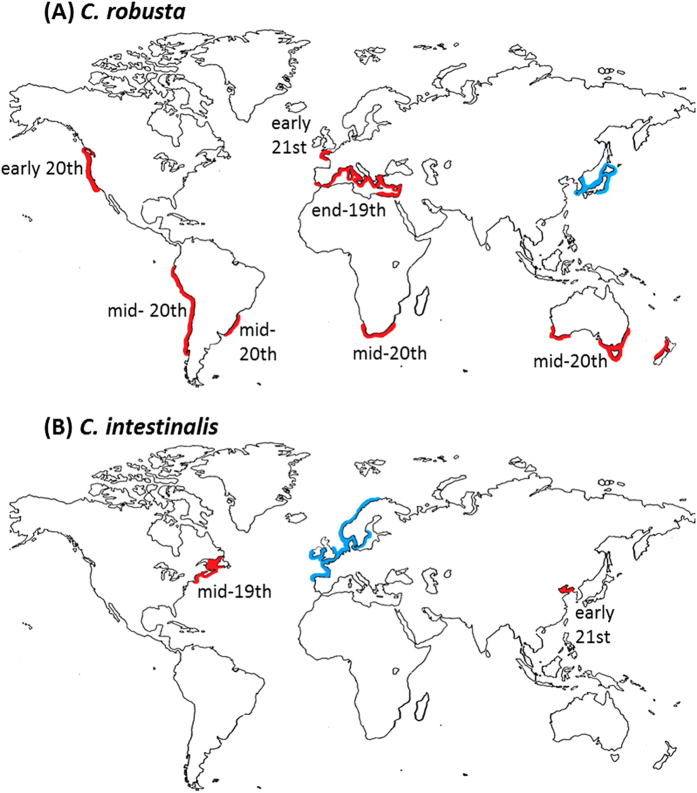
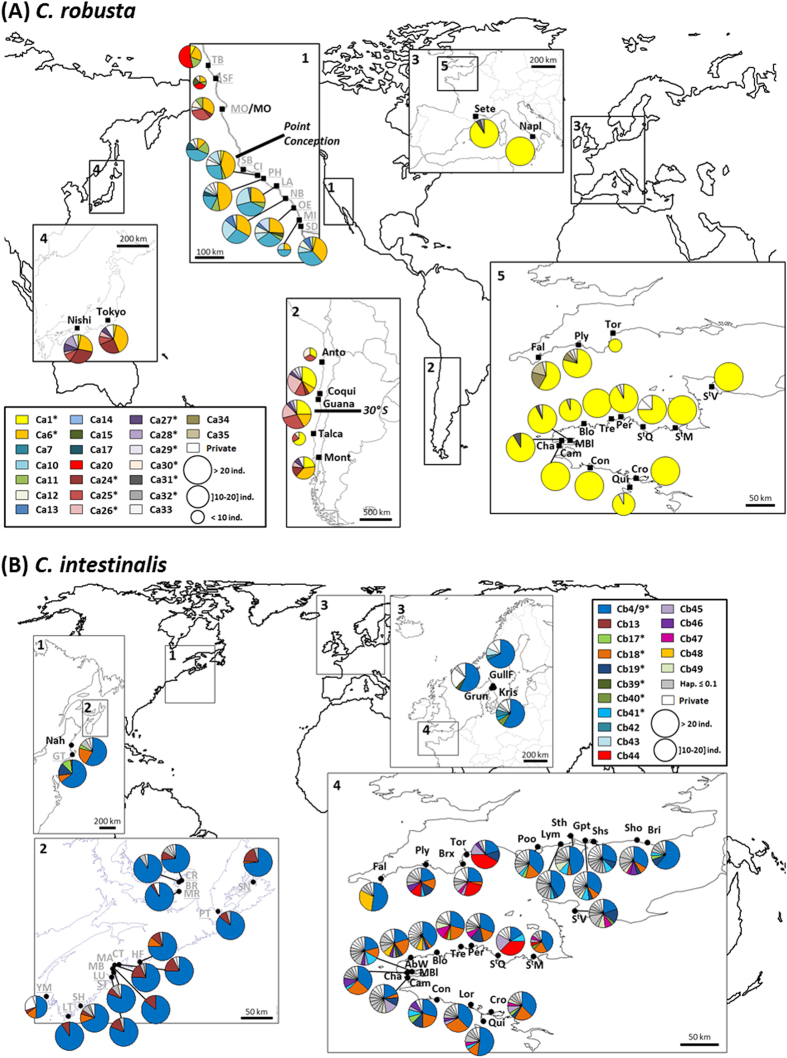
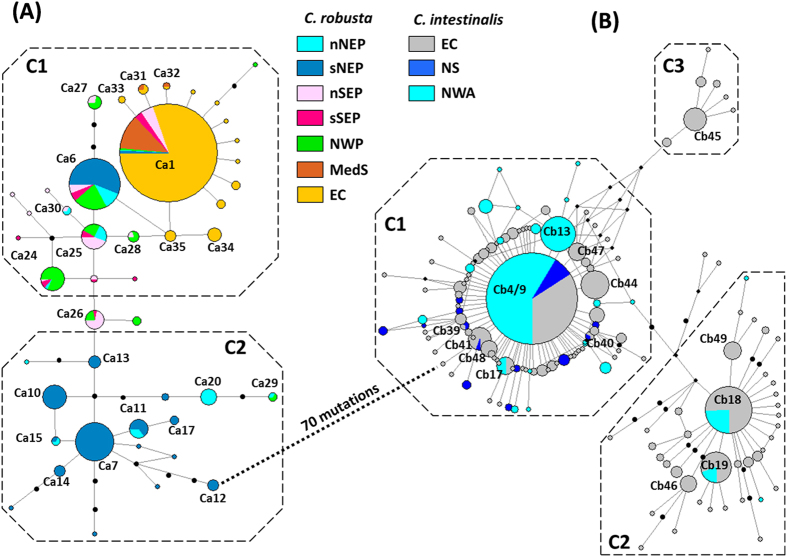
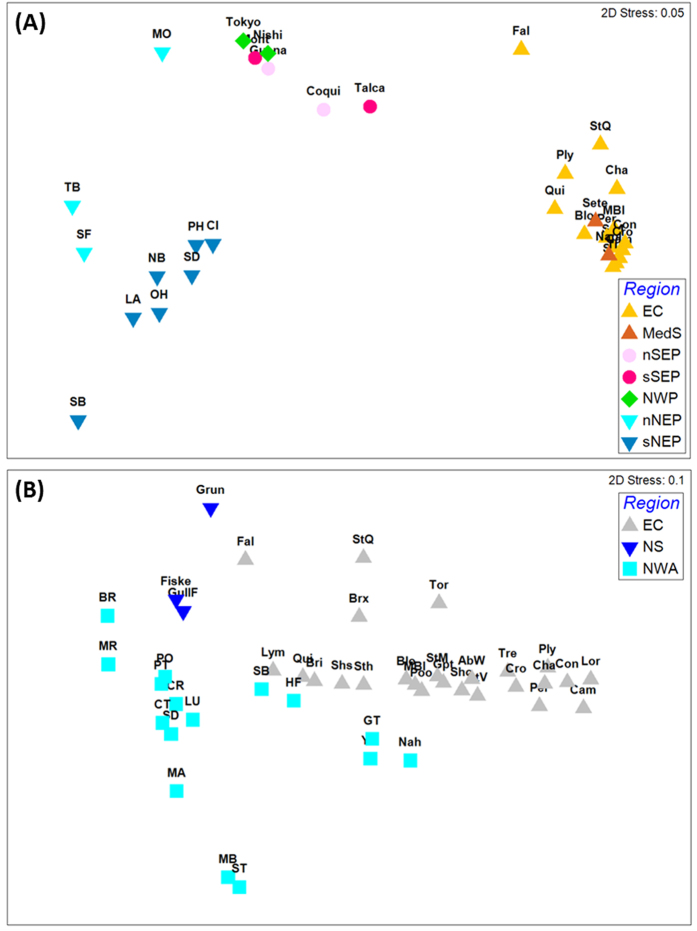
Human-mediated dispersal interplays with natural processes and complicates understanding of the biogeographical history of species. This is exemplified by two invasive tunicates, Ciona robusta (formerly Ciona intestinalis type A) and C. intestinalis (formerly Ciona intestinalis type B), globally distributed and sympatric in Europe. By gathering new mitochondrial sequences that were merged with published datasets, we analysed genetic patterns in different regions, with a focus on 1) their sympatric range and 2) allopatric populations in N and S America and southern Europe. In the sympatric range, the two species display contrasting genetic diversity patterns, with low polymorphism in C. robusta supporting the prevalent view of its recent introduction. In the E Pacific, several genetic traits support the non-native status of C. robusta. However, in the NE Pacific, this appraisal requires a complex scenario of introduction and should be further examined supported by extensive sampling efforts in the NW Pacific (putative native range). For C. intestinalis, Bayesian analysis suggested a natural amphi-North Atlantic distribution, casting doubt on its non-native status in the NW Atlantic. This study shows that both natural and human-mediated dispersal have influenced genetic patterns at broad scales; this interaction lessens our ability to confidently ascertain native vs. non-native status of populations, particularly of those species that are globally distributed.
Overview
The claims and statistics of this paper haven’t been checked yet.
Run the check — free, no account needed. It reads the open-access text and checks the sources it cites.
Integrity signals
Registry
Cites
Statistics
Figures
Verification
Claims the paper makes
The claims and statistics of this paper haven’t been checked yet.
Run the check — free, no account needed. It reads the open-access text and checks the sources it cites.
Claims other papers make about this one
Each is checked against this paper’s own text: does it say what the citing paper says it does?
The cited source says what the claim attributes to it.
In the citing paper
“Furthermore, cryptomonads are widespread in the marine environment and abundant along the coastline (Astudillo et al., 2014; Xing et al., 2008) where ascidians, such as C. intestinalis, are present (Bouchemousse et al., 2016; Locke & Carman, 2009).”
From Mixotrophic flagellate ingestion boosts microplastic accumulation in ascidians (2022) · cites this paper as Bouchemousse et al., 2016
Self-check
Percentages, sums and reported differences re-computed from the paper’s own numbers.
The self-check needs the paper’s full text.
Citations
Cites
Hall, T. A. (1999) · Nucleic Acids Symposium Series · doi:10.14601/phytopathol_mediterr-14998u1.29 · Cited by 38,297
Excoffier, L., & Lischer, H. E. L. (2010) · Molecular Ecology Resources · doi:10.1111/j.1755-0998.2010.02847.x · Cited by 16,679
Dating of the human–ape splitting by a molecular clock of mitochondrial DNA.
Hasegawa, M., Kishino, H., & Yano, T.-A. (1985) · Journal of Molecular Evolution · doi:10.1007/bf02101694 · Cited by 8,687
DnaSP, DNA polymorphism analyses by the coalescent and other methods
Rozas, J., Sánchez-DelBarrio, J. C., Messeguer, X., & Rozas, R. (2003) · Bioinformatics · doi:10.1093/bioinformatics/btg359 · Cited by 6,133
The Ecology of Invasions by Animals and Plants
Elton, C. (1958) · Springer eBooks · doi:10.1007/978-1-4899-7214-9 · Cited by 4,331
The Ecology of Invasions by Animals and Plants.
Richards, P. W., & Elton, C. (1959) · Journal of Ecology · doi:10.2307/2257385 · Cited by 3,907
hp‐rare 1.0: a computer program for performing rarefaction on measures of allelic richness
Kalinowski, S. T. (2004) · Molecular Ecology Notes · doi:10.1111/j.1471-8286.2004.00845.x · Cited by 2,227
Assessing the global threat of invasive species to marine biodiversity
Molnar, J. L., Gamboa, R. L., Revenga, C., & Spalding, M. D. (2008) · Frontiers in Ecology and the Environment · doi:10.1890/070064 · Cited by 1,538
Dispersal, Gene Flow, and Population Structure
Bohonak, A. J. (1999) · The Quarterly Review of Biology · doi:10.1086/392950 · Cited by 1,237
Mitochondrial DNA as a marker of molecular diversity: a reappraisal
Galtier, N., Nabholz, B., Glémin, S., & Hurst, G. D. D. (2009) · Molecular Ecology · doi:10.1111/j.1365-294x.2009.04380.x · Cited by 1,189
Phylogeographic insights into cryptic glacial refugia
Provan, J., & Bennett, K. D. (2008) · Trends in Ecology & Evolution · doi:10.1016/j.tree.2008.06.010 · Cited by 1,096
PROPAGULE DISPERSAL IN MARINE AND TERRESTRIAL ENVIRONMENTS: A COMMUNITY PERSPECTIVE
Kinlan, B., & Gaines, S. (2003) · Ecology · doi:10.1890/01-0622 · Cited by 1,081
Hey, J., & Nielsen, R. (2007) · Proceedings of the National Academy of Sciences · doi:10.1073/pnas.0611164104 · Cited by 982
Isolation with Migration Models for More Than Two Populations
Hey, J. (2010) · Molecular Biology and Evolution · doi:10.1093/molbev/msp296 · Cited by 894
Pattern, process, and prediction in marine invasion ecology
Carlton, J. T. (1996) · Biological Conservation · doi:10.1016/0006-3207(96)00020-1 · Cited by 597
EVALUATING SIGNATURES OF GLACIAL REFUGIA FOR NORTH ATLANTIC BENTHIC MARINE TAXA
Maggs, C. A., Castilho, R., Foltz, D. W., Henzler, C., Jolly, M. T., Kelly, J., Olsen, J., Perez, K. E., Stam, W. T., Väinölä, R., et al. (2008) · Ecology · doi:10.1890/08-0257.1 · Cited by 565
Self-citationPHYLOGEOGRAPHY AND HISTORICAL ECOLOGY OF THE NORTH ATLANTIC INTERTIDAL
Wares, J. P., & Cunningham, C. (2001) · Evolution · doi:10.1554/0014-3820(2001)055[2455:paheot]2.0.co;2 · Cited by 505
How important is intraspecific genetic admixture to the success of colonising populations?
Rius, M., & Darling, J. A. (2014) · Trends in Ecology & Evolution · doi:10.1016/j.tree.2014.02.003 · Cited by 498
The North and South American ascidians
Name, V., & Willard, G. (1945) · American Museum of Natural History eBooks · Cited by 475
The relationship between dispersal ability and geographic range size
Lester, S. E., Ruttenberg, B. I., Gaines, S. D., & Kinlan, B. P. (2007) · Ecology Letters · doi:10.1111/j.1461-0248.2007.01070.x · Cited by 454
Marine connectivity: a new look at pelagic larval duration and genetic metrics of dispersal
Selkoe, K., & Toonen, R. J. (2011) · Marine Ecology Progress Series · doi:10.3354/meps09238 · Cited by 435
Diluting the founder effect: cryptic invasions expand a marine invader's range
Roman, J. (2006) · Proceedings of the Royal Society B Biological Sciences · doi:10.1098/rspb.2006.3597 · Cited by 359
Non-indigenous ascidians in southern California harbors and marinas
Lambert, C. C., & Lambert, G. (1998) · Marine Biology · doi:10.1007/s002270050289 · Cited by 322
Global Diversity of Ascidiacea
Shenkar, N., & Swalla, B. J. (2011) · PLoS ONE · doi:10.1371/journal.pone.0020657 · Cited by 304
Brunetti, R., Gissi, C., Pennati, R., Caicci, F., Gasparini, F., & Manni, L. (2015) · Journal of Zoological Systematics and Evolutionary Research · doi:10.1111/jzs.12101 · Cited by 275
Ecology and natural history of the protochordates
Lambert, G. (2005) · Canadian Journal of Zoology · doi:10.1139/z04-156 · Cited by 253
The ‘Expansion-Contraction’ model of Pleistocene biogeography: rocky shores suffer a sea change?
MARKO, P. B., HOFFMAN, J. M., EMME, S. A., MCGOVERN, T. M., KEEVER, C. C., & NICOLE COX, L. (2010) · Molecular Ecology · doi:10.1111/j.1365-294x.2009.04417.x · Cited by 245
A COMPARATIVE STUDY OF ASYMMETRIC MIGRATION EVENTS ACROSS A MARINE BIOGEOGRAPHIC BOUNDARY
Wares, J. P., Gaines, S. D., & Cunningham, C. (2001) · Evolution · doi:10.1111/j.0014-3820.2001.tb01294.x · Cited by 236
The Biogeography of Marine Invertebrate Life Histories
Marshall, D. J., Krug, P. J., Kupriyanova, E. K., Byrne, M., & Emlet, R. B. (2011) · Annual Review of Ecology Evolution and Systematics · doi:10.1146/annurev-ecolsys-102710-145004 · Cited by 215
Phylogeography in coastal marine animals: a solution from California?
Dawson, M. N. (2001) · Journal of Biogeography · doi:10.1046/j.1365-2699.2001.00572.x · Cited by 209
Cryptic speciation in a model invertebrate chordate
Caputi, L., Andreakis, N., Mastrototaro, F., Cirino, P., Vassillo, M., & Sordino, P. (2007) · Proceedings of the National Academy of Sciences · doi:10.1073/pnas.0610158104 · Cited by 198
Haye, P. A., Segovia, N. I., Muñoz-Herrera, N. C., Gálvez, F., Salinas, A. M., Meynard, A. P., Pardo-Gandarillas, M. C., Poulin, É., & Faugeron, S. (2014) · PLoS ONE · doi:10.1371/journal.pone.0088613 · Cited by 175
Provan, J., Wattier, R. A., & Maggs, C. A. (2005) · Molecular Ecology · doi:10.1111/j.1365-294x.2005.02447.x · Cited by 163
Roux, C., Tsagkogeorga, G., Bierne, N., & Galtier, N. (2013) · Molecular Biology and Evolution · doi:10.1093/molbev/mst066 · Cited by 154
Zhan, A., MacIsaac, H. J., & Cristescu, M. E. (2010) · Molecular Ecology · doi:10.1111/j.1365-294x.2010.04837.x · Cited by 152
Down under the southeastern Pacific: marine non-indigenous species in Chile
Castilla, J. C., Uribe, M., Bahamonde, N., et al. (2005) · Biological Invasions · doi:10.1007/s10530-004-0198-5 · Cited by 140
The Life Cycle of Ciona intestinalis (L.) f. typica in Relation to the Environmental Temperature
Dybern, B. I. (1965) · Oikos · doi:10.2307/3564870 · Cited by 137
Marine invasion genetics: from spatio-temporal patterns to evolutionary outcomes
Rius, M., Turón, X., Bernardi, G., Volckaert, F. A. M., & Viard, F. (2014) · Biological Invasions · doi:10.1007/s10530-014-0792-0 · Cited by 134
Self-citationThe Danish "Ingolf" Expedition
(1900) · Geographical Journal · doi:10.2307/1774695 · Cited by 121
Pennati, R., Ficetola, G. F., Brunetti, R., Caicci, F., Gasparini, F., Griggio, F., Sato, A., Stach, T., Kaul-Strehlow, S., Gissi, C., et al. (2015) · PLoS ONE · doi:10.1371/journal.pone.0122879 · Cited by 116
Process of invasiveness among exotic tunicates in Prince Edward Island, Canada
Ramsay, A., Davidson, J., Landry, T., & Arsenault, G. (2008) · Biological Invasions · doi:10.1007/s10530-007-9205-y · Cited by 116
Hohenlohe, P. A. (2004) · Biological Journal of the Linnean Society · doi:10.1111/j.1095-8312.2004.00318.x · Cited by 111
Panova, M., Blakeslee, A. M. H., Miller, A. W., Mäkinen, T., Ruiz, G. M., Johannesson, K., & André, C. (2011) · PLoS ONE · doi:10.1371/journal.pone.0017511 · Cited by 98
Genealogical relationships within and among shallow-water Ciona species (Ascidiacea)
Nydam, M. L., & Harrison, R. G. (2007) · Marine Biology · doi:10.1007/s00227-007-0617-0 · Cited by 94
Polymorphism and divergence within the ascidian genus Ciona
Nydam, M. L., & Harrison, R. G. (2010) · Molecular Phylogenetics and Evolution · doi:10.1016/j.ympev.2010.03.042 · Cited by 92
Bock, D. G., MacIsaac, H. J., & Cristescu, M. E. (2012) · Proceedings of the Royal Society B Biological Sciences · doi:10.1098/rspb.2011.2610 · Cited by 89
Blakeslee, A. M. H., Byers, J. E., & Lesser, M. P. (2008) · Molecular Ecology · doi:10.1111/j.1365-294x.2008.03865.x · Cited by 89
Range expansions across ecoregions: interactions of climate change, physiology and genetic diversity
Rius, M., Clusella‐Trullas, S., McQuaid, C. D., Navarro, R. A., Griffiths, C. L., Matthee, C. A., von der Heyden, S., & Turón, X. (2013) · Global Ecology and Biogeography · doi:10.1111/geb.12105 · Cited by 86
Mitogenomics reveals two cryptic species in Ciona intestinalis
Iannelli, F., Pesole, G., Sordino, P., & Gissi, C. (2007) · Trends in Genetics · doi:10.1016/j.tig.2007.07.001 · Cited by 86
Genomic Approaches Reveal Unexpected Genetic Divergence Within Ciona intestinalis
Suzuki, M. M., Nishikawa, T., & Bird, A. P. (2005) · Journal of Molecular Evolution · doi:10.1007/s00239-005-0009-3 · Cited by 80
Field identification of ‘types’ A and B of the ascidian Ciona intestinalis in a region of sympatry
Sato, A., Satoh, N., & Bishop, J. (2012) · Marine Biology · doi:10.1007/s00227-012-1898-5 · Cited by 75
Self-citationTherriault, T. W., & Herborg, L. (2008) · ICES Journal of Marine Science · doi:10.1093/icesjms/fsn054 · Cited by 67
Global Phylogeography of the Widely Introduced North West Pacific Ascidian Styela clava
Goldstien, S. J., Dupont, L., Viard, F., Hallas, P. J., Nishikawa, T., Schiel, D. R., Gemmell, N. J., & Bishop, J. (2011) · PLoS ONE · doi:10.1371/journal.pone.0016755 · Cited by 66
Self-citationTaxonomic Studies of Ciona intestinalis (L.) and Its Allies
Hoshino, Z.-I., & Nishikawa, T. (1985) · Publications of the Seto Marine Biological Laboratory · doi:10.5134/176100 · Cited by 65
Brante, A., Fernández, M., & Viard, F. (2012) · Journal of Heredity · doi:10.1093/jhered/ess030 · Cited by 64
Self-citationRamsay, A. (2009) · Aquatic Invasions · doi:10.3391/ai.2009.4.1.17 · Cited by 62
INTROGRESSION DESPITE SUBSTANTIAL DIVERGENCE IN A BROADCAST SPAWNING MARINE INVERTEBRATE
Nydam, M. L., & Harrison, R. G. (2010) · Evolution · doi:10.1111/j.1558-5646.2010.01153.x · Cited by 61
Refuting a controversial case of a human‐mediated marine species introduction
Wares, J. P., Goldwater, D. S., Kong, B. Y., & Cunningham, C. (2002) · Ecology Letters · doi:10.1046/j.1461-0248.2002.00359.x · Cited by 61
Biological Invasions in Changing Ecosystems
Canning‐Clode, J. (2015) · doi:10.1515/9783110438666 · Cited by 60
Rohfritsch, A., Bierne, N., Boudry, P., Heurtebise, S., Cornette, F., & Lapègue, S. (2013) · Evolutionary Applications · doi:10.1111/eva.12086 · Cited by 59
Complex genetic patterns in closely related colonizing invasive species
Zhan, A., Darling, J. A., Bock, D. G., Lacoursière‐Roussel, A., MacIsaac, H. J., & Cristescu, M. E. (2012) · Ecology and Evolution · doi:10.1002/ece3.258 · Cited by 54
Vermeij, G. J. (2005) · Proceedings of the Royal Society B Biological Sciences · doi:10.1098/rspb.2005.3177 · Cited by 54
Late Pleistocene species distribution modelling of North Atlantic intertidal invertebrates
Waltari, E., & Hickerson, M. J. (2012) · Journal of Biogeography · doi:10.1111/j.1365-2699.2012.02782.x · Cited by 52
AN UNUSUALLY ROBUST CIONA FROM THE NORTHEASTERN COAST OF HONSYU ISLAND, JAPAN
Hoshino, Z.-I., & Tokioka, T. (1967) · Publications of the Seto Marine Biological Laboratory · doi:10.5134/175476 · Cited by 51
Bouchemousse, S., Liautard‐Haag, C., Bierne, N., & Viard, F. (2016) · Molecular Ecology · doi:10.1111/mec.13854 · Cited by 51
Self-citationRiquet, F., Daguin‐Thiébaut, C., Ballenghien, M., Bierne, N., & Viard, F. (2013) · Molecular Ecology · doi:10.1111/mec.12161 · Cited by 50
Self-citationWhat is natural? The scale of cryptogenesis in the North Atlantic Ocean
Haydar, D. (2011) · Diversity and Distributions · doi:10.1111/j.1472-4642.2011.00863.x · Cited by 49
Marsh, J. S. (1980) · Food Policy · doi:10.1016/0306-9192(80)90053-6 · Cited by 46
Bouchemousse, S., Lévêque, L., Dubois, G., & Viard, F. (2015) · Evolutionary Ecology · doi:10.1007/s10682-015-9788-1 · Cited by 41
Self-citationDupont, L., Viard, F., David, P., & Bishop, J. (2007) · Diversity and Distributions · doi:10.1111/j.1472-4642.2007.00405.x · Cited by 40
Self-citationAdaptation in marine invasion: a genetic perspective
Tepolt, C. K. (2014) · Biological Invasions · doi:10.1007/s10530-014-0825-8 · Cited by 39
Chapman, J. W., Carlton, J. T., Bellinger, M. R., & Blakeslee, A. M. H. (2007) · Biological Invasions · doi:10.1007/s10530-006-9073-x · Cited by 38
Haydar, D., Hoarau, G. G., Olsen, J., Stam, W. T., & Wolff, W. J. (2010) · Diversity and Distributions · doi:10.1111/j.1472-4642.2010.00718.x · Cited by 37
Geoffroy, A., Gall, L. L., & Destombe, C. (2012) · Aquatic Botany · doi:10.1016/j.aquabot.2012.03.002 · Cited by 37
Bishop, J., Roby, C., Yunnie, A. L. E., Wood, C. A., Lévêque, L., Turón, X., & Viard, F. (2012) · Biological Invasions · doi:10.1007/s10530-012-0286-x · Cited by 31
Self-citationA New Animal Model for Merging Ecology and Evolution
Procaccini, G., Affinito, O., Toscano, F., & Sordino, P. (2011) · Springer eBooks · doi:10.1007/978-3-642-20763-1_6 · Cited by 29
1. Anthropogenic Vectors of Marine and Estuarine Invasions: an Overview Framework
Carlton, J. T., & Ruiz, G. M. (2015) · doi:10.1515/9783110438666-005 · Cited by 22
Phylogeography and trans‐Pacific divergence of the rocky shore gastropod Nucella lima
Cox, L. N., Zaslavskaya, N. I., & Marko, P. B. (2013) · Journal of Biogeography · doi:10.1111/jbi.12217 · Cited by 21
First record of vase tunicate, Ciona intestinalis (Linnaeus, 1767) in coastal Newfoundland waters
Sargent, P. S., Wells, T., Matheson, K., McKenzie, C. H., & Deibel, D. (2013) · BioInvasions Records · doi:10.3391/bir.2013.2.2.01 · Cited by 20
Collin, R. (2009) · Aquatic Invasions · doi:10.3391/ai.2009.4.2.13 · Cited by 13
Lee, T., & Shin, S. (2014) · Proceedings of the Biological Society of Washington · doi:10.2988/0006-324x-127.1.284 · Cited by 13
Affinito, O., Andreakis, N., Caputi, L., Marino, R., Pannone, R., Sordino, P., & Procaccini, G. (2014) · Marine Ecology · doi:10.1111/maec.12226 · Cited by 10
Research works printed but not linked: 5
- Millar, R. H. In L.M.B.C. Memoirs of typical British marine palnts and animals, XXXV (ed J. S. Colman ) 123 (Liverpool University Press, 1953).
- Carver, C. E., Mallet, A. L. & Vercaemer, B. Biological synopsis of the solitary tunicate Ciona intestinalis . Can. Man. Rep. Fish. Aquat. Sci. 2746, v+ 55p. (2006).
- Bouchemousse, S., Haag-Liautard, C., Bierne, N. & Viard, F. Past and contemporary introgression between two strongly differentiated Ciona species as revealed by a post-genomic SNPs panel. BioRxiv, doi: 10.1101/030346 (2015). · DOI
- Guillemin, M.-L. et al. In Seaweed Phylogeography (eds Zi-Min Hu & Ceridwen Fraser ) Ch. 10, 251–277 (Springer Netherlands, 2016).
- Brante, A., Fernandez, M. & Viard, F. Phylogeography and biogeography concordance in the marine gastropod Crepipatella dilatata (Calyptraidae) along the South Eastern Pacific coast J. Heredity 103, 630–637, doi: 10.11093/jhered/ess030 (2012). · DOI
Cited by
Mixotrophic flagellate ingestion boosts microplastic accumulation in ascidians
Pennati, R., Castelletti, C., Parolini, M., Scarì, G., & Mercurio, S. (2022) · Journal of Experimental Zoology Part A: Ecological and Integrative Physiology · doi:10.1002/jez.2596 · Cited by 19
Metadata
- Authors
- Bouchemousse, S., Bishop, J. D. D., & Viard, F.
- Affiliations
- Centre National de la Recherche Scientifique (FR)
- Marine Biological Association of the United Kingdom (GB)
- Corresponding author
- Bouchemousse, Sarah
- Viard, Frédérique
- Venue
- Scientific Reports
- Published
- 2016-05-03
- Volume
- 6
- Issue
- 1
- Pages
- 24875-24875
- ISSN
- 2045-2322 (ISSN-L)
- PMC
- PMC4853746
- OpenAlex
- W2346624115
- Cited by
- 85
- References
- 82
- Citations by year
- 2026: 4 · 2025: 6 · 2024: 5 · 2023: 3 · 2022: 10 · 2021: 6 · 2020: 12 · 2019: 11 · 2018: 12 · 2017: 12 · 2016: 4
- FWCI
- 10.50
- Type
- journal article
- Language
- en
- Open access
- gold
- doi.org
- Locations
- Scientific Reports (publishedVersion, cc-by)
- PubMed Central (publishedVersion, cc-by)
- PubMed (publishedVersion)
- Marine Biological Association (acceptedVersion)
- HAL (submittedVersion, cc-by)
- Funders
- Agence Nationale de la Recherche (ANR-12-BSV7-0011, ANR-12)
- Centre National de la Recherche Scientifique
- Institut National de la Recherche Agronomique
- Muséum National d'Histoire Naturelle
- Interreg
- Topics
- Life Sciences › Biochemistry, Genetics and Molecular Biology › Genetics › Genetic diversity and population structure
- Physical Sciences › Environmental Science › Global and Planetary Change › Marine Ecology and Invasive Species
- Physical Sciences › Earth and Planetary Sciences › Oceanography › Marine Biology and Ecology Research
- Keywords
- Ciona robusta, Ciona intestinalis, invasive species, biogeography, genetic diversity, mitochondrial DNA, sympatric populations, allopatric populations, human-mediated dispersal, North Atlantic distribution, Pacific Ocean distribution
- MeSH terms
- Animals, Ciona intestinalis, DNA, Mitochondrial, Europe, North America, South America, Genetic Variation, Sequence Analysis, DNA, Phylogeography
About these checks
Registry, retraction, Cites and statistics results are computed, not judged, with one exception: a printed reference that no index lists is read once by a model before it counts as a citation error. Claims are extracted by a model and kept only when their quote appears verbatim in the text; each cited source is then checked, with a model’s help, for whether it says what the claim relies on. Those verdicts can be wrong — read the claim’s quote and the cited source before relying on one.
Statistics and arithmetic are recomputed, not judged.
Confidence bands are shown only for fields calibrated on our annotated test set. None is calibrated yet, so no band is shown.
What counts as a claim ›How we measure confidence ›How we check this ›
Are you an author, or do you see a problem with this page? Request a review
Data sources
Bibliographic data: Semantic Scholar, OpenAlex, Crossref.
Contains information from the Semantic Scholar Academic Graph Datasets, made available under the ODC Attribution License (ODC-BY 1.0).
Semantic Scholar’s data is described in: Kinney, R., et al. (2023). The Semantic Scholar Open Data Platform. arXiv:2301.10140.
