

The DOI matches its Crossref record; 50 of the 52 references it cites were found in a registry or an index.
Word pair classification during imagined speech using direct brain recordings
Open accessAbstract
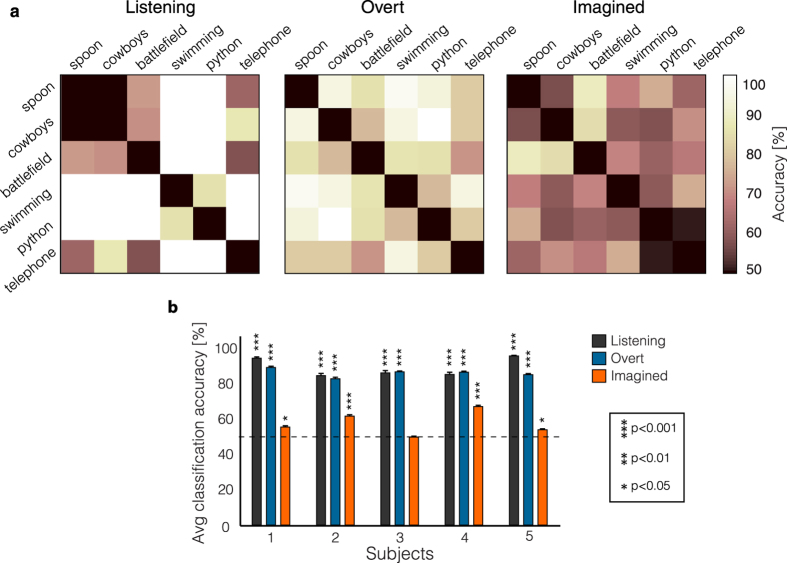
People that cannot communicate due to neurological disorders would benefit from an internal speech decoder. Here, we showed the ability to classify individual words during imagined speech from electrocorticographic signals. In a word imagery task, we used high gamma (70–150 Hz) time features with a support vector machine model to classify individual words from a pair of words. To account for temporal irregularities during speech production, we introduced a non-linear time alignment into the SVM kernel. Classification accuracy reached 88% in a two-class classification framework (50% chance level), and average classification accuracy across fifteen word-pairs was significant across five subjects (mean = 58%; p < 0.05). We also compared classification accuracy between imagined speech, overt speech and listening. As predicted, higher classification accuracy was obtained in the listening and overt speech conditions (mean = 89% and 86%, respectively; p < 0.0001), where speech stimuli were directly presented. The results provide evidence for a neural representation for imagined words in the temporal lobe, frontal lobe and sensorimotor cortex, consistent with previous findings in speech perception and production. These data represent a proof of concept study for basic decoding of speech imagery, and delineate a number of key challenges to usage of speech imagery neural representations for clinical applications.
Overview
The claims and statistics of this paper haven’t been checked yet.
Free: it reads the open-access text and checks the first 5 claims that cite a source we can check. Create a free account to check every claim.
Integrity signals
Registry
Cites
Statistics
Figures



Verification
Claims the paper makes
The claims and statistics of this paper haven’t been checked yet.
Free: it reads the open-access text and checks the first 5 claims that cite a source we can check. Create a free account to check every claim.
Claims other papers make about this one
Each is checked against this paper’s own text: does it say what the citing paper says it does?
The cited source says what the claim attributes to it.
In the citing paper
“Along these lines, when able speakers are instructed to imagine speaking or hearing a word, neural activity in the STG can be used to decode those words with above-chance accuracy59–63.”
From The speech neuroprosthesis (2024) · cites this paper as [59]
Self-check
Percentages, sums and reported differences re-computed from the paper’s own numbers.
The self-check needs the paper’s full text.
Citations
Cites
Controlling the False Discovery Rate: A Practical and Powerful Approach to Multiple Testing
Benjamini, Y., & Hochberg, Y. (1995) · Journal of the Royal Statistical Society Series B: Statistical Methodology · doi:10.1111/j.2517-6161.1995.tb02031.x · Cited by 109,482
LIBSVM: A library for support vector machines
Chang, C.-C., & Lin, C.-J. (2011) · ACM Transactions on Intelligent Systems and Technology · doi:10.1145/1961189.1961199 · Cited by 40,918 · cited 1×
“For all the computations, we used the LIBSVM package 44 .”
MethodThe Elements of Statistical Learning
Hastie, T., Tibshirani, R., & Friedman, J. (2009) · Springer Series in Statistics · doi:10.1007/978-0-387-84858-7 · Cited by 25,970
Fundamentals of speech recognition
Rabiner, L. R., & Juang, B.-H. F. (1993) · Cited by 7,680
Dynamic Programming Algorithm Optimization for Spoken Word Recognition
Sakoe, H., & Chiba, S. (1978) · IEEE Transactions on Acoustics Speech and Signal Processing · doi:10.1109/tassp.1978.1163055 · Cited by 6,727 · cited 2×
“We used dynamic time warping 30,36 (DTW) to locally expand or compress two time series, and find their optimal alignment in time.”
MethodBCI2000: A General-Purpose Brain-Computer Interface (BCI) System
Schalk, G., McFarland, D. J., Hinterberger, T., Birbaumer, N., & Wolpaw, J. R. (2004) · IEEE Transactions on Biomedical Engineering · doi:10.1109/tbme.2004.827072 · Cited by 3,024
Self-citationMultiple Kernel Learning Algorithms
Gönen, M., & Alpaydın, E. (2011) · Journal of Machine Learning Research · doi:10.5555/1953048.2021071 · Cited by 2,173 · cited 2×
“For the final kernel computation, we used a multiple kernel learning approach 37,45 (MKL; see section “Multiple kernel learning” for details) to deal with the multiple kernel matrices – by doing a weighted average of the kernels associated with each electrode (Fig.”
MethodPrice, C. J. (2012) · NeuroImage · doi:10.1016/j.neuroimage.2012.04.062 · Cited by 2,159 · cited 1×
“…imaging studies have shown that imagined speech activates Wernicke’s area 2–8 (superior temporal gyrus and superior temporal sulcus) and Broca’s area 9,10 (inferior frontal gyrus) – two essential language areas involved in speech comprehension and production, respectively (see 11,12 for reviews).”
BackgroundToga, A. W., & Thompson, P. M. (2003) · Nature Reviews Neuroscience · doi:10.1038/nrn1009 · Cited by 1,495
Significance Test for Sphericity of a Normal $n$-Variate Distribution
Mauchly, J. W. (1940) · The Annals of Mathematical Statistics · doi:10.1214/aoms/1177731915 · Cited by 1,136
Cited by
Rhythmic facilitation of sensory processing: A critical review
Haegens, S., & Zion Golumbic, E. (2018) · Neuroscience & Biobehavioral Reviews · doi:10.1016/j.neubiorev.2017.12.002 · Cited by 343
“These observations have prompted some researchers to propose that the stress pattern itself forms a metrical or rhythmic framework that guides speech processing (Martin, 1972; Cutler and Foss, 1977; Hayes, 1984; Cutler, 1986; Cutler and Norris, 1988).”
BackgroundInferring imagined speech using EEG signals: a new approach using Riemannian manifold features
Nguyen, C. H., Karavas, G. K., & Artemiadis, P. (2018) · Journal of Neural Engineering · doi:10.1088/1741-2552/aa8235 · Cited by 289
Towards reconstructing intelligible speech from the human auditory cortex
Akbari, H., Khalighinejad, B., Herrero, J. L., Mehta, A. D., & Mesgarani, N. (2019) · Scientific Reports · doi:10.1038/s41598-018-37359-z · Cited by 221
Speech synthesis from ECoG using densely connected 3D convolutional neural networks
Angrick, M., Herff, C., Mugler, E., Tate, M. C., Slutzky, M. W., Krusienski, D. J., & Schultz, T. (2019) · Journal of Neural Engineering · doi:10.1088/1741-2552/ab0c59 · Cited by 225
“Initial studies in the decoding of attempted [71] and imagined speech [72] emphasize this point.”
BackgroundDecoding speech perception from non-invasive brain recordings
Défossez, A., Caucheteux, C., Rapin, J., Kabeli, O., & King, J.-R. (2023) · Nature Machine Intelligence · doi:10.1038/s42256-023-00714-5 · Cited by 215
“To reach the performance obtained with clinical recordings [7, 8, 37, 52, 59, 61, 66, 93], decoding intended communication will thus require addressing several challenges.”
Background
Metadata
- Authors
- Martin, S., Brunner, P., Iturrate, I., Millán, J. D. R., Schalk, G., Knight, R. T., & Pasley, B. N.
- Affiliations
- École Polytechnique Fédérale de Lausanne (CH)
- New York State Department of Health (US)
- University of California, Berkeley (US)
- Corresponding author
- Pasley, Brian N.
- ORCID
- Venue
- Scientific Reports
- Published
- 2016-05-11
- Volume
- 6
- Issue
- 1
- Pages
- 25803-25803
- ISSN
- 2045-2322 (ISSN-L)
- PMC
- PMC4863149
- OpenAlex
- W2388216700
- Cited by
- 171
- References
- 52
- Citations by year
- 2026: 14 · 2025: 17 · 2024: 16 · 2023: 15 · 2022: 25 · 2021: 21 · 2020: 17 · 2019: 21 · 2018: 12 · 2017: 11 · 2016: 2
- FWCI
- 9.76
- Type
- journal article
- Language
- en
- Update notices
- correction (2017-03-23)
- Open access
- gold
- doi.org
- Licence
- cc-by
- creativecommons.org/licenses/by/4.0 (tdm)
- creativecommons.org/licenses/by/4.0 (vor)
- Locations
- Scientific Reports (publishedVersion, cc-by)
- PubMed Central (publishedVersion, cc-by)
- PubMed (publishedVersion)
- Infoscience (Ecole Polytechnique Fédérale de Lausanne) (submittedVersion, cc-by-nc-nd)
- Infoscience (Ecole Polytechnique Fédérale de Lausanne) (submittedVersion)
- Funders
- National Institutes of Health (EB018783)
- National Institute on Deafness and Other Communication Disorders (K99DC012804)
- National Institute of Neurological Disorders and Stroke (R37NS021135, EB00856, R3721135)
- National Institute of Biomedical Imaging and Bioengineering (R01EB006356, R01EB000856, P41EB018783)
- Army Research Office (W911NF-14-1, W911NF-08-1, W911NF-14-1-0440, W911NF-12-1-0109, W911NF, W911NF-08-1-0216)
- Topics
- Life Sciences › Neuroscience › Cognitive Neuroscience › EEG and Brain-Computer Interfaces
- Life Sciences › Neuroscience › Cognitive Neuroscience › Neurobiology of Language and Bilingualism
- Life Sciences › Neuroscience › Cognitive Neuroscience › Tactile and Sensory Interactions
- Keywords
- imagined speech, electrocorticography, high-gamma oscillations, support vector machine, overt speech, speech perception, sensorimotor cortex, temporal lobe, frontal lobe, neuroprosthetics
- MeSH terms
- Acoustic Stimulation, Auditory Perception, Brain, Brain Mapping, Discrimination, Psychological, Electrodes, Electroencephalography, Humans, Imagination, ROC Curve, Speech, Time Factors, Vocabulary, Gamma Rhythm
About these checks
Registry, retraction, Cites and statistics results are computed, not judged, with one exception: a printed reference that no index lists is read once by a model before it counts as a citation error. Claims are extracted by a model and kept only when their quote appears verbatim in the text; each cited source is then checked, with a model’s help, for whether it says what the claim relies on. Those verdicts can be wrong — read the claim’s quote and the cited source before relying on one.
Statistics and arithmetic are recomputed, not judged.
Confidence bands are shown only for fields calibrated on our annotated test set. None is calibrated yet, so no band is shown.
What counts as a claim ›How we measure confidence ›How we check this ›
Are you an author, or do you see a problem with this page? Request a review
How to cite
Cite CoChat for the checks on this page, and the paper for its own findings.
- This page
- CoChat. (2026). Citation check: Word pair classification during imagined speech using direct brain recordings. https://app.cochat.ai/papers/10.1038/srep25803
- The paper
- Martin, S., Brunner, P., Iturrate, I., Millán, J. D. R., Schalk, G., Knight, R. T., & Pasley, B. N. (2016). Word pair classification during imagined speech using direct brain recordings. Scientific Reports. https://doi.org/10.1038/srep25803
Data sources
Bibliographic data: Semantic Scholar, OpenAlex, Crossref.
Contains information from the Semantic Scholar Academic Graph Datasets, made available under the ODC Attribution License (ODC-BY 1.0).
Semantic Scholar’s data is described in: Kinney, R., et al. (2023). The Semantic Scholar Open Data Platform. arXiv:2301.10140.
