

Word pair classification during imagined speech using direct brain recordings
Open accessThe DOI matches its Crossref record; 50 of the 52 references it cites were found in a registry or an index.
Abstract
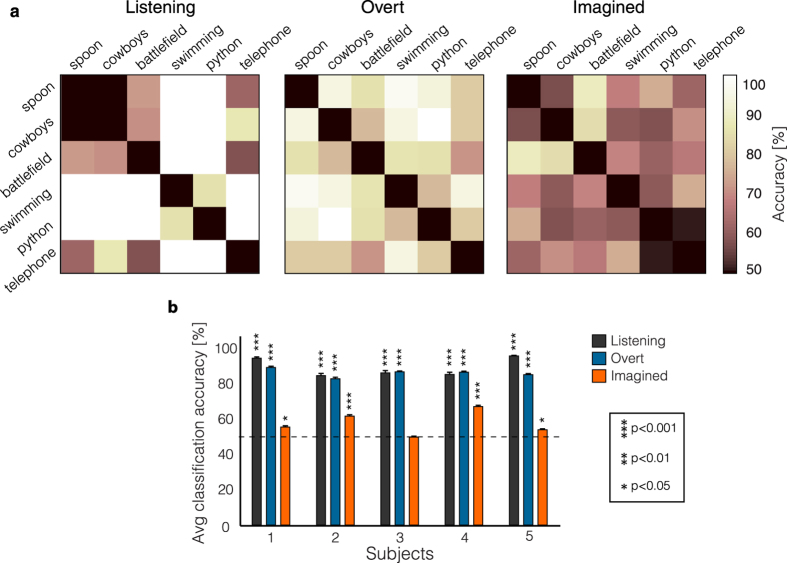
People that cannot communicate due to neurological disorders would benefit from an internal speech decoder. Here, we showed the ability to classify individual words during imagined speech from electrocorticographic signals. In a word imagery task, we used high gamma (70–150 Hz) time features with a support vector machine model to classify individual words from a pair of words. To account for temporal irregularities during speech production, we introduced a non-linear time alignment into the SVM kernel. Classification accuracy reached 88% in a two-class classification framework (50% chance level), and average classification accuracy across fifteen word-pairs was significant across five subjects (mean = 58%; p < 0.05). We also compared classification accuracy between imagined speech, overt speech and listening. As predicted, higher classification accuracy was obtained in the listening and overt speech conditions (mean = 89% and 86%, respectively; p < 0.0001), where speech stimuli were directly presented. The results provide evidence for a neural representation for imagined words in the temporal lobe, frontal lobe and sensorimotor cortex, consistent with previous findings in speech perception and production. These data represent a proof of concept study for basic decoding of speech imagery, and delineate a number of key challenges to usage of speech imagery neural representations for clinical applications.
Overview
The claims and statistics of this paper haven’t been checked yet.
Free: it reads the open-access text and checks the first 5 claims that cite a source we can check. Create a free account to check every claim.
Integrity signals
Registry
Cites
Statistics
Figures



Verification
Claims the paper makes
The claims and statistics of this paper haven’t been checked yet.
Free: it reads the open-access text and checks the first 5 claims that cite a source we can check. Create a free account to check every claim.
Claims other papers make about this one
Each is checked against this paper’s own text: does it say what the citing paper says it does?
The cited source says what the claim attributes to it.
In the citing paper
“Along these lines, when able speakers are instructed to imagine speaking or hearing a word, neural activity in the STG can be used to decode those words with above-chance accuracy59–63.”
From The speech neuroprosthesis (2024) · cites this paper as [59]
Self-check
Percentages, sums and reported differences re-computed from the paper’s own numbers.
The self-check needs the paper’s full text.
Citations
Cites
Controlling the False Discovery Rate: A Practical and Powerful Approach to Multiple Testing
Benjamini, Y., & Hochberg, Y. (1995) · Journal of the Royal Statistical Society Series B: Statistical Methodology · doi:10.1111/j.2517-6161.1995.tb02031.x · Cited by 109,482
LIBSVM: A library for support vector machines
Chang, C.-C., & Lin, C.-J. (2011) · ACM Transactions on Intelligent Systems and Technology · doi:10.1145/1961189.1961199 · Cited by 40,918 · cited 1×
“For all the computations, we used the LIBSVM package 44 .”
MethodThe Elements of Statistical Learning
Hastie, T., Tibshirani, R., & Friedman, J. (2009) · Springer Series in Statistics · doi:10.1007/978-0-387-84858-7 · Cited by 25,970
Fundamentals of speech recognition
Rabiner, L. R., & Juang, B.-H. F. (1993) · Cited by 7,680
Dynamic Programming Algorithm Optimization for Spoken Word Recognition
Sakoe, H., & Chiba, S. (1978) · IEEE Transactions on Acoustics Speech and Signal Processing · doi:10.1109/tassp.1978.1163055 · Cited by 6,727 · cited 2×
“We used dynamic time warping 30,36 (DTW) to locally expand or compress two time series, and find their optimal alignment in time.”
MethodBCI2000: A General-Purpose Brain-Computer Interface (BCI) System
Schalk, G., McFarland, D. J., Hinterberger, T., Birbaumer, N., & Wolpaw, J. R. (2004) · IEEE Transactions on Biomedical Engineering · doi:10.1109/tbme.2004.827072 · Cited by 3,024
Self-citationMultiple Kernel Learning Algorithms
Gönen, M., & Alpaydın, E. (2011) · Journal of Machine Learning Research · doi:10.5555/1953048.2021071 · Cited by 2,173 · cited 2×
“For the final kernel computation, we used a multiple kernel learning approach 37,45 (MKL; see section “Multiple kernel learning” for details) to deal with the multiple kernel matrices – by doing a weighted average of the kernels associated with each electrode (Fig.”
MethodPrice, C. J. (2012) · NeuroImage · doi:10.1016/j.neuroimage.2012.04.062 · Cited by 2,159 · cited 1×
“…imaging studies have shown that imagined speech activates Wernicke’s area 2–8 (superior temporal gyrus and superior temporal sulcus) and Broca’s area 9,10 (inferior frontal gyrus) – two essential language areas involved in speech comprehension and production, respectively (see 11,12 for reviews).”
BackgroundToga, A. W., & Thompson, P. M. (2003) · Nature Reviews Neuroscience · doi:10.1038/nrn1009 · Cited by 1,495
Significance Test for Sphericity of a Normal $n$-Variate Distribution
Mauchly, J. W. (1940) · The Annals of Mathematical Statistics · doi:10.1214/aoms/1177731915 · Cited by 1,136
Cited by
Items 101–172 of 172
Rekrut, M., Fey, A., Nadig, M., Ihl, J., Jungbluth, T., & Krüger, A. (2022) · IEEE International Conference on Metrology for eXtended Reality, Artificial Intelligence and Neural Engineering (MetroXRAINE) · doi:10.1109/metroxraine54828.2022.9967665 · Cited by 8
“This process of silent or imagined speech is comparable to the inner monologue of a person like speaking to oneself or reading a book silently and has become a widely researched topic over the last years [1]–[3].”
BackgroundECoG Beta Suppression and Modulation During Finger Extension and Flexion
Unterweger, J., Seeber, M., Zanos, S. P., Ojemann, J. G., & Scherer, R. (2020) · Frontiers in Neuroscience · doi:10.3389/fnins.2020.00035 · Cited by 9
Roussel, P., Godais, G. L., Bocquelet, F., Palma, M., Jiang, H., Zhang, S., Kahane, P., Chabardès, S., & Yvert, B. (2019) · bioRxiv (Cold Spring Harbor Laboratory) · doi:10.1101/722207 · Cited by 7
Speech imagery brain–computer interfaces: a systematic literature review
Tates, A., Matran‐Fernandez, A., Halder, S., & Daly, I. P. (2025) · Journal of Neural Engineering · doi:10.1088/1741-2552/ade28e · Cited by 13
Progress, challenges and future of linguistic neural decoding with deep learning
Wang, Y., Liu, H., Wang, Y., Xuan, C., Hou, Y., Feng, S., Liu, H., Liao, Y., & Wang, Y. (2025) · Communications Biology · doi:10.1038/s42003-025-08511-z · Cited by 15
Use of BCI Systems in the Analysis of EEG Signals for Motor and Speech Imagery Task : A SLR
Iqbal, A., Suhag, A. K., Kumar, N., & Bhardwaj, A. (2025) · ACM Computing Surveys · doi:10.1145/3757732 · Cited by 8
“In contrast to explicit speech, there is no physical vocalization; however, the neural pathways associated with speech production are stimulated [46].”
Sellami, L., & Neubig, T. (2019) · International Journal of Biosensors & Bioelectronics · doi:10.15406/ijbsbe.2019.05.00160 · Cited by 6
Recognition of imagined speech using electroencephalogram signals
Neubig, T., & Sellami, L. (2019) · Smart Biomedical and Physiological Sensor Technology · doi:10.1117/12.2519028 · Cited by 6
“One such ECoG experiment was led by Stephanie Martin and a team of six other researchers.(6) While ECoG is often preferred over EEG due to its superior spatial resolution and temporal resolution, for this research EEG is preferred due to its noninvasive installation.”
MethodPrediction of Successful Memory Encoding Based on Lateral Temporal Cortical Gamma Power
Jun, S., Kim, J. S., & Chung, C. K. (2021) · Frontiers in Neuroscience · doi:10.3389/fnins.2021.517316 · Cited by 6
Imagined speech can be decoded from low- and cross-frequency features in perceptual spacePreprint
Proix, T., Saa, J. F. D., Christen, A., Martin, S., Pasley, B. N., Knight, R. T., Tian, X., Poeppel, D., Doyle, W., Devinsky, O., et al. (2021) · bioRxiv (Cold Spring Harbor Laboratory) · doi:10.1101/2021.01.26.428315 · Cited by 6
Self-citationNeuronal Avalanches in Naturalistic Speech and Music ListeningPreprint
Neri, M., Runfola, C., Rietmolen, N. T., Sorrentino, P., Schön, D., Morillon, B., & Rabuffo, G. (2023) · bioRxiv (Cold Spring Harbor Laboratory) · doi:10.1101/2023.12.15.571888 · Cited by 7
“This setup is essential for accurately portraying the neurophysiological underpinning of a specific cognitive process (35,36).”
MethodXu, X., & Fu, C. (2024) · IEEE Transactions on Consumer Electronics · doi:10.1109/tce.2024.3472054 · Cited by 6
“Currently, some methods have been developed for imagined speech production [4], [5].”
A Novel SSVEP-Based Brain-Computer Interface Using Joint Frequency and Space Modulation
Wang, Z., Hu, H., Chen, X., Zhou, T., & Xu, T. (2020) · IEEE Conference on Computer Communications Workshops (INFOCOM WKSHPS) · doi:10.1109/infocomwkshps50562.2020.9162716 · Cited by 5
“Though in some cases invasive devices are also adopted to provid with better signal quality and higher spatial resolution [8], [9], due to the great danger caused by intracranial electrodes implantation, noninvasive EEG is still preferred in most relevant studies.”
BackgroundAnalysis of Brain Wave Due to Stimulus Using EEG
Raj, A., & Jaisakthi, S. M. (2018) · International Conference on Computer, Communication and Signal Processing (ICCCSP) · doi:10.1109/icccsp.2018.8452823 · Cited by 5
Speech Recognition with no speech or with noisy speechPreprint
Krishna, G., Tran, C., Yu, J., & Tewfik, A. H. (2019) · arXiv (Cornell University) · doi:10.48550/arxiv.1903.00739 · Cited by 5
“In [3, 4] authors provide interesting results on how Electrocorticography (ECoG) signals, which is an invasive approach can help in speech recognition.”
BackgroundSu, K., & Tian, L. (2025) · PeerJ Computer Science · doi:10.7717/peerj-cs.2938 · Cited by 11
Fernandes, F. G., Raemaekers, M. A. H., Freudenburg, Z. V., & Ramsey, N. F. (2024) · Journal of Neural Engineering · doi:10.1088/1741-2552/ad4178 · Cited by 6
“…feasibility of predicting speech from SMC activity comes from ECoG measurements that successfully used high-band fluctuations ( > 50 Hz), to decode several linguistic components at different levels of complexity including phonemes [20, 22, 53], syllables [34], words [18, 54]), and sentences [27].”
BackgroundTemporal-channel cascaded transformer for imagined handwriting character recognition
Zhou, W., Wang, Y., Mo, L., Li, C., Xu, M., Kong, W., & Dai, G. (2024) · Neurocomputing · doi:10.1016/j.neucom.2024.127243 · Cited by 3
Bisla, M., & Anand, R. S. (2024) · Elsevier eBooks · doi:10.1016/b978-0-443-21870-5.00011-x · Cited by 6
How Does Artificial Intelligence Contribute to iEEG Research?
Berezutskaya, J., Saive, A.-L., Jerbi, K., & van Gerven, M. A. J. (2023) · Studies in neuroscience, psychology and behavioral economics · doi:10.1007/978-3-031-20910-9_47 · Cited by 5
The duality of human cognition: operations and intentionality in mental life and illness
Heinrichs, R. W. (2019) · Neuroscience & Biobehavioral Reviews · doi:10.1016/j.neubiorev.2019.11.002 · Cited by 3
Robust Imagined Speech Production from Electrocorticography with Adaptive Frequency Enhancement
Xu, X., Fu, C., Chen, J., Jeon, G., & Camacho, D. (2024) · International Joint Conference on Neural Networks (IJCNN) · doi:10.1109/ijcnn60899.2024.10651465 · Cited by 2
“Furthermore, Martin et al. [5] combined Hilbert transform and support vector machine (SVM) to reconstruct imagined speech in epileptic patients.”
BackgroundGenerative AI for brain-computer interfaces decoding: Advances, challenges and future
Guo, Y., Ren, G., Ma, S., Zhou, J., Al-Nashash, H. A., Jolfaei, A., Zhang, Z., Li, G., Li, Y., Hu, Y., et al. (2026) · The Innovation Medicine · doi:10.59717/j.xinn-med.2026.100193 · Cited by 8
Hybrid EEG-fNIRS phoneme classification based on imagined and perceived speech
Hons, M., Kober, S. E., Wriessnegger, S. C., & Wood, G. M. D. O. (2026) · Frontiers in Neuroergonomics · doi:10.3389/fnrgo.2026.1696865 · Cited by 3
“Imagined speech generally is considered to evoke subtler differences in neural signatures and consequently lower classification scores than its pendants, perceived speech and speech production (Martin et al., 2016; Sharon et al., 2020).”
[Key technology of brain-computer interaction based on speech imagery].
Liu, Y., Gong, A., Ding, P., Zhao, L., Qian, Q., Zhou, J., Su, L., & Fu, Y. (2022) · PubMed Central · doi:10.7507/1001-5515.202107018 · Cited by 5
Lateralization and Time-Course of Cortical Phonological Representations during Syllable Production
Meier, A. M., Kuzdeba, S., Jackson, L., Daliri, A., Tourville, J. A., Guenther, F. H., & Greenlee, J. D. W. (2023) · eNeuro · doi:10.1523/eneuro.0474-22.2023 · Cited by 3
“…have focused on only one level of linguistic organization, such as sentences (Makin et al., 2020; Komeiji et al., 2022), words (Kellis et al., 2010; Martin et al., 2016), phonemes (Pei et al., 2011; Steinschneider et al., 2011; Toyoda et al., 2014), articulatory kinematics (Chartier et al., 2018;…”
BackgroundEEG Inner Speech Classification Using Machine Learning Cascade Model
Ekizyan, A. K., Shaposhnikov, P. D., Kostulin, D. V., Shevchenko, I. G., & Shaposhnikov, D. G. (2025) · Studies in computational intelligence · doi:10.1007/978-3-031-80463-2_27 · Cited by 2
Online Ternary Classification of Covert Speech by Leveraging the Passive Perception of Speech
Moon, J., & Chau, T. T. (2023) · International Journal of Neural Systems · doi:10.1142/s012906572350048x · Cited by 2
Understanding rumination as a form of inner speech: probing the role of motor processesPreprint
Nalborczyk, L. (2019) · Thesis Commons (OSF Preprints) · doi:10.31237/osf.io/p6dct · Cited by 7
A note on decoding elicited and self-generated inner speechPreprint
Jones, Ō. P., & Voets, N. (2021) · bioRxiv (Cold Spring Harbor Laboratory) · doi:10.1101/2021.05.23.445249 · Cited by 4
Decoding Single and Paired Phonemes Using 7T Functional MRI
Vitória, M. A., Fernandes, F. G., van den Boom, M., Ramsey, N. F., & Raemaekers, M. A. H. (2024) · Brain Topography · doi:10.1007/s10548-024-01034-6 · Cited by 2
“However, some studies observed activation of auditory regions in covert, imagined and attempted speech (Metzger et al. 2023; Zhang et al. 2020; Soroush et al. 2023; Martin et al. 2016), but it needs to be further explored whether this can be used for distinguishing words.”
BackgroundStimulus-independent noninvasive BCI based on EEG patterns of inner speech
Kiroy, V. N., Aslanyan, E. V., Бахтин, О. М., Krivko, E., Paleev, A. V., Gerashchenko, A., Shevchenko, I. G., Saevskiy, A., & Shaposhnikov, D. G. (2024) · Elsevier eBooks · doi:10.1016/b978-0-323-95439-6.00011-9 · Cited by 1
Offenberg, E. C., Berezutskaya, J., Müller, L., Freudenburg, Z. V., Ramsey, N. F., & Vansteensel, M. J. (2026) · Clinical Neurophysiology · doi:10.1016/j.clinph.2026.2111940 · Cited by 3
New Applications of Neurotechnologies for Neurological Disorders
Orsborn, A. L., Pirondini, E., Capogrosso, M., Gaunt, R. A., & Stavisky, S. D. (2025) · Springer eBooks · doi:10.1007/978-3-031-89307-0_25 · Cited by 1
Mohan, A., & Anand, R. S. (2025) · Cognitive Neurodynamics · doi:10.1007/s11571-025-10340-z · Cited by 2
“Martin et al. (2016) did decoding of six words using the SVM algorithm.”
Sümer, E., Saini, R., Chakladar, D. D., Varun, S. K., & Liwicki, F. (2026) · Frontiers in Human Neuroscience · doi:10.3389/fnhum.2026.1838064 · Cited by 2
“Several studies have exploited these advantages to achieve higher decoding performance (Pei et al., 2011; Martin et al., 2016; Komeiji et al., 2024).”
O'Neill, K., House, P. A., & Greger, B. E. (2016) · Asilomar Conference on Signals, Systems and Computers (ACSSC) · doi:10.1109/acssc.2016.7869167 · Cited by 1
RETRACTED CHAPTER: Brain–Computer Interfaces and Neurolinguistics: A Short Review
Aldhaheri, T. A., Kulkarni, S. B., & Bhise, P. R. (2021) · Lecture notes on data engineering and communications technologies · doi:10.1007/978-981-15-8677-4_54 · Cited by 1
RetractedPractical, Conceptual and Ethical Dimensions of a Neuro-controlled Speech Neuroprosthesis
Rainey, S. (2021) · Advances in neuroethics · doi:10.1007/978-3-030-64590-8_13 · Cited by 1
Investigation on Effect of Speech Imagery EEG Data Augmentation with Actual Speech
Choi, J., Kaongoen, N., & Jo, S. (2022) · International Winter Conference on Brain-Computer Interface (BCI) · doi:10.1109/bci53720.2022.9735108 · Cited by 2
Position Paper: Brain Signal-Based Dialogue Systems
Scharenborg, O., & Hasegawa‐Johnson, M. (2021) · Lecture notes in electrical engineering · doi:10.1007/978-981-15-9323-9_36 · Cited by 1
Delgado, J., Christen, A., Martin, S., Pasley, B. N., Knight, R. T., & Giraud, A. (2018) · bioRxiv (Cold Spring Harbor Laboratory) · doi:10.1101/481572 · Cited by 1
Self-citationKrishna, G., Tran, C., Carnahan, M., & Tewfik, A. H. (2020) · arXiv (Cornell University) · doi:10.48550/arxiv.2006.01262 · Cited by 3
Benitez-Andonegui, A. (2021) · Research Publications (Maastricht University) · doi:10.26481/dis.20210301ab · Cited by 2
Online decoding of covert speech based on the passive perception of speechPreprint
Moon, J., & Chau, T. T. (2022) · bioRxiv (Cold Spring Harbor Laboratory) · doi:10.1101/2022.11.13.516334 · Cited by 1
“4 studies have demonstrated the potential of decoding neural patterns relating to the imagery of 70 consonants and vowels (14, 15), phonemes (16,17), syllables (18), whole words (19,20), and 71 sentences (21).”
BackgroundKomeiji, S., Shigemi, K., Mitsuhashi, T., Iimura, Y., Suzuki, H., Sugano, H., Shinoda, K., Yatabe, K., & Tanaka, T. (2024) · bioRxiv (Cold Spring Harbor Laboratory) · doi:10.1101/2024.08.21.608927 · Cited by 2
“These targets may include motor actions or motor intentions [1, 2, 3], internal speech [4, 5, 6], or psychological states [7, 8, 9].”
Predictive models of auditory perception in human electrophysiology
Holdgraf, C. (2017) · eScholarship (California Digital Library)
A Language Model-Based Design of Reduced Phoneme Set for Acoustic Model
Komeiji, S., & Tanaka, T. (2019) · Asia-Pacific Signal and Information Processing Association Annual Summit and Conference (APSIPA ASC) · doi:10.1109/apsipaasc47483.2019.9023292
“Recently, this technology has also been applied to the field of brain machine interface (BMI) for the possibility of decoding the brain activity during speaking, listening or imagining [3], [4], [5], [6], [7].”
MethodSpeech Production in Intracranial Electroencephalography: iBIDS DatasetPreprint
Verwoert, M., Ottenhoff, M. C., Goulis, S., Colon, A., Wagner, L., Tousseyn, S., van Dijk, J. P., Kubben, P., & Herff, C. (2022) · bioRxiv (Cold Spring Harbor Laboratory) · doi:10.1101/2022.04.05.487183
Millán, J. D. R., & Perdikis, S. (2020) · Elsevier eBooks · doi:10.1016/b978-0-12-818422-6.00059-9 · Cited by 1
Self-citationA Framework for Brain-Computer Interfaces Closed-Loop Communication Systems
Cu, M., Peko, G. M., Chan, J., & Sundaram, D. (2023) · Lecture notes of the Institute for Computer Sciences, Social Informatics and Telecommunications Engineering · doi:10.1007/978-3-031-28816-6_6
Multimodal recognition of speech and electrocorticogram
Ahuja, M., Komeiji, S., Mitsuhashi, T., Iimura, Y., Suzuki, H., Sugano, H., Shinoda, K., & Tanaka, T. (2023) · Asia-Pacific Signal and Information Processing Association Annual Summit and Conference (APSIPA ASC) · doi:10.1109/apsipaasc58517.2023.10317527
Feasibility of decoding covert speech in ECoG with a Transformer trained on overt speechPreprint
Komeiji, S., Mitsuhashi, T., Iimura, Y., Suzuki, H., Sugano, H., Shinoda, K., & Tanaka, T. (2024) · Research Square · doi:10.21203/rs.3.rs-3927907/v1
Huettig, F. (2025) · Cambridge University Press eBooks · doi:10.1017/9781009245470.031
Optimizing Temporal and Spectral Interval Selection for Imagined Speech Decoding from EEG
Qiu, F., Tan, T. S., Tiong, M. F. T., & Sheikh, J. (2025) · World Congress on Medical Physics and Biomedical Engineering, September 7 - 12, 2009, Munich, Germany · doi:10.1007/978-3-031-97578-3_17 · Cited by 1
Restoring communication with speech brain–computer interfaces
Prakash, P. R., Luo, S., Crone, N. E., & Slutzky, M. W. (2025) · Elsevier eBooks · doi:10.1016/b978-0-443-24824-5.00015-6 · Cited by 2
Towards decoding inner speech from EEG and MEGPreprint
Csáky, R., van Es, M. W. J., Jones, Ō. P., & Woolrich, M. W. (2025) · bioRxiv (Cold Spring Harbor Laboratory) · doi:10.1101/2025.10.13.682161 · Cited by 4
“This contrasts with more promising results from intracranial recordings in humans (Martin et al., 2016; Wandelt et al., 2022), and suggests non-invasive signals may not adequately capture the subtle dynamics of inner speech.”
Doda, D. Y., He, R., Pang, M., Sun, Y., Li, C., Anwar, F., Yasi, A., Jiang, R., Wang, W., Ming, D., et al. (2025) · Journal of intelligent medicine. · doi:10.1002/jim4.70012 · Cited by 2
“25 This requires modeling between a typical speaker's neural activity patterns and overt and covert speech.”
Comparison of single-channel EEG decoding performance in imagined speech tasks
Ma, X., Ding, Y., Zhao, K., Zhang, P., Tang, Y., Shi, J., Chen, D., Wu, D., & Tang, Z. (2026) · Brain Hemorrhages · doi:10.1016/j.hest.2026.01.001
Word classification across speech modes from low-density electrocorticography signals
de Borman, A., Dyck, B. V., Rooy, K. V., Carrette, E., Meurs, A., Roost, D. V., & Hulle, M. M. V. (2026) · Journal of Neural Engineering · doi:10.1088/1741-2552/ae3a1b · Cited by 1
“A limited number of studies attempted to decode imagined speech (Martin et al 2016, Angrick et al 2021, Proix et al 2022, Komeiji et al 2024, Wandelt et al 2024, Kunz et al 2025) and the decoding accuracy did not match that of attempted or overt speech.”
InfluentialSoft Multiaxial Strain Mapping Interface with AI-Driven Decoding for Silent Speech in Noise
Hong, S., Yoo, J., & Park, S. (2026) · Cyborg and Bionic Systems · doi:10.34133/cbsystems.0536 · Cited by 1
A Convolutional Framework for Mapping Imagined Auditory MEG into Listened Brain Responses
Maghsoudi, M., Rezaeizadeh, M., & Shamma, S. (2025) · Asilomar Conference on Signals, Systems and Computers (ACSSC) · doi:10.1109/ieeeconf67917.2025.11443775 · Cited by 4
“Previous work addressed this difficulty using dynamic time warping (DTW) to temporally align imagined speech to spoken speech [5].”
Nalborczyk, L. (2019) · theses.fr (ABES) · doi:10.70675/f72eff56z8575z4fbbz99a6z91c0f2313786
Analysis of cortical activity for the development of brain-computer interfaces for speech
Roussel, P. (2021) · theses.fr (ABES) · doi:10.70675/809449c4z0d5az4ed2zb815z6c2c02ce8521 · Cited by 1
Decoupling sensory from attentional processes in conscious perception of speech
Garnier-Allain, A. (2022) · theses.fr (ABES) · doi:10.70675/0e9945a4zf9c7z49d6z991az674158fdf237
Cummine, J., Patel, D. H., Holmes, M., Ostevik, A. V., & Aalto, D. (2026) · Frontiers in Human Neuroscience · doi:10.3389/fnhum.2026.1757752
“…show similar activation patterns during imagined and spoken language, with differences largely reflecting sensory consequences of articulation (e.g., hearing one’s own voice; Brumberg et al., 2016; Martin et al., 2016; Novi et al., 2020; Okada et al., 2018; Pei et al., 2011; Si et al., 2021).”
MBCTN: A Multi-band Convolutional Tensor Network for Speech Imagery EEG Decoding
Yan, J., Jin, X., Toya, T., Kong, W., & Ozawa, K. (2026) · Communications in computer and information science · doi:10.1007/978-981-95-8978-4_16
Duhair, H. T. M., Ibrahim, M. B. M., Alsayaydeh, J. A. J., Bacarra, R., Al-Mhiqani, M., & AlZubi, A. A. (2026) · Array · doi:10.1016/j.array.2026.101073
The role of high-amplitude bursts of high-gamma activity in naturalistic speech and music listening
Neri, M., Runfola, C., Guilleminot, P. H., Rietmolen, N. T., Sorrentino, P., Schön, D., Morillon, B., & Rabuffo, G. (2026) · Imaging Neuroscience · doi:10.1162/imag.a.1348 · Cited by 1
“This setup is essential for accurately portraying the neurophysiological underpinning of a specific cognitive process ( Martin et al., 2016; Mercier et al., 2022).”
Sergeyevich, B. P., Konstantinovna, I. T., & Evgenievich, T. M. (2026) · International Siberian workshops and tutorials on electron devices and materials · doi:10.1109/edm69524.2026.11632157
“The systematic investigation of how speech units at different hierarchical levels (letters, syllables, words) modulate cortical oscillations remains largely unexplored [4].”
Rani, S., & Sherly, E. (2026) · Elsevier eBooks · doi:10.1016/b978-0-443-41594-4.00001-0
Serruya, M. D. (2026) · Frontiers in Human Neuroscience · doi:10.3389/fnhum.2026.1893045
Metadata
- Authors
- Martin, S., Brunner, P., Iturrate, I., Millán, J. D. R., Schalk, G., Knight, R. T., & Pasley, B. N.
- Affiliations
- École Polytechnique Fédérale de Lausanne (CH)
- New York State Department of Health (US)
- University of California, Berkeley (US)
- Corresponding author
- Pasley, Brian N.
- ORCID
- Venue
- Scientific Reports
- Published
- 2016-05-11
- Volume
- 6
- Issue
- 1
- Pages
- 25803-25803
- ISSN
- 2045-2322 (ISSN-L)
- PMC
- PMC4863149
- OpenAlex
- W2388216700
- Cited by
- 171
- References
- 52
- Citations by year
- 2026: 14 · 2025: 17 · 2024: 16 · 2023: 15 · 2022: 25 · 2021: 21 · 2020: 17 · 2019: 21 · 2018: 12 · 2017: 11 · 2016: 2
- FWCI
- 9.76
- Type
- journal article
- Language
- en
- Update notices
- correction (2017-03-23)
- Open access
- gold
- doi.org
- Licence
- cc-by
- creativecommons.org/licenses/by/4.0 (tdm)
- creativecommons.org/licenses/by/4.0 (vor)
- Locations
- Scientific Reports (publishedVersion, cc-by)
- PubMed Central (publishedVersion, cc-by)
- PubMed (publishedVersion)
- Infoscience (Ecole Polytechnique Fédérale de Lausanne) (submittedVersion, cc-by-nc-nd)
- Infoscience (Ecole Polytechnique Fédérale de Lausanne) (submittedVersion)
- Funders
- National Institutes of Health (EB018783)
- National Institute on Deafness and Other Communication Disorders (K99DC012804)
- National Institute of Neurological Disorders and Stroke (R37NS021135, EB00856, R3721135)
- National Institute of Biomedical Imaging and Bioengineering (R01EB006356, R01EB000856, P41EB018783)
- Army Research Office (W911NF-14-1, W911NF-08-1, W911NF-14-1-0440, W911NF-12-1-0109, W911NF, W911NF-08-1-0216)
- Topics
- Life Sciences › Neuroscience › Cognitive Neuroscience › EEG and Brain-Computer Interfaces
- Life Sciences › Neuroscience › Cognitive Neuroscience › Neurobiology of Language and Bilingualism
- Life Sciences › Neuroscience › Cognitive Neuroscience › Tactile and Sensory Interactions
- Keywords
- imagined speech, electrocorticography, high-gamma oscillations, support vector machine, overt speech, speech perception, sensorimotor cortex, temporal lobe, frontal lobe, neuroprosthetics
- MeSH terms
- Acoustic Stimulation, Auditory Perception, Brain, Brain Mapping, Discrimination, Psychological, Electrodes, Electroencephalography, Humans, Imagination, ROC Curve, Speech, Time Factors, Vocabulary, Gamma Rhythm
About these checks
Registry, retraction, Cites and statistics results are computed, not judged, with one exception: a printed reference that no index lists is read once by a model before it counts as a citation error. Claims are extracted by a model and kept only when their quote appears verbatim in the text; each cited source is then checked, with a model’s help, for whether it says what the claim relies on. Those verdicts can be wrong — read the claim’s quote and the cited source before relying on one.
Statistics and arithmetic are recomputed, not judged.
Confidence bands are shown only for fields calibrated on our annotated test set. None is calibrated yet, so no band is shown.
What counts as a claim ›How we measure confidence ›How we check this ›
Are you an author, or do you see a problem with this page? Request a review
Data sources
Bibliographic data: Semantic Scholar, OpenAlex, Crossref.
Contains information from the Semantic Scholar Academic Graph Datasets, made available under the ODC Attribution License (ODC-BY 1.0).
Semantic Scholar’s data is described in: Kinney, R., et al. (2023). The Semantic Scholar Open Data Platform. arXiv:2301.10140.
