

Residual Tumor Volume as Best Outcome Predictor in Low Grade Glioma – A Nine-Years Near-Randomized Survey of Surgery vs. Biopsy
Open accessThe DOI matches its Crossref record; 42 of the 44 references it cites were found in a registry or an index.
Abstract
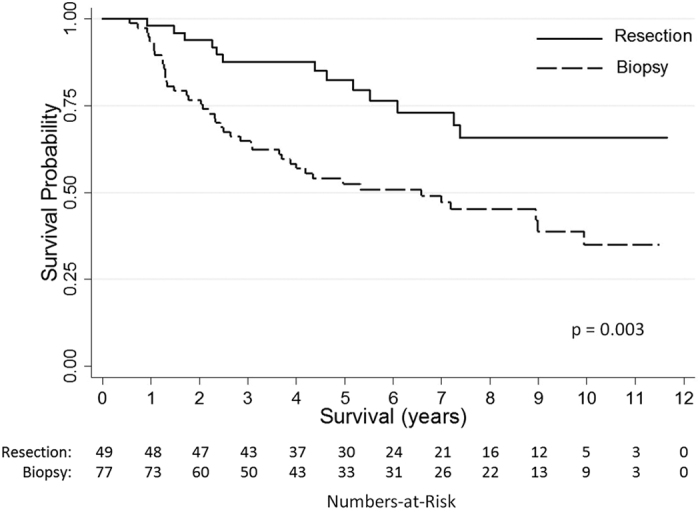
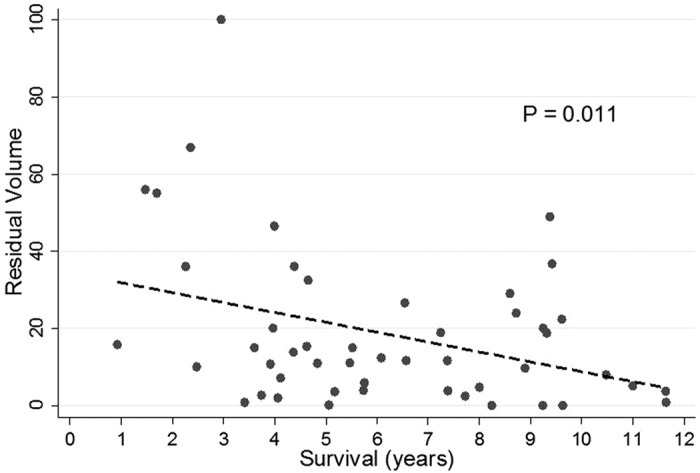
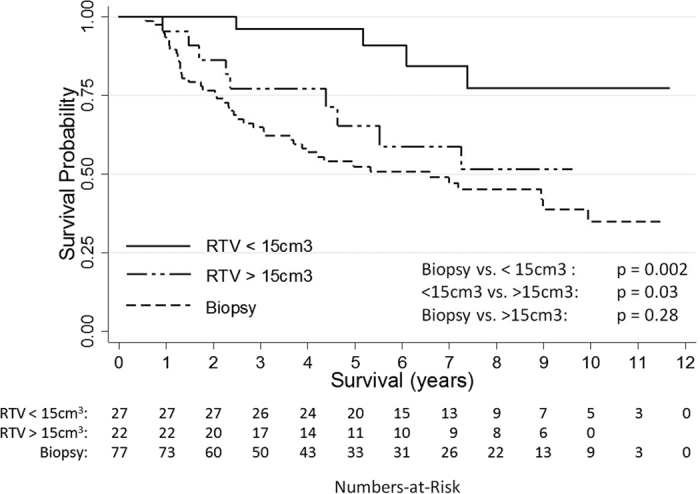
Diffuse low grade gliomas (DLGG) are continuously progressive primary brain neoplasms that lead to neurological deficits and death. Treatment strategies are controversial. Randomized trials establishing the prognostic value of surgery do not exist. Here, we report the results of a nine-year near-randomized patient distribution between resection and biopsy. Until 2012, the Department of Neurosurgery and the Department of Stereotactic Neurosurgery at the University Medical Center Freiburg were organized as separate administrative units both coordinating DLGG patient treatment independently. All consecutive adult patients with a new diagnosis of DLGG by either stereotactic biopsy or resection were included. Pre- and post-operative tumor volumetry was performed. 126 patients, 87 men (69%), 39 women (31%), median age 41 years, were included. 77 (61%) were initially managed by biopsy, 49 (39%) by resection. A significant survival benefit was found for patients with an initial management by resection (5-year OS 82% vs. 54%). The survival benefit of patients with initial resection was reserved to patients with a residual tumor volume of less than 15 cm 3. Maximum safe resection is the first therapy of choice in DLGG patients if a near-complete tumor removal can be achieved. Accurate prediction of the extent-of-resection is required for selection of surgical candidates.
Overview
The claims and statistics of this paper haven’t been checked yet.
Free: it reads the open-access text and checks the first 5 claims that cite a source we can check. Create a free account to check every claim.
Integrity signals
Registry
Cites
Statistics
Figures
Verification
Claims the paper makes
The claims and statistics of this paper haven’t been checked yet.
Free: it reads the open-access text and checks the first 5 claims that cite a source we can check. Create a free account to check every claim.
Claims other papers make about this one
Each is checked against this paper’s own text: does it say what the citing paper says it does?
The source backs part of the claim, not all of it — or backs it for a different population, condition or comparison.
In the citing paper
“RTV > 10–15 cm3 is associated with earlier progression and decreased survival [29,30].”
From BPC 157 Therapy of Myotendinous Junction Injury in Rats (2025) · cites this paper as [29]
Experimental — accuracy not yet measured
Self-check
Percentages, sums and reported differences re-computed from the paper’s own numbers.
The self-check needs the paper’s full text.
Citations
Cites
Charlson, M. E., Pompei, P., Ales, K. L., & MacKenzie, C. R. (1987) · Journal of Chronic Diseases · doi:10.1016/0021-9681(87)90171-8 · Cited by 49,742
The 2007 WHO Classification of Tumours of the Central Nervous System
Louis, D. N., Ohgaki, H., Wiestler, O. D., Cavenee, W. K., Burger, P. C., Jouvet, A., Scheithauer, B. W., & Kleihues, P. (2007) · Acta Neuropathologica · doi:10.1007/s00401-007-0243-4 · Cited by 15,397
Comprehensive, Integrative Genomic Analysis of Diffuse Lower-Grade Gliomas
The Cancer Genome Atlas Research Network (2015) · New England Journal of Medicine · doi:10.1056/nejmoa1402121 · Cited by 3,148
Glioma Groups Based on 1p/19q,IDH, and TERT Promoter Mutations in Tumors
Eckel-Passow, J. E., Lachance, D. H., Molinaro, A. M., Walsh, K. M., Decker, P. A., Sicotte, H., Pekmezci, M., Rice, T., Kosel, M. L., Smirnov, I. V., et al. (2015) · New England Journal of Medicine · doi:10.1056/nejmoa1407279 · Cited by 1,982 · cited 1×
“014 Astrocytoma WHO°II 44 (57%) 18 (37%) Oligoastrocytoma WHO°II 27 (35%) 19 (39%) Oligodendroglioma WHO°II 6 (8%) 12 (24%) Tumor size Maximum diameter, mean, (SD), mm 50 (19) 58 (23) p = 0.”
GLIOMA EXTENT OF RESECTION AND ITS IMPACT ON PATIENT OUTCOME
Sanai, N., & Berger, M. S. (2008) · Neurosurgery · doi:10.1227/01.neu.0000318159.21731.cf · Cited by 1,328
Role of extent of resection in the long-term outcome of low-grade hemispheric gliomas
Smith, J. S., Chang, E. F., Lamborn, K. R., Chang, S. M., Prados, M. D., Cha, S., Tihan, T., VandenBerg, S., McDermott, M. W., & Berger, M. S. (2008) · Journal of Clinical Oncology · doi:10.1200/jco.2007.13.9337 · Cited by 1,283
Prognostic Factors for Survival in Adult Patients With Cerebral Low-Grade Glioma
Pignatti, F., van den Bent, M., Curran, D., Debruyne, C., Sylvester, R., Therasse, P., Áfra, D., Cornu, P., Bolla, M., Vecht, C., et al. (2002) · Journal of Clinical Oncology · doi:10.1200/jco.2002.08.121 · Cited by 955
Neurosurgical Outcomes in a Modern Series of 400 Craniotomies for Treatment of Parenchymal Tumors
Sawaya, R., Hammoud, M., Schoppa, D., Hess, K. R., Wu, S. Z., Shi, W.-M., & WiIdrick, D. M. (1998) · Neurosurgery · doi:10.1097/00006123-199805000-00054 · Cited by 644 · cited 1×
“014 Astrocytoma WHO°II 44 (57%) 18 (37%) Oligoastrocytoma WHO°II 27 (35%) 19 (39%) Oligodendroglioma WHO°II 6 (8%) 12 (24%) Tumor size Maximum diameter, mean, (SD), mm 50 (19) 58 (23) p = 0.”
Jakola, A. S., Myrmel, K. S., Kloster, R., Torp, S. H., Lindal, S., Unsgård, G., & Solheim, O. (2012) · JAMA · doi:10.1001/jama.2012.12807 · Cited by 641
Guidelines on management of low‐grade gliomas: report of an EFNS–EANO* Task Force
Soffietti, R., Baumert, B. G., Bello, L., Von Deimling, A., Duffau, H., Frénay, M., Grisold, W., Grant, R., Graus, F., Hoang‐Xuan, K., et al. (2010) · European Journal of Neurology · doi:10.1111/j.1468-1331.2010.03151.x · Cited by 505
Cited by
Central Nervous System Cancers, Version 3.2020, NCCN Clinical Practice Guidelines in Oncology
Nabors, L. B., Portnow, J., Ahluwalia, M., Baehring, J., Brem, H., Brem, S., Butowski, N., Campian, J. L., Clark, S. W., Fabiano, A. J., et al. (2020) · Journal of the National Comprehensive Cancer Network · doi:10.6004/jnccn.2020.0052 · Cited by 539
Wijnenga, M. M. J., French, P. J., Dubbink, H. J., Dinjens, W. N. M., Atmodimedjo, P. N., Kros, J. M., Smits, M., Gahrmann, R., Rutten, G.-J., Verheul, J. B., et al. (2018) · Neuro-Oncology · doi:10.1093/neuonc/nox176 · Cited by 334
Surgical resection versus watchful waiting in low-grade gliomas
Jakola, A. S., Skjulsvik, A. J., Myrmel, K. S., Sjåvik, K., Unsgård, G., Torp, S. H., Aaberg, K., Berg, T., Dai, H. Y., Johnsen, K., et al. (2017) · Annals of Oncology · doi:10.1093/annonc/mdx230 · Cited by 306
Glioma imaging in Europe: A survey of 220 centres and recommendations for best clinical practice
Thust, S. C., Heiland, S., Falini, A., Jäger, H. R., Waldman, A. D., Sundgren, P. C., Godi, C., Katsaros, V. K., Ramos, A., Bargallo, N., et al. (2018) · European Radiology · doi:10.1007/s00330-018-5314-5 · Cited by 236
“With improved outcomes after complete or near-complete glioma removal, postoperative residual measurement can be expected to become a focus of attention [59, 60].”
BackgroundEvidence-based recommendations on categories for extent of resection in diffuse glioma
Karschnia, P., Vogelbaum, M. A., van den Bent, M., Cahill, D. P., Bello, L., Narita, Y., Berger, M. S., Weller, M., & Tonn, J.-C. (2021) · European Journal of Cancer · doi:10.1016/j.ejca.2021.03.002 · Cited by 212
“When focusing on absolute residual tumor, it has been shown that a linear relationship between residual tumor volume and outcome may exist.(5,64) A postoperative volume of ≤5 cm3 has been used in analogy to near total resection by Smith et al.”
Method
Metadata
- Authors
- Roelz, R., Strohmaier, D., Jabbarli, R., Kraeutle, R., Egger, K., Coenen, V. A., Weyerbrock, A., & Reinacher, P. C.
- Affiliations
- University of Freiburg (DE)
- Corresponding author
- Roelz, Roland
- ORCID
- Venue
- Scientific Reports
- Published
- 2016-08-30
- Volume
- 6
- Issue
- 1
- Pages
- 32286-32286
- ISSN
- 2045-2322 (ISSN-L)
- PMC
- PMC5004168
- OpenAlex
- W2511465040
- Cited by
- 137
- References
- 44
- Citations by year
- 2026: 4 · 2025: 8 · 2024: 8 · 2023: 13 · 2022: 17 · 2021: 16 · 2020: 18 · 2019: 16 · 2018: 20 · 2017: 17
- FWCI
- 12.82
- Type
- journal article
- Language
- en
- Open access
- gold
- doi.org
- Licence
- cc-by
- creativecommons.org/licenses/by/4.0 (tdm)
- creativecommons.org/licenses/by/4.0 (vor)
- Locations
- Scientific Reports (publishedVersion, cc-by)
- PubMed Central (publishedVersion, cc-by)
- PubMed (publishedVersion)
- FreiDok plus (Universitätsbibliothek Freiburg) (submittedVersion)
- Topics
- Health Sciences › Medicine › Oncology › Glioma Diagnosis and Treatment
- Health Sciences › Medicine › Oncology › Ovarian cancer diagnosis and treatment
- Health Sciences › Medicine › Radiology, Nuclear Medicine and Imaging › Advanced Neuroimaging Techniques and Applications
- Keywords
- diffuse low-grade glioma, residual tumor volume, extent of resection, tumor resection, stereotactic biopsy, tumor volume measurement, survival, prognostic factors, adult brain tumors
- MeSH terms
- Adult, Biopsy, Brain Neoplasms, Female, Glioma, Humans, Male, Middle Aged, Prognosis, Surveys and Questionnaires, Survival Analysis, Outcome Assessment, Health Care, Neoplasm, Residual, Neurosurgical Procedures, Tumor Burden, Neoplasm Grading
About these checks
Registry, retraction, Cites and statistics results are computed, not judged, with one exception: a printed reference that no index lists is read once by a model before it counts as a citation error. Claims are extracted by a model and kept only when their quote appears verbatim in the text; each cited source is then checked, with a model’s help, for whether it says what the claim relies on. Those verdicts can be wrong — read the claim’s quote and the cited source before relying on one.
Statistics and arithmetic are recomputed, not judged.
Confidence bands are shown only for fields calibrated on our annotated test set. None is calibrated yet, so no band is shown.
What counts as a claim ›How we measure confidence ›How we check this ›
Are you an author, or do you see a problem with this page? Request a review
Data sources
Bibliographic data: Semantic Scholar, OpenAlex, Crossref.
Contains information from the Semantic Scholar Academic Graph Datasets, made available under the ODC Attribution License (ODC-BY 1.0).
Semantic Scholar’s data is described in: Kinney, R., et al. (2023). The Semantic Scholar Open Data Platform. arXiv:2301.10140.
