

The DOI matches its Crossref record.
A novel method for PEGylation of chitosan nanoparticles through photopolymerization
Abstract
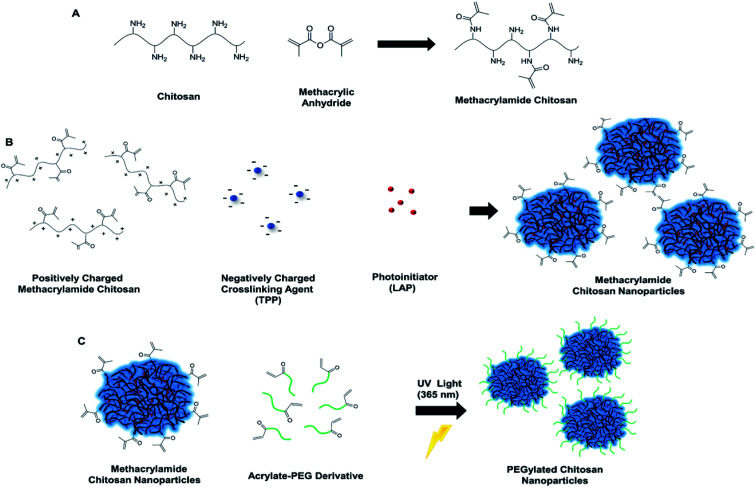
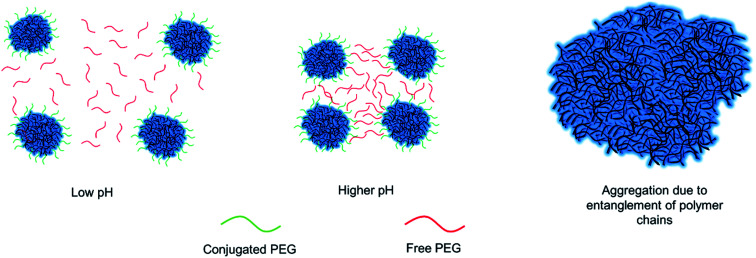
An ultrafast and convenient method for PEGylation of chitosan nanoparticles has been established through a photopolymerization reaction between the acrylate groups of PEG and methacrylated-chitosan nanoparticles.
Overview
The claims and statistics of this paper haven’t been checked yet.
Run the check — free, no account needed. It reads the open-access text and checks the sources it cites.
Integrity signals
Registry
Cites
Statistics
Figures
Verification
Claims the paper makes
The claims and statistics of this paper haven’t been checked yet.
Run the check — free, no account needed. It reads the open-access text and checks the sources it cites.
Claims other papers make about this one
Each is checked against this paper’s own text: does it say what the citing paper says it does?
In the citing paper
“PEGylation is a suitable method for introducing new physicochemical properties to chitosan such as the solubility at wide range of pH values.188”
From Current Advances in Chitosan Nanoparticles Based Oral Drug Delivery for Colorectal Cancer Treatment (2022) · cites this paper as [189]
Self-check
Percentages, sums and reported differences re-computed from the paper’s own numbers.
The self-check needs the paper’s full text.
Citations
Cites
No references could be resolved yet.
Research works printed but not linked: 28
- Ferrari, 2005, Nat. Rev. Cancer, 5, 161, 10.1038/nrc1566 · DOI · Paper page
- Liang, 2008, Curr. Drug Metab., 9, 697, 10.2174/138920008786049230 · DOI
- Petros, 2010, Nat. Rev. Drug Discovery, 9, 615, 10.1038/nrd2591 · DOI · Paper page
- Saboktakin, 2017, Adv. Mater. Sci., 2, 1, 10.15761/AMS.1000127 · DOI
- Sun, 2014, Angew. Chem., Int. Ed., 53, 12320, 10.1002/anie.201403036 · DOI · Paper page
- Zhang, 2008, Clin. Pharmacol. Ther., 83, 761, 10.1038/sj.clpt.6100400 · DOI
- Albanese, 2012, Annu. Rev. Biomed. Eng., 14, 1, 10.1146/annurev-bioeng-071811-150124 · DOI
- Aider, 2010, LWT--Food Sci. Technol., 43, 837, 10.1016/j.lwt.2010.01.021 · DOI
- Dutta, 2004, J. Sci. Ind. Res., 63, 20
- Rinaudo, 2006, Prog. Polym. Sci., 31, 603, 10.1016/j.progpolymsci.2006.06.001 · DOI
- Rabea, 2003, Biomacromolecules, 4, 1457, 10.1021/bm034130m · DOI · Paper page
- Rodrigues, 2012, J. Funct. Biomater., 3, 615, 10.3390/jfb3030615 · DOI
- Tan, 2009, Biomaterials, 30, 2499, 10.1016/j.biomaterials.2008.12.080 · DOI
- Mohammed, 2017, Pharmaceutics, 9, 53, 10.3390/pharmaceutics9040053 · DOI
- Bhattarai, 2010, Adv. Drug Delivery Rev., 62, 83, 10.1016/j.addr.2009.07.019 · DOI
- Roy, 1999, Nat. Med., 5, 387, 10.1038/7385 · DOI
- Yu, 2007, J. Biomed. Mater. Res., Part A, 82, 243, 10.1002/jbm.a.31069 · DOI
- Amsden, 2007, Biomacromolecules, 8, 3758, 10.1021/bm700691e · DOI
- Bozuyuk, 2018, ACS Nano, 12, 9617, 10.1021/acsnano.8b05997 · DOI
- Brunel, 2008, Langmuir, 24, 11370, 10.1021/la801917a · DOI
- Khachane, 2011, Pharmazie, 66, 334
- Dong, 2013, Carbohydr. Polym., 94, 940, 10.1016/j.carbpol.2013.02.013 · DOI
- Divya, 2018, Environ. Chem. Lett., 16, 101, 10.1007/s10311-017-0670-y · DOI
- Makhlof, 2011, Eur. J. Pharm. Sci., 42, 445, 10.1016/j.ejps.2010.12.007 · DOI
- Malhotra, 2011, Int. J. Nanomed., 6, 485
- Zhang, 2007, Biotechnol. Appl. Biochem., 46, 197, 10.1042/BA20060163 · DOI
- Bozuyuk, 2018, ACS Appl. Mater. Interfaces, 10, 33945, 10.1021/acsami.8b11178 · DOI
- Casettari, 2012, Prog. Polym. Sci., 37, 659, 10.1016/j.progpolymsci.2011.10.001 · DOI · Paper page
Cited by
Sorted by citations
Current Advances in Chitosan Nanoparticles Based Oral Drug Delivery for Colorectal Cancer Treatment
Choukaife, H., Seyam, S., Alallam, B., Doolaanea, A. A., & Alfatama, M. (2022) · International Journal of Nanomedicine · doi:10.2147/ijn.s375229 · Cited by 127
Metadata
- Authors
- Bozuyuk, U., Gokulu, I. S., Dogan, N. O., & Kizilel, S.
- Venue
- RSC Advances
- Publisher
- Royal Society of Chemistry (RSC)
- Published
- 2019
- Volume
- 9
- Issue
- 25
- Pages
- 14011-14015
- ISSN
- 2046-2069
- PMC
- PMC9063996
- Cited by
- 16
- References
- 0
- Language
- en
- Funders
- Türkiye Bilimsel ve Teknolojik Araştirma Kurumu (116M995)
About these checks
Registry, retraction, Cites and statistics results are computed, not judged, with one exception: a printed reference that no index lists is read once by a model before it counts as a citation error. Claims are extracted by a model and kept only when their quote appears verbatim in the text; each cited source is then checked, with a model’s help, for whether it says what the claim relies on. Those verdicts can be wrong — read the claim’s quote and the cited source before relying on one.
Statistics and arithmetic are recomputed, not judged.
Confidence bands are shown only for fields calibrated on our annotated test set. None is calibrated yet, so no band is shown.
What counts as a claim ›How we measure confidence ›How we check this ›
Are you an author, or do you see a problem with this page? Request a review
