

Exploiting controlled transesterification as a “top down” approach to tailor poly( ε -caprolactone)-poly(lactic acid) copolymer structures with bis-Zn catalysts
Open accessThe DOI matches its Crossref record; 50 of the 50 references it cites were found in a registry or an index; 1 of the 17 sources its claims cite were checked for support.
Abstract
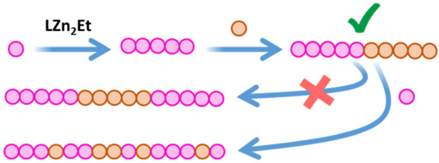
Mediated by a bis-Zn catalyst, poly(lactic acid)- block -poly( ε -caprolactone) diblock copolymers can be modified via controlled transesterification, leading to diverse copolymer structures.
Overview
CoChat Summary
TL;DR
Controlled Zn-mediated transesterification, triggered by adding ε-caprolactone to living PCL-*block*-PLA chains, can be used as a “top down” post-polymerisation method to tune PCL-PLA copolymer randomness versus blockiness. Increasing the ε-CL stoichiometry and decreasing the diblock precursor length increase randomness, while low ε-CL loading or δ-valerolactone tips the balance toward transesterification.
Key findings
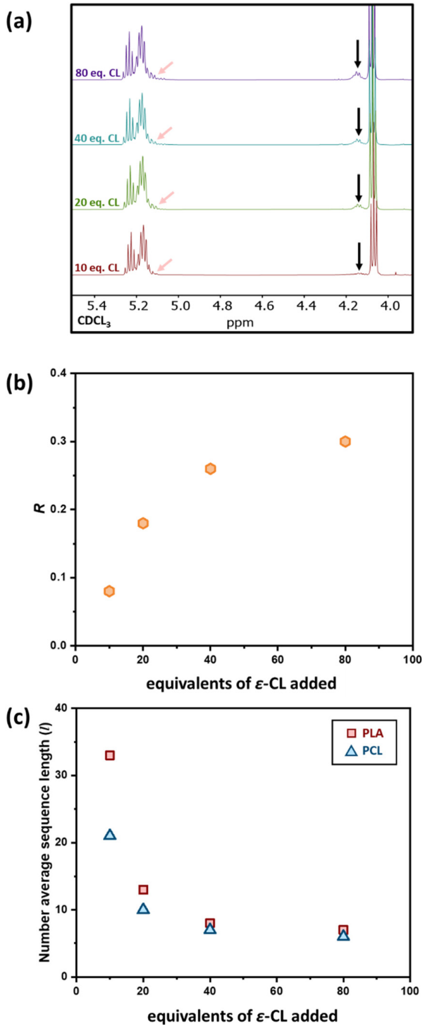
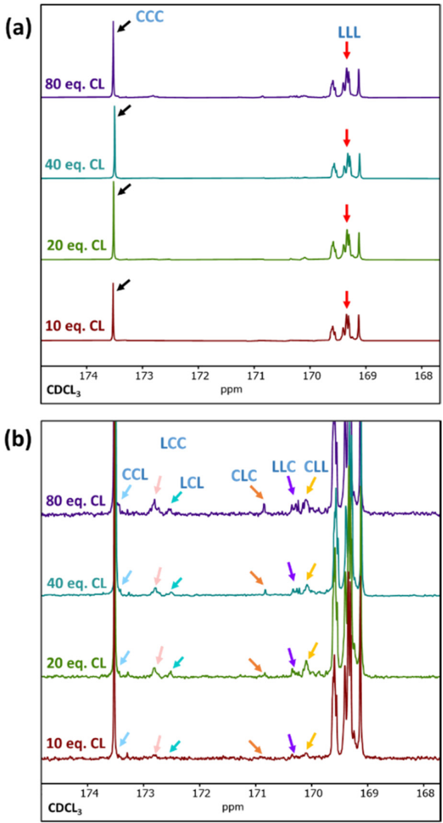
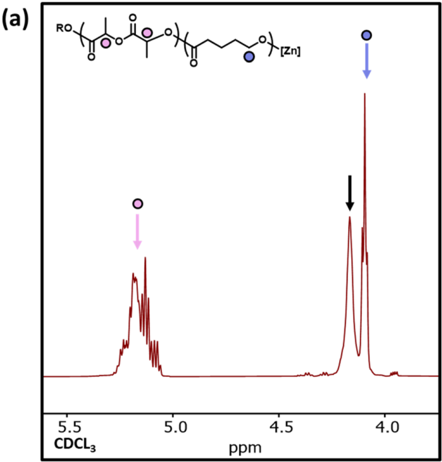
- Adding 10, 20, 40, and 80 eq. of ε-CL to PCL₂₀₀-*block*-PLA₂₀₀* increased the randomness value R from 0.02 in the control to 0.08, 0.18, 0.26, and 0.30, respectively; average sequence lengths fell from l_LA/l_CL = 100/101 in the control to 33/21, 13/10, 8/7, and 7/6 (Table 1).
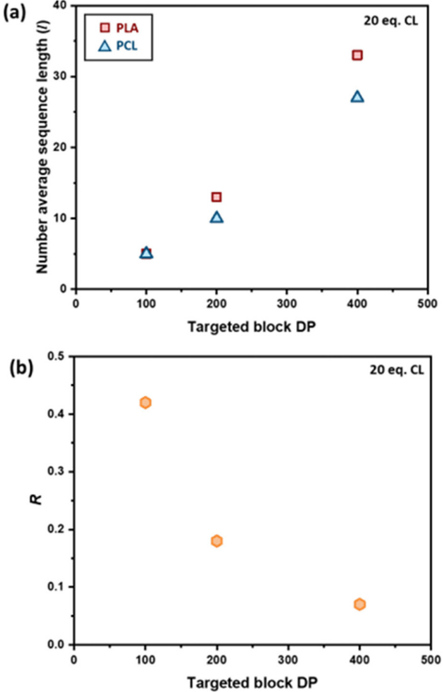
- Block length also controlled the extent of transesterification: with 20 eq. ε-CL, PCL₁₀₀-*block*-PLA₁₀₀ gave R = 0.42 and l_LA/l_CL = 5/5, PCL₂₀₀-*block*-PLA₂₀₀ gave R = 0.18 and l_LA/l_CL = 13/10, and PCL₄₀₀-*block*-PLA₄₀₀ gave R = 0.07 and l_LA/l_CL = 33/27.
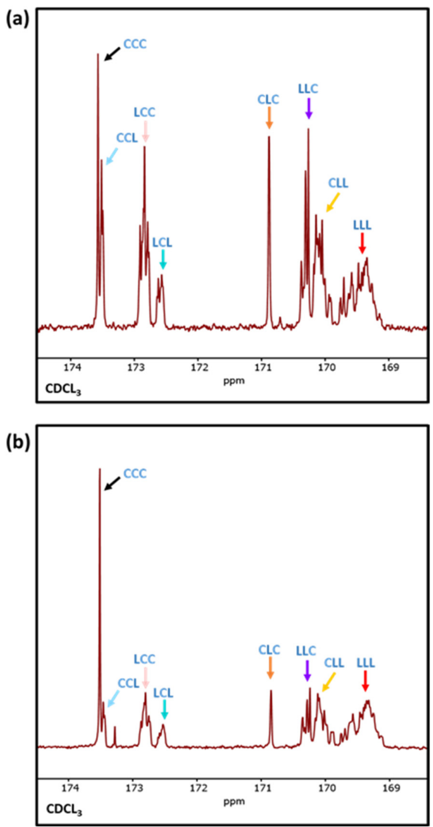
- Transesterification disrupted both PCL and PLA blocks: PLA₂₀* + 20 eq. ε-CL gave l_LA = 1, l_CL = 2, R = 1.33; PCL₁₀-*block*-PLA₂₀ + 10 eq. ε-CL gave l_LA = l_CL = 2, R = 1.05. In the latter, ε-CL in CCC sequences fell to 37% from a theoretical 90% (91% observed), and LA in LLL sequences fell to 52% from a theoretical 95% (96% observed); if ε-CL were inserted only into the PLA block, the minimum CCC percentage would be 45%.
- Post-polymerisation modification of an isolated PCL₂₀₀-*block*-PLA₂₀₀ with 40 eq. ε-CL gave l_LA = 15, l_CL = 13, R = 0.15, versus l_LA = 8, l_CL = 7, R = 0.26 for the comparable one-pot sample 3; no CLC or LCL triads were observed, indicating lower transesterification for the isolated precursor.
Methods
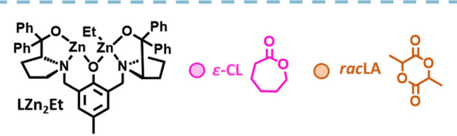
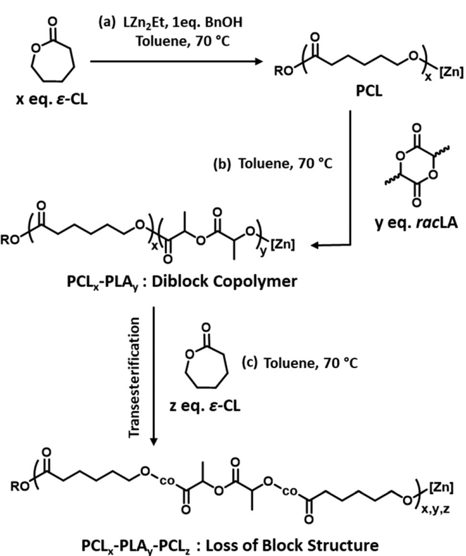
- PCL-*block*-PLA copolymers were prepared by ring-opening polymerisation using LZn₂Et/BnOH, with sequential addition of ε-CL then LA; extended diblocks targeted PCLₙ-*block*-PLAₙ (n = 100, 200, 400) under optimised conditions (ε-CL loading 22% w/w in toluene, 70 °C). ε-CL conversion was ≥95% in <5 min, and rac-LA conversion was ≥80% in <1 h.
- Transesterification was induced by adding ε-CL or δ-VL to living or isolated copolymer chains; products were analysed by ¹H NMR, quantitative ¹³C NMR, SEC, DOSY, and DSC, with l_LA, l_CL, R, and triad distributions calculated from NMR.
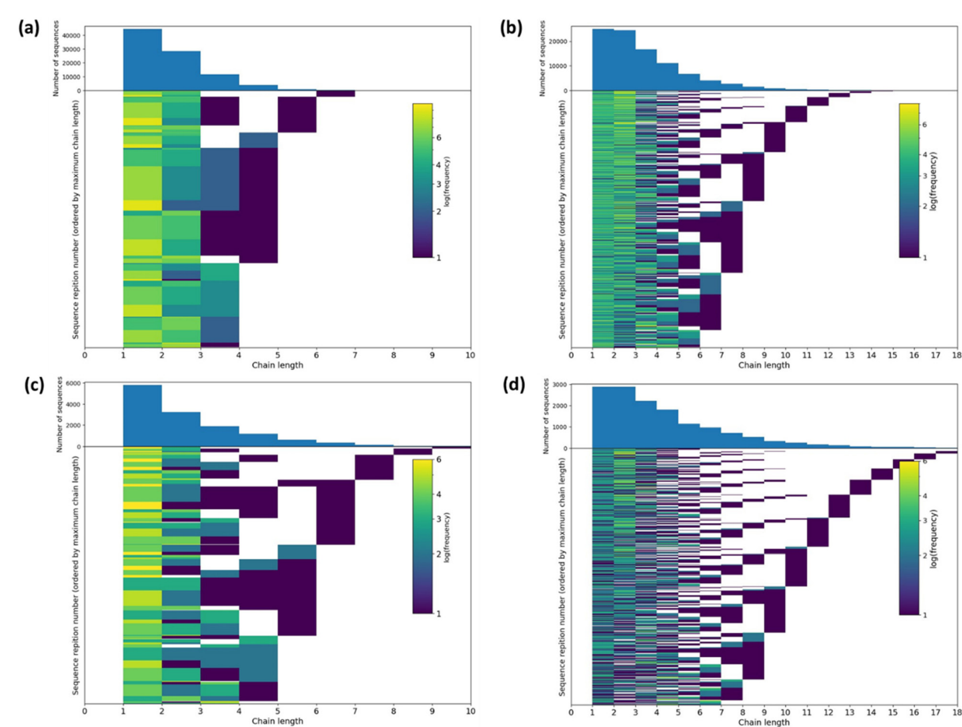
- Reverse Monte Carlo simulations were used to model oligomeric copolymer structures for samples 8 and 9, using 5 × 10⁴ iterations; lowest scores were 14 for sample 8 and 11 for sample 9, compared with a random-sequence score of 28.
Limitations
- The paper does not include a dedicated limitations section. The text notes that ¹H and ¹³C NMR spectra give information averaged over the entire system, so transesterification may occur only in a fraction of the copolymers while others remain unaffected.
- The post-polymerisation modification route deviated from the one-pot route, which the authors suggest may arise from inefficiencies in forming the activated copolymer, i.e. not all copolymer chains are activated by LZn₂Et.
- Simulations were performed on oligomeric model systems to facilitate structural analysis, rather than on the full range of copolymer samples.
Model-written summary. Check it against the paper before relying on it.
Integrity signals
Registry
Cites
Statistics
Figures

Verification
Claims the paper makes
0 Valid · 2 Not valid · 15 Not checked · 86 Own results and interpretations
The cited sources that could be checked couldn’t confirm or dispute this claim.
In the paper
“The high concentration of ε-CL drives the ring-opening of the third monomer, a feature that has been previously reported for other systems.44,45”
§ Exploiting controlled transesterification as a "top down" approach to tailor poly > Factors influencing the extent of transesterification
What the sources say
- Could not verifycites [44] 44. S. Petrovic, Electrochem. Crash Course Eng, 2021, pp. 27-30. sourceExperimental — accuracy not yet measured
The citation appears to support the statement that this concentration-driven ring-opening has been reported in another system. Semantic Scholar identifies Petrovic’s “Effect of Concentration” but returns no full-text snippets for either of two relevant queries, and we do not hold the chapter’s text. Unscoped results discuss ε-CL ring-opening in other papers, but none provides a high-scoring match for the claimed effect on a third monomer; they do not establish misattribution or confirm what Petrovic reports. (LLM, conf=0.68)
- Not matchedcites [45] 45. S. Penczek, J. Pretula and S. Slomkowski, Chem. Teach. Int., 2021, 3, 33-57.
Couldn’t be matched to a paper in Crossref, so it can’t be checked.
plainstates a cause- Asserted: passes — The authors put it forward as true.
- Checkable: passes — It can be checked against evidence.
- Load-bearing: unclear — It is unclear whether the paper’s conclusions depend on it.
- Based: passes — The paper gives a reason why it holds.
- Could not verify
The paper states this without a source or data behind it here, so there is nothing to check it against. The quote shows it is in the paper.
In the paper
“The l and R values showed a clear increase in transesterification upon increasing the ε-CL stoichiometry (Fig. 2 and Table 1).”
§ Exploiting controlled transesterification as a "top down" approach to tailor poly > Factors influencing the extent of transesterification
states a cause- Asserted: passes — The authors put it forward as true.
- Checkable: passes — It can be checked against evidence.
- Load-bearing: passes — The paper’s conclusions depend on it.
- Based: unclear — It is unclear why the paper says it holds.
A result the paper states — it cites no source for it, so there is none to check. The quote shows it is in the paper.
In the paper
“Transesterification is instigated and controlled by the addition of ε-CL to a PCL-block-PLA* chain in the presence of a bis-zinc catalyst.”
§ Exploiting controlled transesterification as a "top down" approach to tailor poly > Introduction
plainstates a cause- Asserted: passes — The authors put it forward as true.
- Checkable: passes — It can be checked against evidence.
- Load-bearing: passes — The paper’s conclusions depend on it.
- Based: passes — The paper gives a reason why it holds.
A result the paper reports from its own data — it cites no other source for it, so there is none to check. The quote shows it is in the paper.
In the paper
“1 H NMR analysis showed high conversion of rac-LA to PLA in under 1 h (≥80%)”
§ Exploiting controlled transesterification as a "top down" approach to tailor poly > Synthesis of PCL-PLA copolymers
plain- Asserted: passes — The authors put it forward as true.
- Checkable: passes — It can be checked against evidence.
- Load-bearing: passes — The paper’s conclusions depend on it.
- Based: passes — The paper gives a reason why it holds.
A result the paper reports from its own data — it cites no other source for it, so there is none to check. The quote shows it is in the paper.
In the paper
“For PCL 100block-PLA 100 , integration of the PCL and PLA resonances determined the PCL : PLA composition to be 116 : 84 (Fig. S2b †), which was comparable to the targeted value.”
§ Exploiting controlled transesterification as a "top down" approach to tailor poly > Synthesis of PCL-PLA copolymers
plainSingle case- Asserted: passes — The authors put it forward as true.
- Checkable: passes — It can be checked against evidence.
- Load-bearing: unclear — It is unclear whether the paper’s conclusions depend on it.
- Based: passes — The paper gives a reason why it holds.
52 more claims
Create a free account to see all 103 claims and every source verdict.
- It may state two separate claims as one. 37
- The quote only partly states this claim. 1
- Probably not a substantial claim. 9
Citations
Cites
Self-assembly of block copolymers
Mai, Y., & Eisenberg, A. (2012) · Chemical Society Reviews · doi:10.1039/c2cs35115c · Cited by 3,610
Farah, S., Anderson, D. G., & Langer, R. (2016) · Advanced Drug Delivery Reviews · doi:10.1016/j.addr.2016.06.012 · Cited by 3,443
Block Copolymers—Designer Soft Materials
Bates, F. S., & Fredrickson, G. H. (1999) · Physics Today · doi:10.1063/1.882522 · Cited by 3,219
Blanazs, A., Armes, S. P., & Ryan, A. J. (2009) · Macromolecular Rapid Communications · doi:10.1002/marc.200800713 · Cited by 1,500
Advanced drug delivery devices via self-assembly of amphiphilic block copolymers
Rösler, A., Vandermeulen, G. W. M., & Klok, H.-A. (2001) · Advanced Drug Delivery Reviews · doi:10.1016/s0169-409x(01)00222-8 · Cited by 1,168
Biobased plastics and bionanocomposites: Current status and future opportunities
Reddy, M. M., Vivekanandhan, S., Misra, M., Bhatia, S. K., & Mohanty, A. K. (2013) · Progress in Polymer Science · doi:10.1016/j.progpolymsci.2013.05.006 · Cited by 1,080
Plastics derived from biological sources: present and future: a technical and environmental review
Chen, G.-Q., & Patel, M. K. (2012) · Chemical Reviews · doi:10.1021/cr200162d · Cited by 997
Progress in bio-based plastics and plasticizing modifications
Mekonnen, T., Mussone, P., Khalil, H., & Bressler, D. (2013) · Journal of Materials Chemistry A · doi:10.1039/c3ta12555f · Cited by 831
(2000) · Medical Entomology and Zoology · Cited by 822
Advanced drug delivery devices via self-assembly of amphiphilic block copolymers
Rösler, A., Vandermeulen, G. W. M., & Klok, H.-A. (2012) · Advanced Drug Delivery Reviews · doi:10.1016/j.addr.2012.09.026 · Cited by 688
Research works printed but not linked: 8
- Kumar, 2014, J. Food Prod. Dev. Packag., 1, 1
- Reddy, 2013, Int. J. Emerging Technol. Adv. Eng., 3, 82
- Sudesh, 2008, Clean: Soil, Air, Water, 36, 433
- King, 2003, Langmuir, 8428
- Xiao, 2010, Int. J. Nanomed., 5, 1057
- S.Petrovic , Electrochem. Crash Course Eng , 2021 , pp. 27–30
- A.Duda and S.Penczek , Polymers from renewable resources: biopolyesters and biocatalysis , ACS symposium series , Washington DC , 2000
- Sangroniz, 2022, Polymers, 14, 1
Cited by
Ntrivala, M. A., Pitsavas, A. C., Lazaridou, K., Baziakou, Z., Karavasili, D., Papadimitriou, M., Ntagkopoulou, C., Balla, E., & Bikiaris, D. N. (2025) · European Polymer Journal · doi:10.1016/j.eurpolymj.2025.114033 · Cited by 178
A decade of innovation: Synthesis, properties and applications of PLA copolymers
Terzopoulou, Z. N., Zamboulis, A., Bikiaris, N. D., Xanthopoulou, E., Ioannidis, R. O., & Bikiaris, D. Ν. (2025) · Progress in Polymer Science · doi:10.1016/j.progpolymsci.2025.101991 · Cited by 68
Ji, R., Fan, M., Liang, L., Tian, C., Dong, S., Deng, C., Wu, H. B., Zhou, L., & Zhao, X. (2025) · Chemical Engineering Journal · doi:10.1016/j.cej.2025.169602 · Cited by 27
Abdul Rahman, M., Neal, T. J., & Garden, J. A. (2024) · Chemical Communications · doi:10.1039/d4cc01664e · Cited by 11
Self-citationNeal, T. J., & Nicolas, J. (2024) · Chemical Communications · doi:10.1039/d4cc04718d · Cited by 8
Self-citationPearcy, R. J., Berrow, S. R., & Platel, R. H. (2025) · Faraday Discussions · doi:10.1039/d5fd00055f · Cited by 3
Baer, A. L., Clarke, R. W., Gowda, R. R., Hesse, S. A., Crowley, M., Xu, S., Hamernik, L. J., Curley, J. B., Urgun-Demirtas, M., Tassone, C. J., et al. (2026) · ACS Sustainable Chemistry & Engineering · doi:10.1021/acssuschemeng.6c00712 · Cited by 2
“29 Rather than targeting perfect diblock structures, we maintain that ease of synthesis”
On the upcycling of PCL to produce building blocks for the development of PCL-PLA copolymers
Damonte, G., Dullaert, L., Pellis, A., Giribaldi, L., & Monticelli, O. (2026) · European Polymer Journal · doi:10.1016/j.eurpolymj.2026.114563 · Cited by 4
Polyester metamorphosis via carbonyl-to-thiocarbonyl editing for tuning polymer lifetime
Hill, M. J. S., Jeschke, J., Mutlu, H., & Garden, J. A. (2026) · Chem Circularity · doi:10.1016/j.checir.2026.100029 · Cited by 3
Self-citationLuo, Z., Ouyang, X., Tian, G., Chen, S., Wu, G., & Wang, Y. (2025) · Macromolecules · doi:10.1021/acs.macromol.5c01700 · Cited by 1
Controlling Sequence and Reactivity in Lactide-based Macromonomers for Hybrid Acrylic Design
Watcharakitti, J., Chamlongrath, B., Severtson, N. P., Smith, T. G., & Severtson, S. J. (2026) · Industrial & Engineering Chemistry Research · doi:10.1021/acs.iecr.5c05340
Nath, P., Sagar, S., Ray, A., Karmakar, H., Mehar, R. K., Sarkar, A., & Panda, T. K. (2026) · Applied Organometallic Chemistry · doi:10.1002/aoc.70635
Hu, Z., Dong, W., Wang, B., et al. (2026) · Materials · doi:10.3390/ma19194221
Metadata
- Authors
- Neal, T. J., Neal, E. D., Cumby, J., & Garden, J. A.
- Affiliations
- University of Edinburgh (GB)
- University of Bristol (GB)
- Corresponding author
- Garden, Jennifer A.
- Venue
- Polymer Chemistry
- Publisher
- Royal Society of Chemistry (RSC)
- Published
- 2024
- Volume
- 15
- Issue
- 17
- Pages
- 1704-1713
- ISSN
- 1759-9954 (ISSN-L)
- 1759-9962
- OpenAlex
- W4393905611
- Semantic Scholar
- 0f6f251b7f08fe5cc71cc9a2aa8909bc769a61a3
- Cited by
- 12
- References
- 47
- Citations by year
- 2026: 6 · 2025: 5 · 2024: 2
- FWCI
- 1.31
- Type
- journal article
- Language
- en
- Open access
- hybrid
- doi.org
- Licence
- Locations
- Polymer Chemistry (publishedVersion, cc-by)
- Edinburgh Research Explorer (University of Edinburgh) (submittedVersion, cc-by)
- Funders
- UK Research and Innovation (MR/T042710/1)
- Engineering and Physical Sciences Research Council (EP/S023593/1)
- Royal Society (RSG\R1\180101)
- Topics
- Physical Sciences › Materials Science › Biomaterials › biodegradable polymer synthesis and properties
- Physical Sciences › Chemistry › Organic Chemistry › Advanced Polymer Synthesis and Characterization
- Physical Sciences › Chemical Engineering › Process Chemistry and Technology › Carbon dioxide utilization in catalysis
- Keywords
- polycaprolactone, polylactic acid, block copolymers, transesterification, top-down approach, ring-opening polymerization
About these checks
Registry, retraction, Cites and statistics results are computed, not judged, with one exception: a printed reference that no index lists is read once by a model before it counts as a citation error. Claims are extracted by a model and kept only when their quote appears verbatim in the text; each cited source is then checked, with a model’s help, for whether it says what the claim relies on. Those verdicts can be wrong — read the claim’s quote and the cited source before relying on one.
The claim verdicts this report counts are experimental: their accuracy is not yet measured.
A language model drew the claims from the paper on 2026-09-30, under version 3 of the claim definition (model deepseek-v4.1-flash, prompt extract-v3).
A second model labelled each claim on 2026-09-30 (model jev-1.13-20260917, definition revision gold-guideline-v0.2).
Cited sources are checked with a language model’s help (gpt-6-sol).
Statistics and arithmetic are recomputed, not judged.
Confidence bands are shown only for fields calibrated on our annotated test set. None is calibrated yet, so no band is shown.
What counts as a claim ›How we measure confidence ›How we check this ›
Are you an author, or do you see a problem with this page? Request a review
Data sources
Bibliographic data: Semantic Scholar, OpenAlex, Crossref.
Contains information from the Semantic Scholar Academic Graph Datasets, made available under the ODC Attribution License (ODC-BY 1.0).
Semantic Scholar’s data is described in: Kinney, R., et al. (2023). The Semantic Scholar Open Data Platform. arXiv:2301.10140.
