

The Risk of Penetration–Aspiration Related to Residue in the Pharynx
Open accessThe DOI matches its Crossref record; 24 of the 24 references it cites were found in a registry or an index.
Abstract
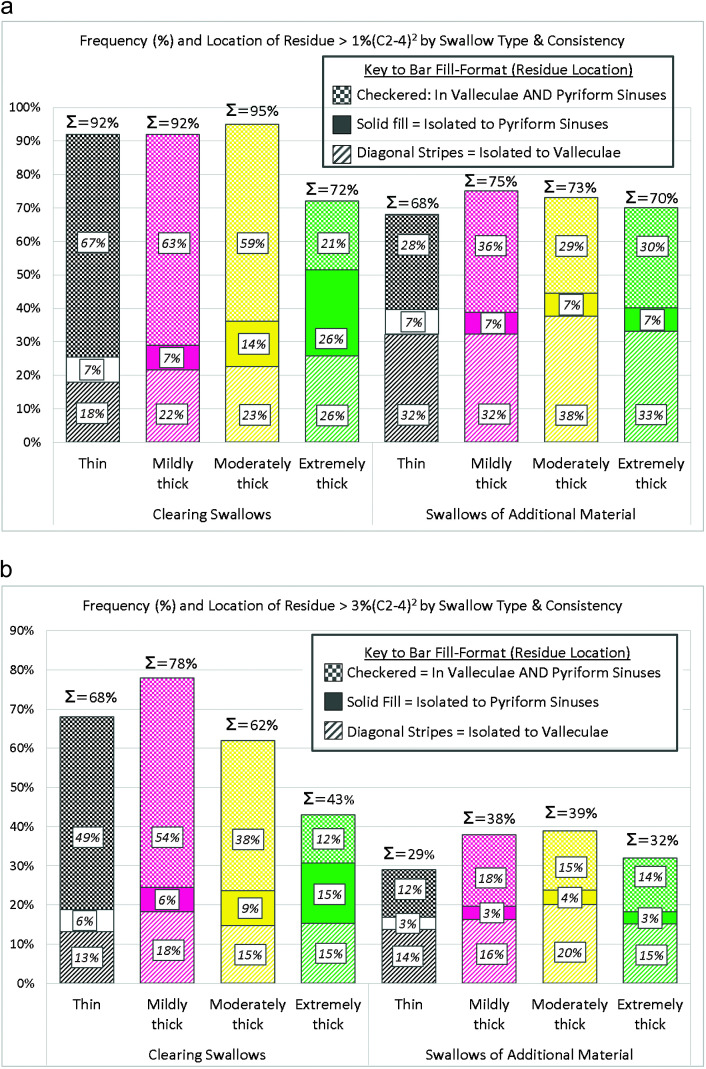
Purpose: Reference data from healthy adults under the age of 60 years suggest that the 75th and 95th percentiles for pharyngeal residue on swallows of thin liquids are 1% and 3%(C2-4) 2 , respectively. We explored how pharyngeal residue below versus above these values prior to a swallow predicts penetration–aspiration. Method: The study involved retrospective analysis of a previous research data set from 305 adults at risk for dysphagia. Participants swallowed six thin boluses and three each of mildly, moderately, and extremely thick barium in videofluoroscopy. Raters measured preswallow residue in %(C2-4) 2 units and Penetration–Aspiration Scale (PAS) scores for each swallow. Swallows were classified as (a) “clean baseline” (with no preswallow residue), (b) “clearing” swallows of residue with no new material added, or (c) swallows of “additional material” plus preswallow residue. Frequencies of PAS scores of ≥ 3 were compared across swallow type by consistency according to residue severity (i.e., ≤ vs. > 1%(C2-4) 2 and ≤ vs. > 3%(C2-4) 2 . Results: The data set comprised 2,541 clean baseline, 209 clearing, and 1,722 swallows of additional material. On clean baseline swallows, frequencies of PAS scores of ≥ 3 were 5% for thin and mildly thick liquids and 1% for moderately/extremely thick liquids. Compared to clean baseline swallows, the odds of penetration–aspiration on thin liquids increased 4.60-fold above the 1% threshold and 4.20-fold above the 3% threshold (mildly thick: 2.11-fold > 1%(C2-4) 2 , 2.26-fold > 3%(C2-4) 2 ). PAS scores of ≥ 3 did not occur with clearing swallows of moderately/extremely thick liquids. Lower frequencies of above-threshold preswallow residue were seen for swallows of additional material than for clearing swallows. Compared to clean baseline swallows, the odds of PAS scores of ≥ 3 on swallows of additional material increased ≥ 1.86-fold above the 1% threshold and ≥ 2.15-fold above the 3% threshold, depending on consistency. Conclusion: The data suggest that a pharyngeal residue threshold of 1%(C2-4) 2 is a meaningful cut-point for delineating increased risk of penetration–aspiration on a subsequent swallow.
Overview
The claims and statistics of this paper haven’t been checked yet.
Free: it reads the open-access text and checks the first 5 claims that cite a source we can check. Create a free account to check every claim.
Integrity signals
Registry
Cites
Statistics
Figures
Verification
Claims the paper makes
The claims and statistics of this paper haven’t been checked yet.
Free: it reads the open-access text and checks the first 5 claims that cite a source we can check. Create a free account to check every claim.
Claims other papers make about this one
Each is checked against this paper’s own text: does it say what the citing paper says it does?
In the citing paper
“In particular, the detection of residue is an important task in VFSS rating, as residues in the oropharynx are associated with a higher risk of aspiration-penetration [48].”
From Automated pharyngeal phase detection and bolus localization in videofluoroscopic swallowing study: killing two birds with one stone? (2022) · cites this paper as [48]
Self-check
Percentages, sums and reported differences re-computed from the paper’s own numbers.
The self-check needs the paper’s full text.
Citations
Cites
A penetration-aspiration scale
Rosenbek, J. C., Robbins, J. A., Roecker, E. B., Coyle, J. L., & Wood, J. L. (1996) · Dysphagia · doi:10.1007/bf00417897 · Cited by 2,803 · cited 2×
“…Residue Ratio Scale (NRRS; Pearson et al., 2013) to explore thresholds of residue severity in the valleculae and the pyriform sinuses that predicted scores of 3 or higher on the Penetration–Aspiration Scale (PAS; Rosenbek et al., 1996) on subsequent, noninitial swallows of the same bolus.”
BackgroundMethodDysphagia: current reality and scope of the problem
Clavé, P., & Shaker, R. (2015) · Nature Reviews Gastroenterology & Hepatology · doi:10.1038/nrgastro.2015.49 · Cited by 577
Murray, J., Langmore, S. E., Ginsberg, S., & Dostie, A. (1996) · Dysphagia · doi:10.1007/bf00417898 · Cited by 386 · cited 2×
“In fact, clean baseline conditions can only be assumed for the very first bolus presented in an assessment or research protocol, and even here, pooled secretions may be present but not visible on videofluoroscopy (Miles et al., 2018; Murray et al., 1996).”
BackgroundReference intervals: current status, recent developments and future considerations
Ozarda, Y. (2016) · Biochemia Medica · doi:10.11613/bm.2016.001 · Cited by 264 · cited 2×
“…of residue are typically positively skewed; consequently, upper boundaries for the healthy reference range are best delineated by the 95th percentile, and values above the 75th percentile can be considered to fall in an at-risk zone that approaches abnormal (Ceriotti et al., 2009; Ozarda, 2016).”
BackgroundReflections on Clinical and Statistical Use of the Penetration-Aspiration Scale
Steele, C. M., & Grace-Martin, K. (2017) · Dysphagia · doi:10.1007/s00455-017-9809-z · Cited by 204 · cited 1×
“Future studies might consider alternative approaches to classifying airway invasion, such as the categorical approach proposed by Steele and Grace-Martin (2017).”
Self-citationReference intervals: the way forward
Ceriotti, F., Hinzmann, R., & Panteghini, M. (2009) · Annals of Clinical Biochemistry: International Journal of Laboratory Medicine · doi:10.1258/acb.2008.008170 · Cited by 199 · cited 2×
“…of residue are typically positively skewed; consequently, upper boundaries for the healthy reference range are best delineated by the 95th percentile, and values above the 75th percentile can be considered to fall in an at-risk zone that approaches abnormal (Ceriotti et al., 2009; Ozarda, 2016).”
BackgroundReference values for healthy swallowing across the range from thin to extremely thick liquids
Steele, C. M., Peladeau-Pigeon, M., Barbon, C. A. E., Guida, B. T., Namasivayam-MacDonald, A. M., Nascimento, W. V., Smaoui, S., Tapson, M. S., Valenzano, T. J., Waito, A. A., et al. (2019) · Journal of Speech, Language, and Hearing Research · doi:10.1044/2019_jslhr-s-18-0448 · Cited by 180
Self-citationImage-based Measurement of Post-Swallow Residue: The Normalized Residue Ratio Scale
Pearson, W. G., Molfenter, S. M., Smith, Z. M., & Steele, C. M. (2013) · Dysphagia · doi:10.1007/s00455-012-9426-9 · Cited by 174
Self-citationMolfenter, S. M., & Steele, C. M. (2013) · Dysphagia · doi:10.1007/s00455-013-9459-8 · Cited by 155 · cited 6×
“…study from which the data were taken (Steele, Mukherjee, et al., 2019) and like previous studies of residue-related risk of airway invasion (Molfenter & Steele, 2013; Namasivayam-MacDonald & Riquelme, 2019), this analysis used a binary reduction of the PAS (< vs. ≥ 3) to denote “safe”…”
BackgroundMethodResultSelf-citationFluoroscopic Surrogate for Pharyngeal Strength: The Pharyngeal Constriction Ratio (PCR)
Leonard, R., Rees, C. J., Belafsky, P., & Allen, J. (2011) · Dysphagia · doi:10.1007/s00455-009-9258-4 · Cited by 109
Research works printed but not linked: 1
- Peck, R., & Olsen, C. (2014). Statistics: Learning from data. Cengage Learning.
Cited by
Curtis, J. A., Borders, J. C., Perry, S. E., Dakin, A. E., Seikaly, Z. N., & Troche, M. S. (2021) · Dysphagia · doi:10.1007/s00455-021-10293-5 · Cited by 87
Phoniatricians and otorhinolaryngologists approaching oropharyngeal dysphagia: an update on FEES
Schindler, A., Baijens, L. W. J., Geneid, A., & Pizzorni, N. (2021) · European Archives of Oto-Rhino-Laryngology · doi:10.1007/s00405-021-07161-1 · Cited by 57
“Penetration/aspiration during the swallow so in the time frame of the whiteout is usually the result of an impaired upper airway closure and postswallow penetration/ aspiration may be the result of secondary leakage from pharyngeal residue or gastroesophageal regurgitation [108].”
BackgroundRobison, R., DiBiase, L., Ashley, A., McElheny, K. L., Anderson, A. S., Wymer, J. P., & Plowman, E. K. (2021) · Dysphagia · doi:10.1007/s00455-021-10315-2 · Cited by 47
Reference Values for Videofluoroscopic Measures of Swallowing: An Update
Steele, C. M., Bayley, M. T., Bohn, M. K., Higgins, V., Péladeau-Pigeon, M., & Kulasingam, V. (2023) · Journal of Speech Language and Hearing Research · doi:10.1044/2023_jslhr-23-00246 · Cited by 53
Self-citationMancopes, R., Péladeau-Pigeon, M., Barrett, E., Guran, A., Smaoui, S., Pasqualoto, A. S., & Steele, C. M. (2020) · Journal of Speech Language and Hearing Research · doi:10.1044/2020_jslhr-20-00154 · Cited by 42
“Values beyond the first and third quartile boundaries (henceforth Q1 and Q3, respectively) can be considered “at risk” or approaching abnormal (Ceriotti et al., 2009; Ozarda, 2016; Steele et al., 2020).”
BackgroundSelf-citationInformed or misinformed consent and use of modified texture diets in dysphagia
O’Keeffe, S. T., Leslie, P., Lazenby-Paterson, T., McCurtin, A., Collins, L. B., Murray, A., Smith, A., & Mulkerrin, S. (2023) · BMC Medical Ethics · doi:10.1186/s12910-023-00885-1 · Cited by 40
Chacko, A., Marshall, J., Taylor, O., McEniery, J. C., Sly, P. D., & Gauld, L. (2023) · Neurology · doi:10.1212/wnl.0000000000206826 · Cited by 23
“Although only 2 participants demonstrated aspiration during VFSS, particular features, for example, delayed swallow initiation, residue requiring multiple swallows, and delayed/absent pharyngeal transit, are risk factors for aspiration/aspiration pneumonia.(13,14) VFSS is not a pass/fail examination, and more in-depth…”
BackgroundTransesophageal echocardiography related complications
Zhang, L., Xie, Y., Ren, Z., & Xie, M. (2024) · Frontiers in Cardiovascular Medicine · doi:10.3389/fcvm.2024.1410594 · Cited by 20
Determining the Relationship Between Hyoid Bone Kinematics and Airway Protection in Swallowing
Smaoui, S., Péladeau-Pigeon, M., & Steele, C. M. (2022) · Journal of Speech Language and Hearing Research · doi:10.1044/2021_jslhr-21-00238 · Cited by 20
“Short LVC duration may increase the risk of airway invasion after the swallow, particularly if there is residue in the pharynx when the airway opens (Steele et al., 2020).”
BackgroundSelf-citationDumican, M., Watts, C. R., Drulia, T. C., & Zhang, Y. (2022) · Dysphagia · doi:10.1007/s00455-022-10472-y · Cited by 19
“Other work has also shown that pharyngeal residue presents a significantly increased risk of penetration or aspiration [41, 42].”
BackgroundDeliberador, L. R., Santos, A. B., Carrijo, P. R. S., Batalha, M. O., César, A. D. S., & Ferreira, L. M. D. F. (2023) · Socio-Economic Planning Sciences · doi:10.1016/j.seps.2023.101511 · Cited by 22
“2 system and consequently prevent diseases [16]; the purchase of appliances to facilitate household tasks; improved purchase planning; and social concern for those who do not have enough to eat due to the pandemic, among others.”
BackgroundThe Adverse Effects and Events of Thickened Liquid Use in Adults: A Systematic Review
Abrams, S. W., Gandhi, P., & Namasivayam-MacDonald, A. M. (2023) · American Journal of Speech-Language Pathology · doi:10.1044/2023_ajslp-22-00380 · Cited by 19
Bandini, A., Smaoui, S., & Steele, C. M. (2022) · Computer Methods and Programs in Biomedicine · doi:10.1016/j.cmpb.2022.107058 · Cited by 16
Self-citationLe, W. A. N. G., Li, Y., Liu, R., Li, H., Wang, L., Yongkang, Y. U. A. N., Li, W., Song, Y., & Zeng, X. (2024) · European Journal of Physical and Rehabilitation Medicine · doi:10.23736/s1973-9087.24.08471-5 · Cited by 15
Wang, L., Wang, F., Lin, Y., Guo, X., Wang, J., Liu, J., Feng, C., Xu, S., Wang, Y., Gao, C., et al. (2023) · Journal of Integrative Neuroscience · doi:10.31083/j.jin2203053 · Cited by 14
“SSA scores range from 18 to 46 points, with higher scores suggesting a diminished ability to swallow [23].”
BackgroundBarbon, C. E. A., Chepeha, D. B., Hope, A. J., Péladeau-Pigeon, M., Waito, A. A., & Steele, C. M. (2021) · Otolaryngology · doi:10.1177/01945998211010435 · Cited by 13
Self-citationRobison, R., DiBiase, L., Wymer, J. P., & Plowman, E. K. (2022) · Dysphagia · doi:10.1007/s00455-022-10499-1 · Cited by 13
Quantifying Bolus Residue and Its Risks in Children: A Videofluoroscopic Study
Dharmarathna, I., Miles, A., & Allen, J. E. (2021) · American Journal of Speech-Language Pathology · doi:10.1044/2020_ajslp-20-00275 · Cited by 12
Predictive Value of Laryngeal Penetration to Aspiration in a Cohort of Pediatric Patients
Miller, A. L., Miller, C. K., Fei, L., Sun, Q., Willging, J. P., de Alarcón, A., & Pentiuk, S. P. (2023) · Dysphagia · doi:10.1007/s00455-023-10589-8 · Cited by 10
“The majority of quantitative research regarding swallowing parameters such as laryngeal penetration, aspiration, and post-swallow residue and the clinical implications has been conducted in adults [13–15].”
Garand, K. L., Grissett, A., Corbett, M. M., Molfenter, S. M., Herzberg, E. G., Kim, H., & Choi, D. (2023) · Journal of Speech Language and Hearing Research · doi:10.1044/2022_jslhr-22-00413 · Cited by 9
Robison, R., DiBiase, L., Anderson, A. S., Wymer, J. P., & Plowman, E. K. (2022) · Neurogastroenterology & Motility · doi:10.1111/nmo.14521 · Cited by 9
Chen, K., Chen, S., Hsiao, M., Wang, T., & Lin, M.-T. (2024) · Journal of the Formosan Medical Association · doi:10.1016/j.jfma.2024.08.015 · Cited by 8
Schar, M. S., Omari, T. I., Woods, C. M., Footner, L. R., Marshall, N., Cock, C., Thompson, A., Nguyen, T., Athanasiadis, T., & Ooi, E. H. (2022) · Head & Neck · doi:10.1002/hed.27104 · Cited by 8
Borders, J. C., Sevitz, J. S., Curtis, J. A., Vanegas‐Arroyave, N., & Troche, M. S. (2023) · Dysphagia · doi:10.1007/s00455-023-10560-7 · Cited by 7
“, oral intake), nutritional outcomes, quality of life, and risk of airway invasion [43, 44], pharyngeal residue may represent an important treatment target for individuals with PSP in future rehabilitation paradigms.”
BackgroundDevelopment of a Pediatrics Dysphagia Screening Questionnaire
Aziz, A. M., Osman, D. M., Abdelhameed, A. M., Alasheery, R., & Nagy, A. M. (2023) · Egyptian Journal of Ear Nose Throat and Allied Sciences · doi:10.21608/ejentas.2023.226365.1661 · Cited by 6
“Dysphagia is a difficulty in swallowing that involves impairment, specifically in the safety and efficiency of swallowing [1] .”
BackgroundLiou, H.-H., Hsieh, M. H., Tsai, S., Hung, D. S.-Y., Chen, Y., Hsiao, J., Huang, C., Ou, C., Chang, C., Lee, W., et al. (2022) · Dysphagia · doi:10.1007/s00455-022-10501-w · Cited by 5
“The pharyngeal residue is a risk factor for penetration–aspiration in healthy adults and patients with neurogenic dysphagia [6, 32].”
BackgroundThe Influence of Liquid Consistency and Food Texture on Swallowing: A Systematic Review Update
Steele, C. M., Dharmarathna, I., Benfield, J. K., Sollereder, S., Lipkin, E. M., Pedrolli, C., Nagy, A., Goldenberg, K., Smaoui, S., Yu, D., et al. (2026) · Dysphagia · doi:10.1007/s00455-026-10977-w · Cited by 6
Self-citationProfiling Number of Swallows per Bolus and Residue in Individuals With Amyotrophic Lateral Sclerosis
Donohue, C., Robison, R., Steele, C. M., Wymer, J. P., & Plowman, E. K. (2023) · Journal of Speech Language and Hearing Research · doi:10.1044/2023_jslhr-23-00209 · Cited by 4
Self-citationDumican, M., Harper, K., & Stankiewicz, J. (2024) · Dysphagia · doi:10.1007/s00455-024-10688-0 · Cited by 4
“An important implication of these findings likely relates to subsequent airway protection, as shorter durations of LVC are linked to increases in airway invasion [35].”
Acoustic Correlation with Dysphagia in Stroke Patients
Fang, G., Zhuang, R., Wang, C., Zhou, M., & Zhang, Y. (2025) · Dysphagia · doi:10.1007/s00455-025-10830-6 · Cited by 4
“Steele et al. [16] found that the pharyngeal residue threshold of 1% (C2–4) 2 is a meaningful cutoff point for identifying an increased risk of penetrating aspiration during subsequent swallowing.”
Chen, Q., Huang, H., Chen, G., Chen, J., Fang, F., Lei, H., Zhang, Y., Lin, J., Chen, X., Liu, N., et al. (2022) · Cerebrovascular Diseases · doi:10.1159/000524241 · Cited by 4
Wilson, T. R., Checklin, M., Lawson, N., Burnett, A. J., Lombardo, T., & Freeman-Sanderson, A. L. (2024) · International Journal of Speech-Language Pathology · doi:10.1080/17549507.2024.2420606 · Cited by 4
Jansen, M., van Iperen, I. D., Kröner, A., Hemler, R. J. B., Dekker-Holverda, E., & Spronk, P. E. (2025) · JMIR Serious Games · doi:10.2196/60685 · Cited by 2
“Dysphagia was judged to be present if Murray Secretion Scale score was 2 or higher and PAS score was higher than 2 in thin, modified liquid or regular food [17].”
Karakurt, N., Akyol, E., Gölaç, H., Atalık, G., Şendur, H. N., Ceylan, B. T., & Varan, H. D. (2025) · Dysphagia · doi:10.1007/s00455-025-10908-1 · Cited by 3
“Large-scale, longitudinal studies are necessary to validate calf circumference as a reliable clinical indicator and to clarify its role within comprehensive dysphagia assessment protocols. dysphagia-related complications in this population [ 29 , 36].”
Pharyngeal Dysphagia After Transesophageal Echocardiography
Bolton, L., Skeoch, C., Bhudia, S. K., & Sutt, A. (2023) · Journal of Cardiothoracic and Vascular Anesthesia · doi:10.1053/j.jvca.2023.05.017 · Cited by 2
Rapid Detection of Penetration-Aspiration from Fluoroscopic Videos in Dysphagia Patients
Sanjeevi, G., Gopalakrishnan, U., Pathinarupothi, R. K., Arya, C. J., & Subramania Iyer, K. (2023) · IEEE International Conference on Bioinformatics and Bioengineering (BIBE) · doi:10.1109/bibe60311.2023.00073 · Cited by 2
“The common causes of dysphagia are neurological conditions (Stroke or Parkinson’s disease), head and neck surgery, and genetic disorders [10].”
BackgroundCross-Sectional Study of Swallowing Phases in Cases of Megaesophagus Caused by Chagas Disease
Gasparim, A. Z., & Dantas, R. O. (2021) · Gastroenterology Research · doi:10.14740/gr1458 · Cited by 2
“However, the occurrence of residues in the pharyngeal phase, especially in the vallecula [36], associated with a decreased food consistency, increased the risk of airway aspiration [36-38].”
BackgroundDesempenho da função de deglutição entre idosos com e sem queixas clínicas
de Araújo, R. C. P., Godoy, C. M. D. A., Ferreira, L. M. D. B. M., Godoy, J. F., & Magalhães, H. V. (2025) · CoDAS · doi:10.1590/2317-1782/e20240091pt · Cited by 1
Hirata, A., Sato, M., Fujiu‐Kurachi, M., Ishizaka, M., Sawaya, Y., Shiba, T., & Urano, T. (2025) · Folia Phoniatrica et Logopaedica · doi:10.1159/000546491 · Cited by 1
“Using video fl uoroscopic, it has also been reported that pharyngeal residue after swallowing can cause aspiration [13, 14].”
Leveraging Ensemble on Self-Supervised Techniques to Enhance Model Performance: A Regime Analysis
Martinović, I., Dousty, M., Li, W., Djukanović, M., Coyle, J. L., & Sejdić, E. (2025) · Journal of Imaging Informatics in Medicine · doi:10.1007/s10278-025-01600-9 · Cited by 1
Vergara, J., Miles, A., Moraes, J. L., & Chone, C. T. (2024) · Journal of Speech Language and Hearing Research · doi:10.1044/2023_jslhr-23-00375 · Cited by 1
Beyond thickened liquids: for your consideration
McCurtin, A., Collins, L. B., King, L., Lazenby-Paterson, T., Lisiecka, D., Leslie, P., McInerney, M., Moran, A., O’Keeffe, S. T., & Smith, A. M. (2024) · Journal of Clinical Practice in Speech-Language Pathology · doi:10.1080/22000259.2024.2359368 · Cited by 2
“A subsequent bolus may help to clear residue (Steele et al., 2020).”
BackgroundLaborstudie zu bakteriologischen Aspekten von Getränken und Andickungsmitteln für Dysphagiepatienten
Schmeyers, L., Hoffmann, J., & Schulz, S. (2021) · Zeitschrift für Gerontologie und Geriatrie · doi:10.1007/s00391-021-01898-4
Algún criterio para mitigar la hiperabundancia normativa: STS (Sala 1.ª) de 23 de febrero de 2009
Jiménez, J. M. L. (2009) · Diario La Ley
Influence of Adhesive Use on Swallowing in Removable Complete Denture Wearers
Dantas, R. O., Montaldi, M. R., Fortes, C. V., Ribeiro, A. B., & Silva, C. (2023) · British journal of healthcare and medical research · doi:10.14738/bjhmr.101.13819
A Large Cohort Analysis of Epiglottic Phenotypes and Pharyngeal Residue
Kravietz, A., Crosby, T. W., Yang, J., Balou, S., Dion, G. R., Logan, A. M., & Amin, M. R. (2024) · Annals of Otology Rhinology & Laryngology · doi:10.1177/00034894231218892 · Cited by 1
“7,14,15 All data are reported as means and standard deviations ( σ ).”
MethodThe Influence of Perspective on Perception: Assessing Residue Across Planes of Videofluoroscopy
Jones‐Rastelli, R. B., Crossman, C., Price, D., Stal, F., & Molfenter, S. M. (2024) · The Laryngoscope · doi:10.1002/lary.31873
“3.”
Performance of swallowing function between older people with and without clinical complaints
de Araújo, R. C. P., Godoy, C. M. D. A., Ferreira, L. M. D. B. M., Godoy, J. F., & Magalhães, H. V. (2025) · CoDAS · doi:10.1590/2317-1782/e20240091en · Cited by 1
“However, thin and slightly thick liquids have higher frequencies of laryngeal penetration than other consistencies (29) .”
Reedy, E. L., O’Rourke, A. K., Simpson, A. N., & Bonilha, H. S. (2025) · Foregut The Journal of the American Foregut Society · doi:10.1177/26345161251335325
Curtis, J. A., Mocchetti, V., Jagdhar, B., Rameau, A., Clark, C. M., & Grasso, M. (2025) · Folia Phoniatrica et Logopaedica · doi:10.1159/000547346
“The presence of pharyngeal residue is clinically important, as it is associated with an increased risk of post-swallow aspiration [1, 2] as well as serious downstream medical consequences including malnutrition [3] and pneumonia [4].”
Experimental and Computational Analysis of Bolus Fragmentation during Model Oropharyngeal Swallowing
McFarland, S., Leichter, D. M., Stark, N. E. ‐., Gilbert, R., & Nicosia, M. A. (2025) · Dysphagia · doi:10.1007/s00455-025-10899-z · Cited by 1
Flexible Endoscopic Evaluation in Neurogenic Dysphagia for Detection and Clinical Decision-Making
Erensoy, İ. (2026) · IGI Global eBooks · doi:10.4018/979-8-3373-6405-6.ch011
Baraka, M. A. S., Sallam, Y. A. N., ElNeshwey, H. M., & Emam, H. A. F. (2026) · European Archives of Oto-Rhino-Laryngology · doi:10.1007/s00405-025-09920-w
“These find - ings align with those of Steele et al. [29], Bahia and Lowell [ 17], who observed that minimal bolus volumes might not deliver enough stimulus to trigger measurable physiological clear anatomical landmarks for residue and airway inva - sion assessment [14].”
Wearable sensors for monitoring neurogenic dysphagia: a scoping review
Gasperini, D., Pierotti, F., Privitera, L., Steele, C. M., & Bandini, A. (2026) · Progress in Biomedical Engineering · doi:10.1088/2516-1091/ae6d5d · Cited by 1
“If left untreated, it can lead to severe complications, including entry of food, liquid, or saliva into the airway (aspiration) [14], poor clearance of material through the pharynx, resulting in residue [15], silent aspiration [16], aspiration pneumonia [17], malnutrition [18], and dehydration [6].”
Self-citationHuang, S., Liu, L., Chen, Y., Liu, C., Chen, S., Chen, H., Liu, C., & Chen, H. (2026) · Frontiers in Neurology · doi:10.3389/fneur.2026.1790412
Aspiration-Related Alveolar Disease: From Acute Injury to Chronic Pulmonary Sequelae
Singla, A., Sharma, D. S., Krekeler, B. N., & Meyer, C. A. (2026) · Seminars in Respiratory and Critical Care Medicine · doi:10.1055/a-2917-5503
Evaluation of Lingual Tactile Sensitivity Using a Pneumatic Multi‐Point Stimulation Device
Kadowaki, H., SASAKI, M., Tamada, Y., & Tanaka, Y. (2026) · Journal of Oral Rehabilitation · doi:10.1111/joor.70280
Dharmarathna, I., Gandhi, P., Panes, V., Alvarez, C., Barbon, C. E. A., Valencia, D., Warneke, C. L., Steele, C. M., & Hutcheson, K. A. (2026) · Scientific Reports · doi:10.1038/s41598-026-76049-z
Self-citation
Metadata
- Authors
- Steele, C. M., Peladeau-Pigeon, M., Barrett, E., & Wolkin, T. S.
- Affiliations
- University Health Network (CA)
- Swallowing Rehabilitation Research Laboratory, KITE, Toronto Rehabilitation Institute, University Health Network, Canada
- Corresponding author
- Steele, Catriona M.
- ORCID
- Steele, Catriona M.
- Venue
- American Journal of Speech-Language Pathology
- Published
- 2020-08-04
- Volume
- 29
- Issue
- 3
- Pages
- 1608-1617
- ISSN
- 1058-0360 (ISSN-L)
- 1558-9110
- PMC
- PMC7893525
- OpenAlex
- W3038287147
- Semantic Scholar
- 298ae99df634fa6d2c9385062e027b84dfc04657
- Cited by
- 57
- References
- 24
- Citations by year
- 2026: 6 · 2025: 10 · 2024: 9 · 2023: 13 · 2022: 9 · 2021: 8 · 2020: 1
- FWCI
- 11.04
- Type
- journal article
- Language
- en
- Open access
- hybrid
- doi.org
- Licence
- cc-by
- Locations
- American Journal of Speech-Language Pathology (publishedVersion, cc-by)
- PubMed Central (publishedVersion, cc-by)
- PubMed (publishedVersion)
- Funders
- National Institute on Aging (R01AG077481)
- National Institute on Deafness and Other Communication Disorders (R01DC011020)
- Topics
- Health Sciences › Health Professions › Speech and Hearing › Dysphagia Assessment and Management
- Health Sciences › Health Professions › Speech and Hearing › Voice and Speech Disorders
- Health Sciences › Medicine › Otorhinolaryngology › Head and Neck Cancer Studies
- Keywords
- penetration-aspiration, dysphagia, videofluoroscopy, barium swallow, bolus consistency, Penetration-Aspiration Scale
- MeSH terms
- Adult, Cineradiography, Deglutition, Deglutition Disorders, Humans, Middle Aged, Pharynx, Retrospective Studies
About these checks
Registry, retraction, Cites and statistics results are computed, not judged, with one exception: a printed reference that no index lists is read once by a model before it counts as a citation error. Claims are extracted by a model and kept only when their quote appears verbatim in the text; each cited source is then checked, with a model’s help, for whether it says what the claim relies on. Those verdicts can be wrong — read the claim’s quote and the cited source before relying on one.
Statistics and arithmetic are recomputed, not judged.
Confidence bands are shown only for fields calibrated on our annotated test set. None is calibrated yet, so no band is shown.
What counts as a claim ›How we measure confidence ›How we check this ›
Are you an author, or do you see a problem with this page? Request a review
Data sources
Bibliographic data: Semantic Scholar, OpenAlex, Crossref.
Contains information from the Semantic Scholar Academic Graph Datasets, made available under the ODC Attribution License (ODC-BY 1.0).
Semantic Scholar’s data is described in: Kinney, R., et al. (2023). The Semantic Scholar Open Data Platform. arXiv:2301.10140.
