

The DOI matches its Crossref record; 4 of the 4 references it cites were found in a registry or an index.
Number of stars in the Sun’s birth cluster revisited
Open accessAbstract
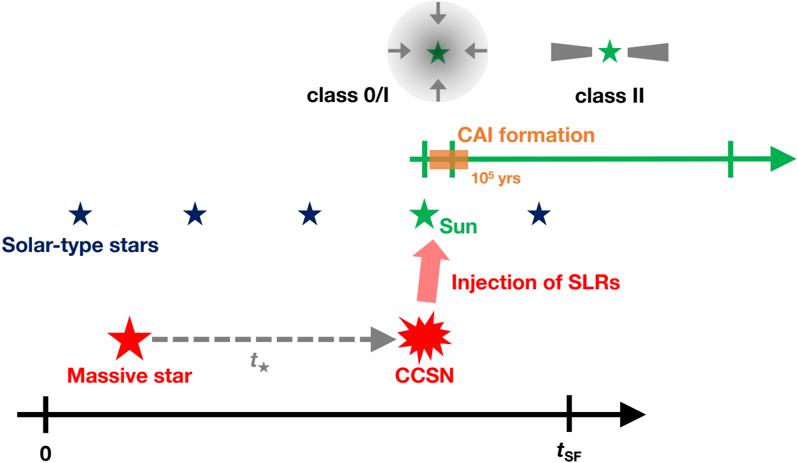
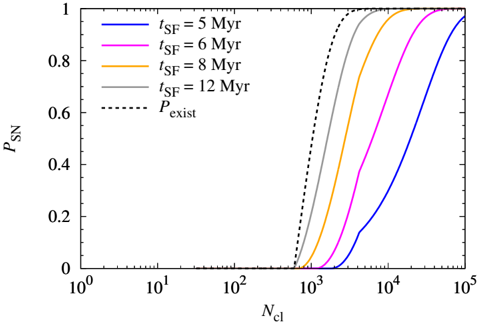
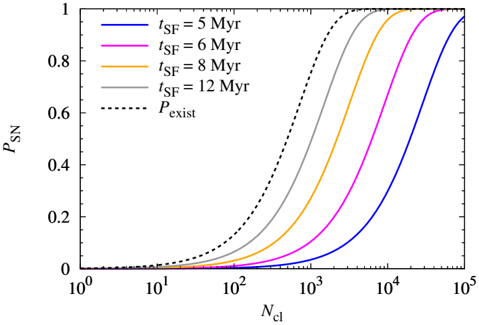
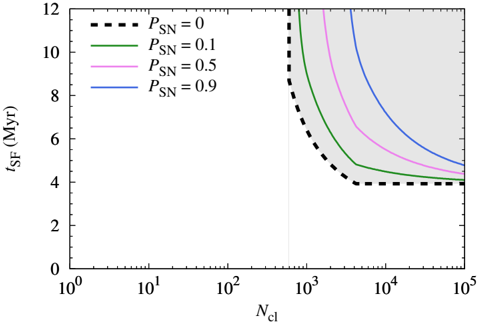
The Sun is thought to have been formed within a star cluster. The coexistence of 26 Al-rich and 26 Al-poor calcium–aluminum-rich inclusions indicates that a direct injection of 26 Al-rich materials from a nearby core-collapse supernova would be expected to occur in the first 10 5 years of the existence of the Solar System. Therefore, at least one core-collapse supernova ought to occur within the duration of star formation in the Sun’s birth cluster. Here, we revisit the number of stars in the Sun’s birth cluster from the point of view of the probability of experiencing at least one core-collapse supernova within the finite duration of star formation within the birth cluster. We find that the number of stars in the birth cluster may be significantly greater than that previously considered, depending on the duration of star formation.
Overview
The claims and statistics of this paper haven’t been checked yet.
Run the check — free, no account needed. It reads the open-access text and checks the sources it cites.
Integrity signals
Registry
Cites
Statistics
Figures
Verification
Claims the paper makes
The claims and statistics of this paper haven’t been checked yet.
Run the check — free, no account needed. It reads the open-access text and checks the sources it cites.
Claims other papers make about this one
Each is checked against this paper’s own text: does it say what the citing paper says it does?
In the citing paper
“Importantly, this broadening is expected, given that the solar system almost certainly originated within a star cluster (see Adams 2010; Arakawa & Kokubo 2023), and the orbital distribution of TNOs would have been affected by cluster dynamics within the first ∼100 Myr of the solar system's evolution.”
From Generation of Low-inclination, Neptune-crossing Trans-Neptunian Objects by Planet Nine (2024) · cites this paper as Arakawa & Kokubo 2023
Self-check
Percentages, sums and reported differences re-computed from the paper’s own numbers.
The self-check needs the paper’s full text.
Citations
Cites
Mass Loss: Its Effect on the Evolution and Fate of High-Mass Stars
Smith, N. (2014) · Annual Review of Astronomy and Astrophysics · doi:10.1146/annurev-astro-081913-040025 · Cited by 1,042
The Birth Environment of the Solar System
Adams, F. C. (2010) · Annual Review of Astronomy and Astrophysics · doi:10.1146/annurev-astro-081309-130830 · Cited by 464
Discovery of a Candidate Inner Oort Cloud Planetoid
Brown, M. E., Trujillo, C., & Rabinowitz, D. (2004) · The Astrophysical Journal · doi:10.1086/422095 · Cited by 242
Scenarios for the Origin of the Orbits of the Trans-Neptunian Objects 2000 CR105and 2003 VB12(Sedna)
Morbidelli, A., & Levison, H. F. (2004) · The Astronomical Journal · doi:10.1086/424617 · Cited by 193
Research works printed but not linked: 69
- Adams, 2001, Icarus, 150, 151, 10.1006/icar.2000.6567 · DOI
- Allen, 2001, ApJ, 549, L241, 10.1086/319165 · DOI
- Amelin, 2002, Science, 297, 1678, 10.1126/science.1073950 · DOI
- Arnould, 1997, A&A, 321, 452
- Arnould, 2006, A&A, 453, 653, 10.1051/0004-6361:20053966 · DOI
- Beck, 2005, ApJ, 621, L153, 10.1086/429224 · DOI
- Boss, 2008, ApJ, 686, L119, 10.1086/593057 · DOI
- Brasser, 2006, Icarus, 184, 59, 10.1016/j.icarus.2006.04.010 · DOI · Paper page
- Cameron, 1977, Icarus, 30, 447, 10.1016/0019-1035(77)90101-4 · DOI
- Chevalier, 2000, ApJ, 538, L151, 10.1086/312814 · DOI
- Clayton, 1977, Icarus, 32, 255, 10.1016/0019-1035(77)90001-X · DOI
- Concha-Ramírez, 2019, MNRAS, 482, 732, 10.1093/mnras/sty2721 · DOI
- Connelly, 2012, Science, 338, 651, 10.1126/science.1226919 · DOI
- Dauphas, 2011, Ann. Rev. Earth Planet. Sci., 39, 351, 10.1146/annurev-earth-040610-133428 · DOI
- Desch S. J., Young E. D., Dunham E. T., Fujimoto Y., & Dunlap D. R. 2022, ApJ, submitted [arXiv:2203.11169] · arXiv
- Dwarkadas, 2017, ApJ, 851, 147, 10.3847/1538-4357/aa992e · DOI
- Ekström, 2012, A&A, 537, A146, 10.1051/0004-6361/201117751 · DOI
- Forbes, 2021, Nat. Astron., 5, 1009, 10.1038/s41550-021-01442-9 · DOI
- Fujii, 2021, PASJ, 73, 1074, 10.1093/pasj/psab061 · DOI
- Fujimoto, 2018, MNRAS, 480, 4025, 10.1093/mnras/sty2132 · DOI
- Fukai, 2021, ApJ, 908, 64, 10.3847/1538-4357/abd2b9 · DOI
- Fukushima, 2021, MNRAS, 506, 5512, 10.1093/mnras/stab2099 · DOI
- Fukushima, 2020, MNRAS, 497, 3830, 10.1093/mnras/staa2062 · DOI
- Georgy, 2012, A&A, 542, A29, 10.1051/0004-6361/201118340 · DOI
- Goodwin, 2004, A&A, 413, 929, 10.1051/0004-6361:20031529 · DOI
- Gounelle, 2015, A&A, 582, A26, 10.1051/0004-6361/201526174 · DOI
- Gounelle, 2012, A&A, 545, A4, 10.1051/0004-6361/201219031 · DOI
- Gritschneder, 2012, ApJ, 745, 22, 10.1088/0004-637X/745/1/22 · DOI
- Holst, 2013, Proc. Natl. Acad. Sci., 110, 8819, 10.1073/pnas.1300383110 · DOI
- Huss, 2009, Geochim. Cosmochim. Acta., 73, 4922, 10.1016/j.gca.2009.01.039 · DOI
- Kawasaki, 2020, Geochim. Cosmochim. Acta., 279, 1, 10.1016/j.gca.2020.03.045 · DOI
- Kinoshita, 2021, ApJ, 921, 150, 10.3847/1538-4357/ac1d4b · DOI
- Kobayashi, 2001, Icarus, 153, 416, 10.1006/icar.2001.6700 · DOI
- Kodolányi, 2022, ApJ, 929, 107, 10.3847/1538-4357/ac5910 · DOI
- Kodolányi, 2022, ApJ, 940, 95, 10.3847/1538-4357/ac8b85 · DOI
- Kööp, 2016, Geochim. Cosmochim. Acta., 189, 70, 10.1016/j.gca.2016.05.014 · DOI
- Kroupa, 2002, Science, 295, 82, 10.1126/science.1067524 · DOI · Paper page
- Kroupa P., & Jerabkova T. 2021, Star-formation Rates of Galaxies (Cambridge: Cambridge University Press)
- Kruijssen, 2019, Nature, 569, 519, 10.1038/s41586-019-1194-3 · DOI
- Kuffmeier, 2016, ApJ, 826, 22, 10.3847/0004-637X/826/1/22 · DOI
- Kumar, 2020, A&A, 642, A87, 10.1051/0004-6361/202038232 · DOI
- Kumar, 2022, A&A, 658, A114, 10.1051/0004-6361/202140363 · DOI
- Lada, 2003, ARA&A, 41, 57, 10.1146/annurev.astro.41.011802.094844 · DOI
- Larsen K. K., Wielandt D., Schiller M., Krot A. N., & Bizzarro M. 2020, Earth Planet. Sci. Lett., 535 · DOI
- Lee, 1998, ApJ, 506, 898, 10.1086/306284 · DOI
- Li, 2014, MNRAS, 444, 2884, 10.1093/mnras/stu1571 · DOI
- MacPherson, 2012, Earth Planet. Sci. Lett., 331, 43, 10.1016/j.epsl.2012.03.010 · DOI
- Meynet, 2003, A&A, 404, 975, 10.1051/0004-6361:20030512 · DOI
- Nittler, 2016, ARA&A, 54, 53, 10.1146/annurev-astro-082214-122505 · DOI
- Nomoto, 2006, Nucl. Phys. A, 777, 424, 10.1016/j.nuclphysa.2006.05.008 · DOI
- Ouellette, 2007, ApJ, 662, 1268, 10.1086/518102 · DOI
- Ouellette, 2010, ApJ, 711, 597, 10.1088/0004-637X/711/2/597 · DOI
- Park, 2017, Geochim. Cosmochim. Acta., 201, 6, 10.1016/j.gca.2016.10.002 · DOI
- Portegies Zwart, 2019, A&A, 622, A69, 10.1051/0004-6361/201833974 · DOI
- Portegies Zwart, 2009, ApJ, 696, L13, 10.1088/0004-637X/696/1/L13 · DOI · Paper page
- Portegies Zwart, 2018, A&A, 616, A85, 10.1051/0004-6361/201732060 · DOI
- Sahijpal, 1998, ApJ, 509, L137, 10.1086/311778 · DOI
- Schaller, 1992, A&AS, 96, 269
- Sugiura, 2014, Meteorit. Planet. Sci., 49, 772, 10.1111/maps.12292 · DOI
- Tachibana, 2003, ApJ, 588, L41, 10.1086/375362 · DOI
- Takigawa, 2008, ApJ, 688, 1382, 10.1086/592184 · DOI
- Tang, 2015, ApJ, 802, 22, 10.1088/0004-637X/802/1/22 · DOI
- Tang, 2012, Earth Planet. Sci. Lett., 359, 248, 10.1016/j.epsl.2012.10.011 · DOI
- Telus, 2018, Geochim. Cosmochim. Acta., 221, 342, 10.1016/j.gca.2017.06.013 · DOI
- Thrane, 2006, ApJ, 646, L159, 10.1086/506910 · DOI
- Trappitsch, 2018, ApJ, 857, L15, 10.3847/2041-8213/aabba9 · DOI
- Vanhala, 2002, ApJ, 575, 1144, 10.1086/341356 · DOI
- Wasserburg, 1996, ApJ, 466, L109, 10.1086/310177 · DOI
- Weidner, 2006, MNRAS, 365, 1333, 10.1111/j.1365-2966.2005.09824.x · DOI
Cited by
Sorted by citations
Nesvorný, D., Bernardinelli, P., Vokrouhlický, D., & Batygin, K. (2023) · Icarus · doi:10.1016/j.icarus.2023.115738 · Cited by 26
Generation of Low-inclination, Neptune-crossing Trans-Neptunian Objects by Planet Nine
Batygin, K., Morbidelli, A., Brown, M. E., & Nesvorný, D. (2024) · The Astrophysical Journal Letters · doi:10.3847/2041-8213/ad3cd2 · Cited by 11
“Importantly, this broadening is expected, given that the solar system almost certainly originated within a star cluster (see Adams 2010; Arakawa & Kokubo 2023), and the orbital distribution of TNOs would have been affected by cluster dynamics within the first ∼ 100 Myr of the solar system’s…”
Background
Metadata
- Authors
- Arakawa, S., & Kokubo, E.
- Affiliations
- Japan Agency for Marine-Earth Science and Technology (JP)
- National Astronomical Observatory of Japan (JP)
- Venue
- Astronomy & Astrophysics
- Publisher
- EDP Sciences
- Published
- 2023-02
- Volume
- 670
- Pages
- A105
- ISSN
- 0004-6361 (ISSN-L)
- 1432-0746
- OpenAlex
- W4315631752
- Cited by
- 18
- References
- 4
- Citations by year
- 2026: 1 · 2025: 7 · 2024: 7 · 2023: 3
- FWCI
- 2.10
- Type
- journal article
- Language
- en
- Open access
- gold
- doi.org
- Licence
- Locations
- Astronomy and Astrophysics (publishedVersion, cc-by)
- arXiv (Cornell University) (submittedVersion)
- Springer Link (Chiba Institute of Technology) (submittedVersion)
- arXiv (Cornell University)
- Funders
- Japan Society for the Promotion of Science (JP20J00598, 18H05438)
- Topics
- Physical Sciences › Physics and Astronomy › Astronomy and Astrophysics › Astrophysics and Star Formation Studies
- Physical Sciences › Physics and Astronomy › Astronomy and Astrophysics › Stellar, planetary, and galactic studies
- Physical Sciences › Earth and Planetary Sciences › Space and Planetary Science › Astro and Planetary Science
- Keywords
- core-collapse supernovae, calcium-aluminum-rich inclusions, 26Al, cluster size, solar system formation
About these checks
Registry, retraction, Cites and statistics results are computed, not judged, with one exception: a printed reference that no index lists is read once by a model before it counts as a citation error. Claims are extracted by a model and kept only when their quote appears verbatim in the text; each cited source is then checked, with a model’s help, for whether it says what the claim relies on. Those verdicts can be wrong — read the claim’s quote and the cited source before relying on one.
Statistics and arithmetic are recomputed, not judged.
Confidence bands are shown only for fields calibrated on our annotated test set. None is calibrated yet, so no band is shown.
What counts as a claim ›How we measure confidence ›How we check this ›
Are you an author, or do you see a problem with this page? Request a review
