

A virtual chromoendoscopy artificial intelligence system to detect endoscopic and histologic activity/remission and predict clinical outcomes in ulcerative colitis
Open accessThe DOI matches its Crossref record; 27 of the 27 references it cites were found in a registry or an index.
Abstract
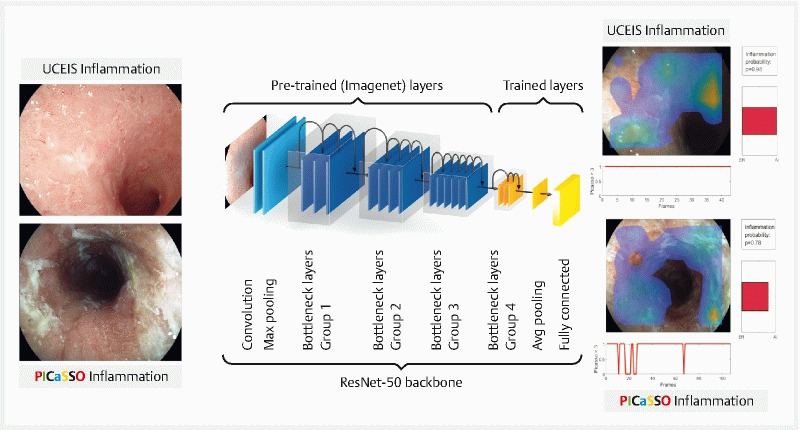
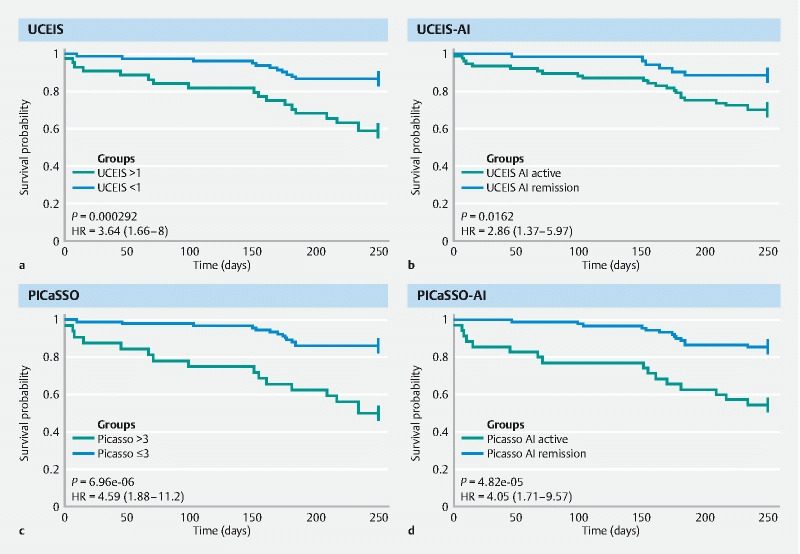
Background Endoscopic and histological remission (ER, HR) are therapeutic targets in ulcerative colitis (UC). Virtual chromoendoscopy (VCE) improves endoscopic assessment and the prediction of histology; however, interobserver variability limits standardized endoscopic assessment. We aimed to develop an artificial intelligence (AI) tool to distinguish ER/activity, and predict histology and risk of flare from white-light endoscopy (WLE) and VCE videos. Methods 1090 endoscopic videos (67 280 frames) from 283 patients were used to develop a convolutional neural network (CNN). UC endoscopic activity was graded by experts using the Ulcerative Colitis Endoscopic Index of Severity (UCEIS) and Paddington International virtual ChromoendoScopy ScOre (PICaSSO). The CNN was trained to distinguish ER/activity on endoscopy videos, and retrained to predict HR/activity, defined according to multiple indices, and predict outcome; CNN and human agreement was measured. Results The AI system detected ER (UCEIS ≤ 1) in WLE videos with 72 % sensitivity, 87 % specificity, and an area under the receiver operating characteristic curve (AUROC) of 0.85; for detection of ER in VCE videos (PICaSSO ≤ 3), the sensitivity was 79 %, specificity 95 %, and the AUROC 0.94. The prediction of HR was similar between WLE and VCE videos (accuracies ranging from 80 % to 85 %). The model’s stratification of risk of flare was similar to that of physician-assessed endoscopy scores. Conclusions Our system accurately distinguished ER/activity and predicted HR and clinical outcome from colonoscopy videos. This is the first computer model developed to detect inflammation/healing on VCE using the PICaSSO and the first computer tool to provide endoscopic, histologic, and clinical assessment.
Overview
The claims and statistics of this paper haven’t been checked yet.
Free: it reads the open-access text and checks the first 5 claims that cite a source we can check. Create a free account to check every claim.
Integrity signals
Registry
Cites
Statistics
Figures

Verification
Claims the paper makes
The claims and statistics of this paper haven’t been checked yet.
Free: it reads the open-access text and checks the first 5 claims that cite a source we can check. Create a free account to check every claim.
Claims other papers make about this one
Each is checked against this paper’s own text: does it say what the citing paper says it does?
The source backs part of the claim, not all of it — or backs it for a different population, condition or comparison.
In the citing paper
“Recently, several AI algorithms have been developed to accurately grade disease activity across various endoscopic scoring systems in ulcerative colitis (UC) to overcome these limitations, showing excellent diagnostic performance and strong concordance with experts.13-23”
From Artificial intelligence and endo-histo-omics: new dimensions of precision endoscopy and histology in inflammatory bowel disease (2024) · cites this paper as [21]
Experimental — accuracy not yet measured
Self-check
Percentages, sums and reported differences re-computed from the paper’s own numbers.
The self-check needs the paper’s full text.
Citations
Cites
DeLong, E. R., DeLong, D. M., & Clarke-Pearson, D. L. (1988) · Biometrics · doi:10.2307/2531595 · Cited by 22,649
THE USE OF CONFIDENCE OR FIDUCIAL LIMITS ILLUSTRATED IN THE CASE OF THE BINOMIAL
CLOPPER, C. J., & PEARSON, E. S. (1934) · Biometrika · doi:10.1093/biomet/26.4.404 · Cited by 5,003
Ungaro, R., Mehandru, S., Allen, P. B., Peyrin-Biroulet, L., & Colombel, J.-F. (2017) · The Lancet · doi:10.1016/s0140-6736(16)32126-2 · Cited by 3,531
Coated Oral 5-Aminosalicylic Acid Therapy for Mildly to Moderately Active Ulcerative Colitis
Schroeder, K. W., Tremaine, W. J., & Ilstrup, D. M. (1987) · New England Journal of Medicine · doi:10.1056/nejm198712243172603 · Cited by 3,026
Turner, D., Ricciuto, A., Lewis, A., D’Amico, F., Dhaliwal, J., Griffiths, A. M., Bettenworth, D., Sandborn, W. J., Sands, B. E., Reinisch, W., et al. (2021) · Gastroenterology · doi:10.1053/j.gastro.2020.12.031 · Cited by 2,911
Travis, S. P. L., Schnell, D., Krzeski, P., Abreu, M. T., Altman, D. G., Colombel, J.-F., Feagan, B. G., Hanauer, S. B., Lémann, M., Lichtenstein, G. R., et al. (2012) · Gut · doi:10.1136/gutjnl-2011-300486 · Cited by 632
Development and validation of the Nancy histological index for UC
Marchal-Bressenot, A., Salleron, J., Boulagnon-Rombi, C., Bastien, C., Cahn, V., Cadiot, G., Diebold, M.-D., Danese, S., Reinisch, W., Schreiber, S., et al. (2017) · Gut · doi:10.1136/gutjnl-2015-310187 · Cited by 479
Bryant, R. V., Burger, D. C., Delo, J., Walsh, A. J., Thomas, S., von Herbay, A., Buchel, O. C., White, L., Brain, O., Keshav, S., et al. (2016) · Gut · doi:10.1136/gutjnl-2015-309598 · Cited by 443
The Use of Confidence or Fiducial Limits Illustrated in the Case of the Binomial
Clopper, C. J., & Pearson, E. S. (1934) · Biometrika · doi:10.2307/2331986 · Cited by 438
Confidence intervals for predictive values with an emphasis to case–control studies
Mercaldo, N. D., Lau, K. F., & Zhou, X. H. (2007) · Statistics in Medicine · doi:10.1002/sim.2677 · Cited by 411
Cited by
Iacucci, M., Santacroce, G., Majumder, S., Morael, J., Zammarchi, I., Maeda, Y., Ryan, D., Sabatino, A. D., Rescigno, M., Aburto, M. R., et al. (2024) · Gut · doi:10.1136/gutjnl-2023-331579 · Cited by 114
Self-citationArtificial intelligence and inflammatory bowel disease: Where are we going?
Rio, L. D., Spadaccini, M., Parigi, T. L., Gabbiadini, R., Buono, A. D., Busacca, A., Maselli, R., Fugazza, A., Colombo, M., Carrara, S., et al. (2023) · World Journal of Gastroenterology · doi:10.3748/wjg.v29.i3.508 · Cited by 94
Self-citationIacucci, M., Santacroce, G., Zammarchi, I., Maeda, Y., Del Amor, R., Meseguer, P., Kolawole, B. B., Chaudhari, U., Di Sabatino, A., Danese, S., et al. (2024) · The Lancet Gastroenterology & Hepatology · doi:10.1016/s2468-1253(24)00053-0 · Cited by 73
Self-citationArtificial intelligence to revolutionize IBD clinical trials: a comprehensive review
Sedaño, R., Solitano, V., Vuyyuru, S. K., Yuan, Y., Hanžel, J., Ma, C., Nardone, O. M., & Jairath, V. (2025) · Therapeutic Advances in Gastroenterology · doi:10.1177/17562848251321915 · Cited by 67
Self-citationCannarozzi, A. L., Latiano, A., Massimino, L., Bossa, F., Giuliani, F., Riva, M., Ungaro, F., Guerra, M., Brina, A. L. D., Biscaglia, G., et al. (2024) · United European Gastroenterology Journal · doi:10.1002/ueg2.12655 · Cited by 65
Metadata
- Authors
- Cannatelli, R., Parigi, T. L., Iacucci, M., Nardone, O. M., Tontini, G. E., Labarile, N., Buda, A., Rimondi, A., Bazarova, A., Bisschops, R., del Amor, R., Meseguer, P., Naranjo, V., Ghosh, S., Grisan, E., & on behalf of the PICaSSO group
- Affiliations
- University Hospitals Birmingham NHS Foundation Trust (GB)
- University of Milan (IT)
- Gastroenterology Hospital "Saverio de Bellis" (IT)
- Hospital of Prato (IT)
- Universitair Ziekenhuis Leuven (BE)
- Instituto de Investigación e Innovación en Bioingeniería, Universitat Politècnica de València, València, Spain
- Universitat Politècnica de València (ES)
- University of Padua (IT)
- Corresponding author
- Iacucci, Marietta
- ORCID
- Venue
- Endoscopy
- Publisher
- Georg Thieme Verlag KG
- Published
- 2022-10-13
- Volume
- 55
- Issue
- 04
- Pages
- 332-341
- ISSN
- 0013-726X (ISSN-L)
- 1438-8812
- PMC
- PMC10060056
- OpenAlex
- W4306146983
- Cited by
- 80
- References
- 26
- Citations by year
- 2026: 18 · 2025: 20 · 2024: 25 · 2023: 14 · 2022: 3
- FWCI
- 9.34
- Type
- journal article
- Language
- en
- Open access
- hybrid
- doi.org
- Licence
- Locations
- Endoscopy (publishedVersion, cc-by-nc-nd)
- PubMed Central (publishedVersion, cc-by-nc-nd)
- PubMed (publishedVersion)
- University of Birmingham Research Portal (University of Birmingham) (publishedVersion, cc-by-nc-nd)
- Research Open (London South Bank University) (acceptedVersion, cc-by)
- Archivio Istituzionale della Ricerca (Universita Degli Studi Di Milano) (submittedVersion, other-oa)
- Lirias (KU Leuven) (submittedVersion, other-oa)
- RiuNet (Universitat Politècnica de València) (submittedVersion, cc-by-nc-nd)
- Funders
- University Hospitals Birmingham NHS Foundation Trust
- National Institute for Health and Care Research
- University of Birmingham
- Birmingham Biomedical Research Centre
- Topics
- Health Sciences › Medicine › Gastroenterology › Inflammatory Bowel Disease
- Physical Sciences › Computer Science › Artificial Intelligence › AI in cancer detection
- Health Sciences › Medicine › Oncology › Colorectal Cancer Screening and Detection
- Keywords
- ulcerative colitis, virtual chromoendoscopy, artificial intelligence, convolutional neural networks, endoscopic remission, histological remission, endoscopic activity, white light endoscopy, Pablo Picasso, UCEIS, interobserver variability
- MeSH terms
- Artificial Intelligence, Colitis, Ulcerative, Colonoscopy, Humans, ROC Curve, Severity of Illness Index
About these checks
Registry, retraction, Cites and statistics results are computed, not judged, with one exception: a printed reference that no index lists is read once by a model before it counts as a citation error. Claims are extracted by a model and kept only when their quote appears verbatim in the text; each cited source is then checked, with a model’s help, for whether it says what the claim relies on. Those verdicts can be wrong — read the claim’s quote and the cited source before relying on one.
Statistics and arithmetic are recomputed, not judged.
Confidence bands are shown only for fields calibrated on our annotated test set. None is calibrated yet, so no band is shown.
What counts as a claim ›How we measure confidence ›How we check this ›
Are you an author, or do you see a problem with this page? Request a review
How to cite
Cite CoChat for the checks on this page, and the paper for its own findings.
- This page
- CoChat. (2026). Citation check: A virtual chromoendoscopy artificial intelligence system to detect endoscopic and histologic activity/remission and predict clinical outcomes in ulcerative colitis. https://app.cochat.ai/papers/10.1055/a-1960-3645
- The paper
- Cannatelli, R., Parigi, T. L., Iacucci, M., Nardone, O. M., Tontini, G. E., Labarile, N., Buda, A., Rimondi, A., Bazarova, A., Bisschops, R., del Amor, R., Meseguer, P., Naranjo, V., Ghosh, S., Grisan, E., & on behalf of the PICaSSO group. (2023). A virtual chromoendoscopy artificial intelligence system to detect endoscopic and histologic activity/remission and predict clinical outcomes in ulcerative colitis. Endoscopy. https://doi.org/10.1055/a-1960-3645
Data sources
Bibliographic data: Semantic Scholar, OpenAlex, Crossref.
Contains information from the Semantic Scholar Academic Graph Datasets, made available under the ODC Attribution License (ODC-BY 1.0).
Semantic Scholar’s data is described in: Kinney, R., et al. (2023). The Semantic Scholar Open Data Platform. arXiv:2301.10140.
