

Ethical Use of Electronic Health Record Data and Artificial Intelligence: Recommendations of the Primary Care Informatics Working Group of the International Medical Informatics Association
Open accessThe DOI matches its Crossref record; 35 of the 35 references it cites were found in a registry or an index.
Abstract
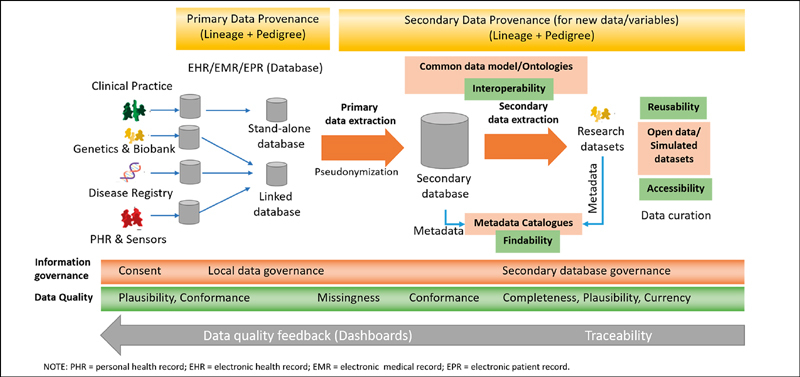
Summary: Objective: To create practical recommendations for the curation of routinely collected health data and artificial intelligence (AI) in primary care with a focus on ensuring their ethical use. Methods: We defined data curation as the process of management of data throughout its lifecycle to ensure it can be used into the future. We used a literature review and Delphi exercises to capture insights from the Primary Care Informatics Working Group (PCIWG) of the International Medical Informatics Association (IMIA). Results: We created six recommendations: (1) Ensure consent and formal process to govern access and sharing throughout the data life cycle; (2) Sustainable data creation/collection requires trust and permission; (3) Pay attention to Extract-Transform-Load (ETL) processes as they may have unrecognised risks; (4) Integrate data governance and data quality management to support clinical practice in integrated care systems; (5) Recognise the need for new processes to address the ethical issues arising from AI in primary care; (6) Apply an ethical framework mapped to the data life cycle, including an assessment of data quality to achieve effective data curation. Conclusions: The ethical use of data needs to be integrated within the curation process, hence running throughout the data lifecycle. Current information systems may not fully detect the risks associated with ETL and AI; they need careful scrutiny. With distributed integrated care systems where data are often used remote from documentation, harmonised data quality assessment, management, and governance is important. These recommendations should help maintain trust and connectedness in contemporary information systems and planned developments.
Overview
The claims and statistics of this paper haven’t been checked yet.
Free: it reads the open-access text and checks the first 5 claims that cite a source we can check. Create a free account to check every claim.
Integrity signals
Registry
Cites
Statistics
Figures
Verification
Claims the paper makes
The claims and statistics of this paper haven’t been checked yet.
Free: it reads the open-access text and checks the first 5 claims that cite a source we can check. Create a free account to check every claim.
Claims other papers make about this one
Each is checked against this paper’s own text: does it say what the citing paper says it does?
The cited source says what the claim attributes to it.
In the citing paper
“This might for example entail an initial risk assessment of vulnerabilities in data and software, including the risk of re-identification33, the risk of data loss and manipulation33,35, and the risk of adversarial attacks9,22,23,26,35,43,59.”
From Guidelines and quality criteria for artificial intelligence-based prediction models in healthcare: a scoping review (2022) · cites this paper as [33]
Self-check
Percentages, sums and reported differences re-computed from the paper’s own numbers.
The self-check needs the paper’s full text.
Citations
Cites
The FAIR Guiding Principles for scientific data management and stewardship
Wilkinson, M. D., Dumontier, M., Aalbersberg, I. J., Appleton, G., Axton, M., Baak, A., Blomberg, N., Boiten, J.-W., da Silva Santos, L. B., Bourne, P. E., et al. (2016) · Scientific Data · doi:10.1038/sdata.2016.18 · Cited by 18,423 · cited 1×
“We incorporated the FAIR guiding principles for scientific data management: Findability, Accessibility, Interoperability and Re-usability [14].”
MethodDissecting racial bias in an algorithm used to manage the health of populations
Obermeyer, Z., Powers, B., Vogeli, C., & Mullainathan, S. (2019) · Science · doi:10.1126/science.aax2342 · Cited by 7,137 · cited 1×
“Discrimination prevention ensures that data mining models do not lead to discriminatory decisions, even if the data set is inherently biased against vulnerable and disadvantaged groups [40].”
BackgroundKim, D. J., Ferrin, D. L., & Rao, H. R. (2008) · Decision Support Systems · doi:10.1016/j.dss.2007.07.001 · Cited by 3,613 · cited 1×
“Deployment of “apps” and systems that enable unethical and unlawful exchange of digital information undermine trust [24].”
BackgroundBig healthcare data: preserving security and privacy
Abouelmehdi, K., Beni-Hessane, A., & Khaloufi, H. (2018) · Journal of Big Data · doi:10.1186/s40537-017-0110-7 · Cited by 738 · cited 2×
“Data repositories are difficult to access to verify and validate the quality of the data and algorithms used [4, 5].”
BackgroundBlockchain technology for improving clinical research quality
Benchoufi, M., & Ravaud, P. (2017) · Trials · doi:10.1186/s13063-017-2035-z · Cited by 367 · cited 1×
“New and often disruptive technologies such as blockchain are being used to accelerate the consent process for clinical trials [22], potentially addressing personal data privacy concerns associated with data sharing in integrated service delivery.”
MethodAvailability and quality of mobile health app privacy policies
Sunyaev, A., Dehling, T., Taylor, P. L., & Mandl, K. D. (2015) · Journal of the American Medical Informatics Association · doi:10.1136/amiajnl-2013-002605 · Cited by 360 · cited 1×
“Recommendation 2: Implement sustainable data creation/collection to build and maintain trust as well as permission Community-driven health data repositories may not be as private as citizens assume [23].”
BackgroundMagrabi, F., Ammenwerth, E., McNair, J. B., De Keizer, N. F., Hyppönen, H., Nykänen, P., Rigby, M., Scott, P. J., Vehko, T., Wong, Z. S.-Y., et al. (2019) · Yearbook of Medical Informatics · doi:10.1055/s-0039-1677903 · Cited by 347 · cited 1×
“Trials comparing AI-based or AI-guided practice with usual practice are needed to provide the evidence to support policy recommendations and requirements for current poorly regulated AI practices [41].”
MethodAlgorithmic Bias: From Discrimination Discovery to Fairness-aware Data Mining
Hajian, S., Bonchi, F., & Castillo, C. (2016) · Proceedings of the 22nd ACM SIGKDD International Conference on Knowledge Discovery and Data Mining · doi:10.1145/2939672.2945386 · Cited by 334
Ten Ways Artificial Intelligence Will Transform Primary Care
Lin, S. Y., Mahoney, M. R., & Sinsky, C. A. (2019) · Journal of General Internal Medicine · doi:10.1007/s11606-019-05035-1 · Cited by 248 · cited 1×
“AI in primary care should “augment (not subvert) the patient-physician relationship” [38].”
BackgroundLiyanage, H., Liaw, S.-T., Jonnagaddala, J., Schreiber, R., Kuziemsky, C., Terry, A. L., & de Lusignan, S. (2019) · Yearbook of Medical Informatics · doi:10.1055/s-0039-1677901 · Cited by 200 · cited 2×
“The tendency for a ‘black-box’ paradigm with AI systems, especially those where intrinsic estimations are biased or not clinically interpretable in biological terms [11], should be strongly discouraged.”
BackgroundSelf-citation
Research works printed but not linked: 1
- Azarm M Backman C Kuziemsky CSystem level patient-centered data sharing. Proc 2019 IEEE/ACM 1st Int Workshop on Software Engineering for Healthcare, SEH 2019; 2019:45-8
Cited by
Ethical and regulatory challenges of AI technologies in healthcare: A narrative review
Mennella, C., Maniscalco, U., De Pietro, G., & Esposito, M. (2024) · Heliyon · doi:10.1016/j.heliyon.2024.e26297 · Cited by 1,229
“Vigilance in recognizing potential pitfalls and implementing safeguards is essential for ensuring the reliability and security of the data transfer process [108].”
Backgroundde Hond, A. A. H., Leeuwenberg, A. M., Hooft, L., Kant, I. M. J., Nijman, S. W. J., van Os, H. J. A., Aardoom, J. J., Debray, T. P. A., Schuit, E., van Smeden, M., et al. (2022) · npj Digital Medicine · doi:10.1038/s41746-021-00549-7 · Cited by 499
“Legislation may require identi fi cation of the right legal basis (such as informed consent) for processing con fi dential information of individuals 12,20,26,32,33,36,37 .”
BackgroundInfluentialKarimian, G., Petelos, E., & Evers, S. M. A. A. (2022) · AI and Ethics · doi:10.1007/s43681-021-00131-7 · Cited by 279
“The principle of explicability of AI algorithms was also frequently discussed in the literature [35, 38, 41, 45, 46, 48–51].”
BackgroundInfluentialDigital technologies, artificial intelligence, and bureaucratic transformation
Newman, J., Mintrom, M., & O'Neill, D. (2022) · Futures · doi:10.1016/j.futures.2021.102886 · Cited by 129
“On the negative side, critics have argued that automation in public administration can pose ethical problems (Liaw et al., 2020), increase inequality (Eubanks, 2018), and generally reduce the quality of democratic governance (Young et al., 2019: 312).”
Javaid, M., Haleem, A., & Singh, R. P. (2024) · Informatics and Health · doi:10.1016/j.infoh.2024.05.001 · Cited by 167
AI and its implications for research in higher education: a critical dialogue
Butson, R., & Spronken-Smith, R. (2024) · Higher Education Research & Development · doi:10.1080/07294360.2023.2280200 · Cited by 130
“These types of ethical complexities require us to reconsider our approach to participant ethics, particularly when their data can be used in multiple ways (Liaw et al., 2020; Tozzi & Cinelli, 2021).”
BackgroundHasan, H. E., Jaber, D., Khabour, O. F., & Alzoubi, K. H. (2024) · BMC Medical Ethics · doi:10.1186/s12910-024-01062-8 · Cited by 121
Quality assessment of real-world data repositories across the data life cycle: A literature review
Liaw, S., Guo, J., Ansari, S., Jonnagaddala, J., Godinho, M. A., Borelli, A. J., de Lusignan, S., Daniel Capurro, N., Liyanage, H., Bhattal, N., et al. (2020) · Journal of the American Medical Informatics Association · doi:10.1093/jamia/ocaa340 · Cited by 104
“Artificial intelligence (AI) and deep machine learning algorithms are increasingly being harnessed to mine these repositories for research, population health, quality improvement, clinical decision support, and personalized medicine.(1,2) Guiding principles have evolved for data custodians and data stewards to ethical…”
BackgroundInfluentialSelf-citationA review of machine learning applications in soccer with an emphasis on injury risk
Nassis, G. P., Verhagen, E. A. L. M., Brito, J., Figueiredo, P., & Krustrup, P. (2022) · Biology of Sport · doi:10.5114/biolsport.2023.114283 · Cited by 91
Ethical AI in practice: Balancing technological advancements with human values
Ayinla, B. S., Amoo, O. O., Atadoga, A., Abrahams, T. O., Osasona, F., & Farayola, O. A. (2024) · International Journal of Science and Research Archive · doi:10.30574/ijsra.2024.11.1.0218 · Cited by 37
“Liaw et al. (2020) provide practical recommendations for the ethical use of electronic health record data and AI in primary care.”
Challenges of Large Language Models for Mental Health CounselingPreprint
Chung, N. C., Dyer, G., & Brocki, L. (2023) · arXiv (Cornell University) · doi:10.48550/arxiv.2311.13857 · Cited by 82
“However, the incorporation of patient electronic health records (EHRs) into these models raises significant challenges concerning data security and patient privacy [47].”
BackgroundTerry, A. L., Kueper, J. K., Beleno, R., Brown, J. B., Cejic, S., Dang, J., Leger, D., McKay, S., Meredith, L., Pinto, A. D., et al. (2022) · BMC Medical Informatics and Decision Making · doi:10.1186/s12911-022-01984-6 · Cited by 64
“These wider ethical, legal, and social implications of AI use in primary health care have led to proposed regulations about AI use more broadly [45], as well as recommendations for ethical use of electronic health record data and AI in primary health care [46].”
BackgroundSelf-citationde Lusignan, S., Liyanage, H., McGagh, D., Jani, B., Bauwens, J., Byford, R. C., Evans, D., Fahey, T. P., Greenhalgh, T., Jones, N. R., et al. (2020) · JMIR Public Health and Surveillance · doi:10.2196/21434 · Cited by 66
“We carried out a rapid Delphi consensus exercise by inviting a panel (n=9) of international primary care clinicians and informaticians through the International Medical Informatics Association Primary Health Care Informatics working group and extended networks [32,33].”
MethodSelf-citationEthics of AI in healthcare: a scoping review demonstrating applicability of a foundational framework
Gorelik, A. J., Li, M., Hahne, J., Wang, J., Ren, Y., Yang, L., Zhang, X., Liu, X., Wang, X., Bogdan, R., et al. (2025) · Frontiers in Digital Health · doi:10.3389/fdgth.2025.1662642 · Cited by 61
Synergy of AI and Blockchain to Secure Electronic Healthcare Records
Rathore, N., Kumari, A., Patel, M., Chudasama, A. S., Bhalani, D., Tanwar, S., & Alabdulatif, A. (2024) · Security and Privacy · doi:10.1002/spy2.463 · Cited by 67
Yousefi, F., Dehnavieh, R., Laberge, M., Gagnon, M.-P., Ghaemi, M. M., Nadali, M., & Azizi, N. (2025) · BMC Primary Care · doi:10.1186/s12875-025-02785-2 · Cited by 70
Torres, D. R., Wermelinger, E., & Ferreira, A. (2025) · Saúde em Debate · doi:10.1590/2358-2898202514510070p · Cited by 6
The Role of Artificial Intelligence Model Documentation in Translational Science: Scoping Review
Brereton, T. A., Malik, M. M., Lifson, M. A., Greenwood, J. D., Peterson, K. J., & Overgaard, S. M. (2023) · Interactive Journal of Medical Research · doi:10.2196/45903 · Cited by 50
“If a clinician’s decision contradicts the AI output, how must a clinician proceed, and who is liable [23,25,32,34]?”
InfluentialA Literature Review on Ethics for AI in Biomedical Research and Biobanking
Kargl, M., Plass, M., & Müller, H. (2022) · Yearbook of Medical Informatics · doi:10.1055/s-0042-1742516 · Cited by 50
“The Primary Care Informatics Working Group of the International Medical Informatics Association (IMIA) stated 14 principles for ethical use of routinely collected health data and AI [23] and formulated the following six concrete recommendations:”
BackgroundLiaw, S., & Godinho, M. A. (2022) · Journal of the American Medical Informatics Association · doi:10.1093/jamia/ocac228 · Cited by 56
Self-citationFederico, C. A., & Trotsyuk, A. A. (2024) · Annual Review of Biomedical Data Science · doi:10.1146/annurev-biodatasci-102623-104553 · Cited by 43
Maris, M., Koçar, A., Willems, D. L., Pols, J. J., Tan, H. L., Lindinger, G. L., & Bak, M. (2024) · BMC Medical Ethics · doi:10.1186/s12910-024-01042-y · Cited by 44
“While AI has made significant progress in areas like medical image analysis in radiology, and natural language processing for extracting and structuring data from electronic health records [2], its general use in medicine is still in its early stages [3].”
BackgroundSchultz, K., Bej, S., Hahn, W., Wolfien, M., Srivastava, P. K., & Wolkenhauer, O. (2023) · Pattern Recognition · doi:10.1016/j.patcog.2023.110138 · Cited by 45
Shi, Z., Landrum, E., O'Connell, A., Kian, M., Pinto-Alva, L., Shrestha, K., Zhu, X., & Matarić, M. J. (2024) · Proceedings of the AAAI Symposium Series · doi:10.1609/aaaiss.v3i1.31245 · Cited by 34
Forecasting the future of smart hospitals: findings from a real-time delphi study
Jovy-Klein, F., Stead, S., Salge, T. O., Sander, J., Diehl, A., & Antons, D. (2024) · BMC Health Services Research · doi:10.1186/s12913-024-11895-z · Cited by 30
Artificial Intelligence Adoption for E-Government: Analysis of Enablers in an Emerging Economy
Fetais, A. H. M. A., Faisal, M. N., Sabir, L. B., & Al-Esmael, B. A. (2022) · International Journal of Electronic Government Research · doi:10.4018/ijegr.300773 · Cited by 24
Hahn, W., Schütte, K., Schultz, K., Wolkenhauer, O., Sedlmayr, M., Schuler, U. S., Eichler, M., Bej, S., & Wolfien, M. (2022) · Journal of Personalized Medicine · doi:10.3390/jpm12081278 · Cited by 21
“In terms of ethics, with the rise of novel technologies, such as Artificial Intelligence (AI), the problem also of re-identification from data, such as images and genomic information, becomes an essential aspect [27,28].”
BackgroundGodinho, M. A., Ashraf, M. M., Narasimhan, P., & Liaw, S. (2023) · International Journal of Medical Informatics · doi:10.1016/j.ijmedinf.2023.105174 · Cited by 20
Self-citationHealthcare data governance assessment based on hospital management perspectives
Shinta Oktaviana, R., Handayani, P. W., Hidayanto, A. N., & Siswanto, B. B. (2025) · International Journal of Information Management Data Insights · doi:10.1016/j.jjimei.2025.100342 · Cited by 20
Ten Topics to Get Started in Medical Informatics Research
Wolfien, M., Ahmadi, N., Fitzer, K., Grummt, S., Heine, K.-L., Jung, I.-C., Krefting, D., Kühn, A., Peng, Y., Reinecke, I., et al. (2023) · Journal of Medical Internet Research · doi:10.2196/45948 · Cited by 19
“In terms of ethics and with the rise of novel technologies, like artificial intelligence (AI), the possible re-identification of data, such as images and genomic information, is a major concern [16,17].”
Enhancing Fairness and Accuracy in Diagnosing Type 2 Diabetes in Young Adult Population
Pias, T. S., Su, Y., Tang, X., Wang, H., Faghani, S., & Yao, D. D. (2025) · IEEE Journal of Biomedical and Health Informatics · doi:10.1109/jbhi.2025.3616312 · Cited by 17
Educación médica e inteligencia artificial: perspectivas y desafíos éticos
Chávez-Martínez, O., & Ragacini, L. A. (2025) · Revista Médica del Instituto Mexicano del Seguro Social · doi:10.5281/zenodo.16748309 · Cited by 24
Orchestrating generative AI in pharmacovigilance: predicting and preempting the unpredictable
Ramcharran, D., Painter, J. L., Kara, V., Glaser, M., Vanini, M., Chalamalasetti, V. R., Golds, C., Abdelkarim, A., Bate, A., & Stegmann, J. (2025) · Therapeutic Advances in Drug Safety · doi:10.1177/20420986251396023 · Cited by 14
“…dimensions must be addressed in the application of AI, some of which are broadly relevant across domains, while others are specific to PV. 43,44 For example, the ethical use of EHR data and AI has been explored by the Primary Care Informatics Working Group of the International Medical…”
Luo, X., Wang, B., Shi, Q., Wang, Z., Lai, H., Liu, H., Qin, Y., Chen, F., Song, X., Ge, L., et al. (2025) · Journal of Clinical Epidemiology · doi:10.1016/j.jclinepi.2025.111903 · Cited by 12
Empowering Patients With AI-Ethical Digital Tools for Health Data Management and Decision
Tariq, M. U. (2025) · IGI Global eBooks · doi:10.4018/979-8-3693-7630-0.ch008 · Cited by 10
Wubineh, B. Z., Deriba, F. G., & Gemeda, F. W. (2026) · BMC Medical Ethics · doi:10.1186/s12910-026-01404-8 · Cited by 11
“Liaw et al. [24] offered ethical recommendations regarding the use of electronic health record (EHR) data and AI, focusing on equity, fairness, and trust.”
Artificial Intelligence in Australian Dental and General Healthcare: A Scoping Review
Weerakoon, A. T., Girdis, T., & Peters, O. A. (2025) · Australian Dental Journal · doi:10.1111/adj.70000 · Cited by 9
The Ethics of Leveraging Routinely Collected Patient Data for AI Development: Mixed Methods Study
Maris, M., Klopotowska, J. E., Cornet, R., van den Hoven, M., Lieverse, J. E., Fernández-Llaneza, D., & Bak, M. (2026) · Journal of Medical Internet Research · doi:10.2196/79863 · Cited by 8
“The risks described in the literature include security breaches, such as hacking or malware attacks, that could lead to data exploitation, intentional discrimination, or identity theft [27,31, 35].”
InfluentialDullabh, P., Zott, C., Gauthreaux, N. A., Peterson, C., Aronoff, A., Monkhouse, K., & Sittig, D. F. (2026) · Journal of Medical Internet Research · doi:10.2196/81628 · Cited by 9
“…GenAI’s potential, including limited GenAI implementation frameworks that consider the full sociotechnical environment [6], variability in requirements for reporting and validating GenAI [7], and mixed perceptions about the utility and safety of the technology among clinicians and patients [8].”
Nwokedi, V. U., Odedele, M. K., Yusuff, T. A., Anderson, I. A., Akanbi, O. O., Agu, C. P., & Omoike, A. O. (2025) · Epidemiology and Health Data Insights · doi:10.63946/ehdi/17369 · Cited by 8
“Scholars argue that algorithmic ethics must be proactive, not an after-thought: embedding algorithmic audits, human-in-the-loop review, and dynamic compliance monitoring increases trust [44].”
Fajkis-Zajączkowska, N., Zawada, A., Bojko, M., & Kolasa, K. (2025) · Computers in Biology and Medicine · doi:10.1016/j.compbiomed.2025.110750 · Cited by 8
Primary Care Informatics: Vitalizing the Bedrock of Health Care
You, J. G.-T., Leung, T. I., Pandita, D., & Sakumoto, M. (2024) · Journal of Medical Internet Research · doi:10.2196/60081 · Cited by 7
“Furthermore, as technologies, like generative AI, are implemented across health care [52,53], PCI professionals have and continue to lead the charge in steering the primary care and informatics communities toward equitable [54-56] and ethical [57] approaches to implementing these technologies.”
Guideline and knowledge management in a digital world
Hovenga, E. J. S. (2022) · Elsevier eBooks · doi:10.1016/b978-0-12-823413-6.00012-4 · Cited by 6
Ethical Implications with the Utilization of Artificial Intelligence in Dentistry
Saudagar, N., Jabeen, R., Sharma, P., Mong, S., & Vaderhobli, R. M. (2021) · Ethics in Biology Engineering and Medicine An International Journal · doi:10.1615/ethicsbiologyengmed.2022043936 · Cited by 6
Gupta, N. (2022) · International Journal of Science and Research Archive · doi:10.30574/ijsra.2022.7.1.0274 · Cited by 11
Ferreira, É. D. S., de Santana, M. M., Monteiro, I. D. S., & Moreira, K. S. (2023) · Saúde em Redes · doi:10.18310/2446-4813.2023v9n3.4137 · Cited by 4
The Future of Finance: Artificial Intelligence's Influence on Behavioral Investment Decisions
Rao, A., & Hossain, M. R. (2023) · Advances in business information systems and analytics book series · doi:10.4018/979-8-3693-1902-4.ch010 · Cited by 10
Skaletska, Z. (2025) · Analytical and Comparative Jurisprudence · doi:10.24144/2788-6018.2025.06.3.73 · Cited by 3
Akiri, S., Joshi, V., Williams, G., Mentis, H. M., & Kleinsmith, A. (2025) · Annual Symposium on Human-Computer Interaction for Work (CHIWORK) · doi:10.1145/3729176.3729177 · Cited by 3
Strudwick, G., Lo, B., Kemp, J., Jessa, K., Tajirian, T., White, P., & Nagle, L. (2022) · PubMed Central · Cited by 5
Hunik, L., Uijen, A. A., Kueper, J. K., Terry, A. L., Hartman, T. O., van Laarhoven, T., & Schers, H. (2026) · European Journal of General Practice · doi:10.1080/13814788.2026.2620908 · Cited by 3
Self-citationІНТЕГРАЦІЯ ШТУЧНОГО ІНТЕЛЕКТУ В СИСТЕМИ ЗАХИСТУ ПЕРСОНАЛЬНИХ ДАНИХ У СФЕРІ ОХОРОНИ ЗДОРОВ'Я
Diorditsa, I. V., & Коваль, О. (2024) · Наука і техніка сьогодні · doi:10.52058/2786-6025-2024-5(33)-87-97 · Cited by 1
Devereux, C., Jacob, B. M., Araz, K., Bullen, C., Murphy, C. F., & Redmond, P. (2025) · HRB Open Research · doi:10.12688/hrbopenres.14169.1 · Cited by 1
Addressing challenges with implementing essential digital tools
Jonnagaddala, J., & Liaw, S. (2025) · Elsevier eBooks · doi:10.1016/b978-0-323-95260-6.00011-3 · Cited by 1
Self-citationLidströmer, N., Davids, J., Sood, H. S., & Ashrafian, H. (2022) · Springer eBooks · doi:10.1007/978-3-030-64573-1_340 · Cited by 3
Study of Text Patterns Found on Social Networks of Mental Health Reactions to COVID-19
Cedeño-Moreno, D., Delgado-Herrera, A., Montilla-Herrera, N., & Vargas-Lombardo, M. (2024) · Acta Informatica Medica · doi:10.5455/aim.2024.32.15-18 · Cited by 1
“We carried out an analysis of tweets with help from the Natural Language Understanding tool from IBM Watson, which is a free NLP-based artificial intelligence platform to help with research (21).”
MethodNavigating the path of AI integration in public health: challenges and opportunities
Lacsa, J. E. M., & Arroyo, R. C. (2024) · Journal of Public Health · doi:10.1093/pubmed/fdae117 · Cited by 1
Lidströmer, N., Davids, J., Sood, H. S., & Ashrafian, H. (2021) · Springer eBooks · doi:10.1007/978-3-030-58080-3_340-1 · Cited by 1
Perspectives numériques, intelligence artificielle
Carbonnel, F., Schuers, M., & Darmon, D. (2022) · Elsevier eBooks · doi:10.1016/b978-2-294-76710-4.00005-x
Review: Current Trends in Artificial Intelligence on Healthcare
Janasekaran, S., Yousef, A. Z., Singh, A., & Jamadon, N. H. (2023) · SpringerBriefs in applied sciences and technology · doi:10.1007/978-3-031-25178-8_1 · Cited by 1
Moreira, K. S., de Santana, M. M., Monteiro, I. D. S., & Ferreira, É. D. S. (2024) · Saúde em Redes · doi:10.18310/2446-4813.2024v10n1.4138
Integration of Data into Commercial HEDIS Systems
-, S. H. (2025) · International Journal of Multidisciplinary Research and Growth Evaluation · doi:10.54660/.ijmrge.2025.6.3.2012-2021
Foundations of Clinical Informatics for Generalists
Patel, S. Y., Mezoff, E. A., & Rust, L. (2025) · Medical Clinics of North America · doi:10.1016/j.mcna.2025.06.003 · Cited by 2
Digital Health Maturity Stage 3: Standardized and interoperable
Kahn, M. G., Jonnagaddala, J., & Liaw, S. (2025) · Elsevier eBooks · doi:10.1016/b978-0-323-95260-6.00003-4
Self-citationMethodologies for quality measurement, monitoring, and evaluation
Liaw, S. (2025) · Elsevier eBooks · doi:10.1016/b978-0-323-95260-6.00006-x · Cited by 1
Self-citationLiaw, S. (2025) · Elsevier eBooks · doi:10.1016/b978-0-323-95260-6.09999-8
Self-citationMaris, M., Koçar, A., Willems, D. L., Pols, J. J., Tan, H. L., Lindinger, G. L., & Bak, M. (2024) · Figshare · doi:10.6084/m9.figshare.26702278
Terry, A. L., Kueper, J. K., Beleno, R., Brown, J. B., Cejic, S., Dang, J., Leger, D., McKay, S., Meredith, L., Pinto, A. D., et al. (2022) · Figshare · doi:10.6084/m9.figshare.21077165
Self-citationMaris, M., Koçar, A., Willems, D. L., Pols, J. J., Tan, H. L., Lindinger, G. L., & Bak, M. (2024) · Figshare · doi:10.6084/m9.figshare.25547136
Maris, M., Koçar, A., Willems, D. L., Pols, J. J., Tan, H. L., Lindinger, G. L., & Bak, M. (2024) · Figshare · doi:10.6084/m9.figshare.25547013
Maris, M., Koçar, A., Willems, D. L., Pols, J. J., Tan, H. L., Lindinger, G. L., & Bak, M. (2024) · Figshare · doi:10.6084/m9.figshare.26702275
Oshin, M. (2024) · D-Scholarship@Pitt (University of Pittsburgh) · Cited by 1
Ananta, B. R., Rahmayani, C. A., Sugiarto, L., Nugroho, A. A., & Assalamah, S. (2025) · Risalah Hukum · doi:10.30872/risalah.v21.i2.1885 · Cited by 1
Balancing Support and Autonomy: Investigating ChatGPT's Impact on PhD Students' Research Practices
Zerrik, A., & Abdellaoui, S. (2026) · IGI Global eBooks · doi:10.4018/979-8-3373-6911-2.ch015
Facilitating Co-regulation: An LLM-Powered Multimodal Social Robot for Parent-Child Dyads
Li, J., Schijve, F., Hu, J., & Barakova, E. I. (2026) · ACM/IEEE International Conference on Human-Robot Interaction (HRI) · doi:10.1145/3776734.3794485
Health knowledge management in a digital world
Hovenga, E. J. S. (2026) · Elsevier eBooks · doi:10.1016/b978-0-443-44073-1.00026-2
Khatun, S. (2026) · Studies in big data · doi:10.1007/978-3-032-18871-7_18
The Role of Artificial Intelligence in Primary Care: A Systematic literature review
Reginato, E., Fadda, I., Floris, M., & Paglietti, P. (2026) · MECOSAN · doi:10.3280/mesa2025-134oa22019
Gavryliuk, N., Kozak, O., Volkov, R. K., Danchak, S. V., & Prokopchuk, O. V. (2026) · Academic Visions · doi:10.66556/2786-586x.53.gavryliuk-n · Cited by 2
Leveraging AI-Powered Tools in Academic Research: Promises and Perils
Aouri, Z. E. (2026) · Lingua. Language and Culture · doi:10.24193/llc.2025.1.9
“Case Study 1: Accelerating literature review using AI Bernard et al. (2025) conducted a study in which”
Designing an LLM-Powered Social Robot for Supporting Emotion Regulation in Parent-Child Dyads
Li, J., Schijve, F., Li, S., Barakova, E. I., & Hu, J. (2026) · Lecture notes in computer science · doi:10.1007/978-3-032-26051-2_15
Mapping artificial intelligence applications in electronic medical records research
Putra, B. A., & Arini, M. (2026) · International Journal of Advances in Applied Sciences · doi:10.11591/ijaas.v15.i2.pp646-655
“As healthcare systems become more integrated, managing AI-related risks requires coordinated efforts in data governance, assessment, and security [37].”
Artificial Intelligence and Blockchain as Determinants of Healthcare Data Security Transformation
Gbolade, O. (2026) · Journal of Information Technology Cybersecurity and Artificial Intelligence · doi:10.70715/jitcai.2026.v3.i4.083
Nurses’ Ethical Reasoning About Digital Ethical Risks: A Vignette‐Elicited Qualitative Study
Betül, B. A. L., KABA, N. K., & APAYDIN, E. (2026) · International Nursing Review · doi:10.1111/inr.70224
Ética e vieses em dados: perspectivas gerais
Marin, L. H. G., Nobre, R. L. D. S., Marin, R. P. M., & Silva, R. A. (2024) · doi:10.24208/abecined.2024.416
Mayán, Y. S., Yanes, A. R., Queija, Y. F., Cuétara, L. H., & Diaz, A. C. (2025) · SAP Artificial Intelligence in Dentistry · doi:10.62486/aid202535
Artificial intelligence in neurocritical care medical rounds
Salazar-Ruiz, S., Barrios-Martínez, D. D., & Cárdenas-Bohórquez, L. (2026) · World Journal of Critical Care Medicine · doi:10.5492/wjccm.125980
Lai, H., Tong, B., Spruyt, K., Jemioło, P., Kuriyama, A., Florez, I. D., Bała, M., Albarqouni, L., Myeong Soo, L. E. E., Liu, J., et al. (2026) · AI Evidence-Based Medicine · doi:10.1097/ai9.0000000000000004 · Cited by 1
Metadata
- Authors
- Liaw, S.-T., Liyanage, H., Kuziemsky, C., Terry, A. L., Schreiber, R., Jonnagaddala, J., & de Lusignan, S.
- Affiliations
- UNSW Sydney (AU)
- University of Oxford (GB)
- MacEwan University (CA)
- Western University (CA)
- Geisinger Health System (US)
- Clnical Informatics and Health Outcomes Research Group, Nuffield Department of Primary Care Health Sciences, University of Oxford, Eagle House, 7 Walton Well Road, Oxford, OX2 6ED, UK
- ORCID
- Venue
- Yearbook of Medical Informatics
- Publisher
- Georg Thieme Verlag KG
- Published
- 2020-04-17
- Volume
- 29
- Issue
- 01
- Pages
- 051-057
- ISSN
- 0943-4747 (ISSN-L)
- 2364-0502
- PMC
- PMC7442527
- OpenAlex
- W3017144593
- Cited by
- 76
- References
- 34
- Citations by year
- 2026: 11 · 2025: 18 · 2024: 19 · 2023: 9 · 2022: 14 · 2021: 3 · 2020: 2
- FWCI
- 6.15
- Type
- journal article
- Language
- en
- Open access
- hybrid
- doi.org
- Licence
- Locations
- Yearbook of Medical Informatics (publishedVersion, cc-by-nc-nd)
- PubMed Central (publishedVersion, cc-by-nc-nd)
- PubMed (publishedVersion)
- Topics
- Health Sciences › Health Professions › Health Information Management › Electronic Health Records Systems
- Health Sciences › Medicine › Health Informatics › Artificial Intelligence in Healthcare and Education
- Health Sciences › Health Professions › Health Information Management › Medical Coding and Health Information
- Keywords
- electronic health records, AI ethics, data curation, data lifecycle, primary care, data governance, data quality management, informed consent, integrated care systems, ethical frameworks
- MeSH terms
- Data Accuracy, Artificial Intelligence, Ethics, Medical, Humans, Medical Informatics, Primary Health Care, Medical Records Systems, Computerized, Information Dissemination, Electronic Health Records
About these checks
Registry, retraction, Cites and statistics results are computed, not judged, with one exception: a printed reference that no index lists is read once by a model before it counts as a citation error. Claims are extracted by a model and kept only when their quote appears verbatim in the text; each cited source is then checked, with a model’s help, for whether it says what the claim relies on. Those verdicts can be wrong — read the claim’s quote and the cited source before relying on one.
Statistics and arithmetic are recomputed, not judged.
Confidence bands are shown only for fields calibrated on our annotated test set. None is calibrated yet, so no band is shown.
What counts as a claim ›How we measure confidence ›How we check this ›
Are you an author, or do you see a problem with this page? Request a review
Data sources
Bibliographic data: Semantic Scholar, OpenAlex, Crossref.
Contains information from the Semantic Scholar Academic Graph Datasets, made available under the ODC Attribution License (ODC-BY 1.0).
Semantic Scholar’s data is described in: Kinney, R., et al. (2023). The Semantic Scholar Open Data Platform. arXiv:2301.10140.
