

The DOI matches its Crossref record; 3 of the 3 references it cites were found in a registry or an index.
Comparative Evaluation of Large Language Models for Translating Radiology Reports into Hindi
Open accessAbstract
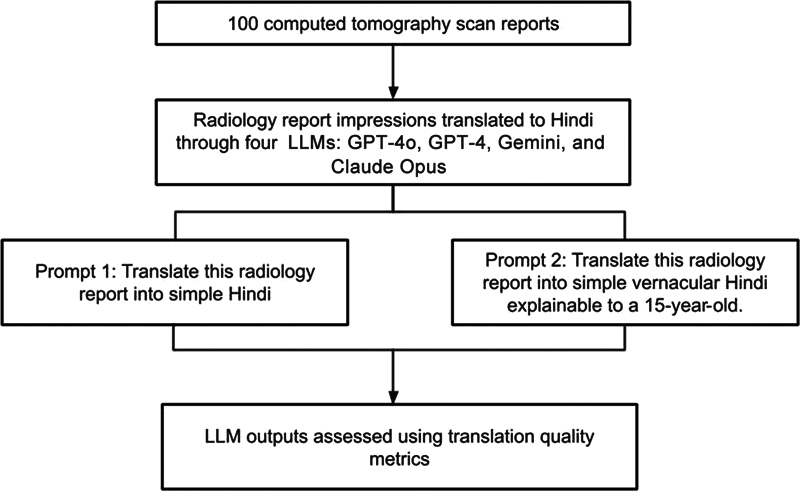
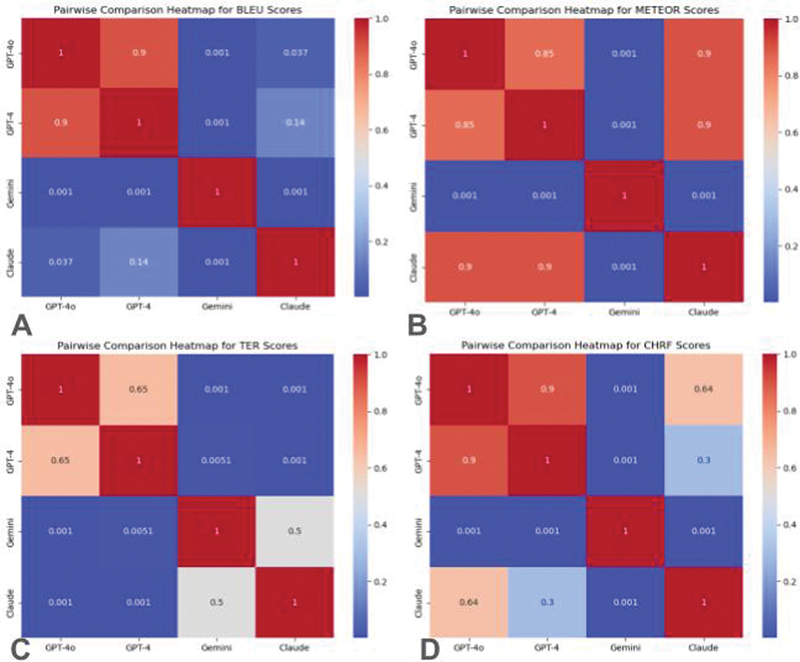
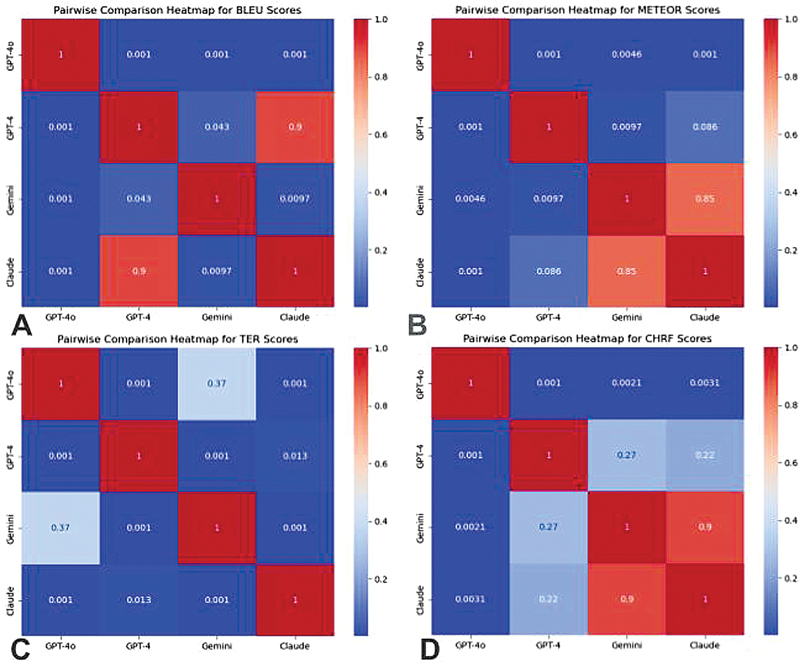
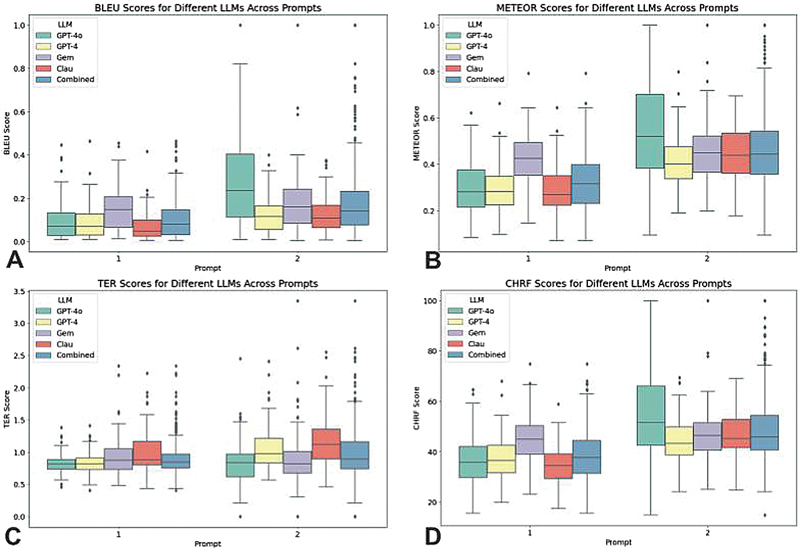
Objective The aim of this study was to compare the performance of four publicly available large language models (LLMs)—GPT-4o, GPT-4, Gemini, and Claude Opus—in translating radiology reports into simple Hindi. Materials and Methods In this retrospective study, 100 computed tomography (CT) scan report impressions were gathered from a tertiary care cancer center. Reference translations of these impressions into simple Hindi were done by a bilingual radiology staff in consultation with a radiologist. Two distinct prompts were used to assess the LLMs' ability to translate these report impressions into simple Hindi. Translated reports were assessed by a radiologist for instances of misinterpretation, omission, and addition of fictitious information. Translation quality was assessed using Bilingual Evaluation Understudy (BLEU), Metric for Evaluation of Translation with Explicit ORdering (METEOR), Translation Edit Rate (TER), and character F-score (CHRF) scores. Statistical analyses were performed to compare the LLM performance across prompts. Results Nine instances of misinterpretation and two instances of omission of information were found on radiologist evaluation of the total 800 LLM-generated translated report impressions. For prompt 1, Gemini outperformed others in BLEU (p < 0.001) and METEOR scores (p = 0.001), and was superior to GPT-4o and GPT-4 in TER and CHRF (p < 0.001), but comparable to Claude (p = 0.501 for TER and p = 0.90 for CHRF). For prompt 2, GPT-4o outperformed all others (p < 0.001) in all metrics. Prompt 2 yielded better BLEU, METEOR, and CHRF scores (p < 0.001), while prompt 1 had a better TER score (p < 0.001). Conclusion While each LLM's effectiveness varied with prompt wording, all models demonstrated potential in translating and simplifying radiology report impressions.
Overview
The claims and statistics of this paper haven’t been checked yet.
Run the check — free, no account needed. It reads the open-access text and checks the sources it cites.
Integrity signals
Registry
Cites
Statistics
Figures
Verification
Claims the paper makes
The claims and statistics of this paper haven’t been checked yet.
Run the check — free, no account needed. It reads the open-access text and checks the sources it cites.
Claims other papers make about this one
Each is checked against this paper’s own text: does it say what the citing paper says it does?
The cited source says what the claim attributes to it.
In the citing paper
“Large language model (LLM) chatbots, such as ChatGPT, Claude, Copilot, Gemini, Meta AI, and Perplexity, have demonstrated remarkable capabilities in natural language processing including text summarization, translation [8], and content generation [9].”
From Evaluating the Capability of Large Language Model Chatbots for Generating Plain Language Summaries in Radiology (2025) · cites this paper as [8]
Self-check
Percentages, sums and reported differences re-computed from the paper’s own numbers.
The self-check needs the paper’s full text.
Citations
Cites
ChatGPT makes medicine easy to swallow: an exploratory case study on simplified radiology reports
Jeblick, K., Schachtner, B., Dexl, J., Mittermeier, A., Stüber, A. T., Topalis, J., Weber, T., Wesp, P., Sabel, B. O., Ricke, J., et al. (2023) · European Radiology · doi:10.1007/s00330-023-10213-1 · Cited by 549
Lyu, Q., Tan, J., Zapadka, M. E., Ponnatapura, J., Niu, C., Myers, K. J., Wang, G., & Whitlow, C. T. (2023) · Visual Computing for Industry, Biomedicine, and Art · doi:10.1186/s42492-023-00136-5 · Cited by 367 · cited 1×
“6,7,15 These studies have reported better performance of GPT models using the prompts where additional context was provided.”
Li, H., Moon, J. T., Iyer, D., Balthazar, P., Krupinski, E. A., Bercu, Z. L., Newsome, J. M., Banerjee, I., Gichoya, J. W., & Trivedi, H. M. (2023) · Clinical Imaging · doi:10.1016/j.clinimag.2023.06.008 · Cited by 118
Research works printed but not linked: 10
- S Patil, 2021, Radiology reporting in the era of patient-centered care: how can we improve readability?, J Digit Imaging, 34, 367, 10.1007/s10278-021-00439-0 · DOI
- B Bruno, 2022, Informed or anxious: patient preferences for release of test results of increasing sensitivity on electronic patient portals, Health Technol (Berl), 12, 59, 10.1007/s12553-021-00628-5 · DOI
- R Bhayana, 2024, Chatbots and large language models in radiology: a practical primer for clinical and research applications, Radiology, 310, e232756, 10.1148/radiol.232756 · DOI
- J N Itri, 2015, Patient-centered radiology, Radiographics, 35, 1835, 10.1148/rg.2015150110 · DOI
- R Doshi, 2023, Utilizing Large Language Models to Simplify Radiology Reports: a comparative analysis of ChatGPT3. 5, ChatGPT4. 0, Google Bard, and Microsoft Bing, medRxiv, 10.1101/2023.06.04.23290786 · DOI
- P K Sarangi, 2023, Assessing ChatGPT's proficiency in simplifying radiological reports for healthcare professionals and patients, Cureus, 15, e50881
- A Lavie, 2009, The METEOR metric for automatic evaluation of machine translation, Mach Transl, 23, 105, 10.1007/s10590-009-9059-4 · DOI
- M Snover, 2006, A study of translation edit rate with targeted human annotation, 223
- M Popović, 2015, chrF: character n-gram F-score for automatic MT evaluation, 392
- K S Amin, 2023, Accuracy of ChatGPT, Google Bard, and Microsoft Bing for simplifying radiology reports, Radiology, 309, e232561, 10.1148/radiol.232561 · DOI
Cited by
Sorted by citations
Sarangi, P. K., Hui, P., Mondal, H., Kumar Nayak, D. S., Swarup, M. S., Ishan, & Panda, S. (2025) · iRADIOLOGY · doi:10.1002/ird3.70030 · Cited by 6
“Large language model (LLM) chatbots, such as ChatGPT, Claude, Copilot, Gemini, Meta AI, and Perplexity, have demonstrated remarkable capabilities in natural language processing including text summarization, translation [8], and content generation [9].”
Metadata
- Authors
- Gupta, A., Rastogi, A., Malhotra, H., & Rangarajan, K.
- Affiliations
- DR. B.R.A. Institute Rotary Cancer Hospital (IN)
- Corresponding author
- Rangarajan, Krithika
- Venue
- Indian Journal of Radiology and Imaging
- Publisher
- Georg Thieme Verlag KG
- Published
- 2024-09-04
- Volume
- 35
- Issue
- 01
- Pages
- 088-096
- ISSN
- 0970-2016 (ISSN-L)
- 0971-3026
- 1998-3808
- PMC
- PMC11651845
- OpenAlex
- W4402216602
- Cited by
- 10
- References
- 3
- Citations by year
- 2026: 4 · 2025: 6
- FWCI
- 0.93
- Type
- journal article
- Language
- en
- Open access
- diamond
- doi.org
- Licence
- Locations
- Indian journal of radiology and imaging - new series/Indian journal of radiology and imaging/Indian Journal of Radiology & Imaging (publishedVersion, cc-by-nc-nd)
- PubMed Central (publishedVersion, cc-by-nc-nd)
- PubMed (publishedVersion)
- DOAJ (DOAJ: Directory of Open Access Journals) (submittedVersion, cc-by-sa)
- Topics
- Health Sciences › Medicine › Health Informatics › Artificial Intelligence in Healthcare and Education
- Physical Sciences › Computer Science › Artificial Intelligence › Natural Language Processing Techniques
- Physical Sciences › Computer Science › Artificial Intelligence › Topic Modeling
- Keywords
- large language models, Hindi translation, GPT-4o, GPT-4, Gemini, Claude Opus, prompt engineering, translation quality assessment
About these checks
Registry, retraction, Cites and statistics results are computed, not judged, with one exception: a printed reference that no index lists is read once by a model before it counts as a citation error. Claims are extracted by a model and kept only when their quote appears verbatim in the text; each cited source is then checked, with a model’s help, for whether it says what the claim relies on. Those verdicts can be wrong — read the claim’s quote and the cited source before relying on one.
Statistics and arithmetic are recomputed, not judged.
Confidence bands are shown only for fields calibrated on our annotated test set. None is calibrated yet, so no band is shown.
What counts as a claim ›How we measure confidence ›How we check this ›
Are you an author, or do you see a problem with this page? Request a review
