

The DOI matches its Crossref record; 26 of the 26 references it cites were found in a registry or an index.
Efficacy of Single-Dose Human Papillomavirus Vaccination among Young African Women
Open accessAbstract
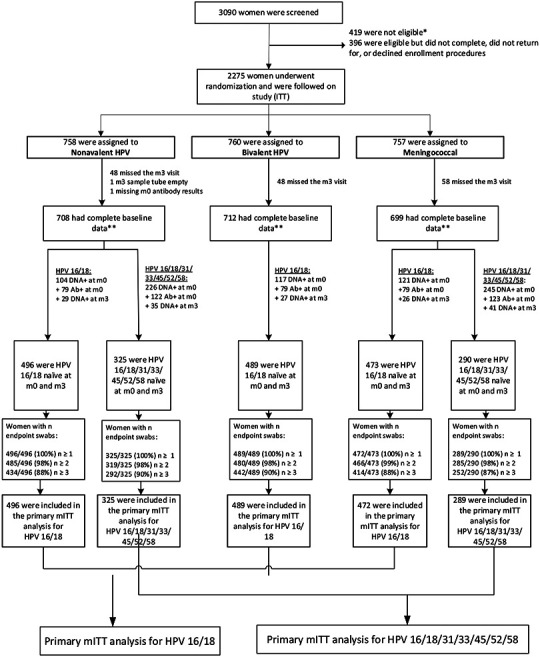
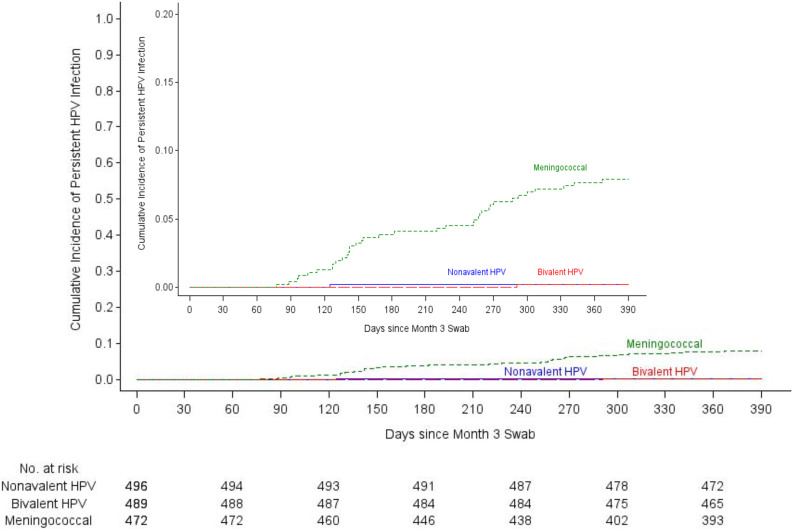
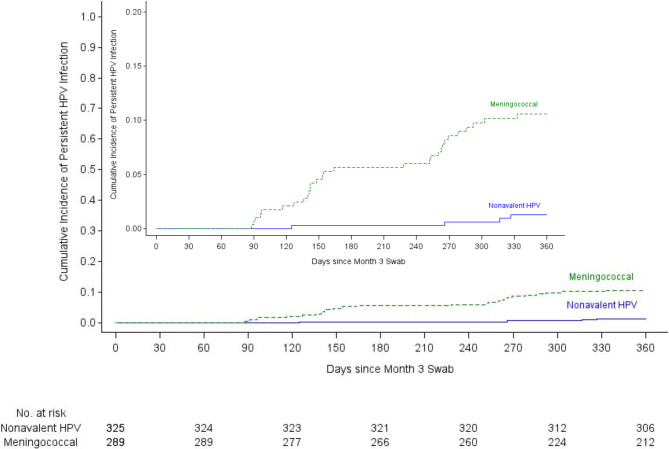
BACKGROUND: Single-dose human papillomavirus (HPV) vaccination, if efficacious, would be tremendously advantageous, simplifying implementation and decreasing costs. METHODS: We performed a randomized, multicenter, double-blind, controlled trial of single-dose nonavalent (HPV 16/18/31/33/45/52/58/6/11 infection) or bivalent (HPV 16/18 infection) HPV vaccination compared with meningococcal vaccination among Kenyan women 15 to 20 years of age. Enrollment and 6-monthly cervical swabs and a month 3 vaginal swab were tested for HPV deoxyribonucleic acid (DNA). Enrollment sera were tested for HPV antibodies. The modified intent-to-treat (mITT) cohort comprised participants who had an HPV antibody-negative result at enrollment and an HPV DNA-negative result at enrollment and month 3. The primary outcome was incident persistent vaccine-type HPV infection by month 18. RESULTS: Between December 2018 and June 2021, 2275 women were randomly assigned and followed. A total of 758 participants received the nonavalent HPV vaccine, 760 received the bivalent HPV vaccine, and 757 received the meningococcal vaccine; retention was 98%. Thirty-eight incident persistent infections were detected in the HPV 16/18 mITT cohort: one each among participants assigned to the bivalent and nonavalent groups and 36 among those assigned to the meningococcal group. Nonavalent vaccine efficacy (VE) was 97.5% (95% confidence interval [CI], 81.7 to 99.7%; P≤0.0001), and bivalent VE was 97.5% (95% CI, 81.6 to 99.7%; P≤0.0001). Thirty-three incident persistent infections were detected in the HPV 16/18/31/33/45/52/58 mITT cohort: four in the nonavalent group and 29 in the meningococcal group. Nonavalent VE for HPV 16/18/31/33/45/52/58 was 88.9% (95% CI, 68.5 to 96.1; P<0.0001). The rate of serious adverse events was 4.5% to 5.2% by group. CONCLUSIONS: Over the 18-month timeframe we studied, single-dose bivalent and nonavalent HPV vaccines were each highly effective in preventing incident persistent oncogenic HPV infection, similar to multidose regimens. (Funded by the National Institutes of Health, the Bill and Melinda Gates Foundation, and the University of Washington; ClinicalTrials.gov number, NCT03675256.)
Overview
The claims and statistics of this paper haven’t been checked yet.
Run the check — free, no account needed. It reads the open-access text and checks the sources it cites.
Integrity signals
Registry
Cites
Statistics
Figures
Verification
Claims the paper makes
The claims and statistics of this paper haven’t been checked yet.
Run the check — free, no account needed. It reads the open-access text and checks the sources it cites.
Claims other papers make about this one
Each is checked against this paper’s own text: does it say what the citing paper says it does?
The source backs part of the claim, not all of it — or backs it for a different population, condition or comparison.
In the citing paper
“Recently, initial results from a vaccine trial in Kenya12 designed to compare the protection of single-dose versus multi-dose HPV vaccination corroborate these findings.”
From Evidence-based impact projections of single-dose human papillomavirus vaccination in India: a modelling study (2022) · cites this paper as [12]
Experimental — accuracy not yet measuredThe cited source says what the claim attributes to it.
In the citing paper
“higher valency vaccines, which are also likely to be efficacious under a single-dose schedule.12”
From Evidence-based impact projections of single-dose human papillomavirus vaccination in India: a modelling study (2022) · cites this paper as [12]
Self-check
Percentages, sums and reported differences re-computed from the paper’s own numbers.
The self-check needs the paper’s full text.
Citations
Cites
Sung, H., Ferlay, J., Siegel, R. L., Laversanne, M., Soerjomataram, I., Jemal, A., & Bray, F. (2021) · CA: A Cancer Journal for Clinicians · doi:10.3322/caac.21660 · Cited by 108,699
Cancer incidence and mortality worldwide: Sources, methods and major patterns in GLOBOCAN 2012
Ferlay, J., Soerjomataram, I., Dikshit, R., Eser, S., Mathers, C., Rebelo, M., Parkin, D. M., Forman, D., & Bray, F. (2015) · International Journal of Cancer · doi:10.1002/ijc.29210 · Cited by 28,766
A Controlled Trial of a Human Papillomavirus Type 16 Vaccine
Koutsky, L. A., Ault, K. A., Wheeler, C. M., Brown, D. R., Barr, E., Alvarez, F. B., Chiacchierini, L. M., & Jansen, K. U. (2002) · New England Journal of Medicine · doi:10.1056/nejmoa020586 · Cited by 1,719
Harper, D. M., Franco, E. L., Wheeler, C. M., Ferris, D. G., Jenkins, D., Schuind, A., Zahaf, T., Innis, B. L., Naud, P., de Carvalho, N. S., et al. (2004) · The Lancet · doi:10.1016/s0140-6736(04)17398-4 · Cited by 1,639
A 9-valent HPV vaccine against infection and intraepithelial neoplasia in women
Joura, E. A., Giuliano, A. R., Iversen, O.-E., Bouchard, C., Mao, C., Mehlsen, J., Moreira, E. D., Ngan, Y., Petersen, L. K., Lazcano-Ponce, E., et al. (2015) · New England Journal of Medicine · doi:10.1056/nejmoa1405044 · Cited by 1,433
Drolet, M., Bénard, É., Pérez, N., Brisson, M., Ali, H., Boily, M.-C., Baldo, V., Brassard, P., Brotherton, J. M. L., Callander, D., et al. (2019) · The Lancet · doi:10.1016/s0140-6736(19)30298-3 · Cited by 1,384
Bruni, L., Saura‐Lázaro, A., Montoliu, A., Brotons, M., Alemany, L., Diallo, M., Afsar, O. Z., LaMontagne, D. S., Mosina, L., Contreras, M., et al. (2020) · Preventive Medicine · doi:10.1016/j.ypmed.2020.106399 · Cited by 767
Waterboer, T., Sehr, P. A., Michael, K. M., Franceschi, S., Nieland, J. D., Joos, T. O., Templin, M. F., & Pawlita, M. (2005) · Clinical Chemistry · doi:10.1373/clinchem.2005.052381 · Cited by 595
Kreimer, A. R., Struyf, F., Rosario‐Raymundo, M. R. D., Hildesheim, A., Skinner, S. R., Wacholder, S., Garland, S. M., Herrero, R., David, M., & Wheeler, C. M. (2015) · The Lancet Oncology · doi:10.1016/s1470-2045(15)00047-9 · Cited by 316
Basu, P., Malvi, S. G., Joshi, S., Bhatla, N., Muwonge, R., Lucas, E., Verma, Y., Esmy, P. O., Poli, U. R. R., Shah, A., et al. (2021) · The Lancet Oncology · doi:10.1016/s1470-2045(21)00453-8 · Cited by 272
Research works printed but not linked: 1
- Watson-Jones D Changalucha J Whitworth H et al. Month 24 immunogenicity and safety of 1 2 and 3 doses of Gardasil-9 and Cervarix in Tanzanian girls aged 9-14Y: the DoRIS randomized trial. Presented at the 34th International Papillomavirus Virtual Conference; November 15–19 2021.
Cited by
Sorted by citations
Overcoming barriers to patient adherence: the case for developing innovative drug delivery systems
Baryakova, T. H., Pogostin, B. H., Langer, R., & McHugh, K. J. (2023) · Nature Reviews Drug Discovery · doi:10.1038/s41573-023-00670-0 · Cited by 566
Recent Developments in Human Papillomavirus (HPV) Vaccinology
Williamson, A. (2023) · Viruses · doi:10.3390/v15071440 · Cited by 227
Human Papillomavirus Vaccination
Markowitz, L. E., & Unger, E. R. (2023) · New England Journal of Medicine · doi:10.1056/nejmcp2108502 · Cited by 136
Watson‐Jones, D., Changalucha, J. M., Whitworth, H. S., Pinto, L. A., Mutani, P., Indangasi, J., Kemp, T. J., Hashim, R., Kamala, B., Wiggins, R. C., et al. (2022) · The Lancet Global Health · doi:10.1016/s2214-109x(22)00309-6 · Cited by 120
Barnabas, R. V., Brown, E. R., Onono, M. A., Bukusi, E. A., Njoroge, B., Winer, R. L., Galloway, D. A., Pinder, L. F., Donnell, D. J., Wakhungu, I., et al. (2023) · Nature Medicine · doi:10.1038/s41591-023-02658-0 · Cited by 104
Self-citation
Metadata
- Authors
- Barnabas, R. V., Brown, E. R., Onono, M. A., Bukusi, E. A., Njoroge, B., Winer, R. L., Galloway, D. A., Pinder, L. F., Donnell, D., Wakhungu, I., Congo, O., Biwott, C., Kimanthi, S., Oluoch, L., Heller, K. B., Leingang, H., Morrison, S., Rechkina, E., Cherne, S., Schaafsma, T. T., McClelland, R. S., Celum, C., Baeten, J. M., & Mugo, N.
- Affiliations
- Harvard University (US)
- University of Washington (US)
- Kenya Medical Research Institute (KE)
- Fred Hutch Cancer Center (US)
- ORCID
- Barnabas, Ruanne V.
- Brown, Elizabeth R.
- Onono, Maricianah A.
- Bukusi, Elizabeth A.
- Winer, Rachel L.
- Galloway, Denise A.
- Pinder, Leeya F.
- Donnell, Deborah
- Congo, Ouma
- Oluoch, Lynda
- Heller, Kate B.
- Leingang, Hannah
- Morrison, Susan
- Cherne, Stephen
- Schaafsma, Torin T.
- McClelland, R. Scott
- Celum, Connie
- Baeten, Jared M.
- Mugo, Nelly
- Venue
- NEJM Evidence
- Publisher
- Massachusetts Medical Society
- Published
- 2022-04-26
- Volume
- 1
- Issue
- 5
- Pages
- EVIDoa2100056-EVIDoa2100056
- ISSN
- 2766-5526 (ISSN-L)
- PMC
- PMC9172784
- OpenAlex
- W4223574449
- Cited by
- 223
- References
- 26
- Citations by year
- 2026: 49 · 2025: 48 · 2024: 54 · 2023: 52 · 2022: 19
- FWCI
- 31.22
- Type
- journal article
- Language
- en
- Open access
- green
- www.ncbi.nlm.nih.gov
- Licence
- cc-by
- Locations
- NEJM Evidence (publishedVersion)
- PubMed (publishedVersion)
- PubMed Central (acceptedVersion, cc-by)
- Funders
- National Cancer Institute (R35CA209979, T32CA009515)
- National Institute of Allergy and Infectious Diseases (R01AI038382)
- Topics
- Health Sciences › Medicine › Epidemiology › Cervical Cancer and HPV Research
- Health Sciences › Medicine › Surgery › Genital Health and Disease
- Life Sciences › Immunology and Microbiology › Microbiology › Reproductive tract infections research
- Keywords
- HPV vaccine, nonavalent HPV vaccine, bivalent HPV vaccine, vaccine efficacy, persistent HPV infection, HPV 16/18, meningococcal vaccine, young women, Kenya, vaccine safety
- MeSH terms
- Adolescent, Africa, Uterine Cervical Neoplasms, Female, Humans, Papillomavirus Infections, Papillomavirus Vaccines, Young Adult
About these checks
Registry, retraction, Cites and statistics results are computed, not judged, with one exception: a printed reference that no index lists is read once by a model before it counts as a citation error. Claims are extracted by a model and kept only when their quote appears verbatim in the text; each cited source is then checked, with a model’s help, for whether it says what the claim relies on. Those verdicts can be wrong — read the claim’s quote and the cited source before relying on one.
Statistics and arithmetic are recomputed, not judged.
Confidence bands are shown only for fields calibrated on our annotated test set. None is calibrated yet, so no band is shown.
What counts as a claim ›How we measure confidence ›How we check this ›
Are you an author, or do you see a problem with this page? Request a review
