

Competitive pricing on online markets: a literature review
Open accessThe DOI matches its Crossref record; 205 of the 205 references it cites were found in a registry or an index; none of the 84 sources its claims cite is checked for support yet.
Abstract
Past reviews of studies concerning competitive pricing strategies lack a unifying approach to interdisciplinarily structure research across economics, marketing management, and operations. This academic void is especially unfortunate for online markets as they show much higher competitive dynamics compared to their offline counterparts. We review 132 articles on competitive posted goods pricing on either e-tail markets or markets in general. Our main contributions are (1) to develop an interdisciplinary framework structuring scholarly work on competitive pricing models and (2) to analyze in how far research on offline markets applies to online retail markets.
Overview
CoChat Summary
TL;DR
This literature review synthesizes 132 articles on competitive posted-goods pricing, mainly in B2C online retail, and proposes an interdisciplinary framework along product similarity, product durability, time dependence, and market structure. It concludes that online markets intensify competition and that dynamic pricing models generally outperform static ones in e-commerce, while much competitive pricing research remains theoretical and only weakly empirically validated.
Key findings
- The review develops a framework classifying competitive pricing models by four characteristics: product similarity (identical vs. quality-differentiated goods), product durability (perishable vs. durable goods), time dependence (time-dependent vs. time-independent settings), and market structure (monopolistic, duopolistic, oligopolistic, or perfect competition).
- Online markets differ from offline markets through lower search costs, increased price transparency, easy product comparison, low menu costs, and higher impact of competitor pricing on demand, which intensifies competition.
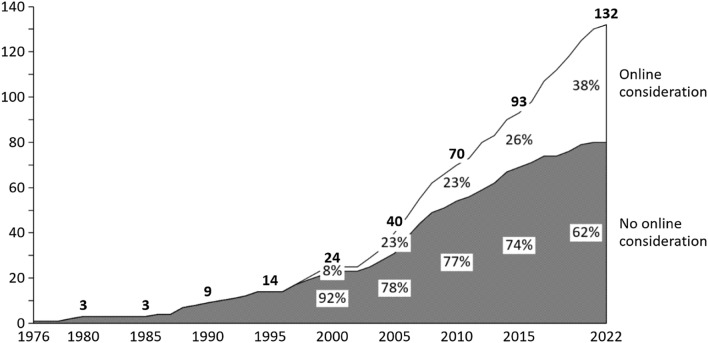
- Among the 132 reviewed articles, 71.8% of papers published from 2015 to 2022 consider online settings specifically, compared with 43.8% from 2000 to 2005; 60% study duopolies, 49% oligopolies, 7% monopolistic competition, and 3% perfect competition.
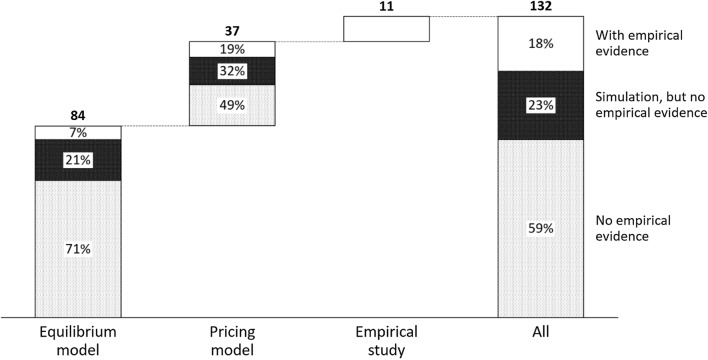
- Only 18% of reviewed articles use empirical evidence to validate hypotheses, 23% use simulation data or numerical examples, and 59% provide no empirical evidence or numerical examples; equilibrium models use empirical data in only 7% of papers.
Methods
- Literature review using a semi-structured multi-pronged search strategy: screening prior reviews, searching EBSCO, Scopus, and Web of Science, and screening high-impact journals in economics, marketing management, and operations.
- The initial sample was 996 unique papers, reduced to 174 after abstract/text screening, and finally to 132 entries relevant to competitive B2C online pricing; the study concentrates on papers published between 2000 and 2022 and only sparsely uses pre-internet literature.
- The authors conduct a descriptive and content analysis of the literature, classifying contributions by journal representation, historical development, research domain, geographic and industry context, research design, and empirical foundation, then structure competitive pricing models along four key characteristics.
Limitations
- The paper states that due to space limitations it focused on four overall product- and market-related attributes, and that more work is needed on other firm- and consumer-related characteristics of competitive pricing models.
- The paper states that its selection considered only peer-reviewed journal and conference proceedings in English; future research could include industry-funded, unpublished, and non-peer-reviewed articles, also in other languages, and the authors cannot claim to capture all competitive pricing publications because they constrained scope to the most influential work and acknowledge remaining subjectivity in selection.
- Evident from the text: the review itself is qualitative and descriptive rather than an empirical test, and it reports that the underlying competitive pricing literature has limited empirical validation, with only 18% of reviewed articles using empirical evidence and 59% providing no empirical evidence or numerical examples.
Model-written summary. Check it against the paper before relying on it.
Integrity signals
Registry
Cites
Statistics
Figures
Verification
Claims the paper makes
0 Valid · 7 Not valid · 57 Not checked · 51 Own results and interpretations
A result the paper states — it cites no source for it, so there is none to check. The quote shows it is in the paper.
In the paper
“We review 132 articles on competitive posted goods pricing on either e-tail markets or markets in general.”
§ Competitive pricing on online markets: a literature review > Abstract
plain- Asserted: passes — The authors put it forward as true.
- Checkable: passes — It can be checked against evidence.
- Load-bearing: unclear — It is unclear whether the paper’s conclusions depend on it.
- Based: passes — The paper gives a reason why it holds.
A result the paper reports from its own data — it cites no other source for it, so there is none to check. The quote shows it is in the paper.
In the paper
“Competitive pricing literature is widely dispersed over a broad range of journals as roughly half of the articles considered are from journals with less than three articles in our review.”
§ Competitive pricing on online markets: a literature review > Overview of competitive pricing research > Journal representation
plain- Asserted: passes — The authors put it forward as true.
- Checkable: passes — It can be checked against evidence.
- Load-bearing: unclear — It is unclear whether the paper’s conclusions depend on it.
- Based: passes — The paper gives a reason why it holds.
A result the paper reports from its own data — it cites no other source for it, so there is none to check. The quote shows it is in the paper.
In the paper
“Competitive pricing literature is predominantly driven by researchers employed by U.S. institutions (60%). The remaining 40% consist of Europe (19%), Asia (17%) and Canada (4%).”
§ Competitive pricing on online markets: a literature review > Overview of competitive pricing research > Geographical and industry context
plain- Asserted: passes — The authors put it forward as true.
- Checkable: passes — It can be checked against evidence.
- Load-bearing: unclear — It is unclear whether the paper’s conclusions depend on it.
- Based: passes — The paper gives a reason why it holds.
A result the paper reports from its own data — it cites no other source for it, so there is none to check. The quote shows it is in the paper.
In the paper
“Almost half of the papers in our review do not concentrate on a specific industry.”
§ Competitive pricing on online markets: a literature review > Overview of competitive pricing research > Geographical and industry context
plain- Asserted: passes — The authors put it forward as true.
- Checkable: passes — It can be checked against evidence.
- Load-bearing: unclear — It is unclear whether the paper’s conclusions depend on it.
- Based: passes — The paper gives a reason why it holds.
A result the paper reports from its own data — it cites no other source for it, so there is none to check. The quote shows it is in the paper.
In the paper
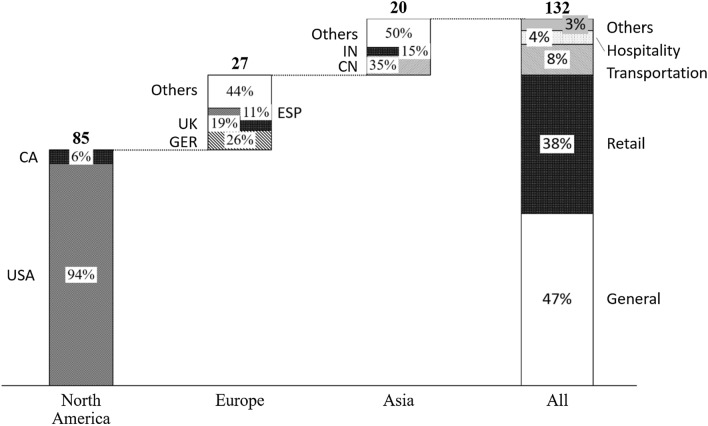
“Besides, most industry-specific competitive pricing articles focus on retail, with 38% concentrating on the retail industry versus 8% and 4% on transportation and hospitality, respectively (see Fig. 3).”
§ Competitive pricing on online markets: a literature review > Overview of competitive pricing research > Geographical and industry context
plain- Asserted: passes — The authors put it forward as true.
- Checkable: passes — It can be checked against evidence.
- Load-bearing: unclear — It is unclear whether the paper’s conclusions depend on it.
- Based: passes — The paper gives a reason why it holds.
68 more claims
Create a free account to see all 115 claims and to verify the 80 references still open.
- It may state two separate claims as one. 20
- Probably not a substantial claim. 26
Self-check
Percentages, sums and reported differences re-computed from the paper’s own numbers.
Each contradiction between two passages listed here was confirmed by an independent check.
Rated minor: it would not touch a result — a value no result rests on, a p-value that stays on the same side of the significance level, or a conflict that is clerical, resolved elsewhere in the paper, or outside its own findings.
In the paper
§ Competitive pricing on online markets: a literature review > Overview of competitive pricing research > Journal representation
“| RAND Journal of Economics | 5 | Chen et al. (2018), Chioveanu (2012), Dana and Petruzzi (2001), Farias et al. (2012), Villas-Boas (1999) |”
§ Competitive pricing on online markets: a literature review > References
“54. Chioveanu Ioana Price and quality competition Journal of Economics 2012 107 1 23 44 10.1007/s00712-011-0259-z”
Rated minor: it would not touch a result — a value no result rests on, a p-value that stays on the same side of the significance level, or a conflict that is clerical, resolved elsewhere in the paper, or outside its own findings.
In the paper
§ Competitive pricing on online markets: a literature review > Overview of competitive pricing research > Journal representation
“| RAND Journal of Economics | 5 | Chen et al. (2018), Chioveanu (2012), Dana and Petruzzi (2001), Farias et al. (2012), Villas-Boas (1999) |”
§ Competitive pricing on online markets: a literature review > References
“63. Dana James D Petruzzi Nicholas C Note: The newsvendor model with endogenous demand Management Science 2001 47 11 1488 1497 10.1287/mnsc.47.11.1488.10252”
Rated minor: it would not touch a result — a value no result rests on, a p-value that stays on the same side of the significance level, or a conflict that is clerical, resolved elsewhere in the paper, or outside its own findings.
In the paper
§ Competitive pricing on online markets: a literature review > Implications and directions
“this study only considered papers in peer-reviewed journals and conference proceedings in English.”
§ Competitive pricing on online markets: a literature review > Overview of competitive pricing research
“94% are peer-reviewed articles. Book chapters, conference papers and preprint/working papers each account for 2%.”
Citations
Cites
Items 201–205 of 205
Cheng, K. (2017) · International Journal of Business Environment · doi:10.1504/ijbe.2017.092223 · Cited by 3
Price Competition, Fluctuations, and Welfare GuaranteesPreprint
Babaioff, M., Leme, R. P., & Sivan, B. (2014) · arXiv · doi:10.48550/arxiv.1411.2036 · Cited by 2
The Downside of Reorder Flexibility under Price Competition
Afeche, P., Hu, M., & Li, Y. (2011) · doi:10.2139/ssrn.1976886 · Cited by 1
Competitive and Cooperative Assortment Games under Markov Chain Choice Model
Nip, K., Wang, C., & Wang, Z. (2020) · SSRN Electronic Journal · doi:10.2139/ssrn.3607722 · Cited by 1
Yang, Y., Lee, Y.-C., & Chen, P.-A. (2020) · arXiv · doi:10.48550/arxiv.2008.05195
Research works printed but not linked: 6
- Adida Elodie Perakis Georgia Dynamic pricing and inventory control: Uncertainty and competition Operations Research 2010 58 2 289 302 10.1287/opre.1090.0718?journalCode=opre · DOI
- Bertrand, Joseph Louis François. 1883. Thèorie mathèmatique de la richesse sociale. Journal des Savants 499–508.
- Parlar Mahmut Game theoretic analysis of the substitutable product inventory problem with random demands Naval Research Logistics 1988 35 3 397 409 10.1002/1520-6750(198806)35:3<397:AID-NAV3220350308>3.0.CO;2-Z · doi:10.1002/1520-6750(198806)35:3<397:aid-nav3220350308>3.0.co;2-z
- Pigou Arthur Cecil The economics of welfare 1920 London Macmillan & co
- Schlosser, Rainer, Martin Boissier, Andre Schober, and Matthias Uflacker. 2016. How to survive dynamic pricing competition in e-commerce. In Proceedings of the 10th ACM conference on recommender systems, Boston. 15-Sept-16 to 19-Sept-16. New York: Association for Computing Machinery.
- Zhang Ting Ge Ling Gou Qinglong Chen Li-Wen Consumer showrooming, the sunk cost effect and online-offline competition Journal of Electronic Commerce Research 2018 19 1 55 74
Cited by
Tan, J., Zhao, Z., Ma, W., Liu, Y., & Zhao, H. (2024) · International Journal of Hospitality Management · doi:10.1016/j.ijhm.2024.104014 · Cited by 37
Berends, J., & Gerpott, T. J. (2023) · Electronic Commerce Research · doi:10.1007/s10660-023-09791-5 · Cited by 25
Self-citationLESS INCLUSIVE GROWTH IN INDONESIA? THE UNINTENDED CONSEQUENCES OF INTERNET PENETRATION
Jamil, H. (2022) · Jurnal Ekonomi Bisnis dan Kewirausahaan · doi:10.26418/jebik.v11i2.53871 · Cited by 24
Lange, F., Dreeßen, L., & Schlößer, R. (2025) · Journal of Revenue and Pricing Management · doi:10.1057/s41272-025-00519-8 · Cited by 16
Metadata
- Authors
- Gerpott, T. J., & Berends, J.
- Affiliations
- University of Duisburg-Essen (DE)
- Corresponding author
- Gerpott, Torsten J.
- ORCID
- Berends, Jan
- Venue
- Journal of Revenue and Pricing Management
- Published
- 2022-06-14
- Volume
- 21
- Issue
- 6
- Pages
- 596-622
- ISSN
- 1476-6930 (ISSN-L)
- 1477-657X
- PMC
- PMC9194889
- OpenAlex
- W4282836061
- Semantic Scholar
- ad0fd3efd3f1d94d2bbd25c68f97a87a56e6ae4f
- Cited by
- 114
- References
- 205
- Citations by year
- 2026: 37 · 2025: 33 · 2024: 30 · 2023: 11 · 2022: 2
- FWCI
- 7.69
- Type
- journal article
- Language
- en
- Open access
- hybrid
- doi.org
- Licence
- cc-by
- creativecommons.org/licenses/by/4.0 (tdm)
- creativecommons.org/licenses/by/4.0 (vor)
- Locations
- Journal of Revenue and Pricing Management (publishedVersion, cc-by)
- PubMed Central (publishedVersion, cc-by)
- RePEc: Research Papers in Economics (submittedVersion)
- Econstor (Econstor) (submittedVersion, cc-by)
- Funders
- Universität Duisburg-Essen
- Topics
- Social Sciences › Business, Management and Accounting › Marketing › Consumer Market Behavior and Pricing
- Social Sciences › Decision Sciences › Management Science and Operations Research › Supply Chain and Inventory Management
- Social Sciences › Business, Management and Accounting › Strategy and Management › Digital Platforms and Economics
- Keywords
- competitive pricing, digital markets, pricing strategy, pricing models, competitive dynamics, online retail, interdisciplinary framework
About these checks
Registry, retraction, Cites and statistics results are computed, not judged, with one exception: a printed reference that no index lists is read once by a model before it counts as a citation error. Claims are extracted by a model and kept only when their quote appears verbatim in the text; each cited source is then checked, with a model’s help, for whether it says what the claim relies on. Those verdicts can be wrong — read the claim’s quote and the cited source before relying on one.
A language model drew the claims from the paper on 2026-11-25, under version 3 of the claim definition (model deepseek-v4.1-flash, prompt extract-v3).
A second model labelled each claim on 2026-11-25 (model jev-1.13-20260917, definition revision gold-guideline-v0.2).
Statistics and arithmetic are recomputed, not judged.
Confidence bands are shown only for fields calibrated on our annotated test set. None is calibrated yet, so no band is shown.
What counts as a claim ›How we measure confidence ›How we check this ›
Are you an author, or do you see a problem with this page? Request a review
Data sources
Bibliographic data: Semantic Scholar, OpenAlex, Crossref.
Contains information from the Semantic Scholar Academic Graph Datasets, made available under the ODC Attribution License (ODC-BY 1.0).
Semantic Scholar’s data is described in: Kinney, R., et al. (2023). The Semantic Scholar Open Data Platform. arXiv:2301.10140.
