

Color discriminability makes over-specification efficient: Theoretical analysis and empirical evidence
Open accessThe DOI matches its Crossref record; 96 of the 96 references it cites were found in a registry or an index.
Abstract
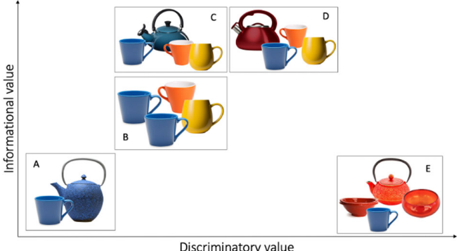
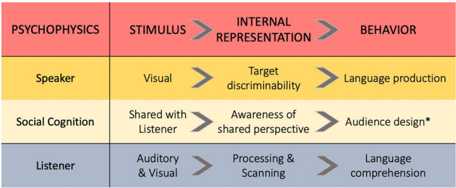
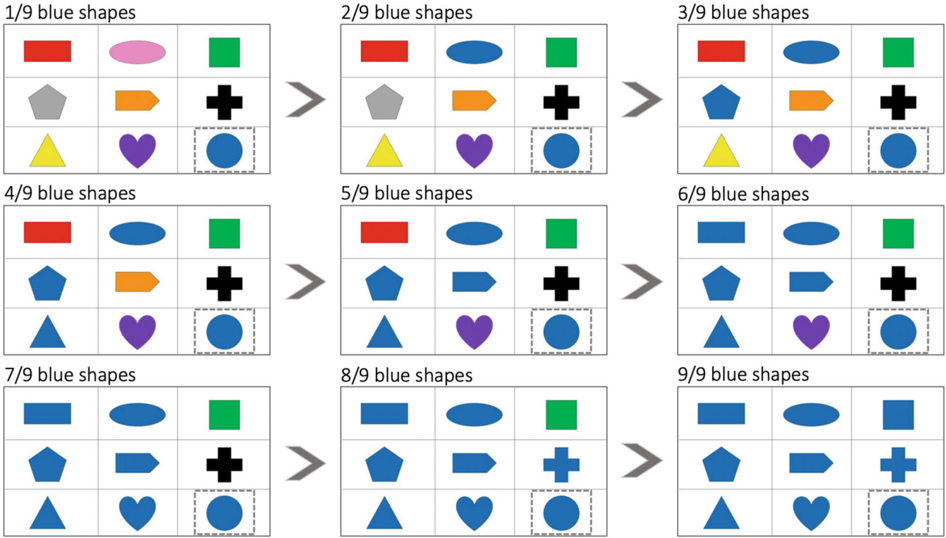
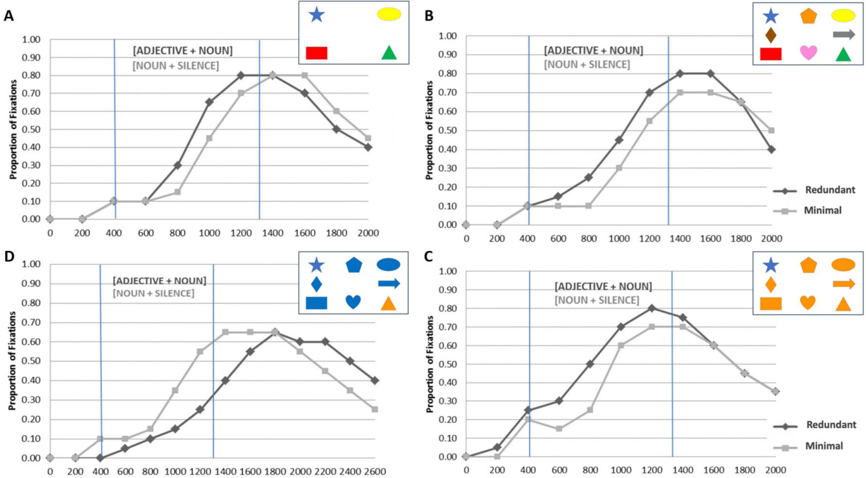
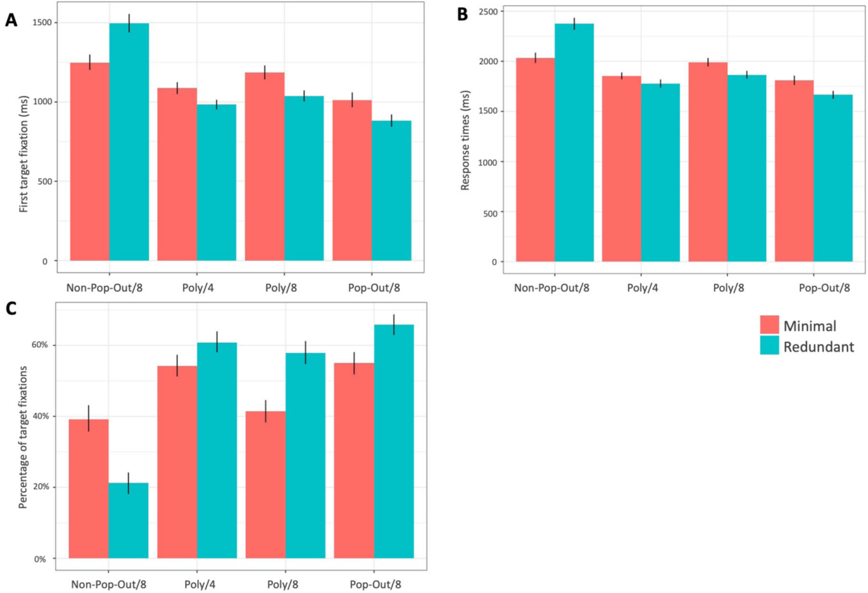
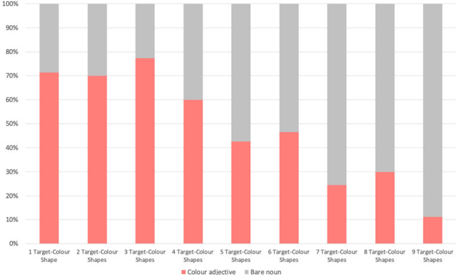
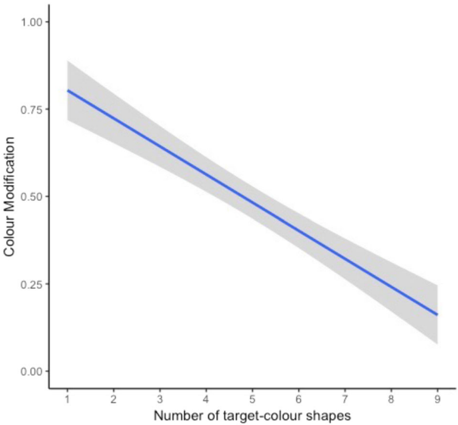
A psychophysical analysis of referential communication establishes a causal link between a visual stimulus and a speaker’s perception of this stimulus, and between the speaker’s internal representation and their reference production. Here, I argue that, in addition to visual perception and language, social cognition plays an integral part in this complex process, as it enables successful speaker-listener coordination. This pragmatic analysis of referential communication tries to explain the redundant use of color adjectives. It is well documented that people use color words when it is not necessary to identify the referent; for instance, they may refer to “the blue star” in a display of shapes with a single star. This type of redundancy challenges influential work from cognitive science and philosophy of language, suggesting that human communication is fundamentally efficient. Here, I explain these seemingly contradictory findings by confirming the visual efficiency hypothesis : redundant color words can facilitate the listener’s visual search for a referent, despite making the description unnecessarily long. Participants’ eye movements revealed that they were faster to find “the blue star” than “the star” in a display of shapes with only one star. A language production experiment further revealed that speakers are highly sensitive to a target’s discriminability, systematically reducing their use of redundant color adjectives as the color of the target became more pervasive in a display. It is concluded that a referential expression’s efficiency should be based not only on its informational value, but also on its discriminatory value, which means that redundant color words can be more efficient than shorter descriptions.
Overview
The claims and statistics of this paper haven’t been checked yet.
Free: it reads the open-access text and checks the first 5 claims that cite a source we can check. Create a free account to check every claim.
Integrity signals
Registry
Cites
Statistics
Figures

Verification
Claims the paper makes
The claims and statistics of this paper haven’t been checked yet.
Free: it reads the open-access text and checks the first 5 claims that cite a source we can check. Create a free account to check every claim.
Claims other papers make about this one
Each is checked against this paper’s own text: does it say what the citing paper says it does?
The cited source says what the claim attributes to it.
In the citing paper
“This is in line with the efficient communication hypothesis which predicts that human languages are optimized for efficient communication”
From The role of pragmatic mechanisms in referential communication and categorization: An emergent communication model (2026) · cites this paper as [9]
Experimental — accuracy not yet measured
Self-check
Percentages, sums and reported differences re-computed from the paper’s own numbers.
The self-check needs the paper’s full text.
Citations
Cites
R: A Language and Environment for Statistical Computing
R Core Team (2025) · doi:10.32614/r.manuals · Cited by 352,181
Zadeh, L. A. (1965) · Information and Control · doi:10.1016/s0019-9958(65)90241-x · Cited by 67,855
Zadeh, L. A. (1996) · Cited by 46,857
Grice, H. P. (1975) · Speech Acts · doi:10.1163/9789004368811_003 · Cited by 23,221
A feature-integration theory of attention.
Treisman, A. M., & Gelade, G. (1980) · Cognitive Psychology · doi:10.1016/0010-0285(80)90005-5 · Cited by 12,366
Re-epithelialization and immune cell behaviour in an ex vivo human skin model
Rakita, A., Nikolić, N., Mildner, M., Matiasek, J., & Elbe-Bürger, A. (2020) · Scientific Reports · doi:10.1038/s41598-019-56847-4 · Cited by 8,228
Linear Mixed-Effects Models using 'Eigen' and S4
Bates, D. M., Maechler, M., Bolker, B. M., & Walker, S. C. (2015) · Cited by 5,924
Marr, D. (1982) · Cumulative Index of Computer Aided Architectural Design · Cited by 5,733
Barlow, H. B. (1983) · Journal of Mathematical Psychology · doi:10.1016/0022-2496(83)90030-5 · Cited by 5,424
Toward a mechanistic psychology of dialogue.
Pickering, M. J., & Garrod, S. (2004) · Behavioral and Brain Sciences · doi:10.1017/s0140525x04000056 · Cited by 2,678
Research works printed but not linked: 4
- Jara-Ettinger J, Rubio-Fernandez, P (2021) A computational model of reference production based on listener visual-search costs. Paper presented at the 34th CUNY Conference on Human Sentence Processing (CUNY2021). University of Pennsylvania, virtual meeting
- Landau B, Gleitman LR (2009) Language and experience: evidence from the blind child (Vol. 8). Harvard University Press, Harvard
- Sedivy J (2004) Evaluating explanations for referential context effects: evidence for Gricean mechanisms in online language interpretation. In: Trueswell J, Tanenhaus M (eds.) Approaches to studying world-situated language use. MIT Press, Cambridge, MA, pp. 345-364
- Umbach C (2006) Non-restrictive modification and backgrounding. In: Proceed- ings of the Ninth Symposium on Logic and Language (vol. 152159). Hun- garian Academy of Sciences, Budapest
Cited by
Contrast perception as a visual heuristic in the formulation of referential expressions
Long, M. R., Moore, I. L., Mollica, F., & Rubio‐Fernández, P. (2021) · Cognition · doi:10.1016/j.cognition.2021.104879 · Cited by 19
Color interpretation is guided by informativity expectations, not by world knowledge about colors
Rohde, H., & Rubio‐Fernández, P. (2022) · Journal of Memory and Language · doi:10.1016/j.jml.2022.104371 · Cited by 16
Jara‐Ettinger, J., & Rubio‐Fernández, P. (2020) · PsyArXiv (OSF Preprints) · doi:10.31234/osf.io/fzuvh · Cited by 11
Saryazdi, R., Nuque, J., & Chambers, C. G. (2022) · Cognitive Science · doi:10.1111/cogs.13123 · Cited by 8
Linguistic alignment of redundancy usage in human-human and human-computer interaction
Dunn, M. S., & Cai, Z. G. (2025) · Applied Psycholinguistics · doi:10.1017/s0142716425100118 · Cited by 6
Linear Order in Language: an Error-Driven Learning Account
Hoppe, D. B. (2022) · University of Groningen research database (University of Groningen / Centre for Information Technology) · doi:10.33612/diss.238906691 · Cited by 6
Varieties of specification: Redefining over- and under-specification
Chen, G., & van Deemter, K. (2023) · Journal of Pragmatics · doi:10.1016/j.pragma.2023.07.019 · Cited by 5
Griber, Y. A., Ivleva, A. I., Solovyev, V. Y., & Paramei, G. V. (2026) · Humanities and Social Sciences Communications · doi:10.1057/s41599-026-07021-5 · Cited by 4
Agents generalize to novel levels of abstraction by using adaptive linguistic strategies
Kobrock, K., Ohmer, X. I., Bruni, E., & Gotzner, N. (2025) · Findings of the Association for Computational Linguistics: ACL (Findings of ACL) · doi:10.18653/v1/2025.findings-acl.455 · Cited by 3
Perceptual, Semantic, and Pragmatic Factors Affect the Derivation of Contrastive Inferences
Ronderos, C. R., Aparicio, H., Long, M. R., Shukla, V., Jara‐Ettinger, J., & Rubio‐Fernández, P. (2024) · Open Mind · doi:10.1162/opmi_a_00165 · Cited by 2
Beyond typicality: Lexical category affects the use and processing of color words
Long, M. R., & Rubio‐Fernández, P. (2022) · Edinburgh Research Explorer (University of Edinburgh) · Cited by 2
Zevakhina, N. A., Dongarova, K. N., Shubina, D., & Popova, D. A. (2024) · Frontiers in Psychology · doi:10.3389/fpsyg.2024.1417047 · Cited by 1
Peña, P. R., & Cowan, B. R. (2026) · CHI Conference on Human Factors in Computing Systems · doi:10.1145/3772318.3790628 · Cited by 1
Taliaferro, M., & Schulz, L. (2026) · Open Mind · doi:10.1162/opmi.a.348 · Cited by 1
Rubio‐Fernández, P. (2024) · PsyArXiv (OSF Preprints) · doi:10.31234/osf.io/tkfqv · Cited by 1
Kobrock, K., Ohmer, X., Bruni, E., & Gotzner, N. (2026) · PLOS Computational Biology · doi:10.1371/journal.pcbi.1014326
“But recent proposals have shown that the redundant expressions provide information that helps listeners to identify the target referent, e.g., by mentioning atypical features or providing salient information in complex scenes that facilitate visual search [9,10,26,31,32].”
Context Shapes Emergent Communication about Concepts at Different Levels of Abstraction
Kobrock, K., Ohmer, X. I., Bruni, E., & Gotzner, N. (2024) · Proceedings of the Language Resources and Evaluation Conference · doi:10.63317/4odxjsoap6qe
The Role of Explanatory Value in Natural Language ProcessingPreprint
van Deemter, K. (2022) · arXiv (Cornell University) · doi:10.48550/arxiv.2209.06169
Reference Production Facilitates Listener Search Across Modalities, but Colour is SpecialPreprint
Giles, M., Mollica, F., & Rubio‐Fernández, P. (2025) · PsyArXiv (OSF Preprints) · doi:10.31234/osf.io/84wsx_v1
Reference Production Facilitates Listener Search Across Modalities, but Colour is SpecialPreprint
Giles, M., Mollica, F., & Rubio‐Fernández, P. (2025) · PsyArXiv (OSF Preprints) · doi:10.31234/osf.io/84wsx_v5
Search Efficiency Drives Reference Production Across Modalities, But Colour is SpecialPreprint
Giles, M., Rubio‐Fernández, P., & Mollica, F. (2025) · PsyArXiv (OSF Preprints) · doi:10.31234/osf.io/84wsx_v4
Color Overmodification Emerges from Data-Driven Learning and Pragmatic ReasoningPreprint
Fang, F., Sinha, K., Goodman, N. D., Potts, C., & Kreiss, E. (2022) · arXiv (Cornell University) · doi:10.48550/arxiv.2205.09172
이다정 (2023) · Seoul National University Open Repository (Seoul National University)
Reference production:How discourse relevance shapes modifier choice
Cheuk, K., Rohde, H., & Cummins, C. (2024) · Edinburgh Research Explorer (University of Edinburgh)
Bolea, M., McNally, L., & Sutton, P. R. (2026) · Lecture notes in computer science · doi:10.1007/978-3-032-14339-6_2
Search Efficiency Drives Reference Production Across Modalities, But Colour Is Special
Giles, M., Rubio‐Fernández, P., & Mollica, F. (2026) · Open Mind · doi:10.1162/opmi.a.337
The Influence of Informativity on Syntactic Linearization in Reference ProductionPreprint
Li, M., Jachmann, T. K., Venhuizen, N. J., Drenhaus, H., & Crocker, M. W. (2026) · SSRN Electronic Journal · doi:10.2139/ssrn.6442001
Perceptual Discriminability Drives Overinformative Reference, But Colour Information is Special
Cognitive Science Society 2025, Giles, M., Mollica, F., & Rubio‐Fernández, P. (2025) · eScholarship (California Digital Library) · doi:10.48448/7w1b-ag04
How grammatical gender supports efficient communication
Cognitive Science Society 2025, Gibson, E. A. F., Hendriks, P., Hoppe, D. B., Jenkins, H., & van Rij, J. (2025) · eScholarship (California Digital Library) · doi:10.48448/6caq-ys82
Theory of mind beyond beliefs: Testing attention-based social micro-processes in LLMsPreprint
Muchovej, J., Rubio‐Fernández, P., & Jara‐Ettinger, J. (2026) · PsyArXiv (OSF Preprints) · doi:10.31234/osf.io/v82a7_v1
Lu, X., Ye, S., & Liu, S. (2026) · Journal of Language and Social Psychology · doi:10.1177/0261927x261478944
Metadata
- Authors
- Rubio-Fernandez, P.
- Venue
- Humanities and Social Sciences Communications
- Published
- 2021-06-17
- Volume
- 8
- Issue
- 1
- ISSN
- 2055-1045 (ISSN-L)
- 2662-9992
- OpenAlex
- W3167786513
- Cited by
- 16
- References
- 96
- Citations by year
- 2026: 6 · 2025: 1 · 2024: 3 · 2023: 1 · 2022: 3 · 2021: 1
- FWCI
- 1.93
- Type
- journal article
- Language
- en
- Open access
- gold
- doi.org
- Licence
- cc-by
- creativecommons.org/licenses/by/4.0 (tdm)
- creativecommons.org/licenses/by/4.0 (vor)
- Locations
- Humanities and Social Sciences Communications (publishedVersion, cc-by)
- RePEc: Research Papers in Economics (submittedVersion)
- DOAJ (DOAJ: Directory of Open Access Journals) (submittedVersion, cc-by-sa)
- NORA - Norwegian Open Research Archives (submittedVersion, cc-by)
- Funders
- Norges Forskningsråd (230718)
- Topics
- Social Sciences › Psychology › Experimental and Cognitive Psychology › Categorization, perception, and language
- Social Sciences › Arts and Humanities › Language and Linguistics › Syntax, Semantics, Linguistic Variation
- Social Sciences › Arts and Humanities › Language and Linguistics › Language, Discourse, Communication Strategies
- Keywords
- referential communication, color adjectives, social cognition, eye movements, visual search, language production, color terms, referring expressions
About these checks
Registry, retraction, Cites and statistics results are computed, not judged, with one exception: a printed reference that no index lists is read once by a model before it counts as a citation error. Claims are extracted by a model and kept only when their quote appears verbatim in the text; each cited source is then checked, with a model’s help, for whether it says what the claim relies on. Those verdicts can be wrong — read the claim’s quote and the cited source before relying on one.
Statistics and arithmetic are recomputed, not judged.
Confidence bands are shown only for fields calibrated on our annotated test set. None is calibrated yet, so no band is shown.
What counts as a claim ›How we measure confidence ›How we check this ›
Are you an author, or do you see a problem with this page? Request a review
Data sources
Bibliographic data: Semantic Scholar, OpenAlex, Crossref.
Contains information from the Semantic Scholar Academic Graph Datasets, made available under the ODC Attribution License (ODC-BY 1.0).
Semantic Scholar’s data is described in: Kinney, R., et al. (2023). The Semantic Scholar Open Data Platform. arXiv:2301.10140.
