

Simplified Josephson-junction fabrication process for reproducibly high-performance superconducting qubits
Open accessThe DOI matches its Crossref record; 32 of the 32 references it cites were found in a registry or an index.
Abstract
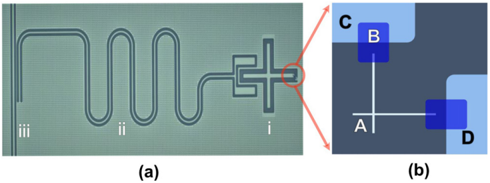
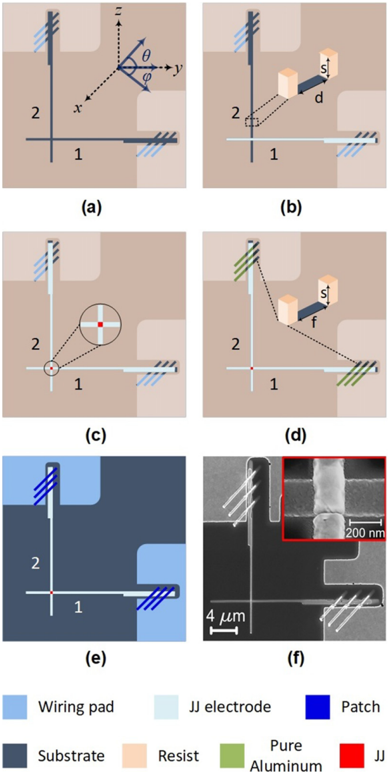
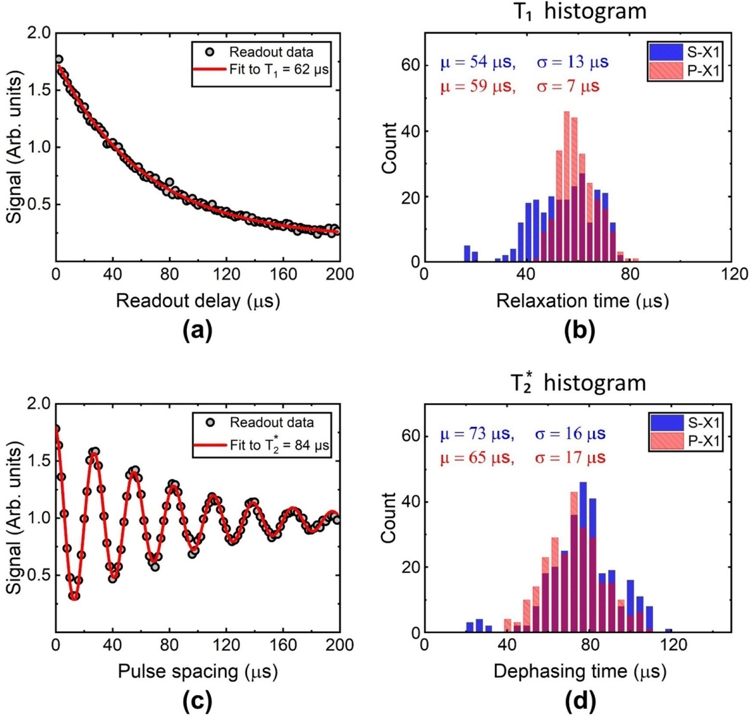
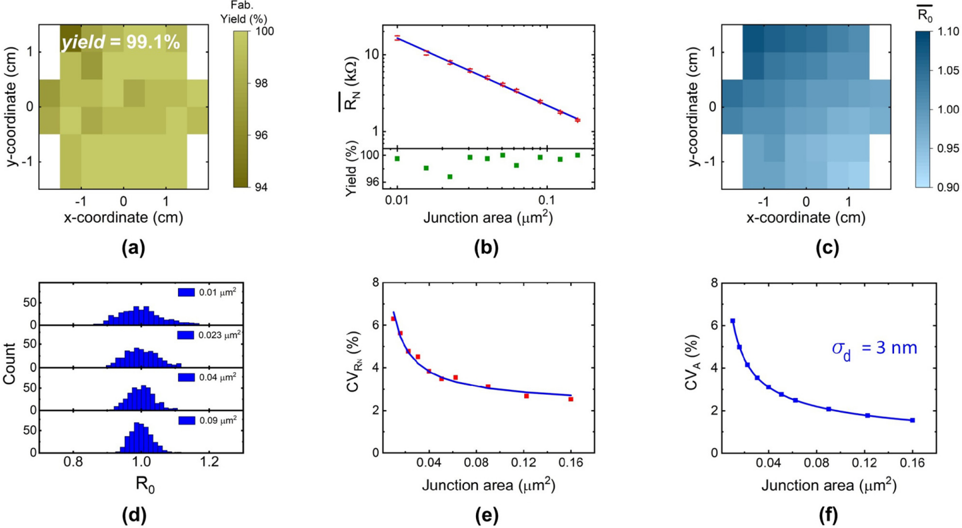
We introduce a simplified fabrication technique for Josephson junctions and demonstrate superconducting Xmon qubits with T1 relaxation times averaging above 50 μs (Q>1.5×10⁶). Current shadow-evaporation techniques for aluminum-based Josephson junctions require a separate lithography step to deposit a patch that makes a galvanic, superconducting connection between the junction electrodes and the circuit wiring layer. The patch connection eliminates parasitic junctions, which otherwise contribute significantly to dielectric loss. In our patch-integrated cross-type junction technique, we use one lithography step and one vacuum cycle to evaporate both the junction electrodes and the patch. This eliminates a key bottleneck in manufacturing superconducting qubits by reducing the fabrication time and cost. In a study of more than 3600 junctions, we show an average resistance variation of 3.7% on a wafer that contains forty 0.5×0.5-cm2 chips, with junction areas ranging between 0.01 and 0.16 μm2. The average on-chip spread in resistance is 2.7%, with 20 chips varying between 1.4% and 2%. For the junction sizes used for transmon qubits, we deduce a wafer-level transition-frequency variation of 1.7%–2.5%. We show that 60%–70% of this variation is attributed to junction-area fluctuations, while the rest is caused by tunnel-junction inhomogeneity. Such high frequency predictability is a requirement for scaling-up the number of qubits in a quantum computer.
Overview
The claims and statistics of this paper haven’t been checked yet.
Free: it reads the open-access text and checks the first 5 claims that cite a source we can check. Create a free account to check every claim.
Integrity signals
Registry
Cites
Statistics
Figures
Verification
Claims the paper makes
The claims and statistics of this paper haven’t been checked yet.
Free: it reads the open-access text and checks the first 5 claims that cite a source we can check. Create a free account to check every claim.
Claims other papers make about this one
Each is checked against this paper’s own text: does it say what the citing paper says it does?
The cited source doesn’t support the claim as written.
In the citing paper
“Furthermore, the dependence of the Rn RSD on the JJ area fits well with a model of constant area variance (), derived by propagating the uncertainty3,52 (Methods):2”
From Advanced CMOS manufacturing of superconducting qubits on 300 mm wafers (2024) · cites this paper as [52]
Checked by a reasoning model — may be wrong.
Experimental — accuracy not yet measured
Self-check
Percentages, sums and reported differences re-computed from the paper’s own numbers.
The self-check needs the paper’s full text.
Citations
Cites
Bardeen, J., Cooper, L. N., & Schrieffer, J. R. (1957) · Physical Review · doi:10.1103/physrev.108.1175 · Cited by 13,213
Quantum supremacy using a programmable superconducting processor
Arute, F., Arya, K., Babbush, R., Bacon, D., Bardin, J. C., Barends, R., Biswas, R., Boixo, S., Brandao, F. G. S. L., Buell, D. A., et al. (2019) · Nature · doi:10.1038/s41586-019-1666-5 · Cited by 7,720
Charge-insensitive qubit design derived from the Cooper pair box
Koch, J., Yu, T. M., Gambetta, J., Houck, A. A., Schuster, D. I., Majer, J., Blais, A., Devoret, M. H., Girvin, S. M., & Schoelkopf, R. J. (2007) · Physical Review A · doi:10.1103/physreva.76.042319 · Cited by 3,351
Tunneling Between Superconductors
Ambegaokar, V., & Baratoff, A. (1963) · Physical Review Letters · doi:10.1103/physrevlett.10.486 · Cited by 2,195
A quantum engineer's guide to superconducting qubits
Krantz, P., Kjaergaard, M., Yan, F., Orlando, T. P., Gustavsson, S., & Oliver, W. D. (2019) · Applied Physics Reviews · doi:10.1063/1.5089550 · Cited by 2,004
Self-citationOn the Exact Variance of Products
Goodman, L. A. (1960) · Journal of the American Statistical Association · doi:10.1080/01621459.1960.10483369 · Cited by 1,469
Decoherence in Josephson Qubits from Dielectric Loss
Martinis, J. M., Cooper, K. B., McDermott, R., Steffen, M., Ansmann, M., Osborn, K. D., Cicak, K., Oh, S., Pappas, D. P., Simmonds, R. W., et al. (2005) · Physical Review Letters · doi:10.1103/physrevlett.95.210503 · Cited by 838
A near–quantum-limited Josephson traveling-wave parametric amplifier
Macklin, C., O’Brien, K., Hover, D., Schwartz, M. E., Bolkhovsky, V., Zhang, X., Oliver, W. D., & Siddiqi, I. (2015) · Science · doi:10.1126/science.aaa8525 · Cited by 821
Coherent Josephson Qubit Suitable for Scalable Quantum Integrated Circuits
Barends, R., Kelly, J., Megrant, A., Sank, D., Jeffrey, E., Chen, Y., Yin, Y., Chiaro, B., Mutus, J., Neill, C., et al. (2013) · Physical Review Letters · doi:10.1103/physrevlett.111.080502 · Cited by 779
Tunneling Between Superconductors
Ambegaokar, V., & Baratoff, A. (1963) · Physical Review Letters · doi:10.1103/physrevlett.11.104 · Cited by 703
Research works printed but not linked: 8
- A. Nersisyan, E. A. Sete, S. Stanwyck, A. Bestwick, M. Reagor, S. Poletto, N. Alidoust, R. Manenti, R. Renzas, C.-V. Bui, K. Vu, T. Whyland, and Y. Mohan, in 2019 IEEE International Electron Devices Meeting (IEDM) (IEEE, 2019), p. 31.1.1.
- P. Krantz, M.Sc. thesis, Chalmers University of Technology, 2010.
- A. Osman, M.Sc. thesis, Chalmers University of Technology-KU Leuven, 2019.
- J. B. Hertzberg, E. J. Zhang, S. Rosenblatt, E. Magesan, J. A. Smolin, J.-B. Yau, V. P. Adiga, M. Sandberg, M. Brink, J. M. Chow, and J. S. Orcutt, arXiv:2009.00781 (2020). · arXiv
- H. R. Mohebbi and A. H. Majedi, in 2009 IEEE Toronto International Conference Science and Technology for Humanity (TIC-STH) (2009), p. 1015.
- A. B. Zorin, M. Khabipov, J. Dietel, and R. Dolata, in 2017 16th International Superconductive Electronics Conference (ISEC) (2017), p. 1.
- I. S. Khukhareva, Sov. Phys. JETP 16, 828 (1963).
- A. Bilmes, A. K. Neumann, S. Volosheniuk, A. V. Ustinov, and J. Lisenfeld, arXiv:2101.01453 (2021). · arXiv
Cited by
Material matters in superconducting qubits
Murray, C. E. (2021) · Materials Science and Engineering R Reports · doi:10.1016/j.mser.2021.100646 · Cited by 173
Building blocks of a flip-chip integrated superconducting quantum processor
Kosen, S., Li, H.-X., Rommel, M., Shiri, D., Warren, C., Grönberg, L., Salonen, J., Abad, T., Biznárová, J., Caputo, M., et al. (2022) · Quantum Science and Technology · doi:10.1088/2058-9565/ac734b · Cited by 88
Self-citationBlueprint for a High-Performance Fluxonium Quantum Processor
Nguyen, L. B., Koolstra, G., Kim, Y., Morvan, A., Chistolini, T., Singh, S., Nesterov, K., Jünger, C., Chen, L., Pedramrazi, Z., et al. (2022) · PRX Quantum · doi:10.1103/prxquantum.3.037001 · Cited by 125
“Although variations in junction parameters have been rigorously characterized recently [44,175,186], side-by-side probing of superinductors and small tunneling junctions corresponding to EL ∼ [0.”
BackgroundControlling Atom-Photon Bound States in an Array of Josephson-Junction Resonators
Scigliuzzo, M., Calajò, G., Ciccarello, F., Lozano, D. P., Bengtsson, A., Scarlino, P., Wallraff, A. J., Chang, D. E., Delsing, P., & Gasparinetti, S. (2022) · Physical Review X · doi:10.1103/physrevx.12.031036 · Cited by 118
“Compared to the predictions of this simple model, the measured traces present deviations in the frequency distribution of the modes, that we attribute to a 3% scatter in the resistance of the fabricated Josephson junctions [37], resulting in an estimated standard deviation 4.”
MethodSelf-citationAdvanced CMOS manufacturing of superconducting qubits on 300 mm wafers
Van Damme, J., Massar, S., Acharya, R., Ivanov, T., Perez Lozano, D., Canvel, Y., Demarets, M., Vangoidsenhoven, D., Hermans, Y., Lai, J. G., et al. (2024) · Nature · doi:10.1038/s41586-024-07941-9 · Cited by 63
“Furthermore, the dependence of the R n RSD on the JJ area fits well with a model of constant area variance ( σ A2 ), derived by propagating the uncertainty 3,52 (Methods): Fitting the data to equation (2) allowed us to disentangle the barrier non-uniformity and area variability.”
Method
Metadata
- Authors
- Osman, A., Simon, J., Bengtsson, A., Kosen, S., Krantz, P., P. Lozano, D., Scigliuzzo, M., Delsing, P., Bylander, J., & Fadavi Roudsari, A.
- Affiliations
- Chalmers University of Technology (SE)
- Department of Microtechnology and Nanoscience, Chalmers University of Technology , 412 96 Gothenburg, Sweden
- Corresponding author
- Osman, A.
- ORCID
- Venue
- Applied Physics Letters
- Publisher
- AIP Publishing
- Published
- 2021-02-08
- Volume
- 118
- Issue
- 6
- ISSN
- 0003-6951 (ISSN-L)
- 1077-3118
- OpenAlex
- W3105047537
- Cited by
- 87
- References
- 31
- Citations by year
- 2026: 9 · 2025: 12 · 2024: 23 · 2023: 18 · 2022: 17 · 2021: 8
- FWCI
- 5.81
- Type
- journal article
- Language
- en
- Open access
- hybrid
- doi.org
- Licence
- cc-by
- creativecommons.org/licenses/by/4.0/ (vor, 2 d)
- creativecommons.org/licenses/by/4.0/ (tdm, 2 d)
- Locations
- Applied Physics Letters (publishedVersion, cc-by)
- arXiv (Cornell University) (submittedVersion)
- Chalmers Research (Chalmers University of Technology) (submittedVersion)
- arXiv (Cornell University)
- Funders
- Wallenberg Center for Quantum Technology
- EU Flagship on Quantum Technology H2020 (820363)
- Topics
- Physical Sciences › Physics and Astronomy › Atomic and Molecular Physics, and Optics › Quantum Information and Cryptography
- Physical Sciences › Engineering › Electrical and Electronic Engineering › Superconducting and THz Device Technology
- Physical Sciences › Computer Science › Artificial Intelligence › Quantum Computing Algorithms and Architecture
- Keywords
- Josephson junction fabrication, superconducting qubits, transmon qubits, T1 relaxation time, wafer-level fabrication
About these checks
Registry, retraction, Cites and statistics results are computed, not judged, with one exception: a printed reference that no index lists is read once by a model before it counts as a citation error. Claims are extracted by a model and kept only when their quote appears verbatim in the text; each cited source is then checked, with a model’s help, for whether it says what the claim relies on. Those verdicts can be wrong — read the claim’s quote and the cited source before relying on one.
Statistics and arithmetic are recomputed, not judged.
Confidence bands are shown only for fields calibrated on our annotated test set. None is calibrated yet, so no band is shown.
What counts as a claim ›How we measure confidence ›How we check this ›
Are you an author, or do you see a problem with this page? Request a review
How to cite
Cite CoChat for the checks on this page, and the paper for its own findings.
- This page
- CoChat. (2026). Citation check: Simplified Josephson-junction fabrication process for reproducibly high-performance superconducting qubits. https://app.cochat.ai/papers/10.1063/5.0037093
- The paper
- Osman, A., Simon, J., Bengtsson, A., Kosen, S., Krantz, P., P. Lozano, D., Scigliuzzo, M., Delsing, P., Bylander, J., & Fadavi Roudsari, A. (2021). Simplified Josephson-junction fabrication process for reproducibly high-performance superconducting qubits. Applied Physics Letters. https://doi.org/10.1063/5.0037093
Data sources
Bibliographic data: Semantic Scholar, OpenAlex, Crossref.
Contains information from the Semantic Scholar Academic Graph Datasets, made available under the ODC Attribution License (ODC-BY 1.0).
Semantic Scholar’s data is described in: Kinney, R., et al. (2023). The Semantic Scholar Open Data Platform. arXiv:2301.10140.
