

Pulse of atmospheric oxygen during the late Cambrian
Open accessThe DOI matches its Crossref record; 56 of the 56 references it cites were found in a registry or an index; 7 of the 76 sources its claims cite were checked for support.
Abstract
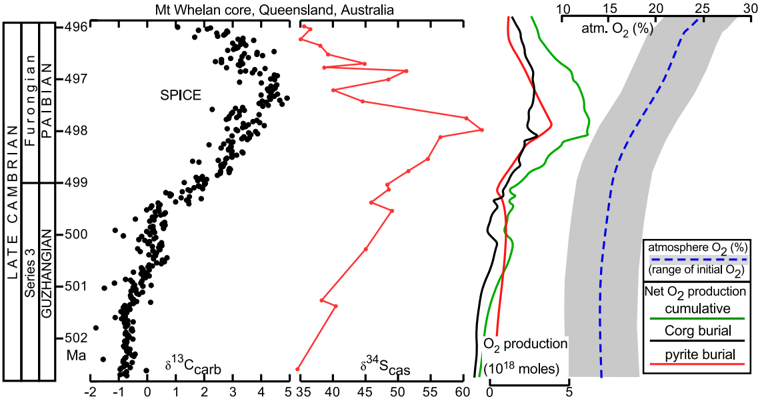
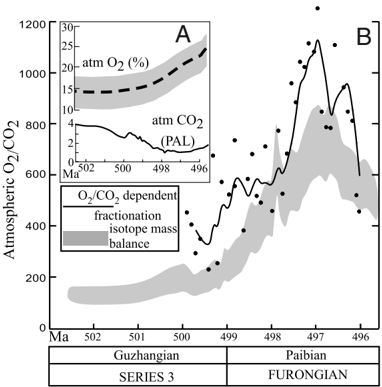
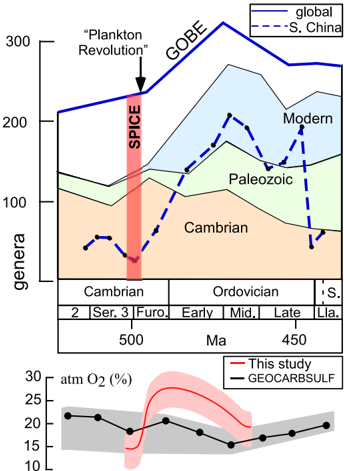
A rise in atmospheric O(2) has been linked to the Cambrian explosion of life. For the plankton and animal radiation that began some 40 million yr later and continued through much of the Ordovician (Great Ordovician Biodiversification Event), the search for an environmental trigger(s) has remained elusive. Here we present a carbon and sulfur isotope mass balance model for the latest Cambrian time interval spanning the globally recognized Steptoean Positive Carbon Isotope Excursion (SPICE) that indicates a major increase in atmospheric O(2). We estimate that this organic carbon and pyrite burial event added approximately 19 × 10(18) moles of O(2) to the atmosphere (i.e., equal to change from an initial starting point for O(2) between 10-18% to a peak of 20-28% O(2)) beginning at approximately 500 million years. We further report on new paired carbon isotope results from carbonate and organic matter through the SPICE in North America, Australia, and China that reveal an approximately 2‰ increase in biological fractionation, also consistent with a major increase in atmospheric O(2). The SPICE is followed by an increase in plankton diversity that may relate to changes in macro- and micronutrient abundances in increasingly oxic marine environments, representing a critical initial step in the trophic chain. Ecologically diverse plankton groups could provide new food sources for an animal biota expanding into progressively more ventilated marine habitats during the Ordovician, ultimately establishing complex ecosystems that are a hallmark of the Great Ordovician Biodiversification Event.
Overview
CoChat Summary
TL;DR
A carbon and sulfur isotope mass balance model for the late Cambrian SPICE event indicates a major rise in atmospheric O₂, with roughly 19 × 10¹⁸ moles of O₂ added by organic carbon and pyrite burial. New paired carbonate–organic carbon isotope data from three regions show an approximately 2‰ increase in biological fractionation, consistent with an O₂ pulse that may have helped set the stage for later plankton diversification.
Key findings
- The isotope mass balance model estimates that organic carbon and pyrite burial during the SPICE added approximately 19 × 10¹⁸ moles of O₂, equivalent to a change from an initial O₂ level between 10–18% to a peak of 20–28% O₂ beginning at approximately 500 million years ago.
- Most O₂ production occurred during a 2-million-year interval centered on the SPICE peak, when organic carbon burial rates were elevated at approximately 7 × 10¹⁸ moles C/my and non-steady-state pyrite burial rates were approximately 3 × 10¹⁸ moles S/my.
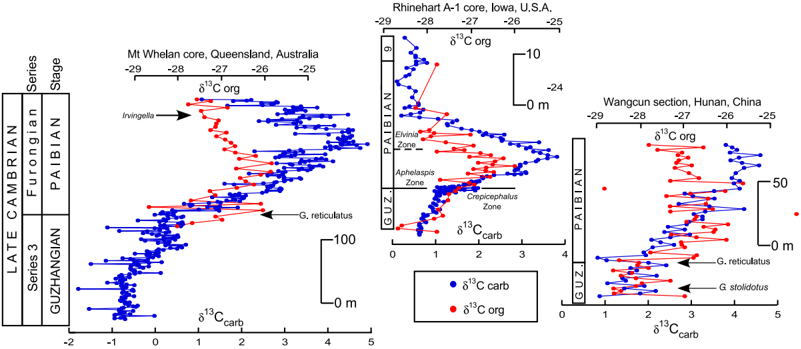
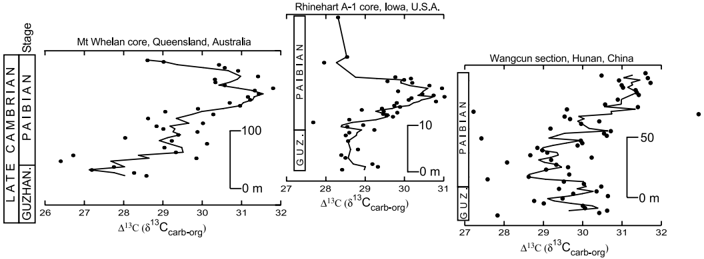
- Paired δ¹³C_carb and δ¹³C_org analyses from Iowa (United States), Queensland (Australia), and Hunan (China) show Δ¹³C increasing from ∼28–29‰ before the SPICE to a peak of 31‰ at the height of the excursion, then returning to pre-excursion values; this approximately 2‰ increase is interpreted as an O₂-dependent biological fractionation signal.
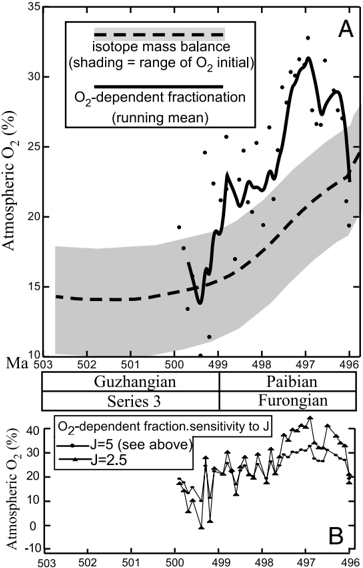
- Using the O₂-dependent fractionation approach with J = 5, the observed fractionation increase translates to a pO₂ rise from a starting point between 14–18% to a peak just over 30%; the authors argue the SPICE O₂ pulse may have promoted diversification of dinoflagellate-like plankton and later animal expansion during the Ordovician.
Methods
- The authors used a carbon and sulfur isotope mass balance model based on the approach of Kurtz et al., using δ¹³C_carb and δ³⁴S_CAS data from the Mt. Whelan core in Australia; the records were smoothed with cubic smoothing splines, and the model was run without assuming steady state, with weathering fluxes and isotopic compositions held constant from an assumed initial steady state.
- For the O₂ proxy, they measured paired δ¹³C_carb and δ¹³C_org from the same samples in drill core from Iowa, drill core from Queensland, and fresh outcrop from Hunan; carbonate was removed by acidification, residues were analyzed by elemental analyzer–isotope ratio mass spectrometry, and Δ¹³C was calculated as δ¹³C_carb − δ¹³C_org.
- They modified the Beerling et al. equation to calculate O₂ from measured δ¹³C_carb and δ¹³C_org values using J = 5, and also modeled pCO₂ during the SPICE using a modified δ¹³C mass balance model from Kump and Arthur.
Limitations
- The paper states that the assumption that experimental results from modern plants and bryophytes apply to early Paleozoic marine phytoplankton—and that these phytoplankton did not utilize a carbon-concentrating mechanism—must be examined further.
- The authors acknowledge that Δ¹³C could also record other variables affecting photosynthetic isotope discrimination, including decreased phytoplankton growth rates, increased cell volume, changes in photoautotroph assemblages, temperature-dependent fractionation, organic matter source, secondary biological fractionation, and thermal maturation; they argue these are unlikely to explain the observed trends.
- The text notes an apparent mismatch at the end of the SPICE: isotopic fractionation indicates pO₂ returned to near pre-SPICE levels, whereas C and S isotope mass balance indicates pO₂ remained at peak levels; fluctuations in pCO₂ and the pO₂/pCO₂ ratio may reconcile this, but the initial O₂ level is also uncertain, with possible starting points of 10.5%, ∼14%, ∼18%, or even ∼5% in other models.
Model-written summary. Check it against the paper before relying on it.
Integrity signals
Registry
Cites
Statistics
Figures
Verification
Claims the paper makes
6 Valid · 1 Not valid · 30 Not checked · 40 Own results and interpretations
The sources with a verdict support this claim; the rest weren’t checked yet, have no full text we could read, or their verdicts aren’t rated yet.
In the paper
“The SPICE event has been documented worldwide and is characterized by a positive δ 13 Cshift of approximately þ 4 ‰ in Upper Cambrian (Paibian Stage of Furongian Series) sections throughout North America and time-equivalent strata in China, Siberia, Baltica, Australia, and Kazakhstan (refs. 14 -16, Fig. S1, and SI Text ).”
What the sources say
- Not checked — no full text of the sourcecites [14] Saltzman MR, et al. (2000) A global carbon isotope excursion (SPICE) during the Late Cambrian: relation to trilobite extinctions, organic-matter burial and sea level. Palaeogeogr Palaeocl 162:211 -223. source
- Not checked — no full text of the sourcecites [15] Ahlberg P, et al. (2009) Cambrian high-resolution biostratigraphy and carbon isotope chemostratigraphy in Scania, Sweden: First record of the SPICE and DICE excursions in Scandinavia. Lethaia 42:2 -16. source
- Supportedcites [16] Kouchinsky A, et al. (2008) The SPICE carbon isotope excursion in Siberia: A combined study of the upper Middle Cambrian -lowermost Ordovician Kulyumbe River section, northwestern Siberian Platform. Geol Mag 145:609 -622. source
Split into 2 atoms — 2 confirmed, 0 partially supported, 0 disputed, 0 misattributed, 0 unverifiable. Expand the claim to see per-atom verdicts.
plain- Asserted: passes — The authors put it forward as true.
- Checkable: passes — It can be checked against evidence.
- Load-bearing: passes — The paper’s conclusions depend on it.
- Based: passes — The paper gives a reason why it holds.
The sources with a verdict support this claim; the rest weren’t checked yet, have no full text we could read, or their verdicts aren’t rated yet.
In the paper
“Depending on the time resolution possible in recent global or regional marine animal diversity compilations (36 -38), the GOBE could arguably be viewed as having been ' rooted ' in the latest Cambrian (Furongian) (Fig. 6).”
What the sources say
- Not checked — no full text of the sourcecites [36] Alroy J (2010) The shifting balance of diversity among major marine animal groups. Science 329:1191 -1194. source
- Not checked — no full text of the sourcecites [37] Sepkoski JJ (1997) Biodiversity: Past, present, and future. J Paleo 71:533 -539. source
- Supportedcites [38] Rong J, Junxuan F, Miller AI, Guoxiang L (2007) Dynamic patterns of latest ProterozoicPalaeozoic-early Mesozoic marine biodiversity in South China. Geol J 42:431 -454. source
Section 4.2 (Early–Middle Ordovician; page not supplied) presents a regional marine-diversity compilation for South China, with counts for the early Furongian and Tremadocian. The citation identifies a compilation that can inform the citing authors’ hedged interpretation; it need not itself use the word “rooted.” (LLM, conf=0.88)
hedgedstates an association- Asserted: passes — The authors put it forward as true.
- Checkable: passes — It can be checked against evidence.
- Load-bearing: unclear — It is unclear whether the paper’s conclusions depend on it.
- Based: passes — The paper gives a reason why it holds.
The sources with a verdict support this claim; the rest weren’t checked yet, have no full text we could read, or their verdicts aren’t rated yet.
In the paper
“This return to lower Δ 13 C likely indicates the role that fluctuations in atmospheric p CO 2 may also play in photosynthetic carbon isotope fractionation (20, 21, 23, 26 -29).”
What the sources say
- Not checked — no full text of the sourcecites [20] Berner RA, et al. (2000) Isotope fractionation and atmospheric oxygen: Implications for Phanerozoic O 2 evolution. Science 287:1630 -1633. source
- Not checked — no full text of the sourcecites [21] Beerling DJ, et al. (2002) Carbon isotope evidence implying high O 2 ∕ CO 2 ratios in the Permo-Carboniferous atmosphere. Geochim Cosmochim Acta 66:3757 -3767. source
- Supportedcites [23] Bergman NM, Lenton TM, Watson AJ (2004) COPSE: A new model of biogeochemical cycling over Phanerozoic time. Am J Sci 304:397 -437. source
The Ocean Nutrient Model section (page not supplied) models carbon isotope fractionation as varying with pCO₂ and identifies pCO₂ as a major source of variation. It also describes a decline in fractionation toward the present as modeled pCO₂ falls, supporting the proposed explanation for a return to lower Δ¹³C. (LLM, conf=0.88)
- Not checked — no full text of the sourcecites [26] Kump LR, Arthur MA (1999) Interpreting carbon-isotope excursions: Carbonates and organic matter. Chem Geol 161:181 -198. source
- Not checked — no full text of the sourcecites [27] Fletcher BJ, Brentnall SJ, Quick WP, Beerling DJ (2006) BRYOCARB: A process-based model of thallose liverwort carbon isotope fractionation in response to CO 2 , O 2 , light and temperature. Geochim Cosmochim Acta 70:5676 -5691. source
- Not checked — no full text of the sourcecites [28] Popp BM, et al. (1998) Effect of phytoplankton cell geometry on carbon isotopic fractionation. Geochim Cosmochim Acta 62:69 -77. source
- Not checked — no full text of the sourcecites [29] Hayes JM, Strauss H, Kaufman AJ (1999) The abundance of 13 C in marine organic matter and isotopic fractionation in the global biogeochemical cycle of carbon during the past 800 Ma. Chem Geol 161:103 -125. source
hedgedstates a possible cause- Asserted: passes — The authors put it forward as true.
- Checkable: passes — It can be checked against evidence.
- Load-bearing: passes — The paper’s conclusions depend on it.
- Based: passes — The paper gives a reason why it holds.
Every source the paper cites for this claim was checked and supports it.
In the paper
“The strong correspondence of the initial δ 13 C shifts in both carbonates and organic matter at the onset of the SPICE rules out the potentially large oxygen sink associated with a dissolved organic carbon (DOC)-rich ' Rothman ocean ' invoked to explain Neoproterozoic carbon isotope anomalies (45).”
What the sources say
- Supportedcites [45] Rothman DH, Hayes JM, Summons RE (2003) Dymanics of the Neoproterozoic carbon cycle. Proc Natl Acad Sci USA 100:8124 -8129. source
Split into 2 atoms — 2 confirmed, 0 partially supported, 0 disputed, 0 misattributed, 0 unverifiable. Expand the claim to see per-atom verdicts.
boostedstates a cause- Asserted: passes — The authors put it forward as true.
- Checkable: passes — It can be checked against evidence.
- Load-bearing: unclear — It is unclear whether the paper’s conclusions depend on it.
- Based: passes — The paper gives a reason why it holds.
- Supported
A result the paper reports from its own data — it cites no other source for it, so there is none to check. The quote shows it is in the paper.
In the paper
“We further report on new paired carbon isotope results from carbonate and organic matter through the SPICE in North America, Australia, and China that reveal an approximately 2 ‰ increase in biological fractionation”
plain- Asserted: passes — The authors put it forward as true.
- Checkable: passes — It can be checked against evidence.
- Load-bearing: passes — The paper’s conclusions depend on it.
- Based: passes — The paper gives a reason why it holds.
45 more claims
Create a free account to see all 77 claims and to verify the 10 references still open.
- Probably not a substantial claim. 9
- It may state two separate claims as one. 22
Claims other papers make about this one
Each is checked against this paper’s own text: does it say what the citing paper says it does?
The source backs part of the claim, not all of it — or backs it for a different population, condition or comparison.
In the citing paper
“Ultimately, coupled burial of both reduced species in marine sediments results in the release of oxygen and other marine oxidants 14 .”
From Possible links between extreme oxygen perturbations and the Cambrian radiation of animals (2019) · cites this paper as [14]
Experimental — accuracy not yet measuredThe source backs part of the claim, not all of it — or backs it for a different population, condition or comparison.
In the citing paper
“A 2‰ rise in Δ13Ccarb-org occurred from the late Ediacaran to the early Cambrian, suggesting a substantial increase in atmospheric oxygen level from 16% to 30% of the present atmospheric level (PAL).”
From Enhanced weathering as a trigger for the rise of atmospheric O2 level from the late Ediacaran to the early Cambrian (2019) · cites this paper as [88]
Experimental — accuracy not yet measuredThe source backs part of the claim, not all of it — or backs it for a different population, condition or comparison.
In the citing paper
“Then, the abrupt increase in the Δ13Ccarb-org values of approximately +2‰ (Fig. 7) indicates that the mass of oxygen in the atmosphere was doubled in the early Cambrian85,88.”
From Enhanced weathering as a trigger for the rise of atmospheric O2 level from the late Ediacaran to the early Cambrian (2019) · cites this paper as [88]
Experimental — accuracy not yet measuredThe cited source says what the claim attributes to it.
In the citing paper
“Burial of these reduced species represents the two main net sources of oxygen to the surface environment 1214 , and also imprints on both the seawater sulphate sulphur isotope (δ 34 S, as recorded by carbonate-associated sulphate) and carbon isotope (δ 13 C, as recorded in carbonate) records, allowing redox changes in the surface environment to be traced through geologic time.”
From Possible links between extreme oxygen perturbations and the Cambrian radiation of animals (2019) · cites this paper as [14]
The cited source says what the claim attributes to it.
In the citing paper
“which may have been associated with large distinct pulses in atmospheric oxygenation, as previously suggested for the late Cambrian SPICE (Steptoean Positive C-isotope Excursion) event 14 .”
From Possible links between extreme oxygen perturbations and the Cambrian radiation of animals (2019) · cites this paper as [14]
1 more claim about this paper
Create a free account to see every claim other papers make about this one.
Citations
Cites
The Evolution of Modern Eukaryotic Phytoplankton
Falkowski, P. G., Katz, M. E., Knoll, A. H., Quigg, A., Raven, J. A., Schofield, O., & Taylor, F. J. R. (2004) · Science · doi:10.1126/science.1095964 · Cited by 1,613 · cited 3×
“Well-studied examples include the rise of animals at the end of the Precambrian eon (3) and the rise of modern phytoplankton groups in the early Mesozoic (4), both of which have been linked to increases in atmospheric O2.”
Proterozoic Ocean Chemistry and Evolution: A Bioinorganic Bridge?
Anbar, A. D., & Knoll, A. H. (2002) · Science · doi:10.1126/science.1069651 · Cited by 1,191 · cited 1×
“F in atmospheric oxygen (O2) and oceanic redox are thought to have played fundamental roles in driving biological evolution throughout geologic time (1, 2).”
Interpreting carbon-isotope excursions: carbonates and organic matter
Kump, L. R., & Arthur, M. A. (1999) · Chemical Geology · doi:10.1016/s0009-2541(99)00086-8 · Cited by 1,171 · cited 6×
“Kump LR, Arthur MA (1999) Interpreting carbon-isotope excursions: Carbonates and organic matter.”
InfluentialSelf-citationGEOCARBSULF: A combined model for Phanerozoic atmospheric O2 and CO2
Berner, R. A. (2006) · Geochimica et Cosmochimica Acta · doi:10.1016/j.gca.2005.11.032 · Cited by 1,120 · cited 13×
“The cumulative atmospheric O2 production of approximately 19 × 1018 moles would have increased an atmosphere initially containing approximately 18% O2 (from Berner’s GEOCARBSULF model) (19) to near 28%.”
InfluentialLate-Neoproterozoic Deep-Ocean Oxygenation and the Rise of Animal Life
Canfield, D. E., Poulton, S. W., & Narbonne, G. M. (2007) · Science · doi:10.1126/science.1135013 · Cited by 1,000 · cited 1×
“Well-studied examples include the rise of animals at the end of the Precambrian eon (3) and the rise of modern phytoplankton groups in the early Mesozoic (4), both of which have been linked to increases in atmospheric O2.”
Hayes, J. M., Strauss, H., & Kaufman, A. J. (1999) · Chemical Geology · doi:10.1016/s0009-2541(99)00083-2 · Cited by 843
Sedimentary Corg:P ratios, paleocean ventilation, and Phanerozoic atmospheric pO2
Algeo, T. J., & Ingall, E. (2007) · Palaeogeography, Palaeoclimatology, Palaeoecology · doi:10.1016/j.palaeo.2007.02.029 · Cited by 769
Effect of Phytoplankton Cell Geometry on Carbon Isotopic Fractionation
Popp, B. N., Laws, E. A., Bidigare, R. R., Dore, J. E., Hanson, K. L., & Wakeham, S. G. (1998) · Geochimica et Cosmochimica Acta · doi:10.1016/s0016-7037(97)00333-5 · Cited by 698
Did Cooling Oceans Trigger Ordovician Biodiversification? Evidence from Conodont Thermometry
Trotter, J. A., Williams, I. S., Barnes, C. R., Lécuyer, C., & Nicoll, R. S. (2008) · Science · doi:10.1126/science.1155814 · Cited by 669 · cited 1×
“Even as O2 levels began to drop in the early Ordovician, increasingly colder waters (42) would be capable of dissolving more atmospheric O2 and progressively ventilating an anoxic deep ocean (46–48).”
Dynamics of the Neoproterozoic carbon cycle
Rothman, D. H., Hayes, J. M., & Summons, R. E. (2003) · Proceedings of the National Academy of Sciences · doi:10.1073/pnas.0832439100 · Cited by 608
Cited by
Items 101–187 of 187
Fossil Lagerstätten and the enigma of anactualistic fossil preservation
Gaines, R. R., & Droser, M. L. (2025) · Paleobiology · doi:10.1017/pab.2024.38 · Cited by 15
Changing palaeobiogeography during the Ordovician Period
Servais, T., Harper, D. A. T., Kröger, B., Scotese, C. R., Stigall, A. L., & Zhen, Y. Y. (2023) · Geological Society London Special Publications · doi:10.1144/sp532-2022-168 · Cited by 18
Crossin, K. L. (2012) · Cell Adhesion & Migration · doi:10.4161/cam.19582 · Cited by 17
Shallow ocean deoxygenation drove trilobite turnover during the late Cambrian SPICE event
Yang, A., Chen, B., Sun, Z., Tostevin, R., He, T., Chen, X., Chen, J., Lu, M., Hu, C., Shengxian, D., et al. (2024) · Geology · doi:10.1130/g52200.1 · Cited by 17
Graul, S., Kallaste, T., Pajusaar, S., Urston, K., Gregor, A., Moilanen, M., Ndiaye, M., & Hints, R. (2023) · Journal of Geochemical Exploration · doi:10.1016/j.gexplo.2023.107311 · Cited by 20
Li, J., Azmy, K., & Kendall, B. (2022) · Chemical Geology · doi:10.1016/j.chemgeo.2022.120882 · Cited by 16
Biebesheimer, E. J., Cramer, B. D., Calner, M., Barnett, B. A., Oborny, S. C., & Bancroft, A. M. (2021) · Chemical Geology · doi:10.1016/j.chemgeo.2021.120256 · Cited by 19
Huang, J., Chen, Y., Chu, X., & Sun, T. (2019) · Geological Magazine · doi:10.1017/s0016756819000025 · Cited by 13
Jiao, W., Li, Y. X., & Yang, Z. (2018) · Physics of The Earth and Planetary Interiors · doi:10.1016/j.pepi.2018.01.009 · Cited by 15
Carbon Isotope Stratigraphy of the Cambrian System in the Eastern Tarim Basin, China
Wang, H., Su, J., Wang, X., Ye, Y., Yu, W. A. N. G., Fang, Y., & Zhang, S. (2022) · Acta Geologica Sinica - English Edition · doi:10.1111/1755-6724.14972 · Cited by 11
Bian, L., Chappaz, A., Wang, X., Amouroux, D., Schovsbo, N. H., Zheng, X., & Sanei, H. (2024) · Geophysical Research Letters · doi:10.1029/2023gl107188 · Cited by 13
Xia, W., Chen, A., Azmy, K., Sun, S., Li, R., Xu, S., Li, Q., & Dong, Y. (2023) · Marine and Petroleum Geology · doi:10.1016/j.marpetgeo.2023.106146 · Cited by 12
An evolutionary solution of terrestrial isopods to cope with low atmospheric oxygen levels
Horváthová, T., Antoł, A., Czarnoleski, M., Kozłowski, J., & Bauchinger, U. (2017) · Journal of Experimental Biology · doi:10.1242/jeb.156661 · Cited by 12
Cordie, D. R., Dornbos, S. Q., & Marenco, P. J. (2019) · Facies · doi:10.1007/s10347-019-0589-9 · Cited by 12
Stolfus, B. M., Allman, L. J., Young, S. A., Calner, M., Hartke, E. R., Oborny, S. C., Bancroft, A. M., & Cramer, B. D. (2023) · Paleoceanography and Paleoclimatology · doi:10.1029/2022pa004484 · Cited by 15
Self-citationNo evidence for a volcanic trigger for late Cambrian carbon-cycle perturbations
Frieling, J., Mather, T. A., Fendley, I., Jenkyns, H. C., Zhao, Z., Dahl, T. W., Bergquist, B. A., Cheng, K., Nielsen, A. T., & Dickson, A. J. (2023) · Geology · doi:10.1130/g51570.1 · Cited by 14
Mackey, J. E., & Stewart, B. W. (2019) · Palaeogeography Palaeoclimatology Palaeoecology · doi:10.1016/j.palaeo.2019.04.018 · Cited by 12
Bergström, S. M., Eriksson, M. E., Young, S. A., & Widmark, E.-M. (2012) · GFF · doi:10.1080/11035897.2012.758169 · Cited by 12
Self-citationThe Ordovician Enigma: Fish, First Appearances and Phylogenetic Controversies
Sansom, I. J., & Andreev, P. S. (2018) · Cambridge University Press eBooks · doi:10.1017/9781316832172.004 · Cited by 12
The dynamic ocean redox evolution during the late Cambrian SPICE: Evidence from the I/Ca proxy
He, R., Pohl, A., Prow‐Fleischer, A. N., Jiang, G., Huan, C. C., Saltzman, M. R., & Lu, Z. (2024) · Global and Planetary Change · doi:10.1016/j.gloplacha.2024.104354 · Cited by 14
Self-citationThe Ordovician ocean circulation: a modern synthesis based on data and models
Pohl, A., Nardin, É., Vandenbroucke, T. R. A., & Donnadieu, Y. (2022) · Geological Society London Special Publications · doi:10.1144/sp532-2022-1 · Cited by 14
Daraei, M., Bayet‐Goll, A., Geyer, G., & Bahrami, N. (2022) · Geological Journal · doi:10.1002/gj.4624 · Cited by 14
Hints, O., Ainsaar, L., Lepland, A., Liiv, M., Männik, P., Meidla, T., Nõlvak, J., & Radzevičius, S. (2023) · Palaeogeography Palaeoclimatology Palaeoecology · doi:10.1016/j.palaeo.2023.111640 · Cited by 11
Rhenium resource exploration prospects in China based on its geochemical properties
Liao, R., He, L., Congying, L., & Weidong, S. (2020) · Acta Petrologica Sinica · doi:10.18654/1000-0569/2020.01.07 · Cited by 11
Trubovitz, S., & Stigall, A. L. (2017) · Lethaia · doi:10.1111/let.12233 · Cited by 9
Farrell, T. P., Cothren, H. R., Sundberg, F. A., Schmitz, M. D., Dehler, C. M., Landing, E., Karlstrom, K. E., Crossey, L. J., & Hagadorn, J. W. (2025) · Geological Society of America Bulletin · doi:10.1130/b37919.1 · Cited by 15
Repeated occurrences of marine anoxia under high atmospheric O 2 and icehouse conditions
Chen, J., Li, S., Zhang, S., Isson, T. T., Dahl, T. W., Planavsky, N. J., Zhang, F., Wang, X., Shen, S., & Montañez, I. P. (2025) · Proceedings of the National Academy of Sciences · doi:10.1073/pnas.2420505122 · Cited by 16
Geological evidences and mechanisms for oceanic anoxic events during the Early Paleozoic
Zhang, J., Li, C., & Zhang, Y. (2021) · Chinese Science Bulletin (Chinese Version) · doi:10.1360/tb-2021-0535 · Cited by 9
Sorci, A., Cirilli, S., Spina, A., Ghorbani, M., & Rettori, R. (2023) · Sedimentary Geology · doi:10.1016/j.sedgeo.2023.106370 · Cited by 9
朱, 茂., 杨, 爱., 袁, 金., 李, 国., 张, 俊., 赵, 方., Soo-Yeun, A., & 苗, 兰. (2018) · SCIENTIA SINICA Terrae · doi:10.1360/n072017-00370 · Cited by 12
Wang, H., Deng, Q., Cheng, B., Zhang, H., Liao, Z., & Peng, P. (2022) · Palaeogeography Palaeoclimatology Palaeoecology · doi:10.1016/j.palaeo.2022.111160 · Cited by 11
Oceanic redox conditions during the terminal Cambrian extinction event
Chen, X., Shields, G., Andersen, M. B., Qiu, C., Min, S.-Y., Shao, Q., & Ling, H. (2023) · Chemical Geology · doi:10.1016/j.chemgeo.2023.121456 · Cited by 9
Zhou, J., Zhang, F., Lin, Y., Ren, G., Wei, G., Yang, A., & Shen, S. (2025) · Geochimica et Cosmochimica Acta · doi:10.1016/j.gca.2025.10.011 · Cited by 9
Luan, G., Lin, C., Azmy, K., Fu, L., Dong, C., Liu, H., Zhu, Z., & Cai, F. (2024) · Marine and Petroleum Geology · doi:10.1016/j.marpetgeo.2024.106813 · Cited by 6
Smith, P. M., Brock, G. A., & Paterson, J. R. (2019) · Alcheringa An Australasian Journal of Palaeontology · doi:10.1080/03115518.2019.1660405 · Cited by 7
Spatio-temporal distribution of the Cambrian maceriate reefs across the North China Platform
Xin, H., Chen, J., Gao, B., Li, F., & Myrow, P. M. (2023) · Palaeogeography Palaeoclimatology Palaeoecology · doi:10.1016/j.palaeo.2023.111429 · Cited by 7
Cordie, D. R. (2023) · Evolving Earth · doi:10.1016/j.eve.2023.100002 · Cited by 5
Chen, X., Yang, A., Shengxian, D., Jahangir, H., Chen, J., Liu, F., Hu, C., & Yan, G. (2024) · Journal of Asian Earth Sciences · doi:10.1016/j.jseaes.2024.106077 · Cited by 7
Konyukhov, A. I. (2015) · Lithology and Mineral Resources · doi:10.1134/s0024490215050041 · Cited by 5
Ahlberg, P., Lundberg, F., Calner, M., Lehnert, O., Dahlqvist, P., & Joachimski, M. M. (2021) · Proceedings of the Estonian Academy of Sciences Geology · doi:10.3176/earth.2021.03 · Cited by 6
Sub-millimeter molybdenum and uranium isotopes track millennial redox events in the Cambrian ocean
Zhao, Z., Hougård, I. W., Zou, C., Dickson, A. J., Dai, S., Jing, Z., Nielsen, A. T., Ju, P., Guo, Z., Basu, A., et al. (2025) · Communications Earth & Environment · doi:10.1038/s43247-025-02722-2 · Cited by 6
Yu, Y., Chen, Y., Li, D., & Xia, B. (2025) · Precambrian Research · doi:10.1016/j.precamres.2025.107723 · Cited by 5
Diamond, C., Saltzman, M. R., Lyons, T. W., & Edwards, C. T. (2024) · Palaeogeography Palaeoclimatology Palaeoecology · doi:10.1016/j.palaeo.2024.112499 · Cited by 5
Self-citationBarnes, G. L., & Cramer, B. D. (2024) · Global and Planetary Change · doi:10.1016/j.gloplacha.2024.104365 · Cited by 5
Majchrzyk, A., Kozłowski, W., & Żylińska, A. (2021) · GFF · doi:10.1080/11035897.2021.1941239 · Cited by 8
Ke, W., Wei, G., Yin, Y., Yu, Z., He, T., Zhu, M., & Ling, H. (2024) · Global and Planetary Change · doi:10.1016/j.gloplacha.2024.104596 · Cited by 4
Enhanced marine biological pump as a trigger for the onset of the late Paleozoic ice age
Zhang, F., Pohl, A., Elrick, M., Wei, G., Cheng, K., Crockford, P. W., Fakhraee, M., Lin, Y.-B., Li, N., Wang, X., et al. (2025) · Science Advances · doi:10.1126/sciadv.adv2756 · Cited by 8
Wang, H., Zhao, G., Cheng, B., Zhang, H., & Liao, Z. (2022) · Marine and Petroleum Geology · doi:10.1016/j.marpetgeo.2022.106038 · Cited by 7
Hu, D., Sun, L., Xu, Y., Zhang, X., Zhang, X., & Shen, Y. (2025) · Chemical Geology · doi:10.1016/j.chemgeo.2025.122890 · Cited by 5
Cascading oxygen loss shoreward in the oceans: Insights from the Cambrian SPICE event
Sørensen, A. L., & Dahl, T. W. (2024) · One Earth · doi:10.1016/j.oneear.2024.05.011 · Cited by 3
Persistent dysoxia in very shallow seas across the late Cambrian SPICE event, Durness Group, UK
Feng, K., Bowyer, F. T., Curtis, A., Poulton, S. W., Pichevin, L., & Wood, R. A. (2025) · Geology · doi:10.1130/g52950.1 · Cited by 5
Wang, H., Zhang, H., Zhang, Y., Cheng, B., Deng, Q., Wang, D., Zhao, G., & Liao, Z. (2024) · Communications Earth & Environment · doi:10.1038/s43247-024-01856-z · Cited by 5
Wang, J., Han, Y., Hu, Z., Zhou, G., Xie, W., & Wu, S. (2025) · Global and Planetary Change · doi:10.1016/j.gloplacha.2025.105191 · Cited by 4
Álvaro, J. J. (2020) · Stratigraphy & timescales · doi:10.1016/bs.sats.2020.08.003 · Cited by 6
Scale-invariant entropy-based theory for dynamic ordering
Mahulikar, S. P., & Kumari, P. (2014) · Chaos An Interdisciplinary Journal of Nonlinear Science · doi:10.1063/1.4892529 · Cited by 3
Shang, Y., Liu, K., Gao, Z., Zhang, C., & Wang, Z. (2023) · Journal of Asian Earth Sciences · doi:10.1016/j.jseaes.2023.105869 · Cited by 2
Fang, L., Liu, J., & Zhan, R. (2012) · Science China Earth Sciences · doi:10.1007/s11430-011-4353-4 · Cited by 2
Temperature: a key driver of Earth’s habitability over the last billion yearsPreprint
Bergmann, K., Boekelheide, N., Clarke, J. W., Cantine, M. D., Wilcots, J., Anderson, N. T., Jost, A. B., Laub, O., Drozd, J. K., Goldberg, S. L., et al. (2022) · ESS Open Archive · doi:10.1002/essoar.10511918.3 · Cited by 3
Servais, T., Harper, D. A. T., & Wang, W. (2023) · Palaeogeography Palaeoclimatology Palaeoecology · doi:10.1016/j.palaeo.2023.111838 · Cited by 2
Balancing Redox Budgets: Mechanisms for Prolonging Anoxia During Major Carbon Burial Events
Newby, S. M., Young, S. A., Them, T. R., Gill, B. C., & Owens, J. D. (2025) · American Journal of Science · doi:10.2475/001c.143665 · Cited by 2
Self-citationCarbon cycle changes during the end-Marjuman (Cambrian) extinction in the Southern Appalachians
Gerhardt, A. M. (2014) · VTechWorks (Virginia Tech) · Cited by 3
Enhanced oceanic phosphorus recycling during the Cambrian SPICE event
Cheng, M., Zhang, J., Schiffbauer, J. D., Zhang, Z., Wang, H., Cao, M., Li, N., Dodd, M. S., Pulsipher, M. A., Algeo, T. J., et al. (2026) · Geology · doi:10.1130/g54063.1 · Cited by 1
房, 亮., 詹, 仁., & 刘, 建. (2012) · SCIENTIA SINICA Terrae · doi:10.1360/zd-2012-42-1-117
Zhang, Y., Yang, T., He, T., Mills, B. J. W., Newton, R. J., Zhao, M., Yang, L. W., & Zhu, M. (2026) · Global and Planetary Change · doi:10.1016/j.gloplacha.2026.105403 · Cited by 3
Earth system instability explains redox paradox during late Cambrian SPICE event
Sheng, K., Li, Z., Zhou, J., Lin, Y.-B., Xiong, G., Ren, G., Chen, Z., Lenton, T. M., Shen, S., & Zhang, F. (2026) · Science Advances · doi:10.1126/sciadv.aeb9224 · Cited by 2
The upper Cambrian SPICE carbon isotope excursion from the Alborz Ranges, northeastern Iran
Navidi-Izad, N., Hashemi, H., & Saltzman, M. R. (2023) · Marine and Petroleum Geology · doi:10.1016/j.marpetgeo.2023.106635 · Cited by 1
Self-citationMorphological Evolution and Extinction of Eodiscids and Agnostoid Arthropods
Li, H., Dai, T., Chen, Y., Xue, C., & Strotz, L. C. (2024) · Life · doi:10.3390/life15010038 · Cited by 1
Wang, H., Zhang, L., Sun, Z., Deng, H., Zhao, G., & Liao, Z. (2025) · Global and Planetary Change · doi:10.1016/j.gloplacha.2025.105036 · Cited by 1
Ham, S., Cho, S. H., Kim, S., Woo, J., Oh, Y., Lee, M., Park, T. S., & Choh, S. (2025) · Geosciences Journal · doi:10.1007/s12303-025-00020-9 · Cited by 1
Luemba, M., Chen, Z., Liu, K., Chai, Z., Chen, Y. Q., Matamba, R., & Ntibahanana, M. (2024) · Palaeogeography Palaeoclimatology Palaeoecology · doi:10.1016/j.palaeo.2024.112632 · Cited by 2
The Role of Oxygen in Evolution of Complexity
Fabrizius, A., & Burmester, T. (2024) · Elsevier eBooks · doi:10.1016/b978-0-443-15750-9.00022-7
Zhang, Y., Yang, A., He, T., Shengxian, D., Chen, J., Chen, B., Hu, C., Sun, Z., Chen, X., & Zhu, M. (2026) · Palaeogeography Palaeoclimatology Palaeoecology · doi:10.1016/j.palaeo.2026.113842
Pulsipher, M. A. (2020) · MOspace Institutional Repository (University of Missouri) · doi:10.32469/10355/94696
Atmospheric Oxygen and Paleotemperature in the Paleozoic and TriassicPreprint
Giles, P. S. (2025) · SSRN Electronic Journal · doi:10.2139/ssrn.5258508
Biostratigraphy of the Cambrian-Ordovician boundary at Krekling, Norway
Kowalczyk, P. P. (2017) · NORA - Norwegian Open Research Archives
Expression of NADPH Oxidase (NOX) 5 in Rabbit Corneal Stromal Cells
Rizvi, F., Heimann, T., & O'Brien, W. J. (2012) · PLoS ONE · doi:10.1371/journal.pone.0034440 · Cited by 13
LeRoy, M. A., Gill, B. C., Newby, S. M., Them, T. R., & Owens, J. D. (2026) · Chemical Geology · doi:10.1016/j.chemgeo.2026.123579
Self-citationMonti, D., & Serra, F. (2026) · Lethaia · doi:10.18261/let.59.4.5
Redox Geochemistry of the Late Cambrian SPICE Event in Durness Group, UKPreprint
Feng, K., Wood, R. A., & Bowyer, F. T. (2024) · EarthArXiv (California Digital Library) · doi:10.31223/x51395
Toohey, M. (2016) · Geoscientific model development · doi:10.5194/gmd-2016-83-ac1
New insights into Cambrian time and the Sauk transgression from the Grand Canyon
Farrell, T. P., Schmitz, M. D., Sundberg, F. A., Dehler, C. M., Karlstrom, K. E., Crossey, L. J., & Hagadorn, J. W. (2026) · Geological Magazine · doi:10.1017/s0016756826100909
Complexity, the Role of Oxygen in Evolution of
Burmester, T. (2016) · Elsevier eBooks · doi:10.1016/b978-0-12-800049-6.00269-9
Taphonomic characteristics of fossils on the burgessshale-type spectrum
Broce, J. S. (2018) · MOspace Institutional Repository (University of Missouri) · doi:10.32469/10355/66096
Álvaro, J. J., Bayet‐Goll, A., Daraei, M., & Martínez-Benítez, B. (2025) · Sedimentary Geology · doi:10.1016/j.sedgeo.2025.106959
Metadata
- Authors
- Saltzman, M. R., Young, S. A., Kump, L. R., Gill, B. C., Lyons, T. W., & Runnegar, B.
- Affiliations
- The Ohio State University (US)
- Indiana University Bloomington (US)
- Pennsylvania State University (US)
- University of California, Riverside (US)
- Harvard University (US)
- University of California, Los Angeles (US)
- ORCID
- Venue
- Proceedings of the National Academy of Sciences
- Publisher
- National Academy of Sciences
- Published
- 2011-02-22
- Volume
- 108
- Issue
- 10
- Pages
- 3876-3881
- ISSN
- 0027-8424 (ISSN-L)
- 1091-6490
- PMC
- PMC3053972
- OpenAlex
- W2011440133
- Cited by
- 188
- References
- 56
- Citations by year
- 2026: 10 · 2025: 15 · 2024: 15 · 2023: 20 · 2022: 18 · 2021: 12 · 2020: 9 · 2019: 20 · 2018: 13 · 2017: 14 · 2016: 7 · 2015: 11 · 2014: 7 · 2013: 6 · 2012: 7
- FWCI
- 5.34
- Type
- journal article
- Language
- en
- Open access
- green
- www.ncbi.nlm.nih.gov
- Locations
- Proceedings of the National Academy of Sciences (publishedVersion)
- Europe PMC (PubMed Central) (publishedVersion)
- PubMed Central (publishedVersion)
- PubMed (publishedVersion)
- VTechWorks (Virginia Tech) (submittedVersion, cc-by-nc-nd)
- Funders
- National Science Foundation
- Ohio State University
- Topics
- Physical Sciences › Earth and Planetary Sciences › Paleontology › Paleontology and Stratigraphy of Fossils
- Physical Sciences › Earth and Planetary Sciences › Paleontology › Evolution and Paleontology Studies
- Physical Sciences › Environmental Science › Global and Planetary Change › Earth Systems and Cosmic Evolution
- Keywords
- atmospheric oxygen, Late Cambrian, Steptoean Positive Carbon Isotope Excursion, Great Ordovician Biodiversification Event, Cambrian explosion, organic carbon burial, pyrite burial, sulfur isotopes, carbon isotope fractionation, mass balance model, marine oxygenation, Ordovician
About these checks
Registry, retraction, Cites and statistics results are computed, not judged, with one exception: a printed reference that no index lists is read once by a model before it counts as a citation error. Claims are extracted by a model and kept only when their quote appears verbatim in the text; each cited source is then checked, with a model’s help, for whether it says what the claim relies on. Those verdicts can be wrong — read the claim’s quote and the cited source before relying on one.
The claim verdicts this report counts are experimental: their accuracy is not yet measured.
A language model drew the claims from the paper on 2026-09-29, under version 3 of the claim definition (model deepseek-v4.1-flash, prompt extract-v3).
A second model labelled each claim on 2026-09-29 (model jev-1.13-20260917, definition revision gold-guideline-v0.2).
Cited sources are checked with a language model’s help (gpt-6-sol).
Statistics and arithmetic are recomputed, not judged.
Confidence bands are shown only for fields calibrated on our annotated test set. None is calibrated yet, so no band is shown.
What counts as a claim ›How we measure confidence ›How we check this ›
Are you an author, or do you see a problem with this page? Request a review
Data sources
Bibliographic data: Semantic Scholar, OpenAlex, Crossref.
Contains information from the Semantic Scholar Academic Graph Datasets, made available under the ODC Attribution License (ODC-BY 1.0).
Semantic Scholar’s data is described in: Kinney, R., et al. (2023). The Semantic Scholar Open Data Platform. arXiv:2301.10140.
