

Pulse of atmospheric oxygen during the late Cambrian
Open accessThe DOI matches its Crossref record; 56 of the 56 references it cites were found in a registry or an index; 7 of the 76 sources its claims cite were checked for support.
Abstract
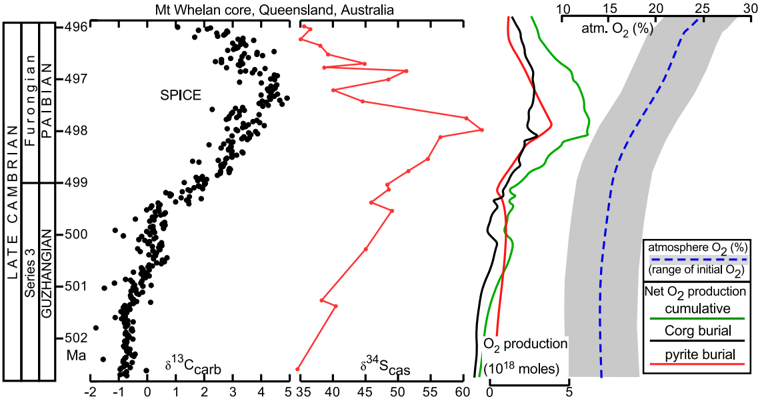
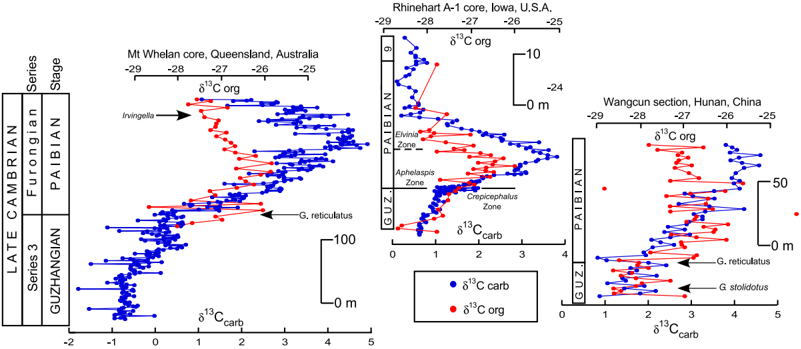
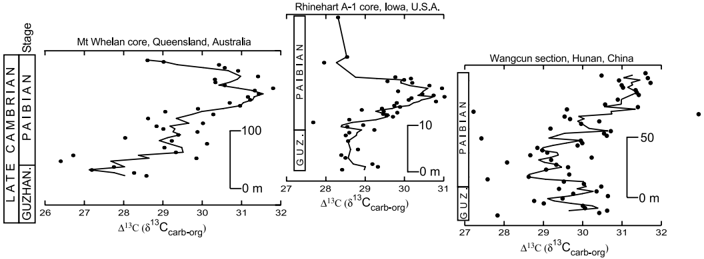
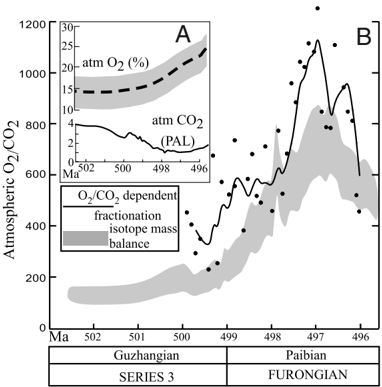
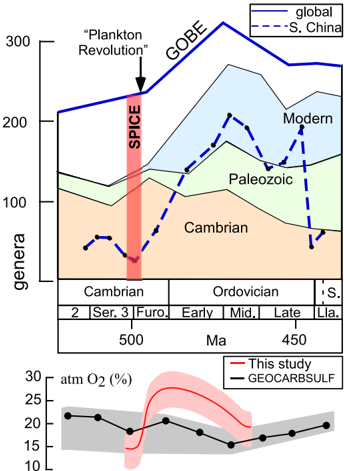
A rise in atmospheric O(2) has been linked to the Cambrian explosion of life. For the plankton and animal radiation that began some 40 million yr later and continued through much of the Ordovician (Great Ordovician Biodiversification Event), the search for an environmental trigger(s) has remained elusive. Here we present a carbon and sulfur isotope mass balance model for the latest Cambrian time interval spanning the globally recognized Steptoean Positive Carbon Isotope Excursion (SPICE) that indicates a major increase in atmospheric O(2). We estimate that this organic carbon and pyrite burial event added approximately 19 × 10(18) moles of O(2) to the atmosphere (i.e., equal to change from an initial starting point for O(2) between 10-18% to a peak of 20-28% O(2)) beginning at approximately 500 million years. We further report on new paired carbon isotope results from carbonate and organic matter through the SPICE in North America, Australia, and China that reveal an approximately 2‰ increase in biological fractionation, also consistent with a major increase in atmospheric O(2). The SPICE is followed by an increase in plankton diversity that may relate to changes in macro- and micronutrient abundances in increasingly oxic marine environments, representing a critical initial step in the trophic chain. Ecologically diverse plankton groups could provide new food sources for an animal biota expanding into progressively more ventilated marine habitats during the Ordovician, ultimately establishing complex ecosystems that are a hallmark of the Great Ordovician Biodiversification Event.
Overview
CoChat Summary
TL;DR
A carbon and sulfur isotope mass balance model for the late Cambrian SPICE event indicates a major rise in atmospheric O₂, with roughly 19 × 10¹⁸ moles of O₂ added by organic carbon and pyrite burial. New paired carbonate–organic carbon isotope data from three regions show an approximately 2‰ increase in biological fractionation, consistent with an O₂ pulse that may have helped set the stage for later plankton diversification.
Key findings
- The isotope mass balance model estimates that organic carbon and pyrite burial during the SPICE added approximately 19 × 10¹⁸ moles of O₂, equivalent to a change from an initial O₂ level between 10–18% to a peak of 20–28% O₂ beginning at approximately 500 million years ago.
- Most O₂ production occurred during a 2-million-year interval centered on the SPICE peak, when organic carbon burial rates were elevated at approximately 7 × 10¹⁸ moles C/my and non-steady-state pyrite burial rates were approximately 3 × 10¹⁸ moles S/my.
- Paired δ¹³C_carb and δ¹³C_org analyses from Iowa (United States), Queensland (Australia), and Hunan (China) show Δ¹³C increasing from ∼28–29‰ before the SPICE to a peak of 31‰ at the height of the excursion, then returning to pre-excursion values; this approximately 2‰ increase is interpreted as an O₂-dependent biological fractionation signal.
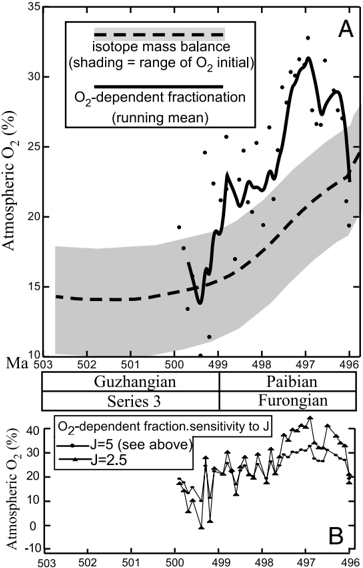
- Using the O₂-dependent fractionation approach with J = 5, the observed fractionation increase translates to a pO₂ rise from a starting point between 14–18% to a peak just over 30%; the authors argue the SPICE O₂ pulse may have promoted diversification of dinoflagellate-like plankton and later animal expansion during the Ordovician.
Methods
- The authors used a carbon and sulfur isotope mass balance model based on the approach of Kurtz et al., using δ¹³C_carb and δ³⁴S_CAS data from the Mt. Whelan core in Australia; the records were smoothed with cubic smoothing splines, and the model was run without assuming steady state, with weathering fluxes and isotopic compositions held constant from an assumed initial steady state.
- For the O₂ proxy, they measured paired δ¹³C_carb and δ¹³C_org from the same samples in drill core from Iowa, drill core from Queensland, and fresh outcrop from Hunan; carbonate was removed by acidification, residues were analyzed by elemental analyzer–isotope ratio mass spectrometry, and Δ¹³C was calculated as δ¹³C_carb − δ¹³C_org.
- They modified the Beerling et al. equation to calculate O₂ from measured δ¹³C_carb and δ¹³C_org values using J = 5, and also modeled pCO₂ during the SPICE using a modified δ¹³C mass balance model from Kump and Arthur.
Limitations
- The paper states that the assumption that experimental results from modern plants and bryophytes apply to early Paleozoic marine phytoplankton—and that these phytoplankton did not utilize a carbon-concentrating mechanism—must be examined further.
- The authors acknowledge that Δ¹³C could also record other variables affecting photosynthetic isotope discrimination, including decreased phytoplankton growth rates, increased cell volume, changes in photoautotroph assemblages, temperature-dependent fractionation, organic matter source, secondary biological fractionation, and thermal maturation; they argue these are unlikely to explain the observed trends.
- The text notes an apparent mismatch at the end of the SPICE: isotopic fractionation indicates pO₂ returned to near pre-SPICE levels, whereas C and S isotope mass balance indicates pO₂ remained at peak levels; fluctuations in pCO₂ and the pO₂/pCO₂ ratio may reconcile this, but the initial O₂ level is also uncertain, with possible starting points of 10.5%, ∼14%, ∼18%, or even ∼5% in other models.
Model-written summary. Check it against the paper before relying on it.
Integrity signals
Registry
Cites
Statistics
Figures
Verification
Claims the paper makes
6 Valid · 1 Not valid · 30 Not checked · 40 Own results and interpretations
The sources with a verdict support this claim; the rest weren’t checked yet, have no full text we could read, or their verdicts aren’t rated yet.
In the paper
“The SPICE event has been documented worldwide and is characterized by a positive δ 13 Cshift of approximately þ 4 ‰ in Upper Cambrian (Paibian Stage of Furongian Series) sections throughout North America and time-equivalent strata in China, Siberia, Baltica, Australia, and Kazakhstan (refs. 14 -16, Fig. S1, and SI Text ).”
What the sources say
- Not checked — no full text of the sourcecites [14] Saltzman MR, et al. (2000) A global carbon isotope excursion (SPICE) during the Late Cambrian: relation to trilobite extinctions, organic-matter burial and sea level. Palaeogeogr Palaeocl 162:211 -223. source
- Not checked — no full text of the sourcecites [15] Ahlberg P, et al. (2009) Cambrian high-resolution biostratigraphy and carbon isotope chemostratigraphy in Scania, Sweden: First record of the SPICE and DICE excursions in Scandinavia. Lethaia 42:2 -16. source
- Supportedcites [16] Kouchinsky A, et al. (2008) The SPICE carbon isotope excursion in Siberia: A combined study of the upper Middle Cambrian -lowermost Ordovician Kulyumbe River section, northwestern Siberian Platform. Geol Mag 145:609 -622. source
Split into 2 atoms — 2 confirmed, 0 partially supported, 0 disputed, 0 misattributed, 0 unverifiable. Expand the claim to see per-atom verdicts.
plain- Asserted: passes — The authors put it forward as true.
- Checkable: passes — It can be checked against evidence.
- Load-bearing: passes — The paper’s conclusions depend on it.
- Based: passes — The paper gives a reason why it holds.
The sources with a verdict support this claim; the rest weren’t checked yet, have no full text we could read, or their verdicts aren’t rated yet.
In the paper
“Depending on the time resolution possible in recent global or regional marine animal diversity compilations (36 -38), the GOBE could arguably be viewed as having been ' rooted ' in the latest Cambrian (Furongian) (Fig. 6).”
What the sources say
- Not checked — no full text of the sourcecites [36] Alroy J (2010) The shifting balance of diversity among major marine animal groups. Science 329:1191 -1194. source
- Not checked — no full text of the sourcecites [37] Sepkoski JJ (1997) Biodiversity: Past, present, and future. J Paleo 71:533 -539. source
- Supportedcites [38] Rong J, Junxuan F, Miller AI, Guoxiang L (2007) Dynamic patterns of latest ProterozoicPalaeozoic-early Mesozoic marine biodiversity in South China. Geol J 42:431 -454. source
Section 4.2 (Early–Middle Ordovician; page not supplied) presents a regional marine-diversity compilation for South China, with counts for the early Furongian and Tremadocian. The citation identifies a compilation that can inform the citing authors’ hedged interpretation; it need not itself use the word “rooted.” (LLM, conf=0.88)
hedgedstates an association- Asserted: passes — The authors put it forward as true.
- Checkable: passes — It can be checked against evidence.
- Load-bearing: unclear — It is unclear whether the paper’s conclusions depend on it.
- Based: passes — The paper gives a reason why it holds.
The sources with a verdict support this claim; the rest weren’t checked yet, have no full text we could read, or their verdicts aren’t rated yet.
In the paper
“This return to lower Δ 13 C likely indicates the role that fluctuations in atmospheric p CO 2 may also play in photosynthetic carbon isotope fractionation (20, 21, 23, 26 -29).”
What the sources say
- Not checked — no full text of the sourcecites [20] Berner RA, et al. (2000) Isotope fractionation and atmospheric oxygen: Implications for Phanerozoic O 2 evolution. Science 287:1630 -1633. source
- Not checked — no full text of the sourcecites [21] Beerling DJ, et al. (2002) Carbon isotope evidence implying high O 2 ∕ CO 2 ratios in the Permo-Carboniferous atmosphere. Geochim Cosmochim Acta 66:3757 -3767. source
- Supportedcites [23] Bergman NM, Lenton TM, Watson AJ (2004) COPSE: A new model of biogeochemical cycling over Phanerozoic time. Am J Sci 304:397 -437. source
The Ocean Nutrient Model section (page not supplied) models carbon isotope fractionation as varying with pCO₂ and identifies pCO₂ as a major source of variation. It also describes a decline in fractionation toward the present as modeled pCO₂ falls, supporting the proposed explanation for a return to lower Δ¹³C. (LLM, conf=0.88)
- Not checked — no full text of the sourcecites [26] Kump LR, Arthur MA (1999) Interpreting carbon-isotope excursions: Carbonates and organic matter. Chem Geol 161:181 -198. source
- Not checked — no full text of the sourcecites [27] Fletcher BJ, Brentnall SJ, Quick WP, Beerling DJ (2006) BRYOCARB: A process-based model of thallose liverwort carbon isotope fractionation in response to CO 2 , O 2 , light and temperature. Geochim Cosmochim Acta 70:5676 -5691. source
- Not checked — no full text of the sourcecites [28] Popp BM, et al. (1998) Effect of phytoplankton cell geometry on carbon isotopic fractionation. Geochim Cosmochim Acta 62:69 -77. source
- Not checked — no full text of the sourcecites [29] Hayes JM, Strauss H, Kaufman AJ (1999) The abundance of 13 C in marine organic matter and isotopic fractionation in the global biogeochemical cycle of carbon during the past 800 Ma. Chem Geol 161:103 -125. source
hedgedstates a possible cause- Asserted: passes — The authors put it forward as true.
- Checkable: passes — It can be checked against evidence.
- Load-bearing: passes — The paper’s conclusions depend on it.
- Based: passes — The paper gives a reason why it holds.
Every source the paper cites for this claim was checked and supports it.
In the paper
“The strong correspondence of the initial δ 13 C shifts in both carbonates and organic matter at the onset of the SPICE rules out the potentially large oxygen sink associated with a dissolved organic carbon (DOC)-rich ' Rothman ocean ' invoked to explain Neoproterozoic carbon isotope anomalies (45).”
What the sources say
- Supportedcites [45] Rothman DH, Hayes JM, Summons RE (2003) Dymanics of the Neoproterozoic carbon cycle. Proc Natl Acad Sci USA 100:8124 -8129. source
Split into 2 atoms — 2 confirmed, 0 partially supported, 0 disputed, 0 misattributed, 0 unverifiable. Expand the claim to see per-atom verdicts.
boostedstates a cause- Asserted: passes — The authors put it forward as true.
- Checkable: passes — It can be checked against evidence.
- Load-bearing: unclear — It is unclear whether the paper’s conclusions depend on it.
- Based: passes — The paper gives a reason why it holds.
- Supported
A result the paper reports from its own data — it cites no other source for it, so there is none to check. The quote shows it is in the paper.
In the paper
“We further report on new paired carbon isotope results from carbonate and organic matter through the SPICE in North America, Australia, and China that reveal an approximately 2 ‰ increase in biological fractionation”
plain- Asserted: passes — The authors put it forward as true.
- Checkable: passes — It can be checked against evidence.
- Load-bearing: passes — The paper’s conclusions depend on it.
- Based: passes — The paper gives a reason why it holds.
45 more claims
Create a free account to see all 77 claims and to verify the 10 references still open.
- Probably not a substantial claim. 9
- It may state two separate claims as one. 22
Claims other papers make about this one
Each is checked against this paper’s own text: does it say what the citing paper says it does?
The source backs part of the claim, not all of it — or backs it for a different population, condition or comparison.
In the citing paper
“Ultimately, coupled burial of both reduced species in marine sediments results in the release of oxygen and other marine oxidants 14 .”
From Possible links between extreme oxygen perturbations and the Cambrian radiation of animals (2019) · cites this paper as [14]
Experimental — accuracy not yet measuredThe source backs part of the claim, not all of it — or backs it for a different population, condition or comparison.
In the citing paper
“A 2‰ rise in Δ13Ccarb-org occurred from the late Ediacaran to the early Cambrian, suggesting a substantial increase in atmospheric oxygen level from 16% to 30% of the present atmospheric level (PAL).”
From Enhanced weathering as a trigger for the rise of atmospheric O2 level from the late Ediacaran to the early Cambrian (2019) · cites this paper as [88]
Experimental — accuracy not yet measuredThe source backs part of the claim, not all of it — or backs it for a different population, condition or comparison.
In the citing paper
“Then, the abrupt increase in the Δ13Ccarb-org values of approximately +2‰ (Fig. 7) indicates that the mass of oxygen in the atmosphere was doubled in the early Cambrian85,88.”
From Enhanced weathering as a trigger for the rise of atmospheric O2 level from the late Ediacaran to the early Cambrian (2019) · cites this paper as [88]
Experimental — accuracy not yet measuredThe cited source says what the claim attributes to it.
In the citing paper
“Burial of these reduced species represents the two main net sources of oxygen to the surface environment 1214 , and also imprints on both the seawater sulphate sulphur isotope (δ 34 S, as recorded by carbonate-associated sulphate) and carbon isotope (δ 13 C, as recorded in carbonate) records, allowing redox changes in the surface environment to be traced through geologic time.”
From Possible links between extreme oxygen perturbations and the Cambrian radiation of animals (2019) · cites this paper as [14]
The cited source says what the claim attributes to it.
In the citing paper
“which may have been associated with large distinct pulses in atmospheric oxygenation, as previously suggested for the late Cambrian SPICE (Steptoean Positive C-isotope Excursion) event 14 .”
From Possible links between extreme oxygen perturbations and the Cambrian radiation of animals (2019) · cites this paper as [14]
1 more claim about this paper
Create a free account to see every claim other papers make about this one.
Citations
Cites
The Evolution of Modern Eukaryotic Phytoplankton
Falkowski, P. G., Katz, M. E., Knoll, A. H., Quigg, A., Raven, J. A., Schofield, O., & Taylor, F. J. R. (2004) · Science · doi:10.1126/science.1095964 · Cited by 1,613 · cited 3×
“Well-studied examples include the rise of animals at the end of the Precambrian eon (3) and the rise of modern phytoplankton groups in the early Mesozoic (4), both of which have been linked to increases in atmospheric O2.”
Proterozoic Ocean Chemistry and Evolution: A Bioinorganic Bridge?
Anbar, A. D., & Knoll, A. H. (2002) · Science · doi:10.1126/science.1069651 · Cited by 1,191 · cited 1×
“F in atmospheric oxygen (O2) and oceanic redox are thought to have played fundamental roles in driving biological evolution throughout geologic time (1, 2).”
Interpreting carbon-isotope excursions: carbonates and organic matter
Kump, L. R., & Arthur, M. A. (1999) · Chemical Geology · doi:10.1016/s0009-2541(99)00086-8 · Cited by 1,171 · cited 6×
“Kump LR, Arthur MA (1999) Interpreting carbon-isotope excursions: Carbonates and organic matter.”
InfluentialSelf-citationGEOCARBSULF: A combined model for Phanerozoic atmospheric O2 and CO2
Berner, R. A. (2006) · Geochimica et Cosmochimica Acta · doi:10.1016/j.gca.2005.11.032 · Cited by 1,120 · cited 13×
“The cumulative atmospheric O2 production of approximately 19 × 1018 moles would have increased an atmosphere initially containing approximately 18% O2 (from Berner’s GEOCARBSULF model) (19) to near 28%.”
InfluentialLate-Neoproterozoic Deep-Ocean Oxygenation and the Rise of Animal Life
Canfield, D. E., Poulton, S. W., & Narbonne, G. M. (2007) · Science · doi:10.1126/science.1135013 · Cited by 1,000 · cited 1×
“Well-studied examples include the rise of animals at the end of the Precambrian eon (3) and the rise of modern phytoplankton groups in the early Mesozoic (4), both of which have been linked to increases in atmospheric O2.”
Hayes, J. M., Strauss, H., & Kaufman, A. J. (1999) · Chemical Geology · doi:10.1016/s0009-2541(99)00083-2 · Cited by 843
Sedimentary Corg:P ratios, paleocean ventilation, and Phanerozoic atmospheric pO2
Algeo, T. J., & Ingall, E. (2007) · Palaeogeography, Palaeoclimatology, Palaeoecology · doi:10.1016/j.palaeo.2007.02.029 · Cited by 769
Effect of Phytoplankton Cell Geometry on Carbon Isotopic Fractionation
Popp, B. N., Laws, E. A., Bidigare, R. R., Dore, J. E., Hanson, K. L., & Wakeham, S. G. (1998) · Geochimica et Cosmochimica Acta · doi:10.1016/s0016-7037(97)00333-5 · Cited by 698
Did Cooling Oceans Trigger Ordovician Biodiversification? Evidence from Conodont Thermometry
Trotter, J. A., Williams, I. S., Barnes, C. R., Lécuyer, C., & Nicoll, R. S. (2008) · Science · doi:10.1126/science.1155814 · Cited by 669 · cited 1×
“Even as O2 levels began to drop in the early Ordovician, increasingly colder waters (42) would be capable of dissolving more atmospheric O2 and progressively ventilating an anoxic deep ocean (46–48).”
Dynamics of the Neoproterozoic carbon cycle
Rothman, D. H., Hayes, J. M., & Summons, R. E. (2003) · Proceedings of the National Academy of Sciences · doi:10.1073/pnas.0832439100 · Cited by 608
Cited by
Authigenic Carbonate and the History of the Global Carbon Cycle
Schrag, D. P., Higgins, J. A., Macdonald, F. A., & Johnston, D. T. (2013) · Science · doi:10.1126/science.1229578 · Cited by 532
Saltzman, M. R., & Thomas, E. (2012) · The Geologic Time Scale · doi:10.1016/b978-0-444-59425-9.00011-1 · Cited by 436
Self-citationCambrian integrative stratigraphy and timescale of China
Zhu, M., Yang, A., Yuan, J., Li, G., Zhang, J., Zhao, F., Ahn, S.-Y., & Miao, L. (2019) · Science China Earth Sciences · doi:10.1007/s11430-017-9291-0 · Cited by 289
Stepwise oxygenation of the Paleozoic atmosphere
Krause, A. J., Mills, B. J. W., Zhang, S., Planavsky, N. J., Lenton, T. M., & Poulton, S. W. (2018) · Nature Communications · doi:10.1038/s41467-018-06383-y · Cited by 255
The Great Ordovician Biodiversification Event (GOBE): definition, concept and duration
Servais, T., & Harper, D. A. T. (2018) · Lethaia · doi:10.1111/let.12259 · Cited by 246
“6), and possibly by an oxygenation event (Saltzman et al. 2011), but it is so far not understood why planktonic organisms suddenly diversified during the late Cambrian – Early Ordovician.”
BackgroundCo-evolution of oceans, climate, and the biosphere during the ‘Ordovician Revolution’: A review
Algeo, T. J., Marenco, P. J., & Saltzman, M. R. (2016) · Palaeogeography, Palaeoclimatology, Palaeoecology · doi:10.1016/j.palaeo.2016.05.015 · Cited by 199
“The relatively stable oceanic 214 conditions implied by such limited δ13Ccarb variation were favorable for benthic marine 215 communities and skeletal carbonate production, possibly contributing to the GOBE (Pruss et al., 216 2010; Saltzman et al., 2011).”
BackgroundSelf-citationPossible links between extreme oxygen perturbations and the Cambrian radiation of animals
He, T., Zhu, M., Mills, B. J. W., Wynn, P. M., Zhuravlev, A. Y., Tostevin, R., Pogge von Strandmann, P. A. E., Yang, A., Poulton, S. W., & Shields, G. A. (2019) · Nature Geoscience · doi:10.1038/s41561-019-0357-z · Cited by 193
The onset of the ‘Ordovician Plankton Revolution’ in the late Cambrian
Servais, T., Perrier, V., Danelian, T., Klug, C., Martin, R., Munnecke, A., Nowak, H., Nützel, A., Vandenbroucke, T. R. A., Williams, M., et al. (2016) · Palaeogeography, Palaeoclimatology, Palaeoecology · doi:10.1016/j.palaeo.2015.11.003 · Cited by 174
“The evolution of the zooplankton feeding on the phytoplankton and then larger animals feeding on the zooplankton could reasonably have taken 3 to 5 myr or more, making the hypothesis of Saltzman et al. (2011) plausible.”
BackgroundMethodInfluentialUranium isotopes distinguish two geochemically distinct stages during the later Cambrian SPICE event
Dahl, T. W., Boyle, R. A., Canfield, D. E., Connelly, J. N., Gill, B. C., Lenton, T. M., & Bizzarro, M. (2014) · Earth and Planetary Science Letters · doi:10.1016/j.epsl.2014.05.043 · Cited by 172
“The SPICE event is thought to represent a 2–4 Myr interval when anoxic and sulfidic water masses expanded over the shallow ocean, contemporaneous with enhanced burial of organic carbon (Gill et al., 2011; Saltzman et al., 2011), as well as pyrite and molybdenum (Gill et al.”
BackgroundInfluentialSelf-citationStabilization of the coupled oxygen and phosphorus cycles by the evolution of bioturbation
Boyle, R. A., Dahl, T. W., Dale, A. W., Shields-Zhou, G. A., Zhu, M., Brasier, M. D., Canfield, D. E., & Lenton, T. M. (2014) · Nature Geoscience · doi:10.1038/ngeo2213 · Cited by 157
Geology and mineral resources of the Northern Territory
Ahmad, M. U., Scrimgeour, I., Close, D., Wygralak, A., Edgoose, C., Donnellan, N., Munson, T., Khan, M. O. F., Hollis, J., Glass, L., et al. (2013) · Northern Territory Geological Survey eBooks · Cited by 147
Saltzman, M. R., Edwards, C. T., Adrain, J. M., & Westrop, S. R. (2015) · Geology · doi:10.1130/g36814.1 · Cited by 144
“1) are not well understood, but an emerging theme focuses on fluctuations in oceanic redox state over a range of time scales (e.g., Hurtgen et al., 2009; Pruss et al., 2010; Saltzman et al., 2011; Gill et al., 2011; Thompson and Kah, 2012; Marenco et al., 2013).”
Self-citationA high-resolution record of early Paleozoic climate
Goldberg, S. L., Present, T. M., Finnegan, S., & Bergmann, K. D. (2021) · Proceedings of the National Academy of Sciences · doi:10.1073/pnas.2013083118 · Cited by 129
Cramer, B. D., & Jarvis, I. (2020) · Geologic Time Scale 2020 · doi:10.1016/b978-0-12-824360-2.00011-5 · Cited by 122
Atmospheric CO2 and O2 During the Phanerozoic: Tools, Patterns, and Impacts
Royer, D. L. (2013) · Elsevier eBooks · doi:10.1016/b978-0-08-095975-7.01311-5 · Cited by 138
Chen, Z., Tu, C., Pei, Y., Ogg, J. G., Fang, Y., Wu, S., Feng, X., Huang, Y., Guo, Z., & Yang, H. (2019) · Earth-Science Reviews · doi:10.1016/j.earscirev.2019.01.015 · Cited by 117
The Geologic History of Seawater
Lowenstein, T. K., Kendall, B., & Anbar, A. D. (2013) · Elsevier eBooks · doi:10.1016/b978-0-08-095975-7.00621-5 · Cited by 128
Marine oxygenation, lithistid sponges, and the early history of Paleozoic skeletal reefs
Lee, J., & Riding, R. (2018) · Earth-Science Reviews · doi:10.1016/j.earscirev.2018.04.003 · Cited by 107
“These Ordovician upturns in diversity have been broadly related to increase in atmospheric O2 (Servais et al., 2008, 2010, 2016; Saltzman et al., 2011; Edwards et al., 2017) and decline in global temperature (Trotter et al., 2008).”
BackgroundThresholds of catastrophe in the Earth system
Rothman, D. H. (2017) · Science Advances · doi:10.1126/sciadv.1700906 · Cited by 120
Innovation not recovery: dynamic redox promotes metazoan radiations
Wood, R., & Erwin, D. H. (2018) · Biological Reviews · doi:10.1111/brv.12375 · Cited by 101
“The SPICE shows a shift of approximately 4‰, and is also associated with an approximately 20‰ increase in the 34S/32S ratio of sea water as measured in carbonate-associated sulphate (Saltzman et al., 2011).”
BackgroundMeert, J. G., Levashova, N. M., Bazhenov, M. L., & Landing, E. (2016) · Gondwana Research · doi:10.1016/j.gr.2016.01.001 · Cited by 102
“Atmospheric oxygen levels in the late Ediacaran (~550 Ma) and through the Furongian (~497 Ma) remained at around 15% (Saltzman et al., 2011).”
BackgroundDiversity partitioning during the Cambrian radiation
Na, L., & Kiessling, W. (2015) · Proceedings of the National Academy of Sciences · doi:10.1073/pnas.1424985112 · Cited by 95
“Alternatively, a late Cambrian rise in oxygen levels has been proposed to explain the onset of the Ordovician radiation (37).”
BackgroundNielsen, A. T., & Schovsbo, N. H. (2015) · Earth-Science Reviews · doi:10.1016/j.earscirev.2015.09.012 · Cited by 105
The middle–late Cambrian reef transition and related geological events: A review and new view
Lee, J., Chen, J., & Chough, S. K. (2015) · Earth-Science Reviews · doi:10.1016/j.earscirev.2015.03.002 · Cited by 99
The Great Ordovician Biodiversification Event (GOBE) is not a single event
Servais, T., Cascales-Miñana, B., & Harper, D. A. T. (2021) · Paleontological Research · doi:10.2517/2021pr001 · Cited by 88
“…different, and sometimes completely opposing interpretations are presented for oxygen levels in the Ordovician (e.g. Munnecke et al., 2010), there is now general agreement that oxygenation levels increased during the Ordovician (e.g. Saltzman et al., 2011; Algeo et al., 2016; Edwards et al., 2017).”
Early Palaeozoic diversifications and extinctions in the marine biosphere: a continuum of change
Harper, D. A. T., Cascales-Miñana, B., & Servais, T. (2020) · Geological Magazine · doi:10.1017/s0016756819001298 · Cited by 83
“…& Lefebvre, 2010), oxygenation (pulse of atmospheric oxygen aids metabolism, production of collagen and skeletal material; Berner et al. 2007; Saltzman et al. 2011; C Diamond, unpub. thesis, Ohio State University, 2013), substrate change (general trend from carbonate to siliciclastic…”
BackgroundInfluentialSchiffbauer, J. D., Huntley, J. W., Fike, D. A., Jeffrey, M. J., Gregg, J. M., & Shelton, K. L. (2017) · Science Advances · doi:10.1126/sciadv.1602158 · Cited by 84
Revisiting the Great Ordovician Diversification of land plants: Recent data and perspectives
Servais, T., Cascales-Miñana, B., Cleal, C. J., Gerrienne, P., Harper, D. A. T., & Neumann, M. (2019) · Palaeogeography, Palaeoclimatology, Palaeoecology · doi:10.1016/j.palaeo.2019.109280 · Cited by 77
Hoffman, P. F., & Lamothe, K. G. (2019) · Proceedings of the National Academy of Sciences · doi:10.1073/pnas.1909570116 · Cited by 74
“S1 and S5)? Why is there growing evidence for synchroneity between CIEs on distant platforms (9, 10, 46, 59, 60)? Is there a mystery process that generates CIEs zonally, if not globally, independent of open-ocean DIC? Such a process should no longer be in operation (Fig.”
BackgroundServais, T., Cascales-Miñana, B., Harper, D. A. T., Lefebvre, B., Munnecke, A., Wang, W., & Zhang, Y. (2023) · Palaeogeography, Palaeoclimatology, Palaeoecology · doi:10.1016/j.palaeo.2023.111592 · Cited by 74
Vermeij, G. J. (2013) · Annual Review of Earth and Planetary Sciences · doi:10.1146/annurev-earth-050212-124123 · Cited by 74
Edwards, C. T., & Saltzman, M. R. (2014) · Palaeogeography Palaeoclimatology Palaeoecology · doi:10.1016/j.palaeo.2014.02.005 · Cited by 74
“All rights reserved. a b s t r a c t a r t i c l e i n f o Article history: Received 7 September 2013 Received in revised form 30 December 2013 Accepted 5 February 2014 Available online 13 February 2014 Keywords: Carbon isotopes Ordovician Chemostratigraphy Carbon cycling Great Basin Great Ordovician Biodiversificatio…”
BackgroundInfluentialSelf-citationThe Furongian (late Cambrian) Biodiversity Gap: real or apparent?
Harper, D. A. T., Topper, T. P., Cascales-Miñana, B., Servais, T., Zhang, Y.-D., & Ahlberg, P. (2019) · Palaeoworld · doi:10.1016/j.palwor.2019.01.007 · Cited by 69
Chen, Y., Diamond, C., Stüeken, E. E., Cai, C., Gill, B. C., Zhang, F., Bates, S. M., Chu, X., Ding, Y., & Lyons, T. W. (2019) · Geochimica et Cosmochimica Acta · doi:10.1016/j.gca.2019.05.017 · Cited by 71
“Widespread ventilation of the deep ocean may not have occurred until later in the Paleozoic with the ecological expansion of land plants (Dahl et al., 2010; Saltzman et al., 2011; Sperling et al., 2015; Lenton et al., 2016; Wallace et al., 2017).”
BackgroundSelf-citationEvidence for local and global redox conditions at an Early Ordovician (Tremadocian) mass extinction
Edwards, C. T., Fike, D. A., Saltzman, M. R., Lu, W., & Lu, Z. (2017) · Earth and Planetary Science Letters · doi:10.1016/j.epsl.2017.10.002 · Cited by 73
Self-citationPagano, G., Talamanca, A. A., Castello, G., Pallardó, F. V., Zatterale, A., & Degan, P. (2011) · Biological Chemistry · doi:10.1515/bc-2011-227 · Cited by 74
“The obvious answer may be that postCambrian aerobic biota are all faced with the generalized damages exerted by atmospheric oxygen, the second most reactive non-metallic element after fl uorine (Saltzman et al. , 2011 ).”
BackgroundElrick, M., Rieboldt, S., Saltzman, M. R., & McKay, R. M. (2011) · Geology · doi:10.1130/g32109.1 · Cited by 70
Self-citationAstronomically forced climate change in the late Cambrian
Sørensen, A. L., Nielsen, A. T., Thibault, N., Zhao, Z., Schovsbo, N. H., & Dahl, T. W. (2020) · Earth and Planetary Science Letters · doi:10.1016/j.epsl.2020.116475 · Cited by 62
Edwards, C. T., & Saltzman, M. R. (2015) · Palaeogeography Palaeoclimatology Palaeoecology · doi:10.1016/j.palaeo.2015.08.005 · Cited by 73
“…- 13Corg), have been used to make inferences into whether 13C 82 perturbations were associated with changes in atmospheric pCO2 or pO2 that affected 83 biological fractionation (Patzkowsky et al., 1997; Hayes et al., 1999; Pancost et al., 1999, 84 2013; Young et al., 2008; Saltzman et al., 2011).”
BackgroundMethodSelf-citationYoung, S. A., Gill, B. C., Edwards, C. T., Saltzman, M. R., & Leslie, S. A. (2015) · Palaeogeography Palaeoclimatology Palaeoecology · doi:10.1016/j.palaeo.2015.09.040 · Cited by 66
Self-citationNowak, H., Servais, T., Monnet, C., Molyneux, S. G., & Vandenbroucke, T. R. A. (2015) · Earth-Science Reviews · doi:10.1016/j.earscirev.2015.09.005 · Cited by 65
“Comasphaeridium densispinosum Vidal in Vidal & Peel 1993 “Comasphaeridium filiforme” Fombella 1979 [nomen nudum, acc. to Fensome et al. 1990] Comasphaeridium formosum Moczydłowska 1988 Comasphaeridium francinae Jachowicz-Zdanowska 2013 Comasphaeridium gogense (Downie 1982) Sarjeant & Stancliffe 1994 Comasphaeridium la…”
InfluentialA model for the decrease in amplitude of carbon isotope excursions across the Phanerozoic
Bachan, A., Lau, K., Saltzman, M. R., Thomas, E., Kump, L. R., & Payne, J. L. (2017) · American Journal of Science · doi:10.2475/06.2017.01 · Cited by 61
Self-citationA meta-analysis of the Steptoean Positive Carbon Isotope Excursion: The SPICEraq database
Pulsipher, M. A., Schiffbauer, J. D., Jeffrey, M. J., Huntley, J. W., Fike, D. A., & Shelton, K. L. (2020) · Earth-Science Reviews · doi:10.1016/j.earscirev.2020.103442 · Cited by 67
Jones, D. S. J., Brothers, R. W., Ahm, A. C., Slater, N., Higgins, J. A., & Fike, D. A. (2019) · Geology · doi:10.1130/g46861.1 · Cited by 59
Li, D., Zhang, X., Hu, D., Chen, X., Huang, W., Zhang, X., Li, M., Qin, L., Peng, S., & Shen, Y. (2018) · Geology · doi:10.1130/g40231.1 · Cited by 59
Edwards, C. T. (2019) · Palaeoworld · doi:10.1016/j.palwor.2018.08.006 · Cited by 53
LeRoy, M. A., Gill, B. C., Sperling, E. A., McKenzie, N. R., & Park, T. S. (2021) · Palaeogeography Palaeoclimatology Palaeoecology · doi:10.1016/j.palaeo.2020.110209 · Cited by 54
Self-citationRiding, R., Liang, L., Lee, J., & Virgone, A. (2018) · Palaeogeography Palaeoclimatology Palaeoecology · doi:10.1016/j.palaeo.2018.10.006 · Cited by 48
“linked the transition from microbial carbonate to skeletal carbonates during the early–mid Ordovician to changes in temperature and oxygenation (Berry and Wilde, 1978; Webby, 2002; Servais et al., 2008, 2010, 2016; Trotter et al., 2008; Saltzman et al., 2011; Kah et al., 2016; Rasmussen et al., 2016; Young et al., 201…”
BackgroundSynchronizing rock clocks in the late Cambrian
Zhao, Z., Thibault, N. R., Dahl, T. W., Schovsbo, N. H., Sørensen, A. L., Rasmussen, C. M. Ø., & Nielsen, A. T. (2022) · Nature Communications · doi:10.1038/s41467-022-29651-4 · Cited by 54
“9% calculated from a robust AR(1) noise model80.”
BackgroundPruss, S. B., Jones, D. S. J., Fike, D. A., Tosca, N. J., & Wignall, P. B. (2019) · Geology · doi:10.1130/g45871.1 · Cited by 53
Zhao, Z., Ahlberg, P., Thibault, N. R., Dahl, T. W., Schovsbo, N. H., & Nielsen, A. T. (2022) · Global and Planetary Change · doi:10.1016/j.gloplacha.2022.103751 · Cited by 47
Liu, J., Algeo, T. J., Qie, W., & Saltzman, M. R. (2018) · Palaeogeography Palaeoclimatology Palaeoecology · doi:10.1016/j.palaeo.2018.10.021 · Cited by 49
Self-citationHammer, Ø., & Svensen, H. H. (2016) · Palaeogeography Palaeoclimatology Palaeoecology · doi:10.1016/j.palaeo.2016.12.016 · Cited by 46
LeRoy, M. A., & Gill, B. C. (2019) · Geobiology · doi:10.1111/gbi.12334 · Cited by 49
Self-citationZhang, W., Shi, X., Jiang, G., Tang, D., & Wang, X. (2014) · Gondwana Research · doi:10.1016/j.gr.2014.03.015 · Cited by 47
Redox dynamics of later Cambrian oceans
Gill, B. C., Dahl, T. W., Hammarlund, E. U., LeRoy, M. A., Gordon, G. W., Canfield, D. E., Anbar, A. D., & Lyons, T. W. (2021) · Palaeogeography, Palaeoclimatology, Palaeoecology · doi:10.1016/j.palaeo.2021.110623 · Cited by 41
Self-citationOxygen as a Driver of Early Arthropod Micro-Benthos Evolution
Williams, M., Vannier, J., Corbari, L., & Massabuau, J. (2011) · PLoS ONE · doi:10.1371/journal.pone.0028183 · Cited by 42
“[3] used a carbon and sulphur isotope mass balance model to show a dramatic increase in oxygen-levels through the interval from 502 to 496 Ma (through the Guzhangian – Pabian Stage boundary) that encapsulates the interval of the SPICE positive CIE (Figure 4).”
BackgroundMethodInfluentialWotte, T., & Strauß, H. (2015) · Geological Magazine · doi:10.1017/s0016756815000187 · Cited by 40
“Carbon and sulphur isotope mass-balance models further indicate that the positive excursions in δ13C and δ34S are associated with a significant rise in the atmospheric O2 level (Saltzman et al. 2011).”
BackgroundZhao, Z., Pang, X., Zou, C., Dickson, A. J., Basu, A., Guo, Z., Pan, S., Nielsen, A. T., Schovsbo, N. H., Jing, Z., et al. (2023) · Earth and Planetary Science Letters · doi:10.1016/j.epsl.2023.118013 · Cited by 42
Marine organic carbon burial increased forest fire frequency during Oceanic Anoxic Event 2
Boudinot, F. G., & Sepúlveda, J. (2020) · Nature Geoscience · doi:10.1038/s41561-020-0633-y · Cited by 42
Hartke, E. R., Cramer, B. D., Calner, M., Melchin, M. J., Barnett, B. A., Oborny, S. C., & Bancroft, A. M. (2020) · Global and Planetary Change · doi:10.1016/j.gloplacha.2020.103373 · Cited by 43
“Hopane/sterane (H/S) ratios are also above the Phanerozoic average (0.5–2.0, Cao et al., 2009) during the negative excursion in δ13Corg prior to the onset of the ICIE (blue box in Fig.”
BackgroundInfluentialSchmid, S. (2017) · Chemical Geology · doi:10.1016/j.chemgeo.2017.01.019 · Cited by 36
Link, P. K., Todt, M. K., Pearson, D. M., & Thomas, R. C. (2017) · Lithosphere · doi:10.1130/l671.1 · Cited by 36
“2), correlated with a high in atmospheric oxygen and a punctuated increase in invertebrate complexity (Saltzman et al., 1998, 2004, 2011).”
BackgroundAhlberg, P., & Terfelt, F. (2012) · Geological Magazine · doi:10.1017/s0016756812000167 · Cited by 36
“According to Saltzman et al. (2011), massive amounts of oxygen were released as a side product of chemical reactions in the buried material.”
BackgroundRooney, A. D., Millikin, A. E. G., & Ahlberg, P. (2022) · Geology · doi:10.1130/g49833.1 · Cited by 39
Yu, Y., Chen, Y., Li, D., & Su, J. (2021) · Precambrian Research · doi:10.1016/j.precamres.2021.106527 · Cited by 35
Colmenar, J., & Rasmussen, C. M. Ø. (2018) · Lethaia · doi:10.1111/let.12238 · Cited by 31
Strauss, J. V., Fraser, T. A., Melchin, M. J., Allen, T. J., Malinowski, J., Feng, X., Taylor, J. F., Day, J. E., Gill, B. C., & Sperling, E. A. (2020) · Canadian Journal of Earth Sciences · doi:10.1139/cjes-2020-0017 · Cited by 33
Self-citationKozik, N. P., Young, S. A., Bowman, C. N., Saltzman, M. R., & Them, T. R. (2019) · Palaeogeography Palaeoclimatology Palaeoecology · doi:10.1016/j.palaeo.2019.01.032 · Cited by 33
Self-citationPagès, A., & Schmid, S. (2016) · Palaeogeography Palaeoclimatology Palaeoecology · doi:10.1016/j.palaeo.2016.08.008 · Cited by 32
Li, Y., Zhang, T., Shen, B., Li, Z., Shao, D., & Lash, G. G. (2021) · Palaeogeography Palaeoclimatology Palaeoecology · doi:10.1016/j.palaeo.2021.110285 · Cited by 30
Hu, D., Zhang, X., Li, M., Xu, Y., & Shen, Y. (2021) · Global and Planetary Change · doi:10.1016/j.gloplacha.2021.103546 · Cited by 29
Li, D., ZHANG, X., Chen, K., Zhang, G., CHEN, X., Huang, W., Peng, S., & Shen, Y. (2017) · Geological Magazine · doi:10.1017/s0016756817000188 · Cited by 33
“…environmental changes such as oceanic redox conditions and sea level changes were thought to have influenced the extinction and recovery events around the Cambrian Furongian Epoch (Gill et al. 2011; Saltzman et al. 2011), though the global significance of these hypotheses remains to be tested.”
BackgroundPohl, A., Harper, D. A. T., Donnadieu, Y., Hir, G. L., Nardin, É., & Servais, T. (2017) · Lethaia · doi:10.1111/let.12247 · Cited by 31
“Published by John Wiley & Sons Ltd concomitant rise in plankton diversity led Saltzman et al. (2011) and Servais et al. (2016) to hypothesize that the increase in pO2 might have triggered the increase of plankton diversity, which may be related to changes in macro- and micronutrient abundances in…”
BackgroundInfluentialPotin, G. J.-M., Guériau, P., & Daley, A. C. (2023) · Frontiers in Ecology and Evolution · doi:10.3389/fevo.2023.1214109 · Cited by 33
Liu, M., Chen, D., Zhou, X., Tang, D., Them, T. R., & Jiang, M. (2019) · Global and Planetary Change · doi:10.1016/j.gloplacha.2019.103032 · Cited by 27
Wong, J. C. Y., Raven, J. A., Aldunate, M., Silva, S., Gaitán‐Espitía, J. D., Vargas, C. A., Ulloa, O., & von Dassow, P. (2023) · Limnology and Oceanography · doi:10.1002/lno.12367 · Cited by 30
“Planktonic green algae, which are larger and sink faster, and sequester more carbon, than cyanobacteria, have been credited with the late proterozoic increase in O2 (neoproterozoic oxidation event) that allowed the evolution of animals and the Cambrian explosion (Saltzman et al. 2011).”
BackgroundWade, D. C., Abraham, N. L., Farnsworth, A., Valdes, P. J., Bragg, F. J., & Archibald, A. T. (2019) · Climate of the past · doi:10.5194/cp-15-1463-2019 · Cited by 30
Peng, Y., Peng, Y., Lang, X., Ma, H., Huang, K., Li, F., & Shen, B. (2016) · Journal of Earth Science · doi:10.1007/s12583-016-0694-4 · Cited by 29
Life on the Edge: The Cambrian Marine Realm and Oxygenation
Pruss, S. B., & Gill, B. C. (2023) · Annual Review of Earth and Planetary Sciences · doi:10.1146/annurev-earth-031621-070316 · Cited by 32
“Later, in the wake of expanded ocean anoxia during the SPICE, there is evidence for a net rise in marine oxygenation linked to enhanced organic carbon and pyrite burial that occurred across the event (Saltzman et al. 2011, Zhang et al. 2023, Zhao et al. 2023).”
BackgroundSelf-citationNg, T.-W., Yuan, J., & Lin, J. (2014) · Geobios · doi:10.1016/j.geobios.2014.09.003 · Cited by 25
Lin, J., Sundberg, F. A., Jiang, G., Montañez, I. P., & Wotte, T. (2019) · Scientific Reports · doi:10.1038/s41598-019-53685-2 · Cited by 25
Gao, Y., Zhang, X., Xu, Y., Fang, C., Gong, Y., & Shen, Y. (2019) · Precambrian Research · doi:10.1016/j.precamres.2019.105411 · Cited by 27
Ng, T.-W., Yuan, J., & Lin, J. (2013) · Lethaia · doi:10.1111/let.12027 · Cited by 24
“2008) and Australia (Saltzman et al. 2011).”
BackgroundInfluentialMaharjan, D., Jiang, G., Peng, Y., & Henry, R. A. (2017) · Palaeogeography Palaeoclimatology Palaeoecology · doi:10.1016/j.palaeo.2017.11.026 · Cited by 26
Yuan, C., Liu, S., Chen, J., & Fang, L. (2022) · Palaeogeography Palaeoclimatology Palaeoecology · doi:10.1016/j.palaeo.2022.111302 · Cited by 24
Bhattacharya, R., Brown, J. S., Gatenby, R. A., & Ibrahim‐Hashim, A. (2024) · Seminars in Cancer Biology · doi:10.1016/j.semcancer.2024.06.003 · Cited by 29
Zhang, L., Algeo, T. J., Zhao, L., Chen, Z., Zhang, Z., & Li, C. (2022) · Global and Planetary Change · doi:10.1016/j.gloplacha.2022.103798 · Cited by 23
Álvaro, J. J., Pour, M. G., Sánchez-García, T., Zadeh, M. K., Hairapetian, V., & Popov, L. E. (2022) · Journal of Asian Earth Sciences · doi:10.1016/j.jseaes.2022.105240 · Cited by 23
Li, W.-P., Zhao, Y.-Y., Zhao, M.-Y., Zha, X.-P., & Zheng, Y.-F. (2019) · Scientific Reports · doi:10.1038/s41598-019-47142-3 · Cited by 19
Barili, R., Neilson, J., Brasier, M., Goldberg, K., Bardola, T. P., Ros, L. F. D., & Leng, M. J. (2018) · Canadian Journal of Earth Sciences · doi:10.1139/cjes-2018-0025 · Cited by 20
“The isotope offset between δ 13 Corg and δ 13 Ccarb curves 294 has been noted previously in Queensland, Australia and Iowa, USA by Saltzman et al. (2011).”
BackgroundInfluentialMarine oxygenation, deoxygenation, and life during the Early Paleozoic: An overview
Zhang, J., Edwards, C. T., Diamond, C., Lyons, T. W., & Zhang, Y. (2021) · Palaeogeography Palaeoclimatology Palaeoecology · doi:10.1016/j.palaeo.2021.110715 · Cited by 20
Self-citationNo Furongian Biodiversity Gap: Evidence from South China
Deng, Y., Fan, J., Yang, S., Shi, Y., Lu, Z., Xu, H., Sun, Z., Zhao, F., & Hou, Z.-S. (2022) · Palaeogeography Palaeoclimatology Palaeoecology · doi:10.1016/j.palaeo.2023.111492 · Cited by 19
Bian, L., Chappaz, A., Schovsbo, N. H., Nielsen, A. T., & Sanei, H. (2022) · Chemical Geology · doi:10.1016/j.chemgeo.2022.120846 · Cited by 18
Kozik, N. P., Young, S. A., Lindskog, A., Ahlberg, P., & Owens, J. D. (2023) · Geobiology · doi:10.1111/gbi.12545 · Cited by 16
“This increase in diversity at the base of the food chain has been postulated to have fueled the diversification of higher trophic level organisms in later pulses of the GOBE (Achab & Paris, 2007; Saltzman et al., 2011; Servais et al., 2008).”
BackgroundSelf-citationCannell, A., Blamey, N. J. F., Brand, U., Escapa, I. H., & Large, R. R. (2022) · Earth-Science Reviews · doi:10.1016/j.earscirev.2022.104062 · Cited by 18
Seawater signatures of Ordovician climate and environment
Young, S. A., Edwards, C. T., Ainsaar, L., Lindskog, A., & Saltzman, M. R. (2023) · Geological Society London Special Publications · doi:10.1144/sp532-2022-258 · Cited by 21
Self-citationConcluding IGCP 503: Towards a holistic view of Ordovician and Silurian Earth systems
Harper, D. A. T., Li, J., Munnecke, A., Owen, A. W., Servais, T., & Sheehan, P. M. (2011) · Episodes · doi:10.18814/epiiugs/2011/v34i1/005 · Cited by 15
Bian, L., Chappaz, A., Schovsbo, N. H., Wang, X., Zhao, W., & Sanei, H. (2023) · Earth and Planetary Science Letters · doi:10.1016/j.epsl.2023.118170 · Cited by 16
Metadata
- Authors
- Saltzman, M. R., Young, S. A., Kump, L. R., Gill, B. C., Lyons, T. W., & Runnegar, B.
- Affiliations
- The Ohio State University (US)
- Indiana University Bloomington (US)
- Pennsylvania State University (US)
- University of California, Riverside (US)
- Harvard University (US)
- University of California, Los Angeles (US)
- ORCID
- Venue
- Proceedings of the National Academy of Sciences
- Publisher
- National Academy of Sciences
- Published
- 2011-02-22
- Volume
- 108
- Issue
- 10
- Pages
- 3876-3881
- ISSN
- 0027-8424 (ISSN-L)
- 1091-6490
- PMC
- PMC3053972
- OpenAlex
- W2011440133
- Cited by
- 188
- References
- 56
- Citations by year
- 2026: 10 · 2025: 15 · 2024: 15 · 2023: 20 · 2022: 18 · 2021: 12 · 2020: 9 · 2019: 20 · 2018: 13 · 2017: 14 · 2016: 7 · 2015: 11 · 2014: 7 · 2013: 6 · 2012: 7
- FWCI
- 5.34
- Type
- journal article
- Language
- en
- Open access
- green
- www.ncbi.nlm.nih.gov
- Locations
- Proceedings of the National Academy of Sciences (publishedVersion)
- Europe PMC (PubMed Central) (publishedVersion)
- PubMed Central (publishedVersion)
- PubMed (publishedVersion)
- VTechWorks (Virginia Tech) (submittedVersion, cc-by-nc-nd)
- Funders
- National Science Foundation
- Ohio State University
- Topics
- Physical Sciences › Earth and Planetary Sciences › Paleontology › Paleontology and Stratigraphy of Fossils
- Physical Sciences › Earth and Planetary Sciences › Paleontology › Evolution and Paleontology Studies
- Physical Sciences › Environmental Science › Global and Planetary Change › Earth Systems and Cosmic Evolution
- Keywords
- atmospheric oxygen, Late Cambrian, Steptoean Positive Carbon Isotope Excursion, Great Ordovician Biodiversification Event, Cambrian explosion, organic carbon burial, pyrite burial, sulfur isotopes, carbon isotope fractionation, mass balance model, marine oxygenation, Ordovician
About these checks
Registry, retraction, Cites and statistics results are computed, not judged, with one exception: a printed reference that no index lists is read once by a model before it counts as a citation error. Claims are extracted by a model and kept only when their quote appears verbatim in the text; each cited source is then checked, with a model’s help, for whether it says what the claim relies on. Those verdicts can be wrong — read the claim’s quote and the cited source before relying on one.
The claim verdicts this report counts are experimental: their accuracy is not yet measured.
A language model drew the claims from the paper on 2026-09-29, under version 3 of the claim definition (model deepseek-v4.1-flash, prompt extract-v3).
A second model labelled each claim on 2026-09-29 (model jev-1.13-20260917, definition revision gold-guideline-v0.2).
Cited sources are checked with a language model’s help (gpt-6-sol).
Statistics and arithmetic are recomputed, not judged.
Confidence bands are shown only for fields calibrated on our annotated test set. None is calibrated yet, so no band is shown.
What counts as a claim ›How we measure confidence ›How we check this ›
Are you an author, or do you see a problem with this page? Request a review
Data sources
Bibliographic data: Semantic Scholar, OpenAlex, Crossref.
Contains information from the Semantic Scholar Academic Graph Datasets, made available under the ODC Attribution License (ODC-BY 1.0).
Semantic Scholar’s data is described in: Kinney, R., et al. (2023). The Semantic Scholar Open Data Platform. arXiv:2301.10140.
