

Robust paths to net greenhouse gas mitigation and negative emissions via advanced biofuels
Open accessThe DOI matches its Crossref record; 75 of the 76 references it cites were found in a registry or an index; 1 of the 78 sources its claims cite were checked for support.
Abstract
Significance: The climate benefits of cellulosic biofuels have been challenged based on carbon debt, opportunity costs, and indirect land use change, prompting calls for withdrawing support for research and development. Using a quantitative ecosystem modeling approach, which explicitly differentiates primary production, ecosystem carbon balance, and biomass harvest, we show that none of these arguments preclude cellulosic biofuels from realizing greenhouse gas mitigation. Our assessment illustrates how deliberate land use choices support the climate performance of current-day cellulosic ethanol technology and how technological advancements and carbon capture and storage addition could produce several times the climate mitigation potential of competing land-based biological mitigation schemes. These results affirm the climate mitigation logic of biofuels, consistent with their prominent role in many climate stabilization scenarios.
Overview
CoChat Summary
## TL;DR
The paper models land-based climate mitigation from cellulosic biofuels, reforestation, and grassland restoration at three U.S. sites and finds that switchgrass biofuel on former agricultural land can deliver immediate net mitigation, while conversion of secondary forest can impose a carbon debt. Future higher-yield biofuel systems plus CCS are reported to substantially outperform vegetation restoration in per-hectare mitigation potential.
## Key findings
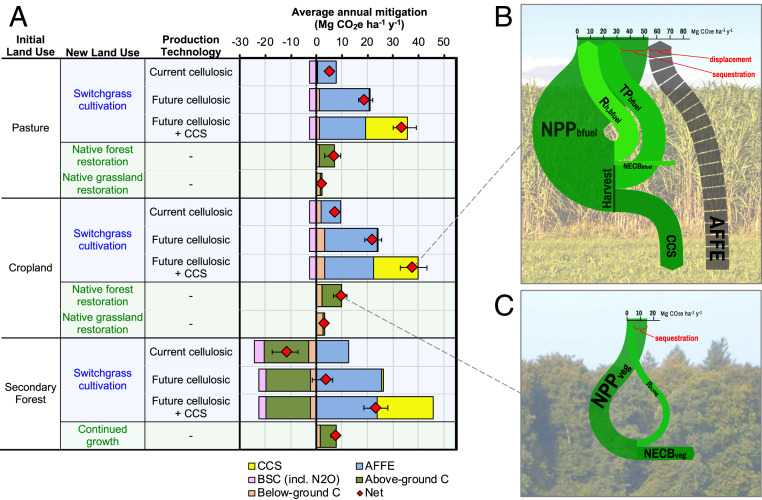
- Current cellulosic biofuel (BP) on former agricultural land achieved a mean net mitigation potential (NM) of 6.0 Mg CO2e ha−1 y−1 across the three sites and all previous agricultural land uses, which the paper says is within the range of reforestation on former agricultural land and 250% greater than grassland restoration.
- Reforestation on former agricultural land had mitigation potential of 3.4 to 11.9 Mg CO2e ha−1 y−1; grassland restoration had 1.7 to 3.5 Mg CO2e ha−1 y−1; current switchgrass cultivation on former agricultural land sequestered soil carbon at 0.5 to 3.3 Mg CO2e ha−1 y−1.
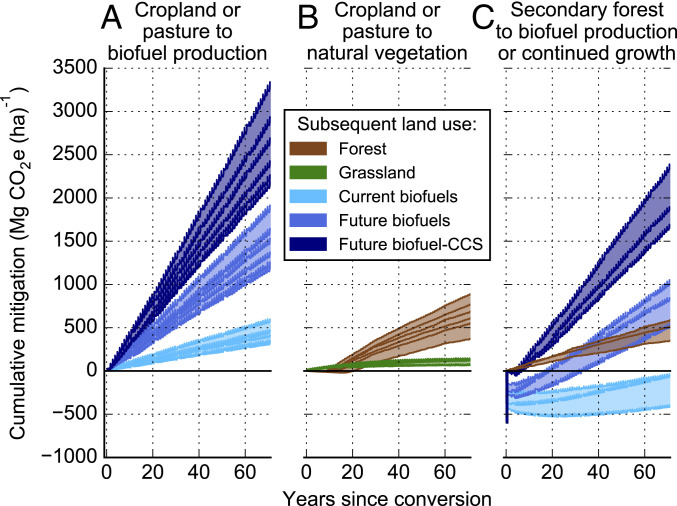
- Future biofuel technology with CCS was reported to require only 6 to 8 years to repay the carbon debt from converting secondary forest, compared with 27 to 52 years for future biofuel technology without CCS; current technology did not repay that debt over the 70-y simulation.
- The paper states that future BECCS achieved about 4 times the total per-hectare NM of reforestation and about 15 times the total mitigation potential of grassland restoration, while future technology improvements and CCS together could improve bioenergy system mitigation performance by about a factor of six relative to current-day performance.
## Methods
- The study used a case study-based, scenario analysis at three U.S. sites east of the 100th meridian: Webster County, Iowa; La Salle Parish, Louisiana; and Wayne County, New York.
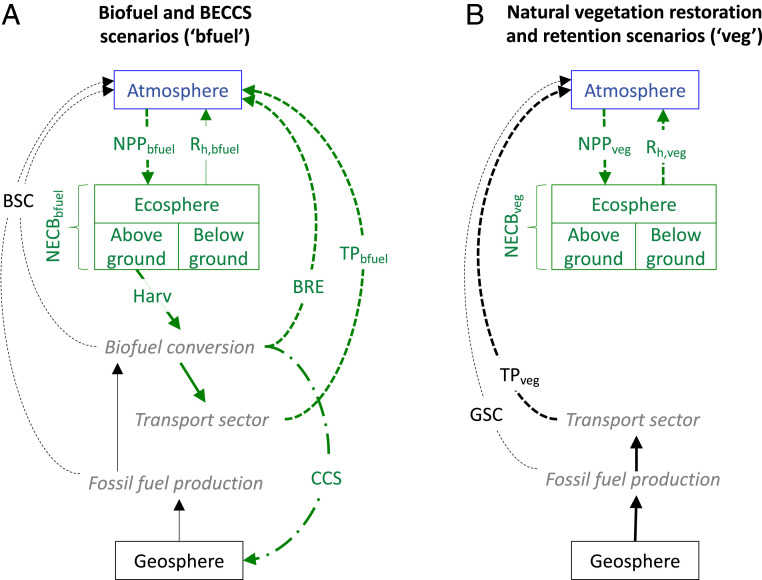
- It coupled a process-based ecosystem model (DayCent) with biorefinery engineering and life cycle emissions accounting to simulate 70-year forward changes in productivity, ecosystem carbon storage, soil N2O emissions, fuel displacement, and CCS.
- Scenarios included conversion of cropland, pasture, and secondary forest to switchgrass, reforestation/grassland restoration/continued forest growth, and biofuel technology cases ranging from current ethanol production to future hybrid ethanol + Fischer–Tropsch liquids, with and without CCS.
## Limitations
- The paper explicitly states that biofuel economics, sustainable deployment scale, and impacts on biodiversity and other ecosystem services fall outside the scope of the analysis.
- It notes that indirect effects such as ILUC are not included in the direct emissions accounting, though they are discussed separately; the text also says rebound effects were not quantified and deserve further study.
- Evident from the text: the results are based on three case study sites and model simulations, so the findings are not a full empirical assessment of all regions or deployment scales.
Model-written summary. Check it against the paper before relying on it.
Integrity signals
Registry
Cites
Statistics
Figures
Verification
Claims the paper makes
1 Valid · 4 Not valid · 45 Not checked · 52 Own results and interpretations
The sources with a verdict support this claim; the rest weren’t checked yet, have no full text we could read, or their verdicts aren’t rated yet.
In the paper
“In addition, bioenergy systems can contribute to large-scale carbon dioxide removal (CDR) via carbon sequestration in the soils on which feedstock crops are cultivated (depending on former land use) ( 6 ) and via bioenergy with carbon capture and storage (BECCS) ( 7 ) or biochar coproduction ( 8 ).”
What the sources say
- Supportedcites [7] matched to “Betting on negative emissions” (2014) source
Citation (7) is attached to BECCS, not biochar coproduction, which has its own citation (8). The Abstract describes BECCS as transferring CO₂ from the atmosphere into geological storage, and ‘The challenges ahead’ discusses its potential deployment at large scale while stressing substantial uncertainties. (LLM, conf=0.93)
- Not checked yetcites [8] matched to “A handful of carbon” (2007) source
plainstates a cause- Asserted: passes — The authors put it forward as true.
- Checkable: passes — It can be checked against evidence.
- Load-bearing: passes — The paper’s conclusions depend on it.
- Based: passes — The paper gives a reason why it holds.
- Supported
A result the paper reports from its own data — it cites no other source for it, so there is none to check. The quote shows it is in the paper.
In the paper
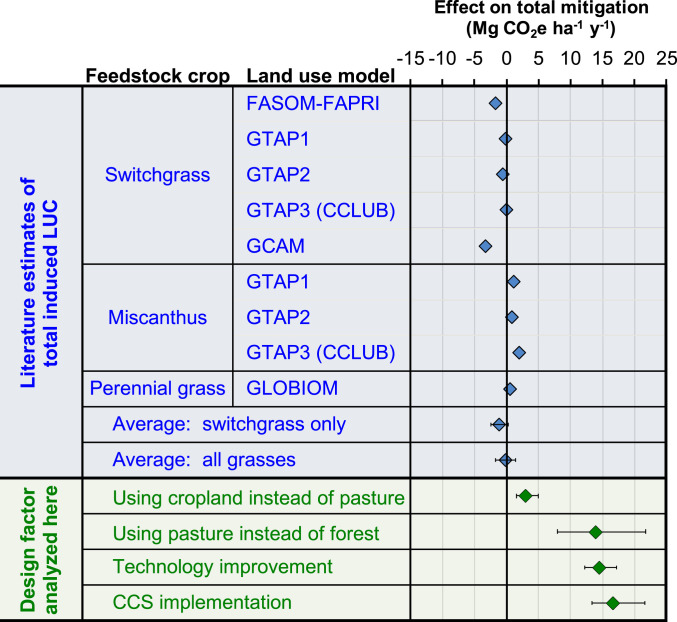
“We do, however, show that several bioenergy system design factors that we analyzed (initial land cover, feedstock production and conversion technology, and CCS) have substantially larger impact on system mitigation performance than previous estimates of ILUC from growing cellulosic crops.”
plainstates a cause- Asserted: passes — The authors put it forward as true.
- Checkable: passes — It can be checked against evidence.
- Load-bearing: passes — The paper’s conclusions depend on it.
- Based: passes — The paper gives a reason why it holds.
A result the paper reports from its own data — it cites no other source for it, so there is none to check. The quote shows it is in the paper.
In the paper
“The analysis shows that many, but not all, of the cellulosic BP scenarios considered achieve greater GHG mitigation potential than alternate land uses.”
plainstates an associationn = 3- Asserted: passes — The authors put it forward as true.
- Checkable: passes — It can be checked against evidence.
- Load-bearing: passes — The paper’s conclusions depend on it.
- Based: passes — The paper gives a reason why it holds.
A result the paper reports from its own data — it cites no other source for it, so there is none to check. The quote shows it is in the paper.
In the paper
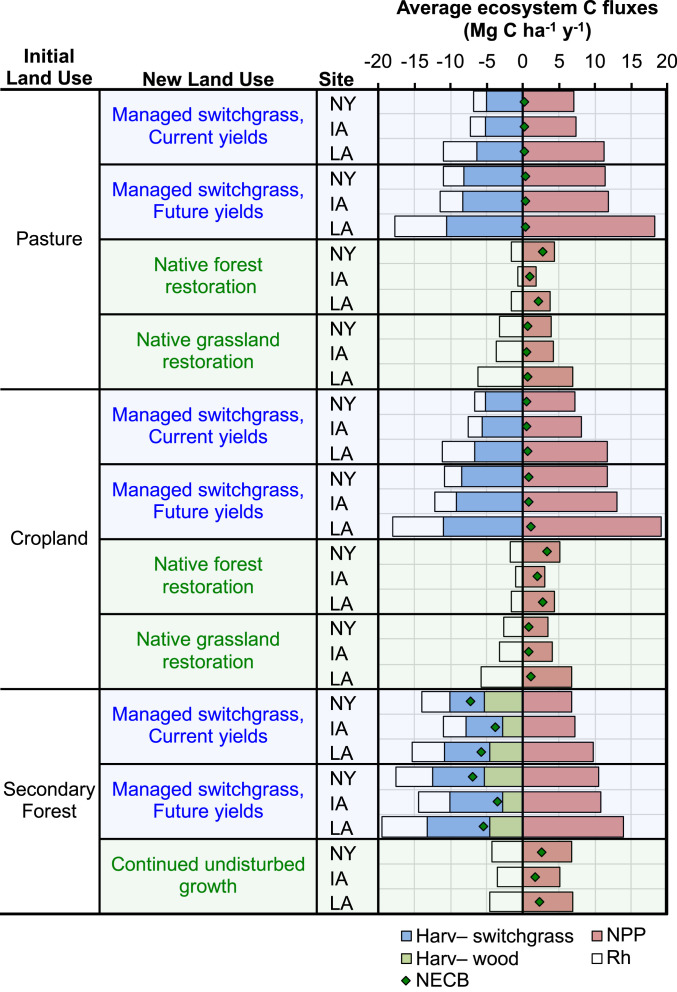
“Grassland restoration, in which herbaceous aboveground biomass senesces each season and only a fraction of the carbon therein is ultimately retained as litter or soil organic matter, had NECB comparable with the managed switchgrass scenarios (0.5 to 1.0 Mg C ha −1 y −1 , equivalent to 15% of NPP in those systems).”
plain- Asserted: passes — The authors put it forward as true.
- Checkable: passes — It can be checked against evidence.
- Load-bearing: unclear — It is unclear whether the paper’s conclusions depend on it.
- Based: passes — The paper gives a reason why it holds.
In the paper
“Our associated yield estimates for managed current-day switchgrass (10 to 14 Mg biomass ha −1 y −1 ) compare well with other estimates, whereas our future switchgrass yields (16 to 22 Mg biomass ha −1 y −1 ) are similar to current-day Miscanthus yields in the Midwest ( 38 ).”
What the sources say
- Not checked yetcites [38]
plain- Asserted: passes — The authors put it forward as true.
- Checkable: passes — It can be checked against evidence.
- Load-bearing: unclear — It is unclear whether the paper’s conclusions depend on it.
- Based: passes — The paper gives a reason why it holds.
35 more claims
Create a free account to see all 102 claims and to verify the 77 references still open.
- It may state two separate claims as one. 32
- Probably not a substantial claim. 38
Citations
Cites
Use of U.S. Croplands for Biofuels Increases Greenhouse Gases Through Emissions from Land-Use Change
Searchinger, T., Heimlich, R., Houghton, R. A., Dong, F., Elobeid, A., Fabiosa, J., Tokgoz, S., Hayes, D., & Yu, T.-H. (2008) · Science · doi:10.1126/science.1151861 · Cited by 4,888 · cited 10×
“There are other potential indirect effects of biofuel deployment beyond ILUC.”
InfluentialLand Clearing and the Biofuel Carbon Debt
Fargione, J., Hill, J., Tilman, D., Polasky, S., & Hawthorne, P. (2008) · Science · doi:10.1126/science.1152747 · Cited by 3,902
North American Regional Reanalysis
Mesinger, F., DiMego, G., Kalnay, E., Mitchell, K., Shafran, P. C., Ebisuzaki, W., Jović, D., Woollen, J., Rogers, E., Berbery, E. H., et al. (2006) · Bulletin of the American Meteorological Society · doi:10.1175/bams-87-3-343 · Cited by 3,378
Global diets link environmental sustainability and human health
Tilman, D., & Clark, M. (2014) · Nature · doi:10.1038/nature13959 · Cited by 3,026 · cited 2×
“ILUC concerns may be minimized or avoided by targeting feedstock production on low-productivity or abandoned cropland (15, 16) or on land “spared” from continued agricultural use through future agricultural intensification or dietary shifts (17, 18).”
Ethanol Can Contribute to Energy and Environmental Goals
Farrell, A. E., Plevin, R. J., Turner, B. T., Jones, A. D., O'Hare, M., & Kammen, D. M. (2006) · Science · doi:10.1126/science.1121416 · Cited by 2,823
Lehmann, J. (2007) · Nature · doi:10.1038/447143a · Cited by 2,477 · cited 2×
“In addition, bioenergy systems can contribute to large-scale carbon dioxide removal (CDR) via carbon sequestration in the soils on which feedstock crops are cultivated (depending on former land use) (6) and via bioenergy with carbon capture and storage (BECCS) (7) or biochar coproduction (8).”
Net-zero emissions energy systems
Davis, S. J., Lewis, N. S., Shaner, M., Aggarwal, S., Arent, D., Azevedo, I. L., Benson, S. M., Bradley, T., Brouwer, J., Chiang, Y.-M., et al. (2018) · Science · doi:10.1126/science.aas9793 · Cited by 2,391 · cited 1×
“Liquid biofuel production (BP) is currently among the most technologically mature and cost-effective routes to decarbonizing aviation, shipping, long-haul transport, and residual nonelectrified light-duty transport (4, 5).”
The global tree restoration potential
Bastin, J.-F., Finegold, Y., Garcia, C., Mollicone, D., Rezende, M., Routh, D., Zohner, C. M., & Crowther, T. W. (2019) · Science · doi:10.1126/science.aax0848 · Cited by 2,197 · cited 1×
“, wildfire, insect outbreaks), or local climate shifts that could reduce the mitigation value of restored grasslands or especially forests (53, 54).”
Carbon-Negative Biofuels from Low-Input High-Diversity Grassland Biomass
Tilman, D., Hill, J., & Lehman, C. (2006) · Science · doi:10.1126/science.1133306 · Cited by 1,813 · cited 1×
“In addition, bioenergy systems can contribute to large-scale carbon dioxide removal (CDR) via carbon sequestration in the soils on which feedstock crops are cultivated (depending on former land use) (6) and via bioenergy with carbon capture and storage (BECCS) (7) or biochar coproduction (8).”
Roberts, K. G., Gloy, B. A., Joseph, S., Scott, N. R., & Lehmann, J. (2010) · Environmental Science & Technology · doi:10.1021/es902266r · Cited by 1,243 · cited 1×
“The gasification process also produces a small amount of char, which we assume is soil applied with 80% long-term carbon retention (73).”
Cited by
Biofuels for a sustainable future
Liu, Y., Cruz-Morales, P., Zargar, A., Belcher, M. S., Pang, B., Englund, E., Dan, Q., Yin, K., & Keasling, J. D. (2021) · Cell · doi:10.1016/j.cell.2021.01.052 · Cited by 399
“These biofuels are attractive because their net carbon footprint (emitted carbon – consumed carbon) can be neutral or even negative (Field et al., 2020; Tilman et al., 2006), and their generation from agricultural and forest residues or white wood chips provides economical advantages compared to crops.”
Bocken, N. M. P., & Short, S. W. (2021) · Journal of Cleaner Production · doi:10.1016/j.jclepro.2021.127828 · Cited by 299
Microbial production of advanced biofuels
Keasling, J., Garcia Martin, H., Lee, T. S., Mukhopadhyay, A., Singer, S. W., & Sundstrom, E. (2021) · Nature Reviews Microbiology · doi:10.1038/s41579-021-00577-w · Cited by 294
Environmental outcomes of the US Renewable Fuel Standard
Lark, T. J., Hendricks, N. P., Smith, A., Pates, N., Spawn-Lee, S. A., Bougie, M., Booth, E. G., Kucharik, C. J., & Gibbs, H. K. (2022) · Proceedings of the National Academy of Sciences · doi:10.1073/pnas.2101084119 · Cited by 254
“To date, however, most RFS biofuel production has come from conventional corn ethanol, thereby missing much of the policy’s promised emissions savings and potential environmental benefits expected from more advanced feedstocks (2, 35, 73).”
Dietary change in high-income nations alone can lead to substantial double climate dividend
Sun, Z., Scherer, L., Tukker, A., Spawn-Lee, S. A., Bruckner, M., Gibbs, H. K., & Behrens, P. (2022) · Nature Food · doi:10.1038/s43016-021-00431-5 · Cited by 236
“…sequestration, avoided emissions from fossil fuels and carbon capture and storage during bioenergy production) in some US contexts could be 4 to 15 times greater than the sequestration attained by restoring current cropland or pastureland to natural forest and grassland over the first 30 years 58 .”
InfluentialXu, H., Ou, L., Li, Y., Hawkins, T. R., & Wang, M. (2022) · Environmental Science & Technology · doi:10.1021/acs.est.2c00289 · Cited by 222
Self-citationThe land–energy–water nexus of global bioenergy potentials from abandoned cropland
Næss, J. S., Cavalett, O., & Cherubini, F. (2021) · Nature Sustainability · doi:10.1038/s41893-020-00680-5 · Cited by 147
Northrup, D. L., Basso, B., Wang, M. Q., Morgan, C. L. S., & Benfey, P. N. (2021) · Proceedings of the National Academy of Sciences · doi:10.1073/pnas.2022666118 · Cited by 138
Self-citationInfluence of functional groups on low-temperature combustion chemistry of biofuels
Rotavera, B. M., & Taatjes, C. A. (2021) · Progress in Energy and Combustion Science · doi:10.1016/j.pecs.2021.100925 · Cited by 129
Technologies to deliver food and climate security through agriculture
Horton, P., Long, S. P., Smith, P., Banwart, S. A., & Beerling, D. J. (2021) · Nature Plants · doi:10.1038/s41477-021-00877-2 · Cited by 121
Self-citationRedefining marginal land for bioenergy crop production
Khanna, M., Chen, L., Basso, B., Cai, X., Field, J. L., Guan, K., Jiang, C., Lark, T. J., Richard, T. L., Spawn‐Lee, S. A., et al. (2021) · GCB Bioenergy · doi:10.1111/gcbb.12877 · Cited by 105
“…in net greenhouse gas emissions (Crippa et al., 2021), whereas bioenergy crops processed into biofuels are | 1599KHANNA et Al. expected to accrue net social benefits including substitution credits relative to fossil fuel emissions and potentially carbon capture and storage (Field et al., 2020).”
BackgroundSelf-citationCarbon accounting for negative emissions technologies
Brander, M., Ascui, F., Scott, V., & Tett, S. F. B. (2021) · Climate Policy · doi:10.1080/14693062.2021.1878009 · Cited by 125
Estimating induced land use change emissions for sustainable aviation biofuel pathways
Zhao, X., Taheripour, F., Malina, R. M., Staples, M. D., & Tyner, W. E. (2021) · The Science of The Total Environment · doi:10.1016/j.scitotenv.2021.146238 · Cited by 119
Potential of land-based climate change mitigation strategies on abandoned cropland
Gvein, M. H., Hu, X., Næss, J. S., Watanabe, M. D. B., Cavalett, O., Malbranque, M., Kindermann, G., & Cherubini, F. (2023) · Communications Earth & Environment · doi:10.1038/s43247-023-00696-7 · Cited by 108
Deep CCS: Moving Beyond 90% Carbon Dioxide Capture
Dods, M. N., Kim, E. J., Long, J. R., & Weston, S. C. (2021) · Environmental Science & Technology · doi:10.1021/acs.est.0c07390 · Cited by 89
Leirpoll, M. E., Næss, J. S., Cavalett, O., Dorber, M., Hu, X., & Cherubini, F. (2020) · Renewable Energy · doi:10.1016/j.renene.2020.11.159 · Cited by 85
Tiwari, T., Kaur, G. A., Singh, P. K., Balayan, S., Mishra, A., & Tiwari, A. (2024) · The Science of The Total Environment · doi:10.1016/j.scitotenv.2024.172433 · Cited by 92
Implications of preferential access to land and clean energy for Sustainable Aviation Fuels
Becken, S., Mackey, B., & Lee, D. S. (2023) · Science of The Total Environment · doi:10.1016/j.scitotenv.2023.163883 · Cited by 76
“The conversion of high carbon stock peatlands for palm oil production, for example, comes with many decades of ‘ carbon debt ’ which negates the bene fi ts of any SAP deployment (Field et al., 2020).”
Delbecq, S., Fontane, J., Gourdain, N., Planès, T., & Simatos, F. (2023) · Progress in Aerospace Sciences · doi:10.1016/j.paerosci.2023.100920 · Cited by 109
Liu, G., & Qu, Y. (2021) · Engineering Microbiology · doi:10.1016/j.engmic.2021.100005 · Cited by 73
Recent progress in the synthesis of advanced biofuel and bioproducts
Pfleger, B. F., & Takors, R. (2023) · Current Opinion in Biotechnology · doi:10.1016/j.copbio.2023.102913 · Cited by 69
Leveraging the bioeconomy for carbon drawdown
Dees, J., Sagues, W. J., Woods, E., Goldstein, H. M., Simon, A. J., & Sanchez, D. L. (2023) · Green Chemistry · doi:10.1039/d2gc02483g · Cited by 73
“55,56 Specifically, the cultivation of switchgrass for biofuel production coupled with CO 2 capture and sequestration has climate mitigation potential 4 and 15 times larger than forest and grassland restoration, respectively.”
InfluentialLife cycle assessment of BECCS systems: critical review of life cycle inventories
Duval-Dachary, S., Beauchet, S., Lorne, D., Salou, T., Hélias, A., & Pastor, A. V. (2022) · Renewable and Sustainable Energy Reviews · doi:10.1016/j.rser.2023.113415 · Cited by 63
Innovative wood use can enable carbon-beneficial forest management in California
Cabiyo, B., Fried, J. S., Collins, B. M., Stewart, W., Wong, J., & Sanchez, D. L. (2021) · Proceedings of the National Academy of Sciences · doi:10.1073/pnas.2019073118 · Cited by 54
Mapping abandoned cropland using Within-Year Sentinel-2 time series
Liu, B., & Song, W. (2023) · CATENA · doi:10.1016/j.catena.2023.106924 · Cited by 56
Tanzer, S. E., Blok, K., & Ramírez, A. (2021) · Current Sustainable/Renewable Energy Reports · doi:10.1007/s40518-021-00195-3 · Cited by 73
Trade-offs in land-based carbon removal measures under 1.5 °C and 2 °C futures
Zhao, X., Mignone, B. K., Wise, M., & McJeon, H. C. (2024) · Nature Communications · doi:10.1038/s41467-024-46575-3 · Cited by 78
“Recent studies have explored the biophysical and economic mitigation potential of A/R 9 – 12 and BECCS 13 – 15 .”
BackgroundGalán‐Martín, Á., Contreras, M. D. M., Romero, I., Ruiz, E., Bueno, S., Eliche‐Quesada, D., & Castro-Galiano, E. (2022) · Renewable and Sustainable Energy Reviews · doi:10.1016/j.rser.2022.112609 · Cited by 64
Perennial biomass crops on marginal land improve both regional climate and agricultural productivity
He, Y., Jaiswal, D., Liang, X., Sun, C., & Long, S. P. (2022) · GCB Bioenergy · doi:10.1111/gcbb.12937 · Cited by 54
“Perennial biomass crops can potentially be 4– 15 times more effective than forest and grassland conservation in reducing CO2 emissions and mitigating climate change even after taking account of carbon emissions from landuse changes and opportunity costs (Field et al., 2020).”
BackgroundSelf-citationDrivers and implications of alternative routes to fuels decarbonization in net-zero energy systems
Mignone, B. K., Clarke, L., Edmonds, J., Gurgel, A., Herzog, H. J., Johnson, J. X., Mallapragada, D. S., McJeon, H. C., Morris, J., O’Rourke, P., et al. (2024) · Nature Communications · doi:10.1038/s41467-024-47059-0 · Cited by 54
“Given variability in these estimates around zero for second-generation biomass crops 40 – 42, WhileCO 2 emissionsacrossthelifecyclearerelevanttospecifying emissionsinanet-zeroCO 2 system,theinclusionofnon-CO 2 emissions is effectively a question about scenario design.”
Næss, J. S., Hu, X., Gvein, M. H., Iordan, C.-M., Cavalett, O., Dorber, M., Giroux, B., & Cherubini, F. (2022) · Journal of Environmental Management · doi:10.1016/j.jenvman.2022.116474 · Cited by 56
Jeoh, T., Nill, J., Zhao, W., et al. (2023) · Green Chemistry · doi:10.1039/d3gc03279e · Cited by 42
Bioenergy sorghum’s deep roots: A key to sustainable biomass production on annual cropland
Lamb, A., Weers, B. D., McKinley, B. A., Rooney, W. L., Morgan, C. L. S., Marshall‐Colón, A., & Mullet, J. E. (2021) · GCB Bioenergy · doi:10.1111/gcbb.12907 · Cited by 49
“Therefore, a goal of this study was to obtain information about bioenergy sorghum root system biomass accumulation and distribution in soil profiles that contributes to our understanding of SOC accumulation, improves modeling, and informs comparisons to other crops (Field et al., 2020; Gelfand et al., 2020; MartinezFe…”
Cheng, Y., Huang, M., Lawrence, D. M., Calvin, K., Lombardozzi, D., Sinha, E., Pan, M., & He, X. (2022) · Science Advances · doi:10.1126/sciadv.abm8237 · Cited by 46
“Despite a growing body of research ( 2 , 20 ) on these land-based carbon removal strategies, it still remains contentious whether BECCS is more effective than re/ afforestation in terms of atmospheric CO 2 removal ( 2 , 20 , 21 ).”
Weaponising microbes for peace
Anand, S., Hallsworth, J. E., Timmis, J. K., Verstraete, W., Casadevall, A., Ramos, J. L., Sood, U., Kumar, R., Hira, P., Rawat, C. D., et al. (2023) · Microbial Biotechnology · doi:10.1111/1751-7915.14224 · Cited by 48
Luo, H., Gao, L., Liu, Z., Shi, Y., Xie, F., Bilal, M., Yang, R., & Taherzadeh, M. J. (2021) · Bioresources and Bioprocessing · doi:10.1186/s40643-021-00488-x · Cited by 43
Metabolic engineering of energycane to hyperaccumulate lipids in vegetative biomass
Luo, G., Cao, V. D., Kannan, B., Liu, H., Shanklin, J., & Altpeter, F. (2022) · BMC Biotechnology · doi:10.1186/s12896-022-00753-7 · Cited by 44
“Biofuel enhances the reliability, security, and affordability of the energy supply and reduces carbon emissions to combat global warming [2].”
BackgroundJin, W., Gándara-Loe, J., Pastor‐Pérez, L., Villora-Picó, J. J., Sepúlveda‐Escribano, A., Rinaldi, R., & Reina, T. R. (2023) · Renewable Energy · doi:10.1016/j.renene.2023.118907 · Cited by 38
Samantaray, B., Mohapatra, S., Mishra, R. R., Behera, B. C., & Thatoi, H. (2023) · International Journal of Green Energy · doi:10.1080/15435075.2023.2253871 · Cited by 51
“Moreover, carbon capture and storage in the soils where feedstock crops are grown, bio energy with carbon sequestration, or coproduction of biochar are other ways that bio energy systems can help with large-scale deoxygenation (Field et al. 2020).”
BackgroundCan biofuels help achieve sustainable development goals in India? A systematic review
Das, P., Jha, C. K., Saxena, S., & Ghosh, R. (2023) · Renewable and Sustainable Energy Reviews · doi:10.1016/j.rser.2023.114246 · Cited by 41
Iordan, C.-M., Giroux, B., Næss, J. S., Hu, X., Cavalett, O., & Cherubini, F. (2022) · Environmental Impact Assessment Review · doi:10.1016/j.eiar.2022.106942 · Cited by 48
Land‐based climate solutions for the United States
Robertson, G. P., Hamilton, S. K., Paustian, K., & Smith, P. (2022) · Global Change Biology · doi:10.1111/gcb.16267 · Cited by 37
“Particularly missing from current discussions of land-based mitigation scenarios are quantitative assessments of potential solutions that include both nature-based (Fargione et al., 2018 ) and cellulosic bioenergy (Field et al., 2020 ) solutions.”
BackgroundInfluentialSelf-citationCao, B., Bai, C., Meng, Z., Lu, Y., Gao, P., Yang, H. J., Xue, Y., & Li, G. (2021) · The Science of The Total Environment · doi:10.1016/j.scitotenv.2021.150946 · Cited by 39
Alkanolamines as Dual Functional Solvents for Biomass Deconstruction and Bioenergy Production
Achinivu, E. C., Frank, S., Baral, N. R., Das, L., Mohan, M., Otoupal, P. B., Shabir, E., Utan, S. W., Scown, C. D., Simmons, B. A., et al. (2021) · Green Chemistry · doi:10.1039/d1gc02667d · Cited by 38
Lask, J., Rukavina, S., Zorić, I., Kam, J., Kiesel, A., Lewandowski, I. M., & Wagner, M. (2020) · GCB Bioenergy · doi:10.1111/gcbb.12781 · Cited by 38
“It needs to be highlighted that commercialization of lignocellulosic ethanol production has just begun and improvements in biorefining technologies can be expected (Field et al., 2020).”
BackgroundPirelli, T., Chiumenti, A., Morese, M. M., Bonati, G., Fabiani, S., & Pulighe, G. (2021) · Journal of Cleaner Production · doi:10.1016/j.jclepro.2021.128483 · Cited by 37
Sustainable land use and viability of biojet fuels
Aragon, N. U., Parker, N., VanLoocke, A. D., Bagley, J. E., Wang, M., & Georgescu, M. (2022) · Nature Sustainability · doi:10.1038/s41893-022-00990-w · Cited by 40
Self-citationSallustio, L., Harfouche, A. L., Salvati, L., Marchetti, M. A., & Corona, P. (2022) · Socio-Economic Planning Sciences · doi:10.1016/j.seps.2022.101309 · Cited by 36
Singh, N., Sharma, R. L., & Yadav, K. (2023) · Asian Journal of Civil Engineering · doi:10.1007/s42107-023-00732-z · Cited by 46
“Producing biofuels from agricultural and forest leftovers or white wood chips offers financial benefits over crop production, and their net carbon footprint can be neutral or even zero (Christian, 2011; Field et al., 2020).”
BackgroundAllegretti, G., Montoya, M. A., Bertussi, L. A. S., & Talamini, E. (2022) · Renewable and Sustainable Energy Reviews · doi:10.1016/j.rser.2022.112860 · Cited by 37
Global biomethane and carbon dioxide removal potential through anaerobic digestion of waste biomass
Feng, Y., & Rosa, L. (2024) · Environmental Research Letters · doi:10.1088/1748-9326/ad1e81 · Cited by 42
“Alternative waste biomass feedstocks, such as forestry residues and biomass grown on marginal land, can be used to produce additional BECCS [40, 57, 139, 140].”
BackgroundEngineering the cellulolytic bacterium, Clostridium thermocellum, to co-utilize hemicellulose
Chou, K., Croft, T., Hebdon, S. D., Magnusson, L. R., Xiong, W., Reyes, L. H., Chen, X., Miller, E. J., Riley, D. M., Dupuis, S., et al. (2024) · Metabolic Engineering · doi:10.1016/j.ymben.2024.03.008 · Cited by 31
Yao, Y., & Zhang, B. (2025) · Environmental Science & Technology · doi:10.1021/acs.est.4c09510 · Cited by 48
Life‐cycle greenhouse gas emissions reduction potential for corn ethanol refining in the USA
Hui, X., Lee, U., & Wang, M. (2022) · Biofuels Bioproducts and Biorefining · doi:10.1002/bbb.2348 · Cited by 34
Self-citationLi, Y., Trimmer, J. T., Hand, S. M., Zhang, X., Chambers, K. G., Lohman, H. A. C., Shi, R., Byrne, D. M., Cook, S. M., & Guest, J. S. (2022) · Environmental Science Water Research & Technology · doi:10.1039/d2ew00431c · Cited by 45
Taheripour, F., Sajedinia, E., & Karami, O. (2022) · Frontiers in Energy Research · doi:10.3389/fenrg.2021.790421 · Cited by 38
Local food security impacts of biofuel crop production in southern Africa
Gasparatos, A., Mudombi, S., Balde, B. S., von Maltitz, G. P., Johnson, F. X., Romeu–Dalmau, C., Jumbe, C. B., Ochieng, C., Luhanga, D., Nyambane, A., et al. (2021) · Renewable and Sustainable Energy Reviews · doi:10.1016/j.rser.2021.111875 · Cited by 36
“In some cases some biofuel options can have emissions saving compared to conventional fuels [6,7] and store carbon on the biomass of the feedstock and the soil [8,9], having the potential to offer larger climate-related benefits compared to other land-based mitigation options [10].”
BackgroundZhang, T., Meng, F., Gao, M., et al. (2023) · Small · doi:10.1002/smll.202301121 · Cited by 29
Cheng, Y., Lawrence, D. M., Pan, M., Zhang, B., Graham, N. T., Lawrence, P., Liu, Z., & He, X. (2024) · Proceedings of the National Academy of Sciences · doi:10.1073/pnas.2306775121 · Cited by 32
“Additional model improvement of CESM to factor in the potential annual yield increase of bioenergy crops driven by technology advances (6, 56) could lead to more realistic assessment of future water consumption of bioenergy crops as well as the associated regional climate outcomes (57).”
BackgroundHerbstritt, S. M., Richard, T. L., Lence, S. H., Wu, H., O’Brien, P. L., Emmett, B. D., Kaspar, T. C., Karlen, D. L., Kohler, K. A., & Malone, R. W. (2022) · Agriculture · doi:10.3390/agriculture12101691 · Cited by 39
Self-citationPathway to a land-neutral expansion of Brazilian renewable fuel production
Camargo, L. R., Castro, G. M., Gruber, K., Jewell, J., Klingler, M., Turkovska, O., Wetterlund, E., & Schmidt, J. (2022) · Nature Communications · doi:10.1038/s41467-022-30850-2 · Cited by 26
“2 Land-use efficiency of methanol production versus total fuel production for all Brazilian ethanol facilities in (1) the Central-West, (2) the SouthEast, (3) the North-East, and (4) other Brazilian regions.”
BackgroundKumar, D., Long, S. P., Arora, A., & Singh, V. (2021) · GCB Bioenergy · doi:10.1111/gcbb.12871 · Cited by 30
“Biodiesel and cellulosic ethanol are two promising alternatives to petrobased liquid transportation fuels that can be produced from renewable feedstocks and lead to significant environmental benefits (Field et al., 2020; Jaiswal et al., 2017; Parajuli et al., 2020; Somerville et al., 2010).”
BackgroundSelf-citationEscobar, N., Seber, G., Skalský, R., Wögerer, M., Jung, M. H., & Malina, R. M. (2024) · The Science of The Total Environment · doi:10.1016/j.scitotenv.2024.174635 · Cited by 31
“The crop establishment releases GHG emissions when carbon stocks are lost relative to previous uses, especially when forests are converted (Field et al., 2020; Harris et al., 2015).”
BackgroundThe contribution of bioenergy to the decarbonization of transport: A multi-model assessment
Leblanc, F., Bibas, R., Mima, S., Muratori, M., Sakamoto, S., Sano, F., Bauer, N., Daioglou, V., Fujimori, S., Gidden, M. J., et al. (2022) · Climatic Change · doi:10.1007/s10584-021-03245-3 · Cited by 21
Stewart, D. W., Cortes-Pena, Y. R., Li, Y., Stillwell, A. S., Khanna, M., & Guest, J. S. (2023) · Environmental Science & Technology · doi:10.1021/acs.est.2c07936 · Cited by 28
Large-scale spatially explicit analysis of carbon capture at cellulosic biorefineries
O’Neill, E. G., Geissler, C. H., & Maravelias, C. T. (2024) · Nature Energy · doi:10.1038/s41560-024-01532-8 · Cited by 26
“Previous studies used the DayCent crop model to optimize landscape design around a single, pre-existing biorefinery and showed that careful crop establishment and management can increase the amount of soil carbon sequestration, complementing industrial carbon capture and storage (CCS) 10,11 .”
Xie, W., Yu, H., Li, Y., Dai, M., Long, X., Li, N., & Wang, Y. (2021) · Journal of Industrial Ecology · doi:10.1111/jiec.13191 · Cited by 20
“Assessing the land footprints and environmental impacts for biomass-related products ismore straightforward, such as food (deRuiter et al., 2017), livestock products (Gephart et al., 2016), and biofuels (Field et al., 2020; Searchinger et al., 2008).”
BackgroundChapter 24 : Midwest. Fifth National Climate Assessment
Wilson, A. B., Baker, J. M., Ainsworth, E. A., Andresen, J. A., Austin, J. A., Dukes, J. S., Gibbons, E., Hoppe, B. O., LeDee, O. E., Noel, J., et al. (2023) · doi:10.7930/nca5.2023.ch24 · Cited by 31
Korkeakoski, M. (2021) · Energies · doi:10.3390/en14102862 · Cited by 20
“Field et al. (2020) argue that net greenhouse gas mitigation benefit of biofuel pathways is “controversial due to concerns around ecosystem carbon losses from land use change and foregone sequestration benefits from alternative land uses” [57].”
BackgroundUnraveling the role of biofuels in road transport under rapid electrification
Cavalett, O., & Cherubini, F. (2022) · Biofuels Bioproducts and Biorefining · doi:10.1002/bbb.2395 · Cited by 24
Akinwumi, A. R., Nwinyi, O. C., Ayeni, A. O., Ahuekwe, E. F., & Chukwu, M. N. (2022) · Scientific African · doi:10.1016/j.sciaf.2022.e01233 · Cited by 22
Climate cooling benefits of cellulosic bioenergy crops from elevated albedo
Lei, C., Chen, J., & Robertson, G. P. (2023) · GCB Bioenergy · doi:10.1111/gcbb.13098 · Cited by 21
“Conversions of non-agricultural land such as forests with high initial carbon stocks to the cultivation of another bioenergy crop could also result in large carbon debt before net mitigation is achieved as much as a century later (Amiro et al., 2010; Field et al., 2020; Robert-son et al., 2017).”
BackgroundCao, V. D., Luo, G., Korynta, S., Liu, H., Liang, Y., Shanklin, J., & Altpeter, F. (2023) · Biotechnology for Biofuels and Bioproducts · doi:10.1186/s13068-023-02393-1 · Cited by 20
“Production of biofuel from perennial crops will increase energy security by reducing the need for fossil fuels while increasing carbon sequestration for combating climate change [1, 2].”
BackgroundCao, V. D., Kannan, B., Luo, G., et al. (2023) · GCB Bioenergy · doi:10.1111/gcbb.13107 · Cited by 17
“Biofuels produced by perennial feedstocks such as energycane will enhance energy independence, while contributing to carbon neutrality (Durrett et al., 2008; Field et al., 2020).”
BackgroundNguyễn, T. H., Field, J. L., Kwon, H., Hawkins, T. R., Paustian, K. H., & Wang, M. (2022) · Journal of Cleaner Production · doi:10.1016/j.jclepro.2022.131691 · Cited by 17
Self-citationRye-soybean double-crop: planting method and N fertilization effects in the North Central US
Malone, R. W., O’Brien, P. L., Herbstritt, S. M., Emmett, B. D., Karlen, D. L., Kaspar, T. C., Kohler, K. A., Radke, A. G., Lence, S. H., Wu, H., et al. (2022) · Renewable Agriculture and Food Systems · doi:10.1017/s1742170522000096 · Cited by 18
Self-citationSustainability implications of the EU's bioeconomy transition along global supply chains
Többen, J., Stöver, B., Reuschel, S., Distelkamp, M., & Lutz, C. (2024) · Journal of Cleaner Production · doi:10.1016/j.jclepro.2024.142565 · Cited by 21
Saura, P. P., Chabi, M., Corato, A., Cardol, P., & Remacle, C. (2022) · Frontiers in Plant Science · doi:10.3389/fpls.2022.978246 · Cited by 17
“One of the strategies to reduce this impact is the use of renewable energies, such as renewable biofuels (Field et al., 2020; International Energy Agency, 2021; Nazari et al., 2021).”
BackgroundWaste to Worth: A Case Study of the Biogas Circular Economy in Pennsylvania
Herbstritt, S. M., Fathel, S. L., Reinford, B., & Richard, T. L. (2023) · Journal of the ASABE · doi:10.13031/ja.14889 · Cited by 20
Self-citationXing, L., Lian, L., Wang, Z., Cheng, Z., He, Y., Cui, J., & Truhlar, D. G. (2022) · Journal of the American Chemical Society · doi:10.1021/jacs.2c06124 · Cited by 12
Clauser, N. M., Scown, C. D., Pett‐Ridge, J., & Sagues, W. J. (2025) · Renewable and Sustainable Energy Reviews · doi:10.1016/j.rser.2025.115714 · Cited by 16
Khadim, S. R., Mohanta, A., Singh, P., Maurya, P., Singh, A. K., Singh, A. K., & Asthana, R. K. (2022) · BioEnergy Research · doi:10.1007/s12155-022-10460-y · Cited by 12
“Increasing utilization of petroleum-derived fossil fuels is leading to rapid climate changes as a consequence of greenhouse gases (GHGs) emissions [1].”
BackgroundBordonal, R. D. O., Tenelli, S., Oliveira, D. M. D. S., Chagas, M. F., Cherubin, M. R., Weiler, D. A., Campbell, E. E., Gonzaga, L. C., Barbosa, L. C., Cerri, C. E. P., et al. (2024) · The Science of The Total Environment · doi:10.1016/j.scitotenv.2024.174670 · Cited by 20
Næss, J. S., Iordan, C.-M., Muri, H., & Cherubini, F. (2022) · Environmental Research Letters · doi:10.1088/1748-9326/ac5e67 · Cited by 13
“Perennial grasses can serve as an input to BECCS in thermal power plants or in biorefineries, as the biomass conversion processes involved produce exhaust CO2 streams targetable for carbon capture [69, 72, 73].”
BackgroundHow to rescue biofuels from a sustainable dead end
Fairley, P. (2022) · Nature · doi:10.1038/d41586-022-03649-w · Cited by 13
Woodruff, W., Deshavath, N. N., Susanto, V., Rao, C. V., & Singh, V. (2023) · Biotechnology for Biofuels and Bioproducts · doi:10.1186/s13068-023-02429-6 · Cited by 12
“Plant and microbial oils are the closest biological analogues to fossil fuels and have long been explored as a potential replacement for these finite resources [1–3].”
BackgroundAnimal waste use and implications to agricultural greenhouse gas emissions in the United States
Qin, Z., Deng, S., Dunn, J. B., Smith, P., & Sun, W. (2021) · Environmental Research Letters · doi:10.1088/1748-9326/ac04d7 · Cited by 14
Self-citationTian, R. L., Zhu, B., Hu, Y., et al. (2023) · International Journal of Biological Macromolecules · doi:10.1016/j.ijbiomac.2023.127499 · Cited by 12
Quantifying uncertainties in greenhouse gas savings and abatement costs with cellulosic biofuels
Lee, Y. S., Khanna, M., Chen, L., Shi, R., Guest, J. S., Blanc‐Betes, E., Jiang, C., Guan, K., Hudiburg, T. W., & DeLucia, E. H. (2023) · European Review of Agricultural Economics · doi:10.1093/erae/jbad036 · Cited by 14
Blanc‐Betes, E., Gomez‐Casanovas, N., Hartman, M. D., Hudiburg, T. W., Khanna, M., Parton, W. J., & DeLucia, E. H. (2023) · Environmental Science & Technology · doi:10.1021/acs.est.3c05240 · Cited by 12
Ballal, V. P., Watanabe, M. D. B., Gilardi, M., Jåstad, E. O., Rørstad, P. K., Huang, B., Werra, M., Bisotti, F., Wittgens, B., & Cherubini, F. (2025) · Energy Conversion and Management · doi:10.1016/j.enconman.2025.119586 · Cited by 13
Post-Combustion Capture of Carbon Dioxide by Natural and Synthetic Organic Polymers
Ghosh, S. K., & Ghosh, M. (2023) · Polysaccharides · doi:10.3390/polysaccharides4020012 · Cited by 11
“This approach could have climate mitigation and stabilization potential [20].”
BackgroundKont, R., Pihlajaniemi, V., Niemelä, K., Kuusk, S., Marjamaa, K., & Väljamäe, P. (2021) · ACS Sustainable Chemistry & Engineering · doi:10.1021/acssuschemeng.1c05491 · Cited by 11
Escobar, N., Valin, H., Frank, S., Galperin, D., Wade, C. M., Ringwald, L., Tanner, D., Hinkel, N., Havlík, P., Baker, J. S., et al. (2024) · Environmental Science & Technology · doi:10.1021/acs.est.3c09944 · Cited by 12
Microalgae Biomass Modelling and Optimization for Sustainable Biotechnology – A Concise Review
Ugya, A. Y., & Meguellati, K. (2022) · Journal of Ecological Engineering · doi:10.12911/22998993/150627 · Cited by 14
Deshavath, N. N., Dien, B. S., Slininger, P. J., Jin, Y., & Singh, V. (2022) · Fermentation · doi:10.3390/fermentation9010005 · Cited by 13
Private finance for food system climate adaptation: opportunity or contradiction?
Clapp, J., & Isakson, S. R. (2023) · Current Opinion in Environmental Sustainability · doi:10.1016/j.cosust.2023.101273 · Cited by 10
Michelbach, C. A., & Tomlin, A. S. (2023) · International Journal of Chemical Kinetics · doi:10.1002/kin.21705 · Cited by 9
Martinho, V. J. P. D., & Rodrigues, R. N. (2024) · Heliyon · doi:10.1016/j.heliyon.2024.e26267 · Cited by 10
“Nonetheless, there are still fields that need deeper research [5] and opportunities to be explored [6].”
BackgroundSesmero, J., Trull, N. U., & Gramig, B. M. (2021) · GCB Bioenergy · doi:10.1111/gcbb.12843 · Cited by 10
“The capacity we assume in this study is smaller than capacity levels previously used in the literature (e.g., Field et al., 2020; Perrin et al., 2012).”
Result
Metadata
- Authors
- Field, J. L., Richard, T. L., Smithwick, E. A. H., Cai, H., Laser, M. S., LeBauer, D. S., Long, S. P., Paustian, K., Qin, Z., Sheehan, J. J., Smith, P., Wang, M. Q., & Lynd, L. R.
- Affiliations
- Colorado State University (US)
- Pennsylvania State University (US)
- Argonne National Laboratory (US)
- Dartmouth College (US)
- University of Arizona (US)
- University of Illinois Urbana-Champaign (US)
- Universidade Estadual de Campinas (UNICAMP) (BR)
- University of Aberdeen (GB)
- Corresponding author
- Field, John L.
- ORCID
- Venue
- Proceedings of the National Academy of Sciences
- Publisher
- National Academy of Sciences
- Published
- 2020-08-24
- Volume
- 117
- Issue
- 36
- Pages
- 21968-21977
- ISSN
- 0027-8424 (ISSN-L)
- 1091-6490
- PMC
- PMC7486778
- OpenAlex
- W3080506706
- Cited by
- 173
- References
- 76
- Citations by year
- 2026: 15 · 2025: 19 · 2024: 27 · 2023: 37 · 2022: 39 · 2021: 34 · 2020: 2
- FWCI
- 35.02
- Type
- journal article
- Language
- en
- Open access
- hybrid
- doi.org
- Licence
- Locations
- Proceedings of the National Academy of Sciences (publishedVersion, other-oa)
- PubMed Central (publishedVersion, cc-by-nc-nd)
- PubMed (publishedVersion)
- Aberdeen University Research Archive (Aberdeen University) (submittedVersion, other-oa)
- Lancaster EPrints (Lancaster University) (submittedVersion)
- OSTI OAI (U.S. Department of Energy Office of Scientific and Technical Information) (submittedVersion)
- Funders
- Fundação de Amparo à Pesquisa do Estado de São Paulo (2014/26767-9)
- DOE | Office of Science (DE-AC05-00OR22725)
- USDA | National Institute of Food and Agriculture (2013-68005-21298, 2017-67019-26327, 2012-68005-19703)
- Topics
- Life Sciences › Agricultural and Biological Sciences › Agronomy and Crop Science › Bioenergy crop production and management
- Physical Sciences › Engineering › Biomedical Engineering › Biofuel production and bioconversion
- Life Sciences › Agricultural and Biological Sciences › General Agricultural and Biological Sciences › Bioeconomy and Sustainability Development
- Keywords
- advanced biofuels, carbon dioxide removal, carbon capture and storage, cellulosic ethanol, switchgrass, land use change, carbon debt, reforestation, grassland restoration, biorefining, climate change mitigation, ecosystem modeling
- MeSH terms
- Greenhouse Gases, Ethanol, Biotechnology, Carbon, Cellulose, Ecosystem, Crops, Agricultural, Biofuels
About these checks
Registry, retraction, Cites and statistics results are computed, not judged, with one exception: a printed reference that no index lists is read once by a model before it counts as a citation error. Claims are extracted by a model and kept only when their quote appears verbatim in the text; each cited source is then checked, with a model’s help, for whether it says what the claim relies on. Those verdicts can be wrong — read the claim’s quote and the cited source before relying on one.
A language model drew the claims from the paper on 2026-10-11, under version 3 of the claim definition (model deepseek-v4.1-flash, prompt extract-v3).
A second model labelled each claim on 2026-10-11 (model jev-1.13-20260917, definition revision gold-guideline-v0.2).
Cited sources are checked with a language model’s help (gpt-6-sol).
Statistics and arithmetic are recomputed, not judged.
Confidence bands are shown only for fields calibrated on our annotated test set. None is calibrated yet, so no band is shown.
What counts as a claim ›How we measure confidence ›How we check this ›
Are you an author, or do you see a problem with this page? Request a review
Data sources
Bibliographic data: Semantic Scholar, OpenAlex, Crossref.
Contains information from the Semantic Scholar Academic Graph Datasets, made available under the ODC Attribution License (ODC-BY 1.0).
Semantic Scholar’s data is described in: Kinney, R., et al. (2023). The Semantic Scholar Open Data Platform. arXiv:2301.10140.
