

Robust paths to net greenhouse gas mitigation and negative emissions via advanced biofuels
Open accessThe DOI matches its Crossref record; 75 of the 76 references it cites were found in a registry or an index; 1 of the 78 sources its claims cite were checked for support.
Abstract
Significance: The climate benefits of cellulosic biofuels have been challenged based on carbon debt, opportunity costs, and indirect land use change, prompting calls for withdrawing support for research and development. Using a quantitative ecosystem modeling approach, which explicitly differentiates primary production, ecosystem carbon balance, and biomass harvest, we show that none of these arguments preclude cellulosic biofuels from realizing greenhouse gas mitigation. Our assessment illustrates how deliberate land use choices support the climate performance of current-day cellulosic ethanol technology and how technological advancements and carbon capture and storage addition could produce several times the climate mitigation potential of competing land-based biological mitigation schemes. These results affirm the climate mitigation logic of biofuels, consistent with their prominent role in many climate stabilization scenarios.
Overview
CoChat Summary
## TL;DR
The paper models land-based climate mitigation from cellulosic biofuels, reforestation, and grassland restoration at three U.S. sites and finds that switchgrass biofuel on former agricultural land can deliver immediate net mitigation, while conversion of secondary forest can impose a carbon debt. Future higher-yield biofuel systems plus CCS are reported to substantially outperform vegetation restoration in per-hectare mitigation potential.
## Key findings
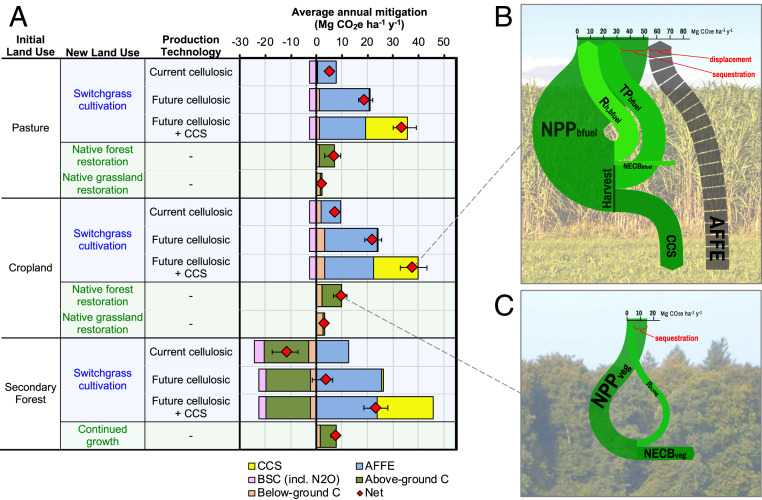
- Current cellulosic biofuel (BP) on former agricultural land achieved a mean net mitigation potential (NM) of 6.0 Mg CO2e ha−1 y−1 across the three sites and all previous agricultural land uses, which the paper says is within the range of reforestation on former agricultural land and 250% greater than grassland restoration.
- Reforestation on former agricultural land had mitigation potential of 3.4 to 11.9 Mg CO2e ha−1 y−1; grassland restoration had 1.7 to 3.5 Mg CO2e ha−1 y−1; current switchgrass cultivation on former agricultural land sequestered soil carbon at 0.5 to 3.3 Mg CO2e ha−1 y−1.
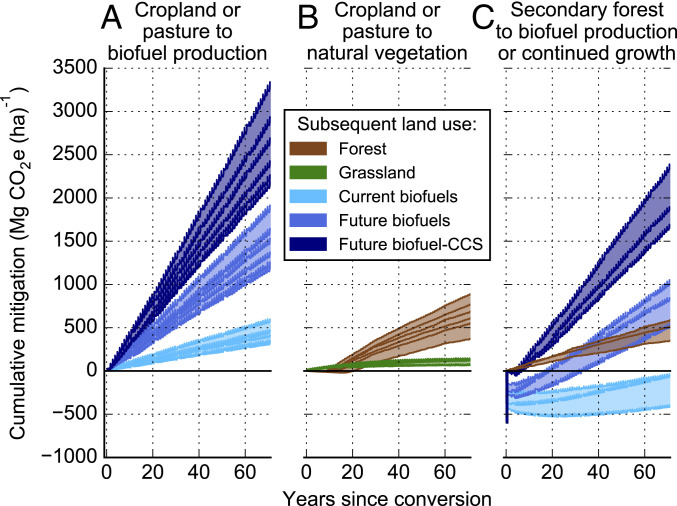
- Future biofuel technology with CCS was reported to require only 6 to 8 years to repay the carbon debt from converting secondary forest, compared with 27 to 52 years for future biofuel technology without CCS; current technology did not repay that debt over the 70-y simulation.
- The paper states that future BECCS achieved about 4 times the total per-hectare NM of reforestation and about 15 times the total mitigation potential of grassland restoration, while future technology improvements and CCS together could improve bioenergy system mitigation performance by about a factor of six relative to current-day performance.
## Methods
- The study used a case study-based, scenario analysis at three U.S. sites east of the 100th meridian: Webster County, Iowa; La Salle Parish, Louisiana; and Wayne County, New York.
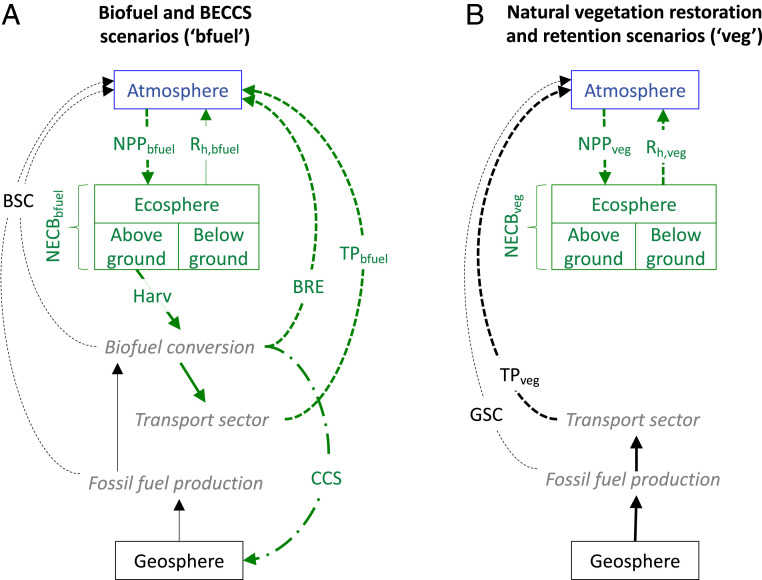
- It coupled a process-based ecosystem model (DayCent) with biorefinery engineering and life cycle emissions accounting to simulate 70-year forward changes in productivity, ecosystem carbon storage, soil N2O emissions, fuel displacement, and CCS.
- Scenarios included conversion of cropland, pasture, and secondary forest to switchgrass, reforestation/grassland restoration/continued forest growth, and biofuel technology cases ranging from current ethanol production to future hybrid ethanol + Fischer–Tropsch liquids, with and without CCS.
## Limitations
- The paper explicitly states that biofuel economics, sustainable deployment scale, and impacts on biodiversity and other ecosystem services fall outside the scope of the analysis.
- It notes that indirect effects such as ILUC are not included in the direct emissions accounting, though they are discussed separately; the text also says rebound effects were not quantified and deserve further study.
- Evident from the text: the results are based on three case study sites and model simulations, so the findings are not a full empirical assessment of all regions or deployment scales.
Model-written summary. Check it against the paper before relying on it.
Integrity signals
Registry
Cites
Statistics
Figures
Verification
Claims the paper makes
1 Valid · 4 Not valid · 45 Not checked · 52 Own results and interpretations
The sources with a verdict support this claim; the rest weren’t checked yet, have no full text we could read, or their verdicts aren’t rated yet.
In the paper
“In addition, bioenergy systems can contribute to large-scale carbon dioxide removal (CDR) via carbon sequestration in the soils on which feedstock crops are cultivated (depending on former land use) ( 6 ) and via bioenergy with carbon capture and storage (BECCS) ( 7 ) or biochar coproduction ( 8 ).”
What the sources say
- Supportedcites [7] matched to “Betting on negative emissions” (2014) source
Citation (7) is attached to BECCS, not biochar coproduction, which has its own citation (8). The Abstract describes BECCS as transferring CO₂ from the atmosphere into geological storage, and ‘The challenges ahead’ discusses its potential deployment at large scale while stressing substantial uncertainties. (LLM, conf=0.93)
- Not checked yetcites [8] matched to “A handful of carbon” (2007) source
plainstates a cause- Asserted: passes — The authors put it forward as true.
- Checkable: passes — It can be checked against evidence.
- Load-bearing: passes — The paper’s conclusions depend on it.
- Based: passes — The paper gives a reason why it holds.
- Supported
A result the paper reports from its own data — it cites no other source for it, so there is none to check. The quote shows it is in the paper.
In the paper
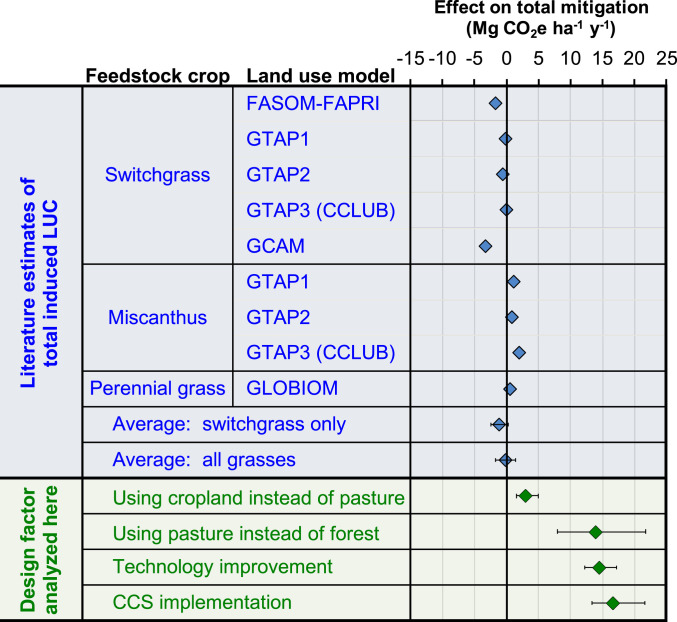
“We do, however, show that several bioenergy system design factors that we analyzed (initial land cover, feedstock production and conversion technology, and CCS) have substantially larger impact on system mitigation performance than previous estimates of ILUC from growing cellulosic crops.”
plainstates a cause- Asserted: passes — The authors put it forward as true.
- Checkable: passes — It can be checked against evidence.
- Load-bearing: passes — The paper’s conclusions depend on it.
- Based: passes — The paper gives a reason why it holds.
A result the paper reports from its own data — it cites no other source for it, so there is none to check. The quote shows it is in the paper.
In the paper
“The analysis shows that many, but not all, of the cellulosic BP scenarios considered achieve greater GHG mitigation potential than alternate land uses.”
plainstates an associationn = 3- Asserted: passes — The authors put it forward as true.
- Checkable: passes — It can be checked against evidence.
- Load-bearing: passes — The paper’s conclusions depend on it.
- Based: passes — The paper gives a reason why it holds.
A result the paper reports from its own data — it cites no other source for it, so there is none to check. The quote shows it is in the paper.
In the paper
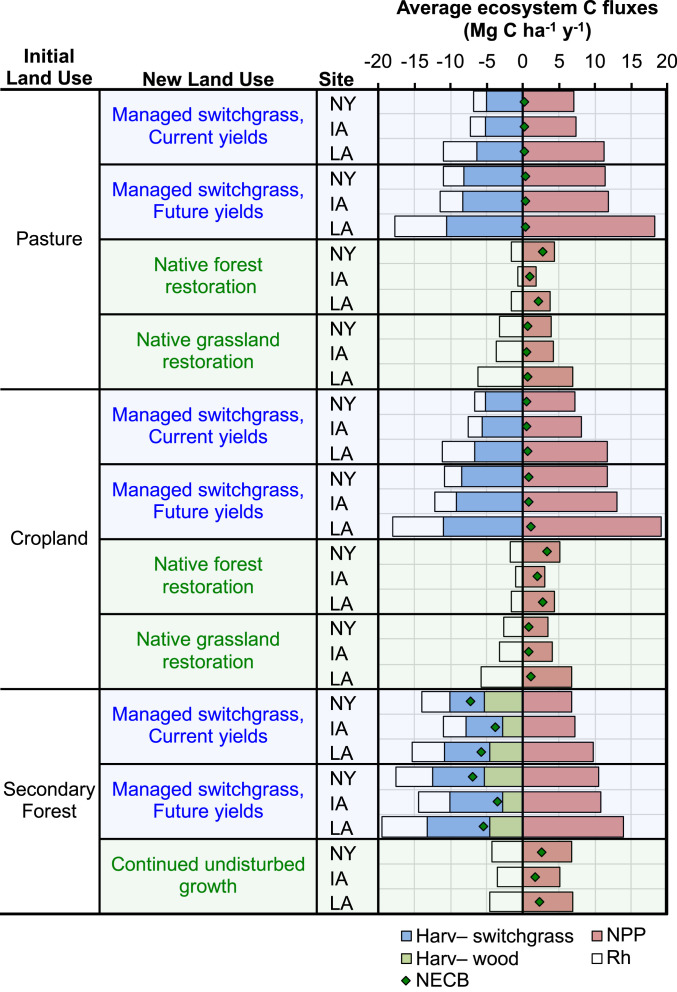
“Grassland restoration, in which herbaceous aboveground biomass senesces each season and only a fraction of the carbon therein is ultimately retained as litter or soil organic matter, had NECB comparable with the managed switchgrass scenarios (0.5 to 1.0 Mg C ha −1 y −1 , equivalent to 15% of NPP in those systems).”
plain- Asserted: passes — The authors put it forward as true.
- Checkable: passes — It can be checked against evidence.
- Load-bearing: unclear — It is unclear whether the paper’s conclusions depend on it.
- Based: passes — The paper gives a reason why it holds.
In the paper
“Our associated yield estimates for managed current-day switchgrass (10 to 14 Mg biomass ha −1 y −1 ) compare well with other estimates, whereas our future switchgrass yields (16 to 22 Mg biomass ha −1 y −1 ) are similar to current-day Miscanthus yields in the Midwest ( 38 ).”
What the sources say
- Not checked yetcites [38]
plain- Asserted: passes — The authors put it forward as true.
- Checkable: passes — It can be checked against evidence.
- Load-bearing: unclear — It is unclear whether the paper’s conclusions depend on it.
- Based: passes — The paper gives a reason why it holds.
35 more claims
Create a free account to see all 102 claims and to verify the 77 references still open.
- It may state two separate claims as one. 32
- Probably not a substantial claim. 38
Citations
Cites
Use of U.S. Croplands for Biofuels Increases Greenhouse Gases Through Emissions from Land-Use Change
Searchinger, T., Heimlich, R., Houghton, R. A., Dong, F., Elobeid, A., Fabiosa, J., Tokgoz, S., Hayes, D., & Yu, T.-H. (2008) · Science · doi:10.1126/science.1151861 · Cited by 4,888 · cited 10×
“There are other potential indirect effects of biofuel deployment beyond ILUC.”
InfluentialLand Clearing and the Biofuel Carbon Debt
Fargione, J., Hill, J., Tilman, D., Polasky, S., & Hawthorne, P. (2008) · Science · doi:10.1126/science.1152747 · Cited by 3,902
North American Regional Reanalysis
Mesinger, F., DiMego, G., Kalnay, E., Mitchell, K., Shafran, P. C., Ebisuzaki, W., Jović, D., Woollen, J., Rogers, E., Berbery, E. H., et al. (2006) · Bulletin of the American Meteorological Society · doi:10.1175/bams-87-3-343 · Cited by 3,378
Global diets link environmental sustainability and human health
Tilman, D., & Clark, M. (2014) · Nature · doi:10.1038/nature13959 · Cited by 3,026 · cited 2×
“ILUC concerns may be minimized or avoided by targeting feedstock production on low-productivity or abandoned cropland (15, 16) or on land “spared” from continued agricultural use through future agricultural intensification or dietary shifts (17, 18).”
Ethanol Can Contribute to Energy and Environmental Goals
Farrell, A. E., Plevin, R. J., Turner, B. T., Jones, A. D., O'Hare, M., & Kammen, D. M. (2006) · Science · doi:10.1126/science.1121416 · Cited by 2,823
Lehmann, J. (2007) · Nature · doi:10.1038/447143a · Cited by 2,477 · cited 2×
“In addition, bioenergy systems can contribute to large-scale carbon dioxide removal (CDR) via carbon sequestration in the soils on which feedstock crops are cultivated (depending on former land use) (6) and via bioenergy with carbon capture and storage (BECCS) (7) or biochar coproduction (8).”
Net-zero emissions energy systems
Davis, S. J., Lewis, N. S., Shaner, M., Aggarwal, S., Arent, D., Azevedo, I. L., Benson, S. M., Bradley, T., Brouwer, J., Chiang, Y.-M., et al. (2018) · Science · doi:10.1126/science.aas9793 · Cited by 2,391 · cited 1×
“Liquid biofuel production (BP) is currently among the most technologically mature and cost-effective routes to decarbonizing aviation, shipping, long-haul transport, and residual nonelectrified light-duty transport (4, 5).”
The global tree restoration potential
Bastin, J.-F., Finegold, Y., Garcia, C., Mollicone, D., Rezende, M., Routh, D., Zohner, C. M., & Crowther, T. W. (2019) · Science · doi:10.1126/science.aax0848 · Cited by 2,197 · cited 1×
“, wildfire, insect outbreaks), or local climate shifts that could reduce the mitigation value of restored grasslands or especially forests (53, 54).”
Carbon-Negative Biofuels from Low-Input High-Diversity Grassland Biomass
Tilman, D., Hill, J., & Lehman, C. (2006) · Science · doi:10.1126/science.1133306 · Cited by 1,813 · cited 1×
“In addition, bioenergy systems can contribute to large-scale carbon dioxide removal (CDR) via carbon sequestration in the soils on which feedstock crops are cultivated (depending on former land use) (6) and via bioenergy with carbon capture and storage (BECCS) (7) or biochar coproduction (8).”
Roberts, K. G., Gloy, B. A., Joseph, S., Scott, N. R., & Lehmann, J. (2010) · Environmental Science & Technology · doi:10.1021/es902266r · Cited by 1,243 · cited 1×
“The gasification process also produces a small amount of char, which we assume is soil applied with 80% long-term carbon retention (73).”
Cited by
Items 101–174 of 174
Løvenskiold, A. C., Hu, X., Zhao, W., & Cherubini, F. (2022) · Geography and sustainability · doi:10.1016/j.geosus.2022.11.004 · Cited by 10
Wang, W. (2022) · Energies · doi:10.3390/en15238796 · Cited by 13
Estimating Soil Carbon Sequestration of Jatropha for Sustainable Aviation Fuel Pathway
Zhang, Z., Li, J., Wang, Z., Liu, H., & Wei, K. (2023) · Water Air & Soil Pollution · doi:10.1007/s11270-023-06832-5 · Cited by 8
“Field et al. pointed out in their study that energy plants increase carbon sequestration in the soil during the cultivation of biomass raw materials (Field et al., 2020).”
Fossil energy deployment through midcentury consistent with 2°C climate stabilization
McJeon, H. C., Mignone, B. K., O’Rourke, P., Horowitz, R., Kheshgi, H. S., Clarke, L., Kyle, P. G., Patel, P., & Edmonds, J. (2021) · Energy and Climate Change · doi:10.1016/j.egycc.2021.100034 · Cited by 16
Methane, a renewable biofuel: from organic waste to bioenergy
Torres-Sebastián, M. J., Collí-Mull, J. G., Escobedo-Sánchez, L., Martínez‐Fong, D., Rios‐Solis, L., Gutiérrez-Castillo, M. E., López-Jiménez, G., Moreno-Rivera, M. L., Tovar-Gálvez, L. R., & Espadas-Álvarez, A. J. (2021) · Biofuels · doi:10.1080/17597269.2021.2016105 · Cited by 7
Accelerating the development of a sustainable bioenergy portfolio through stable isotopes
Blanc‐Betes, E., Gomez‐Casanovas, N., Yang, W. H., Chandrasoma, J. M., Clark, T. J., DeLucia, E. H., Hyde, C. A., Kent, A. D., Pett‐Ridge, J., Rabinowitz, J., et al. (2023) · GCB Bioenergy · doi:10.1111/gcbb.13056 · Cited by 9
“However, concerns persist over large deployment of biofuels for climate mitigation planning on the grounds of uncertain environmental impacts, the effective delivery of carbon (C) savings and potential to meet energy production targets (Calvin et al., 2021; Field et al., 2020; Reid et al., 2020).”
BackgroundYan, X., Chen, J., & Zhou, S. (2024) · The Science of The Total Environment · doi:10.1016/j.scitotenv.2024.175763 · Cited by 10
Land-based climate mitigation strategies for achieving net zero emissions in India
Jaiswal, D., Siddique, K. M., Jayalekshmi, T. R., Sajitha, A. S., Kushwaha, A., & Surendran, S. (2025) · Frontiers in Climate · doi:10.3389/fclim.2025.1538816 · Cited by 11
Martin, J. A., Burton, J., Luecke, J. H., et al. (2021) · SAE technical papers on CD-ROM/SAE technical paper series · doi:10.4271/2021-01-0497 · Cited by 7
“These biofuels can have low net CO2 emissions and their carbon mitigation potential (with some pathways even showing the promise of negative net carbon) makes them an essential tool in combating climate change [4].”
BackgroundBreakthroughs at the disciplinary nexus: Rewards and challenges for applied economists
Khanna, M. (2022) · American Journal of Agricultural Economics · doi:10.1111/ajae.12295 · Cited by 8
Mignone, B. K., Huster, J. E., Torkamani, S., O’Rourke, P., & Wise, M. (2022) · Climate Change Economics · doi:10.1142/s2010007822500087 · Cited by 9
Advances in microbial pretreatment for biorefining of perennial grasses
Vasco‐Correa, J., Zuleta-Correa, A., Gómez-León, J., & Pérez, J. (2023) · Applied Microbiology and Biotechnology · doi:10.1007/s00253-023-12639-5 · Cited by 8
de Souza, N. R. D., Petrielli, G. P., Hernandes, T. A. D., Leduc, S., Fulvio, F. D., Henzler, D. D. S., Chagas, M. F., Junqueira, T. L., & Cavalett, O. (2023) · Journal of Cleaner Production · doi:10.1016/j.jclepro.2023.138586 · Cited by 15
Design of task-specific metal phosphides for the sustainable manufacture of advanced biofuels
Dierks, M., Cao, Z., & Rinaldi, R. (2021) · Advances in inorganic chemistry · doi:10.1016/bs.adioch.2021.02.002 · Cited by 6
Bridging Quantitative and Qualitative Science for BECCS in Abandoned Croplands
Næss, J. S., Henriksen, I. M., & Skjølsvold, T. M. (2024) · Earth s Future · doi:10.1029/2023ef003849 · Cited by 8
Advancing life cycle assessment of bioenergy crops with global land use models
Arvesen, A., Humpenöder, F., Gutiérrez, T. N., Gibon, T., Baustert, P., Dietrich, J. P., Stadler, K., Iordan, C.-M., Luderer, G., Popp, A., et al. (2024) · Environmental Research Communications · doi:10.1088/2515-7620/ad97ac · Cited by 6
Ferreira, P. H. N., Silva, N. V., Woloche, C. S., de Sousa, J. E. S., da Silva, J. C. G., Cassiano, G. H., Pereira, V. H., Carazzolle, M. F., Pereira, G. A. G., & de Abreu, L. G. F. (2025) · Biomass and Bioenergy · doi:10.1016/j.biombioe.2025.108497 · Cited by 6
Chang, J., Song, Y., Lee, D.-S., Jegal, E. G., Nguyen, D. T., & Bae, H. (2024) · Process Biochemistry · doi:10.1016/j.procbio.2024.05.009 · Cited by 8
Lynd, L. R., Kemanian, A. R., Smith, J., Richard, T. L., Arifi, A., Bozzetto, S., Fabbri, C., Field, J., Pries, C. H., Kubis, M., et al. (2024) · Environmental Research Letters · doi:10.1088/1748-9326/ad601a · Cited by 9
“…fuels produced from cellulosic biomass feature prominently in many future energy scenarios, primarily because of their potential to enable carbon (C) neutral or C negative heavy duty transport (Fulton et al 2015, Brown and Le Feuvre 2017, van Vuuren et al 2018, Field et al 2020, Rogelj et al 2022).”
Self-citationRegional cooling potential from expansion of perennial grasses in Europe
Zhang, X., Huang, B., de Souza, N. R. D., Hu, X., & Cherubini, F. (2024) · Communications Earth & Environment · doi:10.1038/s43247-024-01923-5 · Cited by 7
“Land availability, biomass yields, and conversion technologies affect biomass potentials and climate bene fi ts of perennial grasses 8,28,29 .”
Craig, M. E., Harman-Ware, A. E., Cope, K. R., & Kalluri, U. C. (2024) · PLoS ONE · doi:10.1371/journal.pone.0309321 · Cited by 6
“Frontier technologies offer the potential to enhance soil C sequestration beyond what is currently achievable with best management practices [5], especially if combined with other strategies like BECCS (bioenergy with carbon capture and storage) [6].”
BackgroundLiang, S., Li, L., Ling, M., Ruan, L., Huang, L., & Shang, C. (2024) · Algal Research · doi:10.1016/j.algal.2024.103753 · Cited by 4
Tanzer, S. E., Cummings, S. A., Valenti, O. M., Junginger, M., & Duden, A. S. (2025) · Environmental Research Communications · doi:10.1088/2515-7620/add3d5 · Cited by 5
Field, J. (2021) · Frontiers in Climate · doi:10.3389/fclim.2021.603239 · Cited by 6
“, achieving greater climate benefits per unit of feedstock consumed (Field et al., 2020).”
BackgroundSelf-citationZaky, A. S., Moirangthem, K., & Wahid, R. (2022) · Springer eBooks · doi:10.1007/978-3-030-91570-4_4 · Cited by 7
Slowdown of Enzymatic Cellulose Conversion Emerges from Cellulase Mode of Action
Eibinger, M., Kaira, G. S., & Nidetzky, B. (2026) · ACS Catalysis · doi:10.1021/acscatal.5c08098 · Cited by 7
Kim, H. Y., Jung, Y.-J., & Choi, W. (2026) · Journal of Cleaner Production · doi:10.1016/j.jclepro.2026.148030 · Cited by 3
Ma, J.-Y., Zhong, Q., Sun, X., Yang, Y., Feng, L., Duan, J.-L., Liu, X.-Y., Li, X., Hao, J., Cui, J., et al. (2023) · Environmental Science Nano · doi:10.1039/d3en00471f · Cited by 6
Kim, S., Dale, B. E., & Basso, B. (2024) · GCB Bioenergy · doi:10.1111/gcbb.13179 · Cited by 3
Sources, Properties, and Modification of Lignocellulolytic Enzymes for Biomass Degradation
Nevalainen, H. K. M., Aggarwal, S., & Adlakha, N. (2024) · Springer eBooks · doi:10.1007/978-94-007-6308-1_23 · Cited by 5
Evaluating Decarbonisation Pathways in Road Transportation via Life Cycle Assessment
Vargas, J. E. V., Capaz, R. S., de Souza, S. P., Cavalett, O., & Seabra, J. E. A. (2022) · Biofuel and biorefinery technologies · doi:10.1007/978-3-031-01241-9_15 · Cited by 3
Schübel, H., & Wallimann-Helmer, I. (2021) · Congress of the European Society for Agricultural and Food Ethics (EurSafe) · doi:10.3920/978-90-8686-915-2_8 · Cited by 4
Sands, R. D., Wachs, L., Lamers, P., Bahn, O., Beach, R., Binsted, M. T., Blanford, G. J., Cai, Y., de la Chesnaye, F. C., Edmonds, J., et al. (2025) · Energy and Climate Change · doi:10.1016/j.egycc.2025.100209 · Cited by 4
“Production of a dedicated energy crop (e.g., switchgrass) for BECCS implies trade-offs such as competition for agricultural land and indirect land use change [16].”
Supplementing biofuel mandates with a carbon mitigation policy can lead to water quality co-benefits
Fan, X., Khanna, M., Hartman, T., & VanLoocke, A. D. (2025) · European Review of Agricultural Economics · doi:10.1093/erae/jbaf064 · Cited by 3
Wang, J., Lin, Y., Xue, X., Beuchat, G., Li, Y., Li, J., & Chen, L. (2026) · New Phytologist · doi:10.1111/nph.71160 · Cited by 3
“Bioenergy derived from feedstock crops presents a promising sustainable alternative to fossil fuels, offering the potential to reduce carbon emissions and mitigate climate change (Field et al ., 2020).”
Bioenergy sustainability in the global South: Constraints and opportunities
Brady, A. M., & Sharma, S. (2023) · Center for International Forestry Research (CIFOR) eBooks · doi:10.17528/cifor-icraf/008846 · Cited by 2
“Reducing and replacing fossil fuel has been a major focus to achieve the global target of net-zero carbon emission through diversifying energy source for ensuring energy security (Field et al. 2020).”
BackgroundKeiner, D., Mühlbauer, A., Gerhards, C., & Breyer, C. (2025) · Environmental Research Letters · doi:10.1088/1748-9326/adccd9 · Cited by 5
Arnau, M., Sans, J., Turón, P., et al. (2022) · Advanced Sustainable Systems · doi:10.1002/adsu.202200283 · Cited by 2
Impact of advanced biofuels on climate change
Nadaf, N. H., & Nadaf, S. H. (2024) · Elsevier eBooks · doi:10.1016/b978-0-443-21433-2.00001-3 · Cited by 1
Sustainability Indicators of Four Biomass Pretreatment Methods for the Energy Transition in Colombia
Orozco, Y. C., Gutierrez, J. A., & Orozco, A. C. (2024) · Revista de Gestão Social e Ambiental · doi:10.24857/rgsa.v18n12-076 · Cited by 2
Sustainable Bioenergy Generation from Biological Resources in the Global South
Oyewusi, T. F., Olaniyan, A. R., Ogundahunsi, O. E., Ilori, O. O., & Soji-Adekunle, A. R. (2025) · Springer eBooks · doi:10.1007/978-981-96-0305-3_9 · Cited by 2
Sobti, R. C., Singh, S., Singh, A. N., & Sharma, S. (2026) · Springer eBooks · doi:10.1007/978-981-97-9859-9_120 · Cited by 1
Liquid Biofuels for Transportation: Lessons of the Last Two Decades for the Next Two
Rajagopal, D., Hochman, G., Mishra, S. K., Mishra, U., & Spatari, S. (2026) · Environmental Science & Technology · doi:10.1021/acs.est.5c16314 · Cited by 3
Biomass carbon removal can help sustainable aviation fuels achieve on-time arrival
Langholtz, M., Levy, C. R., Field, J., Sanchez, D. L., Christensen, P., Murdoch, L. C., Ugarte, D. D. L. T., Oyedeji, O. A., Jacobson, R., Zeng, N., et al. (2026) · iScience · doi:10.1016/j.isci.2026.115956 · Cited by 2
“14,21,34 Low-input, resilient perennial crops can diversify farm income with stable, predictable yields, 35,36 which can be an asset in the face of commodity price uncertainty and extreme weather events.”
Self-citationCombustion Modeling of Hydrotreated Vegetable Oil in Diesel Engines
Alkhayat, S., Trivedi, M., & Henein, N. A. (2025) · Energy & Fuels · doi:10.1021/acs.energyfuels.5c00387 · Cited by 1
Sources, Properties, and Modification of Lignocellulolytic Enzymes for Biomass Degradation
Nevalainen, H. K. M., Aggarwal, S., & Adlakha, N. (2023) · Springer eBooks · doi:10.1007/978-94-007-6724-9_23-1 · Cited by 3
A land-neutral expansion of Brazilian renewable fuel productionPreprint
Camargo, L. R., Castro, G. M., Gruber, K., et al. (2021) · Research Square · doi:10.21203/rs.3.rs-257691/v1
The New Kid on the Block: Negative Emissions through Greenhouse Gas Removal
Rohling, E. J. (2021) · Oxford University Press eBooks · doi:10.1093/oso/9780197502556.003.0004
Craig, M. E., Harman-Ware, A. E., Cope, K. R., & Kalluri, U. C. (2023) · bioRxiv (Cold Spring Harbor Laboratory) · doi:10.1101/2023.06.16.545338
Sustainability Indicators of Four Biomass Pretreatment Methods in the Energetic Transition ContextPreprint
Orozco, Y. C., Gutierrez, J. A., & Orozco, A. C. (2023) · SSRN Electronic Journal · doi:10.2139/ssrn.4574883
Sustainability Indicators of Four Biomass Pretreatment Methods for the Energy Transition in ColombiaPreprint
Orozco, Y. C., Gutierrez, J. A., & Orozco, A. C. (2023) · SSRN Electronic Journal · doi:10.2139/ssrn.4645273
Liu, Y., Hastings, A., Chen, S., van der Hilst, F., Deng, L., & Faaij, A. P. C. (2023) · SSRN Electronic Journal · doi:10.2139/ssrn.4650998
Escobar, N., Seber, G., Skalský, R., Jung, M. H., Wögerer, M., & Malina, R. M. (2024) · SSRN Electronic Journal · doi:10.2139/ssrn.4756004
Lee, Y. S., Clark, C. M., Austin, K. G., Martin, G., & Cowell, C. (2024) · SSRN Electronic Journal · doi:10.2139/ssrn.4821766
Yin, K., Landera, A., Lee, N., Iavarone, A. T., Young, T. D., Deng, K., Chen, Y., Gin, J. W., Benedict, R., Chiu, Y., et al. (2025) · SSRN Electronic Journal · doi:10.2139/ssrn.5080339
Bioenergy Resources in the Global South
Asiedu, B., Iyiola, A. O., Nkansah, E. A., Ipinmoroti, M. O., & Akingba, O. O. (2025) · Springer eBooks · doi:10.1007/978-981-96-0640-5_6
Lee, Y. S., Clark, C. M., Austin, K. G., Martin, G., & Cowell, C. (2025) · Journal of Environmental Management · doi:10.1016/j.jenvman.2025.126050
Sports Competition System Arrangement Based on an Improved Multi-Objective Optimization Algorithm
Wang, F., & Li, Z. (2025) · Journal of Cases on Information Technology · doi:10.4018/jcit.394508
Characterization of new thermophilic antibiotic resistance markersPreprint
Lopes, F. S., Vicentini, R., Kim, E. Y. S., Ashok, N., Guss, A. M., Lynd, L. R., Bergamo, L. W., & Olson, D. G. (2025) · bioRxiv (Cold Spring Harbor Laboratory) · doi:10.64898/2025.12.15.694393
Self-citationKousika, R., Pu, Y., & Ragauskas, A. J. (2025) · Biofuels Bioproducts and Biorefining · doi:10.1002/bbb.70104
“28,29 Other life cycle assessments studies also revealed that future yield potentials of switchgrass could be affected due to increasing average photosynthetic active radiation.”
Luo, G., Cao, V. D., Kannan, B., Liu, H., Shanklin, J., & Altpeter, F. (2022) · Figshare · doi:10.6084/m9.figshare.20742257
Woodruff, W., Deshavath, N. N., Susanto, V., Rao, C. V., & Singh, V. (2023) · Figshare · doi:10.6084/m9.figshare.24669998
Singh, P., & Singh, R. P. (2025) · Elsevier eBooks · doi:10.1016/b978-0-443-31526-8.00014-5
Yang, P., & Cai, X. (2026) · Renewable Energy · doi:10.1016/j.renene.2026.125419
Bio jet fuel potentials in Europe from perennial grasses from abandoned cropland
Iordan, C.-M., & Morales, M. (2026) · Biomass and Bioenergy · doi:10.1016/j.biombioe.2026.109073 · Cited by 1
Feedstock Choices for Advancing the Bioeconomy in the US and Policy Implications
Khanna, M., & Fan, X. (2026) · Natural resource management and policy · doi:10.1007/978-3-032-07112-5_14 · Cited by 4
Ma, C., Jiang, P., Li, M., & Huang, Q. (2026) · Journal of Environmental Management · doi:10.1016/j.jenvman.2026.129558
Navapara, R., Vaghela, T., Chauhan, C., Tripathi, D., & Rathore, M. S. (2026) · Green energy and technology · doi:10.1007/978-981-95-6766-9_12 · Cited by 1
Wu, C., & Han, Y. (2026) · Journal of Agricultural and Food Chemistry · doi:10.1021/acs.jafc.5c13562 · Cited by 1
Scientific mapping of bioenergy systems: Past, present, and future research
Viendyasari, M., Utomo, S. W., Koestoer, R. H., & Nur, M. S. (2026) · AIP conference proceedings · doi:10.1063/5.0343657
Jha, C. K., Stevanović, M., Das, P., Dietrich, J. P., Mosnier, A., Popp, A., Ghosh, R., & Lotze‐Campen, H. (2026) · PLoS ONE · doi:10.1371/journal.pone.0351419 · Cited by 5
Greenhouse gas emission reduction potential of biofuel technologies
Diana, E. J., Jose, J., & Mathew, T. V. (2026) · Elsevier eBooks · doi:10.1016/b978-0-443-34088-8.00122-1
Food, biofuels and the environment: Is there a virtuous path for the EU?
Gossiaux, E., Jayet, P.-A., & Ramirez, E. (2026) · Biomass and Bioenergy · doi:10.1016/j.biombioe.2026.110155
Metadata
- Authors
- Field, J. L., Richard, T. L., Smithwick, E. A. H., Cai, H., Laser, M. S., LeBauer, D. S., Long, S. P., Paustian, K., Qin, Z., Sheehan, J. J., Smith, P., Wang, M. Q., & Lynd, L. R.
- Affiliations
- Colorado State University (US)
- Pennsylvania State University (US)
- Argonne National Laboratory (US)
- Dartmouth College (US)
- University of Arizona (US)
- University of Illinois Urbana-Champaign (US)
- Universidade Estadual de Campinas (UNICAMP) (BR)
- University of Aberdeen (GB)
- Corresponding author
- Field, John L.
- ORCID
- Venue
- Proceedings of the National Academy of Sciences
- Publisher
- National Academy of Sciences
- Published
- 2020-08-24
- Volume
- 117
- Issue
- 36
- Pages
- 21968-21977
- ISSN
- 0027-8424 (ISSN-L)
- 1091-6490
- PMC
- PMC7486778
- OpenAlex
- W3080506706
- Cited by
- 173
- References
- 76
- Citations by year
- 2026: 15 · 2025: 19 · 2024: 27 · 2023: 37 · 2022: 39 · 2021: 34 · 2020: 2
- FWCI
- 35.02
- Type
- journal article
- Language
- en
- Open access
- hybrid
- doi.org
- Licence
- Locations
- Proceedings of the National Academy of Sciences (publishedVersion, other-oa)
- PubMed Central (publishedVersion, cc-by-nc-nd)
- PubMed (publishedVersion)
- Aberdeen University Research Archive (Aberdeen University) (submittedVersion, other-oa)
- Lancaster EPrints (Lancaster University) (submittedVersion)
- OSTI OAI (U.S. Department of Energy Office of Scientific and Technical Information) (submittedVersion)
- Funders
- Fundação de Amparo à Pesquisa do Estado de São Paulo (2014/26767-9)
- DOE | Office of Science (DE-AC05-00OR22725)
- USDA | National Institute of Food and Agriculture (2013-68005-21298, 2017-67019-26327, 2012-68005-19703)
- Topics
- Life Sciences › Agricultural and Biological Sciences › Agronomy and Crop Science › Bioenergy crop production and management
- Physical Sciences › Engineering › Biomedical Engineering › Biofuel production and bioconversion
- Life Sciences › Agricultural and Biological Sciences › General Agricultural and Biological Sciences › Bioeconomy and Sustainability Development
- Keywords
- advanced biofuels, carbon dioxide removal, carbon capture and storage, cellulosic ethanol, switchgrass, land use change, carbon debt, reforestation, grassland restoration, biorefining, climate change mitigation, ecosystem modeling
- MeSH terms
- Greenhouse Gases, Ethanol, Biotechnology, Carbon, Cellulose, Ecosystem, Crops, Agricultural, Biofuels
About these checks
Registry, retraction, Cites and statistics results are computed, not judged, with one exception: a printed reference that no index lists is read once by a model before it counts as a citation error. Claims are extracted by a model and kept only when their quote appears verbatim in the text; each cited source is then checked, with a model’s help, for whether it says what the claim relies on. Those verdicts can be wrong — read the claim’s quote and the cited source before relying on one.
A language model drew the claims from the paper on 2026-10-11, under version 3 of the claim definition (model deepseek-v4.1-flash, prompt extract-v3).
A second model labelled each claim on 2026-10-11 (model jev-1.13-20260917, definition revision gold-guideline-v0.2).
Cited sources are checked with a language model’s help (gpt-6-sol).
Statistics and arithmetic are recomputed, not judged.
Confidence bands are shown only for fields calibrated on our annotated test set. None is calibrated yet, so no band is shown.
What counts as a claim ›How we measure confidence ›How we check this ›
Are you an author, or do you see a problem with this page? Request a review
Data sources
Bibliographic data: Semantic Scholar, OpenAlex, Crossref.
Contains information from the Semantic Scholar Academic Graph Datasets, made available under the ODC Attribution License (ODC-BY 1.0).
Semantic Scholar’s data is described in: Kinney, R., et al. (2023). The Semantic Scholar Open Data Platform. arXiv:2301.10140.
