

The DOI matches its Crossref record; 37 of the 38 references it cites were found in a registry or an index.
Human influence has intensified extreme precipitation in North America
Open accessAbstract
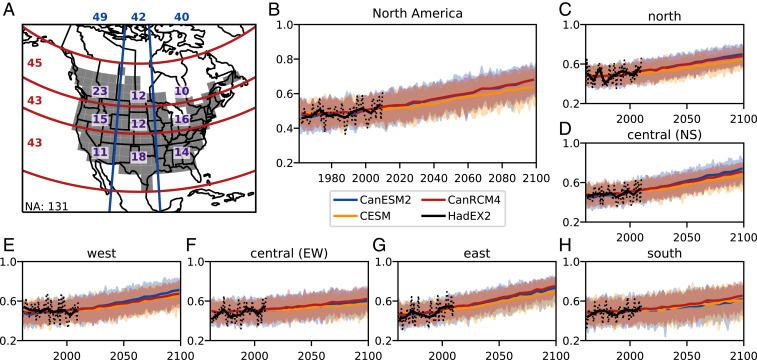
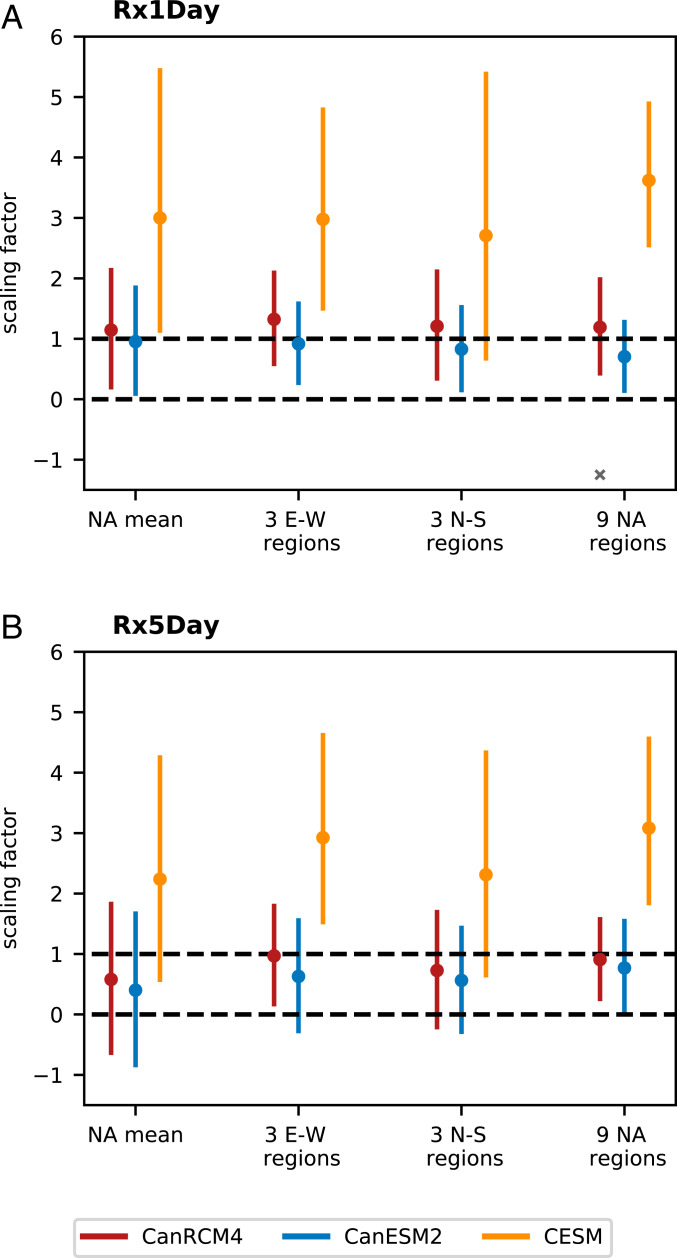
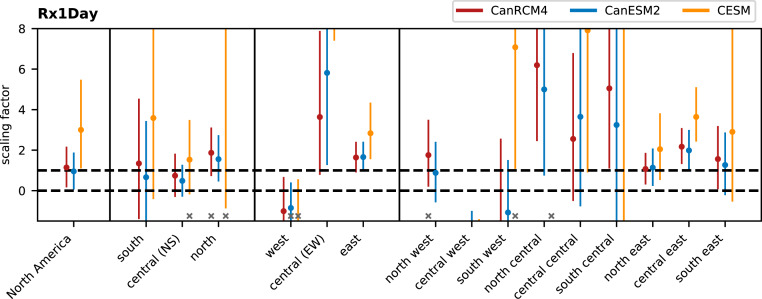
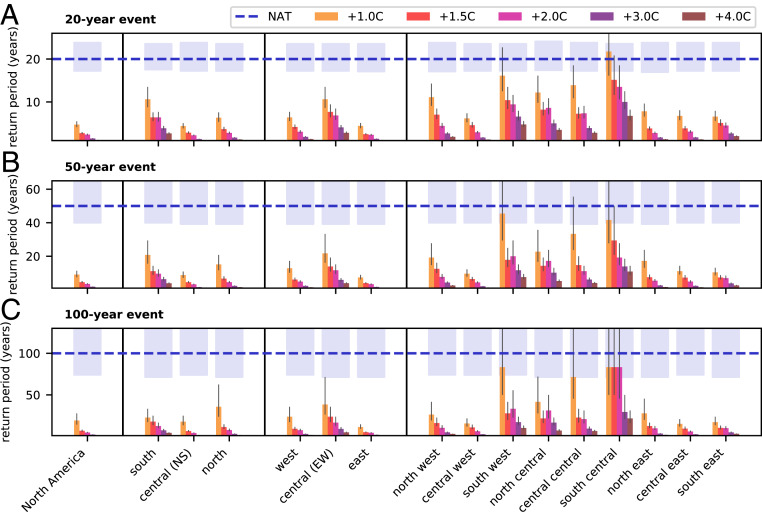
Significance: Extreme precipitation is relevant to many interests, and observations show an increasing trend that is expected to continue under future projections. Although previous work has identified an anthropogenic influence on extreme precipitation at hemispheric scales, this study finds robust results for a continental scale. We establish that anthropogenic climate change has contributed to the intensification of continental and regional extreme precipitation. Furthermore, we also show that the anthropogenic influence on North American regional precipitation will lead to more frequent and intense precipitation extremes in the future.
Overview
The claims and statistics of this paper haven’t been checked yet.
Run the check — free, no account needed. It reads the open-access text and checks the sources it cites.
Integrity signals
Registry
Cites
Statistics
Figures
Verification
Claims the paper makes
The claims and statistics of this paper haven’t been checked yet.
Run the check — free, no account needed. It reads the open-access text and checks the sources it cites.
Claims other papers make about this one
Each is checked against this paper’s own text: does it say what the citing paper says it does?
The source backs part of the claim, not all of it — or backs it for a different population, condition or comparison.
In the citing paper
“Storms will increase in severity and frequency as a result of climate change [42–44].”
From Climate Change, Migration, and Civil Strife. (2020) · cites this paper as [42]
Experimental — accuracy not yet measured
Self-check
Percentages, sums and reported differences re-computed from the paper’s own numbers.
The self-check needs the paper’s full text.
Citations
Cites
Kay, J. E., Deser, C., Phillips, A. S., Mai, A., Hannay, C., Strand, G., Arblaster, J. M., Bates, S. C., Gokhan Danabasoglu, C., Edwards, J., et al. (2014) · Bulletin of the American Meteorological Society · doi:10.1175/bams-d-13-00255.1 · Cited by 2,496
Human contribution to more-intense precipitation extremes
Min, S., Zhang, X., Zwiers, F. W., & Hegerl, G. C. (2011) · Nature · doi:10.1038/nature09763 · Cited by 2,094
Self-citationAddressing climate information needs at the regional level: the CORDEX framework
Giorgi, F., Jones, C., & Asrar, G. (2009) · Cited by 1,755
Anthropogenic contribution to global occurrence of heavy-precipitation and high-temperature extremes
Fischer, E. M., & Knutti, R. (2015) · Nature Climate Change · doi:10.1038/nclimate2617 · Cited by 1,427
Donat, M. G., Alexander, L. V., Yang, H., Durre, I., Vose, R. S., Dunn, R., Willett, K. M., Aguilar, E., Brunet, M., Caesar, J., et al. (2013) · Journal of Geophysical Research Atmospheres · doi:10.1002/jgrd.50150 · Cited by 1,374
Self-citationClimate Science Special Report: Fourth National Climate Assessment, Volume I
USGCRP (2017) · doi:10.7930/j0j964j6 · Cited by 1,273
Detection of human influence on twentieth-century precipitation trends
Zhang, X., Zwiers, F. W., Hegerl, G. C., Lambert, F. H., Gillett, N. P., Solomon, S., Stott, P. A., & Nozawa, T. (2007) · Nature · doi:10.1038/nature06025 · Cited by 1,029
Self-citationArora, V. K., Scinocca, J., Boer, G. J., Christian, J. R., Denman, K. L., Flato, G. M., Kharin, V., Lee, W. G., & Merryfield, W. J. (2011) · Geophysical Research Letters · doi:10.1029/2010gl046270 · Cited by 889
The Max Planck Institute Grand Ensemble: Enabling the Exploration of Climate System Variability
Maher, N., Milinski, S., Suarez‐Gutierrez, L., Botzet, M., Dobrynin, M., Kornblueh, L., Kröger, J., Takano, Y., Ghosh, R., Hedemann, C. J., et al. (2019) · Journal of Advances in Modeling Earth Systems · doi:10.1029/2019ms001639 · Cited by 538
Causes of twentieth-century temperature change near the Earth's surface
Tett, S. F. B., Stott, P. A., Allen, M. R., Ingram, W., & Mitchell, J. F. B. (1999) · Nature · doi:10.1038/21164 · Cited by 504
Research works printed but not linked: 2
- U. Lall , “Water” in Impacts, Risks, and Adaptation in the United States: Fourth National ClimateAssessment,D. R. Reidmiller , Eds. (US Global Change Research Program, Washington, DC, 2018), vol. II, pp. 145–173.
- M. R. Allen , “Framing and Context” in Global Warming of 1.5 °C. An IPCC Special Report on the Impacts of Global Warming of 1.5 °C above Pre-industrial Levels and Related Global Greenhouse Gas Emission Pathways, in the Context of Strengthening the Global Response to the Threat of Climate Change, V. Masson-Delmotte , Eds. (Intergovernmental Panel on Climate Change, 2018), in press.
Cited by
Sorted by citations
A Global, Continental, and Regional Analysis of Changes in Extreme Precipitation
Sun, Q., Zhang, X., Zwiers, F. W., Westra, S., & Alexander, L. V. (2020) · Journal of Climate · doi:10.1175/jcli-d-19-0892.1 · Cited by 430
Self-citationSlater, L. J., Anderson, B. J., Buechel, M., Dadson, S., Han, S., Harrigan, S., Kelder, T., Kowal, K., Lees, T., Matthews, T. K. R., et al. (2021) · Hydrology and earth system sciences · doi:10.5194/hess-25-3897-2021 · Cited by 408
Global concurrent climate extremes exacerbated by anthropogenic climate change
Zhou, S., Yu, B., & Zhang, Y. (2023) · Science Advances · doi:10.1126/sciadv.abo1638 · Cited by 333
Martel, J., Brissette, F. P., Lucas‐Picher, P., Troin, M., & Arsenault, R. (2021) · Journal of Hydrologic Engineering · doi:10.1061/(asce)he.1943-5584.0002122 · Cited by 273
Hydroclimate volatility on a warming Earth
Swain, D. L., Prein, A. F., Abatzoglou, J. T., Albano, C. M., Brunner, M. I., Diffenbaugh, N. S., Singh, D., Skinner, C. B., & Touma, D. (2025) · Nature Reviews Earth & Environment · doi:10.1038/s43017-024-00624-z · Cited by 289
Metadata
- Authors
- Kirchmeier-Young, M. C., & Zhang, X.
- Affiliations
- Climate Research Division, Environment and Climate Change Canada, Toronto, ONT M3H 5T4, Canada
- Environment and Climate Change Canada (CA)
- Venue
- Proceedings of the National Academy of Sciences
- Publisher
- National Academy of Sciences
- Published
- 2020-06
- Volume
- 117
- Issue
- 24
- Pages
- 13308-13313
- ISSN
- 0027-8424 (ISSN-L)
- 1091-6490
- PMC
- PMC7306817
- OpenAlex
- W3032529621
- Cited by
- 288
- References
- 38
- Citations by year
- 2026: 26 · 2025: 47 · 2024: 52 · 2023: 60 · 2022: 47 · 2021: 48 · 2020: 8
- FWCI
- 15.17
- Type
- journal article
- Language
- en
- Open access
- hybrid
- doi.org
- Licence
- Locations
- Proceedings of the National Academy of Sciences (publishedVersion, cc-by-nc-nd)
- PubMed Central (publishedVersion, cc-by-nc-nd)
- PubMed (publishedVersion)
- Topics
- Physical Sciences › Environmental Science › Global and Planetary Change › Climate variability and models
- Physical Sciences › Earth and Planetary Sciences › Atmospheric Science › Meteorological Phenomena and Simulations
- Physical Sciences › Environmental Science › Global and Planetary Change › Climate Change and Environmental Impact
- Keywords
- heavy rainfall, anthropogenic climate change attribution, North America, annual maximum precipitation, climate change detection, regional climate model, Earth system models, external forcing
About these checks
Registry, retraction, Cites and statistics results are computed, not judged, with one exception: a printed reference that no index lists is read once by a model before it counts as a citation error. Claims are extracted by a model and kept only when their quote appears verbatim in the text; each cited source is then checked, with a model’s help, for whether it says what the claim relies on. Those verdicts can be wrong — read the claim’s quote and the cited source before relying on one.
Statistics and arithmetic are recomputed, not judged.
Confidence bands are shown only for fields calibrated on our annotated test set. None is calibrated yet, so no band is shown.
What counts as a claim ›How we measure confidence ›How we check this ›
Are you an author, or do you see a problem with this page? Request a review
