

Comparing crime rates between undocumented immigrants, legal immigrants, and native-born US citizens in Texas
Open accessThe DOI matches its Crossref record; 31 of the 31 references it cites were found in a registry or an index; none of the 26 sources its claims cite is checked for support yet.
Abstract
Significance: Despite its centrality to public and political discourse, we lack even basic information on fundamental questions regarding undocumented immigrants and crime. This stems largely from data constraints. Going beyond existing research, we utilize data from the Texas Department of Public Safety, which checks and records the immigration status of all arrestees throughout the state. Contrary to public perception, we observe considerably lower felony arrest rates among undocumented immigrants compared to legal immigrants and native-born US citizens and find no evidence that undocumented criminality has increased in recent years. Our findings help us understand why the most aggressive immigrant removal programs have not delivered on their crime reduction promises and are unlikely to do so in the future.
Overview
CoChat Summary
TL;DR
Using Texas Department of Public Safety arrest records linked to DHS immigration-status data for 2012–2018, this study finds undocumented immigrants had substantially lower felony arrest rates than legal immigrants and native-born US citizens across violent, property, drug, and traffic offenses. It also finds no evidence that undocumented criminality increased over the period; trends were stable or decreasing.
Key findings
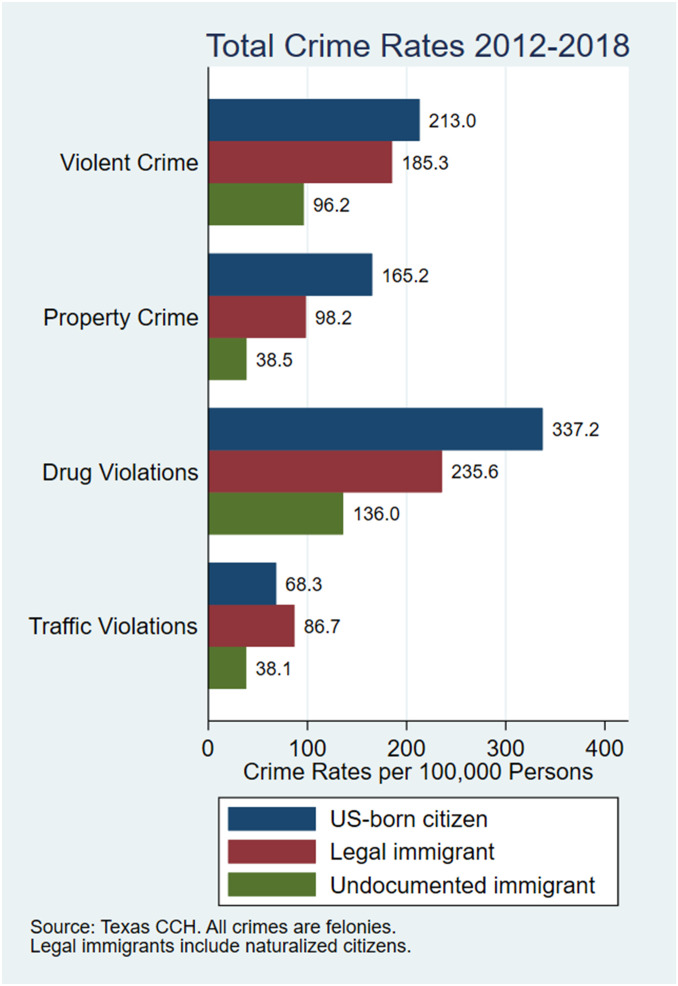
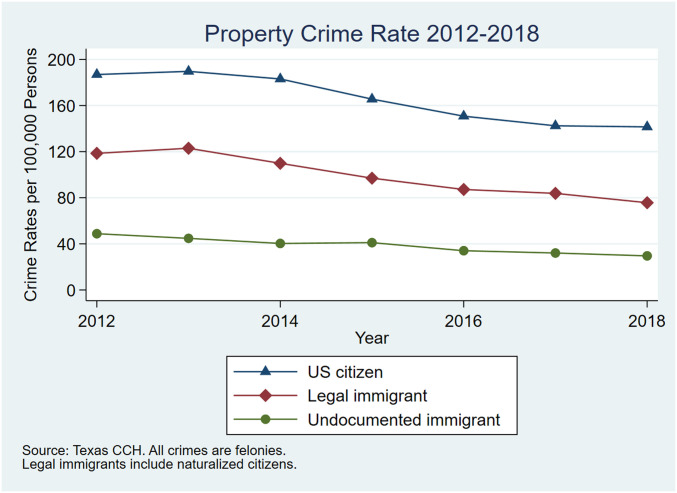
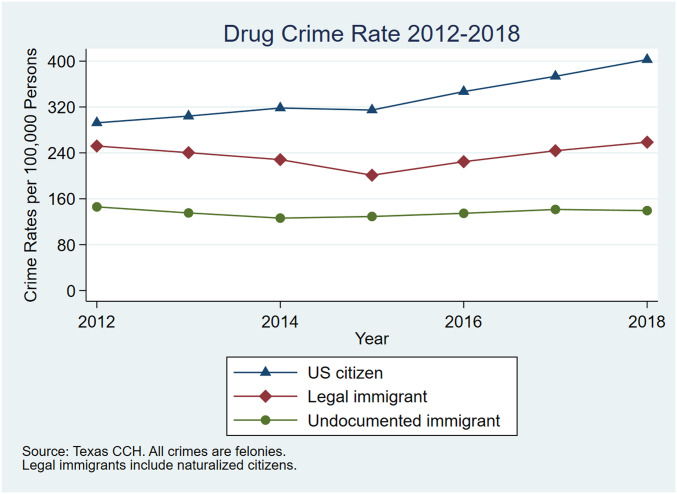
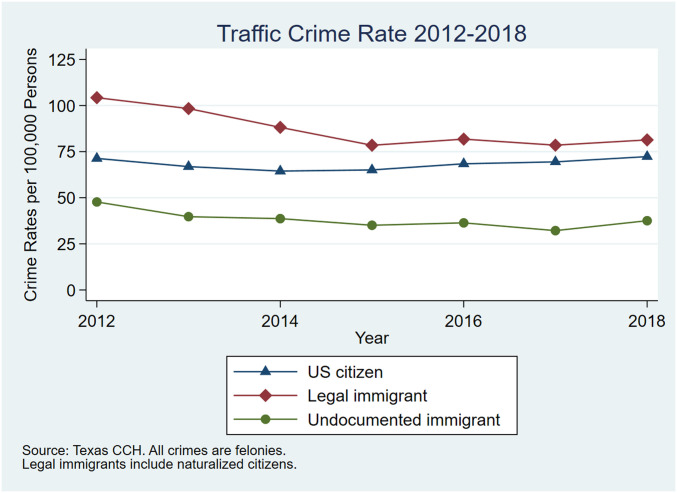
- Undocumented immigrants had the lowest felony arrest rates across violent, property, drug, and traffic offenses. US-born citizens were over 2 times more likely to be arrested for violent crimes, 2.5 times more likely for drug crimes, and over 4 times more likely for property crimes.
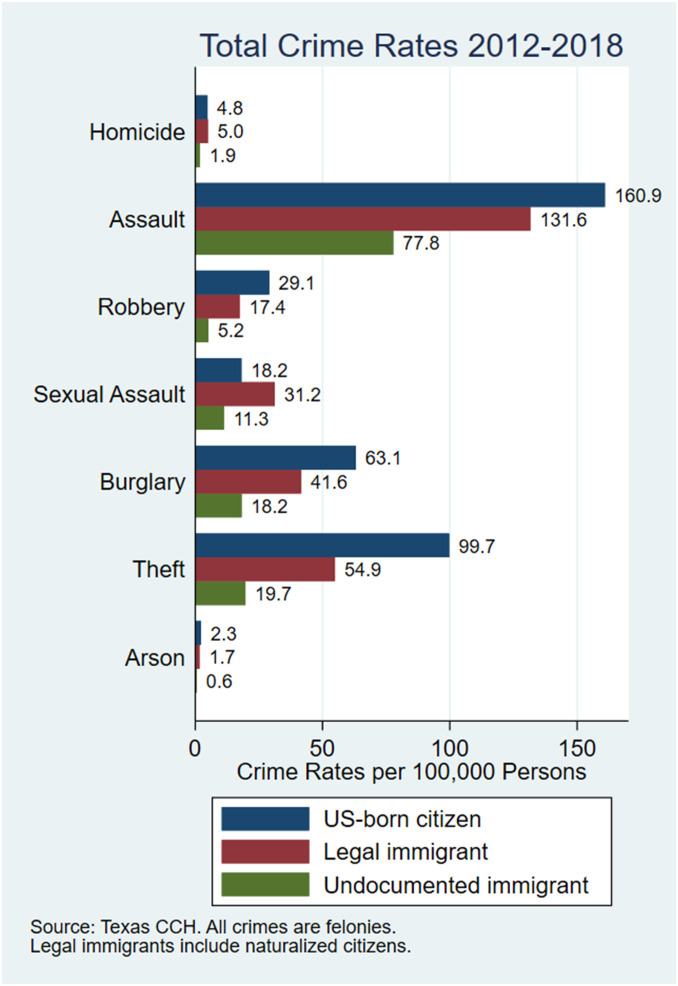
- For detailed offenses, undocumented immigrants were roughly half as likely as native-born citizens to be arrested for homicide, felonious assault, and sexual assault; native-born citizens were between 3 and 5 times more likely to be arrested for robbery, burglary, theft, and arson. Legal immigrants generally had lower rates than native-born citizens, except homicide rates were roughly equal and sexual assault arrest rates for legal immigrants were considerably higher.
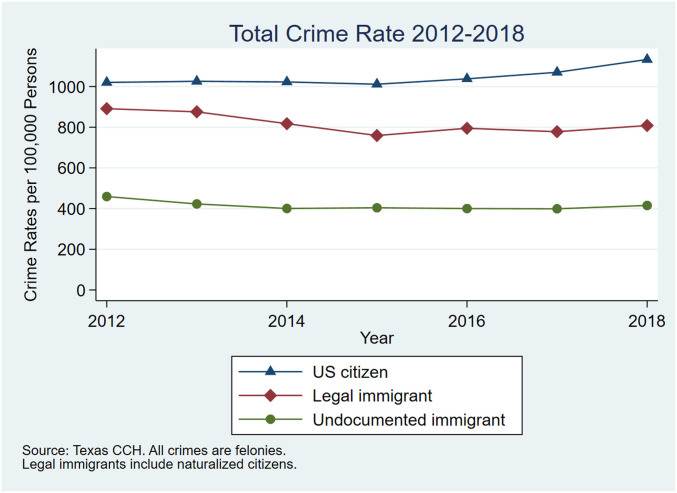
- Felony arrest rates were approximately 1,000 per 100,000 among US-born citizens, 800 per 100,000 among legal immigrants, and 400 per 100,000 among undocumented immigrants. The felony drug rate for undocumented immigrants was less than half that of US-born citizens, and while the undocumented drug rate appeared stable, the US-born drug rate increased nearly 30%.
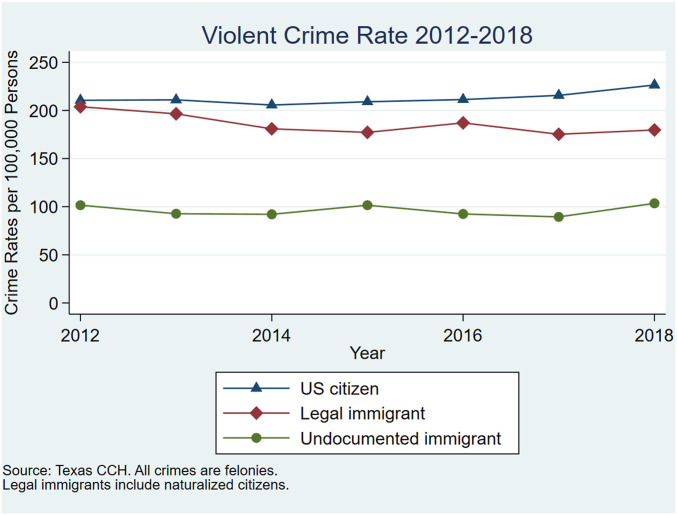
- Trend tests found no evidence that undocumented immigrant crime prevalence grew. Linear trend coefficients were negative and statistically significant for total felony, property, drug, and traffic crimes, and negative but not significant for violent crime; ADF tests indicated total felony and violent crime were trendless/random walk, while property, drug, and traffic offenses decreased. Sensitivity analyses found parity with US-born citizens for violent crimes would require the undocumented population to be less than 45% of the current estimate, and for property crimes 23%.
Methods
- Data came from the Texas Department of Public Safety Computerized Criminal History database for all jailable arrests from 2012 to 2018, linked via Secure Communities/IDENT to DHS immigration-status determinations. Population denominators used American Community Survey 1-y estimates and Center for Migration Studies undocumented population estimates, with Pew Research Center estimates in sensitivity analyses.
- Arrestees were classified as native-born US citizens, legal immigrants (DHS “legal,” non-US citizens not designated “illegal,” and foreign-born US citizens/naturalized citizens), or undocumented immigrants (DHS “illegal”). The felony analysis counted each arrest charge as a separate crime incident and excluded federal offenses.
- Analyses compared arrest rates by offense type and over time using visual plots, linear trend regressions, and augmented Dickey–Fuller tests on the monthly undocumented percentage of arrests; sensitivity checks used alternative population estimates, alternative coding of undocumented status, and conviction rates instead of arrest rates.
Limitations
- The paper states concerns about the accuracy of undocumented population estimates: the residual methodology used by CMS and Pew is not without critics, and if those estimates overstate the undocumented population, observed crime rates would be artificially low. However, the authors argue available evidence suggests undercounting, meaning reported undocumented crime rates may overestimate true criminality.
- The paper states that IDENT misclassification is possible, citing *Gonzalez v. ICE*; if citizens or legal immigrants are incorrectly classified as undocumented, undocumented arrest rates would be overestimated, while if undocumented immigrants are not flagged, some would be misclassified as legal immigrants. In the most extreme alternative coding, undocumented crime rates increased but never reached parity with US-born citizens for violent, property, or drug offenses.
- The paper states that arrest rates are only one metric of criminality and may be influenced by differential policing; conviction-rate analyses replicated the core findings. Evident from the text: the study is limited to Texas from 2012 to 2018, excludes federal offenses and class C misdemeanors, and cannot identify the mechanisms behind the observed patterns.
Model-written summary. Check it against the paper before relying on it.
Integrity signals
Registry
Cites
Statistics
Figures
Verification
Claims the paper makes
0 Valid · 3 Not valid · 22 Not checked · 77 Own results and interpretations
A result the paper reports from its own data — it cites no other source for it, so there is none to check. The quote shows it is in the paper.
In the paper
“To reach parity for property crimes, it would have to a quarter (23%) of the current estimate.”
§ Comparing crime rates between undocumented immigrants, legal immigrants, and native-born US citizens in Texas > Results > Sensitivity Analyses.
hedged- Asserted: passes — The authors put it forward as true.
- Checkable: passes — It can be checked against evidence.
- Load-bearing: unclear — It is unclear whether the paper’s conclusions depend on it.
- Based: passes — The paper gives a reason why it holds.
A result the paper reports from its own data — it cites no other source for it, so there is none to check. The quote shows it is in the paper.
In the paper
“The gaps for robbery, burglary, theft, and arson are considerably larger, whereby native-born citizens are between 3 and 5 times more likely to be arrested for these criminal offenses.”
§ Comparing crime rates between undocumented immigrants, legal immigrants, and native-born US citizens in Texas > Results > Examining Crime Rates.
plainstates an association- Asserted: passes — The authors put it forward as true.
- Checkable: passes — It can be checked against evidence.
- Load-bearing: passes — The paper’s conclusions depend on it.
- Based: passes — The paper gives a reason why it holds.
- Rests on an assumption not shown here.
A result the paper reports from its own data — it cites no other source for it, so there is none to check. The quote shows it is in the paper.
In the paper
“over 4 times more likely to be arrested for property crimes.”
§ Comparing crime rates between undocumented immigrants, legal immigrants, and native-born US citizens in Texas > Results > Examining Crime Rates.
plainstates an association- Asserted: passes — The authors put it forward as true.
- Checkable: passes — It can be checked against evidence.
- Load-bearing: passes — The paper’s conclusions depend on it.
- Based: passes — The paper gives a reason why it holds.
- Rests on an assumption not shown here.
A result the paper reports from its own data — it cites no other source for it, so there is none to check. The quote shows it is in the paper.
In the paper
“The results of both the linear trend analysis and the more robust ADF test reported in Table 1 demonstrate that the monthly trends in undocumented immigrant criminality are either a random walk or decreasing for each offense type (full results reported in SI Appendix, Tables S6 and S7).”
§ Comparing crime rates between undocumented immigrants, legal immigrants, and native-born US citizens in Texas > Results > Trend Analysis.
boosted- Asserted: passes — The authors put it forward as true.
- Checkable: passes — It can be checked against evidence.
- Load-bearing: unclear — It is unclear whether the paper’s conclusions depend on it.
- Based: passes — The paper gives a reason why it holds.
A result the paper reports from its own data — it cites no other source for it, so there is none to check. The quote shows it is in the paper.
In the paper
“Contrary to public perception, we observe considerably lower felony arrest rates among undocumented immigrants compared to legal immigrants and native-born US citizens”
- Also stated in: § Abstract · plain
“we find that undocumented immigrants have considerably lower crime rates than native-born citizens and legal immigrants across a range of criminal offenses, including violent, property, drug, and traffic crimes.”
- Also stated in: § Examining Crime Rates. · plain
“Relative to native-born citizens and legal immigrants, undocumented immigrants have the lowest felony arrest rates across all four crime types.”
§ Comparing crime rates between undocumented immigrants, legal immigrants, and native-born US citizens in Texas > Abstract
plainstates an association- Asserted: passes — The authors put it forward as true.
- Checkable: passes — It can be checked against evidence.
- Load-bearing: passes — The paper’s conclusions depend on it.
- Based: passes — The paper gives a reason why it holds.
- Rests on an assumption not shown here.
- Also stated in: § Abstract · plain
59 more claims
Create a free account to see all 102 claims and to verify the 23 references still open.
- It may state two separate claims as one. 27
- The quote only partly states this claim. 2
- Probably not a substantial claim. 14
Citations
Cites
Remaking the American mainstream: assimilation and contemporary immigration
(2004) · Choice Reviews Online · doi:10.5860/choice.41-3746 · Cited by 2,468
Remaking the American Mainstream: Assimilation and Contemporary Immigration
Alba, R., & Nee, V. (2015) · Harvard University Press eBooks · doi:10.4159/9780674020115 · Cited by 2,133
Remaking the American mainstream assimilation and contemporary immigration
Alba, R. D., & Nee, V. G. (2003) · Cited by 1,217
Rethinking Crime and Immigration
Sampson, R. J. (2008) · Contexts · doi:10.1525/ctx.2008.7.1.28 · Cited by 489
Exploring the Connection between Immigration and Violent Crime Rates in U.S. Cities, 1980–2000
Ousey, G. C., & Kubrin, C. E. (2009) · Social Problems · doi:10.1525/sp.2009.56.3.447 · Cited by 407
Immigration and Crime: Assessing a Contentious Issue
Ousey, G. C., & Kubrin, C. E. (2018) · Annual Review of Criminology · doi:10.1146/annurev-criminol-032317-092026 · Cited by 381
The Many colors of crime: inequalities of race, ethnicity, and crime in America
(2007) · Choice Reviews Online · doi:10.5860/choice.44-4169 · Cited by 372
Did the 2007 Legal Arizona Workers Act Reduce the State's Unauthorized Immigrant Population?
Bohn, S., Lofstrom, M., & Raphael, S. (2014) · The Review of Economics and Statistics · doi:10.1162/rest_a_00429 · Cited by 340
Immigration Enforcement in the United States: The Rise of a Formidable Machinery
Bergeron, C., Kerwin, D. M., Meissner, D. M., & Chishti, M. (2013) · Issue Lab (Candid) · Cited by 255
The Oxford Handbook of Ethnicity, Crime, and Immigration
(2014) · Oxford University Press eBooks · doi:10.1093/oxfordhb/9780199859016.001.0001 · Cited by 246
Research works printed but not linked: 3
- Carson A. E., “ Prisoners in 2016” in NCJ 251149 (Bureau of Justice Statistics, Washington, DC, 2018).
- Nowrasteh A., “ Criminal immigrants in Texas” in Immigration Research and Policy Brief No. 4 (Cato Institute, Washington, DC, 2018).
- Carson A. E., Golinelli D., “ Prisoners in 2012” in NCJ 242467 (Bureau of Justice Statistics, Washington, DC, 2013).
Cited by
Megastudy testing 25 treatments to reduce antidemocratic attitudes and partisan animosity
Voelkel, J. G., Stagnaro, M., Chu, J., Pink, S. L., Mernyk, J. S., Redekopp, C., Ghezae, I., Cashman, M., Adjodah, D., Allen, L., et al. (2023) · doi:10.31219/osf.io/y79u5 · Cited by 174
Megastudy testing 25 treatments to reduce antidemocratic attitudes and partisan animosity
Voelkel, J. G., Stagnaro, M. N., Chu, J. Y., Pink, S. L., Mernyk, J. S., Redekopp, C., Ghezae, I., Cashman, M., Adjodah, D., Allen, L. G., et al. (2024) · Science · doi:10.1126/science.adh4764 · Cited by 174
Persuasion through Slanted Language: Evidence from the Media Coverage of Immigration
Djourelova, M. (2023) · American Economic Review · doi:10.1257/aer.20211537 · Cited by 107
Cheap Versus Deep Manipulation: The Effects of Cheapfakes Versus Deepfakes in a Political Setting
Hameleers, M. (2024) · International Journal of Public Opinion Research · doi:10.1093/ijpor/edae004 · Cited by 59
Cognitive Blame Is Socially Shaped
Malle, B. F., Guglielmo, S., Voiklis, J., & Monroe, A. E. (2022) · Current Directions in Psychological Science · doi:10.1177/09637214211068845 · Cited by 48
Group Threat and Social Control: Who, What, Where, and When
Vogel, M., & Messner, S. F. (2023) · Annual Review of Criminology · doi:10.1146/annurev-criminol-022222-033042 · Cited by 31
Law-Abiding Immigrants: The Incarceration Gap between Immigrants and the US-Born, 1870–2020
Abramitzky, R., Boustan, L. P., Jácome, E., Pérez, S. T., & Torres, J. D. (2024) · American Economic Review Insights · doi:10.1257/aeri.20230459 · Cited by 25
Yue, H., & Chen, J. (2024) · Applied Geography · doi:10.1016/j.apgeog.2024.103503 · Cited by 22
Clemens, M. A. (2022) · Oxford Review of Economic Policy · doi:10.1093/oxrep/grac012 · Cited by 22
Hameleers, M. (2022) · Media and Communication · doi:10.17645/mac.v10i4.5654 · Cited by 21
Law-Abiding Immigrants: The Incarceration Gap Between Immigrants and the US-born, 1870–2020
Abramitzky, R., Boustan, L. P., Jácome, E., Pérez, S. T., & Torres, J. D. (2023) · National Bureau of Economic Research · doi:10.3386/w31440 · Cited by 16
Immigration is difficult?! Informing voters about immigration policy fosters pro-immigration views
Kustov, A., & Landgrave, M. G. (2025) · Journal of Experimental Political Science · doi:10.1017/xps.2024.21 · Cited by 15
Banished Men: How Migrants Endure the Violence of Deportation
Andrews, A. L. (2023) · University of California Press eBooks · doi:10.1525/9780520395985 · Cited by 15
Can We Talk?: Communicating Moral Concern in an Era of Polarized Politics
Anderson, E. (2022) · Journal of Practical Ethics · doi:10.3998/jpe.1180 · Cited by 14
The Fiscal Effect of Immigration: Reducing Bias in Influential EstimatesPreprint
Clemens, M. A. (2021) · SSRN Electronic Journal · doi:10.2139/ssrn.3982027 · Cited by 15
Social, health and ethnicity correlates of complaints of excessive police force
Smith, S., Ferguson, C. J., Miguel, C. E. S., Ynalvez, M. A., & Henderson, H. (2022) · Criminal Behaviour and Mental Health · doi:10.1002/cbm.2255 · Cited by 13
List, A. (2022) · European Journal of Psychology of Education · doi:10.1007/s10212-022-00643-8 · Cited by 13
Protecting Postville? The impact of deportation and immigration on crime
Bedi, J. K., Jia, S., & Williamson, C. R. (2024) · Public Choice · doi:10.1007/s11127-024-01232-7 · Cited by 11
Kerwin, D. M., Carlson, E., & Wheeler, C. (2026) · Journal on Migration and Human Security · doi:10.1177/23315024261456212 · Cited by 10
Coquet, M., & Terrado-Ortuño, N. (2023) · International Journal of Police Science & Management · doi:10.1177/14613557231184707 · Cited by 10
Immigration and crime: The role of self-selection and institutions
Mariani, F., & Mercier, M. (2021) · Journal of Economic Behavior & Organization · doi:10.1016/j.jebo.2021.03.011 · Cited by 9
Influence of Socio-Economic Factors on Crime Among International Migrants in South Africa
Susuman, A. S., & Sithole, K. (2024) · AFRICAN HUMAN MOBILITY REVIEW · doi:10.14426/ahmr.v10i1.1593 · Cited by 8
Caraballo, K. (2024) · Justice Quarterly · doi:10.1080/07418825.2024.2430280 · Cited by 8
Beyond Polarization: Right-Wing News as a Quasi-religious Phenomenon
Mann, M., & Winchester, D. (2025) · Sociological Theory · doi:10.1177/07352751251326951 · Cited by 8
Getting the Facts Straight: A Survey Experiment of Crime and Immigration Attitudes
Puddy, H. N., Burton, A. L., & Jonson, C. L. (2024) · Crime & Delinquency · doi:10.1177/00111287241305059 · Cited by 7
Immigration enforcement and justifications for causing harm
Ip, K. K. W. (2022) · Critical Review of International Social and Political Philosophy · doi:10.1080/13698230.2022.2137751 · Cited by 7
Disparate incarceration rates of foreign citizens in Europe compared to Anglo‐Saxon countries
Cohn, E. G., Coccia, M., & Kakar, S. (2023) · Sociology Compass · doi:10.1111/soc4.13167 · Cited by 7
Experiments in Living Together: How Democracy Drives Social Progress
Fuerstein, M. (2024) · doi:10.1093/oso/9780197784280.001.0001 · Cited by 7
Banished Men: How Migrants Endure the Violence of Deportation
Andrews, A. L. (2023) · University of California Press eBooks · doi:10.1525/luminos.161 · Cited by 7
Zhang, Y., & Kaur, S. (2024) · Journal of Language and Politics · doi:10.1075/jlp.22096.zha · Cited by 6
Ho, A. K., & Kteily, N. (2024) · Social Issues and Policy Review · doi:10.1111/sipr.12109 · Cited by 7
Immigration and Crime in Comparative Perspective: An Emerging Framework for Research
Kubrin, C. E., & Ousey, G. C. (2025) · Crime and Justice · doi:10.1086/736810 · Cited by 6
Law-Abiding Immigrants: The Incarceration Gap Between Immigrants and the US-born, 1870–2020Preprint
Abramitzky, R., Boustan, L. P., Jácome, E., Pérez, S. T., & Torres, J. D. (2023) · SSRN Electronic Journal · doi:10.2139/ssrn.4505070 · Cited by 7
Law-Abiding Immigrants: The Incarceration Gap between Immigrants and the Us-Born, 1850–2020Preprint
Abramitzky, R., Boustan, L. P., Jácome, E., Pérez, S. T., & Torres, J. D. (2023) · SSRN Electronic Journal · doi:10.2139/ssrn.4512476 · Cited by 6
Law-Abiding Immigrants: The Incarceration Gap Between Immigrants and the US-born, 1870-2020Preprint
Abramitzky, R., Boustan, L. P., Jácome, E., Pérez, S. T., & Torres, J. D. (2024) · SSRN Electronic Journal · doi:10.2139/ssrn.4878020 · Cited by 6
Necessary Conversations: Understanding Racism as a Barrier to Achieving Health Equity
Cameron, D. (2022) · doi:10.1093/oso/9780197641477.001.0001 · Cited by 5
The Politics of Intergroup Attitudes
Osborne, D., & Sibley, C. G. (2022) · Cambridge University Press eBooks · doi:10.1017/9781108779104.012 · Cited by 5
Authoritarianism in US State Policy and its Impact on Nonprofit Civil Liberties
Gazley, B., & Alexander, J. (2025) · Nonprofit Policy Forum · doi:10.1515/npf-2024-0022 · Cited by 4
Ramos, J., & Alaniz, K. (2022) · Crime & Delinquency · doi:10.1177/00111287221111781 · Cited by 4
Richey, S. (2022) · University of Michigan Press eBooks · doi:10.1353/book.110597 · Cited by 4
Immigration and Crime: What We Know and What Remains Unknown
Kubrin, C. E., & Ousey, G. C. (2023) · SpringerBriefs in criminology · doi:10.1007/978-3-031-22839-1_4 · Cited by 4
Abolarin, J., Myers, Q. W. O., Carmichael, H., Moore, A., & Velopulos, C. G. (2023) · Journal of Surgical Research · doi:10.1016/j.jss.2023.01.005 · Cited by 4
Guerra, C., & Cano, M. (2024) · Deviant Behavior · doi:10.1080/01639625.2024.2381082 · Cited by 3
Differential treatment by citizenship within European criminal justice systems
Kakar, S., Coccia, M., & Cohn, E. G. (2024) · Criminal Justice Studies · doi:10.1080/1478601x.2024.2378606 · Cited by 3
Abramitzky, R., & Boustan, L. P. (2024) · PNAS Nexus · doi:10.1093/pnasnexus/pgae344 · Cited by 3
Immigrant and Citizen Reincarceration in Pennsylvania
Alladin, T. A., & Hummer, D. (2021) · American Journal of Criminal Justice · doi:10.1007/s12103-021-09609-w · Cited by 3
Navarro, E., Heath, W. P., & Stein, J. (2022) · Journal of Ethnicity in Criminal Justice · doi:10.1080/15377938.2022.2098546 · Cited by 3
The Political Dynamics of Immigration Opinion Worldwide
Valentino, N. A., & Kim, Y. P. (2022) · Cambridge University Press eBooks · doi:10.1017/9781108779104.023 · Cited by 3
Gelovani, S., Theocharis, Y., & München, T. U. (2022) · mediaTUM (Technical University of Munich) · Cited by 3
Velado, I. D. L. (2023) · e-Archivo (Carlos III University of Madrid) · Cited by 3
Stereotypes and Strategic DiscriminationPreprint
McGee, D. (2026) · SSRN Electronic Journal · doi:10.2139/ssrn.7344795 · Cited by 3
Querengässer, J., & Bezzel, A. (2024) · Forensic Science International · doi:10.1016/j.forsciint.2024.112311 · Cited by 2
Approaching translation through a feminist ethics of care
Anderson, L. L. (2024) · Feminist Translation Studies · doi:10.1080/29940443.2025.2495342 · Cited by 2
Labeling immigrants: Examining the effects of labels on associations toward immigrants
Fernandes, J., & Cleve, M. (2025) · International Journal of Intercultural Relations · doi:10.1016/j.ijintrel.2025.102230 · Cited by 2
Yudhatama, C. F., & Pangestika, E. Q. (2024) · Rechtsnormen Journal of Law · doi:10.55849/rjl.v2i2.712 · Cited by 2
de Valladolid, U., Matas, J. A. V., Sánchez‐Bayón, A., & Carlos, I.-U. R. J. (2021) · Papeles de Población · doi:10.22185/24487147.2021.109.27 · Cited by 4
Heyman, J. (2024) · Journal on Migration and Human Security · doi:10.1177/23315024241259765 · Cited by 2
Nowrasteh, A. (2024) · Issue Lab (Candid) · Cited by 2
The Immigration–Crime Nexus: Inner and Outer Containment Buffer or A Push Toward Delinquency
Hsieh, M., & Shih, M. R. (2024) · Youth Justice · doi:10.1177/14732254241275825 · Cited by 1
Experiments in Living Together
Fuerstein, M. (2024) · Oxford University Press eBooks · doi:10.1093/oso/9780197784280.003.0004 · Cited by 1
Malatji, T. L., Rakubu, K. A., & Ragolane, M. (2024) · JPPUMA Jurnal Ilmu Pemerintahan dan Sosial Politik Universitas Medan Area · doi:10.31289/jppuma.v12i2.13039 · Cited by 2
Crime in a Changing Society: Evidence from Romania
Simona, I. L. I. E. (2024) · Sociologie Romaneasca · doi:10.33788/sr.22.2.3 · Cited by 1
Immigration Status and Crime: A Comparison Between Hispanic Undocumented Immigrants and US Citizens
Nuño, L. E., & Herrera, V. M. (2025) · Hispanic Journal of Behavioral Sciences · doi:10.1177/07399863251348681 · Cited by 1
Yeung, E. S. F., & Glasgow, J. (2025) · The Journal of Politics · doi:10.1086/737780 · Cited by 1
Cohn, E. G., Kakar, S., & Coccia, M. (2025) · Asian Journal of Criminology · doi:10.1007/s11417-025-09481-1 · Cited by 1
The Impact of Migration Processes on Crime Rates
MENSHYKOV, D., T., LUTSYSHYN, H., Iatsyna, M., & Hadzhiieva, A. (2024) · Scientific Repository of Open Access of Portugal (RCAAP) · doi:10.34625/issn.2183-2705(36)2024.ic-1 · Cited by 1
Soekhoe, J. R. (2025) · Scholars Crossing (Liberty University) · Cited by 1
The Effect of the Texas Migrant Busing Program on the 2024 U.S. Presidential Election
Scarborough, W. J., Kwon, R., & Brady, D. (2026) · Sociological Science · doi:10.15195/v13.a11 · Cited by 1
A case for de-diagnosis of harms in the social and behavioral sciences
Graso, M., & Reynolds, T. A. (2026) · Theory and Society · doi:10.1007/s11186-026-09691-1 · Cited by 1
Estrategias de manipulación en el discurso criminalizador de la inmigración de Donald Trump
Cantalapiedra, E. T. (2026) · Estudios del Discurso · doi:10.30973/esdi.2026.12.1.258 · Cited by 1
Causas de muerte en inmigrantes venezolanos residentes en Perú entre el 2017 – 2021
Román-Lazarte, V., Roman, L. Á., & Galeas-Torre, M. K. (2022) · Gaceta Médica de Caracas · doi:10.47307/gmc.2022.130.3.7 · Cited by 1
Impacts of Illegal Migration: Lessons for Migration Management Professionals
Bah, Y. M. (2022) · International Journal of Economics and Management Sciences · doi:10.5281/zenodo.7642097 · Cited by 1
Premigratory experiences with Civil War violence and social trust
Okundaye, G., & Ishiyama, J. (2024) · Social Science Quarterly · doi:10.1111/ssqu.13342 · Cited by 1
Makananise, F. O. (2024) · E-Journal of Humanities Arts and Social Sciences · doi:10.38159/ehass.2024569 · Cited by 1
On the Rationality of Propaganda II: Examples of Reasonable Propaganda Films
Jason, G. J. (2024) · Philosophy International Journal · doi:10.23880/phij-16000337 · Cited by 1
Introduction: Doubters and Demagogues
Fuerstein, M. (2024) · Oxford University Press eBooks · doi:10.1093/oso/9780197784280.003.0001 · Cited by 1
Crime and Migration in North America, 1700–1776
Mahon, R. M. (2024) · Crime and Justice · doi:10.1086/733442 · Cited by 1
Global Sounds: Uncovering Music from Popular Refugees as a Space for Counternarratives
Villela, H. (2023) · ISU Red - Research and eData (Illinois State University) · doi:10.30707/etd2023.20230711063203130745.999940 · Cited by 1
From Theory to Empirics: Data Requirements for Studying Immigration and Crime
Kubrin, C. E., & Ousey, G. C. (2023) · SpringerBriefs in criminology · doi:10.1007/978-3-031-22839-1_3
Kubrin, C. E., & Ousey, G. C. (2023) · SpringerBriefs in criminology · doi:10.1007/978-3-031-22839-1_5
An examination of current sociopolitical issues in the United States of AmericaPreprint
McManus, J. D. (2023) · SocArXiv (OSF Preprints) · doi:10.31235/osf.io/572nc
Impacts of President Trump’s Zero Tolerance Policy and Speech on Illegal Immigrants
Zheng, J. (2023) · Lecture Notes in Education Psychology and Public Media · doi:10.54254/2753-7048/4/2022249
Migrant Protection Protocols: An Examination of its Consequences and Impact on Child Enrollees
Valadez, M. (2023) · Journal of Family Strengths · doi:10.58464/2168-670x.1466
Yin, Y. (2023) · Lecture Notes in Education Psychology and Public Media · doi:10.54254/2753-7048/28/20231305
The research of prediction of future violent crime rate
Yang, M. H. (2023) · Theoretical and Natural Science · doi:10.54254/2753-8818/26/20241063
Light, M. T., Boisten, L., & Kim, J. (2023) · Crime & Delinquency · doi:10.1177/00111287231218704
Self-citationSEFA, J. (2023) · ISU Red - Research and eData (Illinois State University) · doi:10.30707/etd2023.20240124055108222847.999981
“The Police Have Never Been Our Friend”: Exploring Latino Immigrant Perceptions of Law Enforcement
Valadez, M. (2024) · Palgrave's critical policing studies · doi:10.1007/978-3-031-45812-5_12
Richey, A. (2024) · International Journal of Science and Research (IJSR) · doi:10.21275/sr24223170452
Ethics and Globalization: The Tribal Threat
Groves, J. R. (2024) · doi:10.5840/gec20244
Jiahui, X. (2024) · AL-MANHAJ Jurnal Hukum dan Pranata Sosial Islam · doi:10.37680/almanhaj.v6i1.5053
Fuerstein, M. (2024) · Oxford University Press eBooks · doi:10.1093/oso/9780197784280.003.0002
Fuerstein, M. (2024) · Oxford University Press eBooks · doi:10.1093/oso/9780197784280.003.0003
Democratic Rationality Is Social
Fuerstein, M. (2024) · Oxford University Press eBooks · doi:10.1093/oso/9780197784280.003.0006
Fuerstein, M. (2024) · Oxford University Press eBooks · doi:10.1093/oso/9780197784280.003.0005
Fuerstein, M. (2024) · Oxford University Press eBooks · doi:10.1093/oso/9780197784280.002.0003
What Is the Lesson of Donald Trump for Democracy?
Fuerstein, M. (2024) · Oxford University Press eBooks · doi:10.1093/oso/9780197784280.003.0008
Truth, Progress, and the Will of the People
Fuerstein, M. (2024) · Oxford University Press eBooks · doi:10.1093/oso/9780197784280.003.0007
Fuerstein, M. (2024) · Oxford University Press eBooks · doi:10.1093/oso/9780197784280.002.0004
Fuerstein, M. (2024) · Oxford University Press eBooks · doi:10.1093/oso/9780197784280.002.0007
Metadata
- Authors
- Light, M. T., He, J., & Robey, J. P.
- Affiliations
- University of Wisconsin–Madison (US)
- Corresponding author
- Light, Michael T.
- Venue
- Proceedings of the National Academy of Sciences
- Publisher
- National Academy of Sciences
- Published
- 2020-12-07
- Volume
- 117
- Issue
- 51
- Pages
- 32340-32347
- ISSN
- 0027-8424 (ISSN-L)
- 1091-6490
- PMC
- PMC7768760
- OpenAlex
- W3111485761
- Cited by
- 159
- References
- 30
- Citations by year
- 2026: 25 · 2025: 33 · 2024: 44 · 2023: 28 · 2022: 17 · 2021: 12
- FWCI
- 12.78
- Type
- journal article
- Language
- en
- Open access
- hybrid
- doi.org
- Licence
- Locations
- Proceedings of the National Academy of Sciences (publishedVersion, cc-by-nc-nd)
- PubMed Central (publishedVersion, cc-by-nc-nd)
- Europe PMC (PubMed Central) (publishedVersion, cc-by-nc-nd)
- PubMed (publishedVersion)
- RePEc: Research Papers in Economics (submittedVersion)
- Funders
- National Science Foundation (1849297)
- DOJ | National Institute of Justice (2019-R2-CX-0058)
- Topics
- Social Sciences › Sociology and Political Science › Crime Patterns and Interventions
- Social Sciences › Sociology and Political Science › Criminal Justice and Corrections Analysis
- Social Sciences › Sociology and Political Science › Migration, Refugees, and Integration
- Keywords
- undocumented immigrants, legal immigrants, native-born citizens, crime rates, arrest data, violent crime, drug offenses, property crime, Texas
About these checks
Registry, retraction, Cites and statistics results are computed, not judged, with one exception: a printed reference that no index lists is read once by a model before it counts as a citation error. Claims are extracted by a model and kept only when their quote appears verbatim in the text; each cited source is then checked, with a model’s help, for whether it says what the claim relies on. Those verdicts can be wrong — read the claim’s quote and the cited source before relying on one.
A language model drew the claims from the paper on 2026-11-18, under version 3 of the claim definition (model deepseek-v4.1-flash, prompt extract-v3).
A second model labelled each claim on 2026-11-18 (model jev-1.13-20260917, definition revision gold-guideline-v0.2).
Statistics and arithmetic are recomputed, not judged.
Confidence bands are shown only for fields calibrated on our annotated test set. None is calibrated yet, so no band is shown.
What counts as a claim ›How we measure confidence ›How we check this ›
Are you an author, or do you see a problem with this page? Request a review
Data sources
Bibliographic data: Semantic Scholar, OpenAlex, Crossref.
Contains information from the Semantic Scholar Academic Graph Datasets, made available under the ODC Attribution License (ODC-BY 1.0).
Semantic Scholar’s data is described in: Kinney, R., et al. (2023). The Semantic Scholar Open Data Platform. arXiv:2301.10140.
