

Comparing crime rates between undocumented immigrants, legal immigrants, and native-born US citizens in Texas
Open accessThe DOI matches its Crossref record; 31 of the 31 references it cites were found in a registry or an index; none of the 26 sources its claims cite is checked for support yet.
Abstract
Significance: Despite its centrality to public and political discourse, we lack even basic information on fundamental questions regarding undocumented immigrants and crime. This stems largely from data constraints. Going beyond existing research, we utilize data from the Texas Department of Public Safety, which checks and records the immigration status of all arrestees throughout the state. Contrary to public perception, we observe considerably lower felony arrest rates among undocumented immigrants compared to legal immigrants and native-born US citizens and find no evidence that undocumented criminality has increased in recent years. Our findings help us understand why the most aggressive immigrant removal programs have not delivered on their crime reduction promises and are unlikely to do so in the future.
Overview
CoChat Summary
TL;DR
Using Texas Department of Public Safety arrest records linked to DHS immigration-status data for 2012–2018, this study finds undocumented immigrants had substantially lower felony arrest rates than legal immigrants and native-born US citizens across violent, property, drug, and traffic offenses. It also finds no evidence that undocumented criminality increased over the period; trends were stable or decreasing.
Key findings
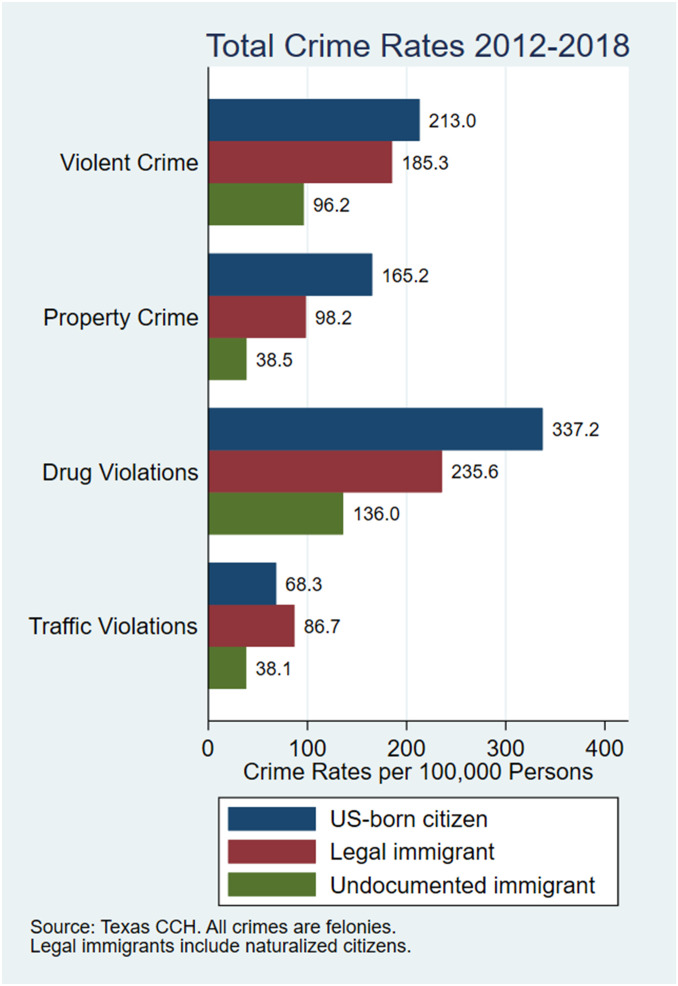
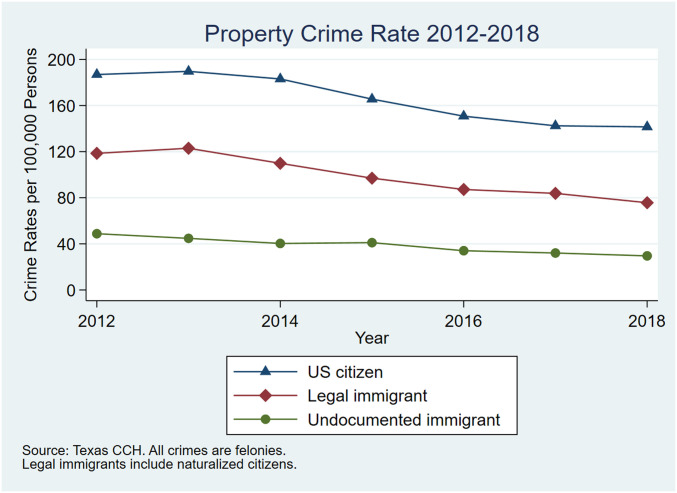
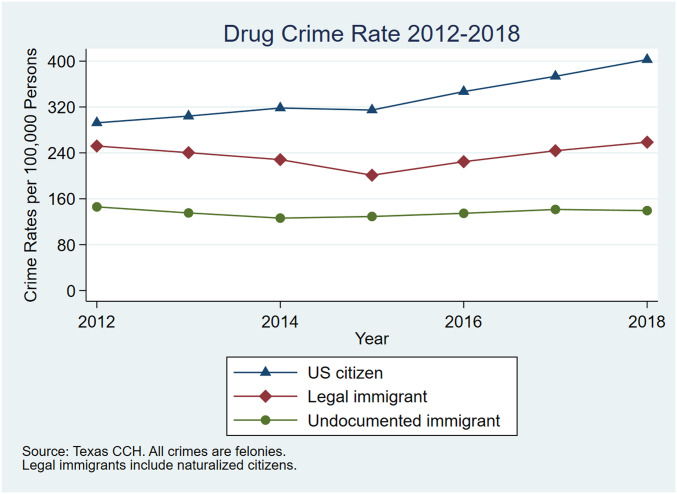
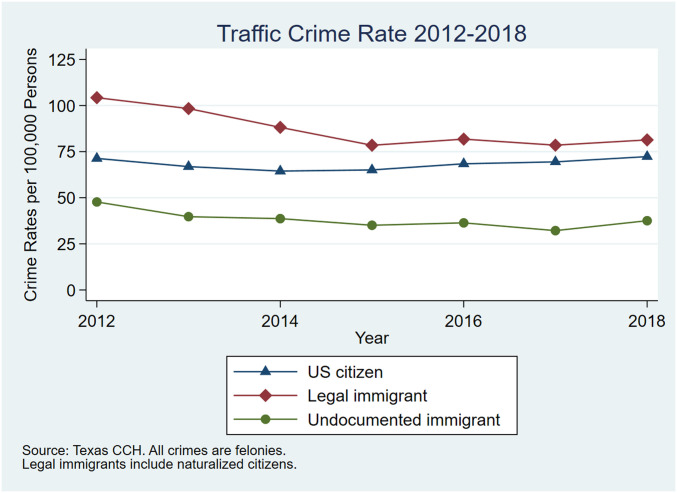
- Undocumented immigrants had the lowest felony arrest rates across violent, property, drug, and traffic offenses. US-born citizens were over 2 times more likely to be arrested for violent crimes, 2.5 times more likely for drug crimes, and over 4 times more likely for property crimes.
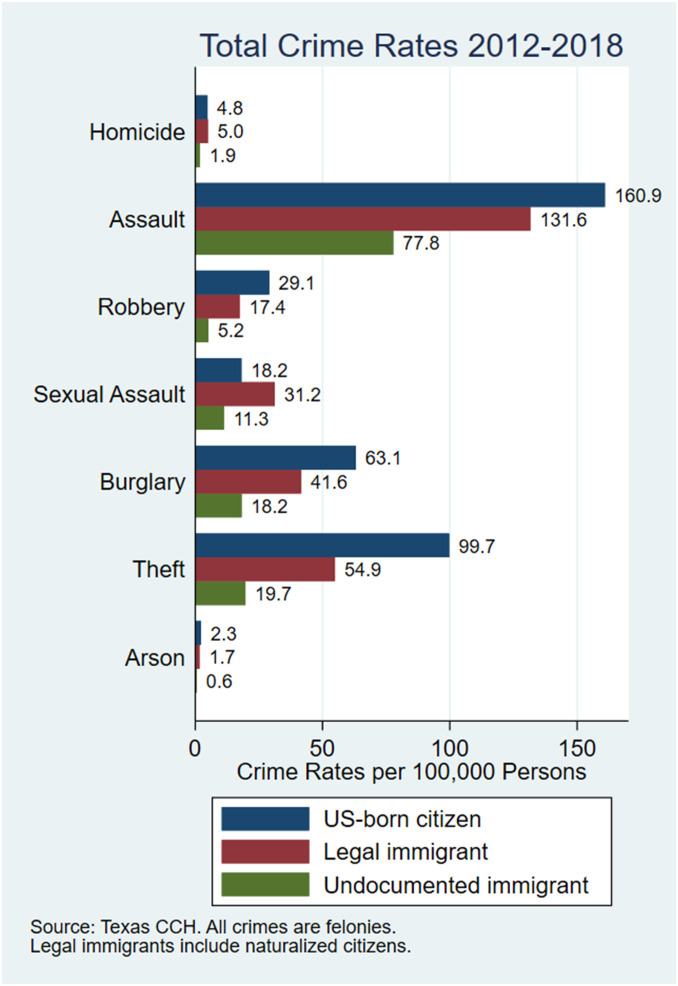
- For detailed offenses, undocumented immigrants were roughly half as likely as native-born citizens to be arrested for homicide, felonious assault, and sexual assault; native-born citizens were between 3 and 5 times more likely to be arrested for robbery, burglary, theft, and arson. Legal immigrants generally had lower rates than native-born citizens, except homicide rates were roughly equal and sexual assault arrest rates for legal immigrants were considerably higher.
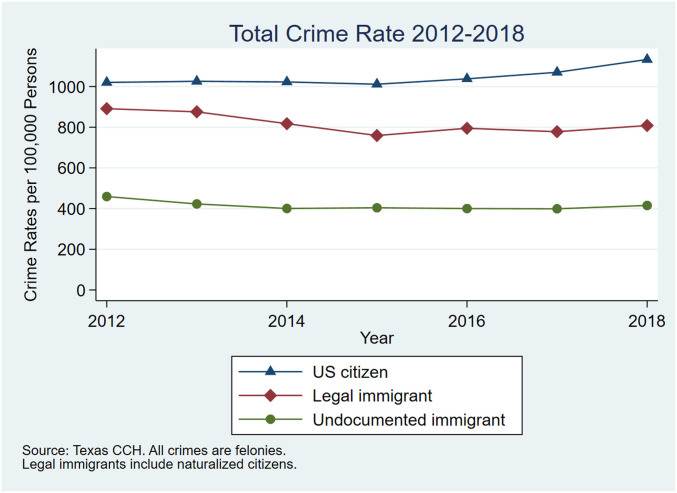
- Felony arrest rates were approximately 1,000 per 100,000 among US-born citizens, 800 per 100,000 among legal immigrants, and 400 per 100,000 among undocumented immigrants. The felony drug rate for undocumented immigrants was less than half that of US-born citizens, and while the undocumented drug rate appeared stable, the US-born drug rate increased nearly 30%.
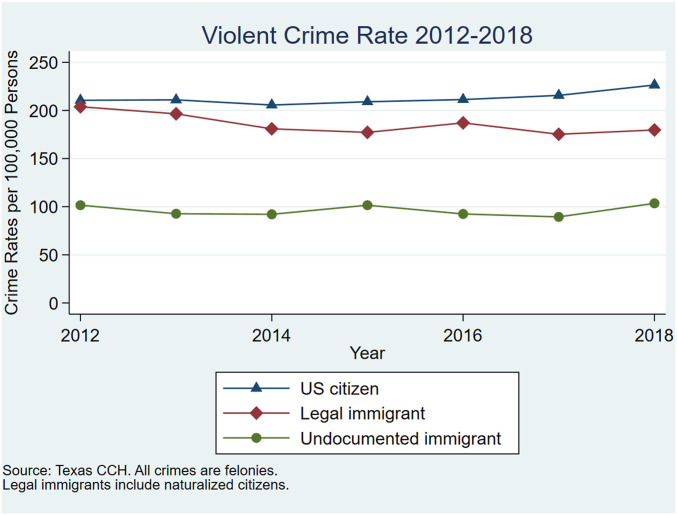
- Trend tests found no evidence that undocumented immigrant crime prevalence grew. Linear trend coefficients were negative and statistically significant for total felony, property, drug, and traffic crimes, and negative but not significant for violent crime; ADF tests indicated total felony and violent crime were trendless/random walk, while property, drug, and traffic offenses decreased. Sensitivity analyses found parity with US-born citizens for violent crimes would require the undocumented population to be less than 45% of the current estimate, and for property crimes 23%.
Methods
- Data came from the Texas Department of Public Safety Computerized Criminal History database for all jailable arrests from 2012 to 2018, linked via Secure Communities/IDENT to DHS immigration-status determinations. Population denominators used American Community Survey 1-y estimates and Center for Migration Studies undocumented population estimates, with Pew Research Center estimates in sensitivity analyses.
- Arrestees were classified as native-born US citizens, legal immigrants (DHS “legal,” non-US citizens not designated “illegal,” and foreign-born US citizens/naturalized citizens), or undocumented immigrants (DHS “illegal”). The felony analysis counted each arrest charge as a separate crime incident and excluded federal offenses.
- Analyses compared arrest rates by offense type and over time using visual plots, linear trend regressions, and augmented Dickey–Fuller tests on the monthly undocumented percentage of arrests; sensitivity checks used alternative population estimates, alternative coding of undocumented status, and conviction rates instead of arrest rates.
Limitations
- The paper states concerns about the accuracy of undocumented population estimates: the residual methodology used by CMS and Pew is not without critics, and if those estimates overstate the undocumented population, observed crime rates would be artificially low. However, the authors argue available evidence suggests undercounting, meaning reported undocumented crime rates may overestimate true criminality.
- The paper states that IDENT misclassification is possible, citing *Gonzalez v. ICE*; if citizens or legal immigrants are incorrectly classified as undocumented, undocumented arrest rates would be overestimated, while if undocumented immigrants are not flagged, some would be misclassified as legal immigrants. In the most extreme alternative coding, undocumented crime rates increased but never reached parity with US-born citizens for violent, property, or drug offenses.
- The paper states that arrest rates are only one metric of criminality and may be influenced by differential policing; conviction-rate analyses replicated the core findings. Evident from the text: the study is limited to Texas from 2012 to 2018, excludes federal offenses and class C misdemeanors, and cannot identify the mechanisms behind the observed patterns.
Model-written summary. Check it against the paper before relying on it.
Integrity signals
Registry
Cites
Statistics
Figures
Verification
Claims the paper makes
0 Valid · 3 Not valid · 22 Not checked · 77 Own results and interpretations
A result the paper reports from its own data — it cites no other source for it, so there is none to check. The quote shows it is in the paper.
In the paper
“To reach parity for property crimes, it would have to a quarter (23%) of the current estimate.”
§ Comparing crime rates between undocumented immigrants, legal immigrants, and native-born US citizens in Texas > Results > Sensitivity Analyses.
hedged- Asserted: passes — The authors put it forward as true.
- Checkable: passes — It can be checked against evidence.
- Load-bearing: unclear — It is unclear whether the paper’s conclusions depend on it.
- Based: passes — The paper gives a reason why it holds.
A result the paper reports from its own data — it cites no other source for it, so there is none to check. The quote shows it is in the paper.
In the paper
“The gaps for robbery, burglary, theft, and arson are considerably larger, whereby native-born citizens are between 3 and 5 times more likely to be arrested for these criminal offenses.”
§ Comparing crime rates between undocumented immigrants, legal immigrants, and native-born US citizens in Texas > Results > Examining Crime Rates.
plainstates an association- Asserted: passes — The authors put it forward as true.
- Checkable: passes — It can be checked against evidence.
- Load-bearing: passes — The paper’s conclusions depend on it.
- Based: passes — The paper gives a reason why it holds.
- Rests on an assumption not shown here.
A result the paper reports from its own data — it cites no other source for it, so there is none to check. The quote shows it is in the paper.
In the paper
“over 4 times more likely to be arrested for property crimes.”
§ Comparing crime rates between undocumented immigrants, legal immigrants, and native-born US citizens in Texas > Results > Examining Crime Rates.
plainstates an association- Asserted: passes — The authors put it forward as true.
- Checkable: passes — It can be checked against evidence.
- Load-bearing: passes — The paper’s conclusions depend on it.
- Based: passes — The paper gives a reason why it holds.
- Rests on an assumption not shown here.
A result the paper reports from its own data — it cites no other source for it, so there is none to check. The quote shows it is in the paper.
In the paper
“The results of both the linear trend analysis and the more robust ADF test reported in Table 1 demonstrate that the monthly trends in undocumented immigrant criminality are either a random walk or decreasing for each offense type (full results reported in SI Appendix, Tables S6 and S7).”
§ Comparing crime rates between undocumented immigrants, legal immigrants, and native-born US citizens in Texas > Results > Trend Analysis.
boosted- Asserted: passes — The authors put it forward as true.
- Checkable: passes — It can be checked against evidence.
- Load-bearing: unclear — It is unclear whether the paper’s conclusions depend on it.
- Based: passes — The paper gives a reason why it holds.
A result the paper reports from its own data — it cites no other source for it, so there is none to check. The quote shows it is in the paper.
In the paper
“Contrary to public perception, we observe considerably lower felony arrest rates among undocumented immigrants compared to legal immigrants and native-born US citizens”
- Also stated in: § Abstract · plain
“we find that undocumented immigrants have considerably lower crime rates than native-born citizens and legal immigrants across a range of criminal offenses, including violent, property, drug, and traffic crimes.”
- Also stated in: § Examining Crime Rates. · plain
“Relative to native-born citizens and legal immigrants, undocumented immigrants have the lowest felony arrest rates across all four crime types.”
§ Comparing crime rates between undocumented immigrants, legal immigrants, and native-born US citizens in Texas > Abstract
plainstates an association- Asserted: passes — The authors put it forward as true.
- Checkable: passes — It can be checked against evidence.
- Load-bearing: passes — The paper’s conclusions depend on it.
- Based: passes — The paper gives a reason why it holds.
- Rests on an assumption not shown here.
- Also stated in: § Abstract · plain
59 more claims
Create a free account to see all 102 claims and to verify the 23 references still open.
- It may state two separate claims as one. 27
- The quote only partly states this claim. 2
- Probably not a substantial claim. 14
Citations
Cites
Remaking the American mainstream: assimilation and contemporary immigration
(2004) · Choice Reviews Online · doi:10.5860/choice.41-3746 · Cited by 2,468
Remaking the American Mainstream: Assimilation and Contemporary Immigration
Alba, R., & Nee, V. (2015) · Harvard University Press eBooks · doi:10.4159/9780674020115 · Cited by 2,133
Remaking the American mainstream assimilation and contemporary immigration
Alba, R. D., & Nee, V. G. (2003) · Cited by 1,217
Rethinking Crime and Immigration
Sampson, R. J. (2008) · Contexts · doi:10.1525/ctx.2008.7.1.28 · Cited by 489
Exploring the Connection between Immigration and Violent Crime Rates in U.S. Cities, 1980–2000
Ousey, G. C., & Kubrin, C. E. (2009) · Social Problems · doi:10.1525/sp.2009.56.3.447 · Cited by 407
Immigration and Crime: Assessing a Contentious Issue
Ousey, G. C., & Kubrin, C. E. (2018) · Annual Review of Criminology · doi:10.1146/annurev-criminol-032317-092026 · Cited by 381
The Many colors of crime: inequalities of race, ethnicity, and crime in America
(2007) · Choice Reviews Online · doi:10.5860/choice.44-4169 · Cited by 372
Did the 2007 Legal Arizona Workers Act Reduce the State's Unauthorized Immigrant Population?
Bohn, S., Lofstrom, M., & Raphael, S. (2014) · The Review of Economics and Statistics · doi:10.1162/rest_a_00429 · Cited by 340
Immigration Enforcement in the United States: The Rise of a Formidable Machinery
Bergeron, C., Kerwin, D. M., Meissner, D. M., & Chishti, M. (2013) · Issue Lab (Candid) · Cited by 255
The Oxford Handbook of Ethnicity, Crime, and Immigration
(2014) · Oxford University Press eBooks · doi:10.1093/oxfordhb/9780199859016.001.0001 · Cited by 246
Research works printed but not linked: 3
- Carson A. E., “ Prisoners in 2016” in NCJ 251149 (Bureau of Justice Statistics, Washington, DC, 2018).
- Nowrasteh A., “ Criminal immigrants in Texas” in Immigration Research and Policy Brief No. 4 (Cato Institute, Washington, DC, 2018).
- Carson A. E., Golinelli D., “ Prisoners in 2012” in NCJ 242467 (Bureau of Justice Statistics, Washington, DC, 2013).
Cited by
Items 101–160 of 160
Richey, A. (2025) · Journal of Social Science and Humanities · doi:10.53469/jssh.2025.7(01).01
Choi, J., Hsu, K., & Lee, J. (2025) · Crime & Delinquency · doi:10.1177/00111287251323515
Caraballo, K., Roberts, R., Daquin, J. C., & Katz, C. M. (2025) · Victims & Offenders · doi:10.1080/15564886.2025.2497533
Undocumented Immigration & Crime in the United States: A Micro-Level AnalysisPreprint
LeRoy, W. (2025) · SSRN Electronic Journal · doi:10.2139/ssrn.5398100
Criminogenic risk factors among immigrants in the U.S.–México border region.
Louden, J. E., Curry, T. R., Hernandez, B., Vaudreuil, E., & Morera, O. F. (2025) · Psychology Public Policy and Law · doi:10.1037/law0000470
Dasgupta, S. (2025) · The Conversation · doi:10.64628/ade.hgscvrsnj
(2025) · Duke University Press eBooks · doi:10.1215/9781478061182-001
(2025) · Duke University Press eBooks · doi:10.2307/jj.35877688.14
(2025) · Duke University Press eBooks · doi:10.2307/jj.35877688.8
(2025) · Duke University Press eBooks · doi:10.1215/9781478061182-013
(2025) · Duke University Press eBooks · doi:10.2307/jj.35877688.9
Sex, Drugs, and Intellectual Property Law
(2025) · Duke University Press eBooks · doi:10.2307/jj.35877688.11
When the State Says “No One Likes Fat Girls”
(2025) · Duke University Press eBooks · doi:10.2307/jj.35877688.10
(2025) · Duke University Press eBooks · doi:10.1215/9781478061182-012
(2025) · Duke University Press eBooks · doi:10.2307/jj.35877688.12
(2025) · Duke University Press eBooks · doi:10.2307/jj.35877688.13
Who Is a Threat to Our Safety? Understanding Xenophobia against Latinx Immigrants
Causadias, J. M. (2025) · Cambridge University Press eBooks · doi:10.1017/9781009099936.014
Causadias, J. M. (2025) · Cambridge University Press eBooks · doi:10.1017/9781009099936.011
From Mass Incarceration to Invisible Incarceration
Newton, S. (2021) · Carolina Digital Repository (University of North Carolina at Chapel Hill) · doi:10.17615/0ynq-9r07
Peters, A. (2021) · Knowledge@UChicago (University of Chicago) · doi:10.6082/uchicago.3238
Transitioning into Academic Writing via a Soft CLIL Module on Immigration Issues
Gwyn, H. (2022) · Institutional Repositories DataBase (IRDB) · doi:10.18910/88365
International Criminal Evidence in Jordanian Law
Krishan, L. A. (2024) · Zenodo (CERN European Organization for Nuclear Research) · doi:10.5281/zenodo.12699888
Job Characteristics and Early Experiences at Work Subpanels
Sojourner, A., Houseman, S. N., Muller, C., Cameron, L., Handel, M. J., Kelly, E. L., Kemp, J., Kosanovich, K., Kreisman, D., Mas, A., et al. (2023) · Upjohn Research (W.E. Upjohn Institute for Employment Research)
Pohl, E. (2025) · QSpace (Queen's University Library)
応用言語学における理論と実践 : 研究と教育を通して (冊子)
(2021) · Institutional Repositories DataBase (IRDB)
Does commercial advertising influence xenophobia?: A personal values-mediated model
Abdallah, S. (2023) · Common Library Network (Der Gemeinsame Bibliotheksverbund)
Far-Right Extremist Influence on American Immigration Policy
Heinrich, C. J. (2023) · ScholarWorks (Walden University)
Carter, T., & Carter, T. (2023) · UA Campus Repository (The University of Arizona)
Impact of Emotional Disturbance on Crime among Latinos in Texas
Sellers, P. K. (2021) · ScholarWorks (Walden University)
The Wrong of Removing the Long-Settled
Beaton, E. (2021) · PhilPapers (PhilPapers Foundation)
Dasgupta, S. (2025) · The Conversation · doi:10.64628/aai.m7wvr5e3y
Epilogue: Why Queer Traffic(k) Now?
(2025) · Duke University Press eBooks · doi:10.1215/9781478061182-010
(2025) · Duke University Press eBooks · doi:10.1215/9781478061182-002
Walling Off Crime: An Analysis of the Local Deterrent Effects of Increased Border Control
LaPlue, L. D., & McFerrin, R. (2023) · American Law and Economics Review · doi:10.1093/aler/ahae004
Smith-Rasmussen, G. (2025) · HELIN Digital Commons
Richey, S. (2023) · Directory of Open access Books (OAPEN Foundation)
Make America safer? interior deportation for non-serious offenses and crime
Park, J., Rocha, R. R., DiPietro, S. M., Stucky, T. D., & Shi, Q. (2026) · Journal of Crime and Justice · doi:10.1080/0735648x.2026.2655788
Do Irregular Immigrants Increase Crime? Evidence for Spain
la Puerta, A. I. D. (2026) · Emerald Group Publishing Limited eBooks · doi:10.1108/s0147-91212026000053b004
No Country for the Needy: Trump’s Immigration Lockdown
Abdullah, L. M. (2021) · Recalling the Founding of the ‘Journal of Black Studies’ a Half-Century Ago · doi:10.65724/ifos9790
Kader, S., & van Rensburg, S. K. J. (2026) · Victims & Offenders · doi:10.1080/15564886.2026.2680004
Understanding the Flow: Deconstructing the Link Between Immigrants and Fentanyl
Nesbitt, M. F. (2026) · Scholarship @ Claremont (The Claremont Colleges)
The Power of Perception: Latine Threat Narratives and Immigration Control in the United States
Gallo, N. (2026) · PDXScholar (Portland State University) · doi:10.15760/honors.1902
Muchow, A. N., Latif, H., Picazo, M., & Huizar-Bautista, V. (2026) · Race and Justice · doi:10.1177/21533687261460874
HUMAIRAH, A. (2026) · Digilib Repository Unila (Lampung University)
Warner, A. E. (2026) · Sociological Quarterly · doi:10.1080/00380253.2026.2682758
An analysis of public crimes committed by migrants of Syrian origin in Türkiye
Koçanlı, M. (2026) · Crime Law and Social Change · doi:10.1007/s10611-026-10293-2
Discussion and Policy Implications
D’Alessio, S. J., Stolzenberg, L., & Teresak, T. (2026) · SpringerBriefs in criminology · doi:10.1007/978-3-032-29949-9_6
Can Education Change Minds? Anti-Immigrant Bias in the University Classroom
Douglas, K., & Dornelles, A. C. (2026) · IntechOpen eBooks · doi:10.5772/intechopen.1016744
Guarded Guests: Immigration and Crime in TaiwanPreprint
Hung, Y.-J. (2026) · SSRN Electronic Journal · doi:10.2139/ssrn.7317443
Crime and immigration in South Africa: a continues rising issue
Sithole, K. (2025) · University of the Western Cape Electronic Theses and Dissertations Repository (University of the Western Cape)
Nickels, A. E., Blanco, F., & Clark, A. D. (2026) · Routledge eBooks · doi:10.4324/9781003734819
Xie, M., & Baumer, E. P. (2026) · Criminology · doi:10.1111/1745-9125.70070
No Country for the Needy Trump’s Immigration Lockdown
Abdullah, L. M. (2021) · Recalling the Founding of the ‘Journal of Black Studies’ a Half-Century Ago · doi:10.65724/eszt4073
Immigration for realists: how we misread the public and the evidence, and how to do better
Kustov, A. (2026) · Journal of Ethnic and Migration Studies · doi:10.1080/1369183x.2026.2742647
No country for border crossers: leisure-based vigilantism and frontier justice in the US
Tauscher, S., Mowatt, R. A., Eskicioğlu, Y. C., & Gündüz, R. B. (2026) · World Leisure Journal · doi:10.1080/16078055.2026.2747038
Beyond Exposure: Belief in Police Misinformation, Media Consumption, and Support for Policing Reform
Dietz, L. B. (2026) · Scholars Archive - University at Albany (University at Albany, State University of New York)
The Trump Administration’s Migration-Related Policies: Causes, Effects, and Future
Kerwin, D. M. (2026) · Journal on Migration and Human Security · doi:10.1177/23315024261494949
Chinese American Voters’ Partisan Shift in 2024: The Roles of Self-Interest and Group Solidarity
Zeyu, P., & Sihui, Z. (2026) · Chinese Political Science Review · doi:10.1007/s41111-026-00348-z
Thapa, P. (2026) · Memorial University Research Repository (Memorial University) · doi:10.48336/532
Metadata
- Authors
- Light, M. T., He, J., & Robey, J. P.
- Affiliations
- University of Wisconsin–Madison (US)
- Corresponding author
- Light, Michael T.
- Venue
- Proceedings of the National Academy of Sciences
- Publisher
- National Academy of Sciences
- Published
- 2020-12-07
- Volume
- 117
- Issue
- 51
- Pages
- 32340-32347
- ISSN
- 0027-8424 (ISSN-L)
- 1091-6490
- PMC
- PMC7768760
- OpenAlex
- W3111485761
- Cited by
- 159
- References
- 30
- Citations by year
- 2026: 25 · 2025: 33 · 2024: 44 · 2023: 28 · 2022: 17 · 2021: 12
- FWCI
- 12.78
- Type
- journal article
- Language
- en
- Open access
- hybrid
- doi.org
- Licence
- Locations
- Proceedings of the National Academy of Sciences (publishedVersion, cc-by-nc-nd)
- PubMed Central (publishedVersion, cc-by-nc-nd)
- Europe PMC (PubMed Central) (publishedVersion, cc-by-nc-nd)
- PubMed (publishedVersion)
- RePEc: Research Papers in Economics (submittedVersion)
- Funders
- National Science Foundation (1849297)
- DOJ | National Institute of Justice (2019-R2-CX-0058)
- Topics
- Social Sciences › Sociology and Political Science › Crime Patterns and Interventions
- Social Sciences › Sociology and Political Science › Criminal Justice and Corrections Analysis
- Social Sciences › Sociology and Political Science › Migration, Refugees, and Integration
- Keywords
- undocumented immigrants, legal immigrants, native-born citizens, crime rates, arrest data, violent crime, drug offenses, property crime, Texas
About these checks
Registry, retraction, Cites and statistics results are computed, not judged, with one exception: a printed reference that no index lists is read once by a model before it counts as a citation error. Claims are extracted by a model and kept only when their quote appears verbatim in the text; each cited source is then checked, with a model’s help, for whether it says what the claim relies on. Those verdicts can be wrong — read the claim’s quote and the cited source before relying on one.
A language model drew the claims from the paper on 2026-11-18, under version 3 of the claim definition (model deepseek-v4.1-flash, prompt extract-v3).
A second model labelled each claim on 2026-11-18 (model jev-1.13-20260917, definition revision gold-guideline-v0.2).
Statistics and arithmetic are recomputed, not judged.
Confidence bands are shown only for fields calibrated on our annotated test set. None is calibrated yet, so no band is shown.
What counts as a claim ›How we measure confidence ›How we check this ›
Are you an author, or do you see a problem with this page? Request a review
Data sources
Bibliographic data: Semantic Scholar, OpenAlex, Crossref.
Contains information from the Semantic Scholar Academic Graph Datasets, made available under the ODC Attribution License (ODC-BY 1.0).
Semantic Scholar’s data is described in: Kinney, R., et al. (2023). The Semantic Scholar Open Data Platform. arXiv:2301.10140.
