

Experienced well-being rises with income, even above $75,000 per year
Open accessThe DOI matches its Crossref record; 23 of the 26 references it cites were found in a registry or an index; 4 of the 37 sources its claims cite were checked for support.
Abstract
Significance: Past research has found that experienced well-being does not increase above incomes of $75,000/y. This finding has been the focus of substantial attention from researchers and the general public, yet is based on a dataset with a measure of experienced well-being that may or may not be indicative of actual emotional experience (retrospective, dichotomous reports). Here, over one million real-time reports of experienced well-being from a large US sample show evidence that experienced well-being rises linearly with log income, with an equally steep slope above $80,000 as below it. This suggests that higher incomes may still have potential to improve people’s day-to-day well-being, rather than having already reached a plateau for many people in wealthy countries.
Overview
CoChat Summary
TL;DR
Using over 1.7 million real-time smartphone reports, this study finds that experienced well-being rises approximately linearly with log household income in a large US sample, with no plateau around $75,000/y. The slope above $80,000/y was virtually identical to the slope below it, challenging prior evidence of an income threshold for day-to-day well-being.
Key findings
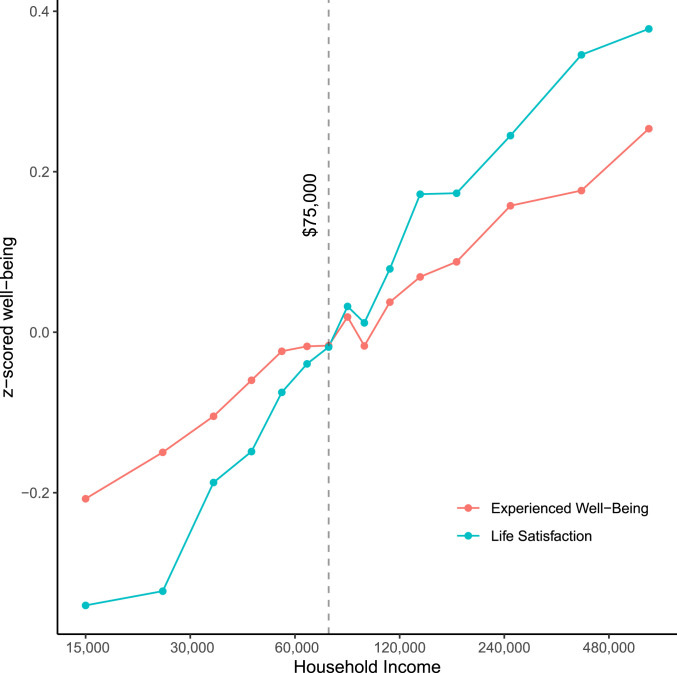
- Experienced well-being rose linearly with log income, with no observed plateau around $75,000/y: the slope was b = 0.109 (P < 0.00001) for incomes below and up to $80,000/y and b = 0.110 (P < 0.00001) for incomes above $80,000/y.
- Evaluative well-being also rose with log income, but its correlation was stronger (r = 0.17) than for experienced well-being (r = 0.09; Pdifference < 0.00001).
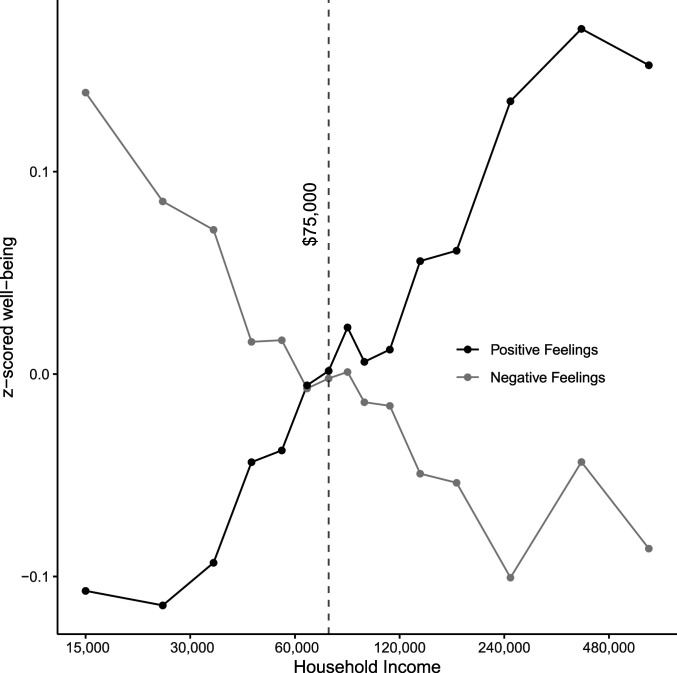
- Larger incomes were associated with significantly higher levels of all positive feelings and significantly lower levels of all negative feelings (all P < 0.00001, except Pstressed = 0.048 and Pangry = 0.00032). Above $80,000/y, higher incomes were associated with all positive feelings and lower levels of four of seven negative feelings (bad, bored, sad, and upset).
- Sense of control accounted for 74% of the association between income and experienced well-being (b = 0.105 without covariates vs. b = 0.027 with control as a covariate; Pmediation < 0.00001), and financial insecurity accounted for 38% (Pmediation < 0.00001). The income–well-being association was over four times as steep for people 1 SD above vs. 1 SD below the mean in money importance (b+1SD = 0.149 vs. b−1SD = 0.035).
Methods
- Experience sampling via trackyourhappiness.org: smartphones signaled participants at randomly timed moments during waking hours, asking about experience at the moment just before the signal. The sample included 33,391 employed US adults ages 18–65; median age was 33, median household income was $85,000/y, 36% were male, 37% were married, and median compliance was 72%.
- Experienced well-being was measured with “How do you feel right now?” on a continuous “Very bad” to “Very good” scale; evaluative well-being was measured with “Overall, how satisfied are you with your life?” on a continuous “Not at all” to “Extremely” scale. Income was measured in bands and log transformed for regression analyses.
- Data included 1,725,994 real-time reports; regression results for experienced well-being used 1,704,162 reports from 33,391 people. Analyses aggregated responses to the person level and used regression in R, including piecewise regressions split below/up to $80,000/y vs. above $80,000/y, plus multilevel regressions for positive and negative feelings and mediation/moderation analyses.
Limitations
- The paper states that no experience sampling study has employed a representative sample, and the present study is no exception; this is a potential disadvantage for generalizability, though the author argues the income distribution closely matches the US census and evaluative well-being follows representative-sample patterns.
- The paper states that explanations for why income correlates with well-being are “necessarily speculative,” since linking factors are likely numerous, complex, and interrelated.
- Evident from the text: the design is cross-sectional and correlational, so it cannot establish that income causes changes in well-being; income was measured in bands and assigned midpoint values for analysis, and the sample was restricted to employed adults ages 18–65 with household incomes of at least $10,000/y.
Model-written summary. Check it against the paper before relying on it.
Integrity signals
Registry
Cites
Statistics
Figures
Verification
Claims the paper makes
4 Valid · 0 Not valid · 13 Not checked · 56 Own results and interpretations
The sources with a verdict support this claim; the rest weren’t checked yet, have no full text we could read, or their verdicts aren’t rated yet.
In the paper
“These studies show that people with larger incomes tend to report greater evaluative well-being (1–10).”
§ Experienced well-being rises with income, even above $75,000 per year > Abstract
What the sources say
- Not checked yetcites [1] E. Diener, R. Biswas-Diener, Will money increase subjective well-being? Soc. Indic. Res. 57, 119– 169 (2002). source
- Not checked yetcites [2] J. Gardner, A. J. Oswald, Money and mental wellbeing: A longitudinal study of medium-sized lottery wins. J. Health Econ. 26, 49– 60 (2007). 16949692 source
- Not checked yetcites [3] M. Argyle, “ Causes and correlates of happiness” in Well-Being: The Foundations of Hedonic Psychology, D. Kahneman, E. Diener, N. Schwarz, Eds. (Russell Sage Foundation, 1999), pp. 353– 373.
- Supportedcites [4] B. Stevenson, J. Wolfers, Economic growth and subjective well-being: Reassessing the Easterlin paradox. Brookings Pap. Econ. Act. 2008, 1– 87 (2008). source
Stevenson and Wolfers (2008) report positive income–life-satisfaction gradients throughout: Section IV (within-country estimates, e.g. average country-specific gradient of 0.38 and Table 2 gradients centred around 0.3, with a linear-log relationship and 'no evidence of satiation') and Section III (World Values Survey satisfaction–income gradient of 0.40). Section II explicitly characterises life satisfaction/ladder measures as the 'more evaluative' component of subjective well-being, matching the claim's term 'evaluative well-being'; Section VII summarises well-being–income gradients centred around 0.4 across datasets. (LLM, conf=0.90)
- Not checked yetcites [5] R. Veenhoven, M. Hagerty, Rising happiness in nations 1946–2004: A reply to Easterlin. Soc. Indic. Res. 79, 421– 436 (2006). source
- Not checked yetcites [6] E. Lindqvist, R. Östling, D. Cesarini, Long-run effects of lottery wealth on psychological well-being. Rev. Econ. Stud. 87, 2703– 2726 (2018). source
- Not checked yetcites [7] E. Diener, E. Sandvik, L. Seidlitz, M. Diener, The relationship between income and subjective well-being: Relative or absolute? Soc. Indic. Res. 28, 195– 223 (1993). source
- Not checked yetcites [8] A. Deaton, Income, health, and well-being around the world: Evidence from the Gallup World Poll. J. Econ. Perspect. 22, 53– 72 (2008). 19436768 PMC2680297 source
- Not checked yetcites [9] R. E. Lucas, U. Schimmack, Income and well-being: How big is the gap between the rich and the poor? J. Res. Pers. 43, 75– 78 (2009). source
- Not checked yetcites [10] B. Stevenson, J. Wolfers, Subjective well-being and income: Is there any evidence of satiation? Am. Econ. Rev. 103, 598– 604 (2013). source
plainstates an association- Asserted: passes — The authors put it forward as true.
- Checkable: passes — It can be checked against evidence.
- Load-bearing: passes — The paper’s conclusions depend on it.
- Based: passes — The paper gives a reason why it holds.
Every source the paper cites for this claim was checked and supports it.
In the paper
“This finding has been the focus of substantial attention from researchers and the general public, yet is based on a dataset with a measure of experienced well-being that may or may not be indicative of actual emotional experience (retrospective, dichotomous reports).”
§ Experienced well-being rises with income, even above $75,000 per year > Abstract
What the sources say
- Supportedcites [11] D. Kahneman, A. Deaton, High income improves evaluation of life but not emotional well-being. Proc. Natl. Acad. Sci. U.S.A. 107, 16489– 16493 (2010). 20823223 PMC2944762 source
Our copy supports every element attributed to this source: the ~$75,000/y satiation of emotional well-being (Results, Table 2 discussion; Abstract) rests on the Gallup-Healthways Well-Being Index, whose emotional-well-being items are explicitly retrospective and dichotomous — Materials and Methods describes 'yes/no response options' to 'Did you experience the following feelings during a lot of the day yesterday?', and Results defines positive affect as 'the average of three dichotomous items' with stress 'also dichotomous'. The remaining clause ('may or may not be indicative of actual emotional experience') is the citing authors' own evaluative hedge rather than a statement attributed to Kahneman & Deaton, and our copy neither asserts nor contradicts it (the Discussion in fact calls the yesterday reports 'a purer measure of emotional well-being'). (LLM, conf=0.86)
hedged- Asserted: passes — The authors put it forward as true.
- Checkable: passes — It can be checked against evidence.
- Load-bearing: passes — The paper’s conclusions depend on it.
- Based: passes — The paper gives a reason why it holds.
- Supported
The sources with a verdict support this claim; the rest weren’t checked yet, have no full text we could read, or their verdicts aren’t rated yet.
In the paper
“The current study possesses a number of methodological differences that may have contributed to this, including measuring experienced well-being in real-time.”
§ Experienced well-being rises with income, even above $75,000 per year > Results and Discussion
What the sources say
- Supportedcites [11] D. Kahneman, A. Deaton, High income improves evaluation of life but not emotional well-being. Proc. Natl. Acad. Sci. U.S.A. 107, 16489– 16493 (2010). 20823223 PMC2944762 source
The Results (page not provided) report that emotional well-being stops improving with income beyond about $75,000, supporting the cited contrast with a linear relationship. The suggestion that real-time measurement may explain the difference is the citing authors’ interpretation of their own study, not a finding attributed to this source. (LLM, conf=0.90)
- Not checked yetcites [12] A. T. Jebb, L. Tay, E. Diener, S. Oishi, Happiness, income satiation and turning points around the world. Nat. Hum. Behav. 2, 33– 38 (2018). 30980059 source
hedgedstates a possible cause- Asserted: passes — The authors put it forward as true.
- Checkable: passes — It can be checked against evidence.
- Load-bearing: passes — The paper’s conclusions depend on it.
- Based: passes — The paper gives a reason why it holds.
- Supported
A result the paper reports from its own data — it cites no other source for it, so there is none to check. The quote shows it is in the paper.
In the paper
“with an equally steep slope above $80,000 as below it.”
- Also stated in: § Results and Discussion · plain
“Results showed that the slope of the association between log(income) and experienced well-being was virtually identical for incomes below and up to $80,000/y (b = 0.109, P < 0.00001) as it was for incomes larger than $80,000/y (b = 0.110, P < 0.00001).”
§ Experienced well-being rises with income, even above $75,000 per year > Abstract
plain- Asserted: passes — The authors put it forward as true.
- Checkable: passes — It can be checked against evidence.
- Load-bearing: passes — The paper’s conclusions depend on it.
- Based: passes — The paper gives a reason why it holds.
- Also stated in: § Results and Discussion · plain
A result the paper reports from its own data — it cites no other source for it, so there is none to check. The quote shows it is in the paper.
In the paper
“Unlike money importance, however, the more people equated money and success, the lower their experienced well-being was on average (P < 0.00001)”
§ Experienced well-being rises with income, even above $75,000 per year > Results and Discussion
plainstates an association- Asserted: passes — The authors put it forward as true.
- Checkable: passes — It can be checked against evidence.
- Load-bearing: unclear — It is unclear whether the paper’s conclusions depend on it.
- Based: passes — The paper gives a reason why it holds.
- Rests on 3 assumptions not shown here.
33 more claims
Create a free account to see all 73 claims and to verify the 33 references still open.
- It may state two separate claims as one. 28
- Probably not a substantial claim. 13
Claims other papers make about this one
Each is checked against this paper’s own text: does it say what the citing paper says it does?
The cited source says what the claim attributes to it.
In the citing paper
“As shown in Fig. 1B, MK found a linear relationship between average experienced happiness and log(income) which extended well beyond $200,000.”
From Income and emotional well-being: A conflict resolved (2023) · cites this paper as [2]
Self-check
Percentages, sums and reported differences re-computed from the paper’s own numbers.
Each contradiction between two passages listed here was confirmed by an independent check.
Rated minor: it would not touch a result — a value no result rests on, a p-value that stays on the same side of the significance level, or a conflict that is clerical, resolved elsewhere in the paper, or outside its own findings.
In the paper
§ Experienced well-being rises with income, even above $75,000 per year > Abstract
“The present results are based on 1,725,994 reports of experienced well-being from 33,391 employed, working-age adults (ages 18 to 65) living in the United States.”
§ Experienced well-being rises with income, even above $75,000 per year > Materials and Methods > Life Satisfaction and Experienced Well-Being Case Details.
“All other results for experienced well-being (e.g., regression results) are based on all 1,704,162 reports from 33,391 people.”
Citations
Cites
The satisfaction with life scale
Diener, E., Emmons, R. A., Larsen, R. J., & Griffin, S. (1985) · Journal of Personality Assessment · doi:10.1207/s15327752jpa4901_13 · Cited by 31,768 · cited 4×
“The first measure was the Satisfaction With Life Scale (21), a five-item scale that asks people about the extent to which they agree or disagree with five statements, such as “ In most ways my life is close to ideal ” and “ If I could live my life over, I would change almost nothing ” with…”
InfluentialWell-being : the foundations of hedonic psychology
Kahneman, D. J., Diener, E. F., & Schwarz, N. (1999) · Cited by 8,352
High income improves evaluation of life but not emotional well-being
Kahneman, D., & Deaton, A. (2010) · Proceedings of the National Academy of Sciences · doi:10.1073/pnas.1011492107 · Cited by 3,162 · cited 6×
“These features offer a number of methodological improvements over the study finding a $75,000 plateau in experienced well-being (11), which was based on a dichotomous (Yes/ No) experienced well-being measure, measured emotions retrospectively for yesterday, on a single occasion, with large…”
InfluentialA wandering mind is an unhappy mind
Killingsworth, M. A., & Gilbert, D. T. (2010) · Science · doi:10.1126/science.1192439 · Cited by 2,575 · cited 1×
“org (18), a large-scale project using the experience sampling method (19, 20), in which participants’ smartphones were signaled at randomly timed moments during their waking hours and prompted to answer questions about their experience at the moment just before the signal.”
Self-citationValidity and reliability of the Experience-Sampling Method
CSIKSZENTMIHALYI, M., & LARSON, R. (1987) · The Journal of Nervous and Mental Disease · doi:10.1097/00005053-198709000-00004 · Cited by 2,544 · cited 1×
“…pooled incomes above $120,000/y. Data are from http://trackyourhappiness.org (18), a large-scale project using the experience sampling method (19, 20), in which participants ’ smartphones were signaled at randomly timed moments during their waking hours and prompted to answer questions about…”
Income, Health, and Well-Being around the World: Evidence from the Gallup World Poll
Deaton, A. (2008) · Journal of Economic Perspectives · doi:10.1257/jep.22.2.53 · Cited by 1,636
Will Money Increase Subjective Well-Being?
Diener, E., & Biswas-Diener, R. (2002) · Social Indicators Research · doi:10.1023/a:1014411319119 · Cited by 1,555
When More Pain Is Preferred to Less: Adding a Better End
Kahneman, D., Fredrickson, B. L., Schreiber, C. A., & Redelmeier, D. A. (1993) · Psychological Science · doi:10.1111/j.1467-9280.1993.tb00589.x · Cited by 1,502
Duration neglect in retrospective evaluations of affective episodes.
Fredrickson, B. L., & Kahneman, D. (1993) · Journal of Personality and Social Psychology · doi:10.1037/0022-3514.65.1.45 · Cited by 1,228 · cited 1×
“This requires people to accurately re-member how they felt across the various moments of the past and then accurately integrate those memories into a single estimate, an approach that is vulnerable to memory errors and biases in judgment (15 – 17).”
The relationship between income and subjective well-being: Relative or absolute?
Diener, E., Sandvik, E., Seidlitz, L., & Diener, M. (1993) · Social Indicators Research · doi:10.1007/bf01079018 · Cited by 1,175
Research works printed but not linked: 1
- M. A. Killingsworth, Experienced well-being rises with income, even above $75,000 per year. Open Science Framework. https://osf.io/nguwz/. Deposited 3 January 2021. PMC7848527 33468644
Cited by
Income and emotional well-being: A conflict resolved
Killingsworth, M. A., Kahneman, D., & Mellers, B. (2023) · Proceedings of the National Academy of Sciences · doi:10.1073/pnas.2208661120 · Cited by 190
“Matthew Killingsworth [(2); hereafter MK] recruited a large number of participants for a study in which he obtained “1,725,994 experience-sampling reports from 33,391 employed US adults.”
Self-citationThe scientific value of numerical measures of human feelings
Kaiser, C., & Oswald, A. J. (2022) · Proceedings of the National Academy of Sciences · doi:10.1073/pnas.2210412119 · Cited by 167
The well-being of women entrepreneurs: the role of gender inequality and gender roles
Love, I., Nikolaev, B., & Dhakal, C. (2023) · Small Business Economics · doi:10.1007/s11187-023-00769-z · Cited by 131
“This is one of the most well-established relationships in the cross-country literature on well-being that has become a stylized fact (e.g., Kahneman & Deaton, 2010; Killingsworth, 2021; Stevenson & Wolfers, 2013).”
Social, Cultural, and Economic Determinants of Well-Being
Livingston, V., Jackson-Nevels, B., & Reddy, V. V. (2022) · Encyclopedia · doi:10.3390/encyclopedia2030079 · Cited by 119
Compensation and performance: A review and recommendations for the future
Fulmer, I. S., Gerhart, B. A., & Kim, J. H. (2023) · Personnel Psychology · doi:10.1111/peps.12583 · Cited by 155
The Cantril Ladder elicits thoughts about power and wealth
Nilsson, A. H., Eichstaedt, J. C., Lomas, T., Schwartz, A., & Kjell, O. (2024) · Scientific Reports · doi:10.1038/s41598-024-52939-y · Cited by 57
“There is consistent research on the importance of income for well-being, but the strength and nature of the relationship (e.g., linear or curvilinear) differ among well-being dimensions and baselines 33,34 .”
BackgroundSun, Y., Ng, M. K., Chao, T.-Y. S., He, S., & Mok, S. H. (2022) · Journal of Aging & Social Policy · doi:10.1080/08959420.2022.2111168 · Cited by 68
“This confirms that income is a predictor of well-being (Killingsworth, 2021).”
BackgroundLomas, T., & VanderWeele, T. J. (2021) · The Journal of Positive Psychology · doi:10.1080/17439760.2021.1991453 · Cited by 54
“Similarly, using an ‘experience sampling method’ with an American population, Killingsworth (2021) observed a linear trend that continued even above earnings of $80,000 per year (though significantly, the effect sizes were very small, meaning the relationship is still weak).”
MethodManaging crises ‘together’: how can the built environment contribute to social resilience?
Rashidfarokhi, A., & Danivska, V. (2023) · Building Research & Information · doi:10.1080/09613218.2023.2191922 · Cited by 48
Money and happiness: the income–happiness correlation is higher when income inequality is higher
Oishi, S., Cha, Y., Komiya, A., & Ono, H. (2022) · PNAS Nexus · doi:10.1093/pnasnexus/pgac224 · Cited by 61
“For instance, Killingsworth (12) analyzed the experience sampling data (i.e. momentary reports of happiness) from 33,391 employed,working-age adults living in the USA and found that self-reported happiness continues to increase as the participants’ household income increases, even beyond $120,000.”
BackgroundSakyi‐Nyarko, C., Ahmad, A. H., & Green, C. J. (2021) · Review of Development Economics · doi:10.1111/rode.12848 · Cited by 35
Measuring the Monetary Value of Online Volunteer Work
Li, H., Hecht, B. J., & Chancellor, S. (2022) · Proceedings of the International AAAI Conference on Web and Social Media · doi:10.1609/icwsm.v16i1.19318 · Cited by 65
Mendelian randomization evidence for the causal effect of mental well-being on healthy aging
Ye, C., Liu, D., Chen, M., Kong, L., Dou, C., Wang, Y.-Y., Xu, M., Xu, Y., Li, M., Zhao, Z., et al. (2024) · Nature Human Behaviour · doi:10.1038/s41562-024-01905-9 · Cited by 37
“…indicators and mental well-being and revealed that income, rather than education or occupation, predominantly drove the effect of SES on mental well-being, consistent with recent evidence that higher income could contribute to better mental well-being, independent of sociodemographics 11,18 .”
Exploring associations between income and wellbeing: new global insights from the Gallup World Poll
Lomas, T. (2023) · The Journal of Positive Psychology · doi:10.1080/17439760.2023.2248963 · Cited by 33
“Similarly, using an experience sampling method with an American population, Killingsworth (2021) found a linear trend that continued even above earnings of $80,000 per year (though significantly, the effect sizes were very small, meaning the relationship is still weak).”
MethodWealth redistribution promotes happiness
Dwyer, R., & Dunn, E. W. (2022) · Proceedings of the National Academy of Sciences · doi:10.1073/pnas.2211123119 · Cited by 43
Material resources and well-being — Evidence from an Ethiopian housing lottery
Andersen, A., Kotsadam, A., & Somville, V. (2022) · Journal of Health Economics · doi:10.1016/j.jhealeco.2022.102619 · Cited by 28
How power increases preference for experiential purchases but not for material purchases
Han, J. J., Smale, M. C., & Lee, J. (2023) · Psychology and Marketing · doi:10.1002/mar.21793 · Cited by 29
Machine learning in the prediction of human wellbeing
Oparina, E., Kaiser, C., Gentile, N., Tkatchenko, A., Clark, A. E., Neve, J.-E. D., & D’Ambrosio, C. (2025) · Scientific Reports · doi:10.1038/s41598-024-84137-1 · Cited by 39
“Given these caveats, and in line with previous work on wellbeing from the US 29,32 , we find no evidence of satiation in the relationship between income and evaluative wellbeing in the Gallup data.”
Pan, D., Yu, Y., & Ji, K. (2024) · Humanities and Social Sciences Communications · doi:10.1057/s41599-024-03052-y · Cited by 29
“The fi rst aspect is socio-demographic individual factors, including income (Killingsworth, 2021; Pouwels et al., 2008), education (Cuñado and de Gracia, 2012), age (Knight et al., 2022), health (Blanch-fl ower and Oswald, 2008), employment (Ashwin et al., 2021), and marital status (Li et al., 2021a).”
THE PSYCHOLOGY OF POVERTY: WHERE DO WE STAND?
Haushofer, J., & Salicath, D. (2023) · Social Philosophy and Policy · doi:10.1017/s0265052523000419 · Cited by 43
Schmitz, A., & Brandt, M. (2022) · Social Indicators Research · doi:10.1007/s11205-022-02967-w · Cited by 22
“While it has been suggested that income gets less relevant once basic needs are met (Graham, 2011 for an overview), empirical studies show that the link between wealth and wellbeing holds up to very high levels of income (e.g. Killingsworth 2021).”
BackgroundKudrna, L., & Kushlev, K. (2022) · Frontiers in Psychology · doi:10.3389/fpsyg.2022.883137 · Cited by 33
“Recently, this finding has been qualified by studies showing that the relationship between income and happiness depends on how happiness is conceptualized and measured: as an overall evaluation of one’s life or as daily emotional states (Kahneman and Deaton, 2010; Killingsworth, 2021).”
BackgroundMethodArrindell, W. A., Checa, I., Espejo, B., Chen, I., Carrozzino, D., Vu-Bich, P., Dambach, H., & Vagos, P. (2022) · International Journal of Environmental Research and Public Health · doi:10.3390/ijerph19063460 · Cited by 33
“The association between SWLS and income is complex: it may not exist [45], it may be linear up to a certain threshold as demonstrated in data collected in 26 European countries [46], or it may rise linearly [9], with an equally steep slope even above a substantially high income (USD 80,000 per year) as below it, as wa…”
ResultConnolly, F. F., & Gärling, T. (2021) · Journal of Happiness Studies · doi:10.1007/s10902-021-00466-2 · Cited by 26
“This is consistent with previous studies (Kahneman & Deaton, 2010; Killingsworth, 2021; Kushlev et al., 2015; Whillans et al., 2017) showing that financial resources are used to reduce negative affect in daily encounters as well as to increase positive affect.”
BackgroundResultInfluentialThe Road from Money to Happiness
Mureșan, G.-M., Fülöp, M. T., & Ciumaş, C. (2021) · Journal of risk and financial management · doi:10.3390/jrfm14100459 · Cited by 31
“…a certain level does not have an enduring impact on the feeling of happiness/joy, because we as individuals are able to adapt to different situations (Killingsworth 2021; Frederick and Loewenstein 1999; Frey and Stutzer 2002; Kahneman and Deaton 2010; Stevenson and Wolfers 2013; Jebb et al. 2018).”
BackgroundInfluentialCait, J., Winder, C. B., & Mason, G. J. (2024) · Applied Animal Behaviour Science · doi:10.1016/j.applanim.2024.106361 · Cited by 21
High life satisfaction reported among small-scale societies with low incomes
Galbraith, E. D., Barrington-Leigh, C. P., Miñarro, S., Álvarez‐Fernández, S., Attoh, E. M. N. A. N., Benyei, P., Calvet‐Mir, L., Carmona, R., Chakauya, R., Chen, Z., et al. (2024) · Proceedings of the National Academy of Sciences · doi:10.1073/pnas.2311703121 · Cited by 38
Liu, T., Liu, Q., & Jiang, D. (2022) · Frontiers in Psychology · doi:10.3389/fpsyg.2022.771598 · Cited by 30
Peterson, R. R., & DiPietro, R. B. (2021) · International Hospitality Review · doi:10.1108/ihr-10-2020-0063 · Cited by 23
Do social and ecological indicators have the same effect on the subjective well-being of residents?
Tang, Z., Xie, M., Chen, B., et al. (2023) · Applied Geography · doi:10.1016/j.apgeog.2023.102994 · Cited by 19
Expanding relationship science to unpartnered singles: What predicts life satisfaction?
Walsh, L. C., Gonzales, A. M., Shen, L. Q., Rodriguez, A., & Kaufman, V. A. (2022) · Frontiers in Psychology · doi:10.3389/fpsyg.2022.904848 · Cited by 29
“This may make sense given that life satisfaction is positively associated with income and education (Meeks and Murrell, 2001; Killingsworth, 2021).”
BackgroundNawa, N. E., & Yamagishi, N. (2024) · BMC Psychology · doi:10.1186/s40359-024-01606-y · Cited by 37
“These additional variables were included based on evidence indicating their influence on individual well-being differences [107–112].”
BackgroundLife satisfaction among persons living with dementia and those without dementia
Gotanda, H., Tsugawa, Y., Xu, H., & Reuben, D. B. (2022) · Journal of the American Geriatrics Society · doi:10.1111/jgs.18174 · Cited by 25
The WELLBY: a new measure of social value and progress
Frijters, P., Krekel, C., Sanchis, R. G., & Santini, Z. I. (2024) · Humanities and Social Sciences Communications · doi:10.1057/s41599-024-03229-5 · Cited by 44
“…not perfectly correlate with those of measures for other concepts and have somewhat different correlations with external variables, see the differences between life satisfaction, experiences of happiness, and income (cf. Kahneman and Deaton, 2010; Killingsworth, 2021; Killings-worth et al., 2023).”
Li, C., & Managi, S. (2024) · Scientific Reports · doi:10.1038/s41598-024-53279-7 · Cited by 20
Lulaj, E., & Dragusha, B. (2022) · International Journal of Professional Business Review · doi:10.26668/businessreview/2022.v7i6.623 · Cited by 23
From MIsgivings to MIse-en-scène: The role of invariance in personality science
Fischer, R. D., & Rudnev, M. (2024) · European Journal of Personality · doi:10.1177/08902070241283081 · Cited by 41
“In contrast, Killingsworth (2021) did not fi nd these differences and reported a linear increase in happiness with income.”
Economic inequality and the long-term future
Schmidt, A. T., & Juijn, D. (2023) · Politics Philosophy & Economics · doi:10.1177/1470594x231178502 · Cited by 28
“However, using real-time rather than retrospective experience wellbeing data, Killingsworth argues there is no satiation point and wellbeing continues to increase logarithmically with growing income (albeit, again, more slowly than life satisfaction) (Killingsworth, 2021).”
BackgroundIncome raises human well-being indefinitely, but age consistently slashes it
Li, C., & Managi, S. (2023) · Scientific Reports · doi:10.1038/s41598-023-33235-7 · Cited by 22
The Science of Dignity: Measuring Personhood and Well-Being in the United States
Hitlin, S., & Andersson, M. A. (2023) · doi:10.1093/oso/9780197743867.001.0001 · Cited by 18
Twins, income, and happiness: Evidence from China
Ye, M., Zhang, J., & Li, H. (2023) · Proceedings of the National Academy of Sciences · doi:10.1073/pnas.2221884120 · Cited by 19
Araki, S. (2023) · Research in Social Stratification and Mobility · doi:10.1016/j.rssm.2023.100782 · Cited by 13
Yaşamın-İşin Anlam Kaynakları ve İyi Oluş İlişkisi Üzerine Bir Araştırma
Alparslan, A. M., Yastıoğlu, S., TAŞ, M. A., & Özmen, M. (2022) · Süleyman Demirel Üniversitesi Vizyoner Dergisi · doi:10.21076/vizyoner.947733 · Cited by 20
Time use and happiness: Evidence across three decades
Han, J., & Kaiser, C. (2021) · Journal of Population Economics · doi:10.1007/s00148-024-00982-4 · Cited by 13
Fischer, R. D., Karl, J. A., Luczak–Roesch, M., & Hartle, L. (2023) · doi:10.31234/osf.io/3f9ca · Cited by 12
Abbas, H., Aida, J., Kondo, K., & Osaka, K. (2022) · Journal of Prosthetic Dentistry · doi:10.1016/j.prosdent.2022.02.014 · Cited by 13
Taking the pulse of nations: A biometric measure of well-being
Blanchflower, D. G., & Bryson, A. (2022) · Economics & Human Biology · doi:10.1016/j.ehb.2022.101141 · Cited by 15
Financial wellbeing of households in instability
Voznyak, H. V., Mulska, O. P., Bil, M., & Radelytskyy, Y. O. (2022) · Investment Management and Financial Innovations · doi:10.21511/imfi.19(1).2022.10 · Cited by 16
“…wellbeing with the determination of the maximum threshold values for income, with the growth of which an individual feels the life improvement (Killingsworth, 2021). http://dx.doi.org/10.21511/imfi.19(1).2022.10 Despite subjective projections of financial wellbeing, its estimation…”
BackgroundInfluentialVarghese, J. S., Waford, R., Adair, L. S., Patel, S. A., Martorell, R., Belleza, D., Kroker-Lobos, M. F., Lee, N. R., Nyati, L. H., Ramírez‐Zea, M., et al. (2022) · Wellbeing Space and Society · doi:10.1016/j.wss.2022.100115 · Cited by 13
“SEP over the life course is associated with life satisfaction (evaluative wellbeing) (Killingsworth, 2021; Niedzwiedz et al., 2014).”
BackgroundVarghese, J. S., Waford, R., DiGirolamo, A. M., Martorell, R., Ramírez‐Zea, M., & Stein, A. D. (2021) · SSM - Population Health · doi:10.1016/j.ssmph.2021.100880 · Cited by 13
Higher income is associated with greater life satisfaction, and more stress
Akkiraju, K., & Rao, N. D. (2025) · Communications Psychology · doi:10.1038/s44271-025-00210-z · Cited by 16
“Most studies fi nd that higher life satisfaction is associated with higher income well beyond the annual household income of $200,000 6 – 9 , although one study fi nds that increases in life satisfaction slow down and reverse with personal income growth past $105,000 10 .”
InfluentialFor living well, behaviors and circumstances matter just as much as psychological traits
Hobbs, W., & Ong, A. D. (2023) · Proceedings of the National Academy of Sciences · doi:10.1073/pnas.2212867120 · Cited by 14
Parenting on Earth: A Philosopher's Guide to Doing Right by Your Kids—and Everyone Else
Cripps, E. (2023) · The MIT Press eBooks · doi:10.7551/mitpress/14297.001.0001 · Cited by 15
Individual differences in personality and positive emotion for wealth creation
Asebedo, S. D., Quadria, T. H., Chen, Y., & Montenegro‐Montenegro, E. (2022) · Personality and Individual Differences · doi:10.1016/j.paid.2022.111854 · Cited by 18
Sustainable Investment: Consequences for Psychological Well-Being
Gärling, T., & Jansson, M. (2021) · Sustainability · doi:10.3390/su13169256 · Cited by 21
“Presumably for this reason, increases in material wealth become more strongly reflected in changes in hedonic and eudaimonic well-being; in affluent societies, these dimensions of PWB thus appear to be less influenced by income than evaluative well-being [78,79].”
BackgroundBiałowolski, P., Makridis, C. A., Bradshaw, M., Węziak‐Białowolska, D., Gundersen, C., Pertel, N. L., Gibson, C. B., Jang, S. J., Padgett, R. N., Johnson, B. R., et al. (2025) · Nature Human Behaviour · doi:10.1038/s41562-025-02207-4 · Cited by 24
“Examining financial well-being across nations and cultures around the world may inform strategies to promote both financial well-being and other aspects of overall well-being, such as health and quality of life, which are irrevocably intertwined 17,18 .”
Wu, L., & Wang, G. (2024) · Healthcare · doi:10.3390/healthcare12212186 · Cited by 13
Binsuwadan, J., Elhaj, M., Bousrih, J., Mabrouk, F., & Alofaysan, H. (2024) · Sustainability · doi:10.3390/su16198317 · Cited by 22
Janicke‐Bowles, S. H. (2023) · Communication Studies · doi:10.1080/10510974.2023.2289688 · Cited by 13
“Furthermore, greater income is associated with overall greater happiness (Killingsworth, 2021), which can partly be explained by reduced stress and greater autonomy on how to live life (Jachimowicz et al., 2022).”
BackgroundKraft, P., & Kraft, B. (2023) · Frontiers in Psychology · doi:10.3389/fpsyg.2023.1283601 · Cited by 20
“Additionally, our findings align with previous research demonstrating that higher income is associated with better SWB across the income spectrum (Killingsworth, 2021; Killingsworth et al., 2023).”
BackgroundResultSevilla, J. P. (2022) · Current Opinion in Immunology · doi:10.1016/j.coi.2022.102243 · Cited by 12
Make science more collegial: why the time for ‘adversarial collaboration’ has come
(2025) · Nature · doi:10.1038/d41586-025-01379-3 · Cited by 13
The Anna Karenina income effect: Well-being inequality decreases with income
Teeselink, B. K., & Zauberman, G. S. (2023) · Journal of Economic Behavior & Organization · doi:10.1016/j.jebo.2023.05.036 · Cited by 16
Income and education show distinct links to health and happiness in daily life
Newman, D. B., Gordon, A. M., & Mendes, W. B. (2025) · Nature Human Behaviour · doi:10.1038/s41562-025-02264-9 · Cited by 12
“For instance, income is positively related to evaluative judgements of life satisfaction 3,11,13,33 and meaning in life 41,42 , and these relationships may be stronger than the relationships we detected between income and emotions.”
Marquez, J., Lambert, L., & Cutts, M. (2022) · Child Indicators Research · doi:10.1007/s12187-022-09993-7 · Cited by 16
“…which to enjoy life and find it satisfying, the same cannot always be said of those same resources defending against mental health issues, like depression, anxiety, etc. (Killingsworth, 2021), which present a particularly high incidence (above global rates) in the GCC region (Chan et al., 2021).”
BackgroundFive Insights for Avoiding Global Collapse
Herrington, G. (2022) · MDPI eBooks · doi:10.3390/books978-3-0365-3721-4 · Cited by 12
Bearson, D., & Sunstein, C. R. (2023) · Behavioural Public Policy · doi:10.1017/bpp.2023.21 · Cited by 14
Valuing Versus Having: The Contrary Roles of Valuing and Having Money and Prestige on Well-Being
Pfund, G. N., Willroth, E. C., Mroczek, D. K., & Hill, P. L. (2023) · Social Psychological and Personality Science · doi:10.1177/19485506231166048 · Cited by 9
“With life satisfaction being a more cognitive-oriented component of well-being (Diener et al., 1999), this finding aligns with previous work highlighting that income is linearly associated with more evaluative aspects of well-being (Killingsworth, 2021).”
MethodResultZhang, F., Liu, D., & Geng, X. (2022) · International Journal of Environmental Research and Public Health · doi:10.3390/ijerph191811551 · Cited by 12
Evidence from 33 countries challenges the assumption of unlimited wants
Bain, P. G., & Bongiorno, R. (2022) · Nature Sustainability · doi:10.1038/s41893-022-00902-y · Cited by 10
Seeking Genuine Vocations through Sustainability in Chemical Engineering
Karjanto, N. (2022) · Sustainability · doi:10.3390/su14126980 · Cited by 7
Abdollahian, M. A., Zeng, Y., & Thomas, J. R. (2024) · Social Sciences & Humanities Open · doi:10.1016/j.ssaho.2024.100981 · Cited by 16
Back to Edgeworth? Estimating the Value of Time Using Hedonic ExperiencesPreprint
Krekel, C., & MacKerron, G. (2023) · SSRN Electronic Journal · doi:10.2139/ssrn.4509724 · Cited by 8
Causality and ability beliefs: An introduction to confounders and colliders
Al‐Hoorie, A. H., & Hiver, P. V. (2025) · Studies in Second Language Learning and Teaching · doi:10.14746/ssllt.48231 · Cited by 10
Diversity, Inclusion, and Equity in Gig Economies
Efthymiou, I.-P. (2025) · IGI Global eBooks · doi:10.4018/979-8-3693-9385-7.ch009 · Cited by 5
Brydges, C. R., Thérond, A., & Norris, T. W. (2025) · Frontiers in Psychiatry · doi:10.3389/fpsyt.2024.1516729 · Cited by 11
Analysis of value chain of the artisanal sea urchin fishery of Baja California, México
Cabrera-Sánchez, C. T., Montaño‐Moctezuma, G., Coronado, E., et al. (2024) · Marine Policy · doi:10.1016/j.marpol.2024.106509 · Cited by 5
The Sensitivity of the Human Development Index to Assumptions about Income
Kula, M. C., Charles J. Moyer, Jr., & Panday, P. (2024) · Journal of Economic Analysis · doi:10.58567/jea04010010 · Cited by 8
“In Killingsworth et al (2023), they reconsider the nature of the Gallup survey questions used by Kahneman and Deaton (2010) and the lack of analysis on different sub-sample data done by Killingsworth (2021).”
Zhu, F., Cao, X., Zhuang, D., Jin, S., & Yang, X. (2024) · Growth and Change · doi:10.1111/grow.12734 · Cited by 6
Happiness in Islam and Influencing Factors (SLR Approach)
Wiliasih, R., Siregar, H., Irawan, T., & Beik, I. S. (2024) · Al-Muzara ah · doi:10.29244/jam.12.1.137-157 · Cited by 5
“According to Clark et al. (2006) and Killingsworth (2021), there is a positive correlation between high income and happiness.”
BackgroundAmo-Agyei, S., & Maurer, J. (2024) · Economics & Human Biology · doi:10.1016/j.ehb.2024.101406 · Cited by 7
The Psychology of Poverty: Where Do We Stand?
Haushofer, J., & Salicath, D. (2023) · National Bureau of Economic Research · doi:10.3386/w31977 · Cited by 15
Oil dependency and happiness in net oil-exporting countries: is it a curse or blessing?
Slesman, L. (2023) · Middle East Development Journal · doi:10.1080/17938120.2023.2275484 · Cited by 6
“Later studies, however, refuted this nonlinear evidence by showing that the relationship remains linear throughout the income range (Deaton, 2008; Killingsworth, 2021; Stevenson & Wolfers, 2013).”
Tønnessen, M. (2023) · Humanities and Social Sciences Communications · doi:10.1057/s41599-023-02210-y · Cited by 10
Gao, X., Lee, K. L., Permpoonputtana, K., & Plitponkarnpim, A. (2022) · Journal of Family and Economic Issues · doi:10.1007/s10834-022-09863-y · Cited by 9
“1 3 Killingsworth 2021), on a bivariate level, higher income and lower financial worries were related to greater happiness and lower distress in both cultures.”
BackgroundLiving Well or Spending More? A 25-Year Review of Income, Consumption, and Life Satisfaction
Bortolotti, A., Berardino, C. D., & Palumbo, R. (2026) · Journal of Happiness Studies · doi:10.1007/s10902-026-01006-6 · Cited by 9
“The synthesis of empirical evidence reveals that spending quality significantly outweighs spending quantity in determining perceived happiness, a finding that remains consistent across multiple cultural contexts and income brackets (Kahneman & Deaton 2010; Killingsworth 2021 ).”
InfluentialDeclining subjective well-being disparities concurrent with urbanization in China
Sun, R., Li, W., He, H., Leng, S., Cheng, J., Yang, X., Yu, Z., & Chen, L. (2025) · National Science Review · doi:10.1093/nsr/nwaf362 · Cited by 5
“Nevertheless, the complexity of this interaction is further intensified by evidence suggesting that the evolution of social and ecological systems may vary depending upon the different stages of urban development [26 –28 ].”
Ip, M. W. S., & Chan, H. C. (2025) · Behavioral Sciences & the Law · doi:10.1002/bsl.70001 · Cited by 4
“Although some studies observed a positive correlation between income and well‐being (Blanchflower and Oswald 2004; Killingsworth 2021; Mentzakis and Moro 2009; Sacks et al. 2012), other studies did not establish this positive relationship (Boyce et al. 2010; Easterlin 2001; Kahneman and Deaton…”
Chen, Y., Nakagomi, A., Hanazato, M., Abe, N., Ide, K., & Kondo, K. (2025) · Scientific Reports · doi:10.1038/s41598-025-88349-x · Cited by 9
Association Between Income and Well-Being Among Working Women in Japan
Suzuki, T., Sasayama, K., Nishimura, E., Yamaji, N., Ota, E., Saito, E., & Yoneoka, D. (2025) · Healthcare · doi:10.3390/healthcare13030240 · Cited by 9
Chain Restaurant Calorie Posting Laws, Obesity, and Consumer Welfare
Courtemanche, C., Frisvold, D., Jimenez‐Gomez, D., Ouayogodé, M. H., & Price, M. (2025) · Journal of the European Economic Association · doi:10.1093/jeea/jvaf004 · Cited by 11
“Following Stevenson and Wolfers ( 2013 ) and Killingsworth ( 2021 ), we standardize life satisfaction so that the coefficient estimates can be interpreted in terms of standard deviation changes.”
Is happiness independent of income? Set point theory à la Kahneman
Khalil, E. L. (2024) · Journal for the Theory of Social Behaviour · doi:10.1111/jtsb.12434 · Cited by 5
Araki, S., & Olivos, F. (2024) · Social Indicators Research · doi:10.1007/s11205-024-03358-z · Cited by 9
Statistical identification of predictors of dropout in secondary education: evidence from Malaysia
Hashim, R. A., Lim, H. E., Jafar, M. F., Shanmugam, S. K. S., & Bukhari, N. (2024) · Journal of the Asia Pacific Economy · doi:10.1080/13547860.2024.2306673 · Cited by 4
“For examples, see Di Tella, MacCulloch, and Oswald (2003), and Killingsworth (2021).”
Shuhidan, S. M., Lokman, A. M., Hamidi, S. R., Kadir, S. A., Syahirah, S., & Alam, M. M. (2023) · Journal of Community & Applied Social Psychology · doi:10.1002/casp.2716 · Cited by 13
Money and happiness: A consideration of history and psychological mechanisms
Buttrick, N. R., & Oishi, S. (2023) · Proceedings of the National Academy of Sciences · doi:10.1073/pnas.2301893120 · Cited by 12
“Others, by contrast, find that those Americans who are making more money report that their pres - ent moments are happier and that this effect does not weaken across the income spectrum: Additional income continues to make everyone happier, both the poor and the rich (3).”
BackgroundExpectation-achievement gaps and satisfaction in World Cup football supporters: a quasi-experiment
Robinson, M. A., Davis, M. C., & Unsworth, K. L. (2021) · European Sport Management Quarterly · doi:10.1080/16184742.2021.2007278 · Cited by 6
“More recently, Killingsworth (2021) found life satisfaction and experienced wellbeing both increased linearly from very low ($15,000) to very high ($480,000) annual household incomes.”
BackgroundIncomes, aspiration adaptation, and happiness: Evidence from China
Yang, J., You, L., & Zhou, Y. (2026) · China Economic Review · doi:10.1016/j.chieco.2026.102718 · Cited by 2
Identifying Key Predictors of Subjective Well-Being across 92 Countries: A Machine Learning Approach
Li, R., & Yueqin, H. U. (2026) · Journal of Happiness Studies · doi:10.1007/s10902-025-01004-0 · Cited by 6
“…high income, higher educational attainment, and better employment status, provides access to material, social, and institutional resources, and also offers security, opportunities (Kahneman & Deaton, 2010; Killingsworth, 2021; Ludwig et al., 2012), as well as autonomy and freedom (Nikolaev, 2018).”
Metadata
- Authors
- Killingsworth, M. A.
- Affiliations
- University of Pennsylvania (US)
- Corresponding author
- Killingsworth, Matthew A.
- Venue
- Proceedings of the National Academy of Sciences
- Publisher
- National Academy of Sciences
- Published
- 2021-01-18
- Volume
- 118
- Issue
- 4
- ISSN
- 0027-8424 (ISSN-L)
- 1091-6490
- PMC
- PMC7848527
- OpenAlex
- W3124335630
- Semantic Scholar
- 0da9f6394716672367bdc3e1774e63abc670c574
- Cited by
- 274
- References
- 26
- Citations by year
- 2026: 51 · 2025: 57 · 2024: 53 · 2023: 67 · 2022: 33 · 2021: 13
- FWCI
- 40.67
- Type
- journal article
- Language
- en
- Open access
- hybrid
- doi.org
- Licence
- Locations
- Proceedings of the National Academy of Sciences (publishedVersion, cc-by-nc-nd)
- Europe PMC (PubMed Central) (publishedVersion, cc-by-nc-nd)
- PubMed Central (publishedVersion, cc-by-nc-nd)
- PubMed (publishedVersion)
- OSF Preprints (OSF Preprints) (submittedVersion)
- Topics
- Social Sciences › Psychology › Social Psychology › Psychological Well-being and Life Satisfaction
- Health Sciences › Medicine › Public Health, Environmental and Occupational Health › Employment and Welfare Studies
- Social Sciences › Sociology and Political Science › Income, Poverty, and Inequality
- Keywords
- experienced well-being, income, subjective well-being, happiness, life satisfaction, income thresholds, income and happiness relationship, working adults, ecological momentary assessment
About these checks
Registry, retraction, Cites and statistics results are computed, not judged, with one exception: a printed reference that no index lists is read once by a model before it counts as a citation error. Claims are extracted by a model and kept only when their quote appears verbatim in the text; each cited source is then checked, with a model’s help, for whether it says what the claim relies on. Those verdicts can be wrong — read the claim’s quote and the cited source before relying on one.
A language model drew the claims from the paper on 2026-09-29, under version 3 of the claim definition (model deepseek-v4.1-flash, prompt extract-v3).
A second model labelled each claim on 2026-09-29 (model jev-1.13-20260917, definition revision gold-guideline-v0.2).
Cited sources are checked with a language model’s help (qwen3.8-omni-flash and gpt-6-sol).
Statistics and arithmetic are recomputed, not judged.
Confidence bands are shown only for fields calibrated on our annotated test set. None is calibrated yet, so no band is shown.
What counts as a claim ›How we measure confidence ›How we check this ›
Are you an author, or do you see a problem with this page? Request a review
Data sources
Bibliographic data: Semantic Scholar, OpenAlex, Crossref.
Contains information from the Semantic Scholar Academic Graph Datasets, made available under the ODC Attribution License (ODC-BY 1.0).
Semantic Scholar’s data is described in: Kinney, R., et al. (2023). The Semantic Scholar Open Data Platform. arXiv:2301.10140.
