

Naming unrelated words predicts creativity
Open accessPublished version of a preprint
The DOI matches its Crossref record; 54 of the 54 references it cites were found in a registry or an index.
Abstract
Significance: Many traditional measures of creativity require time-intensive and subjective scoring procedures. Their scores are relative to the specific sample, which makes multicultural or international assessments difficult. Our results show that a shorter and simpler task with automatic and objective scoring may be at least as reliable at measuring verbal creativity. This finding enables assessments across larger and more diverse samples with less bias.
Overview
The claims and statistics of this paper haven’t been checked yet.
Free: it reads the open-access text and checks the first 5 claims that cite a source we can check. Create a free account to check every claim.
Integrity signals
Registry
Cites
Statistics
Figures
Verification
Claims the paper makes
The claims and statistics of this paper haven’t been checked yet.
Free: it reads the open-access text and checks the first 5 claims that cite a source we can check. Create a free account to check every claim.
Claims other papers make about this one
Each is checked against this paper’s own text: does it say what the citing paper says it does?
The check wasn’t confident either way, so it gives no verdict — never disputed.
In the citing paper
“First, having access to generative AI effectively equalizes the evaluations of stories, removing any disadvantage or advantage based on the writers’ inherent creativity (25).”
From Generative artificial intelligence enhances creativity but reduces the diversity of novel content (2023) · cites this paper as [25]
Experimental — accuracy not yet measured
Self-check
Percentages, sums and reported differences re-computed from the paper’s own numbers.
The self-check needs the paper’s full text.
Citations
Cites
Glove: Global Vectors for Word Representation
Pennington, J., Socher, R., & Manning, C. (2014) · Proceedings of the 2014 Conference on Empirical Methods in Natural Language Processing (EMNLP) · doi:10.3115/v1/d14-1162 · Cited by 34,071 · cited 5×
“For simplicity, we chose a pretrained model that is freely available (35).”
MethodInfluentialThe associative basis of the creative process.
Mednick, S. (1962) · Psychological Review · doi:10.1037/h0048850 · Cited by 4,140 · cited 1×
“Although the precise mechanism underlying this link is unclear, the DAT may indirectly measure the extent or efficiency of the association network, as suggested by associative (3, 4, 6) and executive control theories (2, 20).”
BackgroundThe standard definition of creativity
Runco, M. A., & Jaeger, G. J. (2012) · Creativity Research Journal · doi:10.1080/10400419.2012.650092 · Cited by 3,895 · cited 1×
“• flexibility, the number of distinct categories of uses generated; • originality, how rare each use is relative to the rest of the sample, which is particularly important for creativity (17, 18); and • fluency, how many uses are generated in total.”
BackgroundGuilford, J. P. (1950) · American Psychologist · doi:10.1037/h0063487 · Cited by 3,588
Creativity In Context: Update To The Social Psychology Of Creativity
Amabile, T. M. (1996) · Cited by 3,218
Reliability, Validity, and Factor Structure of the Creative Achievement Questionnaire
Carson, S. H., Peterson, J. B., & Higgins, D. M. (2005) · Creativity Research Journal · doi:10.1207/s15326934crj1701_4 · Cited by 1,023 · cited 1×
“Related measures could include memory retrieval ability, fluid intelligence, or real-world creative achievement (1, 2, 51, 52).”
BackgroundSilvia, P. J., Winterstein, B. P., Willse, J. T., Barona, C. M., Cram, J. T., Hess, K. I., Martinez, J. L., & Richard, C. A. (2008) · Psychology of Aesthetics, Creativity, and the Arts · doi:10.1037/1931-3896.2.2.68 · Cited by 912 · cited 2×
“The scoring is laborious and time intensive (11), and multiple judges are required to assess reliability, which adds to the effort (25).”
BackgroundGender Differences in Creativity
BAER, J., & KAUFMAN, J. C. (2008) · The Journal of Creative Behavior · doi:10.1002/j.2162-6057.2008.tb01289.x · Cited by 665 · cited 1×
“For example, studies are inconclusive about the impact of gender differences (40, 41).”
BackgroundNormative data for 144 compound remote associate problems
Bowden, E. M., & Jung-Beeman, M. (2003) · Behavior Research Methods, Instruments, & Computers · doi:10.3758/bf03195543 · Cited by 649
The roles of associative and executive processes in creative cognition
Beaty, R. E., Silvia, P. J., Nusbaum, E. C., Jauk, E., & Benedek, M. (2014) · Memory & Cognition · doi:10.3758/s13421-014-0428-8 · Cited by 448 · cited 5×
“Related measures could include memory retrieval ability, fluid intelligence, or real-world creative achievement (1, 2, 51, 52).”
BackgroundInfluential
Research works printed but not linked: 2
- 38. Olson J. A., Sandra D. A., Chmoulevitch D., Raz A., Veissière S. P. L., A ten-step behavioural intervention to reduce screen time and problematic smartphone use. https://psyarxiv.com/tjynk/ (4 January 2021).
- 47. Grave E., Bojanowski P., Gupta P., Joulin A., Mikolov T., Learning word vectors for 157 languages. https://arxiv.org/pdf/1802.06893.pdf (28 March 2018). · arXiv
Cited by
Items 101–200 of 222
Multilingualism, creativity, and problem-solving
Chung-Fat-Yim, A., Fernández-Duque, M., & Marian, V. (2024) · Studies in bilingualism · doi:10.1075/sibil.67.01chu · Cited by 6
Bellaiche, L., Horowitz, A. H., McClay, M., Bottary, R. M., Denis, D., Chen, C., Maes, P., & Seli, P. (2024) · Frontiers in Sleep · doi:10.3389/frsle.2024.1258345 · Cited by 5
Innovating Coding: Evaluating the Impact of Innovative Thinking in Programming
Njoku, A. O., Amini, M., & Sharafi, Z. (2024) · IEEE International Conference on Program Comprehension (ICPC) · doi:10.1145/3643916.3644397 · Cited by 5
“Our approach integrated static psychometric assessments of creativity, specifically the Divergent Association Task (DAT) [37] incorporating both divergent and convergent aspects of creativity [32, 37].”
BackgroundMethodChen, Y., Zheng, L., Zhao, Q., Huang, Y., Songqing, L. I., Quanlei, Y. U., & Zhou, Z. (2022) · Acta Psychologica Sinica · doi:10.3724/sp.j.1041.2022.00881 · Cited by 6
Loose and Tight: Creative Formation but Rigid Use of Nominal Compounds in Conspiracist Texts
Miani, A., van der Plas, L., & Bangerter, A. (2024) · The Journal of Creative Behavior · doi:10.1002/jocb.633 · Cited by 5
Creative or uncreative partner: Comparing humans and AI in collaborative creative tasks
Lai, C. K., Luchini, S. A., Lauharatanahirun, N., & Beaty, R. E. (2026) · Computers in Human Behavior · doi:10.1016/j.chb.2026.109172 · Cited by 5
Domanti, U., Campidelli, L., Agnoli, S., & Angeli, A. D. (2026) · CHI Conference on Human Factors in Computing Systems · doi:10.1145/3772318.3790849 · Cited by 6
“As a reliable indicator of real world achievements [69, 100], divergent thinking can be assessed through a set of tasks, including [17] and the production of words that are as different from each other as possible [DAT; 83].”
Information system of strategic watch to rank innovation article by Machine Learning models
Ghoul, D., Patrix, J., Oulmakki, O., & Verny, J. (2024) · Procedia Computer Science · doi:10.1016/j.procs.2024.03.063 · Cited by 4
An integrated benchmark for verbal creativity testing of LLMs and humans
Dinu, A., & Florescu, A. M. (2024) · Procedia Computer Science · doi:10.1016/j.procs.2024.09.380 · Cited by 7
AL-Qadri, A. H., Al-Khadher, M. A., Bakhiet, S. F. A., Albursan, I. S., Halima, B., & Al-Meqdad, Q. (2025) · Acta Psychologica · doi:10.1016/j.actpsy.2025.104741 · Cited by 7
Miroshnik, K. G., Forthmann, B., Karwowski, M., & Benedek, M. (2022) · PsyArXiv (OSF Preprints) · doi:10.31234/osf.io/jfmda · Cited by 4
A Review of Approaches to the Assessment of Product CreativityPreprint
Cropley, D. H. (2023) · PsyArXiv (OSF Preprints) · doi:10.31234/osf.io/7d4av · Cited by 4
A Random Walk Modeling Framework for Boosting the Creativity of Humans and AI
Vardi, S., & Choudhary, V. (2026) · Information Systems Research · doi:10.1287/isre.2024.0982 · Cited by 3
More Complex Cognitive Tasks Increasingly Connect Functionally Dissimilar Brain Regions
Zeitlen, D. C., Zhuang, K., Benedek, M., Qiu, J., & Beaty, R. E. (2026) · Journal of Cognitive Neuroscience · doi:10.1162/jocn.a.2396 · Cited by 4
KAMADA, K., MANAKITRUNGRUENG, N., & Yuizono, T. (2025) · IEICE Transactions on Information and Systems · doi:10.1587/transinf.2025dkp0002 · Cited by 3
The Effects of Rhythmic Footstep and Sound Interactions on Creativity: A Design and Evaluation Study
Tan, P., & Ren, X. (2024) · International Journal of Human-Computer Interaction · doi:10.1080/10447318.2024.2378253 · Cited by 3
“Second, to assess the performance of divergent thinking, we employed the Divergent Association Task ( DAT ) proposed by Olson et al. (2021).”
Berger, S., & Voigt, J. (2026) · Creativity and Innovation Management · doi:10.1111/caim.70090 · Cited by 4
The Role of Chinese Music in Shaping Students’ Creative Thinking
Qi, J. (2023) · Educational Process International Journal · doi:10.22521/edupij.2023.122.7 · Cited by 3
“It is known to highlight the importance not so much through the amount of valuable information a student receives, but rather of the ability to acquire and discover new sources of information and to make use of them in certain situations (Davy et al., 2021; Kukalets et al., 2021; Olson et al., 2021).”
BackgroundHoffmann, T. (2025) · Elsevier eBooks · doi:10.1016/b978-0-323-95504-1.00588-3 · Cited by 3
Liu, L., Zheng, X., Zhang, Q., & Yang, T. (2025) · Thinking Skills and Creativity · doi:10.1016/j.tsc.2025.101818 · Cited by 2
Marko, M., Kubinec, A., Zelenayová, V., & Riečanský, I. (2025) · Cognition · doi:10.1016/j.cognition.2025.106314 · Cited by 3
Constructional Creativity – The Role of Corpus Data
Hoffmann, T. (2025) · Journal of Linguistics/Jazykovedný casopis · doi:10.2478/jazcas-2025-0002 · Cited by 2
Associative thinking as a lever for diagnostic creativity
Isoda, S., Shimizu, T., & Hattori, M. (2026) · Diagnosis · doi:10.1515/dx-2025-0169 · Cited by 2
“(e .g., summer → computer → banana → bicycle) [6, 21] (Figure 2).”
The Effect of Idea Elaboration on the Automatic Assessment of Idea Originality
Domanti, U., Mock, M., Agnoli, S., & Angeli, A. D. (2026) · International Conference on Advanced Visual Interfaces (AVI) · doi:10.1145/3811427.3811453 · Cited by 2
“Semantic distance is considered a proxy of divergent thinking [34].”
Unraveling Generative AI from a Human Intelligence Perspective: A Battery of Experiments
Wang, W., Pei, S., & Sun, T. (2026) · Information Systems Research · doi:10.1287/isre.2023.0487 · Cited by 5
Climate creativity for action: Conceptual development and the catalytic effect of hope
Spence, A., & Burge, J. (2026) · Journal of Environmental Psychology · doi:10.1016/j.jenvp.2026.103075 · Cited by 2
The role of priming in anticipatory thinking
Hiatt, L. M. (2023) · AI Magazine · doi:10.1002/aaai.12100 · Cited by 3
Assessing the Alignment Between Word Representations in the Brain and Large Language Models
Kwon, E., Patterson, J. D., Beaty, R. E., & Goucher-Lambert, K. (2024) · Springer eBooks · doi:10.1007/978-3-031-71922-6_14 · Cited by 4
Bridging the gap through common features: The semantic structure of creative metaphors.
Yang, T., Zheng, X., Dong, Z., Zheng, Y., & Hou, Y. (2025) · Psychology of Aesthetics Creativity and the Arts · doi:10.1037/aca0000737 · Cited by 3
Hof, M. O. ‘., Hu, K., Tong, S., & Bai, H. (2025) · Journal of Intelligence · doi:10.3390/jintelligence13070080 · Cited by 2
“…verbal elements are semantically related to each other) were applied to assess people’s responses to a mathematical creativity task (Marrone et al. 2023) or to divergent thinking tasks (the Divergent Association Task in Olson et al. 2021; and the Alternative Uses Task in Beaty and Johnson 2021).”
Understanding scientific creativity: an exploratory creativity scale for organic chemistry
Blue, M. C., Barr, N., Ma, B., He, H., Cox, C. T., & Seli, P. (2025) · Frontiers in Education · doi:10.3389/feduc.2025.1637218 · Cited by 3
Cotton, K., & Ricker, T. J. (2022) · Attention Perception & Psychophysics · doi:10.3758/s13414-022-02598-w · Cited by 2
“For example, Olson et al. (2021) recently proposed a Divergent Associates Test, which asks participants to name ten words that are as different as possible from each other.”
BackgroundProcessing visual ambiguity in fractal patterns: Pareidolia as a sign of creativityPreprint
Pepin, A. B., Harel, Y., O’Byrne, J., Mageau, G. A., Dietrich, A., & Jerbi, K. (2021) · PsyArXiv (OSF Preprints) · doi:10.31234/osf.io/n38yt · Cited by 2
Karim, A. A., Cataltepe, S., Usman, F., Khedr, E. M., & Khalil, R. (2024) · PsyArXiv (OSF Preprints) · doi:10.31234/osf.io/m6hqn · Cited by 2
Ferreria, M. H. (2024) · PsyArXiv (OSF Preprints) · doi:10.31234/osf.io/wynx5 · Cited by 2
Artificial Hivemind: The Open-Ended Homogeneity of Language Models (and Beyond)
Jiang, L., Chai, Y., Li, M., Liu, M., Fok, R., Dziri, N., Tsvetkov, Y., Sap, M., Albalak, A., & Choi, Y. (2025) · arXiv · doi:10.48550/arxiv.2510.22954 · Cited by 107
Sakai, H., Yoshida, S., Maeda, T., & Tanikawa, T. (2025) · Frontiers in Psychology · doi:10.3389/fpsyg.2025.1668759 · Cited by 1
Reading ability conflates SES creativity gaps
Lichand, G., Lopes, L., & Allums, S. (2026) · npj Science of Learning · doi:10.1038/s41539-026-00404-y · Cited by 1
“These ideationprocessesembodycognitiveskillsessentialforcreativethinkingin educationalsettings 17,32,34 .”
Czerwonka, M., Benedek, M., Zielińska, A., & Lebuda, I. (2026) · Learning and Individual Differences · doi:10.1016/j.lindif.2026.102872 · Cited by 1
Optimally sequencing semantic search predicts creativity
Toubia, O., & Berger, J. A. (2026) · PLoS ONE · doi:10.1371/journal.pone.0352328 · Cited by 1
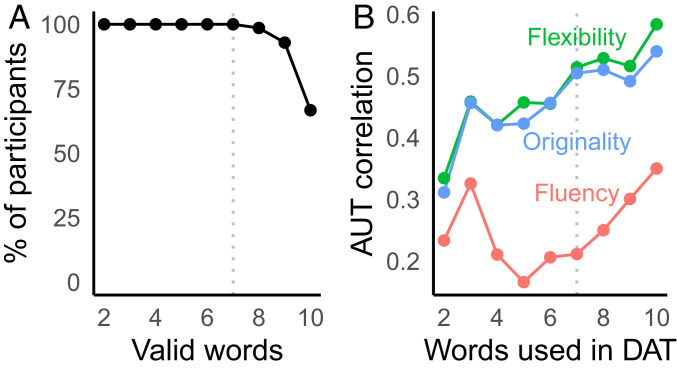
“Following [11], the first seven valid (i.e., recognized by Word2vec) words provided by the participant were retained.”
InfluentialRole of Masked Solutions in the Accuracy of an Insight Problem-Solving Task
Puvia, E., Taibi, D., & Tressoldi, P. E. (2022) · Journal of Anomalous Experience and Cognition · doi:10.31156/jaex.23304 · Cited by 1
The tools of cognitive creativity assessment
Khramtsov, D. M., Муратова, Т. М., Vikarenko, M., & Vorokhta, Y. M. (2024) · INTERNATIONAL NEUROLOGICAL JOURNAL · doi:10.22141/2224-0713.20.2.2024.1057 · Cited by 1
Oka, R., Utsumi, A., & Kusumi, T. (2024) · Thinking Skills and Creativity · doi:10.1016/j.tsc.2024.101606 · Cited by 1
Measuring Group Creativity of Dialogic Interaction Systems by Means of Remote Entailment Analysis
Baumartz, D., Konca, M., Mehler, A., Schrottenbacher, P., & Braunheim, D. (2024) · ACM Conference on Hypertext and Social Media (HT) · doi:10.1145/3648188.3675140 · Cited by 1
“This includes lexical association tests such as the Remote Association Test [42], the Divergent Association Task (DAT) [47], the Alternative Uses Test (AUT) [22].”
Spontaneous associative thought may facilitate scene-gist memory via implicit scene-labeling
Baror, S., Aminoff, E., & Kenett, Y. N. (2024) · Memory & Cognition · doi:10.3758/s13421-024-01672-y · Cited by 1
“This method empirically quantifies one’s ability to search one’s memory and relates such memory search to individual differences in creativity (Merseal et al., 2023), with higher FF scores indexing broader associative thought (see also Olson et al., 2021).”
Pseudo-creativity and authentic creativity differ in conceptual boundaries
Yao, Y., Runco, M. A., Mo, C., Zhang, S., Zhang, M., & Mo, L. (2025) · Thinking Skills and Creativity · doi:10.1016/j.tsc.2025.102007 · Cited by 3
Processing Visual Ambiguity in Fractal Patterns: Pareidolia as a Sign of CreativityPreprint
Pepin, A. B., Harel, Y., O’Byrne, J., Mageau, G. A., Dietrich, A., & Jerbi, K. (2022) · SSRN Electronic Journal · doi:10.2139/ssrn.4073004 · Cited by 2
Resting-State EEG Network Profiles Associated with Creative Engagement and Creative Self-EfficacyPreprint
Damji, S., Kurry, S., Babul, S., Bhattacharya, J., & Virji‐Babul, N. (2025) · arXiv (Cornell University) · doi:10.48550/arxiv.2510.22364 · Cited by 1
Yang, Z., Wenger, E., & So, R. H. Y. (2026) · arXiv (Cornell University) · doi:10.48550/arxiv.2608.05576 · Cited by 1
“We use these metrics to compare human and LLM distributional reach on the Alternative Uses Task (Guilford, 1967), the Divergent Association Task (Olson et al., 2021), and Harry Potter fanfic-tion (Alfassi et al., 2026).”
InfluentialApparatus for Teaching Physics: Circular Motion and an Inverse Square Machine.
Scott, A. (1989) · The Physics Teacher
Balancing novelty and appropriateness leads to creative associations in childrenPreprint
Rastelli, C., Greco, A., Pisapia, N. D., & Finocchiaro, C. (2022) · PsyArXiv (OSF Preprints) · doi:10.31234/osf.io/k5pz3
Balancing novelty and appropriateness leads to creative associations in childrenPreprint
Rastelli, C., Greco, A., Pisapia, N. D., & Finocchiaro, C. (2022) · PsyArXiv (OSF Preprints) · doi:10.31234/osf.io/2tjhd
Pennill, N., Phillips, K., & Birdi, K. (2022) · doi:10.2218/cim22.1a10
“There was a slight increase in pre- and post- event DAT scores when assessed by a paired-samples t-test.”
BackgroundInfluentialProceedings of CIM22: 'Participation' (Single document PDF)
Moran, N., & Kim, Y. (2022) · doi:10.2218/cim22.1p1
Sandra, D. A., Olson, J. A., Langer, E. J., & Roy, M. (2023) · eLife · doi:10.7554/elife.84691.sa2
Self-citationThe flow of ideas in word embeddingsPreprint
Dasgupta, D. (2023) · arXiv (Cornell University) · doi:10.48550/arxiv.2307.16819
“For instance, studies by Olson et al. (2021) have demonstrated that the ability to associate unrelated words can predict creative thinking.”
BackgroundThe effect of diversity and social interaction on cognitive search: An agent-based simulationPreprint
Rocca, R., & Tylén, K. (2024) · PsyArXiv (OSF Preprints) · doi:10.31234/osf.io/n3t6j
Studying Peer Effects in Divergent Thinking: Theory and Method
Wong, C. H., Juvina, I., & Popescu, P. Ș. (2023) · RoCHI - International Conference on Human-Computer Interaction (RoCHI) · doi:10.37789/rochi.2023.1.1.23
Ferreira, M. H. D. M. (2024) · Digital Library of Theses and Dissertations (Universidade de São Paulo) · doi:10.11606/t.47.2024.tde-11072024-144009
Spinzi, C. G. (2024) · Springer eBooks · doi:10.1007/978-3-031-62832-0_9
Razlike u jezičnom razvoju djece predškolske dobi
Erdeg, N., Rački, Ž., & Majdenić, V. (2024) · Život i škola : časopis za teoriju i praksu odgoja i obrazovanja · doi:10.32903/zs.70.1.3
Education Reimagined: The Impact of Advanced Technologies on Learning
Khalil, M. (2024) · Frontiers research topics · doi:10.3389/978-2-8325-5802-7 · Cited by 1
Smith, M. K., Weller, R. S., Duong, T., McClintock, R. J., Peterson, M., Barr, N., Jones, D. M., & Dunn, T. L. (2025) · Frontiers in Psychology · doi:10.3389/fpsyg.2025.1512011
“Like Olson et al. (2021) participants were instructed to: (1) use only single words, (2) use only nouns, (3) avoid proper nouns, (4) avoid specialized vocabulary, and (5) think of words on your own and do not just name objects in your surroundings.”
InfluentialNeural Resonance and Semantic Leaps: Mapping the Intersubjective Terrain of Musical ImprovisationPreprint
Loui, P. (2025) · PsyArXiv (OSF Preprints) · doi:10.31234/osf.io/pztw2_v1
Semantic Measures of Creativity
Johnson, D. R., & Beaty, R. E. (2025) · Elsevier eBooks · doi:10.1016/b978-0-323-95504-1.00716-x
Research on the Measurement Method of Disciplinary Diversity Based on Lexical Semantic Analysis
Chen, G., & Yang, Y. (2025) · International Conference on Scientometrics and Informetrics (ISSI) · doi:10.51408/issi2025_101
Abe, L., Hattori, M., & Hayashi, Y. (2025) · The Japanese Journal of Cognitive Psychology · doi:10.5265/jcogpsy.2504
Moon, K., Green, A. E., & Kushlev, K. (2025) · PsyArXiv (OSF Preprints) · doi:10.31234/osf.io/8p9wu_v3
System 3: Integrating Intuition and Rationality for CreativityPreprint
Chávez-Autor, J. C. (2025) · PsyArXiv (OSF Preprints) · doi:10.31234/osf.io/s843g_v2
Moon, K., Green, A. E., & Kushlev, K. (2025) · PsyArXiv (OSF Preprints) · doi:10.31234/osf.io/8p9wu_v4
Dinu, A., Florescu, A.-M., & Tăbuşcă, Ş. A. (2025) · Procedia Computer Science · doi:10.1016/j.procs.2025.09.165
Testing LLMs in the Wild. The case of reasoning about strategic managementPreprint
Bonaccorsi, A. J., Chiarello, F., Acampora, C., Bello, G., Niccolai, J., & Ruggeri, A. (2025) · SSRN Electronic Journal · doi:10.2139/ssrn.5812559
Розвиток компонентів креативності підлітків в умовах дистанційного навчання в системі МАН України
Dovha, M. (2023) · Digital Library NAES of Ukraine (National Academy of Educational Sciences of Ukraine) · Cited by 1
The neuroscience of creative perception: From visual ambiguity to neuroacoustics
Bellemare, A. (2024) · Spectrum Research Repository (Concordia University)
Laats, T. A. (2025) · DSpace repository (University of Tartu)
Loovuse mudeldamine tehisnärvivõrkudega
Kirikal, J. (2025) · DSpace repository (University of Tartu)
Xia, P., Wesseldijk, L. W., Lu, Y., Sikström, S., de Manzano, Ö., Vach, V., Ullén, F., & Mosing, M. A. (2026) · Molecular Psychiatry · doi:10.1038/s41380-026-03925-5 · Cited by 1
Past Psychedelic Use Predicts Divergent ThinkingPreprint
Pope, G. J., Timmermann, C., Trender, W. R., Hellyer, P. J., Bălăeţ, M., & Laukkonen, R. (2026) · arXiv (Cornell University) · doi:10.48550/arxiv.2601.04380
“Divergent thinking was assessed using the Divergent Association Task (DAT), a brief, reliable, and objective measure of divergent thinking (Olson et al., 2021).”
Incentives and Creativity in Groups—Experimental Evidence on Creative Processes and DimensionsPreprint
Sarrazin, E. (2026) · SSRN Electronic Journal · doi:10.2139/ssrn.6077334
Wynne, O., Flynn, M., Graham, A. J., McCormack, T., Senior, J., McMullen, J. D., & Downes, M. (2026) · Journal of Childhood Education & Society · doi:10.37291/2717638x.202671684
“Likewise, spontaneous association is an integral part of both mind-wandering and pretend play, which is beneficial for creativity and problem solving (Olson et al., 2021; Russ, 2020).”
Grammenos, D., & Lubart, T. (2026) · Research Square · doi:10.21203/rs.3.rs-8718021/v1
Soyez créatif ! Oui, mais comment ?
Lachaux, J.-P. (2026) · Cerveau & Psycho · doi:10.3917/cerpsy.184.0066
LoopLens: Supporting Search as Creation in Loop-Based Music CompositionPreprint
Long, S., Kobayashi, A., & Tateno, K. (2026) · arXiv (Cornell University) · doi:10.48550/arxiv.2603.08571
“Two authors independently analyzed the interview transcripts using re-flexive thematic analysis [13] to identify key themes in participants’ self-reported experiences.”
InfluentialCAD score: context-aware semantic diversity for scalable creativity evaluation of LLMs
Kim, J., Jeong, G., & Kim, H. (2026) · PeerJ Computer Science · doi:10.7717/peerj-cs.3624
Ovando‐Tellez, M. (2021) · theses.fr (ABES) · doi:10.70675/c78e9d5ez77d2z4afczb6b7za8334d6f765c · Cited by 1
Creatividad matemática temprana: una revisión sistemática desde la neurocognición
Pérez, C., & Maiche, A. (2026) · SALUD MILITAR · doi:10.35954/sm2026.45.1.4.e401 · Cited by 1
Drobny-Burján, A. (2026) · Nemzetközi tudományos konferencia a Magyar Tudomány Ünnepe alkalmából (Soproni Egyetem) · doi:10.35511/978-963-334-579-5-s1-5
Creative thinking does not promote dishonestyPreprint
Kunde, W., Reis, M., Foerster, A., & Pfister, R. (2024) · OSF Preprints (OSF Preprints) · Cited by 1
Motomura, Y., Iwayama, T., Ueda, T., Kajihara, M., & Momoi, T. (2026) · Journal of PHYSIOLOGICAL ANTHROPOLOGY · doi:10.1186/s40101-026-00431-z
“In this study, a Japanese version of the DAT was developed based on an algorithm published by Olson et al. [23] (https:// osf. io/ bm5fd/) and was employed as a task.”
InfluentialThe Role of Sleep in Learning and Memory
(2026) · Frontiers research topics · doi:10.3389/978-2-8325-8047-9
Yoshida, M. (2026) · BMC Psychology · doi:10.1186/s40359-026-04959-8
“The DAT [35] was used to assess divergent thinking, a component of creativity.”
Spatial movement entropy as an expression of creativity
Kaljo, M. (2026) · DSpace repository (University of Tartu)
Restuputri, D. P., Yassierli, & Widyanti, A. (2026) · Behavioral Sciences · doi:10.3390/bs16071053
“Creativity was measured using the Divergent Association Task (DAT), a rapid verbal assessment of divergent thinking that requires subjects to generate semantically distant words (Olson et al., 2021).”
Cores-Bilbao, E., García, M. D. C. M., & Conceição, M. C. (2026) · East European Journal of Psycholinguistics · doi:10.29038/eejpl.2026.13.1.cor · Cited by 1
From semantic distance to creative text: Rare word pairings shape creativity judgments
Кузнєцов, І., Masytska, T., Kuznietsova, L., Zhuravlov, О., Revko, S., Kazmirchuk, O., & Kozachuk, N. (2026) · East European Journal of Psycholinguistics · doi:10.29038/eejpl.2026.13.1.kuz
A Time-saving Dishwasher: AI's Role in Team Creative Processes
Medeiros, K. E., Marrone, R. L., & Reiter‐Palmon, R. (2026) · Emerald Group Publishing Limited eBooks · doi:10.1108/s1534-085620260000021013
LLM Randomness and Creativity: An Experiment on Human-AI Collaboration
Villarreal, A., Sachdeva, A., & Brandimarte, L. (2026) · International Convention on Information and Communication Technology, Electronics and Microelectronics · doi:10.1109/mipro70003.2026.11592010
Creative Minds at the Keyboard: Eye-Tracking Insights into How Developers Think and Code
Amini, M., Lafhal, Y. A., & Sharafi, Z. (2026) · International Workshop on Cooperative and Human Aspects of Software Engineering (CHASE) · doi:10.1145/3794860.3794891
“To quantify creativity, in addition to Torrance Tests of Creative Thinking (TTCT) [50], we employed the Divergent Association Task (DAT) [39] and the Remote Associates Test (RAT) [33], capturing both divergent and convergent facets of creativity.”
Measuring children's associative divergent ability through drawings and semantic similarityPreprint
Jing-jing, Z., Zhang, Y., Wei, F., Zhai, Y., Li, H.-R., Liu, T., Wu, J.-B., Zhang, M., Wang, J., Zhao, Y., et al. (2026) · Research Square · doi:10.21203/rs.3.rs-10391563/v1
Metadata
- Authors
- Olson, J. A., Nahas, J., Chmoulevitch, D., Cropper, S. J., & Webb, M. E.
- Affiliations
- Harvard University (US)
- McGill University (CA)
- The University of Melbourne (AU)
- Corresponding author
- Olson, Jay A.
- Venue
- Proceedings of the National Academy of Sciences
- Publisher
- National Academy of Sciences
- Published
- 2021-06-17
- Volume
- 118
- Issue
- 25
- ISSN
- 0027-8424 (ISSN-L)
- 1091-6490
- PMC
- PMC8237676
- OpenAlex
- W3166509103
- Cited by
- 182
- References
- 54
- Citations by year
- 2026: 39 · 2025: 34 · 2024: 53 · 2023: 29 · 2022: 22 · 2021: 3
- FWCI
- 25.85
- Type
- journal article
- Language
- en
- Open access
- hybrid
- doi.org
- Licence
- Locations
- Proceedings of the National Academy of Sciences (publishedVersion, cc-by-nc-nd)
- PubMed Central (publishedVersion, cc-by-nc-nd)
- PubMed (publishedVersion)
- Minerva Access (University of Melbourne) (submittedVersion, cc-by-nc-nd)
- PsyArXiv (OSF Preprints) (submittedVersion)
- Funders
- McGill University
- Canada First Research Excellence Fund (#3c-KM-10)
- Topics
- Social Sciences › Psychology › Experimental and Cognitive Psychology › Creativity in Education and Neuroscience
- Physical Sciences › Engineering › Mechanical Engineering › Design Education and Practice
- Social Sciences › Psychology › Experimental and Cognitive Psychology › Cognitive Abilities and Testing
- Keywords
- creativity, divergent thinking, semantic distance, word naming, alternative uses task, creativity assessment, cross-cultural comparison
- MeSH terms
- Adult, Aged, Child, Creativity, Female, Humans, Male, Middle Aged, Semantics, Task Performance and Analysis, Thinking, Young Adult
About these checks
Registry, retraction, Cites and statistics results are computed, not judged, with one exception: a printed reference that no index lists is read once by a model before it counts as a citation error. Claims are extracted by a model and kept only when their quote appears verbatim in the text; each cited source is then checked, with a model’s help, for whether it says what the claim relies on. Those verdicts can be wrong — read the claim’s quote and the cited source before relying on one.
Statistics and arithmetic are recomputed, not judged.
Confidence bands are shown only for fields calibrated on our annotated test set. None is calibrated yet, so no band is shown.
What counts as a claim ›How we measure confidence ›How we check this ›
Are you an author, or do you see a problem with this page? Request a review
Data sources
Bibliographic data: Semantic Scholar, OpenAlex, Crossref.
Contains information from the Semantic Scholar Academic Graph Datasets, made available under the ODC Attribution License (ODC-BY 1.0).
Semantic Scholar’s data is described in: Kinney, R., et al. (2023). The Semantic Scholar Open Data Platform. arXiv:2301.10140.
